This article describes a simple protein microarray method for profiling humoral immune responses to a 7-plex panel of highly purified Clostridium difficile antigens in human sera. The protocol can be extended for the determination of specific antibody responses in preparations of polyclonal intravenous immunoglobulin.
Method Article
A Protein Microarray Assay for Serological Determination of Antigen-specific Antibody Responses Following Clostridium difficile Infection
In This Article
Summary
Abstract
We provide a detailed overview of a novel high-throughput protein microarray assay for the determination of anti-Clostridium difficile antibody levels in human sera and in separate preparations of polyclonal intravenous immunoglobulin (IVIg). The protocol describes the methodological steps involved in sample preparation, printing of arrays, assay procedure, and data analysis. In addition, this protocol could be further developed to incorporate diverse clinical samples including plasma and cell culture supernatants. We show how protein microarray can be used to determine a combination of isotype (IgG, IgA, IgM), subclass (IgG1, IgG2, IgG3, IgG4, IgA1, IgA2), and strain-specific antibodies to highly purified whole C. difficile toxins A and B (toxinotype 0, strain VPI 10463, ribotype 087), toxin B from a C. difficile toxin-B-only expressing strain (CCUG 20309), a precursor form of a B fragment of binary toxin, pCDTb, ribotype-specific whole surface layer proteins (SLPs; 001, 002, 027), and control proteins (tetanus toxoid and Candida albicans). During the experiment, microarrays are probed with sera from individuals with C. difficile infection (CDI), individuals with cystic fibrosis (CF) without diarrhea, healthy controls (HC), and from individuals pre- and post-IVIg therapy for the treatment of CDI, combined immunodeficiency disorder, and chronic inflammatory demyelinating polyradiculopathy. We encounter significant differences in toxin neutralization efficacies and multi-isotype specific antibody levels between patient groups, commercial preparations of IVIg, and sera before and following IVIg administration. Also, there is a significant correlation between microarray and enzyme-linked immunosorbent assay (ELISA) for antitoxin IgG levels in serum samples. These results suggest that microarray could become a promising tool for profiling antibody responses to C.difficile antigens in vaccinated or infected humans. With further refinement of antigen panels and a reduction in production costs, we anticipate that microarray technology may help optimize and select the most clinically useful immunotherapies for C. difficile infection in a patient-specific manner.
Introduction
This protocol describes the development and validation of a novel and customized protein microarray assay for the detection and semi-quantification of bacterial strain and isotype-specific antibody responses to C. difficile antigens. We successfully use our C. difficile-specific microarray assay as a promising new tool for the compositional bioanalysis of specific antibody content in patient sera1,2, preparations of IVIg3, and identification of antibody specificities that correlate with poor outcomes in CDI4. We demonstrate how biobanked serum samples and commercial preparations of IVIg can be analyzed on microarray slides, allowing high-quality reproducible profiling of C. difficile pathogen-specific antibody responses in this assay.
Many healthy children and adults have detectable serum IgG and IgA antibodies to C. difficile toxins A and B5,6. These are thought to arise following transient exposure during infancy and following exposure to C. difficile in adulthood. For this reason, polyclonal IVIg has been used off-label to treat both recurrent and fulminant CDI7,8,9. However, its definitive role and mode of action remains unclear. Several studies have shown that the humoral immune response to C. difficile toxins plays a role in disease presentation and outcome. Specifically, asymptomatic patients show an increased serum anti-toxin A IgG concentration compared to patients who develop symptomatic disease10. A demonstrable association has been reported for median anti-toxin A IgG titers and 30-day all-cause mortality11. Several reports have also revealed an association with a protection against recurrence and antibody responses to toxin A, B, and several non-toxin antigens (Cwp66, Cwp84, FliC, FliD, and surface layer proteins (SLPs))12,13,14,15. These observations have spurred the development of the first passive immunotherapy drug targeting C. difficile toxin B (bezlotuxumab), which has recently been approved by the US Food and Drug Administration and the European Medicines Agency for the prevention of recurrent CDI16. Vaccination strategies using inactivated toxins or recombinant toxin fragments are also currently under development17,18,19. These new therapeutic approaches will undoubtedly stimulate the requirement for evaluating humoral immune responses to multiple antigens in large sample sizes.
Today, there is a notable lack of commercially available high-throughput assays capable of simultaneously assessing bacterial strain and isotype-specific antibody responses to C. difficile antigens. There is an unmet need to develop such assays to facilitate future research efforts and clinical applications. Protein microarrays are a method to immobilize large numbers of individually-purified proteins as a spatially organized array of spots onto a microscopic slide-based surface by using a robotic system, which can be either a contact20 or a non-contact printing tool21. The spots may represent complex mixtures such as cell lysates, antibodies, tissue homogenates, endogenous or recombinant proteins or peptides, body fluids or drugs22,23.
Protein microarray technology offers distinct advantages over standard in-house ELISA techniques, which have traditionally been used to assess anti-C. difficile antibody responses. These include an increased capacity for detecting a range of multi-isotype-specific antibodies against a more extensive panel of protein targets, reduced volume requirements for antigens, samples, and reagents, and an enhanced ability to incorporate a larger number of technical replicates, in addition to multiple internal quality control (QC) measures1. Microarrays are therefore more sensitive, accurate, and reproducible and have a greater dynamic range. These factors make microarrays a cheaper and potentially favorable alternative to ELISAs for the large-scale detection of known proteins. However, disadvantages of microarray technology result mainly from the large up-front costs associated with establishing a panel of highly purified antigens and setting up the technological platform.
Protein microarrays have been extensively used over the past two decades as a diagnostic and basic research tool in clinical applications. Specific applications include protein expression profiling, the study of enzyme-substrate relationships, biomarker screening, analysis of host-microbe interactions, and profiling antibody specificity23,24,25,26,27,28. Many new pathogen protein/antigen microarrays have been established, including malaria (Plasmodium)29, HIV-130, influenza31, severe acute respiratory syndrome (SARS)32, viral hemorrhagic fever33, herpesviruses34, and tuberculosis35.
The present protocol relates to the establishment of an easy operating C. difficile reactive antigen microarray assay, which enables accurate, precise, and specific quantification of multi-isotype and strain-specific antibody responses to C. difficile antigens in sera and polyclonal IVIg. Herein, we include representative results pertaining to an acceptable microarray assay performance when compared to ELISA as well as assay precision and reproducibility profiles. This assay could be further developed to profile other clinical samples and sets a new standard for research into the molecular basis of CDI.
Protocol
1. Preparing a Microarray Plate
- Dilute C. difficile antigens with a printing buffer [PBS-Tween-trehalose (50 mM)] at the optimum concentration (which was predefined before running the patient sera): toxin A (200 µg/mL) and toxin B (100 µg/mL), pCDTb (200 µg/mL), and purified native whole SLPs derived from ribotypes 001, 002, and 027 (200 µg/mL).
NOTE: Toxin B was obtained from a toxin B-expressing strain CCUG 20309 (90 µg/mL).- Dilute the positive controls, lysates of C. albicans, and tetanus toxoid with the printing buffer at 100 µg/mL. Finally, dilute the purified human immunoglobulin matching the tested antibody isotype serially, starting at 50 µg/mL across 10 dilutions in the printing buffer to create a calibration curve.
- Transfer 10 µL of the dilutions in the printing buffer into a 384-well plate.
- Cover the plate with a plate seal and centrifuge at 300 x g for 5 min.
2. Printing Arrays with a Contact Robot
- Heat the silicon pin using the hand-held gas burner 3x 2 s each and rinse in clean water 3x 3 s each.
- Place the microarray plate into the loading cartridge of the arrayer.
- Place the aminosilane slides on the slide tray.
NOTE: The slide tray can hold 27 slides: three rows of nine slides. The slides are arranged in portrait orientation starting from the left side of the bottom row and the rest of the spaces are covered with blank slides to ensure that all the holes on the slide tray are covered.- Press OK and check that a vacuum has been turned on and all the slides are secure. Leave the slides in the humid environment for at least 1 h before starting the print.
NOTE: The aminosilane slides are provided in a sealed pouch with desiccant. Once opened, any unused slides should be returned immediately to the desiccator for storage up to the expiration date.
- Press OK and check that a vacuum has been turned on and all the slides are secure. Leave the slides in the humid environment for at least 1 h before starting the print.
- Set up the suitable printing programme to print Clostridium difficile antigens. Launch the TAS Application Suite and open the required print run parameters file from the 'My Gridding Runs' directory. Select Clostridium difficile file for printing all the Clostridium difficile antigens in quadruplicate.
- Upon double-clicking on the MicroArray icon on the main window a three-tabbed window will appear called ‘MicroArraying parameters’. The three tabs are “Source,” “Target,” and “Options.” The “Source” tab shows details the number of samples used in the microarray plate. The “Target” tab shows details of how the slides are to be loaded, where the array should be printed on the slide and edit the slide layout (16 subarray formats). The “Options” tab shows details of the wash protocol and tool to be used e.g. wash after every completed sample. Clean the silicon pin between samples to avoid any cross contamination between different samples.
- The programming options are located under Options>Run Preferences on the TAS Application Suite toolbar. There are 9 tabs to work through in this section and as you complete one tab move to the next by clicking on it. Clicking the “OK” the button will take you out of “Run Preferences.” In the “General” tab of the “Run preferences,” there are a number of check boxes available under this section relating to how the instrument will behave when a program is started. Check the “Prime bath before start of run” box, all three wash stations will undergo a short priming sequence prior to the run beginning. Check the “Wash at start of run” box, the pin tool will be washed before the first source visit. Check “Wash at end of run” box, the pin tool will be washed after the last source visit. The user can set the number of wash cycles. In the “Climate” tab of the “Run preferences,” start the humidification. The setting we use are as follows: start rate 55%, run rate 55%, minimum humidity 55%, target humidity 60%. Do not start the run until the target humidity has been reached, otherwise the spots will be the wrong size and the library will rapidly evaporate.
- In the menu bar of TAS, click the green go button. Start the run and periodically observe the arrayer during the print run to be certain everything is OK.
Note: This enables the analysis of 15 samples in parallel on each slide as one subarray is used as a negative control. The design of subarrays is determined by the number of the printed proteins (antigens) and the number of the printed biological replicates.
Note: After printing each sample, the head moves toward the washing baths to allow multiple dipping of the pin into two wash baths containing distilled water and 0.002% Tween 20 for 1.5 s in each bath, followed by rinsing the pin with ultra-pure water and drying the pin in the main wash station for 4 s.
3. Storage of the Arrays
- Keep the printed slides stored overnight at room temperature in the desiccator.
NOTE: The printed slides can be stored for up to one week.
4. Array Probing
- Carefully place printed slides in a slide holder of 16 multi-well chambers format.
NOTE: The chambers, having a depth of approximately 7.5 mm, provide a generous surface to volume ratio to facilitate mixing and washing steps. - Allow all reagents to warm to room temperature before use. Unless specified otherwise, perform all the following steps at room temperature.
- Add 100 µL of filtered 5% bovine serum albumin tween (BSAT; use a 0.2 µm syringe filter) to each block, cover the slides, and incubate them with shaking for 1 h.
- Wash the slides 5x 1 min each in 120 µL of phosphate buffered saline with Tween 20 (PBST; 0.1% Tween) per well with shaking. Do not let the slides dry out.
- Thaw the serum samples on ice for 20 min and dilute each sample with a commercially available antibody diluent with background reducing component (see Table of Materials).
- Optimize the dilution of the serum samples according to the tested immunoglobulin as shown in Table 2.
- Transfer 100 µL of the diluted serum samples to all blocks except one, which will be used as a negative control; to this block, add 100 µL of antibody diluent only. Incubate the slides with gentle agitation for 1 h.
- Wash the slides 5x 3 min each in 120 µL of PBST (0.1% Tween) per well with shaking.
- Add 100 µL of a biotinylated goat anti-human antibody diluted with antibody diluent.
- Optimize the dilution of the secondary antibody according to the tested immunoglobulin as described in Table 2. Cover the slides and incubate them with gentle shaking for 1 h.
- Wash the slides 5x 3 min each in 120 µL of PBST per well with shaking.
- Add 100 µL of streptavidin Cy5 to each block diluted at 1:2000 in 5% BSA. Cover the slides with foil to protect them from light whilst shaking for 15 min with gentle agitation.
- Wash the slides 5x 1 min each in 120 µL of PBST per well with shaking, followed by 2 washes of 1 min each in PBS only with shaking.
- Spin the slides for 5 min at 300 x g to dry them.
- Keep the slides in a dark box for transport and storage at room temperature.
- Proceed to scan the arrays immediately to ensure signal consistency after probing.
NOTE: However, probed slides can be stored in the dark and scanned within one week from probing.
5. Scanning the Arrays
- Switch on the laser scanner (see Table of Materials) 30 min before scanning to warm up the laser. Upload the scanner software and connect the computer to the scanner.
- Place a slide with the printed side face up into the scanner until the play light turns solid green.
- Press the Settings button and adjust the following settings when scanning the slides as follows: Scan Mode, Median; Acquisition, 635 Only; Acquisition Mode, Manual; Gain, 20; Power, Low; Slide Type, Unlabeled Slide; Focus, Auto Focus. Turn Automatic Scrolling off and set Barcode Reading to Pixel Size 10 and Scan 35.
- Save the resultant images as 16-bit grayscale multiple image TIFF format. Press the Import Grid button and select the appropriate array list.
NOTE: The array list describes the size and position of subarrays and the names of the printed substances associated with each feature-indicator.- Align the grid to the spots on the slide.
- Analyze the images by pressing the Quantification process button to measure the fluorescence signal intensities of each spot and save the results in a text format called GenePix Results (GPR).
NOTE: The GPR file contains the localization and identification variables of the antigen targets on the array and also the median fluorescence intensity and the local background that represents the antibody binding signal values of each spot.
6. Data Analysis
- Calculate the median for the replicates of each antigen after background subtraction using a free microarray analysis software called reverse phase protein array (RPPA) analyzer, a module within the R statistical language on CRAN36.
- Plot the standard curve and interpolate the signals of each antigen relative to the immunoglobulin standard curve using commercial scientific graphing and statistics software (see Table of Materials) to calculate the antibody levels.
Results
Figure 1 illustrates a flowchart describing the major steps in the described protocol. Figure 2 shows Spearman correlation tests demonstrating significant agreement between microarray and ELISA for IgG and IgA anti-toxin A and B levels in the patient test sera. Figure 3 shows differential IgG and IgA antibody-class specific antibody responses to toxin A, toxin B, and binary toxin (pCDTb) in patients with CF without diarrhea, CDI patients with diarrhea, and in HC. Figure 4 shows C. difficile antitoxin neutralizing antibody responses in the patient sera. Figure 5 shows the immune reactivity (against C. difficile toxins and SLPs) and neutralizing effect (against C. difficile toxins) of IVIg. Figure 6 shows the immune reactivity (against C. difficile toxins and SLPs) and neutralizing effect (against C. difficile toxins) of the patient sera pre- and post-IVIg administration. Table 1 shows acceptable intra- and inter-assay coefficients of variability of microarray using test sera. Table 2 illustrates a list of immunoglobulins used in this study with relevant concentrations of purified proteins as well as optimized dilutions for sera and secondary antibodies.
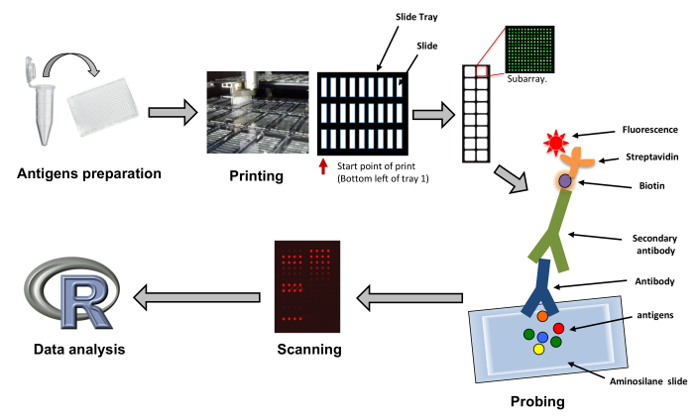
Figure 1: General overview of major steps involved in the microarray protocol. The first step is the preparation of the antigens and controls. The subsequent sample dilutions are transferred to a 384-plate in readiness for printing in quadruplicates onto the aminosilane slides. Following drying and blocking of slides, the arrays are incubated with patient sera. After further washing, the biotinylated anti-human immunoglobulin (Ig) of the specified isotype is added. After the final washing and drying steps, the slides are scanned and the resultant images processed with a microarray image analysis software. Please click here to view a larger version of this figure.
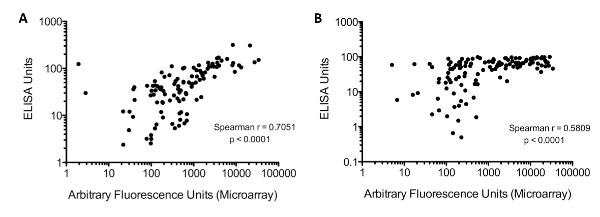
Figure 2: Correlation between microarray and ELISA results. The Spearman correlation coefficient was used to assess the level of agreement between the two platforms. When comparing the microarray performance with an in-house enzyme-linked immunosorbent assay (ELISA), A. a good correlation coefficient was observed for toxin A (r = 0.7051; P <0.0001), B. and a moderately good correlation for toxin B (r = 0.5809; P <0.0001). The full ELISA protocol has been detailed elsewhere37. This figure has been reprinted from Negm et al.1 with permission. Please click here to view a larger version of this figure.
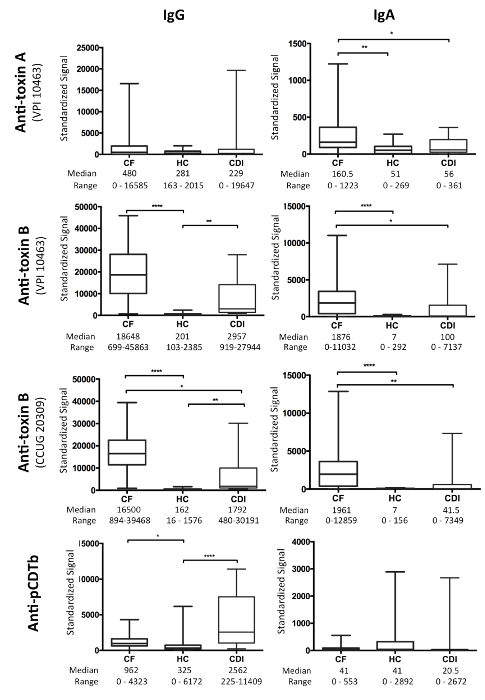
Figure 3: Isotype-specific antibody responses to Clostridium difficile toxins. This image sows the serum anti-toxin IgG and IgA responses (toxinotype 0, strain VPI 10463, ribotype 087; toxin A at 200 µg/mL, toxin B at 100 µg/mL), toxin B (C. difficile toxin B-producing strain CCUG 20309; toxin B at 90 µg/mL) and the precursor form of a B fragment of binary toxin, pCDTb (200 µg/mL), in patients with cystic fibrosis (CF) without diarrhea, patients with C. difficile infection (CDI) with diarrhea, and in healthy controls (HC). The serum dilution for IgG and IgA are 1:500 and 1:100, respectively. The differences between the groups were assessed using the Kruskal-Wallis test, followed by Dunn's post hoc test for multiple responses. Compared with the HC (n = 17) and the patients with symptomatic CDI (n = 16), the adult CF patients (n = 16) exhibited significantly higher levels of serum IgA anti-toxin A and B levels; P ≤0.05. The same pattern prevailed for IgG, except that there was no difference in the anti-toxin A IgG levels between the groups. The box and whisker plots represent the median, range, and quartiles. *** P ≤0.0001; ** P ≤0.01; * P ≤0.05. The standardized signals are normalized to the immunoglobulin standard curve. This figure has been reprinted from Monaghan et al.2 with permission. Please click here to view a larger version of this figure.
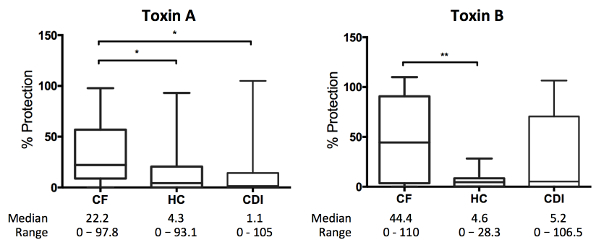
Figure 4: Neutralizing antibody efficacies to C. difficile toxins A and B in patients' sera. This figure shows the protective neutralizing antibody (NAb) responses to C. difficile toxins A and B [toxinotype 0, strain VPI 10463, ribotype 087, used at a 50% lethal dose (LD50)] in the sera (1:100 dilution; toxin A 2.5 ng/mL, toxin B 0.5 ng/mL) from the HC, the patients with CF without diarrhea, and the patients with CDI with diarrhea. The sera from CF patients exhibited significantly stronger protective anti-toxin NAb responses compared with the sera from the HC (toxins A and B) and from the patients with CDI (toxin A). The differences between the groups were assessed using the Kruskal-Wallis test, followed by Dunn's post hoc test for multiple responses. The box and whisker plots represent the median, range, and quartiles. ** P ≤0.01; * P ≤0.05. This figure has been reprinted from Monaghan et al.2 with permission. Please click here to view a larger version of this figure.
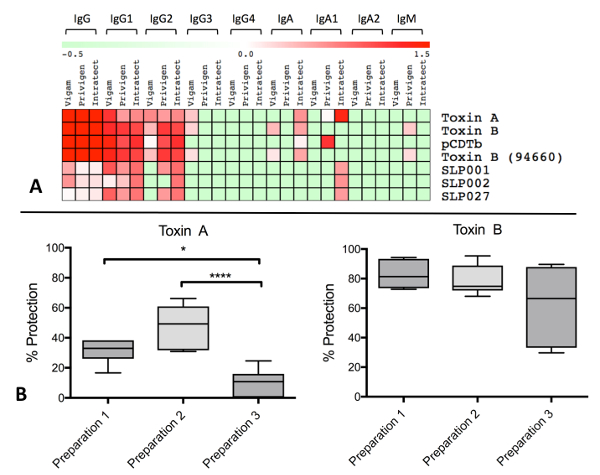
Figure 5: Immune reactivity and neutralizing effect of IVIg to C.difficile antigens. A. This image shows the reactivity of multi-isotype specific antibodies to C. difficile antigens in commercial intravenous immunoglobulin (IVIg) preparations. The heat map illustrates the levels of specific antibody isotypes (IgG, IgG1, IgG2, IgG3, IgG4, IgA, IgA1, IgA2, and IgM) in three commercially available preparations (see Table of Materials) against seven C. difficile antigens [toxin A (200 µg/mL), toxin B (100 µg/mL), pCDTb (200 µg/mL), toxin B (CCUG 20309; 90 µg/mL), and surface layer proteins (SLPs) 001, 002, and 027 (all 200 µg/mL)] using protein microarray technology. The color code of the heat map is as follows: green (low) to red (high) signal intensity. The signal values represented on the color scale for the heat map are log2-transformed from the arbitrary fluorescence units (AFU). Please note that the AFU has more recently been superseded by the descriptor standardized signals2. The total IgG, IgG1, and IgG2 isotypes gave the highest binding reactivities against toxin A, toxin B, binary toxin (pCDTb), and toxin B (CCUG 20309). B. These plots show the IVIg neutralization efficacy against the native C. difficile whole toxins A and B. They give the percentage of the protective neutralization effect of commercial IVIg products against C. difficile toxins A and B. Each plot represents the median of triplicate experiments at 1:100 dilution. IVIg preparation 1 exhibits the lowest protective effect compared to IVIg preparations 2 and 3, particularly against toxin A. **** P ≤0.0001; * P ≤0.05 (one-way analysis of variance). This figure has been modified from Negm et al.3 with permission. Please click here to view a larger version of this figure.
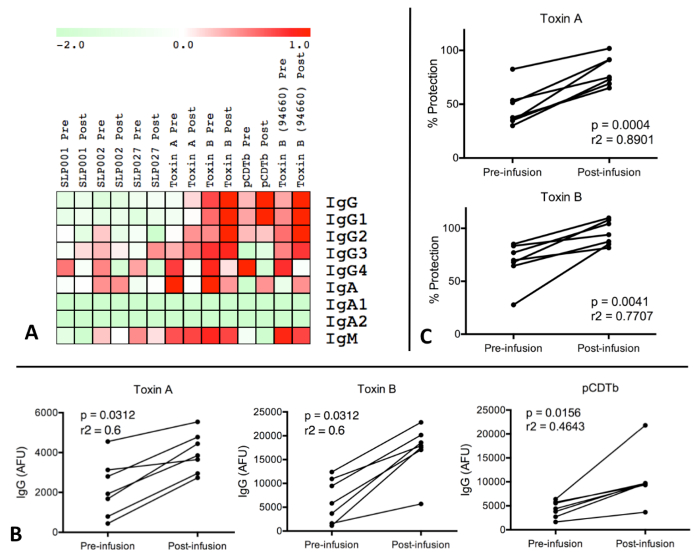
Figure 6: Immune reactivity and neutralizing effect of patient's sera to C. difficile antigens. A. This figure shows a comparison of antibody reactivities against C. difficile proteins in patients' sera before and after IVIg infusion. The heat map illustrates the expression level of the isotypes (IgG, IgG1, IgG2, IgG3, IgG4, IgA, IgA1, IgA2, and IgM) in serum samples in seven patients before and after IVIg infusion against seven C. difficile antigens [toxin A (200 µg/mL), toxin B (100 µg/mL), pCDTb (200 µg/mL), toxin B (CCUG 20309; 90 µg/mL), and SLPs 001, 002, and 027 (all 200 µg/mL)] using protein microarray technology. The color code of the heat map is as follows: green (low) to red (high) signal intensity. The signal values represented on the color scale for the heat map are log2-transformed from the AFU. Please note that the AFU has more recently been superseded by standardized signals2. There was a post-infusion enhancement of the total IgG, IgG1, IgG2, and IgG3 reactivities to toxin A, toxin B, and pCDTb. B. This image shows the IgG responses to toxin A, toxin B, and binary toxin (pCDTb), pre- and post-IVIg administration. The total IgG levels against all toxins show a significant increase following the IVIg administration (using the Wilcoxon signed-rank test). Each plot represents the median of triplicate experiments at 1:10 dilution. C. These plots show the neutralization effect against native C. difficile toxins A and B following IVIg administration. A comparison of pre- and post-infusion neutralizing antibody activities shows an enhanced protective effect after the IVIg infusions against the native C. difficile toxins A and B. Each plot represents the median of triplicate experiments at 1:10 dilution. A significant increase in the protective effect against toxins A and B was noted in the patient sera tested post-IVIg infusion (using the Wilcoxon signed-rank test). This figure has been reprinted from Negm et al.3 with permission. Please click here to view a larger version of this figure.
| Reproducibility | Toxin A | Toxin B | SLP001 | SLP002 | SLP027 | Toxin B CCUG 20309 | pCDTb |
| Intra-assay | 7.70% | 6.40% | 7.40% | 5.10% | 7.60% | 7% | 3.70% |
| Inter-assay | 9.10% | 9.10% | 7.40% | 11.20% | 12.8 | 9.70% | 12.50% |
Table 1: Microarray intra-assay and inter-assay precision1. Microarray intra- and inter-assay variabilities were calculated using the sera of 7 patients. Identical samples were assayed on each of two slides at two independent time points. All antigens (n = 7 test and n = 2 controls) were spotted in replicates of five on each array.
| Purified protein concentration | Serum dilution | Secondary antibody dilution | |
| IgG | 50 μg/ml | 1/500 | 1/20000 |
| IgG1 | 200 μg/ml | 1/100 | 1/5000 |
| IgG2 | 200 μg/ml | 1/100 | 1/10000 |
| IgG3 | 200 μg/ml | 1/100 | 1/5000 |
| IgG4 | 200 μg/ml | 1/100 | 1/5000 |
| IgA | 50 μg/ml | 1/100 | 1/5000 |
| IgA1 | 200 μg/ml | 1/100 | 1/10000 |
| IgA2 | 200 μg/ml | 1/100 | 1/5000 |
| IgM | 50 μg/ml | 1/500 | 1/20000 |
Table 2: List of immunoglobulins used in this study. The Igs are shown with the relevant purified protein concentrations (µg/mL) and dilutions for serum and secondary antibodies.
Discussion
In this protocol, we have shown that microarray is a suitable platform for defining humoral immune responses to C. difficile protein antigens in patient sera (Figures 3 and 6) and commercial preparations of IVIg (Figure 5). We have also demonstrated that the microarray technique performs well when compared to conventional ELISA (Figure 2) and shows excellent reproducibility, with intra- and inter-assay variabilities falling within acceptable limits of precision (Table 1).
Critical steps:
A number of critical steps must be followed when building any successful antigen microarray platform. Initially, it is extremely important to run QC experiments. In the QC experiments, different parameters should be evaluated, such as the selection of the appropriate surface chemistry, printing buffers, blocking buffers, dilutions of the serum samples and the secondary antibodies. These experiments must be performed with the aim of delivering a well-validated and reliable technique38,39.
The selection of a suitable protein immobilization process is one of the most important steps in microarray analyses, to ensure a high-quality performance of the tested aminosilane slides, as seen in this study. It is crucial to observe regular and circular spot morphology, high and specific signal intensity, and a clear background. Another factor affecting microarray performance is the printing buffer, which is equally important to achieve the desired surface chemistry to produce uniform and regular spots on the slide.
It is important to select the correct settings for printing as this will allow the optimal size and shape of a spot to be printed. For example, the humidity level should be maintained around 55% during printing, because without humidity the rate of evaporation in the microarray chamber is increased and fewer spots are printed.
Non-specific protein binding is an additional factor affecting the background and spot signals; therefore, appropriate selection of a blocking buffer could reduce any non-specific binding, leading to improved sensitivity and accuracy of the array data39.
Modifications and troubleshooting:
Antigens and serum samples must be aliquoted and stored in smaller storage tubes in the freezer until use, which helps avoid repeated multiple freeze-thaw cycles, which can deteriorate the signal strength of the array. To enhance the chances of a successful experiment, all the reagents must be prepared fresh and be filtered. Cleaning the arrayer before printing and checking the settings are required. Moreover, the slide holder must be kept clean to minimize background noise.
Limitations:
The application of protein microarrays is currently hampered by the stringent demand on surface chemistry in protein microarray fabrication. Here the great variation in the chemical and physical properties of protein molecules necessitates custom-designing unique surface chemistry for different classes of protein and antibody molecules40. Other technical challenges facing the widespread implementation of such technology include the need for expensive specialized equipment and software with allocated bench-space, as well as consideration of maintenance charges, complex data analysis, relative protein quantification, and critically access to purified antigens.
Significance of method with respect to existing/alternative methods:
Microarray technology is similar in principle to ELISA, Meso Scale Discovery, or Luminex immunoassays, but is customizable, can be scaled up to achieve statistical power, relies on only microliter quantities of precious samples, and has the ability to screen sera for multiple protein reactivities. It is therefore particularly suitable for large-scale, historical serum banks and biomarker discovery and screening.
Future applications or directions of method:
Future efforts will be directed towards optimizing the assay for other samples (cell supernatants), using the assay as a prognostic tool for patient stratification, externally validating potential biomarkers using large cohorts in a double-blind fashion, and predicting and optimizing response to immunotherapy (mAb, vaccines). In the future, the microarray technology could be used in a hospital setting as a useful diagnostic tool or to monitor a drug treatment plan over a period of time.
Acknowledgements
This research was supported by a Hermes Fellowship to Ola Negm and Tanya Monaghan and through separate funding from the Nottingham Digestive Diseases Centre and the NIHR Nottingham Digestive Diseases Biomedical Research Centre.
Materials
| Name | Company | Catalog Number | Comments |
|---|---|---|---|
| BioRobotics MicroGrid II arrayer | Digilab, Malborough, MA, USA | N/A | Contact arrayer used to automated spotting of the antigens onto the slides. |
| Scanner InnoScan 710. | Innopsys | N/A | A fluorescent microarray slide scanner with a red (Cy5) laser to read the reaction. |
| MAPIX software version 7.2.0 | Innopsys | N/A | Measure signal intensities of the spots. |
| Silicon contact pin | Parallel Synthesis Technologies | SMT-P75 | Print the samples onto the slides. |
| Thermo Scientific Nalgene Desiccator | Thermo Scientific | 41102426 | To store the new and printed slides. |
| 384-well plate | Genetix | X7022UN | To prepare the antigens. |
| Plate cover | Sigma Aldrich, UK | CLS6570-100EA | To reduce evaporation of the samples. |
| Aminosilane slides | Schott, Germany | 1064875 | The slide of choice for printing the antigens. |
| Slide holders | GraceBio Labs, USA | 204862 | Divide the slides into identical 16 subarrays. These holders are re-usable, removable, leak-proof wells . |
| Candida albicans lysate | NIBSC | PR-BA117-S | Positive control |
| Tetanus Toxoid | Athens Research and Technology | 04/150 | Positive control |
| Immunoglobulin G (IgG), Normal Human Plasma | Athens research and technology | 16-16-090707 | Purified Native Human Immunoglobulin G IgG, Human Plasma. |
| Immunoglobulin G1 (IgG1), Normal Human Plasma | Athens research and technology | 16-16-090707-1 | Purified Native Human Immunoglobulin G1 IgG1, Human Plasma. |
| Immunoglobulin G2 (IgG2), Normal Human Plasma | Athens research and technology | 16-16-090707-2 | Purified Native Human Immunoglobulin G2 IgG2, Human Plasma. |
| Immunoglobulin G3 (IgG3), Normal Human Plasma | Athens research and technology | 16-16-090707-3 | Purified Native Human Immunoglobulin G3 IgG3, Human Plasma. |
| Immunoglobulin G4 (IgG4), Normal Human Plasma | Athens research and technology | 16-16-090707-4 | Purified Native Human Immunoglobulin G4 IgG4, Human Plasma. |
| Immunoglobulin A (IgA), Human Plasma | Athens research and technology | 16-16-090701 | Purified Native Human Immunoglobulin A (IgA), Human Plasma. |
| Immunoglobulin A1 (IgA1), Human Myeloma Plasma | Athens research and technology | 16-16-090701-1M | Purified Native Human Immunoglobulin A1 (IgA1), Human Plasma. |
| Immunoglobulin A2 (IgA2), Human Myeloma Plasma | Athens research and technology | 16-16-090701-2M | Purified Native Human Immunoglobulin A2 (IgA2), Human Plasma. |
| Immunoglobulin M (IgM), Human Plasma | Athens research and technology | 16-16-090713 | Purified Native Human Immunoglobulin M (IgM), Human Plasma. |
| Biotinylated Goat Anti-Human IgG Antibody, gamma chain specific | Vector Labs | BA-3080 | Goat anti- human IgG (γ-chain specific)-biotin antibody reacts specifically with human IgG but not with other immunoglobulins. |
| Mouse Anti-Human IgG1 Hinge-BIOT | Southern Biotec | 9052-08 | Goat anti- human IgG1 biotin antibody reacts specifically with human IgG1 but not with other immunoglobulins. |
| Mouse Anti-Human IgG2 Fc-BIOT | Southern Biotec | 9060-08 | Goat anti- human IgG2 -biotin antibody reacts specifically with human IgG 2but not with other immunoglobulins. |
| Mouse Anti-Human IgG3 Hinge-BIOT | Southern Biotec | 9210-08 | Goat anti- human IgG3-biotin antibody reacts specifically with human IgG3 but not with other immunoglobulins. |
| Mouse Anti-Human IgG4 pFc'-BIOT | Southern Biotec | 9190-08 | Goat anti- human IgG-biotin antibody reacts specifically with human IgG but not with other immunoglobulins. |
| Anti-Human IgA, alpha chain specific, made in goat - Biotinylated | Vector Labs | BA-3030 | Goat anti- human IgG -biotin antibody reacts specifically with human IgG but not with other immunoglobulins. |
| Mouse Anti-Human IgA1-BIOT | Southern Biotec | 9130-08 | Goat anti- human IgG -biotin antibody reacts specifically with human IgG but not with other immunoglobulins. |
| Mouse Anti-Human IgA2-BIOT | Southern Biotec | 9140-08 | Goat anti- human IgG -biotin antibody reacts specifically with human IgG but not with other immunoglobulins. |
| Mouse Anti-Human IgM-BIOT | Southern Biotec | 9020-08 | Goat anti- human IgG-biotin antibody reacts specifically with human IgG but not with other immunoglobulins. |
| 0.2 mm syringe filter | Thermo scientific | 723-2520 | Filter the 5% BSA. |
| Bovine Serum Albumin (BSA) | Sigma Aldrich, UK | A7284 | Use 5% BSA for blocking the slides. |
| Antibody diluent | Dako, UK | S3022 | To dilute the serum and the secondary antibody. |
| Streptavidin Cy5 | eBioscience | SA1011 | Detection of the immune reaction. |
| Purified whole C. difficile toxins A and B (toxinotype 0, strain VPI 10463, ribotype 087) | Toxins Group, Public Health England | NA | |
| Purified whole C. difficile toxin B (CCUG 20309 toxin B only expressing strain) | Toxins Group, Public Health England | NA | |
| Precursor form of B fragment of binary toxin, pCDTb | University of Bath | NA | Produced in E. Coli from wholly synthetic recombinant gene construct. Amino acid sequence based on published sequence from 027 ribotype (http:www.uniprot.org/uniprot/A8DS70) |
| Purified native whole ribotype-specific (001, 002, 027) surface layer proteins | Dublin City University | NA | |
| Vigam (IVIg preparation 1) | Nottingham University Hospitals NHS Trust | N/A | |
| Privigen (IVIg preparation 2) | Nottingham University Hospitals NHS Trust | N/A | |
| Intratect (IVIg preparation 3) | Nottingham University Hospitals NHS Trust | N/A |
References
- Negm, O. H., et al. Profiling humoral immune responses to Clostridium difficile.-specific antigens by protein microarray analysis. Clinical and Vaccine Immunology. 22 (9), 1033-1039 (2015).
- Monaghan, T. M., et al. High prevalence of subclass-specific binding and neutralizing antibodies against Clostridium difficile. toxins in adult cystic fibrosis sera: possible mode of immunoprotection against symptomatic C. difficile infection. Clinical and Experimental Gastroenterology. 10, 169-175 (2017).
- Negm, O. H., et al. Protective antibodies against Clostridium difficile. are present in intravenous immunoglobulin and are retained in humans following its administration. Clinical & Experimental Immunology. 188 (3), 437-443 (2017).
- Monaghan, T., et al. OC-058 A protein microarray assay for predicting severe outcomes in Clostridium difficile infection. Gut. 66, Suppl. 2 31(2017).
- Bacon, A. E. Immunoglobulin G directed against toxins A and B of Clostridium difficile in the general population and patients with antibiotic-associated diarrhea. Diagnostic Microbiology and Infectious Disease. 18 (4), 205-209 (1994).
- Viscidi, R., et al. Serum antibody response to toxins A and B of Clostridium difficile. The Journal of Infectious Diseases. 148 (1), 93-100 (1983).
- Salcedo, J., et al. Intravenous immunoglobulin therapy for severe Clostridium difficile colitis. Gut. 41 (3), 366-370 (1997).
- Abougergi, M. S., Kwon, J. H. Intravenous immunoglobulin for the treatment of Clostridium difficile infection: a review. Digestive Diseases and Sciences. 56 (1), 19-26 (2011).
- Shah, N., Shaaban, H., Spira, R., Slim, J., Boghossian, J. Intravenous immunoglobulin in the treatment of severe Clostridium difficile colitis. Journal of Global Infectious Diseases. 6 (2), 82-85 (2014).
- Kyne, L., Warny, M., Qamar, A., Kelly, C. P. Asymptomatic carriage of Clostridium difficile and serum levels of IgG antibody against toxin A. The New England Journal of Medicine. 342 (6), 390-397 (2000).
- Solomon, K., et al. Mortality in patients with Clostridium difficile infection correlates with host pro-inflammatory and humoral immune responses. Journal of Medical Microbiology. 62, Pt 9 1453-1460 (2013).
- Kyne, L., Warny, M., Qamar, A., Kelly, C. P. Association between antibody response to toxin A and protection against recurrent Clostridium difficile diarrhoea. Lancet. 357 (9251), 189-193 (2001).
- Leav, B. A., et al. Serum anti-toxin B antibody correlates with protection from recurrent Clostridium difficile infection (CDI). Vaccine. 28 (4), 965-969 (2010).
- Drudy, D., et al. Human antibody response to surface layer proteins in Clostridium difficile infection. FEMS Immunology and Medical Microbiology. 41 (3), 237-242 (2004).
- Bauer, M. P., Nibbering, P. H., Poxton, I. R., Kuijper, E. J., van Dissel, J. T. Humoral immune response as predictor of recurrence in Clostridium difficile infection. Clinical Microbiology and Infection. 20 (12), 1323-1328 (2014).
- Wilcox, M. H., et al. Bezlotoxumab for prevention of recurrent Clostridium difficile infection. The New England Journal of Medicine. 376 (4), 305-317 (2017).
- Leuzzi, R., Adamo, R., Scarselli, M. Vaccines against Clostridium difficile. Human Vaccines & Immunotherapeutics. 10 (6), 1466-1477 (2014).
- Ghose, C., Kelly, C. P. The prospect for vaccines to prevent Clostridium difficile infection. Infectious Disease Clinics of North America. 29 (1), 145-162 (2015).
- Henderson, M., Bragg, A., Fahim, G., Shah, M., Hermes-DeSantis, E. R. A review of the safety and efficacy of vaccines as prophylaxis for Clostridium difficile infections. Vaccines. 5 (3), Basel. (2017).
- Zhu, H., et al. Global analysis of protein activities using proteome chips. Science. 293 (5537), 2101-2105 (2001).
- Delehanty, J. B., Ligler, F. S. Method for printing functional protein microarrays. BioTechniques. 34 (2), 380-385 (2003).
- Sutandy, F. X., Qian, J., Chen, C. S., Zhu, H. Overview of protein microarrays. Current Protocols in Protein Science. , Chapter 27 (Unit 27) 21(2013).
- Huang, Y., Zhu, H. Protein array-based approaches for biomarker discovery in cancer. Genomics, Proteomics & Bioinformatics. 15 (2), 73-81 (2017).
- Vigil, A., Davies, D. H., Felgner, P. L. Defining the humoral immune response to infectious agents using high-density protein microarrays. Future Microbiology. 5 (2), 241-251 (2010).
- Bacarese-Hamilton, T., Mezzasoma, L., Ardizzoni, A., Bistoni, F., Crisanti, A. Serodiagnosis of infectious diseases with antigen microarrays. Journal of Applied Microbiology. 96 (1), 10-17 (2004).
- Davies, D. H., et al. Profiling the humoral immune response to infection by using proteome microarrays: high-throughput vaccine and diagnostic antigen discovery. Proceedings of the National Academy of Sciences of the United States of America. 102 (3), 547-552 (2005).
- Wadia, P. P., Sahaf, B., Miklos, D. B. Recombinant antigen microarrays for serum/plasma antibody detection. Methods in Molecular Biology. 723, 81-104 (2011).
- Moore, C. D., Ajala, O. Z., Zhu, H. Applications in high-content functional protein microarrays. Current Opinion in Chemical Biology. 30, 21-27 (2016).
- Crompton, P. D., et al. A prospective analysis of the Ab response to Plasmodium falciparum before and after a malaria season by protein microarray. Proceedings of the National Academy of Sciences of the United States of America. 107 (15), 6958-6963 (2010).
- Khodakov, D. A., et al. An oligonucleotide microarray for multiplex real-time PCR identification of HIV-1, HBV, and HCV. BioTechniques. 44 (2), 241-246 (2008).
- Ryabinin, V. A., et al. Universal oligonucleotide microarray for sub-typing of Influenza A virus. PLoS One. 6 (4), 17529(2011).
- Zhu, H., et al. Severe acute respiratory syndrome diagnostics using a coronavirus protein microarray. Proceedings of the National Academy of Sciences of the United States of America. 103 (11), 4011-4016 (2006).
- Cleton, N. B., et al. Spot the difference: development of a syndrome based protein microarray for specific serological detection of multiple flavivirus infections in travelers. PloS Neglected Tropical Diseases. 9 (3), 0003580(2015).
- Liu, Y., Yu, F., Huang, H., Han, J. Development of recombinant antigen array for simultaneous detection of viral antibodies. PLoS One. 8 (9), 73842(2013).
- Zhou, F., et al. Protein array identification of protein markers for serodiagnosis of Mycobacterium tuberculosis infection. Scientific Reports. 5, 15349(2015).
- Mannsperger, H. A., Gade, S., Henjes, F., Beissbarth, T., Korf, U. RPPanalyzer: analysis of reverse-phase protein array data. Bioinformatics. 26 (17), 2202-2203 (2010).
- Monaghan, T. M., et al. Circulating antibody and memory B-cell responses to C. difficile-associated diarrhoea, inflammatory bowel disease and cystic fibrosis. PLoS One. 8 (9), 74452(2013).
- Grainger, D. W., Greef, C. H., Gong, P., Lochhead, M. J. Current microarray surface chemistries. Methods in Molecular Biology. 381, 37-75 (2007).
- Wellhausen, R., Seitz, H. Facing current quantification challenges in protein microarrays. Journal of Biomedicine and Biotechnology. 2012, article ID 831347 (2012).
- Guo, A., Zhu, X. -Y. The critical role of surface chemistry in protein microarrays. Functional Protein Microarrays in Drug Discovery. , CRC Press. Boca Raton. (2007).
Reprints and Permissions
