We report detailed procedures for compression experiments on rocks and mineral aggregates within a multi-anvil deformation apparatus coupled with synchrotron X-radiation. Such experiments allow quantification of the stress distribution within samples, that ultimately sheds light on compaction processes in geomaterials.
A subscription to JoVE is required to view this content. Sign in or start your free trial.
Method Article
Stress Distribution During Cold Compression of Rocks and Mineral Aggregates Using Synchrotron-based X-Ray Diffraction
In This Article
Summary
Abstract
We report detailed procedures for performing compression experiments on rocks and mineral aggregates within a multi-anvil deformation apparatus (D-DIA) coupled with synchrotron X-radiation. A cube-shaped sample assembly is prepared and compressed, at room temperature, by a set of four X-ray transparent sintered diamond anvils and two tungsten carbide anvils, in the lateral and the vertical planes, respectively. All six anvils are housed within a 250-ton hydraulic press and driven inward simultaneously by two wedged guide blocks. A horizontal energy dispersive X-ray beam is projected through and diffracted by the sample assembly. The beam is commonly in the mode of either white or monochromatic X-ray. In the case of white X-ray, the diffracted X-rays are detected by a solid-state detector array that collects the resulting energy dispersive diffraction pattern. In the case of monochromatic X-ray, the diffracted pattern is recorded using a two-dimensional (2-D) detector, such as an imaging plate or a charge-coupled device (CCD) detector. The 2-D diffraction patterns are analyzed to derive lattice spacings. The elastic strains of the sample are derived from the atomic lattice spacing within grains. The stress is then calculated using the predetermined elastic modulus and the elastic strain. Furthermore, the stress distribution in two-dimensions allow for understanding how stress is distributed in different orientations. In addition, a scintillator in the X-ray path yields a visible light image of the sample environment, which allows for the precise measurement of sample length changes during the experiment, yielding a direct measurement of volume strain on the sample. This type of experiment can quantify the stress distribution within geomaterials, which can ultimately shed light on the mechanism responsible for compaction. Such knowledge has the potential to significantly improve our understanding of key processes in rock mechanics, geotechnical engineering, mineral physics, and material science applications where compactive processes are important.
Introduction
The rationale behind the method presented in this article is to quantify the stress distribution within rock and mineral aggregate samples during compression and subsequent compaction. Understanding the compaction in rocks and mineral aggregates is of great importance to reservoir and geotechnical engineering8,17,18,19,20,28,33. Compaction acts to reduce porosity, and therefore, leads to an increase in pore pressure. Any such increase in pore pressure leads to a decrease in effective pressure35. The consequence is that it will significantly weaken the reservoir rock, and can therefore be subjected to premature failure at lower stress. Some examples of the resulting consequences of inelastic deformation in the subsurface include: failure in sustaining long term production in oil and gas reservoirs28,33, surface subsidence8,18,19,20, and alteration of fluid flow patterns17. Therefore, a comprehensive knowledge of compaction processes in rocks and mineral aggregates could aid in reducing the possibility of such potentially negative consequences.
The great advantage of using the method highlighted here is that it provides a means to quantify stress distribution internally within a geomaterial5,6 with respect to the globally-averaged externally applied pressure12,22. Moreover, as an in situ experiment, the evolution of the stress distribution is time-resolved. The externally applied pressures considered range from relatively low values (tens of megapascals) to high values (several gigapascals). The stress within the sample is measured indirectly by using the atomic lattice spacing within individual mineral grains as a measure of the local elastic strain5,6. The atomic lattice spacing is determined with the aid of X-radiation, commonly in either the mode of white or monochromatic X-ray. For the white X-ray mode (e.g., DDIA at 6BM-B beamline of the Advanced Photon Source (APS), Argonne National Laboratory), the intensity of the diffracted beam X-ray beam is determined by not just one, but by an array of 10-element Ge detectors (Figure 1) distributed along a fixed circle at azimuthal angles of 0°, 22.5°, 45°, 67.5°, 90°, 112.5°, 135°, 157.5°, 180°, 270°. For the monochromatic X-ray mode, the diffracted pattern is recorded using a CCD detector (e.g., DDIA-30 at 13-ID-D beamline of the GSECARS, APS, Argonne National Laboratory)18,23. Both X-ray modes allow quantification on how the stress varies in different orientations. This approach is fundamentally different from all previous studies of compaction in geomaterials.
In typical compaction studies, a cylindrical sample is compressed by an axial force that is applied across the cross-sectional area by the actuator25. Under such conditions, the magnitude of the applied stress magnitude is generally calculated by simply dividing the axial force (measured by a load cell) by the initial cross-sectional area of the sample. It should be noted that this applied stress magnitude is merely an average, bulk value and, as such, does not realistically represent how the local stress state varies, or is distributed, within a complex, heterogeneous, granular material. Detrital sedimentary rocks, which are examples of complex granular materials, are formed by aggregation of mineral grains that are subsequently compacted and cemented through depositional and diagenetic processes1,7,21,30,31. These aggregates naturally inherit pores that comprise the void spaces between grains, which are intrinsic from the geometry of grain packing modified by secondary dissolution. Hence, any applied stress is expected to be supported by and concentrated at grain-to-grain contacts, and to vanish at grain-pore interfaces.
In addition to the complexity of stress variation within a granular material, other factors further complicate studying compaction in these scenarios. First, the local stress field is vulnerable to any changes due to microstructural artifacts (e.g., grain shape, preexisting fractures) that are inevitably present within any detrital sedimentary rock. Second, although the magnitude of the applied stress acting upon the sample surfaces can be fully quantified, the distribution of stresses within the sample body remained poorly constrained. An end effect32 — a boundary effect whereby the average stress is concentrated near the contact between the loading rams and the samples due to interface friction — is well known to be exhibited in cylindrical samples loaded in compression. As an example, Peng26 demonstrated strain heterogeneity within uniaxially compressed granite samples subjected to a variety of end conditions. Hence, to accurately compute the local stress distribution in granular material, we present the following detailed protocol for performing X-ray diffraction (XRD) experiments on rocks and mineral aggregates, using a multi-anvil deformation apparatus at beamline 6-BM-B of the APS at Argonne National Laboratory.
Access restricted. Please log in or start a trial to view this content.
Protocol
1. Sample Preparation
- Choose the test and/or reference sample; this can be either a rock core (step 1.2) or a mineral aggregate (step 1.3), depending the focus of the experimental study.
NOTE: The following method is certainly not the only way to prepare good quality samples (e.g., other machines can be used). However, the sample preparation adopted in the present study is fully illustrated to achieve the goal of accurate replication. - Rock core samples
- Saw a small rectangular slab from a larger sample rock block. Then surface grind the sample slab such that all six surfaces of the slab are flat and perpendicular to their adjacent surfaces.
- To minimize any movement of the sample slab during core drilling, start by placing a machine vice (Figure 2a) on a working surface that is highly stable. Ensure that all contact surfaces are clean so that non-perpendicularity is not introduced to the setup. Place the sample slab between the vice jaws (Figure 2a) and screw the jaws together ensuring that they are just tight enough to secure the sample without damaging it.
- Setup a rotatory tool with a rotatory workstation package as a coring drill press (Figure 2a). Insert a 2 mm (inner diameter) coring diamond drill bit into an adjustable chuck of the drill press. Screw and lock the core drill bit to ensure the assembly is stable during drilling.
- Turn on the rotatory tool and start lowering the drill assembly towards the sample slab.
NOTE: Heat is produced at the drill bit tip as the drilling progresses. Excess heat could cause the diamonds at the drill bit tip to wear at an accelerated rate. Since the rotatory drill press is not equipped with a water cooling system, and since our sample size is in the millimeter range, the drill bit can be cooled by injecting coolant manually onto the contact between the rotating drill bit and the slab. - Drill to the depth of at least 3.25 mm (double of the ideal final height of the sample) so that substantial height is left for end surface preparation afterwards.
- If after retracting the drill bit, the drilled core is still attached to the sample slab, then insert the drill bit around the core and wiggle it slowly until the core is detached from the slab.
- If the drilled core is already detached and stuck in the interior of the core drill bit, then insert a pin of diameter 1.85 mm from the opposite end to push the core towards the outside for retrieval.
- Use wipes to dry the cooling water, and then air dry the retrieved samples for at least 2 h or, if possible, overnight. Clean the ground dust around the core by rolling it on a piece of low adhesive tape. Measure the diameter of the core and prioritize the samples by a diameter closest to 1.9+ mm.
- Next prepare for surface grinding of the end surfaces.
NOTE: It is extremely important to have the end surface contacts flat so that the applied load can be evenly distributed across the entire surface area.- Place sand paper under the grinding jig (Figure 2b). Start grinding with coarse grit (e.g., 600 grit), progress towards a finer grit, and finish with at least a 1,500 grit. Insert the core into one end of the hole of the grinding jig. Place tape around the core if it does not fit tightly into the hole of the jig.
NOTE: Ensure the work surface remains clean to ensure perpendicularity. - Insert a pin (diameter of 1.4 mm) into the other end of the hole. Keep holding the pin gently downwards to keep the sand paper and core in contact (Figure 2b). Maintain this position and start slowly grinding the core against the sand paper. Take the core out of the jig and check often to see if the final height (1.67 mm) is reached and if the surface is even.
- For parallelism, insert the sample back to the jig for further grinding, until it reaches a precision within 0.5°.
- Place sand paper under the grinding jig (Figure 2b). Start grinding with coarse grit (e.g., 600 grit), progress towards a finer grit, and finish with at least a 1,500 grit. Insert the core into one end of the hole of the grinding jig. Place tape around the core if it does not fit tightly into the hole of the jig.
- To assist in deciding on which sample is the best to use, check the overall shape of the samples using a low magnification (2X–8X) microscope. If possible, obtain some microscopic photographs of the samples for documentation as well.
- Mineral aggregate samples
- Prepare mineral grains by first grinding a suitably sized sample of rock or pre-existing powder in a pestle and mortar.
NOTE: This process can be sped up by using a rotatory tool with a grinding head, instead of the pestle. - Use a low magnification microscope to measure the grain size. Continue grinding until the average diameter of the grains is 4 µm.
- Suspend the grains in ethanol. Then separate the grains from the ethanol suspension by using a tall decantation column (~20 cm in height) and settling by gravity.
NOTE: The removal of grains that are smaller and larger than 4 µm (± 0.5 µm), is based on their mass. The gravitational force acting on the grain is given by:

where m is the mass, and g is the acceleration due to gravity. The forces opposing the motion are buoyancy and drag force. The buoyancy force is given by Archimedes’ principal:

where ρ is the density, and V is the volume of the displaced fluid. The drag force is given by:
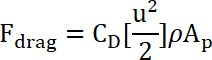
where u is the particle-fluid relative velocity, Ap is the area of the particle projected in direction of the motion, and CD is the drag coefficient. By balancing the forces, set the boundary condition at which the grains reach the terminal velocity. Assuming laminar flow conditions, the velocity of the grain vgrain is given in the resulting equation known as Stokes’ Law:
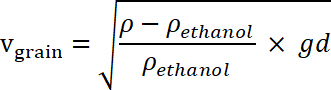
where d is the diameter of the grain.
- Suspend the grains in ethanol. Then separate the grains from the ethanol suspension by using a tall decantation column (~20 cm in height) and settling by gravity.
- Extract the ethanol/grain mix at different heights in the column into separate glass beakers, to obtain grains sorted by their grain diameter.
NOTE: The rate of grain settling depends on its diameter and density. - Leave the content in the beakers overnight to air dry. Measure the final average diameter of the grains using a low magnification microscope and select the batch of grains with a diameter closest to 4 µm (for optimal X-ray signals).
- Prepare mineral grains by first grinding a suitably sized sample of rock or pre-existing powder in a pestle and mortar.
2. Cell Assembly Preparation
- Load the prepared samples into a standard D-DIA cell assembly (Figure 3a).
NOTE: The D-DIA cell assembly was developed under the Consortium for Materials Properties Research in Earth Sciences (COMPRES) multi-anvil cell assembly development project14. The following description of the standard D-DIA cell design (under the COMPRES project) can be used for an addition of increased temperature if desired.- Start with a cell assembly cube (6.18 mm edge length; Figure 3) on a clean working surface.
- Clean an alumina rod (diameter of 1.5 mm, height of 1.46 mm; Figure 3a), an alumina ring (Figure 3a), and a graphite ring (Figure 3a) in an ultrasonic bath. Prepare the end surfaces of the alumina rod flat and parallel to a precision within 0.5° (refer to Section 1.2.7).
- Put a piece of tape at one end of the hole of the cube. Use a pair of tweezers to put the two rings around the alumina rod, and insert them all the way down into the hole of the cube, and such that the graphite ring is in contact with the tape.
NOTE: The alumina ring is used as a separator; the graphite ring is used for electrical conductivity upon higher temperature application (not applied for the cold compression presented in this study). - Mark the corner of the cube to be aligned with the incoming X-ray beam direction (Figure 4b).
NOTE: The tantalum foil is used to obtain better contrast for quantifying the sample volume using radiography during the experiment (Section 3).- Cut a rectangular piece of tantalum foil (1.5 mm x 17 mm). Fold the foil into a U-shape piece (see Figure 3b for more details) and place inside the cylindrical space of the cell assembly. To ensure a tight fit between the foil and the edges of the cylindrical space, use a pin (diameter of 1.83 mm) to push onto the foil against the edges to remove any excess space between the two.
- Align this U-shaped foil with respect to the X-ray beam direction (Figure 4a), and aim to minimize and maximize the 2-D projection of the foil and the samples, respectively.
- Lay a piece of rectangular tantalum foil (1.7 mm x 1 mm) on top of the rock core (Figure 3b). Make sure the foil is flat, and align the foil such that the length (1.7 mm) of the foil is perpendicular to the X-ray beam direction (Figure 4a).
NOTE: Either a rock core or mineral aggregate can be a “reference sample”, depending on the goal of the experimental study. In this particular example, insert the rock core prepared in Section 1.2. as the “reference sample” portion in Figure 3b. The purpose of this piece of foil is to provide better contrast of the boundary between adjacent samples. - Carefully pack the mineral aggregate (prepared in Section 1.3) into the cylindrical space with a spatula (the “sample” portion in Figure 3b).
NOTE: Again, either a rock core or mineral aggregate can be a “sample”, depending on the goal of the experimental study. - Remove the excess grains adhered to the lateral side of the cylindrical space gently with air if necessary. Use a pin (diameter of 1.83 mm) and a caliper to check if the final height has been reached; leave 1.4 mm in the height for inserting the top alumina rod.
- Insert another rectangular piece of tantalum foil (1.7 mm x 1 mm). Clean a new set of an alumina rod (diameter of 1.5 mm, height of 1.46 mm), an alumina ring, and a graphite ring (Figure 3a) in the ultrasonic bath. Use a pair of tweezers to put the two rings around the alumina rod, and insert them such that remaining space of the cylindrical volume is fully filled with the graphite ring on top.
- Use a minimal amount of cement (zirconium powder mixed with activator) to seal the alumina rod exposed on both ends of the cube. After the cement is dried, trim the excess tantalum foil that is still exposed outside of the cube for tidiness.
3. Experimental Procedure
NOTE: The following experiment is performed at beamline 6-BM-B (Figure 4a) of the APS at Argonne National Laboratory. The experiment performed at 6-BM-B is under white X-ray mode. This beamline is an open beamline and welcomes proposals from scientists, researchers, and students worldwide to perform experiments under its general user program.
- Perform the energy calibration of the system by collecting a diffraction pattern for an alumina standard.
- Collect a diffraction pattern by clicking the "start" button on the "12 Element Detector Control Pump" panel.
- Analyze the alumina XRD pattern, which contains built-in Cobalt-57 (Co-57) fluorescence peaks, by calculating the average peak position (Horiz X, Vert Y, and Beam Z dimensions) over the different detectors.
- Enter the average values as new pedestal positions in the "6motors.adl" panel. Recollect a diffraction pattern and save as an energy dispersive diffraction file (EDF), which constrains the 2-theta angle and the correlation function between the detector channel and X-ray energy for each of the 10 detectors.
- Remove the alumina standard and collect an open press X-ray spectrum by clicking the "start" button on the "12 Element Detector Control Pump" panel (with an exposure time of 500 s, to optimize signal-to-noise ratio) to measure the diffraction of the background without any sample assembly.
- Clean the anvils (truncation edge length of 4 mm) with acetone and use a portable vacuum cleaner to remove all debris from previous experiments. Insert the sample assembly prepared in Section 2 into the center of the experiment setup that consists of four, X-ray transparent, sintered diamond and two tungsten carbide (top/bottom) anvils (Figure 4b).
- Slowly lower the opposing pairs of lateral anvils simultaneously. Use a level to check if the anvils are leveled. Gently push the anvil to adjust the alignment until it is all leveled. The bottom and four lateral anvils should now all be in contact with the sample assembly. Release the safety latch and insert the spacer (Figure 4a).
- Close the hutch and enable the shutter to allow the X-ray beam to enter the hutch.
- In the "low-pressure pump panel" (labeled as the pump motor controller module in Figure 5), turn the "low-pressure pump" button ON and push the "up" button next to the "top ram" label to move the top ram to the top, against the spacer (Figure 4a). With the aid of real-time X-radiographic imaging (Figure 5), start moving the bottom ram up slowly and carefully until the anvils start to appear in the radiograph. "Leave a very fine gap" such that the sample is not overloaded initially before the experiment.
- Turn off all the controls on the low-pressure pump controller module (Figure 5) and close the “pressurize” valve before starting to compress with the high-pressure hydraulic pump.
NOTE: The high-pressure pump is controlled using EPICS-based software (Figure 5). EPICS is a non-commercial set of open source software tools, libraries, and applications developed by Argonne National Laboratory.- Move the sample position in the Z direction (parallel to the beam) using the "jog" button in the "6motors.adl" panel such that the center of the sample in the ImageJ EPICS area detector plugin software panel aligns with the diffraction focus mark on the screen. This minimizes parasitic diffraction and optimizes the signal-to-noise ratio.
- Collect diffraction spectra by clicking the "start" button on the "12 Element Detector Control Pump" panel for the core and the aggregate ("jog" button along pedestal Z to move between samples) separately, each with an exposure time of 500 s, at ambient conditions. On the "NDFileTIFF.adl" panel, click the "capture-start" button to capture a radiograph (Figure 5) of these samples with an exposure time of ~6 ms.
- Drive the anvils inwards by wedged guide blocks running on the hydraulics pump by starting the motor. In the "SAM-85 Press Load Control" window (Figure 6), set the target load to 50 tons. Turn the feedback on, with the upper limit of the speed control set to 7 (the slowest compression possible).
NOTE: The press load and speed can be changed depending on the target pressure and the speed of the compression. The maximum press load to avoid the breakage of anvils is 100 tons. - Use the "Diffraction-Imaging-Scan-Prosilica" panel (Figure 7) to set up an automatic data collection by defining the desired locations of the core (e.g., Press X = 20.738 mm, Press Y = 4.3 mm) and the aggregate (e.g., Press X = 20.738 mm, Press Y = 4.8 mm) for diffraction (with preset exposure times of 500 s) and X-radiographic imaging. Set the cycles required to 0 such that this data collection will repeat continuously. Click "start" to start the data collection.
NOTE: As the compression progresses, the sample will move upwards, so new desired locations should be updated accordingly. - After reaching the target load of 50 ton, click the stop button to stop the automatic data collection in the "Diffraction-Imaging-Scan-Prosilica" panel (Figure 7). In the "SAM-85 Press Load Control" window, decompress the sample by setting the lower limit of the speed control to -10 and change the target load to 0 ton.
- After unloading, collect the diffraction spectra for the core and the aggregate separately, by clicking the "start" button on the "12 Element Detector Control Pump" panel; use an exposure time of 500 s for both the core and the aggregate. On the "NDFileTIFF.adl" panel, click the "capture-start" button to capture a radiograph (Figure 5) of these samples with an exposure time of ~6 ms.
- In the low-pressure pump panel (labeled as the pump motor controller module in Figure 5), open the "pressurize valve". Push the "low-pressure pump – on" button. Press the "down" buttons both next to the "top ram" and "bottom ram" labels to move both the top and the bottom ram downwards until the green "Down" light becomes illuminated, then stop driving both rams.
- In the "low-pressure pump" panel, press the out button near the "spacer block" label to move the spacer arm to the "out" position, and then press the "up" button near the "top ram" label to drive the top ram up until the safety lock engages. Turn all the controls off in the pump motor controller unit (Figure 5) afterwards. Slowly and manually move the lateral anvils outwards and remove the sample assembly.
Access restricted. Please log in or start a trial to view this content.
Results
We show one representative result example from an XRD experiment (experiment SIO2_55) run in the multi-anvil press at 6BM-B on a compound quartz aggregate5,6 and novaculite core sample6. The grain sizes of the quartz aggregate and novaculite are ~4 µm and ~6–9 µm, respectively5,6. Selected diffraction spectra collected during this experiment are ill...
Access restricted. Please log in or start a trial to view this content.
Discussion
We present the detailed procedure for carrying out XRD experiments using the multi-anvil cell at 6-BM-B. Perhaps the most critical, and yet most challenging, steps in the above protocol involve optimizing the quality of the sample. Such importance on sample quality applies to almost all rock and mineral deformation experiments. Firstly, it is critical for the end surface of the rock cores to be flat, with both ends parallel to each other and at the same time, perpendicular to the cylindrical surface. That will ensure the...
Access restricted. Please log in or start a trial to view this content.
Disclosures
The authors declare no conflict of interest.
Acknowledgements
The authors would like to gratefully acknowledge two anonymous peer reviewers and JoVE senior review editor Dr. Alisha DSouza for their invaluable comments. This research was performed at 6-BM-B of the Advanced Photon Source (APS) at Argonne National Laboratory. The use of this facility has been supported by Consortium for Materials Properties Research in Earth Sciences (COMPRES) under National Science Foundation (NSF) cooperative agreement EAR 11-57758, EAR 1661511 and by the Mineral Physics Institute, Stony Brook University. The authors acknowledge NSF for research funding for this program through EAR 1361463, EAR 1045629, and EAR 1141895. This research used resources of the Advanced Photon Source, a U.S. Department of Energy (DOE) Office of Science User Facility operated for the DOE Office of Science by Argonne National Laboratory under contract DEAC02-06CH11357. The cell assemblies are under COMPRES multi-anvil cell assembly development project. All the data files are available from the authors upon request (scheung9@wisc.edu). The samples and data are archived at Mineral Physics Institute at Stony Brook University.
Access restricted. Please log in or start a trial to view this content.
Materials
| Name | Company | Catalog Number | Comments |
|---|---|---|---|
| Rotatory Tool Workstation Drill Press Work Station with Wrench | Dremel | 220-01 | |
| MultiPro Keyless Chuck | Dremel | 4486 | |
| Variable-Speed Rotatory Tool | Dremel | 4000-6/50 | |
| Super small Diamond Core Drill - 2.5 mm | Dad's Rock Shop | SDCD | |
| Coolant | NBK | JK-A-NBK-000-020 | Grinding Fluid Concentrate US 5 gal / 20 L |
| commercial software package and codes for instrument control and data acquisition | IDL EPICS and SPEC | installed on the computer at the beamline | |
| CCD Camera | Allied Vision | Prosilica GT | installed at the beamline |
References
- Bjørlykke, K. Relationships between depositional environments, burial history and rock properties. Some principal aspects of diagenetic processes in sedimentary basins. Sedimentary Geology. , 1-14 (2014).
- Burnley, P. C., Zhang, D. Interpreting in situ X-ray diffraction data from high pressure deformation experiments using elastic-plastic self-consistent models: An experiment using quartz. J. Phys. Condens. Matter Solid Earth. 20 (28), 285201(2008).
- Burnley, P. C. Elastic plastic self-consistent (EPSC) modeling of plastic deformation of fayalite olivine. American Mineralogist. 100 (7), 1424-1433 (2015).
- Chen, J., Li, L., Weidner, D. J., Vaughan, M. T. Deformation experiments using synchrotron X-rays: in situ stress and strain measurements at high pressure and temperature. Phys. of the Earth and Planetary Interiors. 143, 347-356 (2004).
- Cheung, S. N. C. Experimental deformation in sandstone, carbonates, and quartz aggregate. , State University of New York at Stony. Ph.D. Thesis (2015).
- Cheung, S. N. C., et al. Stress distribution during cold compression of a quartz aggregate using synchrotron X-ray diffraction: observed yielding, damage, and grain crushing. J. Geophys. Res. Solid Earth. 122, 2724-2735 (2017).
- Croizé, D., Ehrenberg, S. N., Bjørlykke, K., Renard, F., Jahren, J. Petrophysical properties of bioclastic platform carbonates: implications for porosity controls during burial. Marine and Petroleum Geology. 27 (8), 1765-1774 (2010).
- Doornhof, D., Kristiansen, T. G., Nagel, N. B., Pattillo, P. D., Sayers, C. Compaction and subsidence. Oilfield rev. 18 (3), 50-68 (2006).
- Durham, W. B., Weidner, D. J., Karato, S. New developments in deformation experiments at high pressure. Rev. Mineral. Geochem. 51 (1), 22-49 (2002).
- Fyfe, W. S. The evolution of the Earth's crust: modern plate tectonics to ancient hot spot tectonics. Chemical Geology. (1-4), 89-114 (1978).
- Gerward, L., Mo, S., Topso, H. Particle size and strain broadening in energy-dispersive -ray powder patters. J. Appl. Phys. 47 (3), 822-825 (1976).
- Heap, M. J., Farquharson, J. I., Baud, P., Lavallée, Y., Reuschlé, T. Fracture and compaction of andesite in a volcanic edifice. Bulletin of volcanology. 77 (6), 55(2015).
- Lavina, B., Dera, P., Downs, R. T. Modern X-ray diffraction methods in mineralogy and geosci. Reviews in Mineralogy and Geochemistry. 78 (1), 1-31 (2014).
- Leinenweber, K. D., et al. Cell assemblies for reproducible multi-anvil experiments (the COMPRES assemblies). American Mineralogist. 97 (2-3), 353-368 (2012).
- Li, L., Weidner, D. J., Raterron, P., Chen, J., Vaughan, M. T. Stress measurements of deforming olivine at high pressure. Phys. of the Earth and Planetary Interiors. 143, 357-367 (2004).
- Li, L., Weidner, D. J., Chen, J., Vaughan, M. T., Davis, M., Durham, W. B. X-ray strain analysis at high pressure: Effect of plastic deformation in MgO. J. App. Phys. 95 (12), 8357-8365 (2004).
- Minkoff, S. E., Stone, C. M., Bryant, S., Peszynska, M., Wheeler, M. F. Coupled fluid flow and geomechanical deformation modeling. J. Petroleum Sci. and Engineering. 38 (1), 37-56 (2003).
- Miyagi, L., et al. Deformation and texture development in CalrO 3 post-perovskite phase up to 6 GPa and 1300 K. Earth and Planetary. 268 (3), 515-525 (2008).
- Morton, R. A., Bernier, J. C., Barras, J. A. Evidence of regional subsidence and associated interior wetland loss induced by hydrocarbon production, Gulf Coast region, USA. Environmental Geology. 50 (2), 261(2006).
- Nagel, N. B. Compaction and subsidence issues within the petroleum industry: From Wilmington to Ekofisk and beyond. Phys. And Chem. of the Earth, Part A: Solid Earth and Geodesy. 26 (1-2), 3-14 (2001).
- Nichols, G. Sedimentology and Stratigraphy. , John Wiley & Sons. (2009).
- Nicolas, A., Fortin, J., Regnet, J. B., Dimanov, A., Guéguen, Y. Brittle and semi-brittle behaviours of a carbonate rock: influence of water and temperature. Geophysical Journal International. 206 (1), 438-456 (2016).
- Nishiyama, N., Wang, Y., Sanehira, T., Irifune, T., Rivers, M. L. Development of the multi-anvil assembly 6-6 for DIA and DDIA type high-pressure apparatuses. High Pressure Research. 28 (3), 307-314 (2008).
- Nur, A., Walder, J. Time-dependent hydraulics of the Earth's crust. The role of fluids in crustal processes. , 113-127 (1990).
- Paterson, M. S. Rock deformation experimentation. The brittle-ductile transition in rocks. The Heard Volume. The American Geophysical Union, Geophys. Monograph. 56, 187-194 (1990).
- Peng, S. D. Stresses within elastic circular cylinders loaded uniaxially and triaxially. Int. J. Rock Mech. Min. Sci. Geomech. Abst. 78 (1), 399-432 (1971).
- Raterron, P., Merkel, S., Holyoke, C. W. III Axial temperature and gradient and stress measurements in the deformation D-DIA cell using alumina pistons. Rev. of Sci. Instr. 84 (4), 043906(2013).
- Raghavan, R., Chin, L. Y. Productivity changes in reservoirs with stress-dependent permeability. SPE Annual Technical Conference and Exhibition. , Soc. of Petroleum Engineers. (2002).
- Reynolds, C. A., Menke, H., Andrew, M., Blunt, M. J., Samuel, K. Dynamic fluid connectivity during steady-state multiphase flow in a sandstone. Proceedings of National Academy of Sci. 114 (31), 8187-8192 (2017).
- Scholle, P. A. A color illustrated guide to constituents, textures, cements, and porosities of sandstones and associated rocks. , AAPG Memoir 28 (1979).
- Scholle, P. A., Ulmer-Scholle, D. S. A Color Guide to the Petrography of Carbonate Rocks: Grains, Textures, Porosity, Diagenesis. , AAPG Memoir 77 (2003).
- Scholz, C. H. Experimental study of the fracturing process in brittle rock. J. Geophys. Res. 73 (4), 1447-1454 (1968).
- Schutjens, P. M. T. M., et al. Compaction-induced porosity/permeability reduction in sandstone reservoirs: Data and model for elasticity-dominated deformation. SPE Reservoir Evaluation & Engineering. 7 (3), 202-216 (2004).
- Simmons, G., Wang, H. Single Crystal Elastic Constants and Calculated Aggregate Properties. , MIT Press. Cambridge, MA. 135-160 (1971).
- Singh, A. K., Balasingh, C., Mao, H. K., Hemley, R. J., Shu, J. Analysis of lattice strains measured under nonhydrostatic pressure. J. Applied physics. 83 (12), 7567-7575 (1998).
- Terzaghi, K. V. Die berechnung der durchlassigkeitsziffer des tones aus dem verlauf der hydrodynamischen spanningsercheinungen. Sitzungsberichte der Akademie der Wissenschften in Wein. Mathematisch-Naturwissenschaftliche Klasse. Abteilung lla. 132, 125-138 (1923).
- Wang, Y., Durham, W. B., Getting, I. C., Weidner, D. J. The deformation D-DIA: a new apparatus for high temperature triaxial deformation to pressures up to 15 GPa. Rev. Sci. Instrum. 74 (6), 3002-3011 (2003).
- Wang, Y., Hilairet, N., Dera, P. Recent advances in high pressure and temperature rheological studies. J. Earth Sci. 21 (5), 495-516 (2010).
- Weidner, D. J., et al. Characterisation of Stress, Pressure, and Temperature in SAM85, a DIA Type High Pressure Apparatus. Geophys. Monogr. Ser. AGU. , Washington, D.C. 13-17 (1992).
- Weidner, D. J., Wang, Y., Vaughan, M. T. Strength of diamond. Sci. 266 (5184), 419-422 (1994).
- Weidner, D. J. Rheological studies at high pressure. Rev. in Mineralogy and Geochemistry. 37 (1), 493-524 (1998).
- Weidner, D. J., Wang, Y., Chen, G., Vaughan, M. T. Rheology measurements at high pressure and temperature. Properties of Earth and Planetary Materials at High Pressure and Temperature. AGU. , Washington, D.C. 473-482 (1998).
- Weidner, D. J., Vaughan, M. T., Wang, L., Long, H., Li, L., Dixon, N. A., Durham, W. B. Precise stress measurements with white synchrotron x rays. Rev. of Sci. Instrum. 81 (1), 013903(2010).
- Weidner, D. J., Li, L., Whitaker, M., Triplett, R. Ultrasonic Acoustic Velocities During Partial Melting of a Mantle Peridotite KLB-1. J. Geophys. Res: Solid Earth. , (2018).
- Whitaker, M. L., Baldwin, K. J., Huebsch, W. R. DIASCoPE: Directly integrated acoustic system combined with pressure experiments-A new method for fast acoustic velocity measurements at high pressure. Rev. Sci. Instrum. 88 (3), 034901(2017).
Access restricted. Please log in or start a trial to view this content.
Reprints and Permissions
