Optical levitation is a method for levitating micrometer-sized dielectric objects using laser light. Utilizing computers and automation systems, an experiment on optical levitation can be controlled remotely. Here, we present a remotely controlled optical levitation system that is used both for educational and research purposes.
A subscription to JoVE is required to view this content. Sign in or start your free trial.
Method Article
Safe Experimentation in Optical Levitation of Charged Droplets Using Remote Labs
In This Article
Summary
Abstract
The work presents an experiment that allows the study of many fundamental physical processes, such as photon pressure, diffraction of light or the motion of charged particles in electrical fields. In this experiment, a focused laser beam pointing upwards levitate liquid droplets. The droplets are levitated by the photon pressure of the focused laser beam which balances the gravitational force. The diffraction pattern created when illuminated with laser light can help measure the size of a trapped droplet. The charge of the trapped droplet can be determined by studying its motion when a vertically directed electrical field is applied. There are several reasons motivating this experiment to be remotely controlled. The investments required for the setup exceeds the amount normally available in undergraduate teaching laboratories. The experiment requires a laser of Class 4, which is harmful to both skin and eyes and the experiment uses voltages that are harmful.
Introduction
The fact that light carries momentum was first suggested by Kepler when he explained why the tail of a comet always points away from the sun. The use of a laser to move and trap macroscopic objects was first reported by A. Ashkin and J. M. Dziedzic in 1971 when they demonstrated that it is possible to levitate micrometer sized dielectric objects1. The trapped object was exposed to an upward directed laser beam. Part of the laser beam was reflected on the object which imposed a radiation pressure on it that was sufficient to counterbalance gravity. Most of the light, however, was refracted through the dielectric object. The change of the direction of the light causes a recoil of the object. The net effect of the recoil for a particle placed in a Gaussian beam profile is that the droplet will move towards the region of highest light intensity2. Hence, a stable trapping position is created in the center of the laser beam at a position slightly above the focal point where radiation pressure balances gravity.
Since the optical levitation method allows small objects to be trapped and controlled without being in contact with any objects, different physical phenomena can be studied using a levitated droplet. However, the experiment presents two limitations to be reproduced and applied at schools or universities since not all institutions can afford the required equipment and since there are certain risks in the hands-on operation of the laser.
Remote laboratories (RLs) offer online remote access to the real laboratory equipment for experimental activities. RLs first appeared at the end of the 90s, with the advent of the Internet, and their importance and use have been growing over the years, as the technology has progressed and some of their major concerns have been solved3. However, the core of RLs has remained the same over time: the use of an electronic device with Internet connection to access a lab, and control and monitor an experiment.
Due to their remote nature, RLs can be used to offer experimental activities to users without exposing them to the risks that may be associated with the realization of such experiments. These tools allow students to spend more time working with laboratory equipment, and hence develop better laboratory skills. Other advantages of RLs are that they 1) facilitate for handicapped people to perform experimental work, 2) expand the catalog of experiments offered to students by sharing RLs between universities and 3) increase the flexibility in scheduling laboratory work, since it can be performed from home when a physical laboratory is closed. Finally, RLs also offer training in operating computer-controlled systems, which nowadays are an important part of research, development and industry. Therefore, RLs cannot only offer a solution to both the financial and safety issues that traditional labs present, but also provide more interesting experimental opportunities.
With the experimental setup used in this work, it is possible to measure the size and charge of a trapped droplet, investigate the motion of charged particles in electric fields and analyze how a radioactive source can be used to change the charge on a droplet4.
In the experimental setup presented, a powerful laser is directed upwards and focused into the center of a glass cell4. The laser is a 2 W 532 nm diode-pumped solid-state laser (CW), where usually about 1 Watt (W) is used. The focal length of the trapping lens is 3.0 cm. Droplets are generated with a piezo droplet dispenser and descend through the laser beam until they are trapped just above the focus of the laser. Trapping occurs when the force from the upward directed radiation pressure is equal to the downward directed gravitational force. There is no upper time limit observed for trapping. The longest time a droplet has been trapped is 9 hours, thereafter, the trap was turned off. The interaction between the droplet and the laser field produces a diffraction pattern which is used to determine the size of the droplets.
The droplets emitted from the dispenser consist of 10% glycerol and 90% water. The water part quickly evaporates, leaving a 20 to 30 µm sized glycerol droplet in the trap. The maximum size of a droplet that can be trapped is about 40 µm. There is no evaporation observed after about 10 s. At this point, all water is expected to have evaporated. The long trapping time without any observable evaporation indicates that there is minimal absorption and that the droplet essentially is at room temperature. The surface tension of the droplets makes them spherical. The charge of the droplets generated by the droplet dispenser depends on the environmental conditions in the laboratory, where they most commonly become negatively charged. The top and the bottom of the trapping cell consists of two electrodes placed 25 mm apart. They can be used to apply a vertical electric direct current (DC) or alternating current (AC) field over the droplet. The electric field is not strong enough to create any arcs even if 1000 volts (V) is applied over the electrodes. If a DC field is used, the droplet moves up or down in the laser beam to a new stable equilibrium position. If an AC field is applied instead, the droplet oscillates around its equilibrium position. The magnitude of the oscillations depends on the size and charge of the droplet, on the intensity of the electric field, and on the stiffness of the laser trap. An image of the droplet is projected onto a position-sensitive detector (PSD), which allows users to track the vertical position of the droplet.
This work presents a successful initiative of modernizing teaching and research using Information and Communication Technologies through an innovative RL on optical levitation of charged droplets which illustrates modern concepts in physics. Figure 1 shows the architecture of the RL. Table 1 shows the possible injuries that lasers can cause according to their class; In this setup, a Class IV laser has been used, which is the most dangerous one. It can operate with up to 2.0 W of visible laser radiation, so the safety provided by the remote operation is clearly suitable for this experiment. The optical levitation of charged droplets RL was presented in the work of D. Galan et al. in 20185. In this work, it is demonstrated how it can be used online by teachers who want to introduce their students to modern concepts of physics without having to be concerned about the costs, the logistics or the safety issues. Students access the RL through a web portal called University Network of Interactive Laboratories (UNILabs - https://unilabs.dia.uned.es) in which they can find all the documentation regarding the theory related to the experiment and the use of the experimental setup by means of a web application. By using the concept of a remote laboratory, experimental work in modern physics that requires costly and dangerous equipment can be made available to new groups of students. Furthermore, it enhances the formal learning by providing traditional students with more laboratory time and with experiments that normally are inaccessible outside research laboratories.
Access restricted. Please log in or start a trial to view this content.
Protocol
NOTE: The laser used in this experiment is a class IV laser delivering up to 1 W of visible laser radiation. All personnel present in the laser laboratory must have conducted adequate laser safety training.
1. Hands-On Experimental Protocol
- Safety
- Make sure everyone in the lab is aware that a laser will be turned on.
- Turn on the laser warning lamp in the lab.
- Check that no watch or metal rings are worn and put on the laser goggles.
- Check that the four light absorbing boards, closest to the experiment, are in place.
- Check the space between the laser and the absorbing board for obstacles. Also check that the space between the trapping cell and the beam block is free from objects.
- Prepare the software and the experiment.
- Turn on the lab computer. Wait until it is ready to operate.
- Open the Remote Startup folder from the desktop and click the icon Main1806.vi. Run the program by pressing the arrow in the top left corner.
NOTE: This opens the control program (e.g., Labview) shown in Figure 2 and Figure 3 and automatically turns on both the power supply for the laser and the electric field. All buttons referenced from now on in this section refer to those that appear in these figures. - Under “EJS variables”, mark the checkbox named “Laser Remote Enable2” power and set “laser current2” to 25 so that the laser power slide to the right ends up at 25%. Observe the laser beam using alignment laser goggles to make sure that the beam ends up in the beam dump. If not, adjust the position of the beam dump.
- Check Drops2 and move the tip of the droplet dispenser until the droplets are falling into the laser beam. Do this by adjusting the translation stage marked with letter A in Figure 4. For that purpose, gently turn the driving screws at the base of the translation stage until the desired position is reached.
- If no drops are coming, apply some pressure in the syringe until a droplet is shown in the tip of the dispenser. Wipe it off carefully (fragile tip) using a paper with acetone. The droplets should now start coming. When this occurs, start over from point 1.2.4.
- Raise the laser power to about 66% using the Laser Current 2 input field and trap a droplet. Uncheck Drops2 as soon as a droplet is trapped.
NOTE: Figure 5 shows a droplet captured in the experimental environment. The lower green dot corresponds to the real droplet, while the upper one is its reflection on the glass of the cell in which the droplet is located. From this moment on, it will be The trapped droplet is now imaged onto the PSD.
- Determine the size of a droplet.
- Adjust the laser power until the PSD position is as close as possible to zero.
NOTE: As droplets can be trapped below or above previous trapping positions, depending on the laser power or the size/weight. This step is performed to move the droplet image to the center of the PSD. - Observe the diffraction pattern created on the screen (see Figure 1). Take a picture with the web camera that is positioned to observe the screen from underneath.
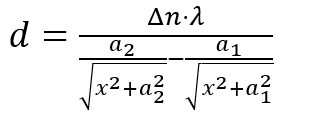
NOTE: The pattern is caused by laser light diffracted by the trapped droplet. - Use the picture to determine distances from the line marked 1 to two arbitrary minima in the image. The distance is positive if it is further from the droplet than the line marked 1, else negative. Then, add 40 cm to both distances. Call the shortest a1, and the longest a2. Use Equation 1 to calculate the size of the droplet:
 (1)
(1)
where, x is the vertical distance from the droplet to the screen (x = 23.5 cm), λ is the wavelength of the laser light (λ = 532 nm) and Δn is the number of fringes (integer) between the two minima used in the calculation.
NOTE: When the droplet is imaged in the middle of the PSD, the distance (x), from the droplet to the screen is 23.5 ± 0.1 cm. A more detailed explanation of the process can be found in the work of J. Swithenbank et al. 6.
- Adjust the laser power until the PSD position is as close as possible to zero.
- Determine the polarity of the charge of the droplet.
- Choose the tab run to the right of EJS variables and set the E-Field DC control2 to +2 V (see Figure 3). Be careful, since the voltage on the electrode is now 200 V.
NOTE: The polarity of the droplet charge is determined by observing how the droplet respond to an applied vertical electric field. A sketch of how the electric field is applied can be seen in Figure 6
- Choose the tab run to the right of EJS variables and set the E-Field DC control2 to +2 V (see Figure 3). Be careful, since the voltage on the electrode is now 200 V.
- Determine the charge of the droplet
NOTE: To calculate the charge of the droplet, it is necessary first to measure the size of the droplet. The weight of the droplet can then be determined since the density of the liquid is known. Figure 7 describes the procedure schematically.- Set the E-field DC control2 to zero.
- Estimate and note an average value for the position of the droplet by the PSD Normalize Position trace in the Chart Waveform.
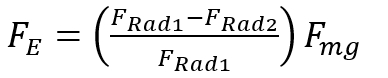
- Note the value of the laser power. This value will be FRad1 in Equation 2.
- Set the E-field DC control2 between +1 and +5 Volts or -1 and -5 Volts so that the drop moves upwards. The droplet is now at a new position. Slowly reduce the laser power until the droplet is back in its original position as noted in Step 1.5.2. Write down the new laser power (FRad2).
If the droplet is lost, check Drops2 and start over from Step 1.2.4. - Use the following procedure to calculate the charge. First, calculate the force from the electric field:
 (2)
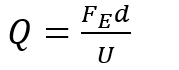
(2) - Determine the absolute charge using the expression
 (3)
(3)
Here d is the distance between the electrodes and U is the applied voltage.
2. Remote Experimentation Protocol
- Access the remote laboratory.
- Open UNILabs webpage on a web browser: https://unilabs.dia.uned.es/
- Select the desired language if needed. The option is found at the first item of the menu under the header.
- Log in with the following data:
Username: test
Password: test
NOTE: The login frame is under the news and introduction info of the webpage. - In the course area, next to the login area, left click on the logo of the University of Gothenburg (GU).
- Click on Optical Levitation to access the material of this experiment.
- Access the remote laboratory by clicking on Remote Laboratory of Optical Levitation. After that, ensure that the main frame of the webpage show the user interface of the remote laboratory, as shown in Figure 8.
- Connect to the Optical Levitation laboratory.
NOTE: All the instructions here refer to Figure 8.- Click on the Connect button. If the connection is successful, the button text will change to Connected.
NOTE: When a user connects to the remote laboratory, it emits an acoustic signal that warns other people in the surrounding area that someone will power on and manipulate the laser remotely. - Click on Tracking droplets and check that the PSD data is being received.
NOTE: As there are no droplets captured at this point, the value obtained is not relevant. - Click on General view to identify all elements of the setup: the laser, the droplet dispenser, the trapping cell and the PSD.
- Click on the Connect button. If the connection is successful, the button text will change to Connected.
- Trap a droplet.
NOTE: All the instructions here refer to Figure 8.- Once the remote laboratory is connected, click on the Trapping droplets button to visualize the pipette and the droplet dispenser nozzle.
- Click on the Turn on laser button to establish the connection to the laser.
NOTE: The laser is started manually and independently of the rest of the instruments because it can damage the environment if it is not correctly aligned. - Set the laser power around the first quarter of the control strip, which is situated under the Turn on laser button. Wait until the green light is visible.
- Check the laser alignment.
NOTE: If the laser is correctly aligned, a thin green light beam will be seen. Otherwise, a scattered green spot will be perceived. In case of incorrect alignment, shut down the system, and contact the lab maintenance services. To contact the maintenance services, click on the icon that represents a speech bubble, located in the upper left corner of UNILabs webpage. Then click on the Admin user message, write down the message at the bottom describing the problem and press Send. This usually does not happen, since all the optics are fixed. - Increase the laser power to 3/4 of the bar.
NOTE: A power of 60% (550 mW) is enough to capture and keep a droplet levitated. - Press the Start drops button to turn on the droplet dispenser.
- Watch the webcam image and wait until a flash is produced. At that moment, a droplet has been captured. Check the webcam image again and verify that a droplet is levitating in the center of the trapping cell. Press the Stop drops button to turn off the droplet dispenser.
NOTE: Optionally, it is possible to obtain a larger droplet by catching several of them and waiting for them to merge with the one already captured. It is necessary to bear in mind that if several are caught, the droplet mass increases so that the laser power may not be enough to keep it levitated.
- Determine the size of a droplet.
NOTE: All instructions here refer to Figure 9.- Press the Sizing droplets button to observe the diffraction pattern formed by the trapped droplet.
- Follow the same procedure as in the hands-on experimentation protocol (Step 1.3) to determine the size of the droplet by means of the diffraction pattern.
- Determining the droplet charge polarity.
NOTE: All instructions here refer to Figure 10.- Click on the Tracking droplets button to view the PSD graph and the webcam view of the pipette.
- Click on the Electric Field tab at the bottom left of the user interface.
- Set the DC voltage to 100 V. To do this, click on the numeric field to the right of the DC (V) label and enter the value 100.
- Check the PSD graph showing the position of the droplet and observe whether the droplet moves upwards or downwards when the electrical field is applied.
NOTE: The polarity of the plates is arranged so that if a positive voltage is applied, a negatively charged droplet will move downwards and a positively charged droplet will move upwards. - Now change the value of the electric field and check that the droplet moves in the opposite direction; for this purpose, enter -100 in the DC (V) numeric field.
- Determine the charge of the droplet.
NOTE: All instructions here refer to Figure 10.- Having a droplet trapped, click on the Tracking droplets view.
- Select the Electric Field menu.
- Set the DC electric field to zero with the DC (V) numeric field.
- Estimate and note an average value of the droplet position given by the chart and note the laser power.
- Set the DC electric field to a value between +500 V and -500 V to make the droplet change its position.
- Reduce or increase the laser power with the slider until the droplet is back in its original position and write down the new value of the laser power.
- Follow the procedure described in Step 1.5.5 to calculate the droplet charge.
Access restricted. Please log in or start a trial to view this content.
Results
When the laser beam is well aligned, and the bottom plate is clean, the drops are almost immediately trapped. When a droplet is trapped it can stay in the trap for several hours, giving plenty of time for investigations. The radius r of the droplets is in the range of 25 ≤ r ≤ 35 µm and the charge has been measured between 1.1x10⁻¹⁷ ±1.1x10⁻¹⁸ C and 5.5x10⁻¹⁶ ±5.5x10⁻¹⁷ C. The size of the droplets stays, according to our measurements, c...
Access restricted. Please log in or start a trial to view this content.
Discussion
This work presents a setup for carrying out a modern physics experiment in which droplets are optically levitated. The experiment can be performed either in a traditional hands-on way or remotely. With the remote system establishment, students and researchers all over the world can get access to the experimental set-up. This also guarantees the users’ safety, since they do not need to be in presence of the high-power laser and electric fields required for the experiment. In addition, the users can interact with the...
Access restricted. Please log in or start a trial to view this content.
Disclosures
The authors have nothing to disclose.
Acknowledgements
This work has been supported by the Swedish Research Council, Carl Trygger´s Foundation for Scientific Research and the Spanish Ministry of Economy and Competitiveness under the project CICYT DPI2014-55932-C2-2-R. Thanks to Sannarpsgymnasiet for letting us try the RL with students.
Access restricted. Please log in or start a trial to view this content.
Materials
| Name | Company | Catalog Number | Comments |
|---|---|---|---|
| GEM 532 | Laser Quantum | Green laser with adjustable power between 50 mW and 2 W | |
| Lateral Effect Position Sensor | THOR Lab | PDP90A | PSD to sensor the position of the droplet in the pipette |
| Advanced Educational Spectrometer Kit, Metric | THOR Lab | EDU-SPEB1/M | Mirrors and other elements to control the laser beam |
| Pipette | Self made | The chamber were the droplet is trapped was specially made for this setup | |
| AC/DC Power supply | Keithley Instruments, Inc. | 2380-500-30 | A power supply to generate the electric field (0V - 500V DC) |
| Power Distribution Unit | APC | AP7900 | A PDU to remotelly connect the lab instrumentation |
References
- Ashkin, A., Dziedzic, J. Optical levitation by radiation pressure. Applied Physics Letters. 19, 283-285 (1971).
- Roosen, G., Imbert, C. Optical levitation by means of two horizontal laser beams: A theoretical and experimental study. Physics Letters. 59 (1), 6-8 (1976).
- Heradio, R., de la Torre, L., Galan, D., Cabrerizo, F. J., Herrera-Viedma, E., Dormido, S. Virtual and remote labs in education: A bibliometric analysis. Computers & Education. 98, 14-38 (2016).
- Isaksson, O., Karlsteen, M., Rostedt, M., Hanstorp, D. An optical levitation system for a physics teaching laboratory. American Journal of Physics. 8810, 88-100 (2018).
- Galan, D., Isaksson, O., Rostedt, M., Enger, J., Hanstorp, D., de la Torre, L. A remote laboratory for optical levitation of charged droplets. European Journal of Physics. 39 (4), 045301(2018).
- Swithenbank, J., Beer, J., Taylor, D., Abbot, D., Mccreath, G. A laser diagnostic technique for the measurement of droplet and particle size distribution. 14th Aerospace Sciences Meeting, Aerospace Sciences Meetings. , (1976).
- Christian, W., Esquembre, F. Modeling physics with easy java simulations. The Physics Teacher. 45, 475-480 (2007).
- de la Torre, L., Sanchez, J., Heradio, R., Carreras, C., Yuste, M., Sanchez, J., Dormido, S. Unedlabs - an example of ejs labs integration into moodle. World Conference on Physics Education. , (2012).
- Chaos, D., Chacon, J., Lopez-Orozco, J. A., Dormido, S. Virtual and remote robotic laboratory using ejs, matlab and labview. Sensors. 13, ISSN 1424-8220 2595-2612 (2013).
- Lundgren, P., Jeppson, K., Ingerman, A. Lab on the web-looking at different ways of experiencing electronic experiments. International journal of engineering education. 22, 308-314 (2006).
- Ivanov, M., Chang, K., Galinskiy, I., Mehlig, B., Hanstorp, D. Optical manipulation for studies of collisional dynamics of micron-sized droplets under gravity. Optics Express. 25, 1391-1404 (2017).
- Galinskiy, I., et al. Measurement of particle motion in optical tweezers embedded in a Sagnac interferometer. Optics express. 23, 27071-27084 (2015).
- Polat, M., Polat, H., Chander, S. Electrostatic charge on spray droplets of aqueous surfactant solutions. Journal of Aerosol Science. 31, 551-562 (2000).
Access restricted. Please log in or start a trial to view this content.
Reprints and Permissions
