We present three protocols that assess different forms of impulsivity in rats and other small mammals. Intertemporal choice procedures evaluate the tendency to discount the value of delayed outcomes. Differential reinforcement of low rates and feature-negative discrimination evaluate response inhibition capacity with and without punishment for inappropriate responses, respectively.
A subscription to JoVE is required to view this content. Sign in or start your free trial.
Method Article
Three Laboratory Procedures for Assessing Different Manifestations of Impulsivity in Rats
* These authors contributed equally
In This Article
Summary
Abstract
The present article provides a guide for the conduction and analysis of three conditioning-based protocols to evaluate impulsivity in rats. Impulsivity is a meaningful concept because it is associated with psychiatric conditions in humans and with maladaptive behavior in non-human animals. It is believed that impulsivity is composed of separate factors. There are laboratory protocols devised to assess each of these factors using standardized automated equipment. Delay discounting is associated with the incapacity to be motivated by delayed outcomes. This factor is evaluated through intertemporal choice protocols, which consist of presenting the individual with a choice situation involving an immediate reward and a larger but delayed reward. Response inhibition deficit is associated with the incapacity to withhold prepotent responses. Differential reinforcement of low rates (DLR) and feature-negative discrimination protocols assess the response inhibition deficit factor of impulsivity. The former imposes a condition to a motivated individual in which most wait a minimum period of time for a response to be rewarded. The latter evaluates the capacity of individuals to refrain from food seeking responses when a signal of the absence of food is presented. The purpose of these protocols is to construct an objective quantitative measure of impulsivity, which serves to make cross-species comparisons, allowing the possibility of translational research. The advantages of these particular protocols include their easy set-up and application, which stems from the relatively small amount of equipment needed and the automated nature of these protocols.
Introduction
Impulsivity can be conceptualized as a behavioral dimension associated with maladaptive outcomes1. Despite the widespread use of this term, there is no universal consensus on its precise definition. In fact, several authors have defined impulsivity by giving examples of impulsive behaviors or their consequences, rather than delineating which distinctive aspects govern the phenomenon. For instance, impulsivity is assumed to involve an inability to wait, plan, inhibit prepotent behaviors, or an insensitivity to delayed outcomes2, and it has been considered a core vulnerability to addictive behavior3. Bari and Robbins4 have characterized impulsivity as the co-occurrence of strong impulses, being triggered by dispositional and situational variables, and dysfunctional inhibitory processes. A different definition was provided by Dalley and Robbins, who stated that impulsivity could be regarded as a predisposition to rapid, often premature, actions without appropriate insight5. Yet, another definition of impulsivity, proposed by Sosa and dos Santos6, is a behavior tendency that deviates an organism from maximizing available rewards due to the acquired control exerted over the organism's responding by stimuli incidentally related to those rewards.
Due to the behavioral processes related to impulsivity, its neurophysiological substrate involves structures in common with those of motivated behavior, decision making and reward valuing. This is supported by studies that show that structures of the cortico-striatal pathway (e.g., nucleus accumbens [NAc], prefrontal cortex [PFC], amygdala, and caudate putamen [CPU]), as well as the ascending monoaminergic neurotransmitter system, participate in the expression of impulsive behavior7. However, the neural substrate of impulsivity is more complex than that. Although NAc and PFC are involved in impulsive behavior, these structures are part of a more complex system, and also are composed by substructures that have different functions (for more detailed documentation, see Dalley and Robbins5).
Regardless of the controversies about its nature and biological substrate, this behavioral dimension is known to vary across individuals, in which case it can be considered as a trait, and within individuals, in which case it can be considered as a state8. Impulsivity has long been recognized as a feature of some psychiatric conditions, such as attention-deficit/hyperactivity disorder (ADHD), substance abuse, and manic episodes9. There seems to be a high consensus that impulsivity is composed by multiple dissociable factors, including unwillingness to wait (i.e., delay discounting), incapacity to refrain prepotent responses (i.e., inhibitory deficit), difficulty to focus on relevant information (i.e., inattention), and a tendency to engage in risky situations (i.e., sensation seeking)5,10,11. Each of these factors can be assessed through special behavioral tasks, which are usually assigned to two broad categories: choice and response inhibition (these may have different labels between each authors' taxonomies). Some important features of such behavioral tasks are that they could be applied across several animal species2 and that they allow studying impulsivity in controlled laboratory conditions.
Modeling a behavioral dimension with laboratory non-human animals has a number of advantages including the possibility of measuring specific, operationalized behavioral tendencies, allowing the researchers to largely reduce confounding variables (e.g., contamination by past life events4) and to implement experimental manipulations such as chronic pharmacological administration, performing neurotoxic lesions, or genetic manipulations. Most of these protocols have analogue versions for humans, which make comparisons easy5. Importantly, using analogues of these laboratory protocols in humans is effective to aid diagnosis of psychiatric conditions, such as ADHD (especially when more than one protocol is applied12).
Like any other psychological measurement, laboratory protocols for assessing impulsivity must comply with particular criteria in order to achieving the goal of providing insight into the phenomenon under study. To be considered as an appropriate model of impulsive behavior a laboratory protocol should be reliable, and possess (at least, in some degree) face, construct, and/or predictive validity13. Reliability could imply either that an effect upon the measurement would replicate if a manipulation is conducted two or more times, or that the measurement is consistent over time or across different situations14,15. The former feature would be especially useful for experimental studies, while the latter would be so for correlational studies14. Face validity refers to the degree in which what is measured resembles the phenomenon that is supposed to be modeled, as to being, for example, affected by the same variables. Predictive validity refers to the ability of a measure to forecast future performance in protocols, which aim to measure the same or a related construct. Finally, construct validity refers to whether the protocol reproduces behavior that is theoretically sound regarding the process or processes assumed to be involved in the phenomenon under study. However, although these are highly desirable features, one should be cautious when stating that a protocol is valid purely based on these criteria16.
There are several protocols to measure impulsivity in laboratory settings. However, the present article presents only three such methods: intertemporal choice, differential reinforcement of low rates, and feature-negative discrimination. Intertemporal procedures aim to assess the delay discounting (i.e., the difficulty of delayed outcomes to control behavior) component of impulsivity. The basic rationale of this protocol is confronting subjects with two rewards that differ in both magnitude and delay17. One alternative provides a small immediate reward (termed smaller sooner, SS) and the other provides a larger but delayed reward (termed larger later, LL). The proportion of responses to the SS alternative can be used as an index of impulsivity18. In differential reinforcement of low rates procedures, the factor of impulsivity to be assessed is response inhibition (i.e., incapacity to withhold prepotent responses) when there is a negative punishment contingency upon inappropriate responding. The rationale of this protocol is introducing subjects to a situation in which the only way of obtaining rewards is to pause their responding19. Finally, feature-negative discrimination procedure evaluates response inhibition when there is no explicit punishment upon inappropriate responding. The rationale of this protocol (also known as Pavlovian conditioned inhibition or the A+/AX- procedure) is to evaluate subjects' ability to withhold unnecessary responses20.
These procedures stand out in comparison to others as having some convenient features. For example, the procedures presented here are suitable for being conducted in minimally equipped conditioning chambers (also known as 'the Skinner box'). Figure 1 shows a diagram of a typical conditioning chamber. Conditioning chambers are useful research instruments due to a number of advantages. They allow automated collection of a relatively large volume of data, maximizing the number of subjects assessed for unity of time and space21. Moreover, behavioral studies conducted in conditioning chambers require minimal researcher intervention, which reduces the time and effort invested by laboratory staff, unlike other available methods (e.g., non-automated T-mazes, set-shifting boxes)21. Minimizing researchers' intervention also help in reducing researchers' bias, decreasing effects of researchers' learning curve, and a reduction of handling-induced stress22. Typical conditioning chambers are fairly standardized to be used with medium sized rodents, such as rats (R. norvegicus), but can be employed to study other taxa, like similar-sized marsupials (e.g., D. albiventris, and L. crassicaudata23). There are also commercial conditioning chambers adapted for smaller (e.g., mice [M. musculus]) and larger (e.g., non-human primates) species. Setting up and conducting the protocols presented in this article require minimal programming skills and demand a quite low number of attainable input and output devices, unlike more sophisticated alternative methods (e.g., 5-choice serial reaction time task [5-CSRTT]24 and sign-tracking25).
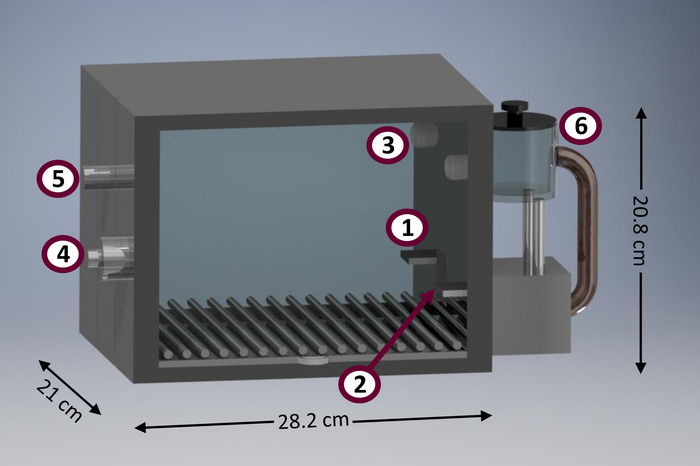
Figure 1: Diagram of a conditioning chamber prototype. The main components of the conditioning chamber include: (1) left lever, (2) food receptacle (equipped with lateral infrared diodes to detect head entries), (3) focalized light, (4) speaker for tone emission (rear view), (5) house light (rear view), (6) food dispenser. Please click here to view a larger version of this figure.
Access restricted. Please log in or start a trial to view this content.
Protocol
The three protocols described in this section require the use of rats as subjects. Most laboratory rat strains are suitable; for example, Wistar, Long-Evans, Sprague-Dawley, etc. The Ethics Committee of the Universidad Iberoamericana, following the Guide for the Care and Use of Laboratory Animals (Institute of Laboratory Animal Resources, Commission on Life Sciences, National Research Council, 1996), approved the laboratory protocols to be described.
1. Animal Housing and Preparation
- Determine the number of rats that will be used. This will depend on several factors, such as the type of design selected, the statistical power desired/required, the costs of conducting the study, and the time available for conducting the study26.
- Label each rat’s tail with an indelible marker for identification purposes.
- House rats either individually or in groups (2-5) with water freely available.
- Restrict rats’ food intake in order to motivate them for the protocols. In the case of individually housed rats, a convenient method for food restriction is to reduce weight to 85% of free-feeding weigh (use only for adult rats)27. Maintain this goal weight by providing supplementary food after conducting the protocol. For group-housed rats, give access to food for 60 min daily after conducting the protocol27.
- House the conditioning chambers within the sound and light attenuating shells.
2. Preliminary Training
NOTE: Before starting any of these behavioral protocols rats need to become accustomed to the conditioning chambers and food pellets. It is also vital to train the responses with which the animals would operate in the protocol. The three protocols presented here use appetitive motivation to induce behavior indicative of impulsiveness, like most other available alternative tasks (with select exceptions28). Conventional food dispensers are well suited to deliver both commercial refined grain and sugar pellets but can even handle “raw” grain under certain circumstances29.
- Habituation
- After starting the food restriction regime, introduce the rats into the conditioning chambers without initiating any protocol for 30 min, in order to habituate exploring responses. Put 60 food pellets in the food receptacle at the beginning of the session in order to habituate food neophobia.
- Repeat daily until the rats consume all of the food pellets.
- Magazine training
- After the habituation stage, introduce the rats into the conditioning chambers for two additional 30 min daily sessions delivering a food pellet every 45 s. This helps the rats identify the source of food pellets.
- Lever-press training
- Use this only for intertemporal choice and DRL protocols.
- Project one (for DRL) or the two levers (for intertemporal choice) into the chambers and start a continuous reinforcement procedure, that is, deliver a food pellet for every lever press. This procedure is used concurrently with a free food pellet delivery every 45 s (i.e., an alternative FR1-FT45 s schedule of reinforcement30), as in the previous stage. Sessions can have durations of 30 min.
- Repeat daily after the rats earn 80 rewards for two consecutive days.
- Shaping by successive approximations
- Use this method in case the rats do not reach the criterion in four sessions.
- Open the isolating shell of the conditioning chamber and observe the rats’ behavior. Deliver a food pellet for every response that approximates the target response (i.e., lever pressing). Examples of these approximate responses are approaching, sniffing, or touching the lever.
- Once the rats consistently perform the approximate responses, stop delivering rewards upon them and start requiring a response that is closer to the target response. Repeat as necessary.
3. Programming Automated Protocols
NOTE: The used values (e.g., delays, reward amounts, number of trials, session durations, schedules’ values, time-out length, inter-trial interval span, threshold for forced trials, presence/absence of accompanying stimuli, stimuli durations) presented were arbitrarily selected. Readers may want to consult the literature for determining appropriate parameters and conditions for accomplishing their particular goals. Codes for conducting samples of the three protocols presented here in a MED-PC environment are provided in the repository that can be found in the following URL: https://github.com/SaavedraPablo/MED-PC-codes. Such codes can be freely downloaded and modified according to particular needs.
- Intertemporal choice
- Select the values for delay and magnitude of reward. For example, choices for the SS alternative deliver one food pellet immediately and choices for the LL alternative deliver five food pellets after a 20 s fixed delay.
- Select a finishing criterion. End sessions automatically after completion of some specified criterion. For example: end the session after 40 choice trials or after 50 min.
- Combine each alternative with a lever (left or right) within the conditioning chamber counterbalancing the laterality of the alternatives among subjects.
- Project both levers into the conditioning chambers and make alternatives SS and LL available upon the accomplishment of a variable interval schedule30. Once the first lever press after a certain interval has elapsed, this activates the associated alternative (delay included). Varying the duration of such an interval in a pseudo-random fashion prevents exclusive preference for a particular alternative.
- Retract both levers and activate the consequence associated with the SS or LL alternatives after accomplishment of a variable-interval schedule of reinforcement.
- Perform a time-out condition (signaled by a house-light blackout) after reward delivery. Adjust this duration of this condition to equate the average duration of inter-trial intervals for both alternatives. The next choice trial begins after the completion of the time-out. Figure 2 shows a diagram of events during two successive trials of an intertemporal choice procedure.
- Implement forced trials. If subjects select one alternative for two consecutive trials, the program will determine that the next trial will be a forced trial of the remaining alternative. That is, in the next trial both levers are available, but only one will operate. This ensures that the subjects experience the outcomes associated with both alternatives.
- Finish a daily session whenever a prespecified number of trials have been completed or whenever the maximum time has elapsed.
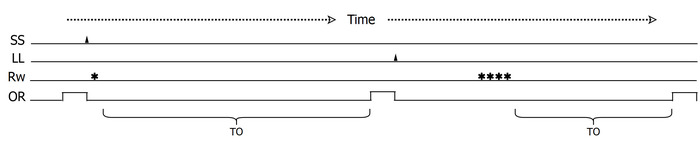
Figure 2: Diagram of input and output events in two consecutive trials of an intertemporal choice procedure. Diagram of a prototypical intertemporal choice procedure, illustrating an SS alternative choice and an LL alternative choice, in two consecutive trials. Each row depicts the timeline of occurrence of particular output or input events. Spikes in the SS timeline represent choices of the smaller-sooner alternative (upon the accomplishment of the variable-interval schedule). Spikes in the LL timeline represent choices of the larger later alternative (idem). Asterisks in the Rw timeline represent reward deliveries. Elevated plateaus in the OR timeline represent periods of opportunity to respond (they are usually signaled, and its duration varies depending on the time that the individual takes to accomplish to the specified criterion); TO stands for the timeout that begins after reward delivery and ends with the next trial; during this period both levers are retracted. Note that timeout durations vary depending on the type of trial (SS choice or LL choice) in order to keep inter-trial intervals equated. Please click here to view a larger version of this figure.
- DLR
- Select the value of the minimum time after which responding will produce a reward. For example, 10 s.
- After the beginning of a session or after any lever-press response, start a countdown timer from the selected time value (e.g., 10 s) to zero. If subjects emit a response before the timer reaches the value of zero the timer resets, so that they must wait for a new opportunity to get a reward. If subjects emit a response after the timer reaches the value of zero, deliver a food pellet and reset the timer after 2 s (this allows the animal to consume the food). Figure 3 shows some possible responding patterns and their corresponding programmed consequences.
NOTE: During the 2 s reward retrieving interval, responses are not counted, which may impact the proportion of burst responses in the rare cases when the rats eat the food quickly enough and happen to respond immediately afterwards or fail to detect the delivery of food. This could be ameliorated by using a cue signaling the 2 s reward retrieving interval31. However, previous research has shown that the amount of such responses is negligible even in the absence of signaling cues. - Finish the session after a time and/or number of rewards criterion.

Figure 3: Diagram of a hypothetical response pattern and its programmed consequences in a DRL 15 s procedure. Spikes in the R timeline represent the timeline of responses spontaneously emitted by the subject. Asterisks in the Rw timeline represent the timeline of reward deliveries. Numbers below the Cl row represent a clock counting down from 15 s the amount of time remaining before the next opportunity to respond and earning a reward. Note that reward delivery only occurs if a response is given since a minimum time of 15 s has elapsed from the last response. Please click here to view a larger version of this figure.
- Feature-negative discrimination
- Select stimuli durations, inter-trial interval durations, and finishing-criterion for sessions. For example, use 8 s durations for conditioned stimuli, variable 92 s inter-trial intervals and finishing criterion of 24 trials.
- Present pseudo-randomly two types of trials, A+ and AX-, at 50% of the times each; A and X represent stimulus types and plus and minus signs represent the presence or absence of food, respectively. A+ trials: turn on one of the focalized lights (stimulus A) for 8 s and then deliver two food pellets (+). AX- trials: turn on one of the focalized lights (either side) for 8 s and concurrently present a tone (stimulus X) but do not deliver food (-). Figure 4 shows a diagram of the programmed events for each type of trial.
- Finish the session after a time and/or number of trials criterion.
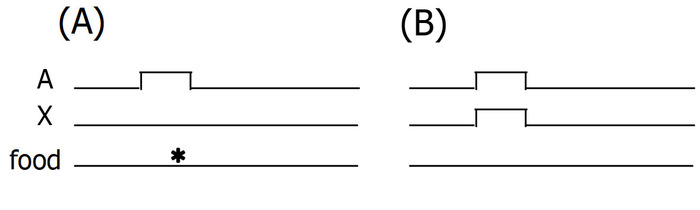
Figure 4: Diagram of the types of trial used in the feature-negative discrimination procedure. Elevations in the A timeline represent onsets of the excitatory stimulus. Elevations in the X timeline represent onsets on the inhibitory stimulus. Asterisks in the food timeline represent food delivery. (A) A+ trials include the presentation of the excitatory stimulus followed by food delivery. (B) AX- trials include the presentation of the excitatory stimulus in compound with the inhibitory stimulus without food delivery. Recall that trials must be interspersed randomly and set apart by relatively long inter-trial intervals for better results. Please click here to view a larger version of this figure.
4. Running the Protocols
- Conduct the protocol daily, at a standard time, always placing rats in the same operant chamber.
- Set up the protocols in the computer software. Make sure to appropriately label the output file with the subjects’ names, condition, and study.
- Clean the inner walls, ceiling, and grill floor of the operant chambers with an ethanol or chlorine solutions, in order to remove odors from previous sessions or previous studies.
- Check that all the crucial inputs and outputs work appropriately by manually activating and monitoring them by means of the computer.
- Check that the food dispenser holds enough food to deliver throughout the session.
- Move the housing cages with the rats inside close to the conditioning chambers.
- Open the housing cage and gently carry each rat to its corresponding conditioning chamber, closing the conditioning chambers and the isolating shells.
- Initiate the program and wait until the program is finished. If data is not saved automatically, save the output files of the session in the computer drive or elsewhere.
- Gently carry the rats back into their corresponding housing cages after the program is finished.
- Give complementary food to the rats according to the selected food restriction regime.
5. Data Collection and Analysis
NOTE: Codes for extracting and manipulating data from MED-PC output files (saved with the extension .txt) for each procedure are provided in the repository that can be found in the following URL: https://github.com/SaavedraPablo/MED-PC-to-R-codes.
- Intertemporal choice
- Record lever presses in the SS alternative and in the LL alternative.
- Divide the SS alternative responses by the total responses to obtain the proportion of impulsive responses. Alternatively, divide the SS alternative responses by the LL alternative responses to calculate the ratio of impulsive responses. Take the common logarithm of ratio data points in order to remove skewness from the distribution.
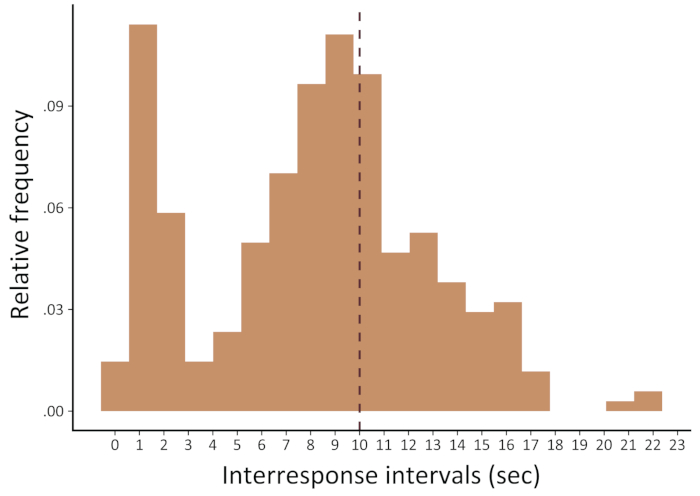
Figure 5: Histogram of IRTs for one rat in a single session on the DRL 10 s protocol. The distribution is bimodal, with one of the peaks at very short IRTs (burst responses) and the other localized near the time criterion of the protocol (timed responses). Note as well that there is an accumulation of a small number of responses to the right and relatively far from the timed distribution (attentional lapses). Data was extracted from the 9th session in the DRL protocol of Rat 6 in a recent unpublished study. Please click here to view a larger version of this figure.
- DRL
- Set a counter variable in the program that increases with each unit of time from the beginning of the session.
- Record the value of the counter variable in a list of values for each one of the responses as they occur during the session. This will provide a cumulative record of responses; that is, the exact time in which each response occurred during the session.
- Get the cumulative record of responses and subtract each value, i, from the previous value, i – 1, in order to obtain the inter-response times (IRTs), which constitute the variable of interest.
- Plot a histogram of IRTs for one rat in one session with 1 s intervals in the X axis, in order to visually inspect the data. For a typical experienced subject, this should see as a bimodal distribution with a portion of the data amassed in the left and another portion of the data clustered near the selected temporal requirement of the DRL protocol. Figure 5 shows an example of typical performance in the DRL protocol for one rat in a single session.
- Classify types of IRTs. As stated above, the distribution of IRTs for a typical subject is bimodal. One possible interpretation of this shape is that it is composed of the mixture of (at least) two distributions reflecting separate processes32.
- Classify IERs indicating attentional lapses.
- Too long IRTs may be indicative of attentional lapses (i.e., periods on which rats were not engaged in the task)33. A useful practice for these means is to separate far-right outliers from the rest of the data32. For example, multiply the interquartile range of the rightward distribution by some arbitrary constant (e.g., 3) and add this number to the median of this distribution to determine a cutoff value that signals the boundary between attentional lapses and the rest of data32.
- Classify responses in either the leftward or the rightward distribution (once the outliers have been removed32).
- The leftward distribution or burst responses distribution is constituted by too short IRTs, which are interpreted as indicative of hyperactivity34 or as a lack of attention and/or response feedback35. On the other hand, IRTs on the rightward distribution or timed responses distribution are considered as indicative of responding in adjustment to the temporal constriction of the protocol32. Either use an arbitrary cutoff to classify the boundaries of leftwards and rightwards distributions31 or use mathematical modeling to do so32,33,36.
- Determine the parameters of the timed responses distribution.
- Pay close attention to the rightward distribution in an experienced animal, which usually takes most of the IRTs and is considered as the most important part of the data set.
- Two parameters of interest are the localization of its peak and its spread. The former gives an index of the capacity to inhibit premature responses; shifts to the left of the time criterion may be interpreted as indicative of impulsivity37. The latter is indicative of temporal estimation; the narrower the distribution, the greater the timing accuracy32,40,43. Estimate these parameters through simple descriptive statistics or by more sophisticated mathematical modeling40,43,33.
- For a useful guide to fitting DRL data to the theoretical distribution proposed by Sanabria and Killeen33, see the supplementary material provided by these authors.
- Obtain a global efficiency measure.
- If the finishing criterion of the session is temporal (i.e., session duration will be constant) divide the number of earned rewards by the number of responses emitted, for obtaining a measure of efficiency. If the finishing criterion is a specific number of rewards calculate reward rate, which is number of rewards divided by session duration. Note that these global measures say little about how animals are obtaining or losing the rewards in the protocol and must be used only as a rough guide.
- Classify IERs indicating attentional lapses.
- Feature-negative discrimination
- Record the frequency or the duration of responses during A+ and AX- trials. The primary measure of conditioned responding may be the mean response frequency38, the mean response duration39, or the percentage of trials with at least one response.
- After choosing the preferred conditioned responding measure, subtract the value of responding during A+ trials minus responding during AX- trials for each subject in a particular session. This will constitute a negative index of impulsivity40; that is, the less the difference between both values, the greater the impulsivity.
NOTE: The data from this task lend quite well to analyses based on measures from signal detection theory41,42, which can be used to supplement simple subtraction measures.
Access restricted. Please log in or start a trial to view this content.
Results
The three protocols described in this article may be each conducted alone or in conjunction with other procedures; this will depend on the research question, which in turn will determine the study design. Some examples of study designs that are compatible with these protocols are: (1) time series studies, which aim to describe longitudinal changes in performance; (2) quantification of individual variability, which aims to determine the reliability of the measures; (3) cross-sectional corr...
Access restricted. Please log in or start a trial to view this content.
Discussion
The present article provided a description of a miscellaneous variety of protocols for screening impulsivity in rats. It is argued that these particular protocols are favored for their ease of programming and data analysis and require fewer operating and stimulus devices than other available alternatives. There are several crucial steps for the effective implementation of these protocols, such as (1) yielding a research question, (2) selecting an appropriate study design, (3) programming the selected protocol, (4) conduc...
Access restricted. Please log in or start a trial to view this content.
Disclosures
The authors have nothing to disclose.
Acknowledgements
We would like to thank Florencia Mata, María Elena Chávez, Miguel Burgos, and Alejandro Tapia for providing technical assistance. We also wish to thank Sarah Gordon Frances for her useful comments on a previous draft of this article and Vladimir Orduña for kindly providing raw data from a published paper. Thanks to Claudio Nallen for creating the diagram in Figure 1. We are grateful to the Dirección de Investigación of the Universidad Iberoamericana Ciudad de México for funding proofreading/editing services and the video producing expenses.
Access restricted. Please log in or start a trial to view this content.
Materials
| Name | Company | Catalog Number | Comments |
|---|---|---|---|
| 25 Pin Cables | Med Associates | SG-213F | Connect smart control cards to smart control panels |
| 40 Pin Ribbon Cable | Med Associates | DIG-700C | Connects the computer with the interface cabinet |
| Computer | Dell Computer Company | T8P8T-7G8MR-4YPQV-96C2F-7THHB | For controlling and monitoring protocols’ processes |
| Conductor Cables | Med Associates | SG-210CP-8 | Provide power to the smart control panels via the rack mount power supply |
| Food dispenser with pedestal | Med Associates | ENV-203M-45 (12937) | Silently provides 45 mg food pellets |
| Head-Entry Detector | Med Associates | ENV-254-CB | Uses an infrared photo-beam to detect head entries into the food receptacle |
| House Light | Med Associates | ENV-215M | For providing diffuse illumination inside the chamber |
| Interface Cabinet | Med Associates | SG-6080D | Pod that can hold up to eight smart control cards |
| Med-PC IV Software | Med Associates | SOF-735 | Translate codes into commands for operating outputs and recording/storing input information |
| Multiple tone generator | Med Associates | ENV-223 (597) | For controlling the frequency of the tones |
| Panel fillers | Med Associates | ENV-007-FP | For filling modular walls when devices are not used |
| Pellet Receptacle | Med Associates | ENV-200R2M | Receives and holds food pellets delivered by the dispenser |
| Rack Mount Power Supply | Med Associates | DIG-700F | Provides power to the interface cabinet |
| Retractable Lever | Med Associates | ENV-112CM (10455) | Detects lever-pressing responses; projects into the chamber or retracts as needed |
| Smart Control Cards | Med Associates | DIG-716 | Controls up to eight inputs and four outputs of a conditioning chamber |
| Smart Control Panels | Med Associates | SG-716 (3341) | Connect smart cards to the devices within the conditioning chambers |
| Speaker | Med Associates | ENV-224AM | For providing tones inside the chamber |
| Standard Modular Chambers for Rat | Med Associates | ENV-008 | Made of aluminum channels designed to hold modular devices |
| Standard sound-, light-, and temperature isolating shells | Med Associates | ENV-022MD | Serve to harbor each conditioning chamber |
| Stimulus Light | Med Associates | ENV-221M | For providing a round focalized light stimulus |
| Three Pin Cables | Med Associates | SG-216A-2 | Connects smart control panel with each of the input and output devices in the conditioning chambers |
References
- Loxton, N. J. The role of reward sensitivity and impulsivity in overeating and food addiction. Current Addiction Reports. 5 (2), 212-222 (2018).
- Richards, J. B., Gancarz, A. M., Hawk, L. W. Inhibitory control and drug abuse prevention. Bardo, M. T., Fishbein, D. H., Milich, R. , Springer. (2011).
- Gullo, M. J., Loxton, N. J., Dawe, S. Impulsivity: Four ways five fectors are not basic to addiction. Addictive Behaviors. 39 (11), 1547-1556 (2014).
- Bari, A., Robbins, T. W. Inhibition and impulsivity: Behavioral and neural basis of response control. Progress in Neurobiology. 108, 44-79 (2013).
- Dalley, J. W., Robbins, T. W. Fractionating impulsivity: neuropsychiatric implications. Nature Reviews Neuroscience. 18 (3), 158-171 (2017).
- Sosa, R., dos Santos, C. V. Toward a unifying account of impulsivity and the development of self-control. Perspectives in Behavior Science. , 1-32 (2018).
- King, J. A., Tenney, J., Rossi, V., Colamussi, L., Burdick, S. Neural substrates underlying impulsivity. Annals of the New York Academy of Sciences. 1008 (1), 160-169 (2003).
- Stayer, R., Ferring, D., Schmitt, M. J. States and traits in psychological assessment. European Journal of Psychological Assessment. 8 (2), 79-98 (1992).
- Moeller, F. G., Barratt, E. S., Dougherty, D. M., Schmitz, J. M., Swann, A. C. Psychiatric aspects of impulsivity. American Journal of Psychiatry. 158, 1783-1793 (2001).
- Evenden, J. L. Varieties of impulsivity. Psychopharmacology. 146 (4), 348-361 (1999).
- Winstanley, C. A. The utility of rat models of impulsivity in developing pharmacotherapies for impulse control disorders. British Journal of Pharmacology. 164 (4), 1301-1321 (2011).
- Solanto, M. V., et al. The ecological validity of delay aversion and response inhibition as measures of impulsivity in AD/HD: A supplement to the NIMH multimodal treatment study of AD/HD. Journal of Abnormal Child Psychology. 29 (3), 215-218 (2001).
- van der Staay, F. J. Animal models of behavioral dysfunctions: Basic concepts and classifications, and an evaluation strategy. Brain Research Reviews. 52, 131-159 (2006).
- Hedge, C., Powell, G., Summer, P. The reliability paradox: Why robust cognitive tasks do not produce reliable individual differences. Behavioral Research Methods. , 1-21 (2017).
- Nakagawa, S., Schielzeth, H. Repeatability for Gaussian and non-Gaussian data: A practical guide for biologists. Biological Reviews. 85, 935-956 (2010).
- Sjoberg, E. Logical fallacies in animal model research. Behavior and Brain Functions. 13 (1), (2017).
- Rachlin, H. Self-control: Beyond commitment. Behavioral and Brain Sciences. 18 (01), 109(1995).
- Logue, A. W. Research on self-control: An integrating framework. Behavioral and Brain Sciences. 11 (04), 665(1988).
- Kramer, T. J., Rilling, M. Differential reinforcement of low rates: A selective critique. Psychological Bulletin. 74 (4), 225-254 (1970).
- Sosa, R., dos Santos, C. V. Conditioned inhibition and its relationship to impulsivity: Empirical and theoretical considerations. The Psychological Record. , (2018).
- Gallistel, C. R., Balci, F., Freestone, D., Kheifets, A., King, A. Automated, quantitative cognitive/behavioral screening of mice: For genetics, pharmacology, animal cognition and undergraduate instruction. Journal of Visualized Experiments. (84), (2014).
- Skinner, B. F. A case history in scientific method. American Psychologist. 11 (5), 221-233 (1956).
- Papini, M. R. Associative learning in the marsupials Didelphis albiventris and Lutreolina crassicaudata. Journal of Comparative Psychology. 102 (1), 21-27 (1988).
- Leonard, J. A. 5 choice serial reaction apparatus. Medical Research Council of Applied Psychology Research. , 326-359 (1959).
- Robinson, T. E., Flagel, S. B. Dissociating the Predictive and Incentive Motivational Properties of Reward-Related Cues Through the Study of Individual Differences. Biological Psychiatry. 65 (10), 869-873 (2009).
- Charan, J., Kantharia, N. D. How to calculate sample size in animal studies? Journal of Pharmacology and Pharmacotherapeutics. 4 (4), 303-306 (2013).
- Toth, L. A., Gardiner, T. W. Food and water restriction protocols: Physiological and behavioral considerations. Journal of the American Association for Laboratory Animal Science. 39 (6), 9-17 (2000).
- Deluty, M. Z. Self-control and impulsiveness involving aversive events. Journal of Experimental Psychology: Animal Behavior Processes. 4, 250-266 (1978).
- Cabrera, F., Robayo-Castro, B., Covarrubias, P. The 'huautli' alternative: Amaranth as reinforcer in operant procedures. Revista Mexicana de Análisis de la Conducta. 36, 71-92 (2010).
- Ferster, C. B., Skinner, B. F. Schedules of reinforcement. , Appleton Century Crofts. (1957).
- Orduña, V., Valencia-Torres, L., Bouzas, A. DRL performance of spontaneously hypertensive rats: Dissociation of timing and inhibition of responses. Behavioural Brain Research. 201 (1), 158-165 (2009).
- Freestone, D. M., Balci, F., Simen, P., Church, R. Optimal response rates in humans and animals. Journal of Experimental Psychology: Animal Behavior and Cognition. 41 (1), 39-51 (2015).
- Sanabria, F., Killeen, P. R. Evidence for impulsivity in the Spontaneously Hypertensive Rat drawn from complementary response-withholding tasks. Behavioral and Brain Functions. 4 (1), 7(2008).
- van den Bergh, F. S., et al. Spontaneously hypertensive rats do not predict symptoms of attention-deficit hyperactivity disorder. Pharmacology, Biochemistry, and Behavior. 83, 11(2006).
- Topping, J. S., Pickering, J. W. Effects of punishing different bands of IRTs on DRL responding. Psychological Reports. 31 (19-22), (1972).
- Richards, J. B., Sabol, K. E., Seiden, L. S. DRL interresponse-time distributions: quantification by peak deviation analysis. Journal of the Experimental Analysis of Behavior. 60 (2), 361-385 (1993).
- Orduña, V. Impulsivity and sensitivity to amount and delay of reinforcement in an animal model of ADHD. Behavioural Brain Research. 294, 62-71 (2015).
- Harmer, C. J., Phillips, G. D. Enhanced conditioned inhibition following repeated pretreatment with d -amphetamine. Psychopharmacology. 142 (2), 120-131 (1999).
- Lister, S., Pearce, J. M., Butcher, S. P., Collard, K. J., Foster, G. Acquisition of conditioned inhibition in rats is impaired by ablation of serotoninergic pathways. European Journal of Neuroscience. 8, 415-423 (1996).
- Meyer, H. C., Bucci, D. J. The contribution of medial prefrontal cortical regions to conditioned inhibition. Behavioral Neuroscience. 128 (6), 644-653 (2014).
- McNicol, D. A primer of signal detection theory. , Erlbaum Associates. (1972).
- Carnero, S., Morís, J., Acebes, F., Loy, I. Percepción de la contingencia en ratas: Modulación fechneriana y metodología de la detección de señales. Revista Electrónica de Metodología Aplicada. 14 (2), (2009).
- López, H. H., Ettenberg, A. Dopamine antagonism attenuates the unconditioned incentive value of estrus female cues. Pharmacology, Biochemistry, and Behavior. 68, 411-416 (2001).
- Schotte, A., Janssen, P. F. M., Megens, A. A. H. P., Leysen, J. E. Occupancy of central neurotransmitter receptors by risperidone, clozapine and haloperidol, measured ex vivo. Brain Research. 631 (2), 191-202 (1993).
- van Hest, A., van Haaren, F., van de Poll, N. Haloperidol, but not apomorphine, differentially affects low response rates of male and female wistar rats. Pharmacology, Biochemistry, and Behavior. 29, 529-532 (1988).
- Finnegan, K. T., Ricaurte, G., Seiden, L. S., Schuster, C. R. Altered sensitivity to d-methylamphetamine, apomorphine, and haloperidol in rhesus monkeys depleted of caudate dopamine by repeated administration of d-methylamphetamine. Psychopharmacology. 77, 43-52 (1982).
- Britton, K. T., Koob, G. F. Effects of corticotropin releasing factor, desipramine and haloperidol on a DRL schedule of reinforcement. Pharmacology, Biochemistry, and Behavior. 32, 967-970 (1989).
- Maricq, A. V., Church, R. The differential effects of haloperidol and metamphetamine on time estimation in the rat. Psychopharmacology. 79, 10-15 (1983).
- Dalley, J. W., et al. Nucleus accumbens D2/3 receptors predict trait impulsivity and cocaine reinforcement. Science. 315, 1267-1270 (2007).
- Cole, B. J., Robbins, T. W. Effects of 6-hydroxydopamine lesions of the nucleus accumbens septi on performance of a 5-choice serial reaction time task in rats: Implications for theories of selective attention and arousal. Behavior and Brain Research. 33, 165-179 (1989).
- Reynolds, B., de Wit, H., Richards, J. B. Delay of gratification and delay discounting in rats. Behavioural Processes. 59 (3), 157-168 (2002).
- Evenden, J. L., Ryan, C. N. The pharmacology of impulsive behavior in rats: The effects of drugs on response choice with varying delays of reinforcement. Psychopharmacology. 128, 161-170 (1996).
- Autor, S. M. Conditioned reinforcement. Hendry, D. P. , Dorsey Press. (1969).
- van den Broek, M. D., Bradshaw, C. M., Szabadi, E. Behaviour of 'impulsive' and 'non-impulsive' humans in a temporal differentiation schedule of reinforcement. Personality and Individual Differences. 8 (2), 233-239 (1987).
- McGuire, P. S., Seiden, L. S. The effects of tricyclicantidepressants on performance under a differential-reinforcement-of-low-rates schedule in rats. Journal of Pharmacology and Experimental Therapeutics. 214 (3), 635-641 (1980).
- O'Donnell, J. M., Seiden, L. S. Differential-reinforcement-of-low-rates 72-second schedule: Selective effects of antidepressant drugs. Journal of Pharmacology and Experimental Therapeutics. 224 (1), 80-88 (1983).
- Seiden, L. S., Dahms, J. L., Shaughnessy, R. A. Behavioral screen for antidepressants: The effects of drugs and electroconvulsive shock on performance under a differential-reinforcement-of-low-rates schedule. Psychopharmacology. 86, 55-60 (1985).
- He, Z., Cassaday, H. J., Howard, R. C., Khalifa, N., Bonardi, C. Impaired Pavlovian conditioned inhibition in offenders with personality disorders. The Quarterly Journal of Experimental Psychology. 64 (12), 2334-2351 (2011).
- He, Z., Cassaday, H. J., Bonardi, C., Bibi, P. A. Do personality traits predict individual differences in excitatory and inhibitory learning? Frontiers in Psychology. 4, 1-12 (2013).
- Bucci, D. J., Hopkins, M. E., Keene, C. S., Sharma, M., Orr, L. E. Sex differences in learning and inhibition in spontaneously hypertensive rats. Behavioural Brain Research. 187 (1), 27-32 (2008).
- Gershon, J. A meta-analytic review of gender differences in ADHD. Journal of Attention Disorders. 5, 143-154 (2012).
- Mobini, S., et al. Effects of lesions of the orbitofrontal cortex on sensitivity to delayed and probabilistic reinforcement. Psychopharmacology. 160 (3), 290-298 (2002).
- Bouton, M. E., Nelson, J. B. Context-specificity of target versus feature inhibition in a negative-feature discrimination. Journal of Experimental Psychology: Animal Behavior Processes. 20 (1), 51-65 (1994).
- Bouton, M. E., Nelson, J. B. Occasion setting: Associative learning and cognition in animals. Schmajuk, N., Holland, P. , American Psychological Association. 69-112 (1998).
- Rescorla, R. A. Pavlovian conditioned inhibition. Psychological Bulletin. 72 (2), 77-94 (1969).
- Miller, R. R., Matzel, L. D. The psychology of learning and motivation. Bower, G. H. , Academic Press. (1988).
- Williams, D. A., Overmier, J. B., Lolordo, V. M. A reevaluation of Rescorla's early dictums about conditioned inhibition. Psychological Bulletin. 111 (2), 275-290 (1992).
- Papini, M. R., Bitterman, M. E. The two-test strategy in the study of inhibitory conditioning. Psychological Review. 97 (3), 396-403 (1993).
- Sosa, R., Ramírez, M. N. Conditioned inhibition: Critiques and controversies in the light of recent advances. Journal of Experimental Psychology: Animal Behavior and Cognition. , in press (2018).
- Fox, A. T., Hand, D. J., Reilly, M. P. Impulsive choice in a rodent model of attention-deficit/hyperactivity disorder. Behavioural Brain Research. 187, 146-152 (2008).
- Foscue, E. P., Wood, K. N., Schramm-Sapyta, N. L. Characterization of a semi-rapid method for assessing delay discounting in rodents. Pharmacology, Biochemistry, and Behavior. 101, 187-192 (2012).
- Brucks, D., Marshall-Pescini, S., Wallis, L. J., Huber, L., Range, F. Measures of Dogs' Inhibitory Control Abilities Do Not Correlate across Tasks. Frontiers in Psychology. 8, (2017).
- McDonald, J., Schleifer, L., Richards, J. B., de Wit, H. Effects of THC on Behavioral Measures of Impulsivity in Humans. Neuropsychopharmacology. 28 (7), 1356-1365 (2003).
- Reynolds, B., Ortengren, A., Richards, J. B., de Wit, H. Dimensions of impulsive behavior: Personality and behavioral measures. Personality and Individual Differences. 40 (2), 305-315 (2006).
- Dellu-Hagedorn, F. Relationship between impulsivity, hyperactivity and working memory: a differential analysis in the rat. Behavioral and Brain Functions. 2 (10), 18(2006).
- López, P., Alba, R., Orduña, V. Individual differences in incentive salience attribution are not related to suboptimal choice in rats. Behavior and Brain Research. 341 (2), 71-78 (2017).
- Ho, M. Y., Al-Zahrani, S. S. A., Al-Ruwaitea, A. S. A., Bradshaw, C. M., Szabadi, E. 5-Hydroxytryptamine and impulse control: prospects for a behavioural analysis. Journal of Psychopharmacology. 12 (1), 68-78 (1998).
- Sagvolden, T., Russell, V. A., Aase, H., Johansen, E. B., Farshbaf, M. Rodent models of attention-deficit/hyperactivity disorder. Biological Psychiatry. 57, 9(2005).
- Tomie, A., Aguado, A. S., Pohorecky, L. A., Benjamin, D. Ethanol induces impulsive-like responding in a delay-of-reward operant choice procedure: impulsivity predicts autoshaping. Psychopharmacology. 139 (4), 376-382 (1998).
- Monterosso, J., Ainslie, G. Beyond discounting: possible experimental models of impulse control. Psychopharmacology. 146 (4), 339-347 (1999).
- Burguess, M. A. Methodology of frontal and executive function. Rabbit, P. , Psychology Press. 81-116 (1997).
- Watterson, E., Mazur, G. J., Sanabria, F. Validation of a method to assess ADHD-related impulsivity in animal models. Journal of Neuroscience Methods. 252, 36-47 (2015).
- Hackenberg, T. D. Of pigeons and people: some observations on species differences in choice and self-control. Brazilian Journal of Behavior Analysis. 1 (2), 135-147 (2005).
- Asinof, S., Paine, T. A. The 5-choice serial reaction time task: A task of attention and impulse control for rodents. Journal of Visualized Experiments. (90), e51574(2014).
- Masaki, D., et al. Relationship between limbic and cortical 5-HT neurotransmission and acquisition and reversal learning in a go/no-go task in rats. Psychopharmacology. 189, 249-258 (2006).
- Bari, A., et al. Prefrontal and monoaminergic contributions to stop-signal task performance in rats. The Journal of Neuroscience. 31, 9254-9263 (2011).
- Flagel, S. B., Watson, S. J., Robinson, T. E., Akil, H. Individual differences in the propensity to approach signals vs goals promote different adaptations in the dopamine system of rats. Psychopharmacology. 191, 599-607 (2007).
- Swann, A. C., Lijffijt, M., Lane, S. D., Steinberg, J. L., Moeller, F. G. Trait impulsivity and response inhibition in antisocial personality disorder. Journal of Psychiatric Research. 43 (12), 1057-1063 (2009).
- Lawrence, A. J., Luty, J., Bogdan, N. A., Sahakian, B. J., Clark, L. Impulsivity and response inhibition in alcohol dependence and problem gambling. Psychopharmacology. 207 (1), 163-172 (2009).
- Dougherty, D. M., et al. Behavioral impulsivity paradigms: a comparison in hospitalized adolescents with disruptive behavior disorders. Journal of Child Psychology and Psychiatry. 44 (8), 1145-1157 (2003).
- Rosval, L., et al. Impulsivity in women with eating disorders: Problem of response inhibition, planning, or attention. International Journal of Eating Disorders. 39 (7), 590-593 (2006).
- Huddy, V. C., et al. Reflection impulsivity and response inhibition in first-episode psychosis: relationship to cannabis use. Psychological Medicine. 43 (10), 2097-2107 (2013).
Access restricted. Please log in or start a trial to view this content.
Reprints and Permissions
