Clinically, estrogen deficiency in menopausal women may aggravate the incidence of lipid disruption and atherosclerosis. We established an in vivo estrogen deficiency model by bilateral ovariectomy via a double dorsal-lateral incision in apoE-/- mice. The mouse model is applicable for screening exogenous estrogen treatments of cardiovascular dysfunction after menopause.
Method Article
An In Vivo Estrogen Deficiency Mouse Model for Screening Exogenous Estrogen Treatments of Cardiovascular Dysfunction After Menopause
In This Article
Summary
Abstract
Postmenopausal women are at greater risk of developing cardiovascular diseases than premenopausal women. Female mice ovariectomized (OVX) at weaning display increased atherosclerotic lesions in the aorta compared with female mice with intact ovarian function. However, laboratory models involving estrogen-deficient mice with atherosclerosis-prone status are lacking. This deficit is crucial because clinical estrogen deficiency in menopausal women may aggravate the incidence of pre-existing or ongoing lipid disruption and atherosclerosis. In this study, we establish an in vivo estrogen-deficient mouse model by bilateral ovariectomy via a double dorsal-lateral incision in apolipoprotein E (apoE)-/- mice. We then compare the effects of 17β-estradiol and pseudoprotodioscin (PPD) (a phytoestrogen) perorally administered via hazelnut spread. We find that although PPD exerts some effect on reducing final body weight and plasma TG in OVX apoE-/- mice, it has anti-atherosclerotic and cardiac-protective capacities comparable with its 17β-estradiol counterpart. PPD is a phytoestrogen that has been reported to exert anti-tumor properties. Thus, the proposed method is applicable for screening phytoestrogens via peroral administration to substitute for traditional hormone replacement therapy in postmenopausal women, which has been reported to have potentially deleterious tumorigenetic capacity. Peroral administration via hazelnut spread is noninvasive, rendering it widely applicable to many patients. This article contains step-by-step demonstrations of bilateral ovariectomy via the double dorsal-lateral incision in apoE-/- mice and peroral 17β-estradiol or phytoestrogen hormone replacement via hazelnut spread. Plasma lipid and cardiovascular function analyses using echocardiography follow.
Introduction
Epidemiological and clinical studies have shown that postmenopausal women are at considerably greater risk of cardiovascular disease than premenopausal women1,2. Hormone replacement therapy (HRT) may reduce the relative risk of cardiovascular disease to 0.37-0.793. Among other complications, atherosclerosis caused by cardiovascular diseases is the leading cause of death worldwide4. However, laboratory models involving estrogen-deficient mice presenting atherosclerosis prone status are lacking. This protocol provides an in vivo estrogen deficiency mouse model for screening exogenous estrogen treatments of cardiovascular dysfunction after menopause.
Previous studies show that the application of OVX in atherosclerotic rodents fed a high-cholesterol diet can mimic postmenopausal women suffering from atherosclerosis5,6,7,8. A reproducible and convenient animal model resembling the atherosclerotic state in menopausal women is the basis of exogenous estrogen research. Here, a double dorsal-lateral incision of bilateral ovariectomy was applied in atherosclerosis-prone apolipoprotein E knockout (apoE-/-) mice9,10. Compared with middle abdominal or dorsal incision, double dorsal-lateral incision is an easier, less time-consuming method that can avoid severe abdominal cavity adhesion and inflammation. Peroral administration via hazelnut spread (see Table of Materials) is noninvasive and convenient, rendering it widely applicable as a long-term administration mode11. Slow-release pellet implantation is also popular6. However, implants mayaggravate the incidence of infection especially in mice subjected to OVX. Other noninvasive administration modes, such as oral gavage and water administration, also have many drawbacks. Oral gavage typically stress mice and may cause esophageal injury. Administering the hormone via drinking water is highly beneficial; however, the adding of DMSO as an emulsifier is inevitable as exogenous estrogens are insoluble in water. Here, we chose peroral 17β-estradiol or phytoestrogen hormone replacement via hazelnut spread for long-term administration.
Recently, the beneficial effect of HRT on the cardiovascular system of postmenopausal women has been contested in women's health initiative (WHI) trials12. On the one hand, exogenous estrogen alone exerts a beneficial effect on the cardiovascular system; on the other hand, it can combine with metohydroxyprogesterone acetate to increase the risk of cardiovascular events. More seriously, HRT may lead to breast and uterine tumor progression, and this effect has markedly limited its use13,14. More interest has been focused on the cardiovascular-protective effects of exogenous estrogens lacking mitotic activity in tumor cells15,16,17. Multiple studies in humans and animals suggest that phytoestrogens with structures similar to that of estrogens can play a beneficial role in cardiovascular protection15,18.
Thus, the aims of the present work are (i) to build an in vivo estrogen deficiency mouse model by bilateral ovariectomy via a double dorsal-lateral incision in apoE-/- mice and (ii) to compare the cardiovascular protective effects of perorally administered 17β-estradiol and pseudoprotodioscin (PPD), via hazelnut spread. 17β-estradiol is one kind of exogenous estrogen that belongs to female sexual hormones6,11,19. PPD, a steroid saponin and phytoestrogen from Dioscorea plants, has been previously reported to exert anti-tumor properties20.
Protocol
All animal care and experimental protocols were approved by the Institutional Animal Care and Use Committee of the Chinese Academy of Medical Sciences and Peking Union Medical College (Permission No.: SYXK (Beijing) 2013-0023). The origin of apoE-/- mice is C57BL/6J9,10.
1. Bilateral Ovariectomy via a Double Dorsal-lateral Incision in apoE-/- Mice
- At weaning (age 28 days), anesthetize female apoE-/- C57BL/6J mice with avertin (tribromoethanol; 200 mg/kg; intraperitoneally).
NOTE: 32 apoE-/- mice were randomly divided into 4 groups: SHAM, OVX, OVX/E2, and OVX/PPD group (n = 8 per group). - Place the animal in prone position on a heating pad. Apply eye lubricant for eye protection during anesthesia.
- Maintain body temperature within 36 ± 0.5 °C. Administer 5 mg/kg body weight of the analgesic carprofen subcutaneously to the lateral aspect of the mouse’s neck.
- Shave a 3 x 5 cm2 mouse area cephalic from the iliac crest. Prior to covering the animal with a 3 x 5 cm2 aperture surgical sheet, clean the shaved area thoroughly with iodine and then 70% ethanol. Use sterile instruments and gloves during the experiment.
- Use scissors and forceps to make an incision 1 cm lateral to the midline and 1 cm lateral to the costal ribs.
- Bluntly dissect the subcutaneous tissue using forceps.
- Use dissecting goggles (see Table of Materials) to identify the white adipose tissue in the abdominal cavity.
- Use microscissors and microforceps to make a 0.5-1 cm incision through the fascia until the abdominal cavity is reached.
NOTE: For the sham-operated group, close the wounds directly. Suture the muscle layer and skin separately using a monofilament suture. - When the white adipose tissue in the abdominal cavity can be seen, grab the adipose tissue using microforceps and gently pull it out. A pink mulberry-shaped ovary wrapped by adipose tissue in the abdominal cavity can be seen.
- Ligate the 0.5-1 cm proximal vessel and the uterine horn using a monofilament suture. Remove the ovary using microscissors and place the remaining tissue back into the abdominal cavity.
NOTE: The main adverse symptoms for the OVX operation is ureteral ligation which leads to high mortality in OVX-operated mice. This can be avoided by identifying the tissues using a dissecting goggle. - Close the wounds. Suture the muscle layer and skin separately using a monofilament suture.
- Use scissors and forceps to make another incision 1 cm lateral to the midline and 1 cm lateral to the costal ribs on the other side. Repeat the above procedure (1.5 to 1.11).
- Let the animal wake from anesthesia. Separately keep the mouse on the first day after surgery.
- Clean or replace the cage frequently during the recovery phase.
- Approximately 24 h after surgery, administer another 5 mg/kg body weight of the analgesic carprofen subcutaneously.
2. Peroral Administration of 17β-estradiol or PPD via Hazelnut Spread
- Thoroughly dissolve 17β-estradiol or PPD in sesame oil, and then mix the sesame oil with hazelnut spread (see Table of Materials). A daily portion for each 30 g mouse contains 3 μg of 17β-estradiol or 15 μg of PPD, 4 μL of sesame oil, and 60 mg of hazelnut spread. Prepare a placebo for each 30 g mouse contains 4 μL of sesame oil and 60 mg of hazelnut spread.
NOTE: The daily administration portion of 17β-estradiol or PPD was based on previous studies6,11 and preliminary experiments. - One week after OVX, feed the mice with a high-cholesterol diet (1.25% cholesterol, 0% cholate) for 12 weeks. A typical experimental treatment scheme, as used in this study, is illustrated in Figure 1.
- 5 days before the peroral administration of hazelnut spread at week 4, train the mice to eat the placebo containing approximately 30 mg hazelnut spread for 2-5 mice for 5 days. Train the mice in groups in their home cages during the first 3 days. Place the mice in separate cages on the fourth and fifth days of training and serve the daily portion to resemble the experimental situation.
- During the last 9 weeks, place the mice in separate cages and then serve a daily portion the hazelnut spread portion for every feeding occasion.
NOTE: Serve a daily portion containing 17β-estradiol (0.1 mg·kg-1) or PPD (0.5 mg·kg-1) via hazelnut spread in OVX/E2 and OVX/PPD group respectively; serve a daily portion containing hormone-free hazelnut spread in SHAM and OVX group.
3. Determination of Intima-media Thickness and Cardiac Dysfunction Using a Microultrasound System
- Ultrasonographic biomicroscopy
- One day before termination, examine intima-media thickness and cardiac dysfunction using a microultrasound system (see Table of Materials) as previously described21.
- Before examination, give each mouse a 200 mg/kg intraperitoneal injection of avertin (tribromoethanol) as anesthesia (n = 8 mice per group).
- Shave the neck hair of each mouse carefully. Apply warm ultrasound transmission gel liberally to ensure optimal image quality.
- Obtain baseline ultrasonographic images of the aortic root and ascending aorta with the 30 MHz scan head at a 12.7 mm focus and a resolution of 40 μm.
- Use electrocardiography with a lead II configuration for monitoring.
- Capture right parasternal long-axis images of the ascending aorta, aortic arch, and brachiocephalic artery branch in one plane in systole (Figure 3).
- Measurements of intima-media and maximal plaque thickness
- Adjust the distance between the transducer and the arterial site readily to obtain clear images.
- Store a 10 s cine loop digitally for offline examination on an image analysis system.
- Choose an optimal freeze-frame ultrasonographic image manually for further measurements. Check the images in the minor curvature of the ascending aorta. If plaque in the ascending aorta can be seen, measure the maximal plaque thickness. If plaque in the ascending aorta cannot be seen, measure the maximal IMT.
- Measure the IMT (distance between the vascular luminal-intimal interface and the medial-adventitial interface). Measure the maximal plaque thickness (the thickest distance between the border of the vascular lumen and adventitial layer).
- Average data from three lesion sites (Figure 3).
- Determination of cardiac dysfunction using echocardiography
NOTE: Examine cardiac function through echocardiography using a microultrasound system, as previously described22.- Direct an ultrasound beam toward the heart, near the papillary muscles.
- Achieve two-dimensional electrocardiogram-based kilohertz visualization.
- Perform in vivo transthoracic echocardiography of the left ventricle using a 30 MHz scan head.
- Measure parameters associated with cardiac function digitally from M-mode tracings.
- Average the data from three to five cardiac cycles (Table 1).
- Intra- and interobserver variability
- For validation of intraobserver variability, analyze the data by one operator on two different occasions.
- For evaluation of interobserver variability, analyze the data by a different operator.
4. Weekly Body Weight Measurement and Plasma Total Cholesterol (TC) and Triglyceride (TG) Determination
- Weekly body weight measurement
- Measure body weights once a week from week -1 to week 12.
NOTE: n = 8 mice per group.
- Measure body weights once a week from week -1 to week 12.
- Plasma preparation
- Before collecting blood samples through intracardiac puncture, prepare syringes and tubes. Use EDTA as an anticoagulant. Add 10 µL of 0.5 M EDTA to each 2 mL syringe, and add 8 µL of 0.5 M EDTA to each 1.5 mL tube.
- At week 12, after an overnight fast, anesthetize the mice with avertin (tribromoethanol; 200 mg/kg; intraperitoneally).
NOTE: n = 3 mice per group. - Prepare the ventral chest area with 70% ethanol.
- Use scissors and forceps to open the thoracic cavity and cut the ribs until the beating heart is exposed.
- Insert the 25 G needle into the right ventricle. Aspirate slowly until blood starts to flow into the syringe.
NOTE: We use disposable syringes in sterile condition with 25 G needles (see Table of Materials). - Continue to aspirate with steady, even pressure. If no blood is seen, reposition the needle and repeat aspiration.
- Keep mice deeply anesthetized before collecting the required blood volume. Normally, up to 1 mL of blood can be collected. Euthanize the mice by cervical dislocation under this deep anesthetic condition.
- Pipette blood samples into 1.5 mL tubes and invert the blood thoroughly to ensure mixing EDTA into the blood. Then place blood samples on ice immediately.
- Centrifuge samples for 20 min at 400 x g at 4 °C within 30 min of collection.
- Collect the supernatant carefully. Aliquot and store plasma samples at -80 °C.
- Construct standard curves for TC or TG content measurement
- For the TC standard curve, prepare various concentrations of cholesterol standards: 0 mmol/L, 0.52 mmol/L, 1.03 mmol/L, 2.07 mmol/L, 4.14 mmol/L, 6.20 mmol/L, 8.27 mmol/L and 10.34 mmol/L. Measure O.D. for each cholesterol standard. Set average O.D. for each cholesterol standard. As the vertical (Y) axis value, set concentration as the horizontal (X) axis value. Create a standard curve by using a statistical software.
- For the TG standard curve, prepare various concentrations of TG standards: 0 mmol/L, 0.45 mmol/L, 0.90 mmol/L, 1.81 mmol/L, 3.62 mmol/L, 5.42 mmol/L, 7.23 mmol/L and 9.04 mmol/L. Measure O.D. for each TG standard. Set average O.D. for each TG standard as the vertical (Y) axis value; set concentration as the horizontal (X) axis value. Create a standard curve by using a statistical software.
NOTE: A four-parameter Logistic curve fitting (4-pl) was used for the standard curve construction in the present study. Check the standard curve before measuring the plasma samples and ensure that r2 is greater than 0.995.
- TC content measurement
- Label the bottle of color reagent (25 mL) from TC assay kit as “TC Working Solution”.
- Vortex the refrigerated specimens briefly. Prepare dilutions: 20 μL of plasma in 80 μL of distilled water. Briefly vortex dilutions.
- Add 2.5 μL of cholesterol standards (5.17 mmol/L) or 2.5 μL of diluted plasma or 2.5 μL of distilled water (blank) to the appropriate wells of a 96-well plate. Triplication is recommended.
- To all wells, add 250 μL of the color reagent.
- Incubate at 37 °C for 10 min.
- Turn the microplate reader on and allow a 10 min warm up.
- Remove the plate(s) from the incubator and read the microplate reader at 510 nm. Ensure that no bubbles or dust are present in the microtiter wells or at the bottom of the plate, respectively.
- Calculate the TC concentration as follows:
TC cont. = cholesterol standards cont. × (plasma sample O.D.-blank O.D)/(cholesterol standards O.D.-blank O.D)
- TG content measurement
- Label the bottle of color reagent (25 mL) from TG assay kit as “TG Working Solution”.
- Vortex the refrigerated specimens briefly.
- Add 2.5 μL of TG standards (2.26 mmol/L) to or 2.5 μL of diluted plasma or 2.5 μL of distilled water (blank) to the appropriate wells of a 96-well plate. Triplication is recommended.
- To all wells, add 250 μL of the color reagent.
- Incubate at 37 °C for 10 min.
- Turn the microplate reader on and allow a 10 min warm up.
- Remove the plate(s) from the incubator and read the microplate reader at 510 nm.
NOTE: Ensure that are no bubbles or dust are present in the microtiter wells or on the bottom of plate. - Calculate the TG concentration as follows:
TG cont. = TG standards cont. × (plasma sample O.D.-blank O.D)/(TG standards O.D.-blank O.D)
5. En Face Analysis of Aortic Atherosclerotic Lesions
- Aorta isolation and excision
- At week 12, after an overnight fast, anesthetize the mice with avertin (tribromoethanol; 200 mg/kg; intraperitoneally). Euthanize the mice by cervical dislocation under this deep anesthetic condition.
NOTE: We used 3 mice per group. - Prepare the ventral chest area with 70% ethanol. Use scissors and forceps to open the thoracic cavity and cut the ribs until the beating heart is exposed.
- Fill a 50 mL syringe with phosphate buffered saline at pH 7.4 (see Table of Materials). Insert a 25 G of needle into the left ventricle and cut the right atrium to avoid high pressure from perfusion.
- Perform in situ perfusion at a flow rate of 0.05-0.08 mL/min. Absorb perfusion fluid with tissues.
- Remove ribs and lungs in thoracic cavity with scissors and forceps. Then, open the abdominal cavity and remove the organs inside for a better view of the aorta.
- Remove the aorta by holding the heart with the microforceps and separating the aorta from spine dorsally with microscisssors until the iliac bifurcation.
NOTE: When dissecting near the renal atrial branches, cut deeply using microscissors to avoid aorta damage. - Fix the heart and aorta for 48 h in 4% paraformaldehyde. Store the aortas in saline at room temperature or at 2-8 °C for a few hours.
NOTE: This procedure will facilitate cleaning.
- At week 12, after an overnight fast, anesthetize the mice with avertin (tribromoethanol; 200 mg/kg; intraperitoneally). Euthanize the mice by cervical dislocation under this deep anesthetic condition.
- Preparation of aorta
- Remove the heart. Carefully remove the adventitial tissues from the aortas using microforceps and microscisssors under a stereomicroscope. Use saline to keep the tissue moist during cleaning.
NOTE: Be careful to not tear or nick the aorta and some important branches, such as the innominate artery, left common carotid artery, and left subclavian artery. - Leave 1 mm of the innominate and left common carotid arteries and cut off the entire left subclavian artery.
- Cut open the outer curvature through the innominate artery, then to the left common carotid artery, and then to the left subclavian artery.
- Cut open along the inner curvature of the ascending portion to the bottom of the abdominal portion.
- Pin the aorta flat onto a black plastic sheet and apply saline to keep aortas from drying.
- Remove the heart. Carefully remove the adventitial tissues from the aortas using microforceps and microscisssors under a stereomicroscope. Use saline to keep the tissue moist during cleaning.
- Image of the intimal region of aorta
- Take pictures of en face aortas with a stereo microscope. Include a millimeter scale ruler in the images to calibrate measurements.
- Include the arch and thoracic regions in the same image and the abdominal region in another. Save images as JPEG or TIFF.
NOTE: The arch region is from the junction of the myocardium to 3 mm distal from the left subclavian artery, the thoracic region is 3 mm distal to the left subclavian artery to the last intercostal artery, and the abdominal region is the last intercostal artery to the iliac bifurcation.
- Quantification of atherosclerotic lesion-en face method
- Calibration
- Open the image with image analysis software (see Table of Materials), go to Spatial Calibration and follow the instructions.
- Change reference units to mm by positioning the ruler over the line.
- Measurement
- Set correct calibration for each image.
- Measure 3 mm on the ruler.
- Arch and thoracic region measurement: Outline the arch region from the junction of the myocardium to 3 mm distal from the left subclavian artery and the thoracic region from 3 mm distal to the left subclavian artery to the last intercostal artery. Trace lesions in the arch and thoracic region and look at the aorta through the microscope.
- Abdominal region measurement: Outline the abdominal region from the end of thoracic region to the iliac bifurcation. Trace lesions in the abdominal region and look at the aorta through the microscope.
- Calculate the lesion area relative to the inner surface of aorta.
- Verify quantification through a second observer who is blind to the study groups.
- Calibration
Results
A typical experimental treatment scheme, as used in this study, is illustrated in Figure 1. At weaning (age 28 days), female apoE-/- C57BL/6J mice were anesthetized withavertin (tribromoethanol; 200 mg/kg; intraperitoneally). Mice were bilaterally OVX or sham operated through a 1 cm dorsal incision. One week after bilateral OVX, the mice were fed a high-cholesterol diet (1.25% cholesterol, 0% cholate) for 12 weeks. 17β-Estradiol (0.1 mg·kg-1) or PPD (0.5 mg·kg-1) was perorally administered in parallel via hazelnut spread during the last 9 weeks of treatment. All mice were weighed weekly. As shown in Figure 2, the effects of both exogenous estrogens (17β-estradiol and PPD) on the plasma lipids and weekly body weight of apoE-/- mice after estrogen deficiency were evaluated. After 12 weeks of a high-cholesterol diet, OVX mice showed a remarkable increase in plasma TC and TG concentrations. OVX mice perorally administered with 17β-estradiol or PPD via hazelnut spread exhibited significantly lower plasma TC concentrations than sham-operated mice (Figure 2A). Plasma TG levels decreased in OVX mice perorally administered with 17β-estradiol but not with PPD (Figure 2B). As is shown in Figure 2C, while a tendency toward increased body weight (BW) was observed in OVX mice compared with the sham-operated mice, BW in OVX mice perorally administered with 17β-estradiol or PPD via hazelnut spread after a high-cholesterol diet showed a tendency opposite that in OVX mice. However, the final body weight of mice in different groups showed no significant changes.
Cardiovascular function was evaluated by using echocardiography. As is shown in Figure 3, the maximal plaque or IMT of the ascending aorta was measured in OVX mice perorally administered with 17β-estradiol or PPD via hazelnut spread. The aortic arch of high-cholesterol-diet-fed apoE-/- mice were observed by B-mode echocardiography. Representative longitudinal images of ascending aorta were captured by ultrasonographic biomicroscopy. The red arrows indicate the plaques. OVX mice exhibited increased maximal plaque or IMT of the ascending aorta compared with sham-operated mice. Following peroral administration of 17β-estradiol or PPD via hazelnut spread, the maximal plaque or IMT of the ascending aorta remarkably decreased compared with that of OVX mice. (Figure 3). We also observed cardiac dysfunction in response to OVX in apoE-/- mice after a 12-week high-cholesterol-diet feeding (Table 1). Cardiac function was examined through echocardiography. In OVX mice, peroral administration of 17β-estradiol or PPD via hazelnut spread could partially attenuate parameters showing cardiac dysfunction.
Next, we used en face analysis to determine aortic atherosclerotic lesions. As previously reported, after 12 weeks, a high-cholesterol diet led to atherosclerotic plaque formation on the luminal surface of the aorta. As shown in Figure 4, the average percentage of aortic lesion area relative to the entire aortic area significantly increased in OVX mice. Following peroral administration with 17β-estradiol or PPD via hazelnut spread, the aortic lesion area remarkably decreased compared with that of the OVX mice counterpart. This result is consistent with the protection of 17β-estradiol or PPD from development of atherosclerosis presented in Figure 3.
In conclusion, the proposed procedure, which uses bilateral ovariectomy via a double dorsal-lateral incision in apoE-/- mice, is applicable for screening noninvasive exogenous estrogen treatments of cardiovascular dysfunction after menopause. It is also especially useful for avoiding deleterious tumorigenetic capacity.
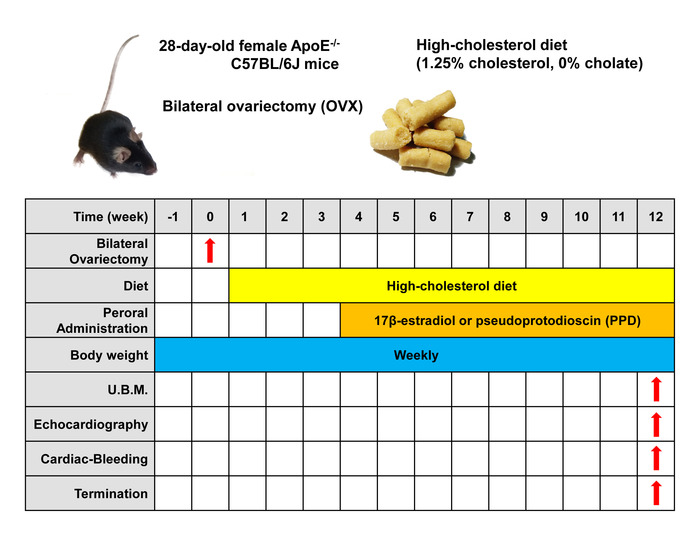
Figure 1. Mouse treatment scheme. At weaning (age, 28 days), female apoE-/- C57BL/6J mice were anesthetized with avertin (tribromoethanol; 200 mg/kg; intraperitoneally). Mice were bilaterally ovariectomized (OVX) or sham operated through a 1 cm dorsal incision. One week after OVX, the mice were fed a high-cholesterol diet (1.25% cholesterol, 0% cholate) for 12 weeks. 17β-Estradiol (0.1 mg·kg-1) or PPD (0.5 mg·kg-1) was perorally administered in parallel via hazelnut spread during the last 9 weeks of treatment. All mice were weighed every week. At week 12, cardiovascular function analysis was evaluated using echocardiography. After 12 weeks of a high-cholesterol diet, all mice were euthanized, and blood samples and tissues were harvested for further investigation. Please click here to view a larger version of this figure.
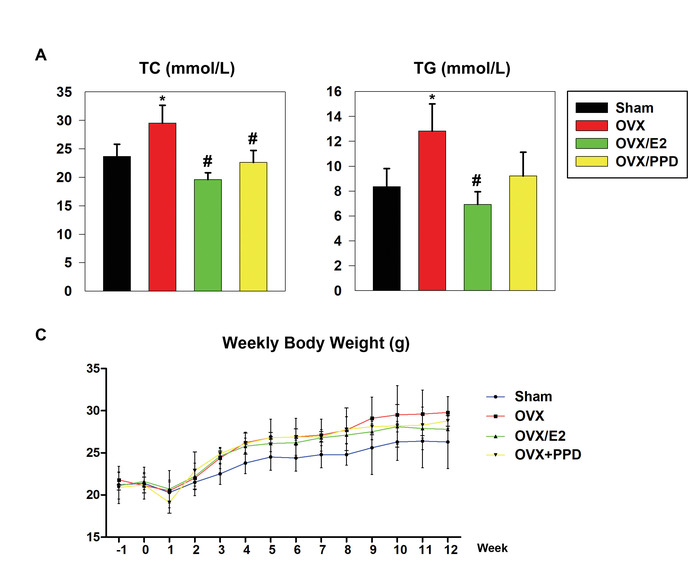
Figure 2. Effects of various exogenous estrogens on plasma lipids and weekly body weight in apoE-/- mice. Sham mice underwent a mock operation and received a high-cholesterol diet. OVX mice underwent bilateral ovariectomy and then randomly divided into the following groups: the OVX group, which was treated with a high-cholesterol diet; the OVX/E2 (17β-estradiol) group, which received a high-cholesterol diet for 12 weeks plus 0.1 mg/kg E2 through peroral administration via hazelnut spread for the last 9 weeks of treatment; and the OVX/PPD group, which received a high-cholesterol diet for 12 weeks plus 0.5 mg/kg PPD through peroral administration via hazelnut spread for the last 9 weeks of treatment. The total cholesterol and triglyceride levels of plasma were measured via enzymatic methods (A-B). Data are expressed as the means ± SEM of n = 5 mice per group. Weekly body weights were measured from week -1 to week 12 (C). Data are expressed as the means ± SEM of n = 8 mice per group. One-way ANOVA followed by Dunnett's post hoc test was conducted for multiple comparisons. *p < 0.05 compared with the sham group; #p < 0.05 compared with the OVX group. Please click here to view a larger version of this figure.
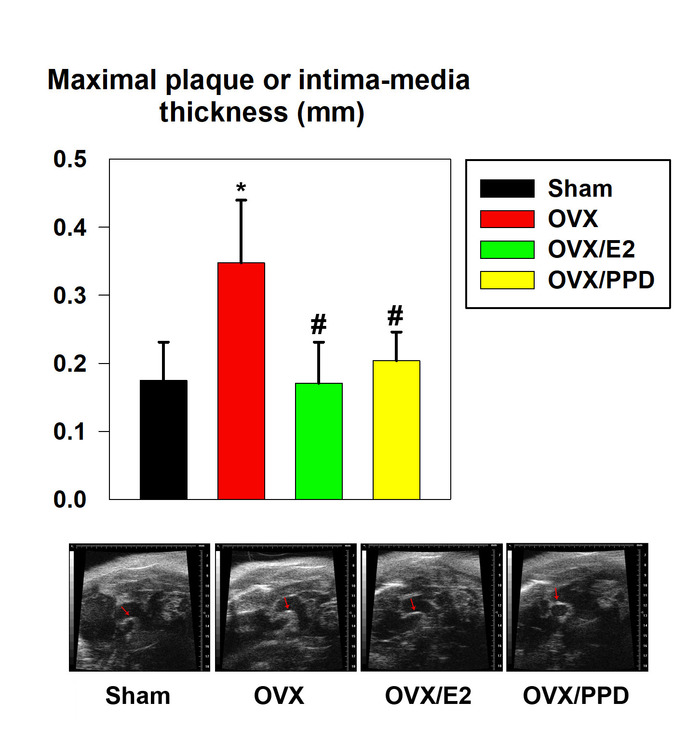
Figure 3. IMT or maximal plaque thickness measurements in apoE-/- mice. B-mode images showing the aortic arch of apoE-/- mice are presented. The longitudinal images of ascending aorta were obtained by ultrasonographic biomicroscopy. Maximal plaque or IMT of the ascending aorta (mm) was measured. The ultrasonographic images show plaque in the minor curvature of the ascending aorta; the red arrows indicate the plaques. Data are expressed as the mean ± SEM of n = 8 mice per group. One-way ANOVA followed by Dunnett's post hoc test was conducted for multiple comparisons. *p < 0.05 compared with the sham group; #p < 0.05 compared with the OVX group. Please click here to view a larger version of this figure.
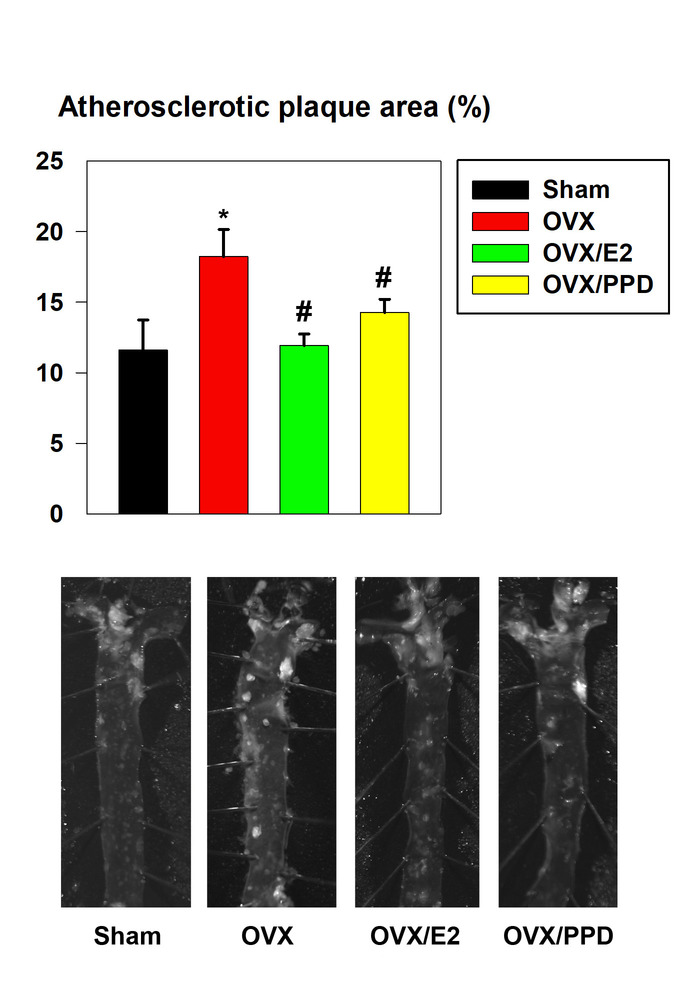
Figure 4. En face analysis of aortic atherosclerotic lesions in apoE-/- mice. The average percentage of aortic lesion area relative to the entire aortic area was quantified in all groups. Representative micrographs of the intimal lesions (en face) of the aorta are shown. Data are expressed as the mean ± SEM of n = 3 mice per group. One-way ANOVA followed by Dunnett's post hoc test was conducted for multiple comparisons. *p < 0.05 compared with the sham group; #P < 0.05 compared with the OVX group. Please click here to view a larger version of this figure.
| Sham | OVX | OVX/E2 | OVX/PPD | |
| LVIDd (mm) | 3.72 ± 0.10 | 3.74 ± 0. 24 | 3.68 ± 0.16 | 3.88 ± 0.16 |
| LVIDs (mm) | 2.34 ± 0.11 | 2.16 ± 0.22 | 2.12 ± 0.13 | 2.55 ± 0.12# |
| IVSd (mm) | 0.83 ± 0.09 | 0.84 ± 0.07 | 0.91 ± 0.05 | 0.74 ± 0.06# |
| IVSs (mm) | 1.24 ± 0.02 | 1.35 ± 0.06* | 1.45 ± 0.04# | 1.09 ± 0.04# |
| PWTd (mm) | 0.7± 0.10 | 0.68 ± 0.04 | 0.72 ± 0.07 | 0.58 ± 0.07# |
| PWTs (mm) | 1.10 ± 0.12 | 1.17 ± 0.08 | 1.24 ± 0.04 | 0.98 ± 0.08# |
| EDV (mm3) | 58.89 ± 3.74 | 59.88 ± 9.02 | 57.39 ± 5.79 | 65.11 ± 6.13 |
| ESV (mm3) | 18.86 ± 2.17 | 15.75 ± 4.00 | 14.85 ± 2.37 | 23.45 ± 2.64# |
| EF (%) | 67.84 ± 1.52 | 73.91 ±3 .63* | 74.23 ± 1.50 | 63.91 ± 3.61# |
| FS (%) | 37.19 ± 1.53 | 42.22 ± 1.17* | 42.36 ± 1.21 | 34.28 ± 2.69# |
| LVIDd = LV internal diameter during diastole; LVIDs = LV internal diameter during systole; IVSd = internal ventricular septum during diastole; IVSs = internal ventricular septum during systole; PWTd = posterior wall thickness during diastole; PWTs = posterior wall thickness during systole; EF = ejection fraction; FS = fractional shortening; EDV = end-diastolic volume; ESV = end-systolic volume. | ||||
Table 1: Cardiac function evaluation by using Echocardiography. Parameters associated with cardiac function digitally from M-mode tracings was quantified in all groups.Data are expressed as the mean ± SEM of n = 8 mice per group. One-way ANOVA followed by Dunnett's post hoc test was conducted for multiple comparisons. *p < 0.05 compared with the sham group; #p < 0.05 compared with the OVX group.
Discussion
The methodology described here is a mouse model resembling lipid disruption and atherosclerosis seen in menopausal women. It is well-documented that estrogen deficiency in postmenopausal women can aggravate the incidence of pre-existing or ongoing hypercholesterolemia with progressively complex and widespread atherosclerostic lesions1. To mimic the atherosclerosis-prone status in clinic, apoE-deficient mice, a reproducible and convenient source of animals with which to study atherogenesis23,24,25, were applied. As is shown in the present study, female OVX apoE-/- mice at weaning displayed an increase in atherosclerotic lesions in the aorta compared with female apoE-/- mice with intact ovarian function. In this animal model, we also compared the effect of various exogenous estrogen replacement therapies on atherosclerotic lesion size under a controlled dietary condition.
The double dorsal-lateral incision of bilateral ovariectomy presented in this article is technically easier, less time consuming, and safer compared with the middle dorsal-lateral incision or middle abdominal incision of bilateral ovariectomy in apoE-/- mice. Bilateral ovariectomy via middle abdominal incision presents a major drawback: it may cause severe abdominal cavity adhesion, which, in turn, may affect drug absorption. Recent reports show that peroral administration of low-dose 17β-estradiol protects against cerebral ischemia26. Thus, we selected peroral administration via hazelnut spread in the present study. Commercial slow-release pellets are a frequently used administration mode for testing pharmacological effects in a mouse model but may cause detrimental cerebral damage27. Implants are prone to infections, especially if mice are subjected to bilateral OVX via a double dorsal-lateral incision. Although careful disinfection of the skin prior to incision is performed, infection is difficult to avoid. Water administration and oral gavage are two less-frequently used methods that have been tested. Administering the hormone via drinking water is highly beneficial due to its being extremely noninvasive because nearly no animal handling is required. However, 17β-estradiol is not soluble in water without an emulsifier. Thus, we used DMSO at a concentration of less than 0.5% to facilitate its solution in drinking water. However, this approach for the long-term administration of low-dose DMSO is difficult to control and toxic to mice or humans. Mice may also drink water over the entire 24 h of surveillance, which makes actual drug consumption difficult to determine. Another disadvantage of this approach is that the individual's water intake is hard to control. The greatest disadvantage of oral gavage is that it is stressful for animals and may cause esophageal injury and affect eating behavior. In the methodology described here, a 5 day training of eating hormone-free hazelnut spread prior to the experiment was conducted. Approximately more than 95% of the mice will accept the hazelnut spread if being trained as what mentioned in the protocol section. Once fully habituated, most of the mice will consume it within seconds. Consistent with a previous study6,11, the plasma E2 levels decreased in OVX mice compared with the sham-operated counterpart at week 4 (data not shown). At week 12 after determination, we observed uterus atrophy in OVX-operated mice. However, the circulating estrogen levels were not monitored after OVX in the present study.
In the absence of detection of atherosclerotic lesions in the ascending aorta, the aortic IMT can be evaluated through measuring the distance between the lumen-intimal interface and the medial-adventitial interface. This measurement is based on a previously validated protocol in humans28. Average data from three sites that are approximately 100 µm apart from each other. The cardiac workload increases after OVX in apoE-/- mice may due to compensatory hypertrophic growth of individual cardiomyocytes which may eventually lead to increase cardiac output (Table 1). Whereas, upon peroral administration of PPD for 9 weeks, the compensatory cardiac hypertrophy was attenuated with an EF% comparable to the sham counterpart. For validation of intra- or inter-observer variability, analyze coefficients of variation for atherosclerotic thickness measurements and parameters associated with cardiac function by one operator on two different occasions or by a different operator.
As presented in our study, OVX mice perorally administered with 17β-estradiol or PPD via hazelnut spread tended to prevent body weight gain and reduce estrogen deficiency-associated lipid disruption, although no significant differences in final body weight were observed. Previous studies have also shown that lipid parameters variation may be too minor to explain the antiatherosclerotic effects of hormones29. The beneficial effects of estrogen are not limited to changes in lipid protein properties. Some nonlipid effects of estrogen30,31, such as inflammation, endothelial dysfunction, and hemodynamic stasis, can facilitate cardiovascular protection in human disease. Considering the results observed in the present study, the protection of exogenous estrogen from atherosclerosis development is partially independent of systemic lipid levels. In endothelial cells, PPD inhibited expressions of adhesion molecule and inflammatory mediators (data not shown). Furthermore, PPD could suppress perivascular adipose formation which is closely correlated with endothelial anti-contractility. Thus, the action of PPD and 17β-estradiol was different and the underlying mechanism is to be further explored. Undoubtedly, excessive consumption of energy-rich food, such as hazelnut spread, could cause weight gain. However, the small amounts of hazelnut spread (200 mg·kg-1·day-1) as mentioned in the present study could only be responsible for less than 5% of the animals' daily energy intake. Also, no obvious weight gain was detected by using this amount of hazelnut spread. The use of 17β-estradiol and PPD was mainly for treatment of cardiovascular disease. Because, during the progression of atherosclerosis in OVX-operated aopE-/- mice, from Week 4 to Week 12, 17β-estradiol or PPD was perorally administered.
One non-negligible point of the clinical use of HRT is its detrimental side effects, which include ovarian and breast cancers13,14. The phytoestrogen tested in the present study is a steroid saponin compound found in Dioscorea plants. PPD has been reported to have an inhibitory effect on some cancer cell lines20. In addition, PPD shows antiatherosclerotic properties comparable with those of 17β-estradiol. The model we present here can help screen potential candidate compounds, including phytoestrogen, which exerts a minimal effect on tumor proliferation.
Disclosures
The authors declare no conflicts of interest.
Acknowledgements
This work was supported by the National Natural Science Foundation of China (81202526 to J.X.), the National Natural Science Foundation of China (81302769 to B.S.), the Beijing Municipal Natural Science Foundation (47144226 to B.S.), the Chinese Postdoctoral Science Foundation (20110490325 to J.X.), and the Ph.D. Programs Foundation of Ministry of Education of China (20121106120031 to B.S.).
Materials
| Name | Company | Catalog Number | Comments |
|---|---|---|---|
| 17β-estradiol, >98% | Sigma-Aldrich | E8875-250MG | Estrogen |
| Disposable syringes (with 25 G needles) | Hunan Luzhou Huikang Development Co., Ltd | 0.5*19TWLB | Cardiac bleeding |
| High-cholesterol mouse diet | Huafukang Bio-Technology | N/A | 1.25% cholesterol, 0% cholate |
| High-Resolution In Vivo Micro-Imaging System | VisualSonics | Vevo®770 | Measurements of intima-media thickness and cardiac dysfunction |
| 2-Methyl-2-butanol | Sigma-Aldrich | 152463-250ML | Preparation of avertin |
| Micro Dissecting forceps, Curved 8mm | Kanghua Medical Equipment Co., Ltd | Surgical tools | |
| Micro Dissecting forceps, Straight 8 mm | Kanghua Medical Equipment Co., Ltd | Surgical tools | |
| Micro Dissecting Scissors, Curved/Sharp 8 mm | Kanghua Medical Equipment Co., Ltd | Surgical tools | |
| Micro Dissecting Scissors, Straight/Sharp 8 mm | Kanghua Medical Equipment Co., Ltd | Surgical tools | |
| Monofilament suture 4-0 1/2 5 x 12 19 mm | Shanghai Pudong Jinhuan Medical Supplies Co., Ltd | R413 | Suture and ligation of the tissues |
| Nut cream (Nutella) | Ferrero | N/A | Medium for peroral 17β-estradiol or PPD |
| OptiVisor optical glass binocular magnifier | Dohegan Optical Company Inc. | N/A | Assistant of identifying the tissues during ovariectomy |
| Phosphate-buffered saline at pH 7.4 | SIGMA | P3813 | Preparing 1 L saline |
| Pro MultiLabel Microplate Reader | Tecan | Infinite M1000 | Plasma TC and TG determination |
| Pseudoprotodioscin | Shanghai Winherb Medical S & T Development | W-0427 | CAS registry no. 102115-79-7 |
| Rimadyl, 50 mg/mL | Pfizer Pharma GmbH | 462986 | Postoperative analgesia after ovariectomy |
| Sesame oil | Sigma-Aldrich | S3547-1L | Dissolving the 17β-estradiol or PPD |
| Solcoseryl Eye-Gel | Menarini, Solco Basle Ltd. | Eye protection during anesthesia | |
| Stereo microscope | MCALON | MCL-6STV | Image of the intimal region of aorta |
| Table model high speed centrifuge | SIGMA | 1-14K | Preparation of plasma |
| Scissors, slight Curve (14 cm) | Kanghua Medical Equipment Co., Ltd | Surgical tools | |
| Scissors, straight Flat (14 cm) | Kanghua Medical Equipment Co., Ltd | Surgical tools | |
| Tissue forceps, serrated, slight Curve (14 cm) | Kanghua Medical Equipment Co., Ltd | Surgical tools | |
| Tissue forceps, serrated, straight Flat (14 cm) | Kanghua Medical Equipment Co., Ltd | Surgical tools | |
| Tribromoethanol | Sigma-Aldrich | T48402-5G | Preparation of avertin |
| Triglycerides (TG) assay kit | Institute of Nanjing Jiancheng Biology Engineering | A110-1 | Plasma TG determination |
| Total cholesterols (TC) assay kit | Institute of Nanjing Jiancheng Biology Engineering | A111-1 | Plasma TC determination |
References
- Mozaffarian, D., et al. Heart Disease and Stroke Statistics-2016 Update: A Report From the American Heart Association. Circulation. 133 (4), e38-e360 (2016).
- Packard, B. L. Cardiovascular health and disease in women. The New England Journal of Medicine. 329 (4), 247-256 (1993).
- Samaan, S. A., Crawford, M. H. Estrogen and cardiovascular function after menopause. Journal of the American College of Cardiology. 26 (6), 1403-1410 (1995).
- Libby, P. Inflammation in atherosclerosis. Nature. 420 (6917), 868-874 (2002).
- Tremollieres, F. A., et al. Effect of hormone replacement therapy on age-related increase in carotid artery intima-media thickness in postmenopausal women. Atherosclerosis. 153 (1), 81-88 (2000).
- Bourassa, P. A., Milos, P. M., Gaynor, B. J., Breslow, J. L., Aiello, R. J. Estrogen reduces atherosclerotic lesion development in apolipoprotein E-deficient mice. Proceedings of the National Academy of Sciences of the United States of America. 93 (3), 10022-10027 (1996).
- Squadrito, F., et al. Genistein supplementation and estrogen replacement therapy improve endothelial dysfunction induced by ovariectomy in rats. Cardiovascular Research. 45 (2), 454-462 (2000).
- Wang, D., et al. Endothelial dysfunction and enhanced contractility in microvessels from ovariectomized rats: roles of oxidative stress and perivascular adipose tissue. Hypertension. 63 (5), 1063-1069 (2014).
- Zhang, S. H., Reddick, R. L., Piedrahita, J. A., Maeda, N. Spontaneous Hypercholesterolemia and Arterial Lesions in Mice Lacking Apolipoprotein E. Science. 258 (5081), 468-471 (1992).
- Nakashima, Y., Plump, A. S., Raines, E. W., Breslow, J. L., Ross, R. ApoE-Deficient Mice Develop Lesions of All Phases of Atherosclerosis Throughout the Arterial Tree. Arteriosclerosis and Thrombosis. 14 (1), 133-140 (1994).
- Ström, J. O., Theodorsson, A., Ingberg, E., Isaksson, I. M., Theodorsson, E. Ovariectomy and 17-estradiol Replacement in Rats and Mice: A Visual Demonstration. Journal of Visualized Experiments. 64 (e4013), 1-4 (2012).
- Rossouw, J. E., et al. Risks and benefits of estrogen plus progestin in healthy postmenopausal women: principal results From the Women's Health Initiative randomized controlled trial. The Journal of the American Medical Association. 288 (3), 321-333 (2002).
- Kumle, M. Declining breast cancer incidence and decreased HRT use. Lancet. 372 (9639), 608-610 (2008).
- Jager, W., et al. A randomized comparison of triptorelin and tamoxifen as treatment of progressive ovarian cancer. Anticancer Research. 15 (6B), 2639-2642 (1995).
- Bhathena, S. J., Velasquez, M. T. Beneficial role of dietary phytoestrogens in obesity and diabetes. The American Journal of Clinical Nutrition. 76 (6), 1191-1201 (2002).
- Wang, L., Qiu, X. M., Hao, Q., Li, D. J. Anti-inflammatory effects of a Chinese herbal medicine in atherosclerosis via estrogen receptor beta mediating nitric oxide production and NF-kappaB suppression in endothelial cells. Cell Death and Disease. 4 (e551), 1-13 (2013).
- Xiao, J., Wang, N. L., Sun, B., Cai, G. P. Estrogen receptor mediates the effects of pseudoprotodiocsin on adipogenesis in 3T3-L1 cells. American Journal of Physiology-Cell Physiology. 299 (1), C128-C138 (2010).
- Guivarc'h, E., et al. Predominant Role of Nuclear Versus Membrane Estrogen Receptor alpha in Arterial Protection: Implications for Estrogen Receptor alpha Modulation in Cardiovascular Prevention/Safety. Journal of the American Heart Association. 7 (13), 1-17 (2018).
- Osako, M. K., et al. Estrogen inhibits vascular calcification via vascular RANKL system: common mechanism of osteoporosis and vascular calcification. Circulation Research. 107 (4), 466-475 (2010).
- Ivanova, A., et al. Screening of some saponins and phenolic components of Tribulus terrestris and Smilax excelsa as MDR modulators. In vivo. 23 (4), 545-550 (2009).
- Xiao, J., Zhu, T., Yin, Y. Z., Sun, B. Notoginsenoside R1, a unique constituent of Panax notoginseng, blinds proinflammatory monocytes to protect against cardiac hypertrophy in ApoE(-/-) mice. European Journal of Pharmacology. 833 (15), 441-450 (2018).
- Sun, B., Xiao, J., Sun, X. B., Wu, Y. Notoginsenoside R1 attenuates cardiac dysfunction in endotoxemic mice: an insight into oestrogen receptor activation and PI3K/Akt signalling. British Journal of Pharmacology. 168 (7), 1758-1770 (2013).
- Adams, M. R., et al. Inhibition of coronary artery atherosclerosis by 17-beta estradiol in ovariectomized monkeys. Lack of an effect of added progesterone. Arteriosclerosis. 10 (6), 1051-1057 (1990).
- Keaney, J. F. Jr, et al. 17 beta-estradiol preserves endothelial vasodilator function and limits low-density lipoprotein oxidation in hypercholesterolemic swine. Circulation. 89 (5), 2251-2259 (1994).
- Nakashima, Y., Plump, A. S., Raines, E. W., Breslow, J. L., Ross, R. ApoE-deficient mice develop lesions of all phases of atherosclerosis throughout the arterial tree. Arteriosclerosis, Thrombosis, and Vascular Biology. 14 (1), 133-140 (1994).
- Saleh, T. M., Cribb, A. E., Connell, B. J. Estrogen-induced recovery of autonomic function after middle cerebral artery occlusion in male rats. American Journal of Physiology- Regulatory, Integrative and Comparative Physiology. 281 (5), R1531-R1539 (2001).
- Bingham, D., Macrae, I. M., Carswell, H. V. Detrimental effects of 17beta-oestradiol after permanent middle cerebral artery occlusion. Journal of Cerebral Blood Flow & Metabolism. 25 (3), 414-420 (2005).
- Pignoli, P., Tremoli, E., Poli, A., Oreste, P., Paoletti, R. Intimal plus medial thickness of the arterial wall: a direct measurement with ultrasound imaging. Circulation. 74 (6), 1399-1406 (1986).
- Hodgin, J. B., Maeda, N. Minireview: estrogen and mouse models of atherosclerosis. Endocrinology. 143 (12), 4495-4501 (2002).
- Bush, T. L., et al. Cardiovascular mortality and noncontraceptive use of estrogen in women: results from the Lipid Research Clinics Program Follow-up Study. Circulation. 75 (6), 1102-1109 (1987).
- Marsh, M. M., Walker, V. R., Curtiss, L. K., Banka, C. L. Protection against atherosclerosis by estrogen is independent of plasma cholesterol levels in LDL receptor-deficient mice. Journal of Lipid Research. 40 (5), 893-900 (1999).
Reprints and Permissions
