This study investigated the biomechanical characteristics of the lower extremity kinematic variables between the initial and terminal phase of 5 km treadmill running. The lower-limb kinematic data of 10 runners were collected using a three-dimensional motion capture system on a treadmill at the initial phase (0.5 km) and the terminal phase (5 km), respectively.
A subscription to JoVE is required to view this content. Sign in or start your free trial.
Method Article
Comparative Analysis of Lower Limb Kinematics between the Initial and Terminal Phase of 5km Treadmill Running
In This Article
Summary
Abstract
Running is beneficial for physical health, but it is also accompanied by many injuries. However, the main factors leading to running injury remain unexplained. This study investigated the effects of long running distance on lower-limb kinematic variables and the lower limb kinematic difference of between the initial (IR) and terminal phase (TR) of 5 km running was compared. Ten amateur runners ran on a treadmill at the speed of 10 km/h. Dynamic kinematic data was collected at the phase of IR (0.5 km) and TR (5 km), respectively. The peak angle, peak angular velocities, and range of motion were recorded in this experiment. The main results demonstrated the following: ankle eversion and knee abduction were increased at TR; ROMs of ankle and knee were increased in the frontal plane at TR than IR; a larger peak angular velocity of ankle dorsiflexion and hip interrotation were found in TR compared to IR. These changes during the long distance running may provide some specific details for exploring potential reasons of running injuries.
Introduction
Running is the most popular sport around the world. There are a large number of individuals that run and this number increases substantially every year1. It has been suggested that participation in regular exercise including running can promote health, reduce the risk of cardiovascular diseases and thus improve life expectancy2,3,4. Despite the significant health benefits of running, the incidence of running injuries has increased from 25% to 83% over the years5,6. There are some risks associated with running, especially to the lower extremities, which are mainly focused on musculoskeletal injuries7. The majority of common running-related injuries are related to patellofemoral pain, ankle sprain, tibial stress fractures, and plantar fasciitis8. Running injuries can be induced by many factors, such as incorrect foot striking patterns, incorrect shoe selection, and other individual biomechanical factors9. For instance, running with a heel-strike pattern can lead to greater pronation, and is accompanied by larger plantar pressure on the medial side of foot, which may lead a higher risk for Achilles tendinopathy and patellofemoral pain10. In addition, running with a greater knee internal rotation has been previously reported to be associated with the iliotibial band syndrome for female runners11, especially when running long distances.
Parameters of kinetics, kinematics, and time-space components can provide a precise analysis of gait biomechanics, and is currently considered to be an important parameter for clinical gait analysis12. Lower vertical ground reaction forces and larger impact accelerations are recoded after long-distance running13,14. Higher hip excursion and smaller knee flexions have also been found along with fatigued muscles15, and the increased stride frequency can result in reduced stride lengths13,16.
However, changes in biomechanical features of lower limbs at the phase of initial and terminal running have not been fully analyzed, since most studies measured biomechanical variation after running. Additionally, only a few studies use standard laboratory techniques to assess the effects of long-distance running on gait biomechanical changes in amateur runners. The main factors leading to running injuries are still unclear. Therefore, in order to reveal the underlying reasons for lower extremity injuries caused by long distance running, this study aims to compare the biomechanical changes of the lower extremity between the IR and TR phases in treadmill 5 km running in amateur runners.
Access restricted. Please log in or start a trial to view this content.
Protocol
Written informed consent was obtained from subjects and the testing procedures were approved by the university ethics committee. All participants were informed of the requirements and process of the trial.
1. Laboratory preparation
- During calibration, switch off the lights and remove other possibly reflective objects. Ensure that eight cameras are appropriately placed and have a clear view without reflection.
- Open the Vicon Nexus 1.8.5 program, and then initialize the cameras. Select System | Local System | MX Cameras in the Resources pane and the cameras will engage.
NOTE: In the Properties pane, the parameters need to be adjusted. The range of values of the strobe intensity are adjusted to 0.95-1, and the value range of the threshold is set to 0.2-0.4. Set the grayscale mode to Auto. The Minimum circularity ratio is set to 0.5, and the Gain to times 1 (x1), the Max blob height to 50, and select Enable LEDs. - Place the T-frame in the center of the capture area, select all the cameras in the system, and use 2D mode. Confirm that the T-frame is in the camera view without any interference points. Select the first item System Preparation in the toolbar. In the T-Frame drop-down list, select the 5 Marker Wand & T-Frame calibration object.
- In the System Preparation Tools pane, click the Start button under the Mask Cameras section. Then click the Start button under Calibrate MX camera section.
NOTE: When the calibration process is completed, the progress bar is restored to 0%. - Place the T-frame in the center of the camera to establish the origin of the coordinates.
- In the Tool pane, click the Start button under the Set Volume Origin section.
- Put the treadmill in the center of the test zone. The eight cameras are displayed around the treadmill (Figure 1).
- Attach a total of 22 reflective markers (diameter: 14 mm) with double-sided tape on the subjects in advance.
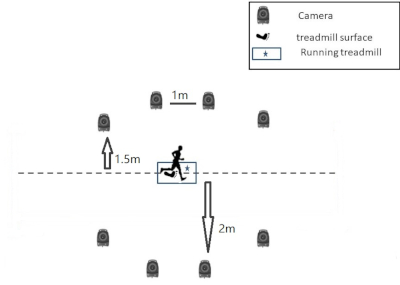
Figure 1: Test site layout. Cameras capture lower-limb motion while the subjects run on the treadmill. Please click here to view a larger version of this figure.
2. Subject preparation
- Before the test, interview subjects in the laboratory and give a simple explanation of the experimental procedures. Then, have the participants complete a questionnaire. Summarize the results of these questionnaires.
- Use the following questions:
- How often do you run in a week?
- How many years have you been running for?
- Have you suffered any lower extremity injuries or received lower extremity surgeries in the last six months?
- How many kilometers do you run per week?
- Use the following questions:
- Use the following inclusion criteria: all participants were right leg dominant and without any lower extremity injuries in the previous six months before the study. All participants ran at least 15 km per week.
NOTE: Ten healthy recreational female runners (ages: 23.4±1.3 years; height: 160.7±3.8 cm; mass: 50.3±2.3 kg; running years: 3.2±1.2 years) were selected.- Obtain written informed consent from participants who meet the inclusion criteria.
- Require that participants wear uniform tights and pants.
- Record the subjects’ height (mm), weight (kg), lower limb length (mm), knee width (mm) and ankle width (mm) for the statistics model.
- Place 16 reflective markers on subjects at the following locations: anterior-superior iliac spine, posterior-superior iliac spine, lateral mid-thigh, lateral knee, lateral mid-shank, lateral malleolus, second metatarsal head, and calcaneus. Place the markers on the second metatarsal head and calcaneus on the corresponding anatomical points of the socks and shoes.
- Instruct the participants to wear uniform sport running shoes. Have the participants warm up with light running and stretching for 5 min.
3. Static calibration
- Click the Data Management button on the toolbar, select Data Management. Click the New Database tab on the toolbar, select the location, describe the trial name and the Clinical Template, and click the create button.
- In the Open Database window, select the name of the database that was created. In the open interface, click the green New Patient Classification button, the yellow New Patient button, and the grey New session button to create the experimental information including subject type, subject name, and different action status.
- Go back to the Nexus pane, in the left toolbar, click Subjects to create a New Subject data set, and choose the trial model. In the Properties pane, fill in all the anthropometric measurements: height (mm), weight (kg), lower limb length (mm), knee width (mm) and ankle width (mm).
- Click the Go live button, select Spilt horizontally and choose the graph to check the Trajectory count.
NOTE: Ensure that all the markers are visible in the 3D Perspective view. This indicates that all markers can be captured for analysis. - Prepare to capture the static model. On the Capture Tools pane, click the Start button in the Subject Capture section.
NOTE: During the whole data collection process, the subjects should remain stationary in the capture area to collect 140-200 frames of images. Then click the Stop button. - In the perspective pane, view the capture marks. Click the Pipeline button in the Tools pane, select Running The Reconstruct Pipeline to create a 3D image of the captured markers. Then, manually label the static model. When the identification is completed, save and press ESC to exit.
- In the toolbar, choose the subject preparation and subject calibration. Select the Static plug-in gait option from the drop-down list. In the Static Settings pane, choose the left foot and right foot, click the start button and save the static model.
4. Dynamic trials
- When finished collecting the static data, select Capture in the right toolbar. Choose Trial Type and Session from top to bottom, and fill in the trial description.
- Ask participants to run on the treadmill in the following manner.
- Warm up by walking at 8 km/h for 1 min.
- Ask the participant to run on the treadmill at speed of 10 km/h. After an adaption period of 4 min at this velocity, record the running data for 40 s. Collect the kinematic data at a distance of 0.5 km and 5 km, respectively.
- Ask the subjects to wear a heart rate monitor to record the heart rate and monitor the subjects’ fatigue status while running.
- In the Tool Capture pane, click the Start button. After collecting the dynamic trials, click Stop to end the collection.
5. Post-processing
- Open the Data Management window, double-click the trial name. Click the run Reconstruct Pipeline and Labels button in the toolbar to reconstruct the mark point position.
- In the Perspective window, move the blue triangles on the time bar to set the required range of time.
- Shift the view of the timeline so that it shows only the selected range, click on the time bar, and click Zoom to Region-of-Interest.
- At this point, select the Label button to identify and check the label points, with the same steps as the static identification process. If necessary, supplement some incomplete identification points. Delete the unlabeled marks.
- In the Subject Calibration pane, select the Dynamic Plug-in Gait. Click the Start button to run the data. Export motorial trials in c3d format for post-processing.
6. Data analysis
- Process the kinematics data. Apply a fourth-order low pass Butterworth filter with a cut off frequency of 10 Hz (kinematic) before exporting the joint angle data. Export the data of the joint angle.
- Calculate the range of motion (ROM), peak angle and peak angular velocity of the lower limb joints (hip, knee, and ankle) in three planes (sagittal, frontal, and transverse) during one stance phase.
7. Statistical analysis
- Use paired-sample T-test to compare lower limb kinematics (peak angles, ROM, peak angular velocity) between the initial (IR) and terminal phase (TR) of 5 km running.
- Calculate mean values and standard deviations of the five valid trials from each subject for different running distances. Set the significance level at p < 0.05.
Access restricted. Please log in or start a trial to view this content.
Results
The results showed that no differences in the peak angle of the ankle and hip were observed in the sagittal plane. Compared with IR, the peak angles of the ankle and the knee in the frontal plane were significantly increased at TR. A larger internal hip angle was found in TR as contrasted to IR. However, TR presented a smaller peak angle in hip abduction, ankle interrotation, and knee interrotation than IR (Figure 2).
In the sagittal plane, the ROMs of the ankle a...
Access restricted. Please log in or start a trial to view this content.
Discussion
This study compared the effect of long distance running on the biomechanical characteristics of the lower extremity in amateur runners. It was found that the peak angle of ankle eversion and knee abduction increased after 5 km running, which is consistent with a previous study17. Studies have shown that excessive ankle eversion and eversion velocity are important factors that increase the risk of ankle injuries18,19. It is not surprising t...
Access restricted. Please log in or start a trial to view this content.
Disclosures
No potential conflict of interest was reported by the authors.
Acknowledgements
This study sponsored by the National Natural Science Foundation of China (81772423), K. C. Wong Magna Fund in Ningbo University, and the National Key R&D Program of China (2018YFF0300903).
Access restricted. Please log in or start a trial to view this content.
Materials
| Name | Company | Catalog Number | Comments |
|---|---|---|---|
| 14 mm Diameter Passive Retro-reflective Marker | Oxford Metrics Ltd., Oxford, UK | n=22 | |
| Double Adhesive Tape | Oxford Metrics Ltd., Oxford, UK | For fixing markers to skin | |
| Heart Rate | Garmin, HRM3-SS, China | Detection of fatigue state | |
| Motion Tracking Cameras | Oxford Metrics Ltd., Oxford, UK | n= 8 | |
| T-Frame | Oxford Metrics Ltd., Oxford, UK | - | |
| Treadmill | Smart Run,China | Subject run on the treadmill for all the process. | |
| Valid Dongle | Oxford Metrics Ltd., Oxford, UK | Vicon Nexus 1.4.116 | |
| Vicon Datastation ADC | Oxford Metrics Ltd., Oxford, UK | - |
References
- Lee, D. C., et al. Running as a Key Lifestyle Medicine for Longevity. Progress in Cardiovascular Diseases. 60 (1), 45-55 (2017).
- Dugan, S. A., Bhat, K. P. Biomechanics and analysis of running gait. Physical Medicine & Rehabilitation Clinics of North America. 16 (3), 603-621 (2005).
- Hart, L. Disability and mortality among aging runners. Clinical Journal of Sport Medicine Official Journal of the Canadian Academy of Sport Medicine. 19 (4), 338(2009).
- Schnohr, P., Marott, J. L., Lange, P., Jensen, G. B. Longevity in male and female joggers: the Copenhagen City Heart Study. American Journal of Epidemiology. 177 (7), 683-689 (2013).
- Bovens, A. M., et al. Occurrence of running injuries in adults following a supervised training program. International Journal of Sports Medicine. 10, 186-190 (1989).
- Blair, S. N., Kohl, H. W., Goodyear, N. N. Rates and Risks for Running and Exercise Injuries: Studies in Three Populations. Research Quarterly for Exercise & Sport. 58 (3), 221-228 (2016).
- Lun, V., Meeuwisse, W. H., Stergiou, P., Stefanyshyn, D. Relation between running injury and static lower limb alignment in recreational runners. British Journal of Sports Medicine. 38 (5), 576-580 (2004).
- Fukuchi, R. K., Fukuchi, C. A., Duarte, M. A public dataset of running biomechanics and the effects of running speed on lower extremity kinematics and kinetics. PeerJ. 5 (5), 3298(2017).
- Iii, E. B. L., Sackiriyas, K. S. B., Swen, R. W. A comparison of the spatiotemporal parameters, kinematics, and biomechanics between shod, unshod, and minimally supported running as compared to walking. Physical Therapy in Sport Official Journal of the Association of Chartered Physiotherapists in Sports Medicine. 12 (4), 151-163 (2011).
- Dowling, G. J., et al. Dynamic foot function as a risk factor for lower limb overuse injury: a systematic review. Journal of Foot & Ankle Research. 7 (1), 53(2014).
- Aderem, J., Louw, Q. A. Biomechanical risk factors associated with iliotibial band syndrome in runners: a systematic review. BMC Musculoskeletal Disorders. 16 (1), 356(2015).
- Anderson, T. Biomechanics and running economy. Sports Medicine. 22 (2), 76-89 (1996).
- Degache, F., et al. Changes in running mechanics and spring-mass behaviour induced by a 5-hour hilly running bout. Journal of Sports Sciences. 31 (3), 299-304 (2013).
- Millet, G. Y., et al. Running from Paris to Beijing: biomechanical and physiological consequences. Eur J Appl Physiol. 107 (6), 731-738 (2009).
- Mizrahi, J., Verbitsky, O., Isakov, E., Daily, D. Effect of fatigue on leg kinematics and impact acceleration in long distance running. Human Movement Science. 19 (2), 139-151 (2000).
- Bisiaux, M., Moretto, P. The effects of fatigue on plantar pressure distribution in walking. Gait & Posture. 28 (4), (2008).
- Dierks, T. A., Davis, I. S., Hamill, J. The effects of running in an exerted state on lower extremity kinematics and joint timing. J. Biomech. 43 (15), 2993-2998 (2010).
- Rolf, C. Overuse injuries of the lower extremity in runners. Scandinavian Journal of Medicine & Science in Sports. 5 (4), 181-190 (1995).
- Marti, B., Vader, J. P., Minder, C. E., Abelin, T. On the epidemiology of running injuries: the 1984 Bern Grand-Prix study. The American Journal of Sports Medicine. 16 (3), 285-294 (1988).
- Dierks, T. A., Davis, I. S., Hamill, J. The effects of running in an exerted state on lower extremity kinematics and joint timing. Journal of Biomechanics. 43 (15), 2993-2998 (2010).
- Noehren, B., Davis, I., Hamill, J. ASB Clinical Biomechanics Award Winner 2006: Prospective study of the biomechanical factors associated with iliotibial band syndrome. Clinical Biomechanics. 22 (9), 951-956 (2007).
- Noehren, B., Pohl, M. B., Sanchez, Z., Cunningham, T., Lattermann, C. Proximal and distal kinematics in female runners with patellofemoral pain. Clinical Biomechanics. 27 (4), 366-371 (2012).
- Souza, R. B., Powers, C. M. Differences in hip kinematics, muscle strength, and muscle activation between subjects with and without patellofemoral pain. Journal of Orthopaedic & Sports Physical Therapy. 39 (1), 12-19 (2009).
- Ferber, R., Hreljac, A., Kendall, K. D. Suspected mechanisms in the cause of overuse running injuries: a clinical review. Sports Health. 1 (3), 242-246 (2009).
Access restricted. Please log in or start a trial to view this content.
Reprints and Permissions
