RBDT integrates behavioral patterns based on discrete responses (e.g., stimuli selection, placement of figures) and continuous responses (e.g., tracking of cursor movements, figure dragging) to study relational behavior with humans. RBDT is a challenging task based on transposition, in which the participant sets up stimuli compounds with a relational criterion (more/less than).
A subscription to JoVE is required to view this content. Sign in or start your free trial.
Method Article
RBDT: A Computerized Task System based in Transposition for the Continuous Analysis of Relational Behavior Dynamics in Humans
* These authors contributed equally
In This Article
Summary
Abstract
The most extensively employed paradigm for the analysis of relational behavior is the transposition task. Nevertheless, it has two important limitations for its use in humans. The first one is the "ceiling effect" reported in linguistic participants. The second limitation is that the standard transposition task, being a simple choice task between two stimuli, does not include active behavioral patterns and their recording, as relevant factors in emergence of relational behavior. In the present work, a challenging multi-object task based on transposition, integrated with recording software, is presented. This paradigm requires behavioral active patterns to form stimuli compounds with a given relational criteria. The paradigm is composed of three arrangements: a) a bank of stimuli, b) sample relational compounds, and c) comparison relational compounds. The task consists of the participant constructing two comparison relational compounds by dragging figures of a bank of stimuli with the same relation shown by the sample relational compounds. These factors conform an integrated system that can be manipulated in an individual or integrative manner. The software records discrete responses (e.g., stimuli selections, placements) and continuous responses (e.g., tracking of cursor movements, figure dragging). The obtained data, data analysis and graphical representations proposed are compatible with frameworks that assume an active nature of the attentional and perceptual processes and an integrated and continuous system between the perceiver and the environment. The proposed paradigm deepens the systematic study of relational behavior in humans in the framework of the transposition paradigm and expands it to a continuous analysis of interaction between active patterns and the dynamics of relational behavior.
Introduction
The ability to recognize and respond based on the relational qualities of objects regardless of absolute attributes that each one possesses is named relational behavior. From an ecological view, relational behavior could be critical to the adjustment of the organisms, humans and not humans, to complex and dynamic natural environments. In social and ecological contexts, the organisms are constrained to respond to permutable aspects of the environment (e.g., food, predators) that vary in relation to given qualities (e.g., size, color, smell, the intensity of a given sound, etc.) of the objects, events, and other organisms. One of the most exciting and controversial issues in the history of behavioral science is the emergence of relational behavior. This is, do animals (non-humans and humans) perceive and respond to relational qualities of stimuli, regardless of the absolute attributes that each one possess?1,2,3,4,5. The affirmative answer implies that organisms' responses integrates segments of stimulation that vary in degree in, at least, one relevant dimension or quality, such as the size or saturation of the stimuli6,7. In spite of the cited controversy, there is strong evidence that supports the emergence of relational behavior in animals4,8,9,10 and humans11,12,13,14,15,16,17,18.
Different paradigms have been used for the analysis of relational behavior. The most extensively employed has been the transposition task5,8. In the transposition task, the participant responds to a given stimulus in such a way that its relevant property (e.g., 'shorter than') is relative to the property of other stimuli in the context of a composed gradient of multiple values (at least three) in a given dimension (e.g., size). Different specific values of the stimuli can take different relational values within the gradient; this is, the specific value of each stimulus can permute its relational values in a given dimension. In simple words, the same stimuli could be 'shorter than' or 'bigger than' depending on comparison stimuli within a size gradient. Some of the reasons of why the transposition task has been a central paradigm for the study of relational behavior are the following: a) the paradigm is susceptible to be extended to different stimuli dimensions2,19,20,21,22,23,24,25; b) by consequence, it is useful for the study of relational behavior in different species (e.g., chickens, pigeons, chimpanzee, turtles, horses, humans)2,4,10,11,18,26; c) it clearly shows changes of the relational value of the stimuli9; d) the task allows parametrical variations of different relevant factors involved in relational behaviour9 and; e) the task allows to conduct comparative studies between different stimuli dimensions and different species or organisms27,28,29,30.
The study of relational behavior in animals is more extensive, systematic and has stronger evidence than in humans. The main reason of this is the 'ceiling effect' frequently observed when the participants are humans11. In this context, recently challenging tasks have been proposed based on transposition for the study of relational behavior in this population6,7,11. In this way, the present work advances from the previous ones and presents a paradigm based on a modified-transposition task for the continuous analysis of relational behavior in humans.
Relational behavior under the transposition paradigm has been usually studied in simple choice situations, with only two stimulus options, and a reduced number of values along a single stimulus dimension in which participants are not allowed to display active patterns with respect to stimuli (e.g., inspecting, dragging, moving, and placing figures). Nevertheless, the experimental analysis of relational behavior might include situations with a) a greater number of stimulus values that allows to permutate or change the relational value of the stimuli; b) more than one relevant stimulus dimension and c) active behavioral patterns requirements, beyond the usually discrete dichotomous selections of the participants. These modifications would allow to evaluate factors not previously considered, mainly, the role of active patterns (e.g., inspecting, dragging, moving and placing figures) in relational behavior, and might prevent the "ceiling effect" observed when linguistic humans solve the standard task11.
RBDT allows the integration of patterns based on discrete responses (e.g., stimuli selection, placement of figures) and continuous responses (e.g., tracking of cursor movements, figure dragging) to analyze the emergence of relational behavior. Two different relational compounds, comprising two stimulus each one, show the same relational properties. They are presented as a sample to compose two new stimulus segments, by means of the active patterns of the participant. The task requires the relational comparability of the stimulus segments. This involves that each one of the two constructed stimulus-segments can be compared to one another as equivalent in terms of their relational properties, but also with respect to the two-sample stimulus-segments. The relations are identified in terms of "greater than" or "less than" magnitude (i.e., size or saturation).
To exemplify some of the possibilities of the experimental arrangements allowed by the presented paradigm, two experiments were conducted. The first experiment shows an exploration of relational behavior under different relational criteria without restriction of active patterns of behavior. The second experiment contrasts the dynamics of relational behavior under restriction of behavioral patterns adding a continuous recording and analysis of dragging and inspection activity with the mouse cursor.
Access restricted. Please log in or start a trial to view this content.
Protocol
Both protocols follow university guidelines to conduct behavioral research with human participants. RBDT software and the user's manual can be downloaded from https://osf.io/7xscj/
1. Experiment 1: Relational behavior under different relational criteria without restriction of active patterns of behavior
NOTE: Five elementary school children, between 10 to 11 years-old, volunteered to participate in this study, with the informed consent of their parents and teachers.
- Apparatus and experimental situation
- Use five Pentium laptop computers, each one with a 14" monitor, keyboard, and optic mouse as response device.
- Program the experimental task in Java as it automatically records responses and presents a graphical representation of data. The program to conduct the experimental task will be available for download.
- Perform experimental sessions daily between 9 and 11 am, in individual stations of the Sidney W. Bijou mobile laboratory at University of Veracruz.
- Use stations equipped with one-way mirrors, air conditioning, desks, and chairs, and the before mentioned computers.
- Experimental design and task
- In the experimental task, present 15 stimulus objects (SOs) consisting of different shapes. Five of these SOs were relevant to the completion of the task and 10 were irrelevant, as shown in the left part of Figure 1.
- Use five different shapes as relevant stimulus objects: pentagon, rectangle, horizontal rhomboid, parallelogram, and figure in V.
- Use ten different shapes were used as irrelevant stimulus objects: hexagon, triangle, circle, trapezoid, oval, rhombus, square, vertical rhomboid, trapeze, and irregular figure in L.
- Vary the SOs in color saturation or size. In this experiment, we employed SOs with four different degrees of saturation: black (#000000), dark gray (#474747), gray (#A7A7A7) and light gray (#E7E7E7). The size remained constant.
- In the experimental task, present 15 stimulus objects (SOs) consisting of different shapes. Five of these SOs were relevant to the completion of the task and 10 were irrelevant, as shown in the left part of Figure 1.

Figure 1. Example of relevant and irrelevant figures used as stimulus objects (SOs) in each experiment. Please click here to view a larger version of this figure.
- Present the SOs in a computer screen, divided in three zones, as shown in the left part of Figure 2.
- In the upper left part of the screen, present the zone of Sample Relational Compounds 1 and 2 (SRC 1, 2). Show two different pairs of figures that set a relationship criterion. Each pair exemplified two degrees of saturation relationship "darker or lighter than" with the same shape.
- In the lower left part of the screen, present the zone of Comparison Relational Compounds 1 and 2 (CRC 1, 2). Show two pairs of empty spaces in this zone. The participant had to form two new pairs of figures that fulfilled the exemplified criteria by choosing figures from the Bank.
- On the right side of the screen, present the Bank zone. In each trial, the bank contained 18 different figures that acquired different relational properties, depending on the criteria exemplified by the SCR 1, 2.
- NOTE: Six figures met the criteria set by the SRC (permutable figures), six figures were eligible to be used correctly but under another criteria (non-permutable figures), and six figures did not meet the criteria set by the SRC (irrelevant figures).
- To place the figures in the CRC zone, have the participant select the figure with the mouse pointer and drag it to the blank spaces in the CRC zone. Placements of figures could be in different sequences and they could be changed.
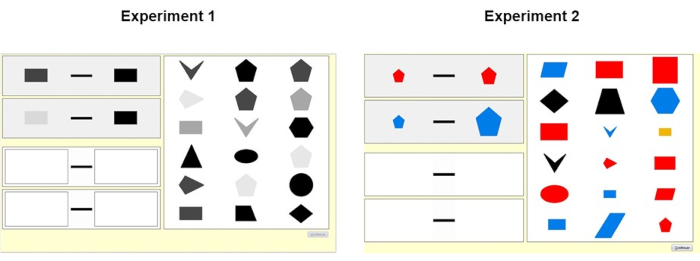
Figure 2. Screens showing a comparison trial in Experiment 1 and 2. In the upper left zone are located the sample relational compounds (SRC), in the bottom zone the boxes to complete de comparison relational compounds (CRC), and in the right section the bank of stimuli. Please click here to view a larger version of this figure.
- Use a single-subject AB design with two replications and three phases (Table 1). Each phase consisted of three training sessions: S1 to S3 (phase 1), S4 to S6 (phase 2), and S7 to S9 (phase 3), consisting of 36 trials (18 "darker than" and 18 "lighter than", randomized) per session (a total of 108 training trials per phase), and one test session consisting of 36 trials (18 "darker than" and 18 "lighter than", randomized).
NOTE: Each phase involved a different relationship criterion in terms of the SOs being used. Examples of the screens of each relationship criteria are shown in Figure 3. - During training, give the participant feedback after completing the CRC 1, and 2. After each trial, present the word "correct" or "incorrect" depending on if the CRC conformed fulfilled the criteria exemplified by the SRC 1, 2.
- Use a corrective procedure when the CRC was incorrect. Display the same trial up to two more times (these trials were called corrective trials). If the answer was wrong again, display a new trial. If the answer was correct, display a new trial immediately.
- Present test trials without feedback and show only once.
- Each phase involved a different relationship criterion in terms of the SOs being used.
- Before the first experimental phase, conduct one session of an "ordering task" to verify that participants could place each type of stimulus component along a saturation continuum.
| Phase 1 | Phase 2 | Phase 3 | |||
| S1 to S3 | Test 1 | S4 to S6 | Test 2 | S7 to S9 | Test 3 |
| Similar stimulus objects | Different stimulus objects | Different stimulus objects in each CRC | |||
Table 1. Design of Experiment 1
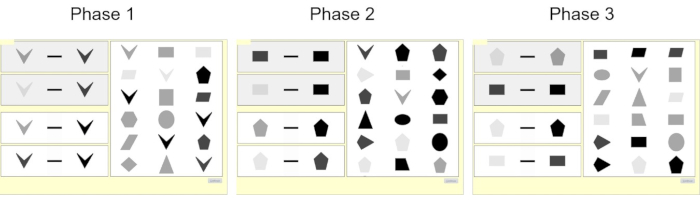
Figure 3. Examples of screen of each relationship in the three phases of the Experiment 1. Please click here to view a larger version of this figure.
- Procedure
- Ordering task
- Present the ordering task on a screen with two zones, as shown in the left part of Figure 4. The upper zone of the screen showed a row of four empty boxes.
- In the lower zone, show four figures with each varying on a saturation continuum.
- Have participants order, from "darker to lighter" (or vice versa), the four figures in each one of the upper empty boxes, using the mouse pointer.
- When stimuli were correctly placed, present a new trial. If stimuli were incorrectly ordered, withdraw the stimuli and have a text indicating "incorrect" in the right upper side of the screen. Then repeat the trial two more times.
- After this, present a new trial.
- Present two blocks of 6 different trials, one for the "darker to lighter" sequence and one for the "lighter to darker" sequence.
- At the beginning of the task, present participants with the following instructions on the screen: "In the upper section of the screen four empty spaces are presented, you must fill them by placing in order the figures located in the lower section." When the ordering criterion changed, present a text informing that figures should be place in the opposite order.
- Ordering task
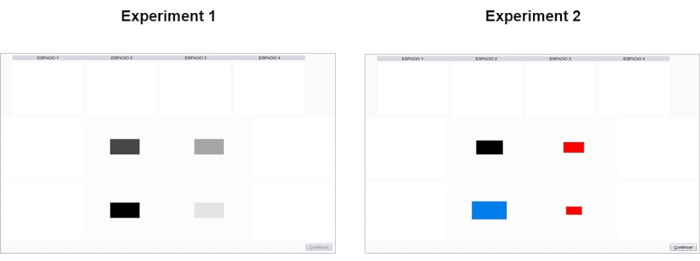
Figure 4. Examples of screen in ordering task in Experiment 1 and 2. In the upper zone are the empty spaces to order the figures shown in the lower zone. Please click here to view a larger version of this figure.
- Comparison task
- Have participants form two relational compounds (CRC) involving two stimuli, each one according to the exemplified relation shown by a pair of sample relational compounds (SRC).
- Form comparison compounds by placing stimulus objects taken from the bank zone.
- Arrange stimuli according to the features above described in terms of modality, absolute value, and relational value relative to a relationship criterion, in this case, saturation.
- Form each comparison compound (CRC) with the same stimulus object (shape) but with two different values in saturation, according to a "darker than" or "lighter than" relationship criteria shown by SRC.
- In each experimental phase, a different relationship criterion applied regarding the stimulus objects being compared (Table 1).
- In the first phase, have each trial include a similar stimulus object in terms of its shape in the four compounds (left screen in Figure 3).
- In the second phase, use a different stimulus object (shape) for the sample and comparison compounds (middle screen in Figure 3).
- In the third phase, have both sample and comparison compounds include different stimulus objects in each of the two relational pairs (right screen in Figure 3).
- Vary stimulus shapes in every trial from a set of five relevant shapes.
- Place stimuli in each box of the comparison compound by using the mouse pointer.
- There was no restriction regarding the order of placements in CRC. The set of placements to complete each trial was called a placement sequence.
- Have participants make as many placements and stimulus changes as they wanted before placing the fourth stimulus and completing both CRC.
- The minimum number of placements to complete a trial was four, one placement for each empty box in the CRC zone. Changes of placed figures were called excessive placements.
- At the beginning of the first training session, present participants with the following instructions on the screen: "There are two spaces in the upper left part of the screen, each with a pair of figures that exemplify how the figures have to be set. In the lower left part of the screen there are two spaces, each with two empty boxes, you must fill these boxes with two figures that go together, as the ones in the upper left, you do this by selecting the figures from those presented in the right side of the screen. To select the figures, place the cursor on the figure you want to use, click on the figure with the left mouse button and drag it to the space where you want to place it. Release the left mouse button, the figure will be placed in the space you choose. If you want to change the figure you chose, follow the same procedure, and place the new figure on the space of the previous figure. If your answer is correct, you will advance to the next window. If your answer is incorrect, the word "incorrect" will appear in the upper right part of the screen, the figures will disappear from the spaces where you had placed them and you will have to choose other figures, following the same procedure. For each window you have a maximum of 3 possible errors, if you accumulate 3 errors, you will automatically advance to the next window".
- At the beginning of the first test session, present participants with the following instructions on the screen: "Solve the task in the same way as in the previous block. When you have completed all four spaces with the arrangement that you consider correct, click the "Continue" button, located at the bottom right of the screen to proceed to the next window. This time you will not be told if your answer is correct or incorrect".
2. Dynamics of relational behavior under restriction of behavioral patterns
NOTE: Two sophomore students, 19 and 21 years old, respectively, participated. Students were awarded an extra point in one of their subjects, regardless of their scores obtained in the experiment.
- Apparatus and experimental situation
- Use the same ones described in Experiment 1.
- Experimental design and task
- Use the task as described in Experiment 1.
NOTE: The difference was that in this experiment, the employed SOs varied in four different sizes: smaller (50 x 33 pixels), small (66 x 42 pixels), large (82 53 pixels), and larger (106 x 66 pixels), with four different colors randomly assigned: blue, yellow, red, and black, as shown in the right part of Figure 1. - Present SOs in a computer screen, divided in three zones, as shown in the right part of Figure 2. In this case SRC 1 and 2 exemplified two degrees of size relationship "larger or smaller than" with the same shape.
- As in Experiment 1, in order to place the figures in the CRC zone, have the participant select the figure with the mouse pointer and drag it to the blank spaces in the CRC zone.
- Place figures in different sequences (called placement sequences) and change (figure changes were called excessive placements) depending on the experimental condition. Placement sequences and excessive placements were considered as local patterns.
- Two sub-experiments of restriction of local patterns were used (Table 2), each participant was assigned to one of two sub-experiments.
- Conform each sub-experiment according to the combination of restrictions or non-restrictions of placement sequences and excessive placements.
- In both sub-experiments, employ three training sessions with 36 trial each (18 "larger than" and 18 "smaller than", randomized), and one test session consisting of 36 trials each (18 "larger than" and 18 "smaller than", randomized). In addition, training and test sessions involved a relationship criterion in terms of the SOs being used.
NOTE: An example of the screen of relationship criteria is shown in Figure 5.
- During training, after each trial, present the word "correct" or "incorrect", depending on the CRC conformed.
- If the answer was correct, display a new trial. If the answer was wrong, display the same trial up to two more times (corrective trials).
- Present test trials without feedback and show only once.
- As in Experiment 1, before the first experimental phase, conduct one session of an "ordering task". In this case, participants could place each type of stimulus component along a size continuum.
- Use the task as described in Experiment 1.
| Sub-Experiments | ||
| P1 No restriction of placement sequences and excessive placements | Training | Test |
| P2 Restriction of placements sequences and restriction of excessive placements |
Table 2. Design of Experiment 2
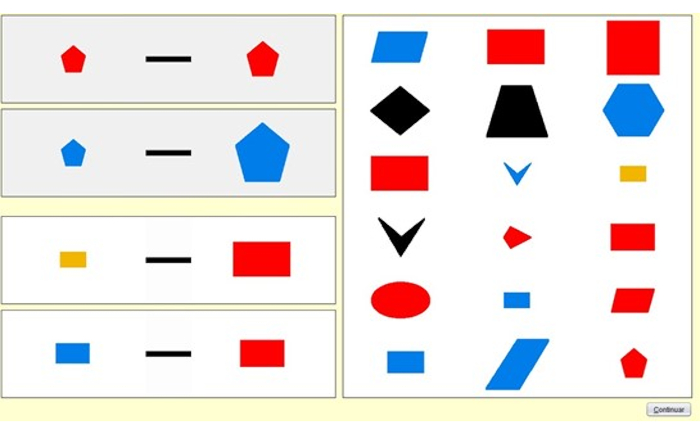
Figure 5. Example of screen of relationship criteria in the four sessions of the Experiment 2. Please click here to view a larger version of this figure.
- Procedure
- Ordering task
- Use the ordering task as described in Experiment 1. The difference was that four figures shown in the lower zone varied on a size continuum. So, participants had to arrange the figures from "larger to smaller" (or vice versa), as shown in the right part of Figure 4.
- Comparison task
- Use the task as described in Experiment 1, the difference was that in each condition, in training and test sessions, a relationship criterion was set in terms of the size (larger or smaller than) and the type (shape) of SOs (see Table 2).
- Have the stimulus objects used in the CRC zone comply with the "larger or smaller than" relationship, had to vary the degrees of size and be different in shape with respect to the SRC (see the right part of Figure 2).
- Differ each sub-experiment in terms of restriction or not of local patterns: 1) in the first one, the placement sequences could vary, and it was allowed to have excessive placements, 2) in the second one, placement sequences and excessive placements were restricted. In the condition with restrictions participant were not informed about it.
- Ordering task
Access restricted. Please log in or start a trial to view this content.
Results
EXPERIMENT 1:
The behavioral continuum of each participant was analyzed. Analysis included comparison of excessive placements and variety of placement sequences, latencies in seconds between placements, choice of permutable, non-permutable and irrelevant stimuli, and correct (correct trials regardless of the number of placements or use of corrective trials) and accurate trials (correct trials with four placements and without corrective trials).
In the ordering task, which ...
Access restricted. Please log in or start a trial to view this content.
Discussion
The proposed paradigm expands and deepens the systematic study of relational behavior in humans in the framework of the transposition paradigm. On the one hand, it allows the analysis of some factors and parameters previously studied in the area - e.g., stimulus modality2,5,10,23,26; difference or disparity between stimuli4,<...
Access restricted. Please log in or start a trial to view this content.
Disclosures
The authors have nothing to disclose.
Materials
| Name | Company | Catalog Number | Comments |
|---|---|---|---|
| Pentium Laptop Computer | - | - | Monitor must be a minimum of 14", and windows processor. |
| Keyboard | - | - | - |
| Optic Mouse | - | - | It is suggested to use a device other than the touchpad to be used as a mouse. |
| RbDT | https://osf.io/7xscj/ |
References
- Lloyd Morgan, C., et al. An Introduction To Comparative Psychology. , Available from: http://archive.org/details/in.ernet.dli.2015.174177 (1903).
- Köhler, W. Simple structural functions in the chimpanzee and in the chicken. A source book of Gestalt psychology. , 217-227 (1918).
- Spence, K. W. The differential response in animals to stimuli varying within a single dimension. Psychological Review. 44 (5), 430-444 (1937).
- Lazareva, O. F., Wasserman, E. A., Young, M. E. Transposition in pigeons: reassessing spence (1937) with multiple discrimination training. Animal Learning & Behavior. 33 (1), 22-46 (2005).
- Reese, H. W. The Perception of Stimulus Relations: Discrimination Learning and Transposition. , Academic Press. (2013).
- Ribes-Iñesta, E., León, A., Andrade-González, D. E. Comparison patterns: An experimental study of transposition in children. Behavioural Processes. 171, 104024(2020).
- Andrade-González, D. E., León, A., Hernández-Eslava, V. Tarea de transposición y contactos funcionales de comparación: Una revisión metodológica y empírica. Acta Comportamentalia: Revista Latina de Análisis de Comportamiento. 28 (4), 539-565 (2020).
- Lazareva, O. F. Relational learning in a context of transposition: A review. Journal of the experimental analysis of behavior. 97 (2), 231-248 (2012).
- Lazareva, O. F., Young, M. E., Wasserman, E. A. A three-component model of relational responding in the transposition paradigm. Journal of Experimental Psychology: Animal Learning and Cognition. 40 (1), 63-80 (2014).
- Leighty, K. A., Grand, A. P., Pittman Courte, V. L., Maloney, M. A., Bettinger, T. L. Relational responding by eastern box turtles (Terrapene carolina) in a series of color discrimination tasks. Journal of Comparative Psychology. 127 (3), 256-264 (2013).
- Lazareva, O. F., McInnerney, J., Williams, T. Implicit relational learning in a multiple-object tracking task. Behavioural processes. 152, 26-36 (2018).
- Vatsuro, E. G., Kashkai, M. D. A Comparative Investigation of Transposition of Learning: (In Normal Children of Various Ages and in Mental Deficients; in Apes and in Monkeys). Soviet Psychology and Psychiatry. 4 (1), 16-25 (1965).
- Kuenne, M. R. Experimental investigation of the relation of language to transposition behavior in young children. Journal of Experimental Psychology. 36 (6), 471(1946).
- Rudel, R. G. Transposition of response by children trained in intermediate-size problems. Journal of Comparative and Physiological Psychology. 50 (3), 292-295 (1957).
- Rudel, R. G. Transposition of response to size in children. Journal of Comparative and Physiological Psychology. 51 (3), 386-390 (1958).
- Zeiler, M. D. Transposition in adults with simultaneous and successive stimulus presentation. Journal of Experimental Psychology. 68 (1), 103-107 (1964).
- Alberts, E., Ehrenfreund, D. Transposition in children as a function of age. Journal of Experimental Psychology. 41 (1), 30-38 (1951).
- Johnson, R. C., Zara, R. C. Relational learning in young children. Journal of Comparative and Physiological Psychology. 53 (6), 594-597 (1960).
- Lazareva, O. F., Miner, M., Wasserman, E. A., Young, M. E. Multiple-pair training enhances transposition in pigeons. Learning & Behavior. 36 (3), 174-187 (2008).
- Marsh, G. Relational learning in the pigeon. Journal of Comparative and Physiological Psychology. 64 (3), 519-521 (1967).
- Pushkina, A. G. Mechanisms of Transposition of Relations in Preschool-Age Children. Soviet Psychology. 9 (3), 213-234 (1971).
- Jackson, T. A., Dominguez, K. Studies in the transposition of learning by children: II. Relative vs. absolute choice with multi-dimensional stimuli. Journal of Experimental Psychology. 24 (6), 630-639 (1939).
- Jackson, T. A., Jerome, E. Studies in the transposition of learning by children: IV. A preliminary study of patternedness in discrimination learning. Journal of Experimental Psychology. 26 (4), 432-439 (1940).
- McKee, J. P., Riley, D. A. Auditory Transposition in Six-Year-Old Children. Child Development. 33 (2), 469(1962).
- Riley, D. A. Experiments on the development of pitch and loudness as psychological dimensions. Anthropology & Medicine. 13 (5), 312-318 (1965).
- Jackson, T. A. Studies In The Transposition Of Learning By Children: III. Transpositional Response As A Function Of The Number Of Transposed Dimensions. Journal of Experimental Psychology. 25 (1), 116-124 (1939).
- Lawrence, D. H., Derivera, J. Evidence for relational transposition. Journal of Comparative and Physiological Psychology. 47 (6), 465(1954).
- Derenne, A., Garnett, A. M. Effects of Successive and Simultaneous Stimulus Presentations on Absolute and Relational Stimulus Control in Adult Humans. The Psychological Record. 66 (1), 165-175 (2016).
- Stevenson, H. W., Iscoe, I., McConnell, C. A developmental study of transposition. Journal of Experimental Psychology. 49 (4), 278-280 (1955).
- Yamazaki, Y. Transposition and its generalization in common marmosets. Journal of Experimental Psychology: Animal Learning and Cognition. , 20140505(2014).
- Kroupin, I., Carey, S. Population differences in performance on Relational Match to Sample (RMTS) sometimes reflect differences in inductive biases alone. Current Opinion in Behavioral Sciences. 37, 75-83 (2021).
- Wasserman, E. A., Young, M. E., Castro, L. Mechanisms of same-different conceptualization: entropy happens. Current Opinion in Behavioral Sciences. 37, 19-28 (2021).
- Kotovsky, L., Gentner, D. Comparison and Categorization in the Development of Relational Similarity. Child Development. 67 (6), 2797-2822 (1996).
- Gibson, E. J. Principles of perceptual learning and development. , Appleton-Century-Crofts. East Norwalk, CT, US. (1969).
- Lombardo, T. J. The Reciprocity of Perceiver and Environment: The Evolution of James J. Gibson's Ecological Psychology. , Routledge. (2017).
- Turvey, M. T. Lectures on Perception: An Ecological Perspective. , Routledge. (2018).
- Gibson, J. J. The Ecological Approach to Visual Perception: Classic Edition. , Psychology Press. (2014).
- Gibson, J. J. A theory of direct visual perception. Vision and mind: selected readings in the philosophy of perception. , (2002).
- Zinchenko, V. P., Chzhi-tsin, V., Tarakanov, V. V. The Formation and Development of Perceptual Activity. Soviet Psychology and Psychiatry. 2 (1), 3-12 (1963).
Access restricted. Please log in or start a trial to view this content.
Reprints and Permissions
