The Utah Biomass Resources Group (UBRG) has scaled-up simple biochar kilns in an innovative approach to hazardous fuel reduction and biochar production using metal boxes, called Big Box kilns, that allow for in-woods biochar production. This article outlines Big Box biochar kiln operation and best practices.
Method Article
Big Box Biochar Kiln Operation and Best Practices
In This Article
Summary
Abstract
Big Box biochar kilns are an alternative to open pile burning that allows for in-woods biochar production in a simple metal box with no moving parts. This approach is based on technology used by charcoal makers for centuries but with a modern, mechanized approach. A mini-excavator or other piece of machinery is used to load, tend, and empty the kilns. This article will outline Big Box biochar kiln best practices, including the design, transportation, placement, loading, lighting, quenching, and dumping procedures for beginners developing their own Big Box biochar kiln programs.
Biochar production requires a low oxygen burning environment, and the Big Box kilns use a flame-cap (sometimes referred to as a flame-curtain) method to burn material with limited smoke production. These kilns have been designed to be easily transferred to the site using an adequately rated trailer. A mini-excavator or other piece of machinery is used to load, tend, and empty the kilns. The author is not aware of a more accessible means for people to sequester durable carbon on the farm, ranch, or in the backyard. This article outlines Big Box biochar kiln best practices, including the design, transportation, placement, loading, lighting, quenching, and dumping procedures for beginners developing their own Big Box biochar kiln programs.
Introduction
Hazardous fuels are a major problem on wildlands throughout the West1. As fire managers can do little to control the weather, controlling fuels is their best option2. The goal of this method is to provide a new, scalable tool for reducing waste wood while producing biochar in an economically and practically accessible manner. Foresters traditionally pile and burn material from logging and fuel reduction projects, but air quality restrictions and longer fire seasons have made open pile burning much more difficult over the past decades3. Furthermore, open pile burning has been shown to cause potential long-term damage to soils from the excessive heat4. All these challenges provide the reason why the UBRG is developing this technique for biochar production. The UBRG set out to provide a low-cost, high-accessibility approach to hazardous fuel reduction that results in a valuable product5. This approach of turning fuels into feedstocks and attempting to make value from low-value wood is rife with challenges. This approach conserves a portion of that carbon, which is otherwise lost to burning or rotting, and processes it into a durable form, with a half-life approaching 1,000 years in the soil6; this is 10-1,000 times longer than residence times of most soil organic matter7.
The Big Box kiln design process began with a review of other derivatives of a technology that originated in Japan. In 2011, Inoue et al.8 reported on the carbonizing efficiency and quality of biochar produced in the "smokeless charcoal kiln M50" manufactured by the Moki company in Japan. Biochar was produced in these small, cone-shaped kilns with conversion efficiencies ranging between 13% and 19.5% on a dry mass basis. The authors found that the values of fixed carbon and carbon content of the char were equal to those of charcoal made in a retort method at the temperature of about 600 °C.
The Big Box shape was first suggested by Kelpie Wilson in a feasibility study for the North Dakota Forest Service on carbonizing shelterbelt tree removals. Wilson suggested using a modified steel trash dumpster as a flame cap kiln for processing larger-sized material. The Big Box kiln design includes several improvements to the concept that help with durability, usability, and mobility, as described below. Wilson's figure includes suggestions for repurposing containers such as dumpsters and oil tanks for this purpose; however, repurposed material generally has been painted or galvanized and may expose workshop participants to harmful chemicals in the air.
Emissions from the Big Box Kiln have not yet been reported, but Cornelissen et al.9 conducted emissions testing on several different types of Kon-Tiki kilns (a deep cone kiln) and found that emissions were generally lower than those from open burning of biomass feedstocks. They also tested the biochars produced for polycyclic aromatic hydrocarbons (PAH) and found that PAH levels were well below the Norwegian maximum tolerable risk (MTR) level for soils. A life-cycle analysis of the Oregon Kiln (a shallow pyramid-shaped kiln) showed that the in-woods operation of a flame cap kiln was carbon-negative, resulting in a net sequestration of atmospheric carbon in soil10.
One limitation of the Big Box approach is wet feedstock. While two batches per day of large-diameter material in these kilns is a reasonable expectation in arid climates and dry feedstock, one batch a day is a more reasonable expectation in locations with higher humidity and fuel moisture. Dry feedstock is more productive; wet feedstock will limit the productivity of the kiln. Wet feedstock on a wet day does not work well. Wet feedstock less than 10 cm in diameter will pyrolyze more completely than larger-diameter wet feedstock. Dry material can easily be pyrolyzed in wet and/or snowy weather. Big Box kilns have successfully pyrolyzed kiln-length dry logs upwards of 0.76 m (30 inches) in diameter and branches down to less than 1 cm in diameter.
Kiln operation is treated like open pile burning by most air quality regulators and, in Utah, permission is only granted three days in advance, which makes planning difficult, especially in winter months when atmospheric inversions are common around our communities. The cost of conducting a biochar burn is much higher than simply burning the piles, which presents another limitation of this approach. This technique is the first published low-tech method for biochar production at a scale that forgoes expensive preprocessing of feedstocks such as grinding and chipping prior to pyrolyzing. This method is useful for most woody debris that has not been chipped or processed beyond cutting into manageable piece sizes. This method is not useful for small piece-size feedstocks or feedstocks that will form mats or globs of material such as grasses, corn stover, and rice hulls.
Kiln design
The BB12 is a double-walled kiln that is 3.7 m (12 feet) long, 1.8 m (6 feet) wide, and 1.2 m (4 feet tall), made from 14-gauge steel. The size and shape can be varied. Plans are available on the UBRG Website11. No air is allowed into the kiln except at the top; this is critical to developing the flame cap that consumes most of the combustibles as they rise through the heat column. See Figure 1 for details of the inside corners of the kiln. The exception is a drainage port, referred to as the dog door, shown in Figure 2 because it is similar in size to a common dog door. It has a sliding piece of metal with a handle so it can be pushed down closed when operating the kiln and lifted (Caution: Hot) when ready to dump the kiln.
The two walls are separated to provide an air gap12 and are open on the top and not completely sealed on the bottom, except on the interior of the kiln. See Figure 3 for details of the air gap and the top of walls. Avoid sealed spaces to avoid problems during heat expansion and resultant contraction. Single-walled kilns are still effective at reducing hazardous fuels and producing biochar, but the double-walled kiln allows for equipment and operators to get close with less heat exposure. If biochar production is the most important goal, a double-walled kiln might be more effective. If hazardous fuels reduction is the primary goal and biochar is secondary, a single-walled kiln is likely adequate.
Protocol
1. Transportation to site
- Load the BB12 onto a trailer for transport using either a mini-excavator (with thumb) and chains OR a 4 x 4 forklift, utilizing the fork pockets.
NOTE: All further references to the mini-excavator assume it has an operable thumb with the bucket. - Secure the kiln to the trailer with ratchet straps with a breaking strength of over 1,361 kilograms (3,000 lbs.) each. See Figure 4 for an example.
- Unload the kiln using the mini-excavator or forklift or tie it to a tree/vehicle and drive away, allowing it to fall on the ground. Once at the site, drag the kiln on the ground on its skids using a pickup truck and straps.
2. On-site preparation
- Place the BB12 on a relatively flat surface (slopes < 10%) fairly close to the pile of wood, ensuring the dog-door draining panel is on the downhill side, if on a slope.
NOTE: Keep the dog-door draining panel closed during operation. - Select feedstocks, which can be any woody species. Use small, dry material to get the kiln going, especially when working with wet feedstock.
- Gather and pile an adequate amount of feedstock to feed the kiln. Cut all the feedstock to a length that is shorter than the maximum dimension of the kiln so it fits in easily.
3. Hazard reduction
- Before ignition, check with local fire and air quality authorities to ensure that the fire danger is not too high for ignition and that the air quality regulations do not impact burning plans. Be sure to alert local fire authorities of plans before ignition.
- Before ignition, build a fire line (1 foot-wide trail scraped down to mineral soil) entirely around the kiln to prevent a fire from creeping away. Ensure there is a charged hose connected to an adequate water supply, dependent on the current fire hazard, for fire control before igniting the kiln.
4. Loading and lighting kiln
- Load the kiln randomly with feedstock using the mini-excavator; the size/order of adding the feedstocks does not matter. See Figure 5 for an image of a loaded kiln.
- Pile a layer of smaller-diameter fuels (feedstock) on top of the kiln to aid in quick ignition.
- Once loaded, light the kiln with a drip torch, propane torch, or other ignition device by lighting the top of the kiln first. See Figure 6 for images of lighting the kiln and kiln operation.
5. Tending kiln
- Allow the kiln to burn down and add fuels as the fire allows; expect a short period of smoke production after materials are added to the kiln. Observe that the flame cap will soon reform and continue to consume the combustibles as they rise through the heat/smoke column. Tend the kiln similar to a campfire; adding too much fuel at once will smother the fire, but too little will cause the fire to go out. See Figure 7 for an image of a flame cap.
- Monitor the kiln and surrounding vegetation for escaped sparks or embers that can cause unwanted ignition.
- Continue tending/loading the kiln this way until the kiln is full/ the feedstock is depleted/the end of the shift.
6. Quenching
- When the kiln is full or nearly full of coals and the flaming combustion gives way to smoldering or glowing combustion, quench to halt combustion and preserve the coals. Figure 8 shows a kiln ready to quench.
- Use a 3.8 cm (1.5 inch) diameter hose and water pump (often referred to as volume pump or trash pump at rental stores) from a water source or water truck to quench the kiln using approximately 300 gallons of water. Drown the coals; continue adding water until the coals are in standing water and stir using the mini-excavator to eliminate dry hot spots and continued combustion. Figure 9 demonstrates quenching with a hose.
- Once the kiln is fully quenched, open the dog door to drain out the water, which will make the kiln lighter for tipping out the biochar.
7. Tipping
- Once the kiln is completely quenched and drained, dump the contents onto the ground adjacent to the kiln.
- Prepare the area first by using the machine to construct a fire line around the space where the coals will be, and scrape away any fuels, including grass, sticks, brush, and logs from this space.
- Use the machine and chains/straps to pull the kiln over towards the machine. Figure 10 shows the kiln being tipped by the mini-excavator.
- Monitor the boom/hydraulic hoses/fittings of the mini-excavator for heat exposure; occasionally place the back of a hand first near and eventually on these parts to ensure they are not too hot to touch; if so, allow them to cool immediately.
8. Cold trailing
- Before leaving the site, ensure the fire is out by moving hands through the entire amount of biochar that was produced. Make sure that it is completely cool to the touch to call the fire out.
NOTE: The BB12 comes with lids that can be used for safety purposes; if an emergency were to occur, such as an escaped fire or injury, the lids can be placed on the kiln to prevent sparks/embers from exiting the kiln and the area can be evacuated safely. The procedure can be stalled at any time. In high-humidity locations where fire danger is generally low, lids may not be necessary.
Results
From October to March, Big Box kilns pyrolyzed various types of feedstocks into biochar (Table 1). The drier and cleaner the fuels are, the more productive the kilns are. The diameter of the fuels is less important, the kilns have pyrolyzed full-length logs upwards of 76 cm diameter; however, if biochar production is the most important aspect of the project, it is necessary to note that filling the kilns with more consistently sized feedstock may yield the highest output of biochar. The kilns can be operated in such a way as to maximize biochar production, or they can be operated to maximize hazardous fuel consumption, or they can be operated to focus on any point along the continuum between these somewhat opposite goals.
The lids are heavy and sharp and must not be handled alone. Figure 11 shows the lid being moved by two people. It is best to have 2-3 people tending the kiln; one operating the machine, and the others keeping a lookout for escaped spot fires, cutting any material with a chainsaw that is too long to go into the kiln, picking up small pieces of burning material that may have fallen out of the kiln.
The skids on the bottom of the kiln allow it to be dragged short distances. The kilns can be dragged at least a quarter mile, on dirt roads and over the ground. Figure 12 shows the kiln being towed. When the last part of a feedstock pile is put in the kiln, instead of completing the batch and quenching a partially full kiln, it is more efficient to drag the kiln between piles while it is operating, using a pickup truck and straps. There are eyelets near the bottom of the kiln to attach straps or chains for dragging. Then, once at a fresh pile, operators can continue loading the kiln as per directions.
There will usually be logs that do not completely pyrolyze into biochar that can be added to the next kiln burn or can be spread in the forest as coarse woody debris, which offers ecological advantages or can be used for Hügelkultur applications (wood is mounded and buried to create a raised garden bed). Figure 13 shows incompletely pyrolyzed logs, sometimes called bones.

Figure 1: Inside empty kiln. Inside of an empty kiln; note the lack of air gaps. Please click here to view a larger version of this figure.

Figure 2: Open dog door. The dog door is partially opened and water is flowing out of the kiln after quenching is complete. Please click here to view a larger version of this figure.

Figure 3: Gap between walls. The gap between the walls of the kiln, demonstrating no sealed cavities. Please click here to view a larger version of this figure.

Figure 4: Kiln secured for transport. Strapping and trailer are used to transport the kiln safely. Please click here to view a larger version of this figure.

Figure 5: Loading the kiln. The kiln is being loaded with Russian olive wood, demonstrating the loading method and lack of organization within the kiln. An example of a kiln loaded with light feedstocks. Please click here to view a larger version of this figure.

Figure 6: Lighting kiln. The operator is using drip torch to top-light a loaded kiln. An example of a kiln loaded with heavy materials. Please click here to view a larger version of this figure.

Figure 7: Flame cap. Flame cap formed over the top of the kiln, very little visible smoke coming from kiln; clean view to the landscape in the background. Please click here to view a larger version of this figure.

Figure 8: Ready to quench. A nearly full kiln shifting from flaming combustion to glowing combustion; the point at which the quench commences. Please click here to view a larger version of this figure.
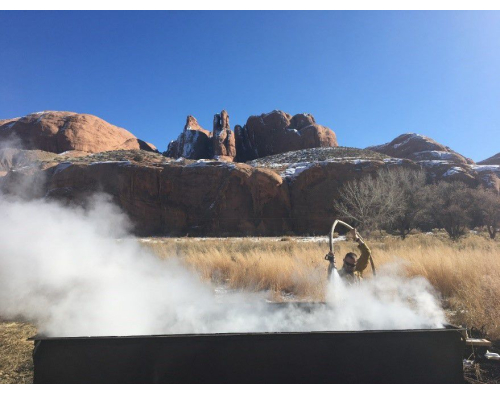
Figure 9: Quench. A fire hose is being used to put approximately 1,100 liters of water on the coals in the kiln to halt combustion and preserve the char. Please click here to view a larger version of this figure.

Figure 10: Tipping. A mini-excavator is used to tip a BB16 Big Box biochar kiln to empty the char and start another batch. Note a second kiln operating in the background; one machine can operate several kilns simultaneously. Please click here to view a larger version of this figure.

Figure 11: Lids. Two operators wearing heavy leather gloves work together to place a lid on the kiln. Please click here to view a larger version of this figure.

Figure 12: Towing. Straps are used to attach the (still burning) kiln from the bottom eyelets to a pickup truck and drug over a dirt road to the next pile of feedstock. Please click here to view a larger version of this figure.

Figure 13: Bones. Incompletely pyrolyzed material, called bones, from the previous batch is added to a kiln before a new batch is started. Please click here to view a larger version of this figure.
| Big Box kilns in | Pyrolysis of | Biochar | |
| Logan Ranger District of Uinta-Wasatch-Cache National Forest in November | 22,000 kg | juniper | 14 cubic meters |
| Moab, Utah in January | 1,200 kg | Russian Olive feedstock | 8 cubic meters |
| Mill Hollow in Uinta-Wsatch-Cache National Forest in November | 25,000 kg | large-diameter Engelmann Spruce and subalpine fir | 16 cubic meters |
| Near Dillon, Montana, in October | 10,000 kg | Douglas fir feedstock | 10 cubic meters |
| Pine Valley Ranch, Utah, in March | 24,000 kg | quaking aspen, subalpine fir, Engelmann Spruce feedstock | 14 cubic meters |
Table 1: Pyrolysis of various feedstocks by Big Box kilns.
Discussion
Typically, a portion of the biochar produced on the site is collected by workshop participants in buckets or bags and applied to people's gardens or agricultural projects. Biochar is friable and can be broken into small pieces to more readily incorporate into the soil by driving over it with a vehicle, stepping on it with a hard surface beneath, or mashing it with the bucket of the mini-excavator. This material can also be referred to as charcoal and has been collected for outdoor charcoal cooking, potentially providing a locally sourced material to add to the culinary features of a meal.
Comparing Big Box flame cap biochar kilns to other biochar production methods12, mobile carbonizers can process 63,502 kg per day (70 tons), compared with 12,500 kg per day with a Big Box kiln. The cost of mobile carbonizers is much higher than a Big Box kiln, starting at $500,000 to purchase, as opposed to less than $10,000 to have a Big Box kiln manufactured. Although a single Big Box kiln can process only 20% of the material that a mobile carbonizer can, it will cost only 2% of the purchase price of a mobile carbonizer.
Heated auger kilns can process up to 5,443 kg of biomass per day, as another example, which is much lower than the 12,500 kg per day capacity of Big Box kilns. Additionally, the cost of preprocessing (chipping) the material can be more than actually pyrolyzing the material. Furthermore, refined machines such as the heated auger will not tolerate soiled feedstock that is common in forestry operations; a shovelful of soil can shut down an auger kiln while a Big Box kiln can tolerate several shovelfuls of soil without significantly impacting the operation. Finally, the cost of an auger kiln can easily be 10 times that of a Big Box kiln.
The first Big Box kiln constructed is referred to as the BB16 as it measures 4.9 m (16 ft) long by 2.4 m (8 ft) wide and is a single-walled construction. It was originally 1.8m (6 ft) high and weighed close to 1,360 kg (3,000 lbs.), which required a larger excavator, a qualified operator, and a low-boy trailer, which led to scheduling challenges. This approach was oversized to deal with the typical Utah fuel loads, and at 1.8 m (6 ft) tall, it was very difficult to light or see what was going on down inside the kiln. To address these issues, to better scale this approach to Utah fuel loads, and to make it more accessible to the average forest manager, the height was reduced to 1.2 m (4 ft) tall. This makes it easier to see into and to ignite. It also got it down to 1,043 kg (2,300 lbs.), which made it manageable to transport with a more available pickup truck and trailer, and to move and operate with a mini-excavator that requires no previous experience and can be rented from most equipment rental shops.
The second kiln built by the UBRG is a double-walled construction, which allows for better heat protection to the operators and equipment near the kiln and allows for more even heating inside the kiln13. Part of this modification was to go from 12-guage steel to 14-gauge steel, which is thinner and lighter. The UBRG has done dozens of burns in these kilns and while they do get a little bent up in spots, they are not yet showing any obvious signs of heat-related metal fatigue. Certainly, additional learning is likely to occur and there is ample room for continued innovation.
The double-walled BB12 is the design that has garnered the most attention and is perhaps the most accessible/practical for fuels in the Intermountain West. Larger kilns will be more appropriate with more/larger fuels, such as the Northwest US. This method has been proven up to a 4.9 m (16-ft-long kiln). To date, Big Box kilns have been built by other parties in Utah, Colorado, Montana, Texas, and New York.
The kilns can be operated to maximize biochar production or maximize hazardous fuels reduction, or somewhere between. If hazardous fuel reduction is the primary goal, then the kilns can be loaded randomly and quenched only when the kiln is full of coals. If surrounding fire danger is low, such as when the ground is covered in several centimeters of snow, the kilns can be stacked high with fuels in the evening before the end of the shift and left to burn all night; thus, consuming fuels in a controlled space. If biochar production is the primary goal, the feedstock can be sorted into like sizes and the kilns loaded with similar size class material and quenched frequently to preserve the coals. Typically, it is a mixture of these opposing goals and the kilns are operated between these two extremes. The species of the feedstock is less important unless a biochar with specific properties is the goal.
A limited amount of smoke comes out of these kilns; the idea is that the flame cap consumes the combustibles as they rise through the column of heat. In 2019 and 2020, the Utah Smoke Management System Coordinator Paul Corrigan brought his emissions testing equipment to Big Box biochar kiln demonstrations near Logan, in northern Utah, and Moab, in southern Utah. In both cases, the equipment registered no increase in emissions from the kilns because the flame-cap consumes the combustibles as they rise through the heat column. In April of 2023, the USDA Forest Service Fire Lab's emissions testing team conduct emissions testing on the kilns in Tooele, Utah; these results are not yet available.
The workers tending the kiln will need firefighting hand tools such as shovels, rakes, Pulaskis, and chainsaws. Best practices include having all people present wear safety gear such as leather gloves, eye protection, fire-resistant clothing or at least natural fiber clothing; synthetic clothing must be avoided. Hard hats and leather boots, long sleeves, and pants help to protect operators.
Emergency communication; contingency planning: The location (often remote) of the operation must be considered in addition to the possibility of an emergency and the communication needs around that. It is crucial to know where local cell phone reception might work best; a satellite phone or emergency locator beacon such as a Garmin InReach would be highly recommended. It is important not to work alone.
In case of an escaped ember/spot fire, the lid must be placed on the kiln to prevent further sparks from exiting the kiln. The machinery must be used to quickly dig a fire line around the spot fire, and the burning fuels must be separated from the unburned fuels. The water source must be used to extinguish the fire. If extinguishment cannot be obtained immediately, call 911.
Biochar from Big Box kilns has been characterized by Control Laboratories in Watsonville, CA using the International Biochar Initiative (IBI) Laboratory Tests for Certification Program and the results show 85% Organic Carbon and 8% ash; these are the characteristics of a moderately high-quality biochar. Collaborators are experimenting with adding roll-off coasters on the bottom, similar to large garbage dumpsters, as well as a door that is one of the end-walls to aid in removing the finished biochar. It remains to be seen if these features remain operable after extreme heat exposure.
Disclosures
The author has no conflict of interest to declare.
Acknowledgements
I would like to acknowledge Kelpie Wilson of Wilson Biochar, the Utah Bureau of Land Management, the USDA Forest Service, the Utah Division of Forestry, Fire and State Lands, the Utah Public Lands Initiative Grant Program, the Utah State University Extension Grant Program, Brandon Barron of Burns, OR, ANR Fabrication of Logan, Utah, and the U.S. Biochar Initiative.
Materials
| Name | Company | Catalog Number | Comments |
|---|---|---|---|
| Big Box biochar kiln | ANR Fabrication | BB12 | Phone: 435-753-0310 |
| Chainsaw | Ace Hardware | #7000565 | Or similar |
| Drip torch | Forestry Suppliers | 7.58182E+11 | Fill with: 30% gasoline, 70% diesel (or propane torch) |
| Garmin InReach | Best Buy | 6499326 | Or similar |
| Honda self priming water pump | Northern Tool | Item# 109418 | Or similar |
| lighter / matches | Amazon | ||
| Log chains | Tractor Supply Co. | SKU: 358788199 | Or similar; for moving/lifting kiln |
| Mini-excavator with thumb | Local rental company | Must have a bucket with thumb | |
| Pulaski | Grainger | 485C27 | Or similar |
| Rachet straps | US Cargo Control | 3,000 lbs strength per | |
| Rags / cardboard | Grainger | 9JZ92 | To protect straps from abrasion while transporting kiln |
| Rake | Grainger | 1WG30 | Or similar |
| Shovel | Grainger | 12N166 | Or similar |
| Truck / trailer | Own/rent locally | For transporting kiln | |
| Water discharge hoses | Grainger | 45DT92 | |
| Water: 300 gallons per quench | Plus more for fire control | ||
| Personal Protective Equipment | |||
| Chainsaw chaps | Global industrial | T9FB2019133 | Or similar |
| Ear protection | Global industrial | T9F708377 | Or similar |
| Eye protection | Global industrial | T9F708119CLAF | Or similar |
| Fire pants | Grainger | 12R487 | Or similar |
| Fire shirt | Grainger | 39EM96 | Or similar |
| Hard hat | Global industrial | T9FB2278977 | Or similar |
| Leather gloves | Global industrial | T9FB1145414 | Or similar |
| Smokejumper fire boots | Whites Boots | Or similar |
References
- Hardy, C. C. Wildland fire hazard and risk: Problems, definitions, and context. Forest Ecology and Management. 211 (1-2), 73-82 (2005).
- Wollstein, K., O'Connor, C., Gear, J., Hoagland, R. Minimize the bad days: Wildland fire response and suppression success. Rangelands. 44 (3), 187-193 (2022).
- Hessburg, P., Reynolds, K., Keane, R., James, K., Salter, R. Evaluating wildland fire danger and prioritizing vegetation and fuels treatments. Forest Ecology and Management. 247 (1-3), 1-17 (2007).
- Busse, M. D., Shestak, C. J., Hubbert, K. R. Soil heating during burning of forest slash piles and wood piles. International Journal of Wildland Fire. 22 (6), 786-796 (2013).
- Galinato, S. P., Yoder, J. K., Granatstein, D. The economic value of biochar in crop production and carbon sequestration. Energy Policy. 39 (10), 6344-6350 (2011).
- Spokas, K. A. Review of the stability of biochar in soils: predictability of O:C molar ratios. Carbon Management. 1 (2), 289(2010).
- Duku, M. H., Gu, S., Hagan, E. B. Biochar production potential in Ghana-A review. Renewable and Sustainable Energy Reviews. 15 (8), 3539-3551 (2011).
- Inoue, Y., Mogi, K., Yoshizawa, S. Properties of cinders from red pine, black locust, and henon bamboo. Asia Pacific Biochar Conference, APBC Kyoto. , (2011).
- Cornelissen, G., et al. Emissions and char quality of flame-curtain "Kon-Tiki" kilns for farmer-scale charcoal/biochar production. PLoS ONE. 11 (5), e0154617(2016).
- Puettmann, M., Kamalakanta, S., Wilson, K., Oneil, E. Life cycle assessments of biochar produced from forest residues using portable systems. Journal of Cleaner Production. 250 (2020), 119564(2020).
- McAvoy, D. J. Utah Biomass Resources Website. , Available from: https://www.usu.edu/ubrg/biochar/simple-kiln-technology (2017).
- Adam, J. C. Improved and more environmentally friendly charcoal production system using a low-cost retort-kiln (Eco-charcoal). Renewable Energy. 34 (8), 1923-1925 (2009).
- Amonette, J. E., et al. Biomass to biochar: Maximizing the carbon value. Pullman, WA: Washington State University, Center for Sustaining Agriculture and Natural Resources. , Available from: https://csanr.wsu.edu/biomass2biochar/ (2021).
Reprints and Permissions
