Exclusive Endoscopic ossiculoplasty (EEO) is a promising and minimally invasive approach for the treatment of conductive hearing loss due to ossicular chain disruptions and associated middle ear pathologies. Herein, step-by-step instructions and a discussion of various endoscopic ossiculoplasty techniques are presented.
Method Article
Techniques of Endoscopic Ossiculoplasty
In This Article
Summary
Abstract
The utilization of endoscopes in modern otology has evolved from diagnostic purposes to the development of exclusive endoscopic ear surgery. This technique offers a panoramic view of the middle ear and provides an optimal magnification of the oval window region, the stapes' suprastructure, and the footplate, allowing great precision in prosthesis positioning during ossiculoplasty (OPL). Various techniques for ossicular chain reconstruction have been described in the literature. Either autologous or synthetic materials can be used for reconstruction. The use of a patient's own tissue minimizes the risk of implant rejection or extrusion of the prosthesis through the tympanic membrane. On the other hand, synthetic materials like titanium are light and rigid and do not require time-consuming prosthesis remodeling. The main objective of this article is to present a comprehensive step-by-step guide that serves as a surgical manual for exclusive endoscopic OPL. This guide will explain various forms of OPL using synthetic and autologous materials. The goal is to provide a comprehensive understanding of the various surgical techniques and support the integration into clinical practice.
Introduction
The use of endoscopes has become prevalent in modern otology. Originally used for diagnostic purposes, the endoscopic technique has gained popularity over time, leading to exclusive endoscopic ear surgery approaches. The endoscopic technique is performed through the auditory canal and requires precise and delicate maneuvers, as the technique must be performed single-handedly. It provides a panoramic view of the middle ear and allows access to hard-to-reach areas, facilitating the elimination of disease by using angled endoscopes1,2. In ossicular chain repair, modern high-definition (HD) or 4k endoscopy, along with its illuminative capabilities directed at specific structures of interest, such as the stapes or its footplate, greatly assists in the recognition of both anatomical and pathological variances3,4,5.
Ossicular chain destruction commonly results from chronic otitis media (COM), but trauma and neoplasms can alter the normal middle ear and, therefore, reduce its sound transmission capabilities6,7. Restoration of normal tympanic membrane (TM) and ossicular chain function has its roots in the 1950s8. The surgical techniques used to treat various pathologies of the middle ear aim not only to eliminate the underlying disease process but also to restore normal auditory function9.Over the past seven decades, various ossiculoplasty (OPL) techniques and prostheses have been studied and reported in the literature7,10,11. Bioinert materials like titanium gained popularity due to their lightweight, rigidity, and good visualization of their distal end during surgery. Nevertheless, these prostheses are quite expensive, and the reported rate of extrusion (1%-5%) is not negligible12. Autologous materials have demonstrated comparable effectiveness to synthetic prostheses. However, they do present certain drawbacks, such as longer surgical durations required for the remodeling process, the potential for retaining cholesteatoma, and availability limitations depending on the condition of the ossicular chain13,14.
According to Tsetsos et al., exclusive endoscopic ossiculoplasty (EEO) is associated with similar postoperative hearing results compared to the traditional microscopic approach15. A trend towards reduced morbidity and a shorter operative time for the endoscopic approach has been observed. Therefore, EEO can be considered a valid surgical option for reestablishing a functioning ossicular chain with acceptable hearing restoration in children and adults16.
This study aims to provide a comprehensive insight into the various technical refinements and latest developments for EEO. It presents different OPL techniques along with representative outcome data.
Protocol
The study protocol conformed to the guidelines of the Human Research Ethics Committee of the Inselspital Bern and was approved by the local review board (KEK-BE 2019-00555). Informed written consent was obtained from all human subjects involved in the study. All surgical procedures were performed under general anesthesia (following institutionally approved protocols) with controlled hypotension, using standard otologic instruments and appropriate hemostasis17,18. Surgical site preparation, exclusive transcanal access, middle ear examination, and defect closure of the TM are described in previously published articles by Beckmann et al. and Anschuetz et al.19,20. Additional reconstructive measures, most frequently tympanoplasties, are often required19. Usually, the OPL is performed in the end after positioning the grafts for tympanoplasty or scutum reconstruction. However, these techniques will not be covered in this protocol. Moreover, many other OPL techniques are described in the literature21,22. This article covers the methods with which we have a strong and positive experience. Figure 1 illustrates the technique for partial ossicular replacement, and Figure 2 shows the technique for total ossicular replacement. The surgical tools and the equipment needed are listed in the Table of Materials.
1. Incus interposition
- Use a needle dissector to dissect and detach the chorda tympani from the long process of the incus and proceed to slightly resect the scutum with a bone curette.
NOTE: Resection of the scutum provides wide access to the posterior mesotympanum and helps to identify the incudostapedial joint between the long process of the incus and the stapes head20. - Identify the incudostapedial joint and cautiously disarticulate the lenticular process from the stapes head using a microhook or a small round knife. Then, gently push the incus upward to detach it from the head of the malleus. Remove the incus by pulling the long process inferiorly and then laterally. Preserve the detached incus for its intended use in the interposition procedure.
- Thoroughly examine the incus for any signs of erosion, ensuring its appropriateness for the upcoming reconstruction.
- Grind the graft using the following steps23:
- Hold the incus using a grasping forceps.
- Use a diamond burr to carefully drill both the long and short processes of the incus until the level of the incus body is reached.
- On the opposite side of the former long process, drill an acetabulum approximately 1 mm wide to accommodate the stapes head.
- Verify that the length of the interposition aligns with the range of 2-2.5 mm, depending on the anatomy of the patient.
- Utilize a microsuction tip and/or a needle to position the remodeled incus inside the tympanic cavity and to precisely locate the acetabulum onto the stapes head and, if appropriate, the anterior surface in contact with the malleus handle.
2. Malleus head interposition
- After removal of the incus (step 1), identify the malleus and dissect the chorda tympani away from its neck.
- Use the malleus nipper to transect the malleus neck and remove its head for its intended use in the interposition procedure.
- Thoroughly examine the malleus head for any signs of erosion, ensuring its appropriateness for the upcoming reconstruction.
- Grind the graft using the following steps24:
- Hold the malleus head using a grasping forceps.
- If the whole malleus is used, use a diamond burr to carefully drill both the manubrium, lateral, and anterior process until the level of the malleus neck is reached.
- On the malleus head, drill an acetabulum approximately 1 mm wide to accommodate the stapes head.
- Verify that the length of the graft is approximately 2-2.5 mm, depending on the anatomy of the patient.
- After carrying the graft towards the tympanic cavity, utilize a microsuction tip and/or a microhook/needle to position the malleus head interposition precisely onto the stapes head.
NOTE: Appropriate treatment of the underlying middle ear pathology often requires resection of the incus and the malleus. As long as the incus body remains intact, it is suitable for an interposition graft. Use the malleus head interposition in cases where the incus is absent or eroded, and the malleus head is still intact.
3. Partial ossicular replacement prosthesis (PORP)
- Confirm the integrity of the stapes suprastructure and ensure that both malleus head and incus are missing or unsuitable for use in interposition ossiculoplasty.
- Assess the size of the defect and decide on the size of the implant. Many different products are commercially available; here, the use of a titanium-based implant is exemplarily shown. Choose the appropriate size of the implant or trim the titanium shaft to the desired length. No pressure should be exerted on the stapes suprastructure to avoid stretching of the annular ligament.
- After carrying the prosthesis towards the tympanic cavity, utilize a microsuction tip and/or a microhook/needle to position the foot of the PORP precisely onto the stapes' head.
- Brace the head of the PORP against the manubrium (if present). Cover the head of the prosthesis with cartilage, and ensure that the implant slightly tents the TM.
4. Double cartilage block (DCB) PORP
- Confirm the integrity of the stapes suprastructure and ensure that both malleus head and incus are missing or unsuitable for interposition OPL.
- Prepare the double-cartilage block (DCB) graft using the following steps25:
- Obtain a rectangular block of tragal or conchal cartilage and remove the perichondrium on one side only.
- Use a scalpel to cut the cartilage in half; avoid transecting the perichondrium on the opposite side.
- Create a shallow acetabulum approximately 1 mm wide to receive the stapes capitulum on the block free from perichondrium.
- Fold the cartilage block on the intact perichondrium.
- Utilize a microsuction tip and/or a microhook/needle to position the DCB precisely onto the stapes head. Establish a contact to the manubrium of the hammer if applicable.
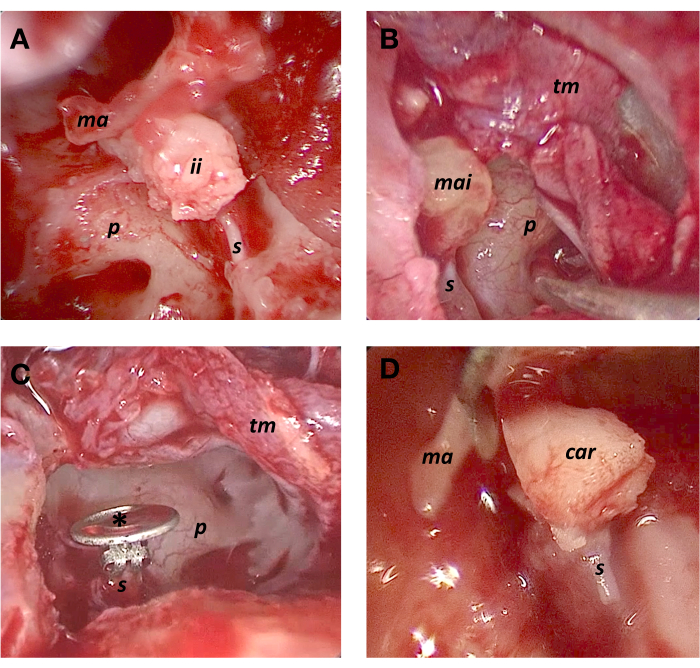
Figure 1: Techniques of partial ossicular replacement. (A) Incus interposition (ii). (B) Malleus head interposition (mai). (C) PORP (*). (D) DCB PORP (car). Abbreviations: malleus (ma), promontory (p), stapes (s), tympanic membrane (tm). Please click here to view a larger version of this figure.
5. Total ossicular replacement prosthesis (TORP)
- Confirm the integrity of the stapes footplate and clean it from disease, adhesions, or scars.
- Assess the size of the defect between the TM and the footplate and decide on the size of the implant. Many different products are commercially available; here, the use of a titanium-based implant is exemplarily shown. Choose the appropriate size of the implant or trim the titanium shaft to the desired length. Ensure the implant slightly tents the TM without exerting too much pressure on the footplate.
- Utilize a microsuction tip and/or a needle to position the TORP inside the tympanic cavity and to locate the foot of the TORP precisely onto the stapes footplate.
- Brace the head of the TORP against the manubrium (if present) and cover its head with cartilage.
6. Semi-synthetic total ossicular replacement prosthesis (ssyTORP)
- Confirm the integrity of the stapes footplate and clean it from disease, adhesions, or scars.
- Prepare the semi-synthetic prosthesis26:
- Choose a platinum/polytetrafluoroethylene (PTFE) stapedotomy prosthesis according to the intended size of the reconstruction.
- Cut the platinum wire at the base of the hook.
- Obtain a cartilage block from the tragal or conchal cartilage. According to the distance between the TM and the footplate, create a 5 mm long ssyTORP.
- Create one square block of tragal cartilage with perichondrium left on both sides.
- Use an insulin needle to create a small hole in the perichondrium in the middle of the block.
- Insert the blunt tip of the shaft into the perichondrium hole and gently push it to penetrate the cartilage.
- To create a 6 mm or 7 mm ssyTORP, obtain a double or triple cartilage block, respectively, by taking a rectangle (2-5 mm), preferably from the tragal cartilage, with the perichondrium left on both sides.
- Cut the cartilage in half. Avoid transection of the perichondrium on the opposite side.
- Make a small hole in the perichondrium in the middle of the block.
- Insert the blunt tip of the shaft into the cartilage block. Fold the cartilage back on itself with the intact perichondrium layer doubled between the two/three cartilage blocks.
NOTE: In all above-mentioned techniques, ensure the stability of the reconstruction by using resorbable gelatin sponges around the interposition graft, if deemed appropriate.
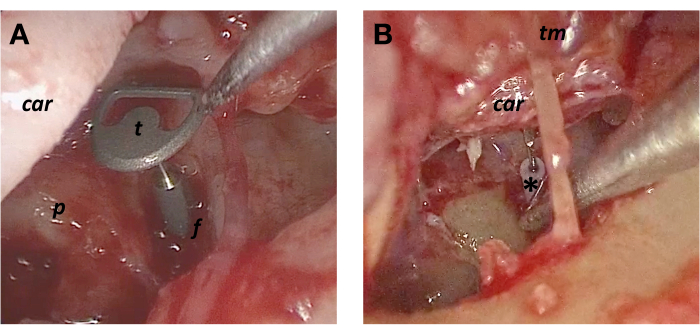
Figure 2: Techniques of total ossicular replacement. (A) TORP (t). (B) ssyTORP (*). Abbreviations: cartilage (car), footplate (f), promontory (p), tympanic membrane (tm). Please click here to view a larger version of this figure.
7. Postoperative care
- Ensure adequate pain management in the postoperative period. Do not administer prophylactic antibiotics unless clinically indicated.
- Advise patients not to blow their nose and emphasize strict protection from water for two weeks postoperatively to avoid possible damage to the surgical site.
- Discharge the patients on the day of the surgery or the following day, depending on their postoperative recovery and the clinical assessment.
- Schedule a follow-up two weeks postoperatively for complete dressing removal and assessment of the surgical site.
NOTE:This is a standard postoperative care protocol. Individual patient needs and clinical scenarios may necessitate modifications.
Results
This study involved a comprehensive analysis of 60 cases of EEO. For each technique presented herein, the last ten consecutive cases with a follow-up (FU) period of at least three months were included. All procedures were performed by experienced surgeons at the Otolaryngology Department of the University Hospital of Bern and Bologna between April 2019 and June 2023. The mean age (± standard deviation (SD)) at the surgery date was 39.28 years (±19.04). Of the total cases, 30 (50.0%) were revision surgeries. The distribution between the left and right sides operated on was almost equal, with 31 cases (51.7%) on the left and 29 cases (48.3%) on the right. In 55 (91.7%) cases, the underlying disease was COM, and 38 patients (63.3%) had cholesteatoma.
Surgical results
The graft intake rate (GIR) showed a success rate of 98.3% by the last FU, and only one case showed a TM re-perforation. The mean FU period was 11.15 months (SD ± 9.38 months). Prosthesis extrusion occurred in 1 case (2.1%), 19 months postoperatively. Additionally, a subset of cases, 7 in total (11.7%), necessitated revision surgery due to persistent conductive hearing loss (3 cases) or recurrent cholesteatoma (4 cases).
Audiological results
Each patient underwent pre- and postoperative pure tone audiometry, reported as pure tone average (PTA) represented as hearing threshold (dB HL) at frequencies 0.5 kHz, 1 kHz, 2 kHz, and 4 kHz. Preoperatively, the average air-bone gap (ABG) was 30.46 dB ± 13.23 dB. Following surgery, a significant improvement was observed with a reduction of the postoperative ABG to an average of 21.41 dB ± 10.64 dB. The improvement was statistically significant as determined by a paired t-test (p < 0.01). A comprehensive overview of the surgical outcomes can be found in Table 1.
Table 1: Patients' disease characteristics and surgical outcome. Abbreviations: Air bone gap (ABG), Mean (M), Range (R), Standard deviation (SD). Please click here to download this Table.
Discussion
This article provides step-by-step instructions for EEO. There are various techniques, types of grafts, and prostheses to reconstruct the ossicular chain10,11. Depending on the presence or absence of the stapes suprastructure, a PORP or TORP is required. The use of an endoscope allows for detailed visualization and assessment of the ossicular chain and its functionality. Even in difficult anatomical conditions, the endoscope provides an optimal view of the oval window and stapes suprastructure or footplate to position the graft with great precision. Postauricular incision and mastoidectomy can often be avoided27. Moreover, it is an excellent tool for educating inexperienced surgeons in both anatomical and surgical aspects28.
Recently published literature has demonstrated comparable audiologic outcomes between endoscopic and microscopic OPL27,29. Das et al. reported significantly improved closure of the ABG after one month with endoscopic PORP OPL, but long-term audiologic outcomes showed no statistically significant difference from the microscopic technique4. A systematic review published by Tsetsos et al. also showed comparable audiologic results for both microscopic and endoscopic techniques15. They also observed a trend toward shorter operative time and lower morbidity, such as postoperative pain and wound infections, with the endoscopic method. The data analysis of the pre- and postoperative audiometric evaluation showed an average ABG of 30.46 dB and 21.41 dB, respectively. There was a statistically significant improvement in ABG completion of 9.05 dB ± 14.72 dB between the preoperative and postoperative ABG (p < 0.01). The publication by Soloperto et al. showed comparable results with a mean ABG closure of 7.85 dB HL (p < 0.01) in patients undergoing autologous graft reconstruction16.
Several authors compared synthetic prostheses, particularly titanium prostheses, and autologous grafts in terms of hearing outcome and complications. Aminth et al. conducted a prospective study comparing an incus autograft to a titanium PORP and found significantly better hearing outcomes and graft uptake in the incus group30. In addition, postoperative complications such as prosthesis extrusion and residual TM perforation occurred more frequently in the titanium PORP group.
OPL performed with a DCB graft was found to offer even greater advantages in reducing the risk of prosthesis displacement or fixation compared with the use of an incus autograft31. In the field of autologous grafts, different options, such as the DCB graft and the malleus allograft, have shown comparable audiological results. Both options have restored the ABG to less than 20 dB in 81% of patients25,32. The use of a patient's own tissue minimizes the risk of implant rejection or extrusion of the prosthesis through the TM, leading to enhanced biocompatibility and reduced postoperative complications15. However, autologous materials do present certain drawbacks. These include longer surgical durations required for the remodeling process, the potential for retaining microscopic pieces of cholesteatoma, and availability limitations depending on the condition of the ossicular chain13,14. A single case of prosthesis extrusion (5%) was recorded in a cohort of 20 synthetic prostheses. No cases of extrusion occurred when autologous materials were used.
COM, with or without cholesteatoma, is the most frequent cause of ossicular chain disruption. In the total 60 cases, COM accounted for 55 (91.7%) cases, and a total of 38 patients (63.3%) showed histologically confirmed cholesteatoma. There is still a debate about the most appropriate timing for ossicular chain reconstruction. In cases of single-stage OPL, endoscopic reconstruction of the ossicular chain is performed at the same time as COM surgery. If residual disease is a potential problem, ossicular chain reconstruction may be deferred to a later procedure, usually scheduled 12 to 18 months after the initial surgery and referred to as a second OPL. In this study, a uniform approach with single-stage surgery was adopted across the cohort to achieve early hearing recovery. However, in scenarios where the disease affects the stapes footplate, it may be appropriate to consider second-stage OPL. Both single-stage and second-stage OPL seem to achieve similar hearing outcomes16.
The long process of the incus is the most vulnerable part for necrosis secondary to both trauma and infections33. In cases with exclusive erosion of the incus long process, rebridging of the ossicular gap with bone cement offers a valid alternative to the OPL procedures presented in this article. Several authors reported comparable long-term audiological outcomes associated with this technique34,35.
The limited sample size of this study and the relatively short FU period prevent robust statistical results and a comprehensive evaluation of the long-term results of the individual OPL techniques. Furthermore, parametric statistical analysis of small subgroups might lead to overestimation or misleading conclusions. The predominant focus on cases of COM limits the generalizability of the results to other middle-ear pathologies. The inclusion of multiple revision cases presents a particular challenge and may not fully represent the primary surgical outcomes.
In conclusion, EEO is a valid surgical option for ossicular chain reconstruction with autologous or synthetic material. It is a safe and minimally invasive procedure with acceptable hearing restoration.
Disclosures
LA is consultant for Stryker ENT.
Materials
| Name | Company | Catalog Number | Comments |
|---|---|---|---|
| Antifog Solution | Karl Storz | 15006H | |
| Endoscopes 3 mm diameter, 15 cm length 0°, 30°, 45°and 70° | Karl Storz | 7220AA/ 7220BA/ 7220FA/ 7220CA | |
| Epinephrine 1 mg/mL | Dr. Bichsel AG | 2824248 | |
| Gelatinous sponge (Gelfoam) | Pfizer | GTIN 00300090315085 | |
| Image 1S 4K | Karl Storz | TH120 | |
| ME 102 | KLS Martin | 80-010-02-04 | |
| Microsuction tubes | Spiggle&Theis | 301004 - 301014 | |
| Monitor 32" 4K/3D | Monitor 32" 4K/3D | TM350 | |
| NIM-Neuro 3.0 | Medtronic | 8253402 | |
| OsseoDuo | Bien Air | 1700524-001 | |
| Otosporin (polymyxin, neomycin, hydrocortison) | GlaxoSmithKline | 2262911000001100.00 | |
| Piezosurgery device | Mectron | N/A | |
| PM2 Line Drill | Bien Air | 1600765-001 | |
| PORP mCLIP ARC Partial Prosthesis | MED-EL | 58502 - 58520 | |
| Povidone-iodine (Betadine) | Mundi-Pharma | 7680342821377 | |
| Ringer Solution | B. Braun | 3570000 | |
| Standard otological instruments (otologic dissectors, needle dissector, round knifes, hooks, curette, microscissors (Bellucci) and microforceps (Hartmann) | Karl Storz | N/A | |
| Stapes Prosthesis Platin/PTFE | Spiggle&Theis | 1054040600/10560600 | |
| Steel and diamond burrs | Bien Air | 1100290-001 - 1100303-001/ 1100247-001 - 1100260-001 | |
| Syringe Injekt Solo 10 mL | Syringe Injekt Solo 10 mL | 4606108N | |
| TORP Implant for shortening | Spiggle&Theis | 11830 - 11870 |
References
- Bonali, M., et al. The variants of the retro- and hypotympanum: an endoscopic anatomical study. European Archives of Oto-Rhino-Laryngology. 274 (5), 2141-2148 (2017).
- Anschuetz, L., et al. Novel Surgical and Radiologic Classification of the Subtympanic Sinus: Implications for Endoscopic Ear Surgery. Otolaryngology-Head and Neck Surgery. 159 (6), 1945998187180(2018).
- Marchioni, D., Molteni, G., Presutti, L. Endoscopic anatomy of the middle ear. Indian Journal of Otolaryngology and Head & Neck Surgery. 63 (2), 101-113 (2011).
- Das, A., Mitra, S., Ghosh, D., Sengupta, A. Endoscopic ossiculoplasty: Is there any edge over the microscopic technique. The Laryngoscope. 130 (3), 797-802 (2020).
- Molinari, G., et al. Surgical implications of 3D vs 2D endoscopic ear surgery: A case-control study. European Archives of Oto-Rhino-Laryngology. 277 (12), 3323-3330 (2020).
- Kamrava, B., Roehm, P. C. Systematic review of ossicular chain anatomy: Strategic planning for development of novel middle ear prostheses. Otolaryngology-Head and Neck Surgery. 157 (2), 190-200 (2017).
- Mudhol, R. S., Naragund, A. I., Shruthi, V. S. Ossiculoplasty: Revisited. Indian Journal of Otolaryngology and Head and Neck Surgery. 65, 451-454 (2013).
- Wullstein, H. Die Eingriffe zur Gehörverbesserung [Surgery for hearing improvement]. Uffenorde W. Anzeige und Ausführung der Eingriffe an Ohr, Nase und Hals. 2nd ed. Thieme, O. hr,N. aseundH. als.2nded.S. tuttgart: , Stuttgart, Thieme. 227-258 (1952).
- Marchioni, D., et al. Selective epitympanic dysventilation syndrome. The Laryngoscope. 120 (5), 1028-1033 (2010).
- Yu, H., et al. PORP vs. TORP: A meta-analysis. European Archives of Oto-Rhino-Laryngology. 270 (12), 3005-3017 (2013).
- McGee, M., Hough, J. V. Ossiculoplasty. Otolaryngologic Clinics of North America. 32 (3), 471-488 (1999).
- Javia, L. R., Ruckenstein, M. J. Ossiculoplasty. Otolaryngologic Clinics of North America. 39 (6), 1177-1189 (2006).
- Woods, O., Fata, F. E., Saliba, I. Ossicular reconstruction: Incus versus universal titanium prosthesis. Auris Nasus Larynx. 36 (4), 387-392 (2009).
- Bartel, R., et al. Hearing results after type III tympanoplasty: incus transposition versus PORP. A systematic review. Acta Oto-Laryngologica. 138 (7), 617-620 (2018).
- Tsetsos, N., Vlachtsis, K., Stavrakas, M., Fyrmpas, G. Endoscopic versus microscopic ossiculoplasty in chronic otitis media: A systematic review of the literature. European Archives of Oto-Rhino-Laryngology. 278 (4), 917-923 (2021).
- Soloperto, D., et al. Exclusive endoscopic ossiculoplasty with autologous material: step-by-step procedure and functional results. European Archives of Oto-Rhino-Laryngology. 280 (11), 4869-4878 (2023).
- Alicandri-Ciufelli, M., et al. Epinephrine use in endoscopic ear surgery: Quantitative Safety assessment. ORL; Journal for Oto-Rhino-Laryngology and its Related Specialties. 82 (1), 1-7 (2020).
- Anschuetz, L., et al. Management of bleeding in exclusive endoscopic ear surgery: Pilot clinical experience. Otolaryngology-Head and Neck Surgery. 157 (4), 700-706 (2017).
- Beckmann, S., et al. Endoscopic cholesteatoma surgery. Journal of Visualized Experiments. (179), e63315(2022).
- Anschuetz, L., et al. Discovering middle ear anatomy by transcanal endoscopic ear surgery: A dissection manual. Journal of Visualized Experiments. (131), e56390(2018).
- Young, A., Ng, M. Ossiculoplasty. StatPearls. , Available from: http://www.ncbi.nlm.nih.gov/books/NBK563162/ (2023).
- Kim, H. H., Wiet, R. J. Preferred technique in ossiculoplasty. Operative Techniques in Otolaryngology-Head and Neck Surgery. 14 (4), 243-246 (2003).
- Springer. Comparative atlas of endoscopic ear surgery: training techniques based on an ovine model. , Springer. Cham, Switzerland. (2021).
- Dornhoffer, J. L., et al. 28 autograft ossicular reconstruction. The chronic ear. , Verlag. Thieme. (2016).
- Malafronte, G., Filosa, B., Mercone, F. A new double-cartilage block ossiculoplasty: long-term results. Otology & Neurotology. 29 (4), 531-533 (2008).
- Malafronte, G. Early results with semi-synthetic total ossicular replacement prosthesis. Otolaryngology-Head and Neck Surgery. 143 (2), 307-308 (2010).
- Caloway, C. L., et al. Pediatric endoscopic ossiculoplasty following surgery for chronic ear disease. The Laryngoscope. 130 (12), 2896-2899 (2020).
- Niederhauser, L., Fink, R. D., Mast, F. W., Caversaccio, M., Anschuetz, L. Video learning of surgical procedures: A randomized comparison of microscopic, 2- and 3-dimensional endoscopic ear surgery techniques. Otology & Neurotology. 43 (7), e746-e752 (2022).
- Coleman, H., Tikka, T., Curran, J., Iyer, A. Comparison of endoscopic vs microscopic ossiculoplasty: A study of 157 consecutive cases. European Archives of Oto-Rhino-Laryngology. 280 (1), 89-96 (2023).
- Amith, N., Rs, M. Autologous incus versus titanium partial ossicular replacement prosthesis in reconstruction of Austin type A ossicular defects: a prospective randomised clinical trial. The Journal of Laryngology and Otology. 131 (5), 391-398 (2017).
- Filosa, B., Previtero, G., Novia, G., Trusio, A., Malafronte, G. Partial Ossiculoplasty: Malafronte's double cartilage block versus incus. Otology & Neurotology. 40 (3), 344-350 (2019).
- Vercruysse, J. P., Offeciers, F. E., Somers, T., Schatteman, I., Govaerts, P. J. The use of malleus allografts in ossiculoplasty. The Laryngoscope. 112 (10), 1782-1784 (2002).
- Ráth, G., et al. Ionomer cement for reconstruction of the long process of the incus: The Pécs experience. Clinical Otolaryngology. 33 (2), 116-120 (2008).
- Katar, O., Kılıç, S., Bajin, M. D., Sennaroğlu, L. Long term results of glass ionomer ossiculoplasty. European Archives of Oto-Rhino-Laryngology. 281 (1), 171-179 (2023).
- Moneir, W., Salem, M. A., Hemdan, A. Endoscopic transcanal management of incus long process defects: rebridging with bone cement versus incus interposition. European Archives of Oto-Rhino-Laryngology. 280 (2), 557-563 (2023).
Reprints and Permissions
