Here, we describe the modified treatment methods for wasting marmoset syndrome (WMS, also known as inflammatory bowel disease (IBD)-like disease) with tranexamic acid. We also present how to administer the therapeutic agents orally, subcutaneously, and intravenously.
Method Article
Modification of the Treatment Methods for Wasting Marmoset Syndrome with Tranexamic Acid and Supportive Measures
Opens in a new tab
In This Article
Summary
Loading...
$$\rightleftharpoonup{xx}$$
$$\longleftharp{xx}$$,
$$\longrightharp{xx}$$,
Abstract
Loading...
$$\rightleftharpoonup{xx}$$
$$\longleftharp{xx}$$,
$$\longrightharp{xx}$$,
Wasting marmoset syndrome (WMS), a serious disease in captive common marmoset (Callithrix jacchus) colonies, is associated with a high mortality rate. The specific cause of WMS is still unclear and there are few effective treatments. Previously, we had reported a tranexamic acid therapy with supportive measures as a useful treatment for WMS. In the present study, we describe the modified method: a combination of 0.1 mL of 5% tranexamic acid subcutaneously five times per week, 2.0 mL of amino acid formulation intravenously three times per week, 5.0 mL of Ringer's lactate with 0.1 mL of a vitamin formulation subcutaneously three times per week, and oral administration of 0.1 mL of an iron formulation five times per week. We also describe how to administer the solution intravenously via the saphenous vein with a tip of restraining the animal, as well as the detailed methods for oral and subcutaneous administration. The modified methods have comparable efficiency to the original WMS treatment method.
Introduction
Loading...
$$\rightleftharpoonup{xx}$$
$$\longleftharp{xx}$$,
$$\longrightharp{xx}$$,
Wasting marmoset syndrome (WMS) is a serious disease that is unique to captive common marmoset colonies. The main symptoms are weight loss, decreased muscle mass, anemia, hypoalbuminemia, and chronic enteritis1,2,3,4. Some studies have reported that 60.5% of euthanized captive marmosets had evidence of chronic enteritis5, and 31-44% of deaths involved this illness6. The high prevalence of this disease necessitated its effective treatment.
In 2016, we reported that tranexamic acid with supportive measures was an effective treatment for WMS7. In addition, intestinal protein loss of WMS-affected marmosets was significantly attenuated with this treatment8. Although the original treatment protocol was definitely effective, it included a somewhat high volume of intravenous injection, a high dose of vitamin formulation, and daily restraining. Since marmosets are susceptible to hand-capture and restraining, these actions must be less frequent. Thus, we aimed to reduce the heavy load for animals with some modification.
In the present paper, we will provide the modified methods: subcutaneous injection of undiluted tranexamic acid 5 times per week (instead of intraperitoneal injection of 5-fold-diluted tranexamic acid solution 7 times per week), 2.0 mL of amino acid formulation for intravenous injection (instead of 3.0 mL), 0.1 mL of vitamin formulation for subcutaneous injection (instead of 0.5 mL), and oral administration of iron formulation 5 times per week (instead of 7 times per week).
Protocol
Loading...
$$\rightleftharpoonup{xx}$$
$$\longleftharp{xx}$$,
$$\longrightharp{xx}$$,
The present study was performed with the approval (W2023-2-041) of the Animal Experiments Committee of RIKEN (Saitama, Japan) and was conducted in accordance with the Institutional Guidelines for Experiments using Animals. In the present study, six female marmosets (2-6 years old) were used.
1. Criteria for commencement of treatment
- Start treatment when any one of the following criteria is observed: i) body weight < 300 g or a decrease of >20 g in the body weight per month; ii) hypoalbuminemia (serum albumin < 3.8 g/dL); iii) anemia (hematocrit < 35%); iv) chronic diarrhea without Clostridium difficile, enteropathogenic Escherichia coli, or intestinal protozoa; and v) an apparent decrease in muscle mass.
NOTE: Because of dehydration and subsequent hemoconcentration accompanied by WMS, the values of serum albumin and hematocrit may be artificially elevated in affected animals.
2. Oral administration
- Mix 0.1 mL of the iron formulation (see the Table of Materials) with a piece of sponge cake.
- Give the mash to the treated marmoset.
NOTE: Ensure that the treated marmoset has completely swallowed the mash.
3. Subcutaneous administration
- Catch the WMS-affected marmoset in the home cage by holding the tail gently.
- Hold the animal's upper body from the back with the other hand.
- Bring the animal to the treatment room.
- Let the animal cling to the assistant's chest or arm.
- Clean the area of the animal's back with an alcohol swab.
- Inject 0.1 mL of tranexamic acid (5% solution, see the Table of Materials) into the back subcutaneously using a 26 G needle 5x per week.
- Inject 5.0 mL of Ringer's lactate (see the Table of Materials) with 0.1 mL of a vitamin formulation (see the Table of Materials) subcutaneously using a 26 G needle 3x per week.
NOTE: Each injection should be done at each different spot within 1 min.
4. Intravenous administration of amino acid formulation
- Catch the WMS-affected marmoset in the home cage by holding the tail gently.
- Hold the animal's upper body from the back with the other hand.
- Bring the animal to the treatment room.
- Have the assistant restrain the animal's upper body by holding the base of both arms and restrain the lower body by holding the base of both legs with the other hand.Ask the assistant to place the thumb restraining the animal's lower body on the anterior side of the animal's knee to prevent it from bending.
- Clean the animal's calf with an alcohol swab.
- Inject 2.0 mL of the amino acid formulation (see the Table of Materials) intravenously via the saphenous vein using a 27 G butterfly needle three times per week.
NOTE: Injection must be done as slowly as possible up to 2 min. - After injection, ask the assistant to press the area with absorbent cotton until bleeding stops.
5. Body weight measurement
- After treatment (intravenous and/or subcutaneous injection), weigh the animal with a carrying box once a week to monitor the body weight.
NOTE: Weigh the marmoset at around the same time because the body weight is affected by the presence of food.
6. Complete blood count (CBC) analysis and serum chemistry tests
- Catch the WMS-affected marmoset in the home cage by holding the tail gently.
- Hold the animal's upper body from the back with the other hand.
- Bring the animal to the treatment room.
- Have the assistant restrain the animal's upper body by holding the base of both arms and restrain the lower body by holding the base of either leg with the other hand.
- Ask the practitioner to hold the animal's leg that is not restrained.
- Clean the animal's inguinal region with an alcohol swab.
- Collect 0.4 mL of blood from the femoral vein using a 26 G needle monthly.
- Use 0.05 mL of the blood sample for CBC analysis, including hematocrit.
- Let the rest of the blood sample stand for 1 h at room temperature and centrifuge at 1,800 × g for 20 min.
- Use the serum for chemistry tests, including albumin.
NOTE: The volume of the blood sample can be reduced by minimizing the number of parameters for the serum chemistry test. Adjust the volume of the blood sample according to the individual marmoset's condition.
Results
Loading...
$$\rightleftharpoonup{xx}$$
$$\longleftharp{xx}$$,
$$\longrightharp{xx}$$,
The modified treatment methods resulted in increased hematocrit (Figure 1A), serum albumin (Figure 1B), and body weight (Figure 1C) in the WMS-affected marmosets. Significant differences in hematocrit (P < 0.05, Wilcoxon matched-pairs signed rank test), serum albumin (P < 0.05, Wilcoxon matched-pairs signed rank test), and body weight (P < 0.05, Wilcoxon matched-pairs signed rank test) were seen between pre and post treatment.
The treatment effects on the appearance were also observed. Figure 2 shows the appearance of a WMS-affected marmoset. Before treatment, tabefaction, arched back, rough fur (Figure 2A), and alopecia (Figure 2B) were observed, whereas no abnormal appearance was seen after treatment (Figure 2C,D).
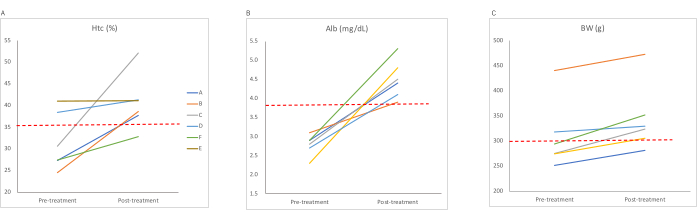
Figure 1: Changes (pre- vs post-treatment) in hematocrit, serum albumin, and body weight in a marmoset receiving the modified treatment. (A) Hematocrit values, (B) serum albumin values, and (C) body weight. The dashed lines indicate the criteria values. Abbreviations: Htc = hematocrit; Alb = serum albumin; BW = body weight. Please click here to view a larger version of this figure.

Figure 2: Representative appearance of WMS-affected marmoset. (A) Appearance of pretreatment animal: tabefaction, arched back, and rough fur are observed. (B) Tail of pretreatment animal: alopecia is observed. (C) Appearance of posttreatment animal. (D) Tail of posttreatment animal. Abbreviation: WMS = wasting marmoset syndrome. Please click here to view a larger version of this figure.
Discussion
Loading...
$$\rightleftharpoonup{xx}$$
$$\longleftharp{xx}$$,
$$\longrightharp{xx}$$,
In 2016, we reported that tranexamic acid with supportive measures was an effective treatment for WMS, which was the first report to demonstrate WMS therapy without the use of glucocorticoids. In humans, glucocorticoids are considered the most effective treatment of IBD. However, predonizolone, one of the most commonly used glucocorticoids, is not suitable for WMS treatment because of its adverse effects. Although budesonide, a glucocorticoid, was reported for WMS treatment9, the therapy was relatively ineffective in animals with acute forms of WMS. Tranexamic acid is a plasmin inhibitor that has anti-inflammatory effects, and no notable side effects were seen in our original methods. However, although the original treatment protocol was definitely effective, it imposed a heavy load for animals and carers.
In the present study, the modified treatment methods for WMS were conducted to decrease both the animal's physiological load and the carers' workload. In the modified methods, the administration route of tranexamic acid was changed (from intraperitoneal to subcutaneous), which contributed to reducing the risk of injury to the abdominal organs. The tranexamic acid solution was not diluted in this protocol to reduce contamination risk and preparation time. In the original methods, 3.0 mL of the amino acid formulation were injected intravenously. However, the volume was somewhat large because 5.0 mL/kg is recommended to be administered as a bolus10. Therefore, the volume was reduced in the modified methods.
The vitamin formulation used in this protocol contains vitamins B and C. In the original method, 0.5 mL of the vitamin formulation contains 2.5 mg of thiamine chloride hydrochloride, which was 2.5x the requirement of laboratory housed postweaning nonhuman primates11. In the present method, 0.1 mL of the vitamin formulation was administered, which contains 1.0 mg of thiamine chloride hydrochloride. The frequency of administration of the iron formulation and tranexamic acid solution was reduced in the modified methods, which contributed to the reduction of burden for the animals as well as the carers.
As written in the Representative Results section, there were significant treatment effects in the modified methods. The average treatment term was 37.8 ± 25.34 days, which was shorter than that of the original methods (56 days). Since marmosets are sensitive to mental stress, prolonged treatments have the opposite effect on the animal such as reduced appetite. Thus, we recommend that the carers should comprehensively decide the timing of treatment termination based on not only the value of each parameter but also the animal's behavior.
Disclosures
Loading...
$$\rightleftharpoonup{xx}$$
$$\longleftharp{xx}$$,
$$\longrightharp{xx}$$,
The authors have no conflicts of interest to disclose.
Acknowledgements
Loading...
$$\rightleftharpoonup{xx}$$
$$\longleftharp{xx}$$,
$$\longrightharp{xx}$$,
This research was partially supported by the Japan Agency for Medical Research and Development (AMED) under the Brain Mapping by Integrated Neurotechnologies for Disease Studies (Brain/MINDS) project (Grant Number JP23dm0207001).
Materials
| Name | Company | Catalog Number | Comments |
|---|---|---|---|
| 1.0 mL Syringe | Terumo Corporation, Tokyo, Japan | SS-01T | For subcutaneously injection of Tranexamic acid |
| 10 mL Syringe | Terumo Corporation, Tokyo, Japan | SS-10SZ | For Intravenous Administration of Amino acid formulation |
| 26 G Needle | Terumo Corporation, Tokyo, Japan | NN-2613S | For subcutaneously injection |
| 27 G Butterfly Needle Type D | Terumo Corporation, Tokyo, Japan | SV-27DL | For Intravenous Administration of Amino acid formulation |
| 5 mL Syringe | Terumo Corporation, Tokyo, Japan | SS-05SZ | For subcutaneously injection of Ringer's lactate and Vitamin formulation |
| Aminoleban Injection | Otsuka Pharma Factory Inc., Tokyo, Japan | 1942 | For subcutaneously injection of Ringer's lactate and Vitamin formulation |
| C-PARA | Takata Pharma Co., Ltd., Saitama, Japan | 120-31960-0 | Vitamin formulation |
| FCV Liquid | Minerva Corporation, Saitama, Japan | Iron formulation | |
| Lactec Injection | Otsuka Pharma Factory Inc., Tokyo, Japan | 0714 | Ringer’s lactate |
| Vasolamin Injection | Meiji Seika Pharma Co., Ltd., Tokyo, Japan | DBASOS | Tranexamic acid |
References
Loading...
$$\rightleftharpoonup{xx}$$
$$\longleftharp{xx}$$,
$$\longrightharp{xx}$$,
- Baxter, V. K., et al. Serum albumin and body weight as biomarkers for the antemortem identification of bone and gastrointestinal disease in the common marmoset. PLoS ONE. 8 (12), e82747(2013).
- Brack, M., Rothe, H. Chronic tubulointerstitial nephritis and wasting disease in marmosets (Callithrix jacchus). Vet Pathol. 18, Suppl 6 45-54 (1981).
- Chalifoux, L. V., Bronson, R. T., Escajadillo, A., McKenna, S. An analysis of the association of gastroenteric lesions with chronic wasting syndrome of marmosets. Vet Pathol Suppl. 7, 141-162 (1982).
- Logan, A. C., Khan, K. N. Clinical pathologic changes in two marmosets with wasting syndrome. Toxicol Pathol. 24 (6), 707-709 (1996).
- Ludlage, E., Mansfield, K. Clinical care and diseases of the common marmoset (Callithrix jacchus). Comp Med. 53 (4), 369-382 (2003).
- Ross, C. N., Davis, K., Dobek, G., Tardif, S. D. Aging phenotypes of common marmosets (Callithrix jacchus). J Aging Res. 2012, 567143(2012).
- Yoshimoto, T., Niimi, K., Takahashi, E. Curative effects of tranexamic acid with supportive measures on wasting marmoset syndrome. Comp Med. 66 (6), 1-6 (2016).
- Niimi, K., et al. Measurement of the α1-proteinase inhibitor (α1-antitrypsin) of common marmoset and intestinal protein loss in wasting syndrome. Biosci Rep. 39 (7), 20190562(2019).
- Otovic, P., Smith, S., Hutchinson, E. The use of glucocorticoids in marmoset wasting syndrome. J Med Primatol. 44 (2), 53-59 (2015).
- Turner, P. V., Brabb, T., Pekow, C., Vasbinder, M. A. Administration of substances to laboratory animals: routes of administration and factors to consider. J Am Assoc Lab Anim Sci. 50 (5), 600-613 (2011).
- Lewis, S. M., Hotchkiss, C. E., Ullrey, D. E. Chapter 13. Nutrition and nutritional diseases. The Laboratory Primates. Wolfe-Coote, S. , 181-208 (2005).
Reprints and Permissions
Request permission to reuse the text or figures of this JoVE article
Request Permission