This article presents a simplified method for preparing 4 hemagglutination units antigen for Newcastle disease virus serological testing. By accurately determining the hemagglutination titer of the antigen, combined with a more rigorous back-titration method, and a well-defined adjustment process, it enhances test efficiency, reduces false positives, and improves disease surveillance in poultry.
A subscription to JoVE is required to view this content. Sign in or start your free trial.
Method Article
Optimization of Antigen Preparation for Hemagglutination Inhibition Assay of Newcastle Disease Virus Serology
In This Article
Summary
Abstract
Accurate assessment of Newcastle disease virus (NDV) antibody titers is crucial for effective poultry disease control and surveillance. This article introduces an optimized method for preparing 4 hemagglutination units (4-HAU) antigen solution, a key component of the hemagglutination inhibition assay (HI) used in NDV serological detection. Unlike conventional methods, which involve time-consuming and undefined back-titration and adjustment steps, this approach streamlines this process by accurately measuring the HA titer using an initial series of dilutions (1:3, 1:5, 1:7, and 1:9). We also provide a specific method for adjusting or reformulating based on the back-titration results, reducing the need for repeated back-titrations. In addition, we evaluated the effect of the accuracy of the 4-HAU antigen solution on serum HI titer and found that when the titer of the 4-HAU antigen was lower than 3, it resulted in the appearance of false-positive HI samples. By providing an accurate method and minimizing computational tasks, this approach increases test efficiency and reliability, contributing to improved disease surveillance and control in poultry populations.
Introduction
Newcastle Disease (ND) is a widespread and severe poultry affliction recognized globally1,2,3. It manifests through various symptoms such as high fever, respiratory distress, dysentery, nervous disorders, and mucosal hemorrhage4. The causative agent, Newcastle Disease Virus (NDV), has endured for almost a century, afflicting more than 200 avian species, including chickens, ducks, geese, and pigeons5. Transmission primarily occurs through direct or indirect contact with infected birds, with poultry, pigeons, and free-ranging birds serving as potential reservoirs6. Despite NDV's single serotype, its genetic diversity poses significant challenges to disease management and control efforts3,7.
Vaccination serves as the primary strategy for controlling ND, complemented by stringent biosecurity measures5,8. Various commercial vaccines are globally available for poultry, provoking robust serum antibody responses following immunization9. These antibodies play a critical role in mitigating symptom severity upon exposure to virulent strains and in curbing interflock transmission10. Standard revaccination protocols, typically involving live attenuated vaccines administered every 6-12 weeks, are standard practice in regions endemic to ND9. Routine monitoring of postvaccination antibody titers in commercial poultry flocks is essential for assessing vaccine effectiveness11,12,13. Low antibody titers post vaccination may indicate vaccine failure, prompting timely corrective measures such as supplementary vaccination or investigation into potential immunosuppressive factors affecting immune response14.
Multiple techniques are utilized for detecting serum antibodies against NDV, including enzyme-linked immunosorbent assay, hemagglutination inhibition (HI), and neutralization assay9,13,15,16. Each method presents unique advantages and limitations concerning sensitivity, specificity, and cost-effectiveness.
This article delineates a step-by-step protocol based on the World Organization for Animal Health (OIE)'s protocol for conducting HI to quantify serum-specific antibody titers against NDV11. Hemagglutination (HA), a phenomenon induced by certain enveloped viruses like NDV, involves the clumping of red blood cells (RBCs)9. The hemagglutinin-neuraminidase (HN) protein on the NDV surface interacts with RBCs, resulting in cell clumping and lattice formation2. HI assay is preferred as a serological method due to its ability to assess serum antibody specificity towards the HN protein of NDV8,9. Furthermore, its cost-effectiveness and independence from specialized instrumentation render it accessible and practical for routine use.
To improve assay efficiency, we refined the workflow of the OIE protocol11, with a focus on attaining more accurate antigen HA titers and offering detailed adjustments for the 4 hemagglutination units (4-HAU) antigen solution. Additionally, through comparative analysis, we assessed the impact of 4-HAU accuracy on HI results, providing valuable insights for field practitioners. This approach is not limited to NDV antibody testing but extends to the detection of viral subtypes and other hemagglutinating viruses, including measles, polyomavirus, mumps, and rubella.
Access restricted. Please log in or start a trial to view this content.
Protocol
Approval for the protocol was granted by the local institutional animal care and use committee. All procedures involving live virus antigens and clinical serum samples were performed in a Biosafety Level 2 laboratory, in compliance with established safety protocols.
1. Preparation of 1% chicken RBC suspension
- Add 3 mL of Alserver's solution (anticoagulant) into a sterile 15 mL conical centrifuge tube.
- Collect 1 mL of blood from the wing vein of each of the three non-immune chickens (without NDV antibodies). Immediately transfer the blood to the tube containing the anticoagulant and gently mix.
- Fill the tube with sterile 1x phosphate-buffered saline solution (PBS, pH 7.2-7.4) to a total volume of 12 mL, and mix gently. Centrifuge at 500 × g for 10 min using a horizontal rotor.
- Carefully remove the supernatant and the white blood cell layer. Repeat steps 1.3 and 1.4 2x to obtain the RBC pellet.
- Reverse pipette 1 mL of the RBC pellet into 99 mL of sterile PBS, to prepare a 1% RBC suspension.
NOTE: The required volume of the 1% chicken RBC suspension is estimated at 3 mL/plate (25 µL/well x 96 wells x 1.25 = 3.0 mL; where 1.25 accounts for pipetting wastage to ensure sufficient volume).
2. Reconstitution of lyophilized antigen or serum
- Add 2 mL of sterile PBS to the ampoule containing the lyophilized antigen or serum. Gently shake the ampoule and allow it to stand for 2-3 min to minimize bubbles and ensure complete dissolution.
NOTE: Follow the specific manufacturer's instructions, as different types of lyophilized materials were not compared in this study. - Aliquot the reconstituted solution into 1.5 mL centrifuge tubes and freeze at -20 °C until use.
NOTE: Re-determine the HA titer each time the antigen is thawed and used, or when a new RBC suspension is prepared.
3. HA titration of antigens
- Dispense 40, 80, 120, and 160 µL of PBS, respectively, into four adjacent wells of a disposable 96-well V-bottom microtiter plate, then add 20 µL of antigen to each well, and mix by pipetting up and down 10x to achieve dilutions of 1:3, 1:5, 1:7 and 1:9, respectively. A schematic diagram of the dilution operation is shown in Figure 1.
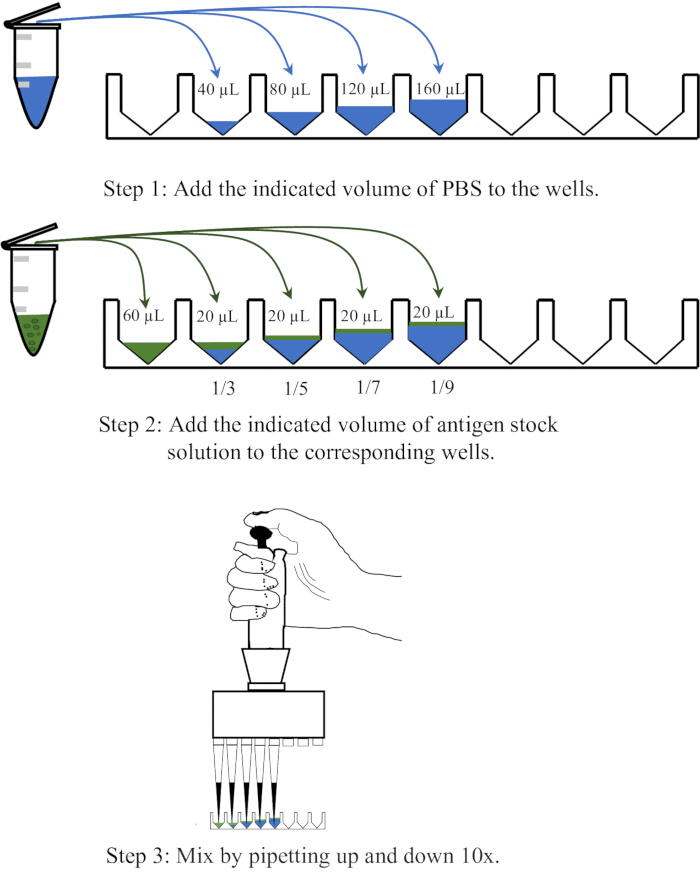
Figure 1: Schematic diagram illustrating the procedure for diluting of the antigen solution in the hemagglutination assay. The antigen solution is diluted in PBS at ratios of 1:3, 1:5, 1:7, and 1:9, respectively. PBS in wells or centrifuge tubes is represented in blue, while antigens are shown in green. Please click here to view a larger version of this figure.
- Label a new microtiter plate. Add 25 µL of PBS to each well in rows 1-5.
- Place 25 µL of the diluted antigen solutions into the first wells of rows 1-5 using a multichannel pipette, and mix by pipetting up and down at least 5x.
- Transfer 25 µL from the first well of each row to the second well, mixing thoroughly. Continue transferring from one well to the next, through to the 11th column, to create two-fold serial dilutions (1:2 to 1:2048). Discard 25 µL after the 11th column.
- Add 25 µL of PBS to each well, starting with the wells containing the lowest antigen concentration.
- Add 25 µL of 1% chicken RBC suspension to each well, again starting with the wells containing the lowest antigen concentration.
- Shake the plate on a microplate shaker for ~20 s to mix thoroughly.
- Leave it undisturbed on benchtop at room temperature (20-25 °C) for ~30 min until the RBC of the 12th column completely settled. For the plate layout refer to Figure 2.
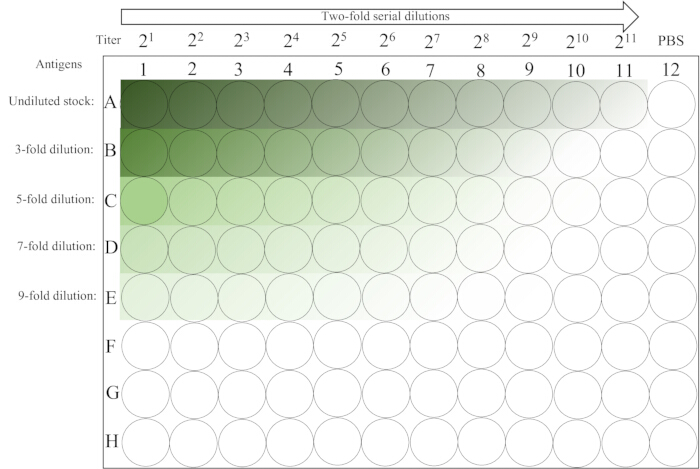
Figure 2: Schematic layout of a microplate used in the hemagglutination assay. The first column of rows 1-5 contains undiluted and various initial dilutions of the antigen solution, followed by a two-fold serial dilution from left to right until column 11. PBS control is placed in the last column. The gradient from dark to light indicates decreasing antigen concentration. Please click here to view a larger version of this figure.
- Read and record the results. HA is determined by tilting the plate by 90° for ~25 s and observing the presence or absence of tear-shaped streaming of the RBCs. The highest dilution showing complete hemagglutination (no streaming), represents 1 HA Unit. Wells in the 12th column serve as RBC (negative) controls.
- Calculate the HA titer of each row using Table 1, the maximum of which is used for the preparation of the 4-HAU antigen solution. For example, if a, b, c, d, and e are equal to 9, 8, 7, 6, 6, respectively, then 3 x 28 = 768 is the maximum value, and is the HA titer of the antigen stock.
| Antigens | Highest dilution column of complete HA | HA titer of undiluted stock |
| Undiluted stock | a | 2a |
| 3-fold dilution | b | 3 x 2b |
| 5-fold dilution | c | 5 x 2c |
| 7-fold dilution | d | 7 x 2d |
| 9-fold dilution | e | 9 x 2e |
Table 1: HA assay results and calculation of HA titer of stock solution.
4. Preparation of the 4-HAU antigen solution
- Calculate the dilution factor for the preparation of the 4-HAU antigen solution:
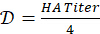 . Determine the total 4-HAU volume needed: V = 3mL x Number of microplates. Then, calculate the required volumes of antigen stock solution:
  , and PBS: Vp = V - Va.
NOTE: Volumes are measured in milliliters. Estimate 3 mL per microtiter plate of the 4-HAU (25 µL/well x 96 wells x 1.25 = 3 mL). - Pipette the calculated volume of PBS into a container, then add the corresponding volume of antigen stock solution and mix well to obtain the 4-HAU antigen solution.
NOTE: The 4-HAU antigen solution should be used as soon as possible.
5. Back-titration of the 4-HAU antigen solution
- Dispense 25, 50, 75, 100, 125, and 150 µL of PBS into six adjacent wells of a microtiter plate, then add 25 µL of the 4-HAU antigen solution to each well, and mix by pipetting up and down 10x.
NOTE: Dilute the 4-HAU antigen solution with PBS at dilutions of 1:2, 1:3, 1:4, 1:5, 1:6, and 1:7. A schematic diagram of the dilution operation is shown in Figure 3.

Figure 3: Schematic diagram of dilution procedure of 4 hemagglutination units' solution in back-titration. The 4-HAU working solution is diluted with PBS at ratios of 1:2, 1:3, 1:4, 1:5, 1:6, and 1:7. PBS is depicted in blue, and antigens in green. Please click here to view a larger version of this figure.
- Transfer 25 µL of each diluted antigen solution to the wells of another row using a multichannel pipette. Add 25 µL of PBS to an extra well as a negative control.
- Add 25 µL of PBS to each well, then add 25 µL of 1% chicken RBC to each well.
- Shake the plate on a microplate shaker for ~20 s to mix.
- Leave it undisturbed on the benchtop at room temperature (20-25 °C) for ~30 min until the RBCs of the negative control are completely settled.
- Read and record the results.
NOTE: The negative control well should show no HA. Ideally, the 1:4 dilution is exactly the highest dilution with complete HA. If the titer of the 4-HAU solution is more than 4, the highest dilution may be 1:5, 1:6, or 1:7; if less, it may be 1:2 or 1:3. A schematic layout of the back-titration and representative results are shown in Figure 4.

Figure 4: Schematic layout of the wells for back-titration and representative result. The diluted 4-HAU working solution is transferred to a new row, with an additional PBS control added. The gradient from dark to light green indicates antigen concentration from high to low. Representative results demonstrate that the 1:4 dilution is the highest dilution showing complete hemagglutination. Please click here to view a larger version of this figure.
- Adjust or reformulate the 4-HAU antigen solution if necessary.
NOTE: If the volume of the 4-HAU antigen solution used in back-titration is ≤1% of the total volume (the volume of 4-HAU antigen solution ≥ 15 mL), refer to Table 2 for specific adjustments. For example, if the highest dilution with complete HA is 1:2, the titer of the 4-HAU antigen solution is now 2, and an equal volume of antigen should be added as in the previous preparation of the 4-HAU antigen solution. Conversely, if the highest dilution of complete HA is 1:6, the titer is now 6, and half the volume of PBS should be replenished.
If the volume used in the back-titration exceeds 1% of the total (the volume of 4-HAU antigen solution < 15 mL), reformulate the 4-HAU antigen solution using the corrected dilution factor. Refer to Table 3 for the specific corrections. For example, if the highest dilution of complete HA is 1:2, the titer of the 4-HAU antigen solution is now 2 and the dilution factor should be adjusted to 1/2 of the original. Conversely, if the highest dilution of complete HA is 1:6, the titer of the 4-HAU antigen solution is now 6, and the dilution factor is adjusted to 3/2 of the original.
| HA titer of back-titration | Replenishment of antigen or PBS |
| 1:2 | Va |
| 1:3 | Va/3 |
| 1:5 | Vp/4 |
| 1:6 | Vp/2 |
| 1:7 | 3Vp/4 |
Table 2: Reference table for adjusting 4-HAU concentration based on back-titration results. Va and Vp represent the volumes of antigen and PBS used in the formulation of 4-HAU antigen solution, respectively.
| HA titer of back-titration | Dilution factor correction |
| 1:2 | D/2 |
| 1:3 | 3D/4 |
| 1:5 | 5D/4 |
| 1:6 | 3D/2 |
| 1:7 | 7D/4 |
Table 3: Reference table of dilution factor correction for re-preparation of 4-HAU antigen. D represents the dilution factor previously used in 4-HAU antigen preparation.
6. Preparation of serum
- Collect ~1 mL of blood from chicken wings without using an anticoagulant.
- Transfer the blood to a 1.5 mL centrifuge tube and incubate at 37 °C for ~2 h. Centrifuge at 3,000 x g for 10 min, and carefully aspirate the supernatant into a new tube.
7. HI assay
- Label microtiter plates according to the assay layout. Add 25 µL of PBS to each well in columns 1-11, and 50 µL to the wells in column 12, using a multichannel pipette.
- Add 25 µL of serum to the first well of each row, including positive and negative serum control rows. Mix thoroughly by pipetting up and down at least 5x.
- Transfer 25 µL from the first well of each row to the second well and mix thoroughly. Continue transferring and mixing from the second well to the third, and so on, until the 10th column. Discard 25 µL of liquid from the well in the 10th column after mixing.
- Add 25 µL of 4-HAU antigen to each well in columns 1-11 in the direction of low to high serum concentration.
- Shake the plate on a microplate shaker for ~20 s. Leave it undisturbed on the benchtop for ~30 min.
- Add 25 µL of 1% chicken RBCs to each well in the direction of low to high serum concentration.
- Shake the plate on a microplate shaker for ~20 s to mix thoroughly. Leave it undisturbed on the benchtop for ~30 min until RBCs of the PBS control wells are completely settled.
- Read and record the results.
NOTE: The HI titer is the highest serum dilution that completely inhibits hemagglutination of the 4-HAU antigen. Tear-shaped streaming of RBCs can be observed in the last column of each row, by tilting the plate 90° for 25 s. Complete HA (no streaming) can be observed in the second last well from the end of each row. Valid test results require the HI titer of the positive serum control to be within one dilution of the known HI titer; the HI titer of the negative serum control to be ≤ 2 log2; and the absence of self-HA of the RBC control. For a schematic diagram of the HA assay workflow, see Figure 5.

Figure 5: Schematic diagram of hemagglutination assay workflow. PBS is represented in blue, serum in yellow, the 4-HAU antigen solution in green, and the 1% chicken RBC suspension in red. Arrows indicate the order of liquid dispensation. Please click here to view a larger version of this figure.
Access restricted. Please log in or start a trial to view this content.
Results
Validation of the titer of 4-HAU antigen solution formulated using the optimized method
The study employed various dilutions of the antigen stock solution to accurately determine the HA titer, facilitating the calculation of the dilution factor for preparing the 4-HAU antigen solution. The results reveal that the optimized method is both efficient and precise, reducing the number of repetitive back-titration and adjustment procedures. In the first scenario, an initial HA titer of ~512 yielded a final...
Access restricted. Please log in or start a trial to view this content.
Discussion
The optimized method proposed in this article presents an approach for accurately preparing the 4-HAU antigen solution. Although the OIE and EU guidelines suggest initial dilutions for HA titration, they do not provide precise details regarding the dilution ratios to be used or offer specific methodologies11,12. Furthermore, although the FAO and OIE recommend back-titration as a means of enhancing the accuracy of 4-HAU, they lack a clear protocol11,...
Access restricted. Please log in or start a trial to view this content.
Disclosures
The authors have no conflicts of interest to declare.
Acknowledgements
C.C. was supported by Taicang Technology program (TC2021JC16), and Innovation Team Funds of Suzhou Chien-shiung Institute of Technology (2023JXKYTD01). H.Y. was supported by Taicang Technology program (TC2021JC11). Both of them were supported by Start-up Fund for New Ph.D. Researchers of Suzhou Chien-Shiung Institute of Technology.
Access restricted. Please log in or start a trial to view this content.
Materials
| Name | Company | Catalog Number | Comments |
|---|---|---|---|
| Sterile Centrifuge Tube (15 mL) | Labshark | 130201030 | |
| Air-cooled Low-speed Tabletop Centrifuge | Titan | LDC-5 | |
| Alserve's Solution | Sangon Biotech | E607058 | |
| Centrifuge | DLAB | 9032002121 | |
| Disposable Pasteur Pipette | Titan | SWXG-004 | |
| Disposable Sterile Syringe(1 mL) | Beyotime | FS801-30PCS | |
| Disposable V-bottom Microtiter Plate(96-well) | Labshark | 130207001 | |
| Microplate Shaker | Jiangsu Xinkang Medical Equipment Co., Ltd | XK96-3 | |
| NDV HI Negative Sera | Qingdao Regen Diagnostics Development Center | ||
| NDV HI Positive Sera | Qingdao Regen Diagnostics Development Center | ||
| NDV HI Test Antigen | Qingdao Regen Diagnostics Development Center | ||
| PBS Solution (1x) | Adamas Life | C8020 | |
| Sterile Centrifuge Tube (1.5 mL) | Labshark | 130201012 |
References
- Ayllon, J., García-Sastre, A., Martínez-Sobrido, L. Rescue of recombinant Newcastle disease virus from cDNA. J Vis Exp. (80), e50830(2013).
- Chen, Y., et al. The HN protein of Newcastle disease virus induces cell apoptosis through the induction of lysosomal membrane permeabilization. PLoS Pathog. 20 (2), e1011981(2024).
- Miller, P. J., Decanini, E. L., Afonso, C. L. Newcastle disease: evolution of genotypes and the related diagnostic challenges. Infect Genet Evol. 10 (1), 26-35 (2010).
- Terregino, C., Capua, I. Clinical traits and pathology of Newcastle disease infection and guidelines for farm visit and differential diagnosis. Avian Influenza and Newcastle Disease: A Field and Laboratory. , 113-122 (2009).
- Dimitrov, K. M., Afonso, C. L., Yu, Q., Miller, P. J. Newcastle disease vaccines—A solved problem or a continuous challenge. Vet Microbiol. 206, 126-136 (2017).
- Sheng, W., et al. Molecular characteristics and phylogenetic analysis of pigeon paramyxovirus type 1 isolates from pigeon meat farms in Shanghai (2009-2012). Sci Rep. 14 (1), 10741(2024).
- Yates, J. G. E., et al. Production of high-titer recombinant Newcastle disease virus from allantoic fluid. J of Vis Exp. (183), e63817(2022).
- van Boven, M., et al. Herd immunity to Newcastle disease virus in poultry by vaccination. Avian Pathol. 37 (1), 1-5 (2008).
- Oberländer, B., et al. Evaluation of Newcastle disease antibody titers in backyard poultry in Germany with a vaccination interval of twelve weeks. PloS One. 15 (8), e0238068(2020).
- Bhattacharya, S., et al. Spillover of Newcastle disease virus to Himalayan Griffon vulture: a possible food-based transmission. Virus Genes. 60 (4), 385-392 (2024).
- World Organisation for Animal Health (OIE). Newcastle disease (Infection with Newcastle disease virus). Manual of diagnostic tests and vaccines for terrestrial animals. , (2024).
- Council of European Union. Council Directive 92/66/EEC of 14 July 1992 Introducing Community measures for the control of Newcastle disease. Document 31992L0066. L260, 1-20 (1992).
- Grimes, S. E. A basic laboratory manual for the small-scale production and testing of I-2 Newcastle disease vaccine. 2002/22, RAP Publication. 1-129 (2002).
- Dortmans, J. C. F. M., Peeters, B. P. H., Koch, G. Newcastle disease virus outbreaks: Vaccine mismatch or inadequate application. Vet Microbiol. 160 (1-2), 17-22 (2012).
- De Sousa, R. L. M., Montassier, H. J., Pinto, A. A. Detection and quantification of antibodies to Newcastle disease virus in ostrich and Rhea sera using a liquid phase blocking enzyme-linked immunosorbent assay. Clin Diagn Lab Immunol. 7 (6), 940-944 (2000).
- Chumbe, A., Izquierdo-Lara, R., Calderón, K., Fernández-Díaz, M., Vakharia, V. N. Development of a novel Newcastle disease virus (NDV) neutralization test based on recombinant NDV expressing enhanced green fluorescent protein. Virol J. 14 (1), 232(2017).
- Webster, R., Cox, N., Stöhr, K. WHO animal influenza manual. WHO/CDS/CSR/NCS. 2002.5, 1-99 (2002).
Access restricted. Please log in or start a trial to view this content.
Reprints and Permissions
