This article presents a DC microgrid with hierarchical control implemented in a simulator, OPAL RT-Lab. It details the circuit modeling, primary and secondary control strategies, and experimental validation. The results demonstrate effective control performance, highlighting the importance of a robust experimental platform for microgrid research and development.
A subscription to JoVE is required to view this content. Sign in or start your free trial.
Method Article
Experimental Investigation of the Hierarchical Control in DC Microgrids Using a Real-time Simulator
In This Article
Summary
Abstract
The rise of renewable energy sources has underscored the significance of microgrids, particularly DC variants, which are well-suited for integrating photovoltaic panels, battery storage systems, and other DC load solutions. This paper presents the development and experimentation of a DC microgrid with hierarchical control implemented in OPAL RT-Lab, a simulator. The microgrid includes distributed energy resources (DERs) interconnected via power converters, a DC bus, and DC loads. The primary control employs a droop control mechanism and double-loop Proportional-Integral (PI) control to regulate voltage and current, ensuring stable operation and proportional power sharing. The secondary control utilizes a consensus-based strategy to coordinate DERs to restore the bus voltage and ensure accurate power sharing, enhancing system reliability and efficiency. The experimental setup detailed in this paper includes circuit modeling, hardware implementation, and control strategies. The hardware platform's circuitry and controller parameters are specified, and the results can be observed through oscilloscope measurements. Two sets of experiments demonstrating the secondary control response with and without delay are conducted to validate the effectiveness of the control strategy. The outcomes confirm the successful implementation of hierarchical control in the microgrid. This study underscores the significance of a comprehensive experimental platform for advancing microgrid technology, providing valuable insights for future research and development.
Introduction
With the rapid development of renewable energy sources, microgrids have gained significant attention globally1. They enable the integration of distributed energy resources (DERs), such as solar photovoltaics (PV), along with energy storage systems (ESSs), into the grid, thereby supporting the transition to sustainable and renewable energy. As a critical component in the integration of renewable energy, DC microgrids have garnered considerable attention due to their compatibility with the inherent DC nature of PV systems, batteries, and other DERs. The DC operation reduces the need for multiple energy conversions, which can improve overall system efficiency and reliability. Consequently, DC microgrids present a promising avenue for optimizing renewable energy integration2.
It is widely recognized that simulation and experimental studies are crucial for advancing microgrid technology. Simulations allow researchers or engineers to model and analyze various scenarios and control strategies in a virtual environment, which is cost-effective and risk-free. However, real-world experimentation is equally important as it validates these models and theories, revealing practical challenges and dynamic behaviors that simulations might not fully capture3. Despite the insights gained from simulations, practical experiments on microgrids are necessary to address issues that arise from physical implementations. These experiments help in understanding the operational characteristics, control dynamics, and interactions between different components in a real-world setting4. Given their smaller scale and modular nature, microgrids offer a more manageable and scalable solution for conducting these vital experimental studies compared to traditional large-scale power grids, which are too extensive and complex for practical experimentation. Therefore, conducting physical experiments on microgrids is essential for advancing our understanding and capabilities in this field.
In a typical DC microgrid, various DERs are connected to a DC bus through power converters. This setup facilitates the direct exchange of power without the need for multiple DC-DC or AC-DC conversions5. These power converters regulate the voltage and current, ensuring efficient power transfer and stability. The DC bus serves as the central node, distributing power to various loads connected to the system. The transmission lines provide the necessary pathways for power flow between the DERs, converters, and loads, maintaining a stable and reliable power supply within the microgrid. To effectively manage the operation of a DC microgrid, a hierarchical control structure is often employed6. This structure is generally divided into three levels: primary, secondary, and tertiary control, each with distinct functions and responsibilities.
Primary control focuses on the immediate regulation of voltage and current within the DC microgrid, ensuring stability and proper current/power sharing among DERs. The most common primary control is the droop control. Compared to other primary controls, it is communication-free and has a fast response. However, due to its droop characteristic, droop control may cause voltage deviation and is unable to maintain the voltage at the nominal value. At the same time, as the load and the number of DERs increase, the accuracy of current sharing decreases. Therefore, additional secondary control is needed for voltage restoration and current regulation. Secondary control restores system operating points after disturbances and coordinates primary controllers for voltage and current regulation. Tertiary control optimizes the economic and strategic operation of the microgrid, managing energy scheduling and interactions with the main power grid7.
Recent literature highlights significant advancements in the application of hierarchical control for DC microgrids, progressing from simulation studies to hardware-in-the-loop (HIL) setups, and ultimately to real-world physical experiments. Initial research studies often employed simulation tools to develop and test hierarchical control algorithms for DC microgrids. These studies focus on modeling the dynamic behavior of microgrids, optimizing control strategies, and evaluating system performance under various conditions. Simulation environments such as MATLAB/Simulink and PSCAD are commonly used due to their flexibility and comprehensive toolsets for power system analysis8. Moving beyond pure simulations, HIL experiments provide a more realistic testing environment by integrating real-time control hardware with simulated microgrid models. This approach allows researchers to validate control algorithms and assess their performance under near-real conditions. HIL setups bridge the gap between theoretical studies and practical implementations, offering valuable insights into the interaction between control systems and microgrid components9. The ultimate validation of hierarchical control strategies is achieved through physical experiments on actual microgrid setups. These experiments involve deploying control algorithms on real microgrid hardware, including DERs, power electronic converters, and control units. Physical experiments provide the most accurate assessment of system performance, revealing practical challenges and operational issues that may not be apparent in simulations or HIL setups.
To summarize the progression of hierarchical control research in DC microgrids, Table 1 presents an overview of key studies categorized by their experimental approach. From the aforementioned literature, it is evident that while some studies have successfully utilized physical microgrid platforms for experimentation, there is a notable lack of systematic documentation and comprehensive descriptions of these experimental platforms and their usage, particularly in the context of hierarchical control. This gap is significant because detailed information on experimental setups, methodologies, and results is crucial for replicating studies, advancing research, and facilitating the practical implementation of hierarchical control strategies in microgrid technologies. In light of this need, this paper aims to provide a detailed and systematic introduction to the development and utilization of a physical experimental platform for DC microgrids, focusing on hierarchical control, to contribute valuable insights and practical guidelines to the ongoing research in this field.
In summary, the main contributions of this paper are as follows. First, under the framework of hierarchical control strategy, the paper elaborates in detail the necessary control algorithms and implementations for microgrid control, while previous works have mostly treated experiments as validation without further elaboration. Second, in line with the deployment of control algorithms, this paper also provides the hardware setup and topology of the microgrid components, enhancing the reproducibility of microgrid control experiments. Third, by constructing a scalable experimental platform, this paper lays the foundation for future research on microgrids, allowing further exploration of control performance under real-world conditions such as communication delays and load variations, thereby supporting the development of more robust and efficient control strategies.
Access restricted. Please log in or start a trial to view this content.
Protocol
In this section, we outline the methods used for developing and experimenting with a DC microgrid that incorporates hierarchical control shown in Figure 1, implemented in OPAL RT-Lab (hereafter referred to as "simulator"). The protocol is divided into three main sections: Physical Setup and Circuit Modeling, Control Strategy Implementation, and Simulator Experimental Setup. It is noted that this protocol does not cover the tertiary control strategy, which involves higher-level optimization and interaction with the main power grid, is beyond the scope of our current experimental setup, and is left for future work.
1. Physical setup and circuit modeling
- System electrical topology
NOTE: Considering the DC microgrid system circuit architecture, we proceed with the construction of the hardware experimental platform through the following steps.- Construction of an individual DER
- Connect the positive pole of the DC current through a wire to the input positive pole of the buck circuit, while simultaneously connecting the corresponding negative poles; the specific converter is shown in Figure 2A. Build a mathematical model for the buck converter to facilitate the design of control parameters for subsequent simulations and experimental setups. For a typical buck converter as shown in Figure 3, construct its state-space equations using the state-space averaging method as follows5:
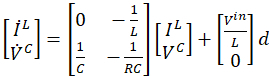 (1)
(1)
Where IL, VC are the inductor current and output voltage, respectively; R, L, C are the component parameters in the converter circuit; Vin represents the input DC voltage; and d represents the duty cycle of the DC-DC converter. Transform Equation ( 1) into the following transfer function form, which is more convenient for the design of a PI controller.

 (2)
(2)
Where s represents the Laplace operator; GId(s) is the transfer function of duty ratio to current; and GVI(s) is the transfer function of current to voltage. - Microgrid construction using multiple DERs
- Repeat the process of constructing individual DERs as described above. With multiple DERs in place, connect the corresponding positive and negative output terminals of each buck circuit.
- To simulate line impedance, insert small resistors in series between the positive poles of each DER.
- Load integration
- Use resistors to simulate common loads in DC microgrids. For global loads, directly connect the resistor's terminals to the confluence points of the positive and negative poles of all DERs. When line impedance is present, connect resistors at the output of each buck circuit to simulate local loads, as shown in Figure 2D.
NOTE: In this experiment, circuit connections are implemented using plug-in connectors as illustrated in Figure 2C.
- Use resistors to simulate common loads in DC microgrids. For global loads, directly connect the resistor's terminals to the confluence points of the positive and negative poles of all DERs. When line impedance is present, connect resistors at the output of each buck circuit to simulate local loads, as shown in Figure 2D.
- Connect the positive pole of the DC current through a wire to the input positive pole of the buck circuit, while simultaneously connecting the corresponding negative poles; the specific converter is shown in Figure 2A. Build a mathematical model for the buck converter to facilitate the design of control parameters for subsequent simulations and experimental setups. For a typical buck converter as shown in Figure 3, construct its state-space equations using the state-space averaging method as follows5:
- Construction of an individual DER
- Hardware circuit design and setup
NOTE: The hardware setup of the DC microgrid experimental platform, corresponding to the topology in Figure 1, primarily consists of the following steps:- DC power supply configuration
- Activate the power supply by pressing the power button.
- Adjust the voltage to the specified value using the knob. This power supply is a constant voltage DC source with an output range of [0 - 300 V] and a maximum power of 600 W. Initiate the power supply at the beginning of the experiment by pressing the switch. The power supply used in this experiment is shown in Figure 2B.
- DC-DC buck converter setup
- Route the input and output signals of the converter to a signal conversion board and connect them to the simulator hardware controller via signal cables.
NOTE: This setup allows for the output of current and voltage signals in analog form and the transmission of PWM signals from the controller to drive the converter at the circuit level.
- Route the input and output signals of the converter to a signal conversion board and connect them to the simulator hardware controller via signal cables.
- Verification of bus and load connections
- Ensure this step aligns with Step 1.1.3. Inspect all connections for accuracy and security.
- DC power supply configuration
2. Control strategy implementation
- 2.1.Droop control configuration
- Construct the droop control module in the control module within the simulator by dragging and dropping components such as gains and difference blocks, as shown in Figure 4.
- Double-click the 'gain' module and set the droop coefficient as required.
- Dual-loop PI control setup
- Construct the control block diagram by dragging and dropping components in the simulator (see Figure 5).
- When selecting PI control gains, use the transfer function model of the buck converter in Equation ( 2), following the sequence of designing the inner loop (current loop) first and then the outer loop (voltage loop).
NOTE: There is a trade-off between fast dynamic response and power-sharing accuracy in the dual-loop control scheme, as rapid voltage adjustments may compromise the precision of power distribution among DERs.
- Construction of distributed communication topology
- Provide different input signals to the controllers of each DER to implement distributed control within the centralized simulator controller. For example, for DER 1, drag the signals from DER 2 and DER 4 into its control module to enable distributed communication, as shown in the left part of Figure 6 and in Figure 7C.
- Implementation of distributed secondary control strategy
- Construct the secondary control block diagram in the simulator based on the consensus-based secondary control, as illustrated in Figure 6. Adjust the secondary control response by modifying the control gains.
3. Real-time simulator experimental setup
NOTE: The specific configuration of the simulator experiment comprises four steps, as illustrated in Figure 8.
- Model initialization
- Click the Edit button to modify the program running on the simulator. Subsequently, activate the SET button to complete the development property settings.
- Model compilation
- After completing the model editing, click the Build button to compile the model into executable code.
- Monitor the software compilation window until the message 'Compilation Successful' appears. If an error occurs, locate the error based on the prompt and make the necessary corrections
- Simulator real-time control configuration
- Upon completion of the compilation process, configure the program code settings such as Simulation mode, real-time communication link type, and other relevant parameters.
- Program download and execution
- Download the compiled executable program into the controller hardware and initiate the experiment.
- Connect the voltage probes of the oscilloscope to the positive and negative terminals of each DER output, and clamp the current probes at the output ports. Use the oscilloscope window to observe the output from each DER in the microgrid.
Access restricted. Please log in or start a trial to view this content.
Results
Figure 4 shows the droop control module in the control module constructed within the simulator. The detailed design is based on the following droop mechanism:
The droop control mechanism is a fundamental strategy for decentralized primary control in DC microgrids. It emulates the behavior of synchronous generators in AC systems to share loads proportionally among different DERs. The droop control a...
Access restricted. Please log in or start a trial to view this content.
Discussion
Figure 10 shows the current and voltage responses of the microgrid system under secondary control without communication delays. Before time t1, the system is regulated solely by droop-based primary control, where it is evident that the voltage cannot stabilize at the nominal value of 48 V, and the current distribution is relatively imprecise. Upon activating the secondary control at time t1, the voltage quickly recovers to around 48 V at t
Access restricted. Please log in or start a trial to view this content.
Disclosures
The authors have no conflicts of interest to disclose.
Acknowledgements
This work was supported in part by the National Natural Science Foundation of China under Grant 62103308 and Grant 62073247, in part by the Fundamental Research Funds for the Central Universities under Grant 2042023kf0095, in part by the Natural Science Foundation of Hubei Province of China under Grant 2024AFB719 and JCZRQN202500524, in part by the Wuhan University Experiment Technology Project Funding under Grant WHU-2022-SYJS-10, and in part by the Postdoctoral Fellowship Program of CPSF under Grant Number GZC20241269.
Access restricted. Please log in or start a trial to view this content.
Materials
| Name | Company | Catalog Number | Comments |
|---|---|---|---|
| Programmable DC power supply | ITECH | IT-M7700 | DC Power Supply |
| Real-time simulator | OPAL RT-Lab | OP5707XG-16 | Real-time controller |
| Oscilloscope | Tektronix | MSO58 5-BW-500 | Oscilloscope |
| Electrical components such as cables and resistors |
References
- Bolsen, T. Framing renewable energy. Nat Energy. 7 (11), 1003-1004 (2022).
- Dai, X., et al. Distributed secondary control for DC microgrids with time-varying communication delays: A networked predictive control scheme. IEEE Trans Power Syst. 39 (2), 4459-4472 (2024).
- Alzahrani, A., et al. Modeling and simulation of microgrid. Procedia Comput Sci. 114, 392-400 (2017).
- Naderi, E., Asrari, A. Experimental validation of a remedial action via hardware-in-the-loop system against cyberattacks targeting a lab-scale PV/wind microgrid. IEEE Trans Smart Grid. 14 (5), 4060-4072 (2023).
- Lei, Z., et al. Digital twin based monitoring and control for DC-DC converters. Nat Commun. 14 (1), 5604(2023).
- Alam, M., et al. Planning and protection of DC microgrid: A critical review on recent developments. Eng Sci Technol Int J. 41, 101404(2023).
- Yuan, M., et al. Hierarchical control of DC microgrid with dynamical load power sharing. Appl Energy. 239, 1-11 (2019).
- Krishnamurthy, S., Ogunwole, E. I. Microgrid system design, modeling, and simulation. Modelling and Control Dynamics. Modelling and Control Dynamics in Microgrid Systems with Renewable Energy Resources. , 345-376 (2024).
- Interoperability analysis of IEC61850 protocol using an emulated IED in a HIL microgrid testbed. Hemmati, M., et al. 2021 IEEE International Conference on Communications, Control, and Computing Technologies for Smart Grids (SmartGridComm), , 152-157 (2021).
- Lai, J., Lu, X., Yu, X. Stochastic distributed frequency and load sharing control for microgrids with communication delays. IEEE Syst J. 13 (4), 4269-4280 (2019).
- Li, Z., et al. Distributed event-triggered hierarchical control to improve economic operation of hybrid AC/DC microgrids. IEEE Trans Power Syst. 37 (5), 3653-3668 (2022).
- Wang, J., Jin, C., Wang, P. A uniform control strategy for the interlinking converter in hierarchical controlled hybrid AC/DC microgrids. IEEE Trans Ind Electron. 65 (8), 6188-6197 (2018).
- Zeng, Y., et al. Hierarchical cooperative control strategy for battery storage system in islanded DC microgrid. IEEE Trans Power Syst. 37 (5), 4028-4039 (2022).
- Guo, F., et al. Distributed voltage restoration and current sharing control in islanded DC microgrid systems without continuous communication. IEEE Trans Ind Electron. 67 (4), 3043-3053 (2020).
Access restricted. Please log in or start a trial to view this content.
Reprints and Permissions
