We present a method to apply permanent markings and patterns to silicone surfaces by adhering fine particles to the surface. The markings can be either a recognizable design or a random speckle pattern such as those used in digital image correlation.
Method Article
Applying Permanent, Robust Stenciled Patterns of Fine Particles to Elastomeric Surfaces
In This Article
Summary
Abstract
Developing nonlinear, large deformation models for elastomeric composites is an ongoing challenge with applications in soft robotics, prosthetics, and impact mitigation (like athletic helmets and padding). Our research goal is to develop models that predict material behavior and produce accurate simulations. As we progressed in our research, we recognized the essential need to experimentally capture surface field deformation, which would enable us to develop robust constitutive relationships.
Common optical tracking techniques, such as digital image correlation (DIC) and grid tracking, require a pattern on the surface of the specimen to track and calculate the surface displacement field. However, the inherent low surface energy of most elastomeric materials, such as cured silicones, inhibits permanent marking of the surface. In other words, it is nearly impossible to affix surface tracking patterns to the material that will not easily wipe off or smudge when handling the specimen. Moreover, large deformation experiments can cause the original surface pattern to distort, crack, or flake off.
Here, we present a novel method of spray casting patterns of powder markings on the inner surface of molds prior to reactive injection molding of our elastomeric parts. We developed this simple method, which allows permanent, high-fidelity surface patterns to be applied to the silicone or elastomeric specimens during the manufacturing process. The surface patterns can range from random speckle patterns utilized in DIC to detailed multicolor patterns. These new, robust patterns can withstand large strain cyclic loadings without fading or cracking and will allow for facile marking of silicones in laboratory and industrial settings.
Introduction
Characterizing large deformation material under advanced loading scenarios tends to create nonhomogeneous strain1,2,3,4,5. To accurately model this nonhomogeneous strain, the experimentalist must capture the surface or volume kinematics. The most common techniques used to acquire surface or volume kinematics are referred to as optical tracking techniques. Digital image correlation (DIC) and grid tracking are the two most common optical tracking techniques in the literature for surface kinematics, and both require visible patterns on the surface of the specimen6,7.
Consider a magnetorheological elastomer (MRE), which is composed of a bulk silicone with fine iron particles suspended in the bulk matrix. The specimen can simultaneously deform from both classic mechanical loads at the boundaries and from an applied magnetic field classified as a noncontact force. In this and other analogous loading scenarios, it is imperative that the experimentalist capture the surface kinematics because the homogeneous strain assumption in common loading modes is no longer valid. Multiple techniques for marking the surface of rubber-like specimens exist, such as simply using a high contrast marker or paint2,6. Experimentalists have also applied cosmetic foundation to biological tissue specimens prior to marking the specimen3,5. In either case, the goal is to have both permanent and high-fidelity markings affixed to the specimen. Permanence is necessary to prevent markings from fading or flaking off the specimen surface during handling and cyclic mechanical testing. High line resolution or "fidelity" is essential for accurate image analysis and tracking of the deformation.
Here, we present a method to apply permanent, high-resolution markings to silicone samples by adhering fine particles to the surface of the specimen during manufacturing as opposed to after the specimen is created. The desired pattern, whether an intricate multicolor design or random speckle pattern used in DIC, is applied to the interior of the mold cavity prior to the injection molding process (Figure 1). The fine particles are suspended in alcohol and subsequently applied using an air brush or similar tool. The pattern is applied to the mold. Once the alcohol has evaporated, the mold is closed, and the uncured thermoset elastomeric material is injected into the mold. Following curing, the solid specimen is removed with the pattern permanently embedded in the surface.
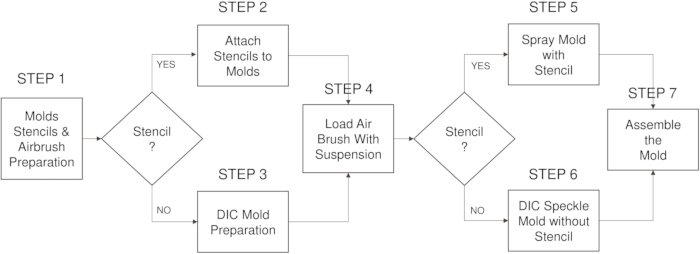
Figure 1: Flow chart protocol for adhering high-fidelity patterns to silicone surfaces. The flow chart or decision tree for our process. This numbering and labeling of each step in the flow chart corresponds to the protocol description. Please click here to view a larger version of this figure.
Protocol
CAUTION: Appropriate personal protective equipment (PPE) consists of glasses, a lab coat, an N95 mask, ear protection, and nonlatex gloves. Nonlatex gloves (i.e., nitrile) are required as latex gloves will inhibit the curing process of platinum silicone specimens.
1. Initial preparation
- Initial preparation of the molds
- Clean the molds with soap and water and allow the molds to dry. Wipe the molds with isopropyl alcohol and allow the molds to air dry.
- Initial preparation of the stencils
- Clean the stencils with soap and water and allow the stencils to dry. Wipe the stencils with isopropyl alcohol and allow the stencils to air dry.
- Initial preparation of the air brush
NOTE: Ear protection could be required based on the type of air compressor utilized. A fume hood is required when utilizing the air brush.- Attach the air compressor to the air brush, plug the air compressor into an appropriate electrical outlet, and turn the air compressor on. Inside a fume hood with the appropriate PPE, fill the air brush with isopropyl alcohol and clean the air brush by running isopropyl alcohol through it multiple times.
NOTE: The air brush must be cleaned after each use. If using a stencil, proceed to section 2. If not using a stencil (such as for DIC speckle pattern application), proceed to section 3.
- Attach the air compressor to the air brush, plug the air compressor into an appropriate electrical outlet, and turn the air compressor on. Inside a fume hood with the appropriate PPE, fill the air brush with isopropyl alcohol and clean the air brush by running isopropyl alcohol through it multiple times.
2. Stenciled mold preparation
CAUTION: A fume hood is required when handling the spray adhesive or mold release.
- Apply the spray adhesive to the stencil.
- Inside a fume hood with the appropriate PPE, place the stencil on a paper towel and apply one coat of the spray adhesive to the stencil. When spraying the adhesive on the stencil, keep the spray nozzle approximately 30 cm away from the stencil and spray in a smooth continuous motion. Wait 30 s to 60 s until the stencil is tacky but no longer wet before proceeding to step 2.2.
NOTE: Only one pass is necessary; too much adhesive will complicate subsequent removal of the stencil from the mold.
- Inside a fume hood with the appropriate PPE, place the stencil on a paper towel and apply one coat of the spray adhesive to the stencil. When spraying the adhesive on the stencil, keep the spray nozzle approximately 30 cm away from the stencil and spray in a smooth continuous motion. Wait 30 s to 60 s until the stencil is tacky but no longer wet before proceeding to step 2.2.
- Adhere the stencil to the mold.
- Inside a fume hood with the appropriate PPE, place the mold on a paper towel. Carefully pick up the stencil with clean, nonlatex gloves, being sure not to disturb the adhesive, and place the stencil on the mold with the adhesive side of the stencil contacting the mold. Flatten the stencil by running one finger firmly across the stencil to ensure uniform contact with the mold.
NOTE: Uniform contact with the mold is necessary to avoid diffuse pattern edges and maintain sharp features.
- Inside a fume hood with the appropriate PPE, place the mold on a paper towel. Carefully pick up the stencil with clean, nonlatex gloves, being sure not to disturb the adhesive, and place the stencil on the mold with the adhesive side of the stencil contacting the mold. Flatten the stencil by running one finger firmly across the stencil to ensure uniform contact with the mold.
- Place the stencil tape on the mold.
- Using painter's tape, tape the edges of the stencil to the mold. Proceed to Step 4.
NOTE: This step ensures the stencil is secured to the mold to prevent separation of the stencil edges from the mold.
- Using painter's tape, tape the edges of the stencil to the mold. Proceed to Step 4.
3. DIC speckle mold preparation
- Apply the mold release to mold for DIC Speckle.
- Inside a fume hood with the appropriate PPE, place the mold on a paper towel with the mold cavity surface facing up. Apply mold release to the mold by spraying the mold with one coat of mold release. When spraying the mold release on the mold, keep the spray nozzle approximately 12 inches away from the mold and spray in a smooth continuous motion.
NOTE: Only one pass is needed; however, too much mold release is not problematic.
- Inside a fume hood with the appropriate PPE, place the mold on a paper towel with the mold cavity surface facing up. Apply mold release to the mold by spraying the mold with one coat of mold release. When spraying the mold release on the mold, keep the spray nozzle approximately 12 inches away from the mold and spray in a smooth continuous motion.
4. Airbrush preparation
NOTE: A fume hood and an N95 mask are required when handling fine powder.
- Initial preparation of the fine powder suspension
- Inside a fume hood with appropriate PPE, prepare a 45 mL suspension of isopropyl alcohol and fine powder (graphite or colored pigment) (Figure 2). To do this, using a funnel or a small spoon as shown in Figure 2A, place approximately 10 mL of fine powder in a test tube and add isopropyl alcohol to fill the remaining volume of the test tube to 45 mL total volume. Seal the test tube and shake vigorously (see Figure 2C for an example of the resulting suspension).
NOTE: Do not fill the air brush at this time to avoid clogging of the air brush nozzle.
- Inside a fume hood with appropriate PPE, prepare a 45 mL suspension of isopropyl alcohol and fine powder (graphite or colored pigment) (Figure 2). To do this, using a funnel or a small spoon as shown in Figure 2A, place approximately 10 mL of fine powder in a test tube and add isopropyl alcohol to fill the remaining volume of the test tube to 45 mL total volume. Seal the test tube and shake vigorously (see Figure 2C for an example of the resulting suspension).
- Filling the air brush prior to spraying (Figure 2D).
NOTE: This step should be performed immediately before using the air brush. The air brush should not sit idle with the powder suspension in the air brush container because the air brush will clog.- Re-shake the premixed suspension from step 4.1. Pour the suspension into the air brush container until 75% of the volume of the air brush container is filled.
NOTE: Do not completely fill the air brush container because the angle of the air brush would lead to spilling. If using a stencil, proceed to section 5. If not using a stencil, proceed to section 6.
- Re-shake the premixed suspension from step 4.1. Pour the suspension into the air brush container until 75% of the volume of the air brush container is filled.
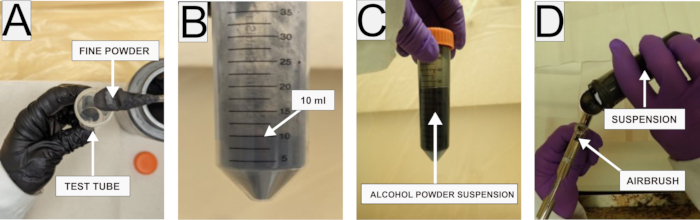
Figure 2: Preparing the airbrush with graphite solution. (A) Placing graphite powder in test tube; (B) 10 mL of graphite powder; (C) solution of isopropyl alcohol and graphite powder. (D) Fill the airbrush immediately prior to use. Please click here to view a larger version of this figure.
5. Spray the mold with the stencil (Figure 3)
- Spraying the fine particle suspension
- Turn the air compressor on. Make sure the compressor air pressure is 1.38 to 1.72 bar (20-25 psi).
- In the fume hood, orient the mold with the adhered stencil at an angle slightly off vertical so that the spray is applied at a 90° angle. Aim the air brush slightly off the side of the mold to ensure that the spray will start before or in front of the mold.
- Pull the air brush trigger back gently. Once the air brush begins to spray, smoothly apply the first coat of the suspension. When spraying the suspension on the stencil and mold, keep the spray nozzle approximately 30 cm away from the surface and spray in a smooth continuous motion as shown in Figure 3C.
- Release the air brush trigger and observe if the fine particle suspension is uniformly applied across the surface. If needed, apply additional layers of the suspension across the surface of the stencil and mold.
- Removing the stencil from the mold (Figure 4)
- Wait until the fine particles are visibly dry before removing the stencil (at least 180 to 300 s) or the suspension may smear. The negative space of the stencil will appear to be filled with the fine particle powder as the isopropyl alcohol has evaporated.
- Remove the painter's tape from the top (shorter end) of the mold and pull the painter's tape up slowly and smoothly. The stencil will detach along with the painter's tape as shown in Figure 4A.
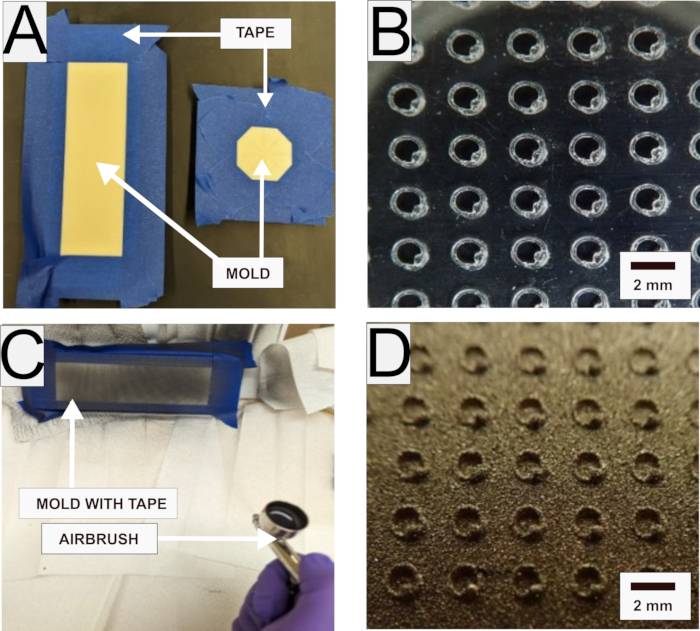
Figure 3: Airbrush application of graphite solution. (A) Prepared molds from protocol section 2. (B) Stencil with square array of circular holes prior to spraying. (C) Spraying the prepared mold with solution. (D) Grid stencil after spraying. Scale bars = 2 mm (B,D). Please click here to view a larger version of this figure.
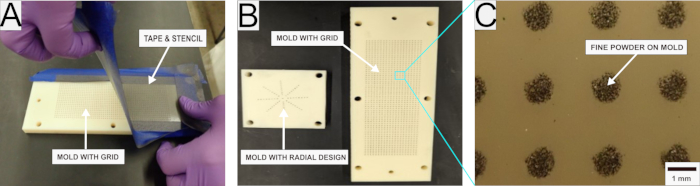
Figure 4: Removing the stencil and inspection of the patterned mold surface. (A) Removing the stencil from the mold. (B) Example molds after allowing alcohol to evaporate. (C) Magnified view of grid on mold prior to injection molding. Scale bar = 1 mm (C). Please click here to view a larger version of this figure.
6. Spray the mold without a stencil
- Spraying a DIC speckle pattern on the mold (Figure 5)
- Turn the air compressor on. Make sure the compressor air pressure is 0.34 to 0.69 bar (5-10 psi).
- In the fume hood, orient the mold with no stencil at an angle slightly off vertical so that the spray is applied at a 90° angle.
- Test the air brush by briefly compressing the trigger while aiming at a spare sheet of paper to ensure the speckle pattern is appropriate (randomly distributed spatially, correct size distribution of spots for the magnification of the experimental imaging setup).
- Flick the trigger over the mold to create the speckle pattern on the mold as shown in Figure 5C. Wait until the fine particles are visibly dry (at least 180 to 300 s) or the suspension may smear.
NOTE: The speckle size can be adjusted by altering the air pressure.
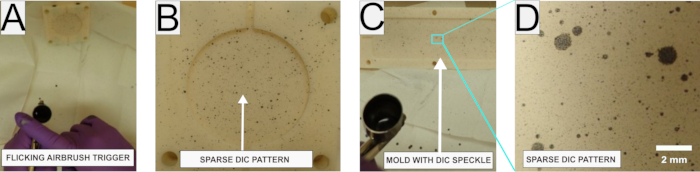
Figure 5: Spraying random pattern on mold. (A) Flicking air brush trigger to create speckle pattern. (B) Speckle pattern on mold. (C) Speckle pattern on mold. (D) Magnified speckle pattern. Please click here to view a larger version of this figure.
7. Assemble the mold (Figure 6)
- Assemble the mold.
- Gently assemble the mold(s) to prepare for the injection molding process.
NOTE: The experimentalist can pause for at least multiple days prior to performing their injection molding process. The injection molding rate should be reduced to avoid smearing of the fine particles.
- Gently assemble the mold(s) to prepare for the injection molding process.
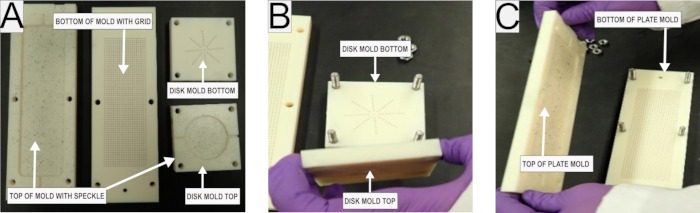
Figure 6: Assembly of molds. (A) Plate and disk molds fully assembled, (B) Assembly of disk mold, (C) Assembly of plate mold. Please click here to view a larger version of this figure.
Results
For the experimentalist pursuing a model representing the mechanical properties of a specific material, it is necessary to run multiple different experiments with a set of specimens having a variety of geometries. Examples of specimens created using this technique are displayed in Figure 7. Figure 7A illustrates an Ecoflex silicone plate with black grid design on a white specimen. The side shown has a black grid, and the reverse side has black DIC speckle. Figure 7B shows an Ecoflex silicone plate with a white grid design on a black specimen. Just like the specimen shown in Figure 7A, the specimen in Figure 7B has the DIC speckle pattern on the reverse side, molded from the prepared mold shown in Figure 6A. This pattern of creating both a black design on white and a white design on black with both a grid and DIC speckle pattern is also shown on the cylinder and the cube specimens shown in panels C, D, F, and G of Figure 7. Figure 7E provides an example of a plate with a blue grid on white.
Figure 8 represents a poorly patterned sample due to the injection molding flow rate being too high. The DIC speckle pattern has smeared so that the particles are spread into streaks. This specimen was purposely manufactured with a sparse DIC speckle pattern to clearly illustrate the smearing. This method allows the experimentalist to place a denser speckle pattern if needed for better DIC results7,8,9, particularly for small strain experiments. Varying density speckle patterns are shown in Figure 9B,C. Figure 10 shows images of silicone plates manufactured using this method with a DIC strain field color map overlay to illustrate successful optical tracking.

Figure 7: Examples of specimens used in experiments. (A) White plate with black grid dots in uniaxial tension. (B) Black plate with white grid dots (stenciled pattern) in uniaxial tension. (C) Black cylinder with white grid dots. (D) Black cylinder with DIC speckle pattern. (E) Blue grid dots (F) White cube with white grid dots and DIC speckle pattern. (G) Black cube with white grid dots. Scale bars = 1 mm (E), 1 cm (A-D,F,G). Abbreviation: DIC = digital image correlation. Please click here to view a larger version of this figure.
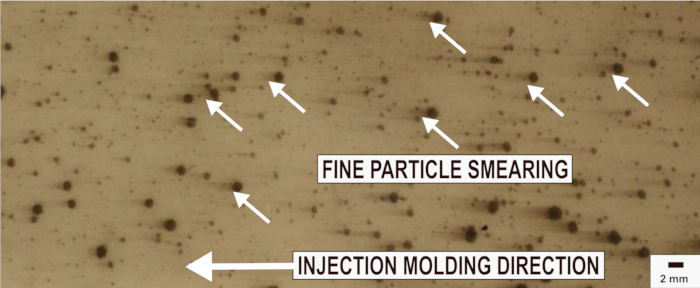
Figure 8: Examples of specimens where the injection molding rate was too fast and the speckled pattern is smeared. The injection molding flow direction is indicated with a horizontal arrow across the bottom of the image. Slanted arrows indicate the locations of several of the streaks of the smeared pattern. Scale bar = 2 mm. Please click here to view a larger version of this figure.
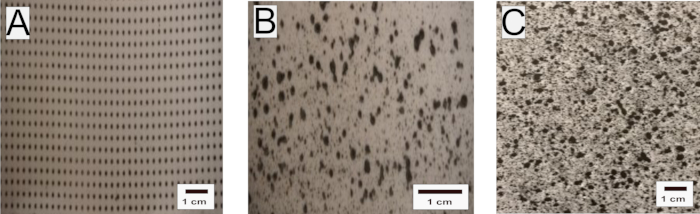
Figure 9: Example image designs used in optical tracking. (A) An example grid pattern for optical tracking, (B) An example of a sparse DIC speckle pattern for optical tracking, (C) An example of a dense DIC speckle pattern for optical tracking. Scale bars = 1 cm. Please click here to view a larger version of this figure.
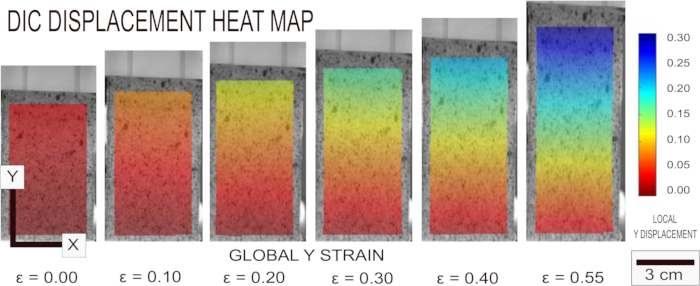
Figure 10: Example of Digital Image Correlation strain field overlayed on top of uniaxial tension experimental images. Strain is applied in the y-direction, and the global engineering strain is listed below each image. The local vertical displacement of various locations of the sample are shown with the color map as indicated on the scale on the right of the figure. Please click here to view a larger version of this figure.
Discussion
The capability to adhere particles to rubber-like materials, such as silicone, provides advantages in both industry and research. However, it is well known that bonding to surfaces of materials with a low surface energy can be a challenge. In general, researchers whose experimental methods require a pattern or design on the surface of their specimens commonly use paint specially formulated for airbrushing such as those manufactured by Createx and Vallejo1,10. These applications using paint often require a primer and still fail to achieve the required durability of the patterns. On flexible substrates, the paint may smear or fall off in flakes as it cracks during mechanical testing. These marking adhesive failures then alter the data field captured by an optical tracking method like digital image correlation. Our method ensures long-lasting durability of the surface pattern. We currently have samples that are over 6 years old that we have attempted to smear aggressively and remove the surface pattern mechanically. All efforts to remove these markings have failed, demonstrating the robustness of the surface patterns.
In industry, it may also be necessary to apply designs, symbols, or words to the surface of rubber-like materials for safety and process instructions, such as the installation of a gasket. For example, in the auto industry, it is common to imprint words such as "THIS SIDE UP" or imprint an arrow on a rubber gasket to provide clear installation instructions. Traditionally, these markings are achieved by modifying the mold surface so that the words are either above or below the surface of the rest of the part. This method requires a new mold to be fabricated each time the markings need to be changed. Additionally, the final part will have a different thickness where the imprint is located, leading to potential failure sites during operation. Our method overcomes both issues by not altering the molds in any way and allowing the surface of the final material to remain a uniform thickness.
Mechanical testing has been performed to confirm that our patterning method does not impact the mechanical attributes of the material. We have repeatedly tested specimens in a variety of loading modes such as simple shear, uniaxial tension, compression, and even impact tests. Furthermore, this method is environmentally safe when compared to alternative paint application methods. We avoid the use of toxic, volatile paint solvents by utilizing alcohol in our solution when air brushing the mold. Finally, a noteworthy characteristic of our method is the ability to create multicolor, high-resolution patterns on the sample surface. The method is limited by the particle size and manufacturing precision of the stencil. The particle size must be sufficiently small to attain the desired fidelity and overcome the flow rate of the injection molding process. The specimen size and geometry are only constrained by the size of the mold and the material chosen. We have manufactured 2 inch cubes with success utilizing silicone with an approximately 20 min pot life at room temperature.
The stencil fabrication method will directly impact the feature size resolution and ones ability to create a high-fidelity design on the mold cavity during particle spray coating. Careful consideration of which stencil fabrication is an integral part of the patterning method. Here, we provide a simple set of stencil preparation techniques along with the minimum feature size that can be formed with each technique, lmin. First, hand-cutting with a craft knife: Precision tools like X-Acto knives or utility blades are best for detailed and intricate designs and work well with materials like plastic sheets, mylar, or cardstock (lmin ≥ 1 mm). Second, hand-cutting with scissors: Can be used for lightweight materials like paper or thin vinyl to produce simple shapes and less intricate designs (lmin ≥ 1 mm). Third, die-cutting machines like Cricut or Silhouette: Can cut complex designs with precision using materials like adhesive vinyl or cardstock (lmin ≥ 250 µm). Fourth, laser cutting: A high-tech option for complex patterns suitable for acrylic, wood, or thick plastic stencils (lmin ≥ 100 µm). Fifth, heat cutting tools: electric hot knives or soldering irons can melt through thermoplastic stencil materials like mylar or other extruded polymer films (lmin ≥ 1 mm). This method produces smooth edges. Sixth, punching: helpful for small, repetitive shapes and they work best on lightweight materials (lmin ≥ 100 µm). Finally, computer-controlled routers could be utilized for large or industrial-scale stencil projects (lmin varies).
In any new manufacturing protocol, certain steps in the process are critical to achieving the desired outcome. In our method, there are three steps that should be highlighted and given special attention. The first critical step is allowing the alcohol to evaporate completely from the airbrushed particle suspension, leaving only the particles adhered to the mold surface. If the alcohol does not completely evaporate, there is a strong chance that the design on the mold will smear and/or the alcohol will mix with the uncured material during the injection molding process. The size of the particles must be sufficiently small since these particles, which are suspended in the alcohol "paint" in the airbrush, adhere to the mold after the alcohol has fully evaporated. The size of the particles is an important limitation to note. If the particles are too large, Van der Waals forces will be insufficient to securely and permanently adhere the particles to the surface of the rubber-like material surface. However, suitably sized particles can be affordably and easily obtained from several commercial pigment suppliers.
The second critical step is the amount of adhesive, which temporarily holds the stencil on the mold. In our experience, the best way to execute this step is to use one quick pass of a spray adhesive. We recommend as little adhesive as possible while still ensuring the stencil has complete contact with the mold. By manually flattening the stencil on the mold with your finger or an appropriate instrument like a rubber spatula, conformal contact can be formed. If the openings of the stencil are not completely flat against the mold, the particle suspension will migrate under the edges of the stencil pattern during air brushing, significantly decreasing the sharpness of the surface design edges. If too much adhesive is used, removing the stencil will be challenging and may damage the newly applied design. Moreover, too much adhesive will lead to the specimen strongly adhering to the mold during the curing process, making the demolding process almost impossible without causing damage to the specimen.
The third critical step is the injection rate of the uncured silicone during the injection molding process. In our experience, we observed that sufficiently slow injection molding flow rate(s) did not overcome the Van der Waals forces adhering the fine particles to the mold, allowing the mold cavity to be filled without disturbing the patterned particles. Some empirical testing is required to determine an optimum injection rate that is slow enough to avoid smearing of the pattern yet fast enough to fill the mold cavity before the onset of curing of the silicone. Curing retardants can be added to the mix if larger volume parts are made. The material's viscosity and curing time will dictate the appropriate injection rate for each material's system.
Disclosures
The authors have no conflicts of interest to disclose.
Acknowledgements
The authors acknowledge Purdue University for providing lab facilities to conduct the research.
Materials
| Name | Company | Catalog Number | Comments |
|---|---|---|---|
| Air Compressor | Craftsman | CMEC6150 | PORTABLE: 6 gal. pancake compressor https://www.craftsman.com/collections/air-compressors/products/cmec6150 |
| Dye for eco flex | Smooth-On | PMS 2757C | Silc Pig silicone color pigments. Silc Pig pigments are concentrated, so a little goes a long way when coloring Smooth-On silicone products. Custom colors are possible by blending different Silc Pig colors. Silc Pig 9 Pack Sampler includes BLACK, BLOOD, BLUE, BROWN, GREEN, LIGHT FLESH, RED, WHITE, YELLOW. https://www.smooth-on.com/products/silc-pig/ |
| Isopropyl alcohol | Swan | 70% Isopropyl Alcohol - 16 oz Bottle S-15966 - Uline | 70% Isopropyl Alcohol - 16 oz Bottle www.uline.com |
| Mixing Cups | Solo | Model No: S-19462R | Plastic Party Cups www.uline.com |
| Mold Release for Stencil | Ease Release 200 & 205 | Model and pattern release agent for making epoxy, urethane and RTV silicone molds. https://www.reynoldsam.com/ | |
| Mylar Sheet 3 mil | Stencils Online LLC | NA | Mylar Sheets | Stencil Material www.stencilsonline.com |
| Painters Masking Tape | Uline | S-26006 | Uline Painters Masking Tape www.uline.com |
| Paper Towels | Uline | S-7711 Uline | S-7711 Uline - An absorbent towel at an economical price. 2-ply. www.uline.com |
| Popsicle sticks | Darice | Item model number: D-0139#, UPC 652695701399 | https://www.amazon.com/Darice-Popsicle-Sticks-Crafts-Natural/dp/B0CPKHS44K/?th=1 |
| Powder | Earth Pigments | Titanium Dioxide PW6 | Titanium White Earth Pigments https://www.earthpigments.com/ |
| Silicone (ecoflex) | Smooth-On | Ecoflex 00-20 | platinum-catalyzed silicones https://www.smooth-on.com/ |
| Spray Adhesive | Stencil Ease | SKU: ASA0005 | Stencil Ease Repositionable Spray Adhesive https://www.stencilease.com/ |
| Spray Gun / Airbrush | Badger | Patriot 105 | Badger Patriot 105 Airbrush https://www.badgerairbrush.com/Patriot_105.asp |
| Test Tubes | Global Scientific | Item 83576, Manufacturer Part #: 6254 | 50mL Polystyrene General Purpose Centrifuge Tubes with Caps - Sterile www.usplastic.com |
| Vinyl Tubing | Sioux Chief | Model Number: 900-01163C00501 Menards SKU: 6840523 | Sioux Chief Clear Vinyl Tubing www.menards.com |
References
- Gustafson, H. M., Melnyk, A. D., Siegmund, G. P., Cripton, P. A. Damage identification on vertebral bodies during compressive loading using digital image correlation. Spine (Phila Pa 1976). 42 (22), E1289-E1296 (2017).
- Han, Y., Rogalsky, A. D., Zhao, B., Kwon, H. J. The application of digital image techniques to determine the large stress-strain behaviors of soft materials. Polymer Engineering & Science. 52 (4), 826-834 (2012).
- Nagelli, C., et al. Mechanical and strain behaviour of human Achilles tendon during in vitro testing to failure. Eur Cell Mater. 43, 153-161 (2022).
- Nunes, L. C. S. Shear modulus estimation of the polymer polydimethylsiloxane (pdms) using digital image correlation. Materials & Design. 31 (1), 583-588 (2010).
- Palanca, M., Tozzi, G., Cristofolini, L. The use of digital image correlation in the biomechanical area: A review. International Biomechanics. 3 (1), 1-21 (2016).
- Pan, B. Recent progress in digital image correlation. Exp Mech. 51, 1223-1235 (2011).
- Reu, P. Introduction to digital image correlation: Best practices and applications. Exp Tech. 36 (1), 3-4 (2012).
- Pan, B., Qian, K., Xie, H., Asundi, A. Topical review: Two-dimensional digital image correlation for in-plane displacement and strain measurement: A review. Meas Sci Technol. 20, 062001(2009).
- Sutton, M., Orteu, J. -J., Schreier, H. Image correlation for shape, motion and deformation measurements: Basic concepts, theory and applications. , (2009).
- Pan, B. Digital image correlation for surface deformation measurement: Historical developments, recent advances and future goals. Meas Sci Technol. 29, 082001(2018).
Reprints and Permissions
