An integrated autosampler and fraction collector (LC-mate) was developed to automate repetitive HPLC separations. Compatible with HPLC detectors that output analog signals, LC-mate enhances the performance of manually operated systems and accelerates research workflows that depend on high-performance liquid chromatography.
A subscription to JoVE is required to view this content. Sign in or start your free trial.
Method Article
Automated HPLC Separation Using LC-Mate: An Integrated Repetitive Autosampler and Fraction Collector for Microscale Purification
In This Article
Summary
Abstract
High-performance liquid chromatography (HPLC) plays a crucial role in the purification of high-value compounds, meeting the increasing demands of chemistry and biology disciplines in both academic and industrial settings. However, repeated manual injection and fraction collection during microscale purification significantly limit efficiency and reproducibility. To overcome this bottleneck, we have developed an integrated autosampler and fraction collector system, temporarily named LC-mate, which automates repetitive separations by responding directly to analog signals from the HPLC detector. The instrument is constructed around a high-pressure six-port switching valve for sample injection and a selector valve for fraction collection, with operational parameters controlled via an intuitive touchscreen interface. LC-mate is compatible with commercial HPLC detectors capable of analog output and can also achieve repetitive separation of gradient elution mode through synchronous signal triggering. Demonstration experiments confirmed stable operation and reproducible separations for natural product purification, showing a clear reduction in manual handling time. The system offers a practical and accessible solution for enhancing automation in conventional HPLC workflows, bridging the gap between manual and fully automated purification systems.
Introduction
Chromatography, pioneered by M.S. Tswett in the early 20th century, evolved into modern high-performance liquid chromatography (HPLC) in the 1960s with advancements in instrumentation1,2,3.
Today, HPLC plays a critical role in the purification of high-value compounds, meeting the growing demands of biomedicine, chemistry, and biology disciplines in both academic and industrial fields. In academic research, the microscale purification of natural products and resolution of chiral molecules depend critically on semi-preparative HPLC techniques4,5,6,7,8. In most practical cases, researchers inject a portion of the sample solution into an HPLC column at a time rather than the whole to avoid unforeseeable sample loss or due to the limitation of column size, which makes repeated sample injection and fraction collection inevitable. Despite its exceptional separation capability, the use of HPLC for sample purification remains limited by inherent constraints in current instrumentation and workflows. A major bottleneck lies in the heavy dependence on manual intervention, particularly in sample injection and fraction collection. These processes are not only time-consuming and labor-intensive, but also susceptible to human error, thereby compromising throughput, reproducibility, and overall operational efficiency9,10.
Commercial autosamplers and fraction collectors from major HPLC manufacturers, such as Agilent, Shimadzu, and Waters provide reliable and precise automation, but are typically constrained within proprietary hardware and software ecosystems. For instance, the Agilent 1260 Infinity II autosampler and G1364F fraction collector are seamlessly integrated within Agilent's HPLC systems, providing excellent reproducibility but limited cross-platform compatibility. Similarly, Shimadzu's SIL-20A/40C autosamplers and FRC-40/FRC-10A fraction collectors offer high throughput and excellent mechanical precision, yet depend on Shimadzu's LC-20 and Nexera control architectures. The Waters Alliance HPLC autosampler and fraction collector III modules also deliver robust performance and flexible collection formats (up to 300 mL/min), but remain tailored to Waters' proprietary UHPLC and LC-MS environments. In addition, traditional autosamplers that rely on injection needles may reduce sample recovery, and tube-based fraction collectors can be inconvenient for handling large eluent volumes. For most other HPLC instruments, semi-preparative separation still depends on tedious repetitive manual operation.
These challenges highlight the need for an innovative approach to automate sample purification in HPLC workflows. To address this need, we have developed LC-mate, a compact and versatile instrument that integrates autosampler and fraction collection modules into a single platform. The fluidic core of LC-mate consists of two key components: a high-pressure six-port switching valve (SKVA-3130-S) constructed from SUS 316 stainless steel with a 0.4-mm flow path and supporting operating pressure up to 45 MPa, rating for precise sample injection control, and a 10-channel multi-position selector valve featuring minimal dead volume (27.5 µL port-to-port, 5 µL rotor groove) with a 1.2 mm flow channel diameter for efficient fraction collection. This configuration minimizes dead volume and reduces the risk of cross-contamination. For detailed instrument specifications, please refer to Table 1. LC-mate may receive analog output from HPLC detectors and trigger the HPLC instrument via synchronous signal, enabling independent control of both sample injection and fraction collection.
Table 1: LC-mate related instrument parameters. Please click here to download this Table.
The instrument is equipped with user-friendly control software and an intuitive touchscreen interface that allows real-time visualization of analog chromatographic signals. LC-mate supports both isocratic and gradient separation modes, allowing users to configure key parameters-including injection volume, number of repetition times, interval time of each injection, and collection mode [threshold-based, time-based, or Collect All (collect fractions both above and below the threshold)], and launch fully automated operation with a single command. This eliminates the need for repetitive manual intervention and significantly enhances the efficiency of HPLC purification.
Figure 1 illustrates the overall appearance, operating principle, and configuration of the LC-mate integrated with an HPLC system. A demonstration of the operational principle is provided in Supplementary Video 1.
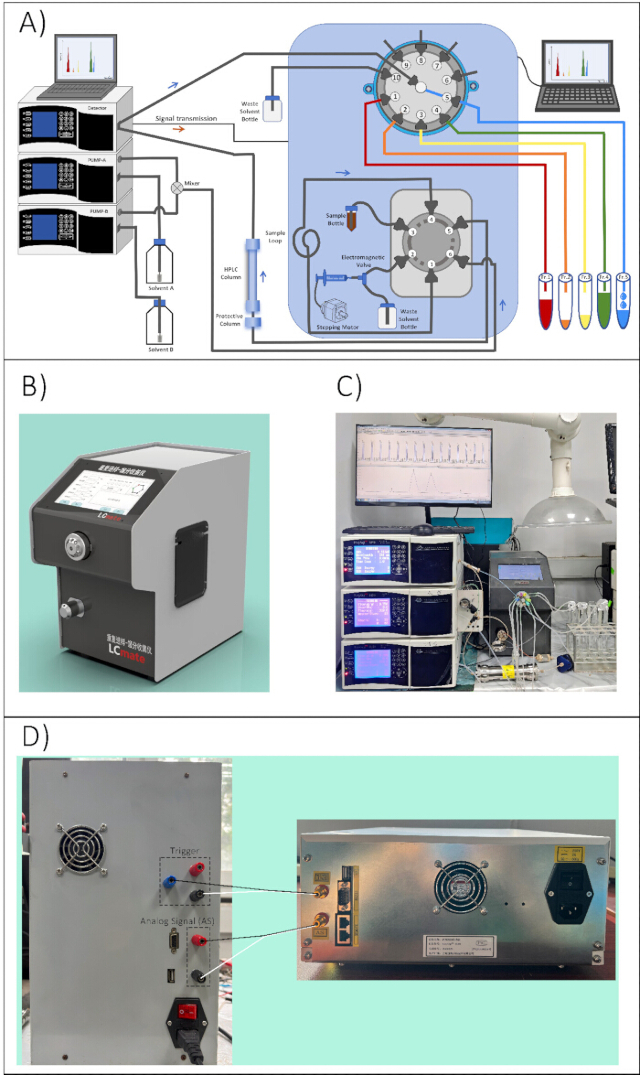
Figure 1: Design and setup of the LC-mate system. (A) Schematic layout. (B) Instrument diagram. (C) Practical setup photo. (D) Connection of the signal transmission line between the UV detector and the LC-mate. Please click here to view a larger version of this figure.
Access restricted. Please log in or start a trial to view this content.
Protocol
1. Checking the connection
- Verify the solvent plumbing connections between the HPLC, LC-mate, and chromatographic column to ensure proper flow paths (Figure 1A).
- Check the connection of the signal transmission line between the UV detector and LC-mate, as shown in Figure 1D.
- Connect the black wire to the red terminal and the white wire to the black terminal to match the polarity of the analog signal output.
- Observe the LC-mate display. If the analog signal waveform appears, the connection is correct.
NOTE: If no waveform is visible, reverse the connections: attach the black wire to the black terminal and the white wire to the red terminal.
- Check the connection of trigger connection between UV detector and LC-mate.
- Plug the single end of the data cable into the output port of the UV detector.
- Connect the black and white wires from the other end to the blue and black trigger terminals on the LC-mate, respectively.
- Tighten the terminal and trigger to ensure a firm connection.
2. Startup of the integrated separation system
- Ensure proper startup of the HPLC.
- Ensure proper startup of the LC-mate.
- Upon startup of the LC-mate system, click on the LC-mate icon on the interface to automatically execute the system self-test program and initialize key hardware modules.
- Wait for the brief Di prompt tone (approximately 0.5 s) and the disappearance of the "Self-Testing" prompt on the screen after the self-test completes, as they indicate that initialization is finished.
3. Condition optimization
- Configure the HPLC separation condition and begin elution to realize column equilibration.
- Click on the Test icon on the left side of the screen of LC-mate, and the following interface will display on the screen (Figure 2A). Input Injection Volume, Elution Time, and Repetition Times parameters, and press the Start icon; the running of autosampler, fraction collector, and HPLC will be initiated. In this case, the eluent only flows out through port 10 of the selector valve, and can be collected manually or discarded.
- Identify the feasible separation conditions, including resolution, running time, retention time, injection volume, and UV wavelength, etc, to facilitate the subsequent separation and fraction collection under suitable modes.
4. Auto-running
NOTE: Based on the chromatogram of feasible separation conditions, one could select a suitable fraction collecting manner from the Threshold, Timing Collection, and Collect All options on the left side of the interface.
- Fraction collection based on threshold value
- Select the Threshold function module on the left side of the interface, and the system will display the parameter setting interface as shown in Figure 2B.
- Enter the Injection Volume, Repetition Times, Threshold, and Elution time, and press Start; the HPLC and LC-mate will run automatically. Fractions with chromatographic peaks exceeding the threshold will be collected in different collection bottles.
- Monitor the status indicators arranged vertically on the display: Observe Injection in Progress to confirm that sample introduction is initiated. Check the Separation in Progress to verify that the chromatographic separation is going on. Note "Syringe Emptying" to identify when the syringe is purging residual liquid. Watch for blue highlighting of the corresponding text to confirm which operational state is currently active.
NOTE: During the separation process, pressing the "Chromatogram" icon will display the chromatogram and threshold line on a new interface, and the chromatogram is identical to that shown on the screen of the computer that controls the HPLC.
- Fraction collection based on time period
- Select the Timing Collection module from the left-side of the interface to open the parameter setting menu (Figure 2C).
- Input the required parameters: Injection Volume, Repetition Times, Elution Time, and a series of Collection Time needed.
- Press the Start button to initiate the automated sequence, then the HPLC system and LC-mate will run repeatedly according to the parameters set.
- Fraction collection with the "Collect All" mode
- Select the Collect All function module on the left side of the interface, the system will display the parameter setting interface as shown in Figure 2D.
- Set a collection threshold value, and chromatographic peaks that are above or below the threshold will all be collected separately, which may guarantee no compound in a mixture would be lost.
NOTE: Acetonitrile is a flammable and toxic solvent. All procedures involving acetonitrile or other organic solvents must be performed in a well-ventilated laboratory space. Personnel must wear appropriate personal protective equipment (PPE), including chemical splash goggles and solvent-resistant gloves, at all times. Waste acetonitrile and other organic solvents must be collected in designated, properly labeled containers for hazardous chemical waste. These waste streams were handled according to our institution's environmental health and safety protocol by a licensed disposal service.
5. Pipeline cleansing
NOTE: Cleaning the pipeline ensures that no sample remains in the pipeline when the autosampler is used next time.
- Prepare a small bottle of clean solvent, and insert the injection pipeline of the autosampler into the solvent.
- Select the Cleansing module from the left-side interface to open the parameter setting menu (Figure 2E).
- Cleansing of injector pipeline
- Set the Injection Volume between 0-1000, and set the Repetition Times (no limits).
- Click on the Cleansing below the "Cleansing Completed" to start the cleansing of the injector pipeline.
- Monitor the "Cycle" count to track the number of completed wash cycles.
- Cleansing of the collection pipeline
- Set the Cleansing Time (no limits).
- Click on the Cleansing below the "Current Pipeline" to start the cleansing of collection pipeline.
- Monitor the Current Pipeline display to confirm which pipeline is being cleaned, as the system processes sequentially from pipeline 0 to pipeline 10.
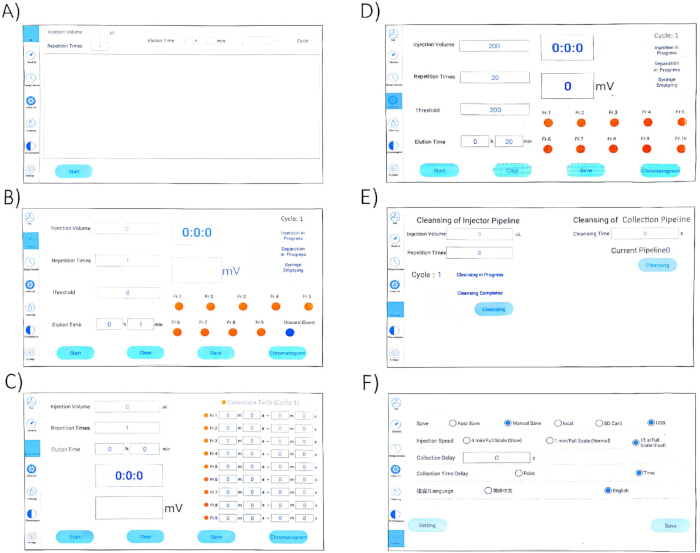
Figure 2: LC-mate touchscreen interface for method operation. (A) Optimization screen. (B) Threshold mode. (C) Timing mode. (D) Collect-all mode. (E) Pipeline cleansing. (F) Settings. Please click here to view a larger version of this figure.
6. Data saving instructions
- Enable automatic saving. The system automatically saves the chromatogram after each elution cycle is completed.
- Perform manual saving. Click on the Save button after elution completes. Enter the required metadata in the dialog box to save the file.
- Select storage location. Choose to save files to the device's local storage, an SD card, or an external USB drive.
NOTE: Use an external USB drive for all data storage to avoid capacity limitations and ensure easy data access.
Access restricted. Please log in or start a trial to view this content.
Results
Purification of 2"-O-galloyl-hyperoside
2"-O-Galloyl-hyperoside (2-GH) is a major water-soluble component of Euphorbia helioscopia L., a traditional Chinese medicine with a long history of use for resolving phlegm and dampness11. Its chemical structure is shown in Figure 3. 2-GH was recently found to possess an anti-fibrotic effect in an animal model12. To prepare...
Access restricted. Please log in or start a trial to view this content.
Discussion
These results demonstrate that the LC-mate system can autonomously perform continuous sample injection and fraction collection following the set parameters, therefore significantly minimizing manual intervention and enhancing separation efficiency. The system features a user-friendly interface, requiring only initial hardware setup followed by intuitive touchscreen operation.
To ensure experimental success, three critical aspects require attention. First, the analog signal and trigger cables m...
Access restricted. Please log in or start a trial to view this content.
Disclosures
Weimin Zhao proposed the design of LC-mate, which was carried out by engineers at Shanghai Betterren Medical Technology Co., Ltd. A patent for this instrument is jointly held by Shanghai Betterren Medical Technology Co., Ltd. and Shanghai Institute of Materia Medica, Chinese Academy of Sciences.
Acknowledgements
The authors sincerely thank Shanghai Betterren Medical Technology Co., Ltd. for all their input in turning an idea of freeing chemists from tedious HPLC manual operation into reality, and Mr. Xuhong He of Welch Materials Inc. for testing the repeatability of LC-mate.
Access restricted. Please log in or start a trial to view this content.
Materials
| Name | Company | Catalog Number | Comments |
|---|---|---|---|
| High performance liquid chromatograph-EasySep-1050 | Shanghai Tongwei Analysis Technology Co., Ltd.. Webpage of the instrument EasySep®-1050 https://www.instrument.com.cn/netshow/sh100522/C140238.htm | 1009992 | A modular preparative HPLC system used in the protocol. It includes a solvent delivery pump, a UV/VIS detector, and a manual injection valve. This system forms the core separation unit that the LC-mate automates. |
| (Liquid chromatographic column) Sharpsil-U C18 150 mm (L) × 30 mm (I.D.) S-10 µm, 100A | Shanghai Xuanmei Industrial Development Co., Ltd. | U180110-300150 | Reversed - phase C18 chromatographic column with a particle size of 10 μm and a pore size of 100 Å. It is designed for the separation of small molecules (such as drugs, organic compounds) and has good reproducibility and stability. The column dimensions (150 mm length, 30 mm inner diameter) make it suitable for preparative or semi-preparative chromatography. |
| LC-mate | Shanghai Betterren Medical Technology Co., Ltd.. For any inquirement on the instrument LC-mate, please contact the corresponding author with E-mail: wmzhao@simm.ac.cn | GD202200337 | Auxiliary equipment for liquid chromatography systems, likely used for sample injection, mobile phase management, or data acquisition. It can be integrated with HPLC systems to improve the automation and efficiency of experimental processes |
References
- Snyder, L. R., Kirkland, J. J., Dolan, J. W. Introduction to modern liquid chromatography. , 3rd ed, John Wiley & Sons. Hoboken, NJ. (2010).
- Georges, A. Preparative liquid chromatography. J Chromatogr A. 965 (1-2), 129-161 (2002).
- Hostettmann, K., Marston, A., Hostettmann, M. Preparative chromatography techniques: applications in natural product isolation. , Springer. Berlin. (1998).
- Queiroz, E. F., Guillarme, D., Wolfender, J. L. Advanced high-resolution chromatographic strategies for efficient isolation of natural products from complex biological matrices: From metabolite profiling to pure chemical entities. Phytochem Rev. 23 (5), 1415-1442 (2024).
- Glowniak, K., Zgórka, G., Józefczyk, A., Furmanowa, M. Sample preparation for taxol and cephalomannine determination in various organs of Taxus sp. J Pharm Biomed Anal. 14 (8-10), 1215-1220 (1996).
- Gumustas, M., Ozkan, S. A., Chankvetadze, B. Analytical and preparative scale separation of enantiomers of chiral drugs by chromatography and related methods. Curr Med Chem. 25 (33), 4152-4188 (2018).
- Wu, T., et al. Preparative separation of four isomers of synthetic anisodamine by HPLC and diastereomer crystallization. Chirality. 31 (1), 11-20 (2019).
- Aguilar, M. I. HPLC of peptides and protein: Methods and protocols. , Humana Press. Totowa, NJ. (2004).
- Dong, M. W. Modern HPLC for practicing scientists. , John Wiley & Sons. Hoboken, NJ. (2006).
- Meyer, V. R. Practical high-performance liquid chromatography. , 5th ed, John Wiley & Sons. Chichester, UK. (2010).
- Ding, J., et al. Research progress on modern pharmacological effects and clinical applications of Euphorbia helioscopia L. World Chin Med. 20 (14), 2588-2594 (2025).
- Wang, J. Q., et al. Hypericin ameliorates renal tubulointerstitial fibrosis by inhibiting YAP. Acta Med Univ Sci Technol Huazhong. 54 (2), 190-197 (2025).
- Li, W. J., et al. Research progress on the hypoglycemic effects of Litsea coreana leaves. Mod Food Sci Technol. 38 (4), 292-297 (2022).
- 1260 Infinity Variable Wavelength Detector User Manual. Document G1314-90013. , Agilent Technologies Inc. https://www.agilent.com/cs/library/usermanuals/Public/G1314-90013_VWD-B-C_USR_EN.pdf (2010).
- 2487 Dual λ absorbance detector operator's guide. Document WAT048740, Rev. 2. , Waters Corporation. (2004).
- UltiMate 3000 series variable wavelength detectors VWD-3100 and VWD-3400RS operating instructions. Document 4820.7451, Rev. 1.7. , Thermo Fisher Scientific. https://conquerscientific.com/wp-content/uploads/2023/01/waters-2487-dual-absorbance-detector_operators-guide.pdf (2013).
- UltiMate 3000 VWD-3400RS detector product specifications. , Thermo Fisher Scientific. https://www.thermofisher.cn/order/catalog/product/cn/zh/5074.0010 (2013).
- Vargas Medina, D. A., Lozada-Blanco, A., García Rodríguez, J. P., Lanças, F. M., Santos-Neto, ÁJ. An open-source smart fraction collector for isocratic preparative liquid chromatography. HardwareX. 15, e00462(2023).
- Caputo, M., Lyles, J. T., Salazar, M. S., Quave, C. L. LEGO MINDSTORMS fraction collector: A low-cost tool for a preparative high-performance liquid chromatography system. Anal Chem. 92 (4), 1687-1690 (2020).
Access restricted. Please log in or start a trial to view this content.
Reprints and Permissions
