Here, we present a protocol that combines live imaging with automated analysis tools to analyze microtubule dynamics in the Drosophila oocyte. This workflow enables efficient and reproducible measurement of microtubule behavior, including growth, orientation, speed, and spatial organization, and can be adapted to other cell types upon optimization.
Method Article
A workflow for Live Imaging and Quantitative Analysis of Acentrosomal Microtubule Networks in Drosophila Oocytes
* These authors contributed equally
In This Article
Summary
Abstract
The microtubule (MT) cytoskeleton is essential for many cellular functions, including cell shape, polarity, migration, and division. While centrosomes function as the main MT-organizing center (MTOC) in dividing animal cells, many differentiated cells, including Drosophila oocytes, rely on acentrosomal pathways to assemble MT networks. In contrast to the extensive knowledge of MT organization in proliferating cells, little is known about how MT networks assemble without centrosomes. Drosophila oocytes provide a powerful model to study acentrosomal MT organization and dynamics. However, their dense MT network challenges conventional imaging. Live imaging enables real-time visualization of MT growth and orientation, yet standardized, analysis methods remain limited. Here, we present a live-imaging-based protocol to analyze MT growth dynamics in Drosophila oocytes using End-Binding Protein 1 (EB1)-Green Fluorescent Protein (GFP), a plus-end tracking protein that labels sites of active MT polymerization. High-resolution Airyscan confocal microscopy enables the detection of EB1 comets, while custom Fiji macros and Python scripts provide streamlined, reproducible quantification of comet density, velocity, length, and orientation. We validated this method by comparing control oocytes with those subjected to a cold-induced MT depolymerization, as well as Patronin mutants (CAMSAP in humans), a conserved MT minus-end stabilizer and a core component of non-centrosomal microtubule organizing centers (ncMTOC), as a positive control for impaired MT dynamics. Our analyses revealed region-specific MT dynamics, including anterior enrichment of EB1 comets and characteristic orientation biases, and confirmed the workflow's sensitivity to detecting subtle perturbations in MT growth. This approach provides a reliable, user-friendly framework for studying MT behavior in oocytes. The step-by-step protocol enables investigation of MT regulators in this context and may be adaptable to other differentiated cell types, such as neurons and epithelial cells, with appropriate optimization. More broadly, it supports mechanistic studies and genetic screens examining how diverse MT architectures underlie specialized cellular functions.
Introduction
The microtubule (MT) cytoskeleton is an essential component of the eukaryotic cell, playing essential roles in establishing and maintaining cell shape, polarity, and division. The dynamic behavior of MT polymers, characterized by growth and shrinkage, is crucial for many MT-based processes1,2. The assembly of different MT arrays relies on the combined action of microtubule-organizing centers (MTOCs), from which MTs are nucleated, and the activity of diverse MT regulatory proteins that control MT stability, orientation, and dynamics1,2,3. The best-studied MTOC is the centrosome, which generates radial arrays of MTs that are important for regulating cell shape and polarity in interphase and for mitotic spindle assembly in mitosis4,5. However, upon mitotic exit or differentiation, as in neurons and epithelial cells, centrosomal MTOC activity is often attenuated, and in extreme cases, such as in oocytes, it can be eliminated6,7. This is frequently associated with cell-type-specific remodeling of the MT cytoskeleton, with the assignment of MTOC function to other cellular sites2,3,8, usually referred to as non-centrosomal MTOCs (ncMTOCs). While substantial progress has been made in elucidating MT organization in mitotic cells, comparatively little is known about how MTs are nucleated, stabilized, and spatially arranged in animal cells exiting mitosis or undergoing differentiation2. Notably, in living organisms, most cells are non-dividing; they have exited the cell cycle and/or differentiated. Therefore, it is critical to understand how the MT cytoskeleton is assembled and regulated in these contexts. This knowledge is essential for uncovering how distinct MT architectures are established to support specialized cellular functions.
The Drosophila melanogaster oocyte provides a powerful system to study acentrosomal MT organization and function. In mid-stages of oogenesis, centrosome activity is attenuated9, and MTs are generated from ncMTOCs localized at the oocyte antero-lateral cortex (Figure 1B). This MT network is essential for the localization of maternal mRNAs, proteins, and organelles, which are in turn critical for the establishment of the future embryo axes and development10,11. Previous work showed that the oocyte’s ncMTOCs are composed of the MT minus-end protein Patronin, which forms a complex with the spectraplakin protein Shot, anchored to the cortical actin cytoskeleton. It was proposed that MTs grow from short MT fragments generated by severing enzymes such as Katanin, which can act as seeds for further MT polymerization12. Similar mechanisms have been proposed in other differentiated cells, like neurons13, where centrosomal activity is reduced. However, the mechanisms by which severing generates complex MT networks, such as in the oocyte, remain poorly understood. It is still unclear whether MTs in these contexts are formed primarily through severing-based rearrangement or a combination of severing and de novo MT nucleation. The complexity of the oocyte MT network makes it an ideal system for studying how MTs are generated and organized outside the well-known centrosomal context. Notably, this also poses a challenge for imaging and analysis: the dense MT network within the oocyte makes it difficult to resolve individual MTs using conventional immunostaining or static imaging approaches2,14.
Live imaging has greatly improved the ability to study MT networks, as it allows visualization of MT polymerization events in real time, offering key insights into the dynamics and orientation of MT growth. Previous studies have successfully analyzed MT growth dynamics in oocytes using live imaging of plus-end markers14,15,16. However, in many cases, the image analysis procedures used to quantify MT dynamics are described only briefly, rely on custom or laboratory-specific implementations, or are not made publicly available, thereby limiting reproducibility and broader adoption. Our method builds on these prior approaches by providing a fully documented, openly available, and user-friendly analysis pipeline that enables standardized quantification of MT growth parameters across datasets and experimental conditions. In this protocol, MT dynamics are imaged at mid-oogenesis, when the MT cytoskeleton is organized by acentrosomal MT networks. Growing MTs are visualized using EB1-GFP, a MT plus-end tracking protein17,18, and are acquired using laser-scanning confocal microscopy with an array detector in high-speed mode. The novelty of our approach lies in its image analysis: a fully documented, user-friendly, step-by-step pipeline that requires users to select only regions of interest. Image processing and quantification are facilitated by custom Fiji macros and Python scripts, enabling efficient, reproducible detection of EB1 comets and extraction of parameters, including growth orientation, speed, and spatial organization. This framework provides a standardized and accessible tool for comparing MT dynamics across experimental conditions.
In this manuscript, we apply this method to compare MT growth in control oocytes and in oocytes depolymerized by cold treatment. This serves both to validate the protocol and to support future studies aimed at dissecting the role of candidate proteins in MT regulation.
Protocol
1. Fly genetics
NOTE: To visualize MTs in the oocyte, this protocol uses a publicly available transgene (Table of Materials) that expresses the MT plus-end tracking protein EB1 tagged with a GFP (Green Fluorescent Protein) tag19. EB1-GFP specifically binds to growing MTs plus ends, appearing as fluorescent "comets" moving along the direction of polymerization17,18. This allows visualization and quantification of MT growth dynamics, including growth orientation, velocity, and spatial distribution within the oocyte14,20.
- Maintain all fly strains on standard cornmeal-agar medium at 25 °C using standard Drosophila husbandry techniques.
- Cross 8–12 virgin female flies carrying a UAS-RNAi transgene targeting the expression of a protein of interest, to 5 males of the genotype matα4-Gal4-VP16; EB1-GFP.
NOTE: To simplify the genetic crosses, generate a fly stock by crossing the V32-Gal4 line (insertion on the second chromosome) with the EB1-GFP line (insertion on the third chromosome). Because EB1-GFP is under the control of a UASp promoter, the V32-Gal4 driver induces expression of EB1-GFP as well as any UAS-RNAi transgene introduced in subsequent crosses if desired. - After the F1 progeny (offspring) hatch, select 10–15 female flies of the desired genotype (less than one week old).
- Transfer the females, along with 2–3 males, to a fresh vial containing a small amount of yeast paste on the surface of the food. Yeast paste stimulates oogenesis and promotes the progression of egg chamber development. The presence of males ensures mating, which also promotes oocyte maturation and egg-laying. Maintain the flies at 25 °C for 2 days.
NOTE: To investigate the role of specific genes in MT dynamics, protein knockdown can be achieved by using the UAS/GAL4 system21, with the publicly available maternal driver matα4-Gal4-VP16 (also known as V32-Gal4; Table of Materials), which initiates Gal4 expression in the germline from states 3–4 of oogenesis. As described above, this driver induces expression of EB1-GFP as well as UAS-RNAi constructs, enabling depletion of proteins of interest only after the germarium stage. This strategy bypasses potential early functions of the targeted proteins during the initial mitotic divisions and oocyte specification. When performing such experiments, flies should be prepared as previously described.
2. Ovary dissection
- Anesthetize the F1 females using CO₂ on a standard fly pad and select one female for dissection.
- Transfer the selected female directly to a 35 mm glass-bottom dish (with 0.13–0.15 mm glass thickness) and place a drop of imaging oil on top of the fly.
- Position the fly facing ventral side up (wings facing down). Using one pair of tweezers, gently hold the lower thorax with a pair of tweezers, and with a second pair of tweezers, pinch a bit of abdominal cuticle from the posterior end of the abdomen.
- Gently extract the reproductive tract by carefully pulling it out through the opening.
- Isolate the ovaries and then individual ovarioles by gently sliding them through the oil using the tweezers. When manipulating the ovaries, always hold them by the older egg chambers (stages 13–14) to avoid damaging the more fragile mid stages (stages 6–9), which are the ones of interest for imaging (Figure 1A,B).
- Grasp the anterior tip of the ovary, where the germarium and early-stage egg chambers are located (Figure 1A,B). Apply slow, steady tension to separate individual ovarioles. As you pull, egg chambers at various developmental stages will emerge. This process can be repeated multiple times per ovary to isolate additional ovarioles22 (see video for demonstration).
NOTE: For oocytes subjected to cold treatment to depolymerize MT, dissections were performed as previously described, but using BRB-80 buffer instead of imaging oil. The dissected ovaries were then transferred to microtubes containing BRB-80 and incubated on ice for 15 min23. After incubation, the ovaries were transferred to a glass-bottom dish with imaging oil, and the protocol was resumed from step 3.1.
3. Live imaging
- Place the glass-bottom dish on the microscope stage using the appropriate slide holder.
- Select egg chambers of stage 7 or 8 for imaging.
NOTE: Egg chambers at these stages can be identified based on oocyte size and nuclear position. The oocyte is clearly larger than individual nurse cells and occupies approximately one-third (stage 7) to one-half (stage 8) of the egg chamber. The oocyte nucleus is positioned at the anterior cortex of the oocyte, adjacent to the nurse cells24. - Avoid imaging egg chambers that show discontinuity in the outer follicle cell layer or other signs of damage, which may indicate mechanical disruption caused by the forceps. For optimal image quality, use a fast confocal imaging system with a high signal-to-noise ratio (SNR) with a 63x objective (1.40 NA, oil immersion). Ensure you are following Nyquist-Shannon sampling criteria.
- Adjust the focus and determine the appropriate exposure, as it may vary depending on the EB1 construct used (e.g., different promoters or fluorescent tags) and the microscope system. The signal should be bright enough to track comet dynamics, yet not saturated or obscured by background fluorescence.
- Set the 488 nm laser to excite the GFP fluorophore (10% laser power; detector gain = 750 V). Select an appropriate emission window of 500–550 nm or equivalent filter set for the GFP fluorophore.
- Acquire time-lapse movies of at least 4 min in duration, using a frame interval of 500 ms (2 frames/s) to obtain sufficient data for tracking individual MT plus ends. (Supplementary Video 1, illustrates a representative time-lapse acquisition suitable for subsequent MT tracking analysis).
- Process the acquired images using the array detector processing in the microscope acquisition software with the default processing filter strength.
NOTE: Once immersed in imaging oil, the dissected ovaries remain viable for up to 90 min. During this period, egg chambers can be imaged without significant signs of degeneration. After this period, a new female should be dissected, and fresh egg chambers prepared for imaging20.
4. Image processing
Perform the following workflow to generate plots and statistics to quantify various parameters associated with MT dynamics. Execute every step either automatically via a macro/script or manually by following the protocol (Figure 2). All Fiji macros, tracking scripts, and Python analysis code used in this workflow are provided as Supplementary Coding Files 1–7.
- Image pre-processing - STEP 1
The following steps prepare raw time-lapse images by correcting for photobleaching and reducing background noise, ensuring signal stability for tracking. First, EB1 visibility is enhanced using a Difference of Gaussians (DoG) filter, which functions as a spatial band-pass filter. By subtracting a heavily blurred image from a lightly blurred image, this process suppresses low-frequency cytoplasmic haze and high-frequency pixel noise while isolating the diffraction-limited signal of EB1 comets. Second, a temporal gradient filter is applied to enhance specifically the growing MT tips. The image stack is resliced to map the temporal dimension to the spatial Y-axis. A 1D convolution with a [-1 0 1] kernel is then applied to calculate the temporal derivative for each pixel, highlighting the leading edge of the moving comets where intensity increases most rapidly. The stack is then resliced back to its original dimensions, merged into a composite image, and exported for analysis.
NOTE: This step can be executed in batch for all files in a folder by dragging the macro file File1.Step1_MTs_macro.ijm (Supplementary Coding File 1) into Fiji and running the macro.- Prerequisite plugin installation (One-time setup)
- Launch Fiji. Navigate to Plugins > Install in the menu bar.
- In the file browser, select the File_7_Kalman_Stack_Filter_Compiled.jar (Supplementary Coding File 7) file provided with this protocol.
- When prompted to save the plugin, ensure the destination is the default plugins folder inside your Fiji installation directory and click Save.
- Restart Fiji to complete the installation.
NOTE: This compiled version of the plugin is identical to Fiji’s built-in version, but it removes the requirement for a separate Java Development Kit (JDK) installation, streamlining the setup process.
- Bleach correction and denoising:
- Open Fiji, then open each file using the Bio-Formats importer plugin
- Compensate for fluorescence decay over time by running the Bleach Correction plugin, using the Simple-Ratio bleach correction (background = 0).
- Run the Kalman Stack Filter Compiled (acquisition_noise = 0.1; bias = 0.7) to suppress random photon noise while preserving true signal dynamics over time
- Crop the resulting image time dimension to reduce processing time, if desired.
NOTE: These steps generate a denoised image, which later appears as channel 1 at the end of step 1 (4.1.5) (Figure 3A). It is recommended to exclude the first 5 to 10 frames (timepoints), as the Kalman filter's rolling window only partially filters these initial frames.
- Feature enhancement difference of Gaussians (DoG):
- Duplicate the image from 4.1.2.4 twice (Right-click the image and click Duplicate).
- Apply the Gaussian Blur Plugin to one copy using a low sigma (σ = 1).
- Apply the Gaussian Blur Plugin to the other copy using a high sigma (σ = 8).
- Open the plugin Image Calculator and subtract the high sigma image from the low sigma image (= Low – High) to isolate fine details.
- Remove the background by using Fiji’s Math > Subtract and select a value (DoG threshold = 100) to keep only the true signal if needed.
NOTE: These steps generate a difference-of-Gaussian image, which later appears as channel 2 at the end of step 1 (4.1.5) (Figure 3B).
- EB1-GFP signal enhancement:
- Select the image from 4.1.2.4 and use the Reslice plugin with settings: top, No interpolation.
- Use the Convolve 2D plugin with kernel [–1 0 1] to enhance MT tips.
- Use the Reslice plugin again with the same settings to restore the original image dimensions.
- NOTE: These steps will generate an image with an enhanced EB1-GFP signal. This image will later appear as channel 3 at the end of step 1 (4.1.5) (Figure 3C).
- Merge channels and export image:
- Merge the MT EB1-GFP image (4.1.2.4) with the Difference of Gaussians image (4.1.3.5) and the EB1-GFP signal enhancement image (4.1.4.3) using the Merge Channels plugin. Ensure that the image to be used for further analysis is placed on Channel 3 during the merging process.
- Save the resulting file as a .tif file, using the naming format: “filename”_processed.tif. Ensure the image used for downstream analysis ends with _processed.tif
- Prerequisite plugin installation (One-time setup)
- Regions of Interest (ROI) - STEP 2
In this step, three ROIs will be defined along the oocyte's anteroposterior axis: anterior (ROI1), middle (ROI2), and posterior (ROI3). Perform this spatial segmentation to enable analysis of MT dynamics across different regions of the oocyte.
NOTE: This Step 2 can be run for each “filename”_processed.tif by dragging the macro file File_2_Step2_MTs_macro.ijm (Supplementary Coding File 2) to Fiji and pressing Run. The macro will prompt the user to draw a rectangle in the oocyte manually. The region closest to the polygon's start (first click) corresponds to the first ROI. The rectangular region selected will automatically be divided into equal rectangular ROIs. If no ROIs are saved, the next steps will run in the full image.- Defining ROIs:
- Open the target file via Plugins → Bio-Formats → Bio-Formats Importer.
- Use the Polygon tool to draw a region of interest spanning the desired region.
- Add the selected region to the ROI Manager (press T key).
- Repeat step 4.2.1 for how many ROIs you need.
- Measure and export area:
- Select the first ROI
- Run Analyze → Measure, and save the Area value as a file named: “filename”_processed_RoiArea.csv
NOTE: The filename must match the original image name and end with: _processed_RoiArea.csv - Use the ROI Manager to save the ROIs. Use the same filename with the. roi extension for a single ROI,or the .zip extension for multiple ROIs.
- Defining ROIs:
- Detect and track EB1-GFP comets - STEP 3
Use the TrackMate plugin25 to detect EB1-GFP comets and track their movement over time.
NOTE: STEP 3 can be applied to each “filename”_processed.tif by dragging the macro file File_3_Step3_MTs_macro_tracking.py (Supplementary Coding File 3) into Fiji and pressing RUN. Then select a folder to be processed. The ROIs will be automatically loaded, and the analysis will be performed for each file, generating corresponding spot and track outputs. Before batch processing, it is recommended to analyze 2–3 representative images to visually verify that the default detector and tracker settings are appropriate for the comets' size and dynamics. If the settings are suitable, the user can adjust the relevant parameters to track EB1 tips accurately, thereby minimizing false negatives and false positives.- Open the target file via Plugins → Bio-Formats → Bio-Formats Importer
- Open the TrackMate plugin. Select YES if asked to swap T and Z.
- Select Log Detector. Set the particle diameter to 0.5 µm (adjust as needed)
- Set the Quality Threshold to 30 (adjust as needed). Activate both Sub-pixel localization and Pre-process with a median filter.
- Remove any additional spot filtering. Select the Kalman Tracking method
- Set an initial search radius to 0.5, search radius of 0.7, and max frame gap of 2 (adjust as needed - The initial search radius seeds the tracker, the search radius controls how far a spot can move between frames, and the max frame gap allows for short disappearances in the trajectory).
- Skip the track filtering that will appear. Once the track is complete, go to Spots → Export to CSV, and name the file: “filename”_ROI01_spots.csv
- NOTE: File naming should reflect the number of ROIs analyzed. If multiple ROIs are used, save each output file with a corresponding identifier, such as _ROI01, _ROI02, etc.
- Data visualization and quantitative analysis - STEP 4
Use the Python scripts to process the tracking data and calculate key parameters, including comet number, speed, lifetime, angular consistency, and orientation. These scripts generate summary tables (CSV files), plots, and statistical analysis to support quantitative analysis of MT dynamics (Figure 4).- Software environment setup:
- Install Python (3.12) distribution. Ensure the following external Python libraries are installed (via pip install pandas numpy scipy matplotlib seaborn ipython statsmodels notebook): Pandas and NumPy (for data structure handling and numerical computation), SciPy and Statsmodels (specifically scipy.stats, for circular statistics and hypothesis testing), Matplotlib and Seaborn (for generating rose plots and statistical bar charts), IPython (for display tools within the notebook), Jupyter Notebook (for using the notebook).
- Place the custom analysis modules (File_5_MTModule1.py and File_6_MTModule2.py – Supplementary Coding Files 5 and 6) in the root directory alongside the analysis notebook (File 4_Step4_MTs_results.ipynb – Supplementary Coding File 4).
- Open Jupyter notebook by running the command “jupyter notebook” in the Python terminal and load the File 4_Step4_MTs_results.ipynb – Supplementary Coding File 4 notebook.
- Input data and parameter definition:
- Fill in the database to map biological replicates to their experimental metadata.
- Provide the following for each experiment: Base Name: The unique identifier string found in the filenames, Condition: The experimental group (e.g., "Control", "Treated"), Correction Angle: The angle required to align the ROI with the biological axis (e.g., Anterior = 0°).
- Adjust the parameters: export image format and dpi, plot colors, and the default bin size for angular calculations
- Set the data filtering parameters to exclude short tracks: Minimum Track Length: tracks shorter than this duration are discarded
- Execution of the analysis pipeline:
- Read and execute all code cells to process the raw tracking data. The script iterates through the database list to perform the following procedural steps:
- Identify all ROI-specific CSV files associated with each Base Name.
- Filter tracks based on the minimum length (Only trajectories persisting for more than 3 frames are kept), calculate instantaneous speeds, compute total displacement, and apply the reference angle correction to all trajectories.
- Normalize the comet count by the ROI area (loaded from metadata) to calculate the comet density.
- Aggregate processed data into a master dataset (df_all) and compute general summary statistics (mean speed, track duration, and angular consistency vector length) for each ROI.
- Execute the make_combined_rose_panel function to generate grouped rose plots. This creates a side-by-side panel comparison of angular distributions for all ROIs within each experimental condition. Execute create_comprehensive_analysis_plots_enhanced to create bar charts for scalar metrics.
- Execute the run_angle_analysis_pipeline function to perform specific orientation analysis:
- Classify tracks into orientation bins using two strategies: Cardinal Binning (4 bins of 90° width: North/Anterior, East/Right, South/Posterior, West/Left) and Anterior/Posterior Binning (2 bins of 180° Anterior vs. Posterior).
- Calculate the percentage of tracks moving in each defined orientation per oocyte.
- Read and execute all code cells to process the raw tracking data. The script iterates through the database list to perform the following procedural steps:
- Statistical analysis and output generation:
- Iterate through defined scalar metrics: Mean comet number per frame per area, Mean comet track duration, and Mean comet velocity. For each metric, it performs:
- Perform Kruskal-Wallis or Mann-Whitney U tests for independent comparisons across experimental conditions.
- Perform Friedman or Wilcoxon tests to assess consistency across ROIs.
- Perform Friedman and Wilcoxon Signed-Rank tests (using the Pratt method) to assess orientation preferences (e.g., North vs. South) within each ROI.
- Export the following results to the Results directory: Summary CSVs (metrics_table.csv, track_table.csv, roi_metrics.csv), Statistical Reports (e.g., Mean comet velocity_mwu.csv), and Plots (high-resolution PNG files).
NOTE: Step 4 can only be executed in Python. Open the File_4_Step4_MTs_results.ipynb and read and execute all cells. Each cell contains instructions for execution and the respective expected outcome.
- Iterate through defined scalar metrics: Mean comet number per frame per area, Mean comet track duration, and Mean comet velocity. For each metric, it performs:
- Software environment setup:
5. Statistical analysis:
NOTE: Due to the non-Gaussian distribution of tracking data, non-parametric statistical tests were employed for all comparisons.
- Assess independent differences between experimental conditions (e.g., Control vs. Treated) using the Mann-Whitney U test (for two groups) or Kruskal-Wallis test followed by post-hoc pairwise Mann-Whitney comparisons (for >2 groups)).
- Assess orientational preferences within the same ROI using the Friedman test (global difference) followed by the Wilcoxon Signed-Rank test (pairwise).
- Handle zero-difference ties using the Pratt method.
- Report pairwise comparisons as uncorrected p-values to preserve statistical power. Use the provided scripts to report both raw and adjusted p-values, with significance set at 0.05. Report all summary statistics as Mean ± Standard Error of the Mean (SEM) unless otherwise noted).
Results
This protocol was successfully used to analyze MT growth dynamics and polarity in Drosophila melanogaster oocytes at mid-stages of oogenesis, using EB1-GFP, a plus-end-tracking protein that marks sites of active MT polymerization17,18. When imaged by laser scanning confocal microscopy, EB1-GFP appears as bright, punctate “comets” that move in the orientation of MT growth17,18 (Figure 3A; Supplementary Video 1). Tracking and quantifying these comets allows precise assessment of MT nucleation, elongation, and organization within the oocyte. Using this workflow protocol, MT dynamics were assessed in control oocytes and in oocytes subjected to experimental perturbation of the MT network. Specifically, EB1 comet behavior was compared across three conditions: untreated control oocytes, cold-treated control oocytes, and cold-treated heterozygous patronin mutant oocytes12,26. Cold treatment induces MT depolymerization, allowing assessment of MT regrowth during recovery. Heterozygous patronin mutant (+/patr05252) oocytes were included as a positive control for impaired MT dynamics. Patronin is a conserved MT minus-end stabilizer27, and a core component of ncMTOCs in oocytes12 and other tissues2. Previous work demonstrated that patronin mutants subjected to MT depolymerization show a significant decrease in EB1 comet number following regrowth12. Thus, including heterozygous patronin mutants allowed validation of the method against a known MT-regrowth-defective background. Stage 7-8 oocytes were imaged when centrosomes are attenuated and MTs are generated via acentrosomal pathways.
Consistent with previous observations, the highest density of EB1 comets was detected in the anterior region of the oocyte, with a gradual decrease toward the posterior14,15 (Figure 5B; Table 1; Supplementary Tables 1 and 2). To distinguish between bona fide MT polymerization events and stationary or out-of-plane signals, this protocol discriminates between the total number of detected EB1-GFP foci and the subset of foci that are motile. The immobile fraction likely represents stationary comets or comets moving predominantly in the axial plane (Figure 5A,B). Analyses of MT track length and growth velocity were performed exclusively on the mobile EB1-GFP comets to avoid inclusion of stationary signals or axial movements that could interfere with the estimation of track length and velocity. Total EB1-GFP foci and the motile fraction are presented in separate plots to allow direct comparison between overall detection and dynamic behavior (Figure 5A,B). In control oocytes, the protocol measured 0.189 ± 0.02 SEM EB1 motile comets/µm2 (18.9 EB1 comets/100 µm2) in the anterior region, followed by 0.064 ± 0.02 SEM and 0.043 ± 0.01 SEM EB1 motile comets/µm2 in the middle and posterior regions, respectively (6.4 and 4.3 EB1 comets/100 µm2) (Figure 5B; Table 1; Supplementary Tables 1 and 2). A previous study28 measuring EB1 comets at the same developmental stage detected 48.54 EB1 comets/100µm2, which is higher than the values detected here for motile EB1-GFP comets. However, the measured values are consistent when taking into consideration the total number of EB1-GFP comets detected (Figure 5A; Table 1; Supplementary Tables 1 and 2). The Materials and Methods section of that study does not specify how many z-stacks were used to image the oocytes. It is therefore possible that more than one z-stack was included in the analysis, which could have contributed to the higher number of EB1-GFP comets detected. Another factor that may influence the reported values is the region of the oocyte selected for comet quantification. If regions of interest were chosen closer to the most anterior pole, where EB1 comet density is highest, this could have increased the average comet density compared with the measurements presented here. Nevertheless, the results obtained here are of the same order of magnitude and consistently reflect a decrease in EB1 comet density toward the posterior region as previously reported14,15.
Following cold-induced MT regrowth, control oocytes showed EB1 comet numbers comparable to untreated controls, indicating robust MT recovery. In contrast, consistent with previous reports12, patronin mutants showed a significant reduction in the number of motile EB1 comets in the anterior region (ROI1) compared to both controls (Figure 5B; Table 1; Supplementary Tables 1 and 2). Although comet numbers in the middle and posterior regions (ROIs 2 and 3) also trended lower, these differences were not statistically significant (Figure 5B). The reduction observed here was less pronounced than that reported in nocodazole-based assays12. This likely reflects the use of heterozygous patronin mutants in which only one allele is mutated. In addition, the cold-induced depolymerization protocol may not fully depolymerize all MTs, and the 5–15 min interval between removal from ice and imaging likely allows some MT nucleation and regrowth before data acquisition. In contrast, nocodazole-based assays are performed immediately upon colcemid inactivation using a microscope UV laser12. Nevertheless, these results demonstrate that this protocol can detect biologically relevant, region-specific alterations in MT organization. They also align with the enrichment of ncMTOCs and of Patronin, a core ncMTOC component, at the anterior of the oocyte. The weaker reduction in comet numbers in the middle and posterior regions may also reflect the developmental exclusion of ncMTOCs and Patronin from the posterior cortex at these stages12.
Analysis of EB1 track length in control oocytes revealed longer comet tracks in the anterior region of the oocyte (0.613 µm ± 0.04 SEM) and shorter comets in the middle and posterior regions (0.463 µm ± 0.04 SEM and 0.488 µm ± 0.05 SEM, respectively) (Figure 5C; Table 1; Supplementary Tables 1 and 2). This finding is consistent with previous data showing that MTs persist for shorter times at the posterior pole than at the anterior pole, suggesting that MTs at the posterior pole are shorter14. In cold-treated heterozygous patronin mutant oocytes, EB1 comet length was significantly reduced compared to cold-treated controls in the anterior and posterior regions. A similar non-statistically significant trend was observed in the middle region (Figure 5C; Table 1; Supplementary Tables 1 and 2), suggesting a partial reduction in MT stability. Taken together, these results support the known role of Patronin as a minus-end MT stabilizer and are consistent with previous observations in Drosophila cultured cells, where loss of Patronin results in shorter MT spindles12,27. These findings also highlight the sensitivity of this protocol in detecting subtle yet biologically meaningful perturbations in MT dynamics.
When measuring EB1 comet velocity in control oocytes, the analysis detected mean velocities of 0.208 ± 0.01 µm/sec, 0.207 ± 0.01 µm/sec, and 0.202 ± 0.01 µm/sec in the anterior, middle, and posterior regions, respectively (Figure 5D; Table 1; Supplementary Tables 1 and 2), which is consistent with previous work14,15. Control oocytes showed a slight decrease in MT growth velocity from the anterior to the posterior region. This may reflect the enrichment of ncMTOCs, along with potentially other unidentified microtubule-associated proteins (MAPs), in the antero-lateral regions, which facilitate MT growth and extension, thereby contributing to the observed posterior decrease. In cold-treated oocytes, patronin heterozygous mutants showed a non-statistically significant trend toward a slight reduction in MT growth velocity compared with controls, although this difference did not reach statistical significance (Figure 5D; Table 1; Supplementary Tables 1 and 2). This finding is consistent with previous observations in Drosophila neural stem cells expressing patronin mutants29.
Localization of ncMTOCs at the antero-lateral region of the oocyte, along with their exclusion from the posterior, results in most of the MTs being grown with their minus ends anchored at the antero-lateral cortex. Consequently, an antero-posterior gradient of MTs is established within the oocyte, with a modest orientation bias: 60% of the MTs grow towards the posterior and 40% towards the anterior14. Our protocol successfully detected this bias in control oocytes across all regions of the oocyte (Figure 5E). The bias in MT orientation was more pronounced at the posterior region, as previously reported14. Notably, this posterior enrichment in orientation bias was lost following cold treatment in control and heterozygous patronin mutant oocytes (Figure 5E,F). In cold-treated control oocytes, MT orientation shifted toward anterior-directed growth across all regions. This shift appeared as a trend in the anterior and middle regions and became statistically significant in the posterior region (Figure 5F). One possible explanation for this loss of bias towards the posterior side is that, under cold-treated conditions, newly polymerized MTs may require time to associate with MAPs, such as motor proteins, that promote MT stabilization and/or crosslinking. Delayed recruitment of these factors could impair the reinforcement of posterior-oriented MTs. In summary, this protocol allows for sensitive, quantitative analysis of MT growth, length, velocity, and orientation within oocytes. It reliably detects region-specific, biologically meaningful changes in MT dynamics, in line with previous studies, and demonstrates sensitivity to resolve subtle differences in MT behavior, as illustrated by the observations made in heterozygous patronin mutants.
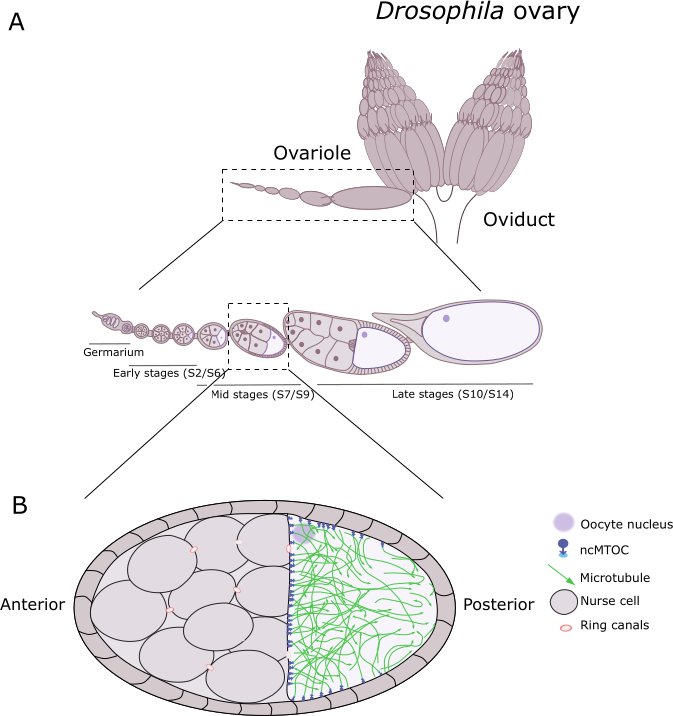
Figure 1: Drosophila melanogaster oogenesis (A) Overview of oogenesis in the Drosophila ovary. Each ovary contains 12–16 ovarioles, which function as an egg production line. Oogenesis begins in the germarium, where 2–3 germline stem cells divide asymmetrically, producing a stem cell and a daughter cell that begins to differentiate. These cells undergo 4 mitotic divisions to form a 16-cell cyst connected by ring canals. From these cells, one will become the oocyte, while the others serve as nurse cells, supporting oocyte growth and development to a stage 14 oocyte at the posterior end. (B) Scheme of stage 9 Drosophila egg chamber. MTs are generated from ncMTOCs localized at the antero-lateral cortex, which are excluded from the posterior side of the oocyte12. Please click here to view a larger version of this figure.
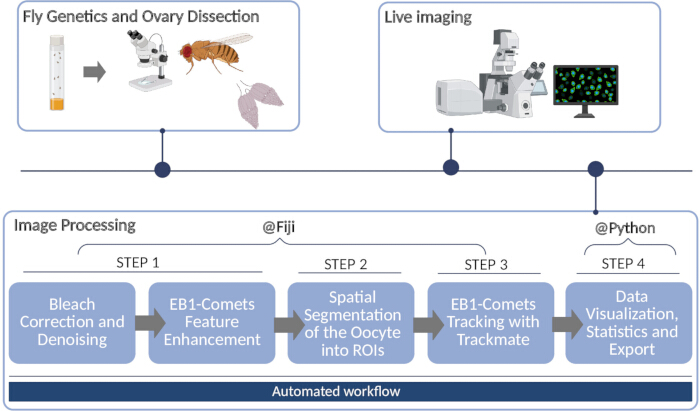
Figure 2: Protocol workflow diagram. Overview of the main steps from ovary dissection and live imaging to comet tracking and quantitative analysis. Please click here to view a larger version of this figure.
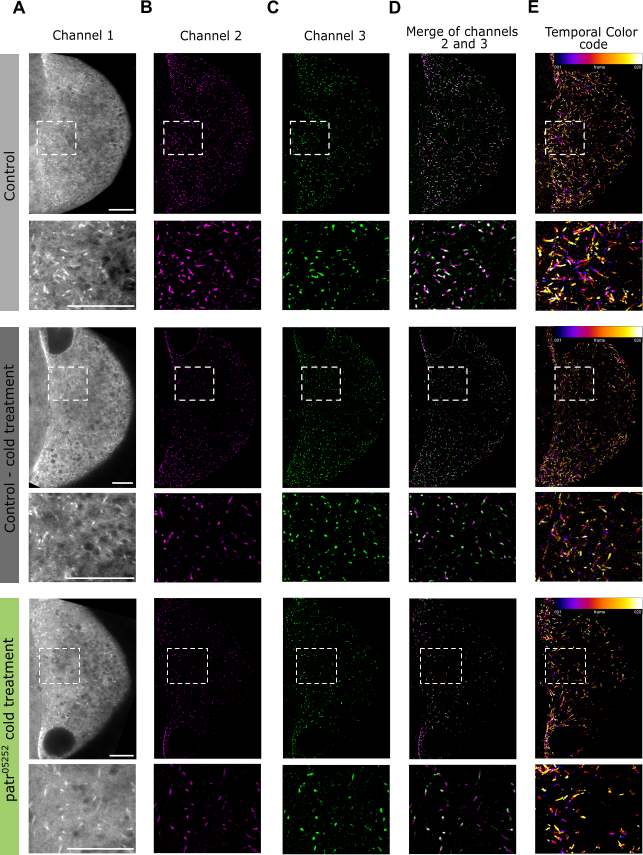
Figure 3: Representative images generated by the processing of stage 7–8 oocytes. (A-E) Representative images illustrating the image-processing workflow in step 1 applied to stage 7–8 oocytes from control, control cold-treated, and heterozygous patronin05252 cold-treated oocytes. Channels are a representative image from a maximum projection of 2 frames from a 150-frame time-lapse movie acquired at 0.5 s per frame. (A) Channel 1, which corresponds to the generation of a denoised image from the corresponding imaged oocyte. (B) Channel 2, which corresponds to the generation of a difference of Gaussian image. (C) Channel 3, which corresponds to the generation of an image where the signal of EB1-GFP comets was enhanced to show the comets’ tips. (D) Merge of channels 2 and 3, which helps to visualize the resultant comet tips from the processing of channel 2. (E) EB1-GFP comet trajectories generated from time-lapse C in FIJI using the Temporal Color code plugin to illustrate MT dynamics. The color code indicates the time projection for 20 frames (0.50 s between the frames). Scale bar = 10 µm. Please click here to view a larger version of this figure.
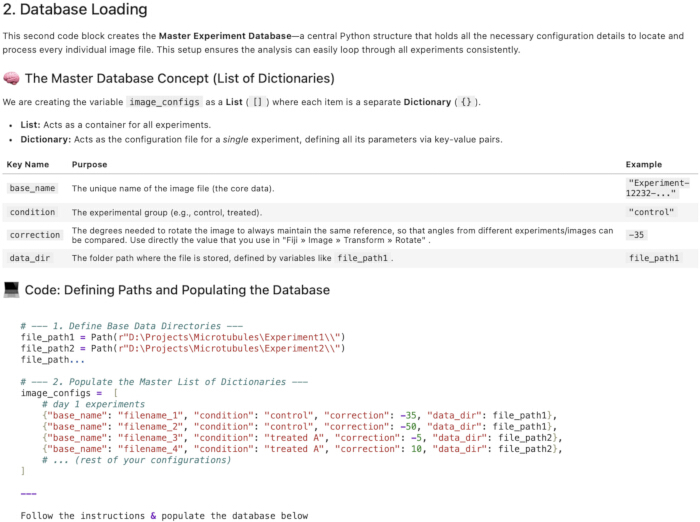
Figure 4: Screenshot of a section in STEP 4 Jupyter Notebook. The notebook is structured with Markdown cells that provide self-explanatory instructions, followed by code cells that output real-time results and logs. Please click here to view a larger version of this figure.
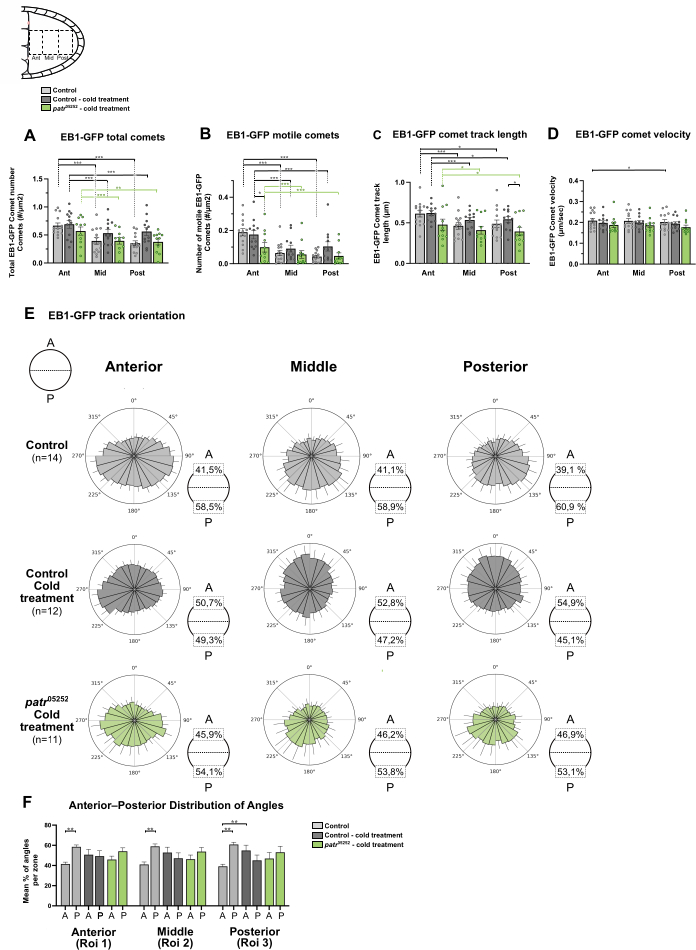
Figure 5: Analysis of EB1-GFP comet dynamics in control and cold-treated stage 7-8 oocytes. Data represent mean ± SEM per ROI (ROI1–ROI3) for control, control cold-treated, and patronin05252 cold-treated oocytes. EB1-GFP comet measurements were obtained from time-lapse images processed in FIJI; unless otherwise indicated, analyses were performed on images processed in Channel 3. Total EB1-GFP comet number was analyzed from Channel 2 images (DoG Image). Statistical significance was assessed using the Kruskal–Wallis test followed by Mann–Whitney post-hoc comparisons, or the Friedman test followed by Wilcoxon matched-pairs tests, as appropriate (p < 0.05; p < 0.001; p < 0.0001). (A) Scatter dot plot showing the average number of total EB1-GFP comet numbers. (B) Scatter dot plot showing the average number of motile EB1-GFP comets. (C) Scatter dot plot showing the average EB1-GFP comet track length. (D) Scatter dot plot showing the average EB1-GFP comet velocity. (E) Rose plots showing the orientation of EB1-GFP tracks within ROI1–ROI3 in control (n = 14), control cold-treated (n = 12), and patronin05252 cold-treated (n = 11) oocytes. The average percentage of each track per oocyte, oriented toward the anterior (A) or posterior (P), is indicated for each condition and ROI. (F) Bar graph showing the mean percentage of EB1-GFP comet track angles oriented toward the anterior and posterior sides of the oocyte. Percentages were calculated per oocyte and represent the relative distribution of comet orientation within each ROI. Please click here to view a larger version of this figure.
| Metric | ROI | Control (n=14) | Control cold-treated (n=12) | patronin05252 cold-treated (n=11) |
| Total EB1-GFP Comet number (#/µm2) | ROI 1 (anterior) | 0.667 ± 0.18 | 0.691 ± 0.20 | 0.570 ± 0.17 |
| ROI 2 (middle) | 0.394 ± 0.11 | 0.532 ± 0.15 | 0.400 ± 0.12 | |
| ROI 3 (posterior) | 0.353 ± 0.09 | 0.561 ± 0.16 | 0.378 ± 0.11 | |
| Motile EB1-GFP Comet number (#/µm2) | ROI 1 (anterior) | 0.189 ± 0.02 | 0.175 ± 0.03 | 0.099 ± 0.03 |
| ROI 2 (middle) | 0.064 ± 0.02 | 0.091 ± 0.02 | 0.056 ± 0.02 | |
| ROI 3 (posterior) | 0.043 ± 0.01 | 0.104 ± 0.03 | 0.047 ± 0.02 | |
| EB1-GFP Comet track length (µm) | ROI 1 (anterior) | 0.613 ± 0.04 | 0.621 ± 0.03 | 0.478 ± 0.07 |
| ROI 2 (middle) | 0.463 ± 0.04 | 0.535 ± 0.03 | 0.410 ± 0.05 | |
| ROI 3 (posterior) | 0.488± 0.05 | 0.543 ± 0.04 | 0.393 ± 0.05 | |
| EB1-GFP Comet velocity (µm/sec) | ROI 1 (anterior) | 0.208 ± 0.01 | 0.198 ± 0.01 | 0.188 ± 0.01 |
| ROI 2 (middle) | 0.207 ± 0.01 | 0.199 ± 0.01 | 0.186 ± 0.01 | |
| ROI 3 (posterior) | 0.202 ± 0.01 | 0.194 ± 0.01 | 0.177 ± 0.01 |
Table 1. Summary of EB1-GFP comet measurements across anterior–posterior regions in analyzed oocytes. Measurements were obtained from control, control cold-treated, and heterozygous patronin05252 cold-treated oocytes. Regions of interest were defined as ROI1 (anterior), ROI2 (middle), and ROI3 (posterior).
Supplementary Table 1. Statistical analysis of EB1-GFP comet measurements between experimental conditions. P-values indicate differences between control, control cold-treated, and heterozygous patronin05252 cold-treated oocytes for each ROI (ROI1-ROI3). Global comparisons among the three conditions were performed using the Kruskal–Wallis test, followed by pairwise Mann–Whitney post hoc comparisons. Please click here to download this file
Supplementary Table 2. Statistical comparison of EB1-GFP comet measurements between ROIs within each experimental condition. P-values indicate differences between ROI1 (anterior), ROI2 (middle) and ROI3 (posterior) within control, control cold-treated, and heterozygous patronin05252 cold-treated oocytes. Overall differences between ROIs within each condition were assessed using the Friedman test. Pairwise comparisons between ROIs were subsequently performed using Wilcoxon matched-pairs signed-rank tests. Please click here to download this file
Supplementary Video 1. Time-lapse imaging of the plus-end–tracking protein EB1-GFP in a control stage 7–8 oocyte, demonstrating a representative acquisition suitable for subsequent MT tracking analysis (related to Figure 3). Please click here to download this file
Supplementary Coding File 1: File_1_Step1_MTs_macro.ijm. A Fiji/ImageJ macro for image pre-processing. It automates photobleaching correction, Kalman filtering and background subtraction using a Difference of Gaussians (DoG) filter. It also applies a temporal gradient enhancement (reslicing and 1D convolution) to sharpen the leading edges of MT tips for improved tracking fidelity. Please click here to download this file
Supplementary Coding File 2: File_2_Step2_MTs_macro.ijm. A Fiji/ImageJ macro for semi-automated Region of Interest (ROI) definition. It prompts the user to define the oocyte boundary and automatically segments the selection into equidistant zones (In our example 3 zones: Anterior, Central, and Posterior) to enable regional stratification of the analysis. Please click here to download this file
Supplementary Coding File 3: File_3_Step3_MTs_macro_tracking.py. A Python script (executed within Fiji/ImageJ) that performs the automated tracking of EB1 comets using Trackmate. It batch-processes pre-processed images, detects comets using defined quality parameters, links them into trajectories, and exports the raw coordinate data as CSV files. Please click here to download this file
Supplementary Coding File 4: File_4_Step4_MTs_results.ipynb. A Jupyter Notebook that serves as the primary interface for quantitative analysis. It loads the raw tracking data, executes the analysis pipeline, and generates all final outputs, including rose plots, statistical summary tables, and comparison charts for comet density, speed, and lifetime. Please click here to download this file
Supplementary Coding File 5: File_5_MTModule1.py. A custom Python module containing foundational utility functions used for data extraction and basic geometric calculations. It includes functions for finding ROI files, calculating instantaneous velocities, and computing basic angular displacements. Please click here to download this file
Supplementary Coding File 6: File_6_MTModule2.py. A custom Python module containing advanced analysis and visualization functions. It houses the algorithms for the orientation analysis pipeline (Cardinal vs. Axial binning), robust statistical testing (Friedman/Wilcoxon with Pratt method), and the generation of publication-quality polar (rose) plots. Please click here to download this file
Supplementary Coding File 7: File_7_KalmanStackFilterCompiled.jar. A compiled Java Kalman Filter plugin for Fiji/ImageJ is required for the noise reduction steps in the pre-processing macro. This standalone version eliminates the need for a separate Java Development Kit (JDK), simplifying the user's software setup. Please click here to download this file
Discussion
Live imaging of MT dynamics in oocytes presents unique challenges, as high-quality datasets and quantitative analyses are required to extract meaningful information. While previous studies have reported live imaging approaches14,15,16, the image analysis steps are often highly customized, and protocols do not provide sufficient detail for reproducibility. Consequently, researchers without extensive imaging or computational expertise may face barriers in reproducing these analyses. To address these challenges, a streamlined workflow was developed, combining high-resolution Airyscan live imaging with user-friendly, automated macros and scripts. This pipeline enables efficient detection and tracking of EB1 comets, followed by quantitative analysis of MT orientation, speed, and spatial organization. By minimizing manual intervention and providing clear, step-by-step instructions, the workflow promotes the accessibility and reproducibility of MT dynamics analysis in oocytes.
Ovary dissection and sample preparation are critical first steps. Oocytes must be carefully dissected to avoid mechanical damage, and imaging duration should be limited to 90 min to maintain viability20. Stage selection is important: after mid-oogenesis, the oocyte increases in size and accumulates yolk in the cytoplasm, which makes visualization of the EB1 signal increasingly difficult beyond stage 9. Therefore, imaging beyond stage 9 is not recommended20. Also, for reproducible quantifications, when possible, oocytes of comparable size are preferable, as this ensures that defined regions of interest correspond to equivalent anterior–posterior positions across samples.
Temperature control is essential for reproducibility. Fly stocks should be maintained at standard culture conditions (25 °C) to support normal development and consistent EB1-GFP expression, particularly when using the GAL4/UAS system, which is sensitive to temperature fluctuations. Temperature stability during imaging is equally important, as variations can affect MT dynamics. Although a temperature-controlled chamber is not required, avoiding temperature fluctuations during acquisition is recommended.
For image acquisition, array detector confocal imaging was selected for its high sensitivity and improved SNR, thereby minimizing the need for post-acquisition denoising. High numerical aperture objectives (as high as possible) in combination with appropriate refractive index matching should be used to maximize lateral and axial resolution, which is critical for resolving individual comets in dense networks. Furthermore, the Nyquist-Shannon30 sampling criteria should be followed in XYZ and time to avoid loss of accuracy in the comet tracking. Equally important is the careful selection of the imaging plane along the z-axis. Imaging too deep results in fluorescence loss due to light scattering, whereas restricting acquisition to the cortical surface fails to capture the full dynamics of EB1 comets. The most informative data are obtained at an intermediate z-position. Oocytes in which the nucleus falls within the selected plane should be avoided, since the nuclear compartment displaces a large portion of the cytoplasm and lacks EB1 tracks, thereby reducing the number of detectable comets.
Although optimized for array detector-based confocal imaging, this analysis pipeline is hardware-agnostic and compatible with other modalities, such as spinning-disk confocal microscopy. However, users should be aware that systems with lower NA or SNR may require adjustments to the macro’s preprocessing parameters (e.g., noise tolerance/DoG sigmas) and may result in reduced comet detection density compared to the values presented in this study. Nevertheless, while absolute values may vary between systems, the relative trends observed between experimental conditions and ROIs as expected to remain robust.
Given the oocyte's large 3D structure, 2D imaging captures only an optical section of the MT network. Consequently, comets moving steeply along the z-axis may exit the focal plane, potentially leading to an underestimation of track lifetimes and absolute velocity (as only the xy-component of the velocity vector is measured). However, high-speed 3D volumetric imaging of the entire oocyte would require smaller fields of view (FOV), shorter exposure times, and faster detector response times, thereby reducing SNR and distributing acquisition time across multiple z-slices, which compromises the temporal resolution required for tracking rapid EB1 comets. To mitigate non-moving comets and out-of-focus artifacts, convolutional and minimum-track duration filters were applied (excluding tracks < 3 frames) to remove transient spots traversing the focal plane. Furthermore, as this geometric limitation applies uniformly across experimental conditions, the observed relative differences in comet density, speed, and orientation remain robust. While emerging techniques like light field microscopy would ideally capture the full 3D structure simultaneously, they are not yet widely available. Nevertheless, the values measured for all MT-dynamics parameters are consistent with previous reports, indicating that this protocol is suitable for investigating MT dynamics across different experimental setups.
Before using the macros in this protocol, it is recommended to process the first few images manually to ensure that the software parameters are correctly optimized. Factors such as imaging resolution, magnification, signal-to-noise ratio, frame rate, and whether the data are single-plane or z-stack can all influence tracking accuracy. Iteratively adjusting parameters while visually inspecting the resulting tracks to minimize false positives and false negatives. Once optimized, apply the parameters consistently across datasets to ensure reproducibility.
Finally, some limitations regarding biological interpretation should be noted. EB1-GFP selectively labels growing MT plus ends and therefore reports on sites of active MT polymerization rather than the entire MT population. Stable, non-polymerizing MTs present during the imaging period are not detected by this method. While this limitation is less restrictive in mid-oogenesis oocytes, where the majority of MTs are highly dynamic, it should be considered when applying the protocol to other cell types with substantial stable MT populations, such as neurons31.
In conclusion, this workflow enables high-resolution, quantitative analysis of MT dynamics in Drosophila oocytes. By integrating optimized dissection, array detector confocal live imaging, and automated analysis tools, it provides a rigorous yet accessible method for investigating MT regulators in an acentrosomal context. While primarily validated in oocytes, the principles of this approach are adaptable, upon optimization, to other cell types, including non-dividing cells such as neurons and epithelia, offering a scalable platform for genetic screens and mechanistic studies of MT organization.
Disclosures
The authors have no conflicts of interest to declare.
Acknowledgements
We are very grateful to Antoine Guichet (Institute Jacques Monod, France) for generously providing the UASp-EB1-GFP fly line. We also acknowledge the technical support and assistance of the Microscopy Facility at NOVA Medical School, supported by PPBI (POCI-01-0145-FEDER-022122), and the Fly Facility at NOVA Medical School, supported by CONGENTO (LISBOA-01-0145-FEDER-022170). This work was supported by funding awarded to A.P.M. (2024/158225/PEX), by the Research Unit UID/04462/2025: iNOVA4Health – Programa de Medicina Translacional, and by the Associated Laboratory LS4FUTURE (LA/P/0087/2020), all financially supported by the Fundação Para a Ciência e Tecnologia (FCT) / Ministério da Educação, Ciência e Inovação. A.P.M. is supported by an FCT researcher contract under the CEECInd programme (CEECIND/02842/2020), and J.C. is supported by an FCT PhD Fellowship (2023/03665/BD).
Materials
| Name | Company | Catalog Number | Comments |
|---|---|---|---|
| Dumont #5 Forceps | Fine Science Tools | 11252-20 | |
| EB1::GFP | From Dr. Antoine Guichet, CNRS, Institut Jacques Monod, France | Genotype: w; +/CyO; UASp-EB1::GFP/TM3 | |
| Glass-bottom Petri dishes | MatTek | P35G-1.0-14-C | |
| Matα4-Gal4-VP16 | Bloomington Drosophila Stock Center | 7062 | Genotype: w[*]; P{w[+mC]=matalpha4-GAL-VP16}V2H |
| Oil 10S, VOLTALEF | VWR Chemicals | 24627.188 | |
| Patronin mutant | Bloomington Drosophila Stock Center | 16647 | Genotype: y[1] w[67c23]; P{y[+mDint2] w[+mC]=EPgy2}Patronin[EY05252]/CyO |
| w1118 | Bloomington Drosophila Stock Center | 3605 | |
| Zeiss LSM 980 with Airyscan 2 | Zeiss |
References
- Goodson, H. V., Jonasson, E. M. Microtubules and microtubule-associated proteins. Cold Spring Harbor Perspectives in Biology. 10 (6), a022608(2018).
- Akhmanova, A., Kapitein, L. C. Mechanisms of microtubule organization in differentiated animal cells. Nature Reviews Molecular Cell Biology. 23 (8), 541-558 (2022).
- Sanchez, A. D., Feldman, J. L. Microtubule-organizing centers: from the centrosome to non-centrosomal sites. Current Opinion in Cell Biology. 44, 93-101 (2017).
- Loncarek, J., Bettencourt-Dias, M. Building the right centriole for each cell type. The Journal of Cell Biology. 217 (3), 823-835 (2018).
- Lattao, R., Kovács, L., Glover, D. M. The Centrioles, Centrosomes, Basal Bodies, and Cilia of Drosophila melanogaster. Genetics. 206 (1), 33-53 (2017).
- Manandhar, G., Schatten, H., Sutovsky, P. Centrosome reduction during gametogenesis and its significance. Biology of reproduction. 72 (1), 2-13 (2005).
- Kalbfuss, N., Gönczy, P. Towards understanding centriole elimination. Open biology. 13 (11), (2023).
- Muroyama, A., Lechler, T. Microtubule organization, dynamics and functions in differentiated cells. Development. 144 (17), 3012-3021 (2017).
- Pimenta-Marques, A., Bento, I., Lopes, C. A. M., Duarte, P., Jana, S. C., Bettencourt-Dias, M. A mechanism for the elimination of the female gamete centrosome in Drosophila melanogaster. Science. 353 (6294), aaf4866-aaf4866 (2016).
- Lasko, P. mRNA localization and translational control in Drosophila oogenesis. Cold Spring Harbor Perspectives in Biology. 4 (10), (2012).
- Lee, J., Lee, S., Chen, C., Shim, H., Kim-Ha, J. Shot regulates the microtubule reorganization required for localization of axis-determining mRNAs during oogenesis. FEBS Letters. 590 (4), 431-444 (2016).
- Nashchekin, D., Fernandes, A. R., St Johnston, D. Patronin/Shot Cortical Foci Assemble the Noncentrosomal Microtubule Array that Specifies the Drosophila Anterior-Posterior Axis. Developmental Cell. 38 (1), 61-72 (2016).
- Kuo, Y. W., Howard, J. Cutting, Amplifying, and Aligning Microtubules with Severing Enzymes. Trends in cell biology. 31 (1), 50-61 (2021).
- Parton, R. M., et al. A PAR-1–dependent orientation gradient of dynamic microtubules directs posterior cargo transport in the Drosophila oocyte. Journal of Cell Biology. 194 (1), 121-135 (2011).
- Nieuwburg, R., et al. Localised dynactin protects growing microtubules to deliver oskar mRNA to the posterior cortex of the Drosophila oocyte. eLife. 6, (2017).
- Lu, W., Lakonishok, M., Gelfand, V. I. The dynamic duo of microtubule polymerase Mini spindles/XMAP215 and cytoplasmic dynein is essential for maintaining Drosophila oocyte fate. Proceedings of the National Academy of Sciences. 120 (39), e2303376120(2023).
- Komarova, Y., et al. Mammalian end binding proteins control persistent microtubule growth. The Journal of cell biology. 184 (5), 691-706 (2009).
- Rogers, S. L., Rogers, G. C., Sharp, D. J., Vale, R. D. Drosophila EB1 is important for proper assembly, dynamics, and positioning of the mitotic spindle. The Journal of cell biology. 158 (5), 873-884 (2002).
- Rebollo, E., Sampaio, P., Januschke, J., Llamazares, S., Varmark, H., González, C. Functionally Unequal Centrosomes Drive Spindle Orientation in Asymmetrically Dividing Drosophila Neural Stem Cells. Developmental Cell. 12 (3), 467-474 (2007).
- Legent, K., Tissot, N., Guichet, A. Visualizing microtubule networks during Drosophila oogenesis using fixed and live imaging. Drosophila Oogenesis: Methods and Protocols. , 99-112 (2015).
- Phelps, C. B., Brand, A. H. Ectopic gene expression in Drosophila using GAL4 system. Methods: A Companion to Methods in Enzymology. 14 (4), 367-379 (1998).
- Weil, T. T., Parton, R. M., Davis, I. Preparing individual Drosophila egg chambers for live imaging. JoVE. (60), (2012).
- Januschke, J., Gervais, L., Gillet, L., Keryer, G., Bornens, M., Guichet, A. The centrosome-nucleus complex and microtubule organization in the Drosophila oocyte. Development. 133 (1), 129-139 (2006).
- Jia, D., Xu, Q., Xie, Q., Mio, W., Deng, W. M. Automatic stage identification of Drosophila egg chamber based on DAPI images. Scientific Reports. 6 (1), 18850(2016).
- Ershov, D., et al. TrackMate 7: integrating state-of-the-art segmentation algorithms into tracking pipelines. Nature methods. 19 (7), 829-832 (2022).
- Bellen, H. J., et al. The BDGP gene disruption project: Single transposon insertions associated with 40% of Drosophila genes. Genetics. 167 (2), 761-781 (2004).
- Goodwin, S. S., Vale, R. D. Patronin regulates the microtubule network by protecting microtubule minus ends. Cell. 143 (2), 263-274 (2010).
- Berisha, A. M., et al. Spatial activation of Kinesin-1 by Ensconsin shapes microtubule networks via ncMTOCs recruitment. bioRxiv. , Pre-print (2025).
- Gujar, M. R., et al. Patronin/CAMSAP promotes reactivation and regeneration of Drosophila quiescent neural stem cells. EMBO Reports. 24 (3), e56624(2023).
- Shannon, C. E. Communication in the Presence of Noise. Proceedings of the IRE. 37 (1), 10-21 (1949).
- van de Willige, D., Hoogenraad, C. C., Akhmanova, A., Hoogenraad choogenraad, C. C., Akhmanova aakhmanova, A. Microtubule plus-end tracking proteins in neuronal development. Cellular and Molecular Life Sciences. 73 (10), 2053-2077 (2016).
Reprints and Permissions
This article has been published
Video Coming Soon