An experimental protocol is presented to assemble, electrically stimulate, and analyze gramicidin A-doped droplet interface bilayers. Lipid-protein structure-function relationships are quantified by measuring changes in membrane area, ionic flux, and single-channel conductance, and relating these responses to plasticity-like changes in ionic conduction in a membrane model inspired by electrical synapses.
Method Article
Lipid-Protein Membrane Structure-Function Characterization using Droplet Interface Bilayers
In This Article
Summary
Abstract
Droplet interface bilayers (DIBs) offer a tunable platform for probing the electromechanical properties of lipid and lipid-peptide membranes under controlled electrical stimulation. DIBs enable both single-channel and ensemble ion conductance measurements over membrane areas orders of magnitude larger than those accessible by traditional patch clamp techniques, thereby allowing membrane-level analyses of electromechanical deformation and its influence on ion-conducting peptides. By systematically tuning membrane structure through the bulk hydrocarbon oil phase (e.g., hexadecane [C16] vs. dodecane/hexadecane [C12/C16] [25%/75%, v/v]), this bottom-up platform enables systematic variation of membrane composition and oil environment, which influence membrane viscoelasticity and structural reorganization, and thereby peptide ion conduction. Detailed procedures are provided for the assembly of gramicidin A-doped 1,2-diphytanoyl-sn-glycero-3-phosphocholine (DPhPC) membranes using different hydrocarbon oil compositions and for the application of voltage-pulse protocols that drive membranes into metastable electromechanical states. Adaptive membrane ion conduction is characterized, including short-term plasticity-like (STP-like) and long-term potentiation- and depression-like (LTP-like/LTD-like) responses in a model membrane system. More broadly, this protocol provides a robust, reproducible approach for systematically investigating composition-dependent, membrane-level electromechanical contributions to synaptic-like conductive behavior and for understanding how lipid membrane environments modulate ion channel function.
Introduction
Biological membranes are critical supramolecular structures that can regulate ionic conduction and enable communication between neurons through electrical and chemical synapses1,2,3,4. This type of communication is further controlled by synaptic plasticity, where structural changes to synapses modulate their strength and persistence over a range of timescales5,6, commonly described in terms of short-term plasticity (STP) and long-term potentiation or depression (LTP or LTD). These phenomena, which involve dynamic changes in membrane conductance in response to neural activity, are often coupled to neuroplasticity7, which underlies learning and memory8. Traditional models of plasticity often emphasize the biochemical regulation of ion channels through protein synthesis, trafficking, or phosphorylation9. However, the role of neuronal plasma membranes in models of plasticity has, for the most part, been overlooked10,11.
Patch-clamp methods have been used for over half a century to study single-ion channel electrophysiology. However, they can interrogate only membrane areas much smaller than intact synapses or large-scale synthetic models. As such, they pose a technical limitation for studying mesoscale membrane reorganization and deformation. The mesoscale is increasingly recognized as a critical length scale for understanding many aspects of membrane biophysics12,13.
A methodology is presented for using 1,2-diphytanoyl-sn-glycero-3-phosphocholine (DPhPC) droplet interface bilayers (DIBs)14,15 doped with the monovalent peptide cation ionophore, gramicidin-A (gA), to model ionic conduction, not unlike what takes place at an electrical synapse. This system offers several key advantages: (i) DIBs provide a tunable lipid and oil platform that allows for systematic membrane reorganization16; (ii) DIBs allow for the study of single-channel and ensemble channel events across a range of length scales17,18; and (iii) DIBs enable interrogation of submillimeter2-size membrane patches that capture collective electromechanically induced membrane restructuring, while preserving the ability to resolve single-channel ion conduction events19,20. This method is most suitable for studies that require simultaneous electrical and optical interrogation of membrane electromechanics over membrane areas larger than those accessible by conventional patch clamp, while still retaining the ability to resolve discrete channel events. It is particularly useful when the experimental goal is to examine how membrane composition, oil environment, and imposed voltage waveforms influence collective membrane restructuring and peptide conduction. The method is less suitable for experiments requiring native cellular architecture or direct molecular readouts of protein conformational changes in intact biological membranes19,20,21.
By applying physiologically relevant electrical stimulation, DIBs are driven into nonequilibrium steady states in which dynamic electromechanical restructuring alters peptide ion-channel conduction. These emergent changes in ionic conduction are descriptively analogous to neurological STP, LTP, and LTD phenomena discussed in neuroscience22,23,24. In the present study, these behaviors are interpreted primarily as membrane-level physical responses to electrical stimulation associated with intrinsic membrane mechanical properties, such as viscoelasticity and compressibility in a model membrane system25. Notably, the study described herein builds on prior evidence that lipid bilayers can exhibit fundamental electrical memory through persistent conductance shifts and capacitive charge storage following stimulation14,15,25,26,27,28,29,30,31,32,33,34, offering new insights into mechanisms by which lipid bilayers can support adaptive, synaptic-like functionality in the absence of complex cellular machinery. Finally, this methodology also enables direct examination of structure-function relationships and how emergent macroscale behavior arises from simple structural reorganization21,25,27.
Protocol
Thoroughly clean all glassware and preparatory equipment with appropriate laboratory detergents and rinse with distilled water before sample preparation. Wear safety glasses at all times and nitrile or latex gloves to avoid contamination. Dispose of all chemical waste according to institutional safety guidelines. Ensure volatile solvents are stored properly in accordance with institutional safety guidelines. Ensure experimentation lab space and hardware (Figure 1A), experimentation vessel (Figure 1B), and electrical and optical connections (Figure 1C) remain unobstructed and clear of obstacles.
1. Preparation of aqueous buffer solution
- Weigh the appropriate amount of 3-(N-morpholino) propanesulfonic acid (MOPS) and potassium chloride (KCl) to obtain the desired final concentrations (e.g., 10 mM MOPS, 0.1 M KCl in 500 mL).
- Add the MOPS and KCl to ~450 mL of distilled water in a 500 mL volumetric flask or graduated cylinder and stir with a magnetic stir bar until fully dissolved.
- Measure the pH with a calibrated pH meter. Adjust the pH to 7.4 by adding 1 M potassium hydroxide (KOH) or hydrochloric acid (HCl) in 0.25 mL increments while stirring continuously.
- Bring the total volume to 500 mL with distilled water and mix thoroughly. Transfer the buffer to a clean, labeled bottle, seal, and store at 4 ˚C.
NOTE: Use the buffer for up to ~2 months. Verify and readjust the pH to 7.4 before each use.
2. Preparation of gramicidin stock solution
- In a chemical fume hood, add 5 mg of gramicidin A (gA) to a clean 20 mL glass vial. Add 10 mL of methanol using a glass or gas-tight syringe and vortex until the peptide is fully dissolved. Label the vial as “gA stock” and store at -80 ˚C.
NOTE: Ensemble experiments use lipid: peptide molar ratios of ~1:10-4. Single-channel experiments use ~10–100 fold lower peptide (1:10-5–10-6) to resolve individual events within short recording times (<1 min). Preparing a dilute stock improves pipetting accuracy at low molar ratios (< ~ 1:10-4). - Purge two additional clean 20 mL glass vials with argon gas for ~5 s each to remove dust.
- Using a clean gas-tight syringe, dispense 9.9 mL of methanol into each purged vial.
- Pipette 100 µL of the gA stock solution with a sterile gas-tight syringe into one vial to obtain a total volume of 10.0 mL. Label this vial as “A”. Concentration = 2.66 µM gA in methanol.
- Pipette 100 µL of solution “A” into the second glass vial to obtain 10.0 mL total volume. Label this vial as solution “B”. Concentration = 26.6 nM gA in methanol.
- Seal vials with caps and wrap with parafilm.
- Store all gA solutions at -80 ˚C until use.
3. Preparation of lipid-peptide vesicles
- Purge a clean 20 mL glass vial with argon gas for ~5 s.
- Add 4 mg of 1,2-diphytanoyl-sn-glycero-3-phosphocholine (DPhPC) lipid to the vial.
- In a fume hood, add 1 mL of methanol using a glass pipette. Gently swirl or vortex until all lipid is dissolved.
- Using a 500 µL gas-tight syringe, add 178 µL of solution “A” (for ensemble-level STP experiments; DPhPC:gA molar ratio = 1:10-4) or 890 µL of solution “B” (for single-channel experiments; DPhPC:gA molar ratio = 1:5×10⁻⁶) into the DPhPC methanol solution. Gently vortex to mix.
- Under a gentle argon stream in the fume hood, evaporate the methanol until a thin, uniform lipid film forms at the bottom of the vial.
- Place the open vial in a 40 ˚C vacuum oven and pull a full vacuum for 10–12 h or overnight to remove residual solvent.
- Remove the vial from the vacuum oven and add 2 mL of the 0.1 M KCl buffer prepared in Section 1 for STP experiments, resulting in a final lipid and gramicidin concentration in suspension of 2.36 mM and 236 nM, respectively. For single-channel experiments, add 2 mL of a 1 M KCl buffer as prepared in Section 1. Vortex to rehydrate the lipid film and obtain a 2 mg/mL lipid suspension, resulting in a final lipid and gramicidin concentration in suspension of 2.36 mM and 11.8 nM, respectively.
- Freeze the vial at -80 ˚C for at least 6 min, then thaw it on a 40 ˚C hot plate or water bath for 6 min. Vortex briefly to mix. Repeat this freeze-thaw cycle six times to promote multilamellar vesicle formation.
- Assemble a lipid vesicle extruder with a 0.1 µm pore diameter track-etched membrane following the manufacturer’s instructions. Pass 500 µL of buffer through the extruder 3 times to hydrate the membrane, verify that there are no leaks, and discard the buffer.
- Load 1 mL of the thawed lipid-peptide suspension into the extruder and perform 31 passes through the 0.1 µm membrane to obtain ~100 nm diameter unilamellar vesicles and ensure size homogeneity.
- Transfer the extruded vesicles (Large unilamellar vesicles, LUV) into a 1 mL PCR tube, label, and store at 4 ˚C. Use within 2 weeks of preparation.
- Seal any remaining non-extruded lipid-protein suspension in the original vial, wrap with parafilm, and store at -80 ˚C for later use.
- If using previously frozen, non-extruded samples, re-melt at 40 ˚C using a hot plate or allow the sample to warm to room temperature, then extrude the sample.
4. Preparation of agarose gel
- Place a clean 50 mL glass beaker on a hot plate. Add one agarose tablet to 50 mL of the same buffer used to hydrate the lipid film (e.g., 10 mM MOPS, 0.1 M KCl, pH 7.4) to form a 1% agarose gel solution.
- Add a clean Teflon stir bar and stir vigorously until the tablet disperses.
- Cover the beaker with aluminum foil and puncture a small vent hole with a metal spatula. Set the hot plate temperature to 220–230 ˚C. The solution will become clear and reach a rolling boil, indicating complete dissolution of agarose.
- Turn off the heat and carefully remove the foil. Skim any surface film with a clean metal spatula. Use the hot agarose solution immediately for electrode coating or allow it to cool and solidify in the beaker for later use.
- After electrode agarose-coating, cover solidified agarose with foil, seal with parafilm, label, and store at 4 ˚C. When needed, reheat to boiling with stirring until fully remelted.
5. Preparation of electrodes
- Cut 0.125 mm-diameter silver wire into ~70 mm lengths for headstage electrodes and ~130 mm lengths for ground electrodes.
- Using an open flame (e.g., hand-held lighter or Bunsen burner), hold one end of each silver wire horizontally in the hottest central cone of the flame until the tip melts and forms a spherical ball of ~0.2 mm diameter (Figure 2A).
- Place the wires on a clean surface and verify under a microscope that the balls are spherical and of similar size. If a ball is oblong or irregular, cut off the tip and repeat the melting (Step 5.2).
- Place the ends of both silver wires into a glass container of fresh household bleach (sodium hypochlorite, NaClO). Ensure the balls are fully submerged and incubate for at least 1 h to chlorinate the surface and form Ag/AgCl. A dull brown-grey appearance confirms successful chlorination (Figure 2B).
- Remove the wires from the bleach once the ball ends are dull grey in color, rinse thoroughly with distilled water, and lay them on a clean, lint-free surface to dry.
- Obtain one headstage pipette holder and one ground electrode holder. Cut a 100-mm borosilicate glass capillary (1.0 mm OD, 0.58 mm ID) in half using a glass cutter.
- Insert one half-capillary into the headstage pipette holder and tighten the holder to secure it. Mount a full 100 mm capillary onto the ground electrode holder and secure it.
- Insert the non-ball end of the 130 mm silver wire into the ground electrode capillary until ~20 mm of the ball end protrudes. Tape the opposite end of the wire to the holder, leaving ~5 mm exposed for ground connection.
- Repeat the next step with a 70 mm wire for the headstage electrode, ensuring firm contact between the wire and the headstage connector (gold-colored piece). Trim any excess wire from the headstage connector end.
- Dip each chlorinated silver ball into the agarose, just above the ball-shaft junction, to form a thin, uniform coating. Dip in and out at least 10 times.
- Withdraw the electrode and allow the agarose to gel at room temperature. Repeat dipping if needed to produce a smooth, even agarose shell tens of micrometers thick. Avoid coating too high or too low on the wire (Figure 2C).
- Mount the headstage and ground electrodes onto micromanipulators. Connect the exposed ground wire (~5 mm) to the amplifier ground using an alligator clip.
- Using tweezers, gently bend each electrode midway between the ball end and the capillary so that the ball end is perpendicular to the microscope stage. Avoid bends greater than 90˚ to minimize optical distortion in the microscope visual and video capture views.
- Adjust electrode orientation in their holders so that the agarose-coated ball ends are perpendicular to the imaging plane of the microscope (Figure 3A).
6. Formation of droplet interface bilayers (DIBs)
- Place a clean, clear-bottom petri dish on the stage of an inverted microscope. Fill the dish with alkane oil (e.g., 100% hexadecane, or 25%/75% v/v dodecane/hexadecane) to a depth of ~ 5 mm (Figure 1B).
- Using the micromanipulator controls, lower both agarose-coated ball ends into the oil to a depth of ~2.5 mm below the oil surface. Avoid rapid motion with the micromanipulator to prevent electrode ball-head collisions with the petri dish.
- Adjust the microscope focus until both ball ends and their agarose coatings are in sharp focus. Position the electrodes near the edge of the field of view so that both can be observed simultaneously.
- Using a calibrated 2 µL pipette, aspirate the extruded lipid-peptide vesicle suspension. Slowly dispense 250 nL of the suspension directly onto each agarose-coated ball end using a separate pipette tip for each, without touching the agarose shell with the pipette tip.
NOTE: To minimize hand vibrations and increase stability, anchor both elbows to the anti-vibration table ledge. Stabilize the pipetting wrist with the non-pipetting hand, slowly submerge the pipette in the oil, and approach the electrode gradually. Brief breath-holding during droplet loading may further reduce unintended movements. - Allow the droplets to spread and coat the agarose shell and sag away from the electrode under gravity. Observe sagging from the side through the Petri dish wall if clear (Figure 3B).
NOTE: The time required for droplet sagging depends on vesicle size distribution, temperature, and agarose topography. For DPhPC DIBs, wait at least 5 min after droplet deposition15. - Gently nudge the anti-vibration table to assess droplet readiness. Confirm that the sagging droplets move with a slight delay relative to electrode motion, indicating formation of fully coated lipid monolayer droplets.
NOTE: The delayed motion occurs because the formation of a lipid monolayer around the aqueous droplet significantly lowers the surface tension, thereby delaying the physical response when moving the electrode in oil. - If this behavior is not observed, wait an additional 2–3 min and repeat the process.
7. Electrical setup and bilayer monitoring (visual and electrical)
- Ensure the microscope, anti-vibration table, Faraday cage, and all electrical components, including the amplifier, digitizer, function generator, and computer, are connected to a common ground (Figure 1).
- Arrange the instrument connections according to the manufacturer’s setup guide. Use Figure 1C as a schematic reference for the essential electrical and optical configuration. Refer to the detailed instructions on grounding35, hardware/software configuration, and pipette offset adjustment for DIB experiments.
NOTE: Follow equipment-specific setup instructions for all software and hardware listed in the Table of Materials. - Connect the headstage and ground electrodes to the patch-clamp amplifier.
- Configure an external function generator (or the acquisition software’s output channel) to generate a 10 Hz, 10 mV triangle voltage waveform. Confirm the amplitude and frequency on a connected oscilloscope and inside the acquisition software.
- After droplets have sagged for ~ 10 min, use the micromanipulators to bring the two droplets into gentle contact. Adjust the electrode positions so that the contact area of the droplets is initially no more than ~ 1/4th of their diameter.
- Turn on the 10 Hz, 10 mV triangle waveform and monitor the capacitive current response with the amplifier and acquisition software.
- Wait for spontaneous bilayer formation, indicated electrically by an expanding peak-to-peak capacitive current response and optically by an increasing internal reflection (oval appearance) from bilayer contact (Figure 4). Confirm that pure lipid bilayers display rectangular current plateaus to the triangular voltage stimulus, while gA-doped bilayers at ~1:10-4 lipid: peptide exhibit sloped plateaus reflecting ensemble ionic conduction.
- Adjust the droplet contact area by slightly moving the electrodes until the peak-to-peak capacitive current response to the 10 Hz, 10 mV triangle waveform is between ~100–200 pA for ~250 nL DIBs in C16 or C12/C16 oils, corresponding to a capacitance range of ~250–500 pF33.
NOTE: High-frequency pulses or non-zero DC holding voltages can induce electrowetting and excessive bilayer expansion, leading to droplet coalescence and bilayer rupture. The 100–200 pA range provides a balance between bilayer stability and signal-to-noise, permitting sufficient area expansion during stimulation. - If the DIB coalesces, lift the electrodes out of the oil. Rinse the electrode heads thoroughly with the same aqueous buffer used for the lipid samples and agarose.
- Remove any aqueous droplets from the Petri dish with a sterile syringe. Refill with fresh oil if needed, re-submerge electrodes. Reload the LUV solution onto the electrodes as described in Section 6 and repeat the process.
- Once stable capacitive or conductive responses are confirmed, turn off the triangle waveform and allow the DIB to equilibrate for at least 15 min before applying stimulation protocols.
8. Electrical stimulation protocols
- Pulse experiments (ensemble STP-like and LTP / LTD-like responses)
- Configure the function generator or acquisition software to deliver voltage pulses of the desired amplitude, duration, and inter-pulse interval (e.g., PPF [paired-pulse facilitation] and PPD [paired-pulse depression] patterns).
- Open the video capture software. Select the appropriate camera and objective lens settings. Set the frame rate to at least 20 frames/s and confirm that it remains stable during recording.
- In the data acquisition software, set the sampling frequency to at least 5 kHz for the current signal.
- Click Acquire > New Protocol to create a new protocol, or Acquire > Edit Protocol to modify an existing one. In the Acquisition Mode tab, select Episodic Stimulation. Set Runs/Trial to 1 and Sweeps/Run to 1.
- Set the sweep duration to 4 s longer than the total experimental duration. For a 120 s STP protocol (60 s PPF + 60 s PPD), set sweep duration to 124 s to allow 2 s pre- and post-stimulus baseline.
- In the Inputs tab, assign the recording channel to the current input. In the Outputs tab, assign the stimulation channel to the voltage output controlling the electrodes.
- Open the Waveform tab. In Column A, set Type to Step, First Level to 0 mV, and First Duration to 2000 ms to define a pre-stimulation baseline.
- In Column B (PPF), set Type to Step. Specify the desired voltage amplitude (e.g., +100 mV), pulse duration (e.g., 100 ms), and Train Rate to set the inter-pulse interval corresponding to the target duty cycle (e.g., 90.9%).
- In Column C (PPD), similarly set Type to Step with the same amplitude and pulse duration, but increase the Train Rate or interpulse interval to achieve the desired lower duty cycle (e.g., 28.6%).
- In Column D, configure a post-stimulation baseline identical to Column A (0 mV, 2000 ms).
NOTE: If the total duration of all epochs in the Waveform tab exceeds the sweep duration in the Mode/Rate tab, increase the sweep duration slightly until the error resolves. - Save the protocol with a descriptive name (e.g., “STP_120s”).
- Start video recording, then immediately start electrical acquisition/stimulation by clicking the red circle “Record” button to record data. Alternatively, configure a digital trigger so that the stimulation onset triggers the video recording and electrical acquisition simultaneously.
- For the first 60 s of stimulation (PPF), measured current response generally increases from the first pulse and may reach a visible plateau by t = 60 s, whereas for the last 60 s of stimulation (PPD), measured current response generally decreases (Figure 5). At the end of the protocol, stop electrical acquisition and video recording simultaneously.
- Single-channel experiments
- On the patch clamp amplifier front panel, set the External Command Input switch to OFF. Set the Holding Voltage to +200 mV. Set the built-in low-pass filter of the amplifier to 1 kHz. In the acquisition software, set the sampling rate to 10–50 kHz and select a continuous “gap-free” recording mode.
NOTE: High sampling rates may reduce the signal-to-noise ratio of the acquired data. Using higher sampling rates when resolving rapid gating transitions or short-lived flickering states is important. Mean open lifetimes of gramicidin A are typically in the range of 0.1 s to 10 s, whereas flickering states may occur on sub-ms and µs timescales; therefore, sampling rates of ~50 kHz may be necessary to capture such events36. Subsequent single-channel idealization analysis with JSMURF permits robust event detection across recordings with variable signal-to-noise ratios37. - With no external command applied, begin recording baseline current signal. On the amplifier, switch the Voltage Command from OFF to “+” to apply a +200 mV DC voltage across the DIB.
- Record for ~15 s to capture single-channel events while limiting baseline drift. At the lipid:gA molar concentration of 1:5×10⁻⁶, the recorded current appears step-like due to the formation and elimination of channel conductance gating events.
- Before stopping the recording, switch the Voltage Command from “+” back to OFF. Stop data acquisition and save the recording with a descriptive filename (e.g., “DIB_C16_postPPF_200mV.abf”).
NOTE: Single-channel recordings of defined duration may also be performed through a programmed Episodic Stimulation, with fixed amplitude and durations as described in Section 8 for PPF/PPD. For “post-PPF” single-channel experiments, Episodic Stimulation with a +200 mV DC voltage is piggybacked immediately following the 60 s of PPF.
- On the patch clamp amplifier front panel, set the External Command Input switch to OFF. Set the Holding Voltage to +200 mV. Set the built-in low-pass filter of the amplifier to 1 kHz. In the acquisition software, set the sampling rate to 10–50 kHz and select a continuous “gap-free” recording mode.
9. Membrane area and flux extrapolation
- At the end of each ensemble experiment (STP, LTP/LTD), slowly move one electrode laterally with the micromanipulators to detach the DIB.
- Loosen the micromanipulator electrode holder and rotate the electrode in its holder by ~45˚ so that the 125 µm silver wire lies in the imaging plane.
- Adjust the electrode height until the wire is in sharp focus under the microscope. Capture a still image or screenshot of the focused silver wire using the camera software. Save the scale image for later calibration of pixel size to millimeters.
- Process the recorded current traces according to procedures outlined in ref. 28 to obtain continuous, artifact-free current vs time data (Figure 6A).
- Determine the frame-to-time mapping by dividing frame indices by the measured frame rate and matching to the acquisition time stamps.
- Import the scale calibration image and experiment frames into image-analysis software.
- Use the known wire diameter (125 µm) from the scale calibration image to set the spatial scale using the software calibration function (Analyze > Set Scale).
- For flux calculations for each experiment, choose N time points spanning the total stimulation period (e.g., 30 time points over the 120 s experiment). Ensure the first time point corresponds to the first stimulus pulse.
- At each time point, measure the DIB diameter by drawing a line across the bilayer edge intersection and recording its length in calibrated units.
- Convert each measured diameter to membrane area (A), assuming circular geometry or using the appropriate ellipse geometric scale factor for the specific lipid-oil configuration. Use the resulting areas to assess membrane area evolution over time for different experimental conditions (Figure 6B).
- For each time point, divide the corresponding current value by the area to obtain flux (I/A). Divide all N flux data points by the first flux value to obtain flux normalized to the first pulse, (I/A) / (I0/A0), when normalized flux analysis is desired (Figure 6C).
- Plot flux or normalized flux vs time or pulse number vs time. Repeat flux analysis for all ensemble experiments (STP, LTP/LTD) (Figure 6D).
- Interpret persistent elevations of flux or normalized flux relative to the first pulse during PPD or beyond 2 min as enhanced conduction, whereas returns to baseline or decreases below the first-pulse value indicate depressed conduction. Use the resulting timescales to classify responses as short-term plasticity-like behavior (<2 min) or long-term potentiation- / depression-like behavior (> ~5 min).
10. Single-channel analysis
- Import raw single-channel recordings into a preferred analysis environment or the clampSeg interface and refer37 for complete descriptions and explanations of software functions.
- Apply a digital low-pass filter matching the experimental acquisition filter (e.g., 1 kHz Bessel).
- Parameter configuration.
- Set alpha (α) = 0.05, defining the statistical confidence level such that each detected step has <5% probability of being a random noise fluctuation.
- Specify 5,000-10,000 Monte Carlo iterations per 1 s segment to estimate the noise distribution and enhance the statistical robustness of event detection.
NOTE: Use parallel computational processing by 1 s “chunks” if available to reduce the analysis time. - Run the JSMURF algorithm on the filtered current trace.
- Model validation.
- Overlay the idealized (square-wave) conductance trace on the filtered current trace and visually confirm that step transitions coincide with abrupt changes in the experimental signal.
- Use the known low-pass filter characteristics to generate a convolved reconstruction of the idealized trace and overlay it on the raw trace37. Confirm that the reconstructed signal closely matches the timing and amplitude envelope of the recorded current.
- Quantification of conductance and lifetimes.
- Define the lowest stable plateau in the idealized trace as the closed baseline state. Identify the first non-zero plateau amplitude as the primary open-state conductance (single-channel level).
- Classify higher integer multiples of this amplitude as multi-channel open states (2+, 3+, etc.). Identify intermediate plateaus that are stable but lower than full open levels as subconductance states.
- Extract the amplitude and duration of each event from the idealized trace and bin them to generate conductance amplitude histograms and lifetime histograms.
- Amplitude histograms and lifetime distributions
- Compare the idealized conductance-amplitude histograms with amplitude histograms generated directly from the filtered data. Confirm that the idealized histograms display sharper, better-separated peaks corresponding to discrete conductance states37.
- For each experimental condition, compute the survival function N(t)/N(0), where N(0) is the total number of open events (full and subconductance) and N(t) is the number of events with durations longer than t. Exclude closed-state intervals from this analysis.
- Plot N(t)/N(0) vs time and fit exponential decay functions using a nonlinear least-squares routine in a preferred software.
- Interpret right-shifts in conductance distribution peaks in amplitude histograms as increased conductance, longer decay time constants in N(t)/N(0) vs time plots as increased open-state stability, and left-shifted distributions as shorter channel lifetimes.
NOTE: Minimize environmental disturbances such as air currents, vibration, and nearby moving objects. Avoid leaning on the optical table and keep conversations away from the experimental setup. Keep mobile phones, tablets, laptops, and other personal electronic devices at least 1.5 m away from the Faraday cage to reduce electromagnetic interference. Use an optically clear oil reservoir and optimize microscope illumination and contrast to sharpen the edges of droplets and bilayers. Acquire and/or export videos in grayscale if it improves boundary contrast and simplifies manual measurements of DIB diameter. For experiments not investigating temperature effects, ensure the laboratory environment, microscope stand, and oil are maintained at 21–22 ˚C.
Results
DIB experimental setup
The recording system is housed inside a Faraday cage on an anti-vibration table, with electrical and video data acquired by two separate computers (Figure 1A), although a single computer with split-screen capability can be used. The DIB sample environment consists of two agarose-coated electrodes submerged in a defined volume of alkane oil (Figure 1B). Figure 1C shows a schematic of the essential electrical and optical connections for the experimental setup described in this manuscript.
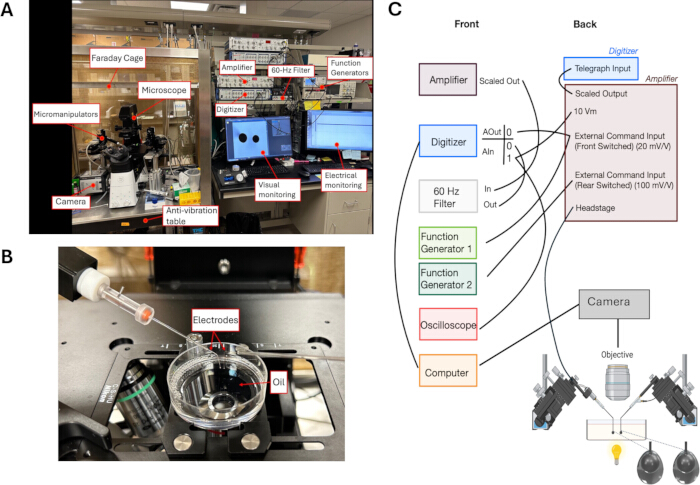
Figure 1: Experimental setup. (A) Anti-vibration table and Faraday cage enclosure with major components indicated, including amplifier, digitizer, noise filter, function generators, and dual-computer interface for electrical and video acquisition. (B) Top-front view of the DIB sample environment and electrodes. (C) Schematic of electrical and optical connections associated with the experimental setup described in this manuscript. All individual components share a common ground in the laboratory building. All experiments were performed at room temperature (21–22 ˚C). Please click here to view a larger version of this figure.
Preparation and quality control of Ag/AgCl electrodes
Melting the silver wire tip forms a spherical ball (Figure 2A); poor-quality melts appear oblong or irregular. Chlorination in bleach produces a dull brown-gray Ag/AgCl surface (Figure 2B). A thin, uniform agarose coat on the order of tens of micrometers thick on the ball is essential for stable droplet support and low-impedance electrochemical coupling, whereas uneven coating leads to poor droplet attachment (Figure 2C).
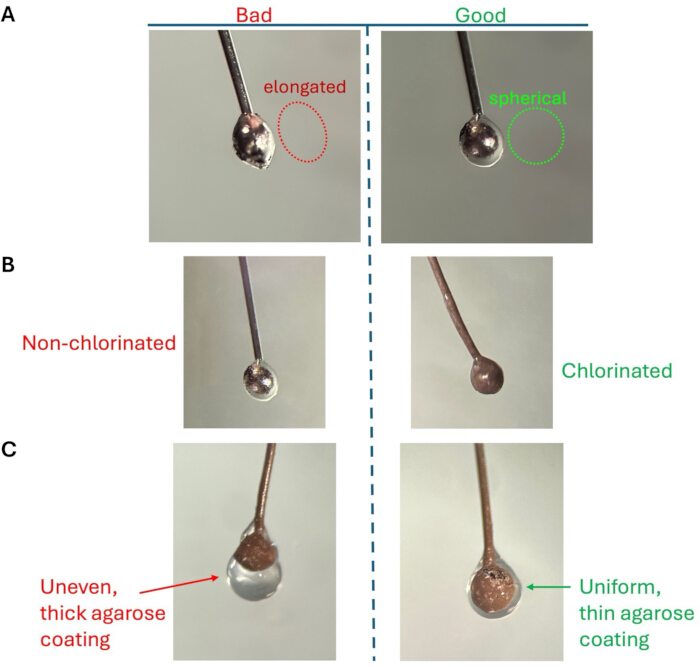
Figure 2: Electrode preparation. (A) Microscope images of good- and poor-quality electrode melts. (B) Comparison of non-chlorinated and chlorinated electrode heads. (C) Examples of good- and poor-quality agarose coatings. Please click here to view a larger version of this figure.
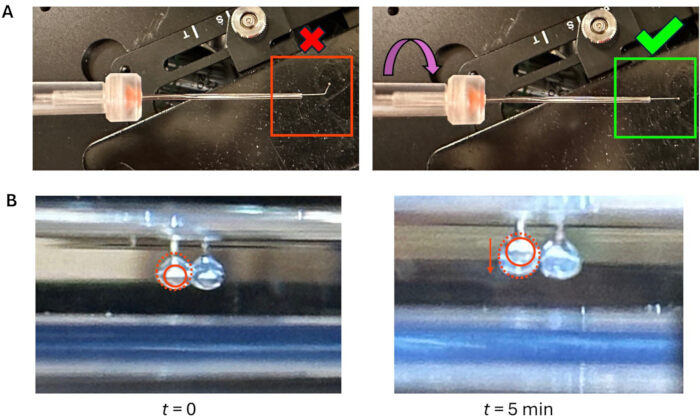
Figure 3: Electrode setup. (A) Top view of mounted electrode angle alignment. (B) Side view of comparing non-sagging droplets immediately after LUV loading with sagging droplets after monolayer formation. Please click here to view a larger version of this figure.
Electrode positioning and droplet sagging behavior
Top-down views show proper angular positioning of electrodes to minimize optical distortion (Figure 3A). Side views compare non-sagging (immediately after LUV solution loading) and sagging lipid-coated droplets (after 5 min) (Figure 3B). Sagging droplets used to form a DIB exhibit delayed physical response to movement due to significant decrease in surface tension from the lipid monolayers, visually confirming the formation of a suspended aqueous droplet fully coated by a lipid monolayer. After sagging is established, triangle wave stimulation is used to provide electrical confirmation of bilayer formation and stability35.
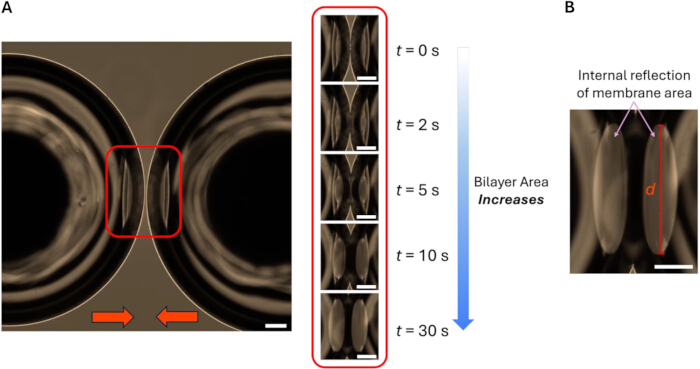
Figure 4: Droplet interface bilayer formation. (A) Time-lapse sequence showing bilayer formation and expansion following droplet contact. (B) Internal membrane reflection used for bilayer diameter and area estimation. DIB imaging is performed from underneath the setup via an inverted microscope. Scale bar = 50 µm. Please click here to view a larger version of this figure.
DIB formation and area measurement
Sequential images capture spontaneous bilayer “zipping” and area expansion when two sagging droplets are brought into contact (Figure 4A). The bright, inner oval-shaped reflections at the droplet contact are used to estimate bilayer diameter and, by extension, membrane area over time (Figure 4B).
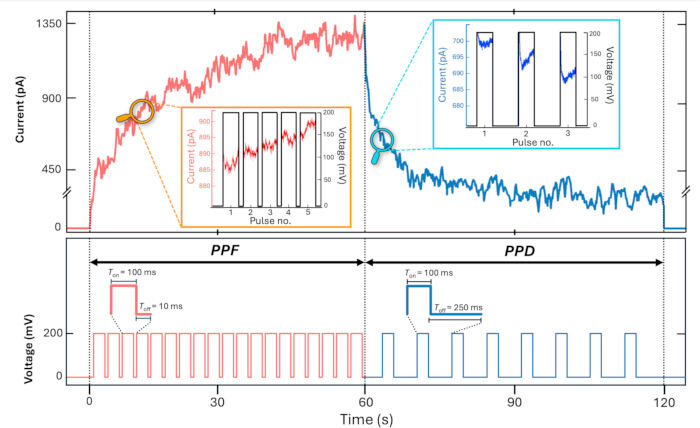
Figure 5: STP protocol—stimulation and response. Representative current responses during paired-pulse facilitation (PPF, 0–60 s, red) and paired-pulse depression (PPD, 60–120 s, blue) are shown (top), together with the corresponding stimulation protocol (bottom). PPF and PPD pulses are 100 ms in duration with OFF times of 10 ms and 250 ms, respectively, yielding duty cycles of 90.9% and 28.6%. Facilitation corresponds to net increases in ionic current; depression corresponds to net decreases. Current responses are recorded only during ON periods; for visualization, data between pulses are interpolated to highlight overall trends in current. Pulse schematic time lengths and number of pulses within PPF and PPD phases are not drawn to scale and are illustrated for visualization purposes. Representative current-response data reproduced from Podar PT et al.,25 under CC BY-NC-ND 4.0. Copyright © 2025 The Author(s). Published by PNAS. Stimulation schematic modified for the present manuscript. Please click here to view a larger version of this figure.
Electrical stimulation protocol for inducing short-term plasticity-like behavior (STP-like)
The stimulation patterns denoted here represent paired-pulse facilitation (PPF) and depression (PPD) by analogy to neuroscience terminology, similar to Koner and Najem28,29. Paired-pulse facilitation (PPF; 0–60 s) and paired-pulse depression (PPD; 60–120 s) are delivered using 100 ms pulses with OFF times of 10 ms and 250 ms, respectively, corresponding to duty cycles of 90.9% for PPF and 28.6% for PPD. The upper panel shows representative current responses during ON periods, while the lower panel shows the stimulation pattern.
Current, area, and ionic flux during STP and subsequent long-term stimulation
Normalized current (I/I0) for gA-doped DPhPC bilayers in C16 and C12/C16 oils is shown during PPF and PPD (Figure 6A). Normalized membrane area (A/A0) measured at 30 time points reveals similar area evolution in both oil conditions despite differing currents (Figure 6B). Data for normalized current and area are represented as mean ± S.D. clouds and bars, respectively, across 28 independent DIBs per oil condition. Normalized flux, J/J0 = (I/I0)/(A/A0), separates area-independent changes in conductance and is consistent with changes in membrane conduction beyond simple area expansion (Figure 6C). However, these changes may reflect contributions from both single-channel conductance and the number of active conducting channels. Extended PPD stimulation for up to 30 min produces long-term depression-like (LTD) behavior in C16 membranes but maintains elevated flux consistent with LTP-like behavior in C12/C16 membranes (Figure 6D). Together, these data show that membrane composition modulates both short- and long-timescale plasticity-like changes in ionic flux.
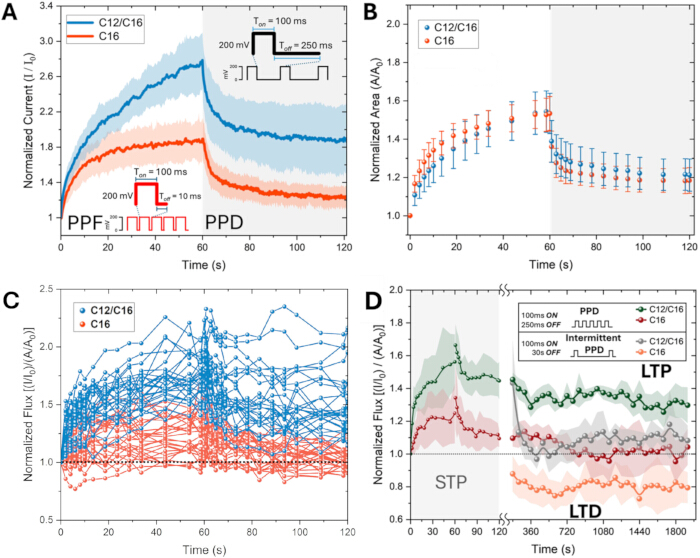
Figure 6: Current, area, and calculated ionic flux of DIBs during STP and transition into LTP/LTD. (A) Normalized current (I/I₀) during PPF (0–60 s, white background) and PPD (60–120 s, gray background) for gA-doped DPhPC membranes in C16 (orange) and C12/C16 (blue) oils, with each condition comprising n = 28 independently formed DIBs. (B) Normalized membrane areas (A/A₀), measured at 30 time points, showing comparable area trajectories despite differing current responses; data are shown as mean ± S.D. across the same n = 28 independent DIBs per oil condition. (C) Normalized flux, J/J₀ = (I/I₀)/(A/A₀)), is calculated from the corresponding current and area measurements, highlighting changes in conductance beyond area effects. (D) Long-term behavior under extended PPD stimulation: following the initial 120 s STP (gray shaded), DIBs were subjected to 30 min PPD with ON = 100 ms and OFF = 250 ms (solid red/green) or 30 s (orange/gray) pulses. Flux decays to or below baseline in C16 membranes, indicating LTD-like behavior, but remains elevated in C12/C16 membranes, indicating persistent LTP-like behavior. Shaded regions represent propagated error from I/I₀ and A/A₀. Extended-PPD datasets in (D) were obtained from n = 6 independent DIBs per oil condition for the 120 s protocol, followed by 3 DIBs per extended PPD condition. All data points are connected for visualization purposes only. Panels A, B, and D reproduced under CC BY-NC-ND 4.0. Copyright © 2025 The Author(s). Published by PNAS. Panel C was newly generated for the present manuscript from data reported in Podar PT et al.,25. Please click here to view a larger version of this figure.
Representative 15 s single-channel current trace from a gA-doped DIB formed in C16 oil following PPF stimulation
The trace includes the raw signal captured at 50 kHz with a 1 kHz low-pass filter, a 250 Hz 8-pole Bessel-filtered trace, and the idealized JSMURF fit. The lowest stable level defines the closed state, and higher levels correspond to single-channel, multi-channel, and subconductance events. These traces provide the basis for conductance amplitude and lifetime analysis. The example conductance-state dwell time indicated represents the duration of a specific conductance level, whose amplitude and duration reflect the combined contribution of multiple simultaneous full and/or subconductance events.
Conductance amplitude and lifetime distributions
Conductance amplitude histograms for C16 and C12/C16 membranes (Figure 7A–B) compare pre-PPF and post-PPF conditions at a DPhPC:gA molar ratio of 1:5×10⁻⁶. Gaussian approximations below the data indicate shifts in mean conductance peaks after PPF and resolve separate peaks corresponding to subconductance and multi-channel states. Statistical comparisons of conductance distributions were performed on pooled event-level data using Welch’s t-test and Mann-Whitney U-test (α = 0.05), with each condition comprising 3 independent DIB recordings and N for a given conductance state denoting the total number of detected events pooled across those recordings. Lifetime probability distributions, N(t)/N(0), before and after (Figure 7C–D) show that C12/C16 membranes develop longer-tailed conductance distributions and altered lifetimes relative to C16, indicating changes in channel stability. Histogram data are representative of the filtered 15 s trace (red trace) acquired for each condition. Conductance-state lifetime distributions were generated from 3 independent DIB recordings per condition; dotted curves denote individual replicates, and solid curves denote global exponential fits to N(t) / N(0) vs t.
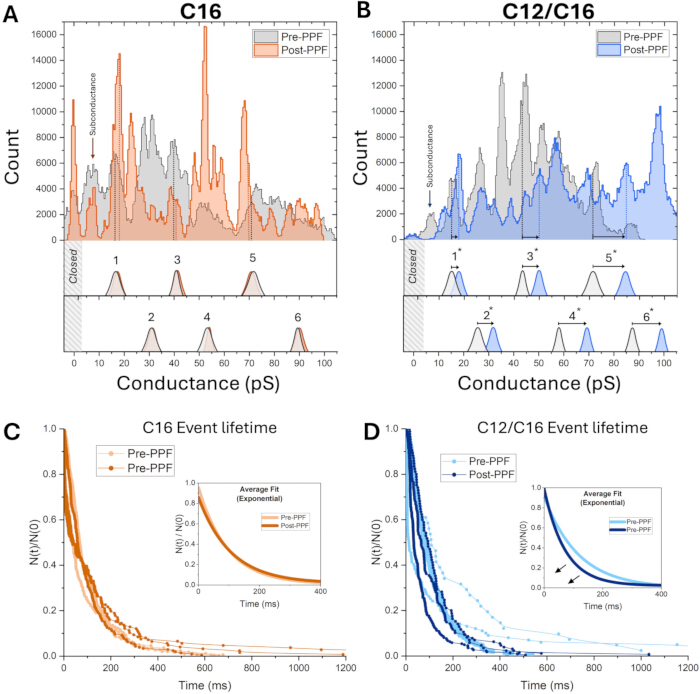
Figure 7: Conductance amplitude histograms and conductance-state dwell-time distributions. Conductance amplitude histograms for gA activity in (A) C16 and (B) C12/C16 membranes compare pre-PPF (gray) and post-PPF (orange / blue) conditions at a 5 × 10⁻⁶ gA:lipid molar ratio. Gaussian approximations beneath the histograms indicate shifts in mean conductance peaks and standard deviations for single- and multi-channel states. Shifts in mean conductance after PPF are indicated by dashed lines (black = pre-PPF; blue/orange = post-PPF) and arrows. Each condition represents 3 independent DIB recordings. Statistical comparisons of conductance distributions were performed on pooled event-level data using Welch’s t-test and Mann-Whitney U-test (α = 0.05), where N for a given conductance state denotes the total number of detected events summed across those three recordings. Subconductance events were also included in the analysis, with representative subconductance distributions indicated to the left of the first open-state peak for each membrane condition. Lifetime probability distributions of conductance-state events in C16 (C) and C12/C16 (D) membranes before (orange / blue) and after PPF stimulation (dark orange / dark blue) at 5×10⁻⁶ M gA:lipid correspond to the conductance analyses shown in Figure 7A–B. Here, N(t) represents the cumulative number of full and subconductance events with durations longer than time t. Dotted lines denote lifetime distributions from individual replicates (n = 3 independent DIBs per condition), and solid insets show global exponential fits performed using nonlinear curve fitting software. Panels A–D reproduced from Podar PT et al.,25 and compiled for the present manuscript under CC BY-NC-ND 4.0. Copyright © 2025 The Author(s). Published by PNAS. Please click here to view a larger version of this figure.
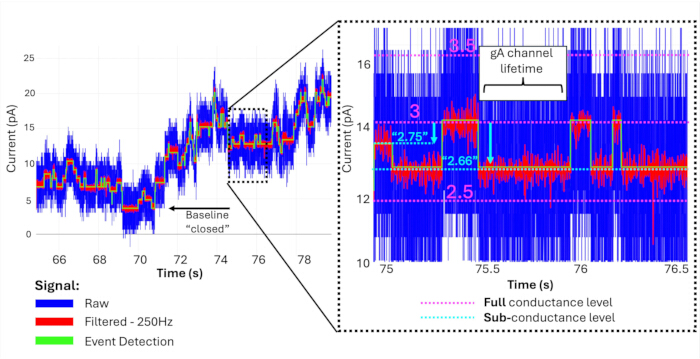
Figure 8: Probing single-channel behavior—current response trace for DIBs in C16 after PPF stimulation. (A) Example 15 s current trace showing raw data (blue), filtered with a 250 Hz 8-pole Bessel low-pass filter (red), and the idealized trace (green) used to identify conductance states. The lowest stable level defines the baseline “closed” state. (B) Representative sub-conductance levels detected between the 2nd and 3rd full-conductance levels, corroborated by distinct intermediate peaks in the amplitude histogram (see Figure 7A, orange). Conductance dwell times are extracted from the duration of each identified conductance level (excluding the closed state) to generate N(t)/N(0) lifetime distributions. Reproduced from Podar PT et al.,25 under CC BY-NC-ND 4.0. Copyright © 2025 The Author(s). Published by PNAS. Please click here to view a larger version of this figure.
Following PPF, C12/C16 membranes exhibit a pronounced rightward shift in conductance amplitude distributions, indicating enhanced single-channel conductance, accompanied by a leftward shift in conductance-state lifetime distributions, consistent with shorter channel open times. These changes are consistent with electromechanical thinning of the C12/C16 bilayer during PPF, as supported by direct mechanical and thickness measurements reported in ref. 25, which lowers the energetic barrier for ion transport through gA and increases ion throughput per opening while reducing channel stability. In contrast, C16 membranes show minimal changes in either distribution, highlighting their limited structural adaptability. Together, these results demonstrate that the DIB platform captures both ensemble- and single-channel correlates of membrane electromechanical adaptation, including STP-like and LTP/LTD-like changes in ionic conduction arising from membrane composition-dependent dynamics (Figure 8).
Discussion
In practical terms, this method provides three key experimental capabilities: controllable variation of bilayer composition through the lipid composition and oil phase, simultaneous optical and electrical monitoring of membrane restructuring, and access to a membrane area regime that bridges single-channel electrophysiology and mesoscale membrane mechanics14,15,20,21,25. These features make the method particularly useful for structure-function studies in simplified membrane systems where membrane electromechanics, rather than full cellular complexity, is the experimental perspective of interest14,15,20,21,25,39.
This protocol describes the assembly and analysis of gramicidin A-doped DIBs in alkane oils to probe the ability of lipid membranes to restructure under physiologically relevant electrical stimulation14,15,25,35,38. Compared with patch clamp techniques21, the DIB platform interrogates membrane patches that are orders of magnitude larger while maintaining sufficient resolution to capture discrete ion-channel events14,15,19,20,21,28,38. This capability is particularly valuable for resolving mesoscale electromechanical remodeling (e.g., as electrowetting and electrocompression) and linking it to microscopic channel behavior that collectively give rise to STP-, LTP-, and LTD-like membrane conductance phenotypes under physiologically inspired stimulation13,25,27,38. The present DIB system is not intended to replicate the molecular complexity of biological synapses1,2,3,4,5,6,7,8,9,10,11. Accordingly, terms such as STP, LTP, LTD, PPF, and PPD are used in a descriptive, analogy-based sense to denote short- and long-timescale increases and decreases in membrane ionic conduction under defined stimulation protocols. The primary findings of this work are therefore interpreted most directly in terms of membrane electromechanics, conductance adaptation, and composition-dependent nonequilibrium restructuring in DIBs, which may offer useful conceptual analogies and physical perspectives on synaptic plasticity without implying mechanistic equivalence to neuronal circuitry or biochemical synaptic regulation10,11,25,38.
Several technical steps are critical for obtaining reproducible results. Careful preparation of the Ag/AgCl electrode, including uniform melting of the silver spherical tip, thorough chlorination, and a thin, even agarose coat, ensures stable droplet attachment and low-impedance electrochemical coupling20,35. Visual confirmation of droplet sagging and correct electrode orientation minimizes optical distortion during video recording and improves the accuracy of membrane area measurements. Post-acquisition scale calibration using the known silver wire diameter provides a robust pixel-to-mm conversion, which is essential for reliable computation of membrane area and ion flux. In this work, membrane conductance (flux) is defined as current per unit area (I/A), and because DIB area changes during electrowetting, accurate flux quantification requires time-matched current and bilayer area measurements13,25,27,35.
This approach also supports complementary ensemble-level and single-channel readouts within the same platform14,15,20,25,35,38. At the ensemble level, synchronized video and electrical recordings quantify dynamic changes in area (electrowetting) and current, from which ionic flux (current/area) is derived. Under electrical stimulation, membranes are driven into nonequilibrium steady states (NESS) where composition-dependent membrane restructuring generates short-timescale plasticity-like responses that can evolve into longer-timescale potentiation-like or depression-like behavior over extended periods (min)25,26,28,29,30,31,32,33,38. At the single-channel level, analysis involves idealizing current traces into stepwise conductance levels (closed, single-channel, multi-channel, and subconductance states). Traditional square-wave idealization tools typically resolve only a limited number of discrete levels; for more complex or noisy data, model-free idealization methods such as JSMURF are preferred37. Brief DC holding potentials analyzed with JSMURF provide statistically rigorous event detection under heterogeneous noise, yielding conductance-amplitude histograms (integer and subconductance levels) and N(t)/N(0) lifetime distributions. Overlaying idealized and filtered amplitude histograms enables visual and quantitative cross-validation of conductance-state assignments, while convolved reconstructions (idealized traces passed through the known low-pass filter) confirm parameter choices and event fidelity37.
Membrane composition, tuned here through the surrounding oil phase (e.g., C16 vs C12/C16), is expected to modulate bilayer viscoelasticity and restructuring capacity under electrical stimulation, consistent with direct measurements reported in previous work22,25,39. More compliant membranes are expected to show larger EC-driven thinning and improved hydrophobic matching with gA during PPF22,23,25, leading to increased single-channel conductance and facilitation that can stabilize as LTP-like behavior25,38. Conversely, stiffer membranes display limited structural responsiveness, smaller conductance changes during PPF and PPD, and a tendency toward LTD under prolonged pulsing. These composition-dependent outcomes highlight how material properties predispose membranes toward distinct, functionally relevant long-term regimes22,23,25,39.
The DIB platform also has important limitations21. The mechanistic interpretation advanced here is that differences in oil composition alter bilayer material properties and susceptibility to electromechanical restructuring, which in turn modulate gramicidin A conduction22,23,25. This interpretation is supported by the prior study, which directly measured membrane viscoelasticity, interfacial tension, as well as dynamic membrane thickness changes under these membrane conditions and stimulation22. In the present work, however, these material properties were not measured simultaneously in each experiment and are therefore used here to support the differing structural and mechanical responses to electrical stimulation of membranes in C16 and C12/C16 environments, rather than independently establish the mechanistic interpretation of the data. In addition, ensemble current and flux may reflect both changes in single channel conductance and changes in the number of conducting channels, which may vary with membrane area, peptide diffusion, and dimerization under nonequilibrium conditions17,18,22,23. The surrounding oil phase may also dynamically infiltrate or recede from the bilayer core during stimulation, contributing to baseline drift in single-channel recordings and gradual changes in membrane composition over time13,21,25. Together, these factors limit the use of long-duration constant-voltage recordings for defining static membrane properties and emphasize that DIBs behave as open, dynamic systems rather than closed equilibrium membranes13,21,25. Thus, while the present protocol captures stimulation-dependent, plasticity-like changes in conduction over the intended experimental timescales25,38, future studies that combine direct mechanical measurements with simultaneous electrical and optical recordings, potentially alongside fluorescence-based single-molecule imaging, will be required to more fully resolve the respective contributions of membrane restructuring, channel conductance, and channel population21,25.
Common failure modes include unstable droplet attachment, incomplete droplet sagging, premature droplet coalescence during bilayer formation, and poor optical definition of the bilayer edge during area analysis. Unstable droplet attachment is often caused by irregular silver-ball geometry or uneven agarose coating and can be reduced by verifying ball symmetry and maintaining a smooth agarose shell. Electrode loading also requires manual deposition of nanoliter-sized aqueous droplets onto a submilimeter electrode head, which demands substantial hand-eye coordination and depth perception across media of different refractive indices (air vs oil). As a result, the pipette tip may unintentionally contact the agarose shell or miss the electrode head during dispensing. Stability-enhancement techniques such as wrist bracing, slow pipette advancement in oil, and breath-holding, together with repeated practice, can improve loading proficiency. Furthermore, incomplete sagging or delayed monolayer formation can result from vesicle heterogeneity, temperature variation, or agarose topography and may be improved by increasing the waiting time after droplet deposition15,20,35. Coalescence during bilayer formation is frequently associated with excessive contact area or overly aggressive electrical stimulation (> ± 200 mV) and can be mitigated by using smaller initial droplet contact areas, allowing additional time for monolayer stabilization, and verifying the low-amplitude triangle-wave capacitance response before pulsing25,35,38.
Despite these constraints, the DIB platform is highly tunable, scalable, and reproducible14,15,20,21,25,35,38,40, and it complements protein-centric electrophysiology by isolating the contribution of lipid mechanics to conduction22,23,25. By unifying ensemble and single-channel measurements in one system, this protocol provides a practical route to dissect how electrical work and membrane viscoelasticity combine to produce synaptic-like conductive behavior (STP-like, LTP-like, and LTD-like responses) in a controllable, bottom-up model25,29,30,31,32,33,38. As such, the methodology offers a foundation for systematic exploration of composition-dependent learning rules in membranes and for quantifying how mechanical and electrical forces couple membrane proteins to their host bilayer across temporal and spatial scales21,22,23,25. Collectively, these capabilities position DIBs as a powerful framework for deconstructing complex neurobiological behaviors into tractable, testable biophysical mechanisms10,11,25,38.
Disclosures
All authors have nothing to disclose.
Acknowledgements
C.P.C. and J.K. are supported through the Scientific User Facilities Division of the Department of Energy (DOE) Office of Science, sponsored by the Basic Energy Science (BES) Program, DOE Office of Science, under Contract No. DE-AC05-00OR22725. D.B. was supported through the National Science Foundation, Division of Molecular and Cellular Biosciences (MCB), under contract no. 2219289. The research was partly funded through the Nonequilibrium and Emergent Transients in Advanced and Soft Materials (NEAT) award, sponsored by the Laboratory Directed Research and Development Program of Oak Ridge National Laboratory, managed by UT-Battelle, LLC, for the U. S. Department of Energy. P.T.P. and C.M. were supported through the DOE Omni Technology Alliance Internship Program and the Education Collaboration at ORNL (ECO) program. P.T.P. and V.S. were supported by the Oak Ridge National Laboratory (ORNL) Research Student Internships (RSI) program. P.T.P., O.Z., and Z.G. were supported through the DOE Science Undergraduate Laboratory Internships (SULI) program. A.A. and J.H.M. were supported by a Graduate Education for Minority Students (GEM) Fellowship. Data acquisition and analysis were carried out at the Shull-Wollan Center and at the Center for Nanophase Materials Sciences, which is a DOE Office of Science User Facility.
Materials
| Name | Company | Catalog Number | Comments |
|---|---|---|---|
| 1,2-diphytanoy-sn-glycero-3-phosphocholine (DPhPC) | Avanti Polar Lipids | 850356P/850356C | Purchased as lyophilized powder (P) or in chloroform (C) |
| Agarose | Sigma-Aldrich | A9539 | |
| Agarose (0.5g Agarose Tablets) | Benchmark | A2501 | You can either use the powder form or the tablets |
| Agilent Technologies 33522A waveform generator | Keysight | – | You can use any waveform generator with BNC cable outputs |
| Argon (Ar) gas | Airgas | AR UHP300; 72-402221259-1 | Argon Compressed; Ultra High Purity |
| Analytical balance | Mettler Toledo | Model: MS304S/03 | Any lab-grade analytical balance with precision of 0.0001 g |
| Axopatch 200B Amplifier | Molecular Devices | – | |
| BK Precision 4017B 10 MHz DDs Sweep/Function Generator | Digi-Key | BK4017B-ND | |
| Borosilicate Glass Capillaries | World Precision Instruments | 1B100F-4 | |
| Clampex pCLAMP 11 Software Suite | Molecular Devices | – | |
| DigiData 1550B system | Molecular Devices | – | This includes a mini-extruder, 2 syringes, 100 PC membranes, 100 filter supports, and 1 holder/heating block |
| Dodecane, 99% | Sigma-Aldrich | 112-40-3 | |
| Extruder Set With Holder/Heating Block | Avanti Polar Lipids | 610000 | |
| Fiji software | ImageJ | – | |
| Freezer (-80 °C) | Fisher Scientific | Isotemp; Model: 8964; S/N: 828278-21 | |
| Glassware | VWR International | – | |
| Gramicidin-A | Millipore Sigma | 368020 | |
| Hexadecane, 99% | Sigma-Aldrich | 544-76-3 | |
| Hum Bug Noise Eliminator (60Hz) | A-M Systems | 726300 | |
| Inverted Microscope System (Nikon Ti2-A) | Nikon | – | Any inverted or upright microscope may be used |
| Isopropyl Alcohol | VWR International | BDH1133-4LP | |
| Microelectrode Holder | World Precision Instruments | MEH1S | |
| Micromanipulators | Sutter Instrument | MP-285 | Manual manipulators may be used |
| Microscope Camera | Olympus | DP74 | |
| Microsoft Excel | Microsoft | – | |
| MOPS | Sigma-Aldrich | M1254 | |
| NIS-Elements Microscope Camera Software | Nikon | – | Camera capture software with live-view and/or video capability may be used. Live-view and simultaneous screen recording may be used to substitute for video capture. |
| Parafilm M All-Purpose Laboratory Film | Parafilm | PM999 | |
| Petri Dish | - | - | The dish must be transparent on the bottom and ideally the side wall too |
| Potassium Chloride (KCl) | Sigma-Aldrich | P3911 | |
| Powder Free Soft Nitrile Examination Gloves | VWR International | CA89-38-272 | |
| Refrigirator (4 °C) | Fisher Scientific | CAT NO: 97-938-1; Model NO: 3556FS | |
| Silver wire | GoodFellow | 147-346-94 | |
| Stirring Hot Plate | Thermo Scientific | SP131325 |
References
- Mateos-Aparicio, P., Rodríguez-Moreno, A. The impact of studying brain plasticity. Front Cell Neurosci. 13, 66 (2019).
- Haas, J. S., Greenwald, C. M., Pereda, A. E. Activity-dependent plasticity of electrical synapses: increasing evidence for its presence and functional roles in the mammalian brain. BMC Cell Biol. 17, 14 (2016).
- Curti, S., Davoine, F., Dapino, A. Function and plasticity of electrical synapses in the mammalian brain: role of non-junctional mechanisms. Biology. 11, 81 (2022).
- Abraham, W. C. Metaplasticity: tuning synapses and networks for plasticity. Nat Rev Neurosci. 9, 387 (2008).
- Volianskis, A., Collingridge, G. L., Jensen, M. S. The roles of STP and LTP in synaptic encoding. PeerJ. 1, e3 (2013).
- Anwar, H., Li, X., Bucher, D., Nadim, F. Functional roles of short-term synaptic plasticity with an emphasis on inhibition. Curr Opin Neurobiol. 43, 71-78 (2017).
- Agnes, E. J., Vogels, T. P. Co-dependent excitatory and inhibitory plasticity accounts for quick, stable and long-lasting memories in biological networks. Nat Neurosci. 27, 964-974 (2024).
- Turrigiano, G. G., Nelson, S. B. Homeostatic plasticity in the developing nervous system. Nat Rev Neurosci. 5, 97-107 (2004).
- Citri, A., Malenka, R. C. Synaptic plasticity: multiple forms, functions, and mechanisms. Neuropsychopharmacology. 33, 18-41 (2008).
- Collier, C. P., Bolmatov, D., Lydic, R., Katsaras, J. Neuronal plasma membranes as supramolecular assemblies for biological memory. Langmuir. 41 (5), 2973-2979 (2025).
- Jerusalem, A., et al. Electrophysiological-mechanical coupling in the neuronal membrane and its role in ultrasound neuromodulation and general anesthesia. Acta Biomater. 97, 116-140 (2019).
- Sarles, S. A., Leo, D. J. Tailored current-voltage relationships of droplet-interface bilayers using biomolecules and external feedback control. J Intell Mater Syst Struct. 20, 1233-1247 (2009).
- El-Beyrouthy, J., et al. A new approach for investigating the response of lipid membranes to electrocompression by coupling droplet mechanics and membrane biophysics. J R Soc Interface. 16, 20190652 (2019).
- Najem, J. S., et al. Memristive ion channel-doped biomembranes as synaptic mimics. ACS Nano. 12, 4702-4711 (2018).
- Najem, J. S., et al. Dynamical nonlinear memory capacitance in biomimetic membranes. Nat Commun. 10, 3239 (2019).
- Budin, I., et al. Viscous control of cellular respiration by membrane lipid composition. Science. 362, 1186-1189 (2018).
- Nielsen, C., Goulian, M., Andersen, O. S. Energetics of inclusion-induced bilayer deformations. Biophys J. 74, 1966-1983 (1998).
- Andersen, O. S., Koeppe, R. E. Bilayer thickness and membrane protein function: an energetic perspective. Annu Rev Biophys Biomol Struct. 36, 107-130 (2007).
- Bartsch, P., Harsman, A., Wagner, R. Single channel analysis of membrane proteins in artificial bilayer membranes. Membrane Biogenesis: Methods and Protocols. , 345-361 (2013).
- Najem, J. S., et al. Multifunctional, micropipette-based method for incorporation and stimulation of bacterial mechanosensitive ion channels in droplet interface bilayers. J Vis Exp. (105), e53362 (2015).
- Stephenson, E. B., Korner, J. L., Elvira, K. S. Challenges and opportunities in achieving the full potential of droplet interface bilayers. Nat Chem. 14, 862-870 (2022).
- Lundbæk, J. A., et al. Lipid bilayer regulation of membrane protein function: gramicidin channels as molecular force probes. J R Soc Interface. 7, 373-395 (2010).
- Lundbæk, J. A., Maer, A. M., Andersen, O. S. Lipid bilayer electrostatic energy, curvature stress, and assembly of gramicidin channels. Biochemistry. 36, 5695-5701 (1997).
- Weinrich, M., Worcester, D. L., Bezrukov, S. M. Lipid nanodomains change ion channel function. Nanoscale. 9, 13291-13297 (2017).
- Podar, P. T., et al. Electromechanically induced membrane restructuring enables learning and memory. Proc Natl Acad Sci U S A. 122 (45), e2510664122 (2024).
- Srikimkaew, O., et al. Short-term and long-term memory functionality of a brain-like device built from nanoparticle atomic switch networks. Adv Electron Mater. 10, 2400360 (2024).
- Heimburg, T. The capacitance and electromechanical coupling of lipid membranes close to transitions: the effect of electrostriction. Biophys J. 103, 918-929 (2012).
- Scott, H. L., et al. Evidence for long-term potentiation in phospholipid membranes. Proc Natl Acad Sci U S A. 119 (50), e2212195119 (2007).
- Li, Z. Neuromorphic ionic computing in droplet interface synapses. Sci Adv. 11 (30), eadv6603 (2025).
- Sarles, S. A., Najem, J. S., Mohamed, A. S. Voltage-responsive biomimetic membranes and ion channels for neuromorphic computing. npj Unconv Comput. 2, 26 (2025).
- Mohamed, A. S., Armendarez, N. X., Hasan, M. S., Najem, J. S. Memimpedance-based biomolecular device for adaptive physical reservoir computing. Adv Intell Syst. , 2500281 (2025).
- Shrestha, S., Freeman, E. Rewiring droplet interface bilayers. Adv Intell Syst. , e202501039 (2026).
- Podar, P., et al. Photoresponsive rotaxanes switch lipid bilayer neuromorphic behavior with light. Adv Electron Mater. , E00759 (2026).
- Bolmatov, D., Zav’yalov, D., Egami, T. Relaxor ferroelectric-like spatiotemporal memory in field-driven lipid bilayers. Langmuir. 42 (3), 2542-2547 (2026).
- Najem, J. S., et al. Assembly and characterization of biomolecular memristors consisting of ion channel-doped lipid membranes. J Vis Exp. (145), e59200 (2019).
- Sigworth, F. J., Shenkel, S. Rapid gating events and current fluctuations in gramicidin A channels. Curr Top Membr Transp. 33, 113-130 (1988).
- Pein, F., Eltzner, B., Munk, A. Analysis of patch-clamp recordings: model-free multiscale methods and software. Eur Biophys J. 50, 187-209 (2021).
- Koner, S., Najem, J. S., Hasan, M. S., Sarles, S. A. Memristive plasticity in artificial electrical synapses via geometrically reconfigurable, gramicidin-doped biomembranes. Nanoscale. 11, 18640-18652 (2019).
- Bolmatov, D., et al. Melatonin-induced modulation of cholesterol-enriched model neuronal membranes. ACS Chem Neurosci. 17 (5), 976-986 (2026).
- Mohamed, A. S., Dhungel, A., Hasan, M. S., Najem, J. S. Intrinsic voltage offsets in memcapacitive biomembranes enable high-performance physical reservoir computing. ACS Appl Eng Mater. 2, 2118-2130 (2024).
Reprints and Permissions
