In cochlear implantation, slow electrode insertion has been shown to improve hearing and preserve structural integrity. This article presents a technique for robotic-arm-assisted slow insertion of cochlear implant (CI) electrodes, combined with cochlear microphonics recording, as a possible instantaneous objective measure of structure preservation.
Method Article
Robotic Arm Assisted Slow Electrode Insertion and Simultaneous Measurement of Cochlear Microphonics in Cochlear Implantation
In This Article
Summary
Abstract
Cochlear microphonic potentials (CMPs) are an electrical response predominantly of the outer and, to a smaller degree, the inner hair cells to acoustic signals. They can be used to monitor hearing and structure preservation during cochlear implantation. Among other precautions, slow and steady electrode insertion has proven beneficial in this regard. In this article, the authors present a combination of robotic-assisted implantation and observation of CMPs. CMPs are recorded through the cochlear implant tip electrode before and after opening the round window membrane, during insertion, and in the final electrode position. Acoustic pure tones at frequencies determined by the patient’s hearing status are used as stimuli. To set the electrode insertion trajectory, a 5-degree-of-freedom manipulator (2 rotational, 3 translational) is used. Electrode insertion is performed with a linear actuator controlled by the surgeon. Additionally, the electrode entrance can be manually guided, and the trajectory readjusted accordingly based on CMP observations. Experiences so far indicate that human-guided robotic CI electrode insertion, combined with simultaneous CMP measurement, is feasible and appears to be a promising strategy to improve cochlear structure preservation.
Introduction
A microphone is a transducer that converts sound into an electrical signal. In a healthy cochlea, acoustic stimulation creates mechanical vibrations of the basilar membrane and the organ of Corti. This causes movement of the inner and outer hair cells’ stereocilia, the latter relative to the tectorial membrane, leading to opening of potassium channels and an ion exchange between the endolymph and the hair cells' intracellular fluid. The combined activity of all hair cells results in changes of potentials in endolymph and perilymph which closely resemble the acoustic stimulation signal. Consequently these potentials are called cochlear microphone potentials (CMP)1. Researchers showed that the CMPs are generated by the hair cells and are an alternating current response to sound with the generation site at the border between the organ of Corti and the endolymphatic space, the reticular lamina2. As a frequency following hair cell response, the CMP amplitude slopes precipitously at cochlear sites apical to the characteristic frequency3.
Besides these potentials, compound action potentials (CAP) generated by the spiral ganglion cells and the acoustic nerve, summation potentials (SP) and auditory nerve neurophonics (ANN) can be recorded1,4. These, however, are of little interest for instantaneously assessing structure and hearing preservation during surgery. In the clinical setting, the electrocochleography (ECochG), the graphical registration of these potentials, is a widely used procedure to assess the status of the inner ear and to diagnose different conditions e.g. auditory neuropathy, endolymphatic hydrops5,6,7. Diagnostic ECochG is performed with a transtympanic needle, where its tip is placed on the promontory in the vicinity of the round window (RW)5. For this, the CMPs are calculated by taking the difference of two responses to alternating acoustic stimuli8.
Opening of the cochlea for only diagnostic purposes is not considered due to the risk of hearing loss. However, in cochlear implantation, intracochlear recordings are possible if the CI is technically capable of performing such measurements9,10,11,12. Intracochlear recordings are considered to be more sensitive since the recording electrode contacts can be brought closer to the generating area. Acoustic hearing and structure preservation is shown to improve speech recognition in noise and in quiet, music perception and spatial orientation13,14 ,15,16.Thus, ECochG is now being used as a monitoring tool for cochlear functioning during electrode insertion17 and especially CMPs may prove to be predictive for postoperative hearing and structure preservation. Furthermore, many patients become cautious and fear losing the residual hearing most18.
Slow electrode insertion has proven beneficial not only for hearing preservation during cochlear implantation, but also for preserving the vestibular function19,20. In line with these findings, slow and steady robotic electrode insertion is expected to improve hearing preservation21,22. One study21 calculated the speed of insertion by analyzing video recordings; the speed of manual insertion was 2.48 ± 0.52 mm/s. A novel robotic insertion system (OTOARM/OTODRIVE, Cascination/Med-El) offers a steady velocity of down to 0.1 mm/s so that the insertion takes about 5 min for conventional electrode lengths. First quantitative in vitro results with this system provide evidence for a more consistent insertion speed compared to manual insertion techniques. Moreover, the use of robotic insertion can significantly reduce factors associated with intracochlear trauma23. To our knowledge, this is the first time that both robotic-assisted electrode insertion and CMPs recordings are applied in combination. Surgical techniques and procedures have been specifically adapted to this combined application.
Protocol
All procedures were conducted in accordance with the Declaration of Helsinki and under institutionally approved protocols (RUB ethics committee approval no. 23–7894) with written informed patient consent.
1. Patient registration and informed consent
- Inform the patient about the additional measurement of cochlear microphonics (CMPs) during the surgery. Describe the robotic electrode insertion and outline the reason for the slow, steady insertion speed.
NOTE: With this extra care, the operations often last 30 min longer. In the case of robotic insertion failure (as in obliteration or increased bleeding), switch immediately to manual insertion and complete the operation. - Inspect the eardrum and remove earwax so that it does not impede the CMP measurement.
2. Preparing the operation
- Position the head of the patient in a 30° supine position rotated contralaterally.
NOTE: When shaving the hair, ensure that the external transmitter coil of the CI system sits reliably in place for several minutes, so ensure that more hair is removed than in other procedures. - Inject retroauricularly and at the implant bed site 10–15 mL local anesthetic with adrenaline (1 % Prilocainhydrochlorid).
- Insert the stimulation foam eartip of the earphone (Table of materials) firmly. Then tape the folded ear tightly anteriorly, together with the ear plug.
NOTE: Insert the ear tip not too deeply into the ear canal and fix it with a cotton pad so that the sound delivery tube exits upright and does not kink or dislocate. - Apply a two-channel facial monitoring system.
- Mount the robotic arm above the patient’s head on the contralateral table side, preferably with a stable rail extension (Table of materials).
NOTE: When mounting the body of the robot, ensure that not only the upper rail but also the lower two teeth on its rail interface on the backside of the box have a firm grip around the table's extension rail from above and from below. Double check. - Adjust the aligner of the robotic system.
NOTE: A position more posterior in the longitudinal direction and inferior in the vertical direction (Y-axis) proved beneficial in our case, since it provided additional forward and upward positioning latitude if needed (Figure 1). When setting up the aligner, take into account the eventual direction of the robotic forceps as needed for insertion. In the initial contralateral resting position of the arm, the tip somewhat counterintuitively needs to point away from the patient (Figure 2). When the arm is put back into position for the insertion its tip automatically points towards the operated ear. - Drape the ear first using a sterile op-site sheet. Then, drape as usual for ear surgery. Finish by draping the robotic arm with the provided drape.
- Coordinate with the anesthesiologist, the audiological team, and the assisting team on the operation steps.
- Perioperatively administer i.v. antibiotic (Cefuroxim 1.5 g), usually half an hour before the operation.
- At the beginning of the operation, if no contraindications for glucocorticoids are present, 250 mg i.v. Solu Decortin can be administered.
3. Incision and double flap
- Use a lazy S-shaped incision at the hairline. Prepare the cutaneous and subcutaneous layers.
- Cut through the underlying tissues, including muscles and periosteal layer, and form a superior-based flap. Expose inferiorly the planum mastoideum, anteriorly the posterior outer ear canal wall, and superiorly the superior one and the linea temporalis.
4. Mastoidectomy and posterior tympanotomy
- Perform a typical mastoidectomy, leaving a thin bony shell over the dura of the middle cranial fossa and the sigmoid sinus. Expose the short process of the incus in the attic.
NOTE: For the mastoidectomy it is essential to have inverted, “overhanging” edges to keep the electrode cable's spare length safely inside the created cavity. To align the cable, the more medial plane (antrum, sinus sigmoideus, and mastoid tip) is optional. The cable positioning is important, since it is best that it is moved as little as possible after insertion in order to avoid compromising structural preservation or residual hearing. - Perform a wide posterior tympanotomy:
- Expose the facial nerve from three sides (posteriorly, laterally, and anteriorly), leaving an intact protective thin bony shell.
- Expose the chorda tympani from the posterior and medial.
- Drill to the chorda facial angle until the styloid eminence in the retrotympanum of the middle ear.
- Prepare a fixation channel for the electrode lead underneath the chorda tympani.
5. Preparing the middle ear and the round window niche for the robotic arm insertion
NOTE: The limit of the insertion angle in the cochlea through the posterior tympanotomy with the robotic system is the anterior rim of the facial nerve.
- Remove the bone in front of the facial nerve in the sinus tympani and sinus subtympanicum, leaving a thin bony shell over the nerve.
NOTE: On occasion, the eminentia pyramidalis needs to be reduced, exposing the stapedius muscle, to provide a more favourable view of the round window niche. - Thin the posterior bony wall of the external ear canal by shaping it so that better exposure of the round window is achieved, thereby enabling both better visibility and further drilling.
NOTE: The electrode insertion trajectory must be parallel to the posterior bony wall of the external ear canal. In this situation, it can help to moderately rotate the patient towards the contralateral side. - Drill out the lateral bony edge of the styloid eminence.
NOTE: By doing this, you can later more easily open the robotic insertion forceps in the posterior tympanotomy. - To minimize noise trauma, reduce burr speed to 4,000 rpm from here onwards. Remove the bony lip over the round window membrane with a 1.2 mm or 1.4 mm diamond burr, exposing it widely.
NOTE: Sometimes a false round window membrane is present. Proceed with extreme care with its removal, since it risks being closer to the actual round window than initially thought. Avoid opening the cochlea at this step. - Remove the posterior pillar at the entrance of the round window.
NOTE: Check at the CT scan for a high jugular bulb here. - Remove the anterior pillar at the entrance of the round window.
NOTE: For electrode insertion, it is beneficial to see the bottom of the scala tympani. This step is sometimes necessary to avoid additional drilling with an already opened cochlea. If the bottom is not visible and you perform this step, you should be able to remove the thinned cochlear bone layer anterior-inferior from the round window with a curette or a hook.
6. Preparing the implant bed, placing the external CI transmitter coil, positioning the robotic arm, and adjusting the insertion trajectory
- Prepare a 3–4 mm deep bony bed for the implant 10–20 mm from the mastoid rim. Cover the electrode lead up to the mastoidectomy rim with bone pâté.
- Ensure that the implant housing is covered by the muscle flap and that the implant housing’s metal electrodes are in good contact with the flap.
- Place the external transmitter coil in a sterile drape and position it on the skin flap opposite the implant’s receiver coil.
- Rotate the robotic arm with the actuator and the forceps in an arch around the patient’s head over to the ipsilateral site with the tip pointing towards the mastoidectomy.
NOTE: The forceps is now at the most anterior position, at the 40 mm position in the control software. - Under microscopic view, the robotic arm with the forceps is positioned to point towards the inferior anterior quadrant of the round window membrane and push the arm until it touches the membrane.
NOTE: The trajectory runs from superior posterior to anterior inferior, approximately parallel to the external ear canal. - Retract the forceps via robotic control using the left foot pedal to the most posterior position; at the 0 mm position in the control software.
- Mount the electrode array on the robotic forceps either by hand or by using thin anatomic forceps.
- Depending on available space, manually guide the spare electrode cable length towards the antrum, back to the sinus sigmoideus, and then into the forceps in order to have a stable cable position, ideally minimizing spring forces upon the intracochlear electrode.
7. Measuring CMPs before the round window
NOTE: This study uses a modified method described in the literature24.
- Advance the electrode with 1.0 mm/s by using the right foot pedal and position the first electrode immediately in front of the round window membrane.
NOTE: Avoid exerting pressure on the RW. - Add a cortisone solution bolus (0.5 mL SoluDecortin 250 mL/2 mL Aqua) onto the RW.
- Start by checking the connection quality of the transmitter coil with the implant.
NOTE: At this point, the patient, implant type, and serial number must have already been established in the MAESTRO fitting software by the audiologist. An in-package impedance (IFT) measurement of the implant is strongly recommended. Checking the connection quality can be done with the coupling check function in the Tools menu of the MAESTRO software. While a weak connection is sufficient to read out the implant’s serial number, a 100% connection quality is mandatory for a reliable measurement of CMP's or compound action potentials (CAPs). - Measure the electrical impedances of all electrode contacts and the connection of the first electrode contact with the conducting bolus, and by this also with the round window membrane.
NOTE: The impedance should be < 5 kΩ. - Depending on the preoperative pure tone audiogram, perform CMP measurements at the most favorable frequency as shown in the literature24.
NOTE: If there is none, use 500 Hz. If time allows and residual hearing is expected at several frequencies, additional frequencies can be measured.
8. Opening the round window and measuring CMPs
- Record the best CMP result with the RW still closed.
NOTE: An acceptable CMP measurement result is one with a near-sinusoidal signal morphology, absent electrical or movement artifacts, and an amplitude clearly above the background noise level. - Move the electrode tip away from the RW without changing the forceps’ position.
- Open the round window anterior inferior widely with a 45° 0.5 mm hook.
- Position the first electrode in the same position at the RW as described above in 7 and repeat steps 7.1–7.5.
- Perform more measurements at different frequencies in this position, by the same criteria as used in step 7.5.
- Establish the best frequency for the continuous measurement during the insertion process, considering the criteria in 8.1.
NOTE: If only one stimulation frequency was used before the RW, continue using it during the electrode insertion.
9. Electrode insertion and simultaneous continuous CMP measurements
- Establish the parameters for the CMP measurements during the insertion process: frequency, as established in step 8.6.; acoustic stimulation level: 30 dB above pure tone threshold or according to step 8.; recording electrode contact: usually the tip electrode no. 1.
- Establish the insertion speed for the forceps, preferably 0.1 mm/s.
- Advance the forceps with the right foot pedal and continuously measure and ideally observe CMPs during insertion.
- To monitor the CMPs’ development during the insertion, get acoustic feedback from the audiologist performing the measurements, or use picture-in-picture through the microscope.
NOTE: Be aware of the possibility of electric artifacts. Metal pieces, e.g., surgical tools, in the vicinity or in direct contact with the CI electrode can cause large electric artifacts. - Perform a total insertion if applicable or consider partial insertion for EAS patients.
10. Removing the robotic arm, sealing the cochlea, and repeating CMP measurements
- Check the electrode lead to be fixed in place and remove the forceps from below by holding the electrode in place from above with the smallest suction tube.
- Do not manipulate the cable anymore.
- Plug the electrode with fascia at the entrance of the cochlea.
NOTE: Let the assisting team undrape, unmount, and remove the robotic arm from this point on. This can significantly reduce turnaround time.
11. Closure and final measurements
- Perform a typical closure: first, the muscle flap to cover the implant, then a two-layer suture.
- Perform the regular measurements (impedances, ECAPs) and final CMP measurements as in step 5, optionally at multiple frequencies.
- Apply a regular head bandage.
12. Postoperative care
- Remove the bandage two days after the operation.
NOTE: Administer 250 mg Solu-Decortin for 3 days only to EAS patients. In case of gusher, three days i.v. Antibiotics (Cefuroxim 1.5 g) are also given. - Schedule the first fitting as early as 14 days after surgery, if not specified otherwise by the surgeon.
Results
Cochlear evaluation criteria
So far, more than 50 patients have been evaluated using these specific methods. Figure 1 shows the robotic arm preparation for the surgery as described in protocol 2. As shown above, this study has modified the surgical technique for cochlear implantation to align with the required measurements and the robotic tool. Figure 3 shows the wide posterior tympanotomy with the forceps, and Figure 4 shows the preparation of the middle ear through the posterior tympanotomy with a large round window exposure. Figure 5 shows the electrode contact impedance measurement with the CI electrode mounted in the forceps, the round window membrane opened, and the electrode tip placed in the very entrance of the cochlea at the round window. The electric impedance of contact no. 1 is below 5 kΩ. Contact no. 6 shows an impedance of about 10 kΩ, likely due to being in contact with the facial recess, which is not relevant or detrimental for the CMP recordings from electrode no. 1. Figure 6 shows CMP recordings with substantial amplitudes of more than 60 µV from the entry of the cochlea with the round window opened and a stimulation frequency of 250 Hz. These recordings continued during the robotic electrode insertion. Figure 7 shows the measurements during the course of insertion, including the development of CMP amplitudes over time. The CI electrode (FLEXSoft in this case) is shown in its almost final, completely inserted position. During the robotic insertion, you can make small manual corrections of the electrode entrance into the cochlea, e.g., insertion angle or point of entrance. You can control insertion, holding, or retraction directly with the foot pedal. The insertion speed has to be set in the OTODRIVE control software and can be modified during insertion. However, this is possible only when the OTODRIVE is holding the position, i.e., both foot pedals are released. Figures 8 and 9 show CMP recordings and good hearing preservation one year after surgery.
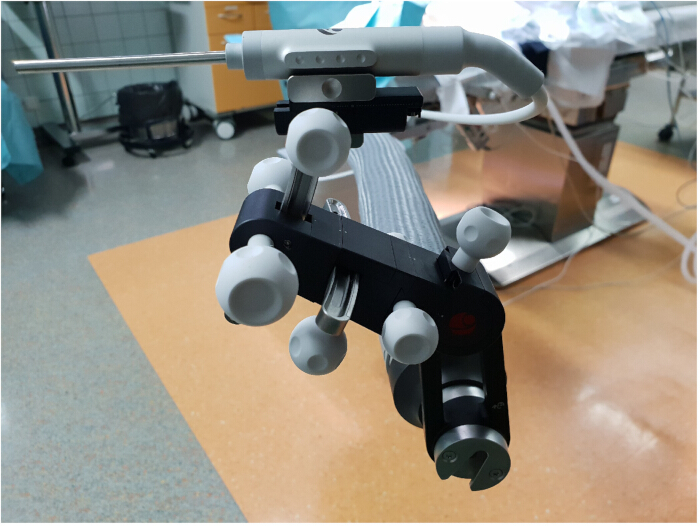
Figure 1: Setup and pre-adjustment of the OTOARM aligner before draping and placing the arm into the resting position. The aligner provides 5 mechanical degrees of freedom (2 rotational, 3 translational) for setting the insertion trajectory. More posterior longitudinal and more inferior vertical (Y-axis) positioning provides additional forward and upward latitude if needed later. Please click here to view a larger version of this figure.
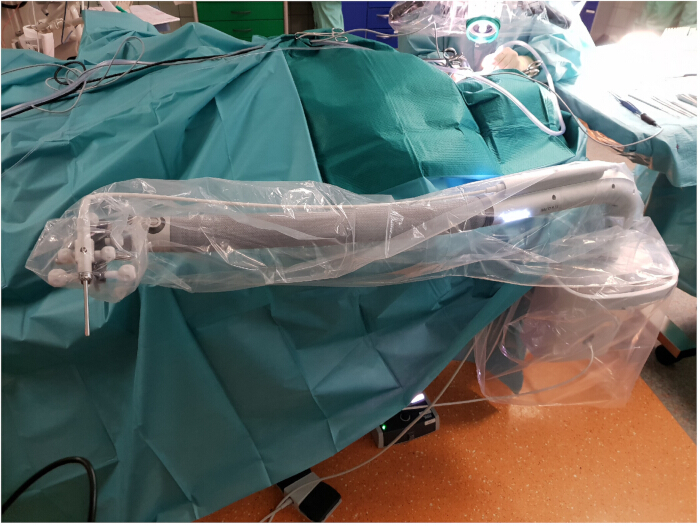
Figure 2: Robotic system draped and in resting position. The forceps are not yet mounted on the handpiece tip. In the resting position, the tip points away from the patient. Please click here to view a larger version of this figure.
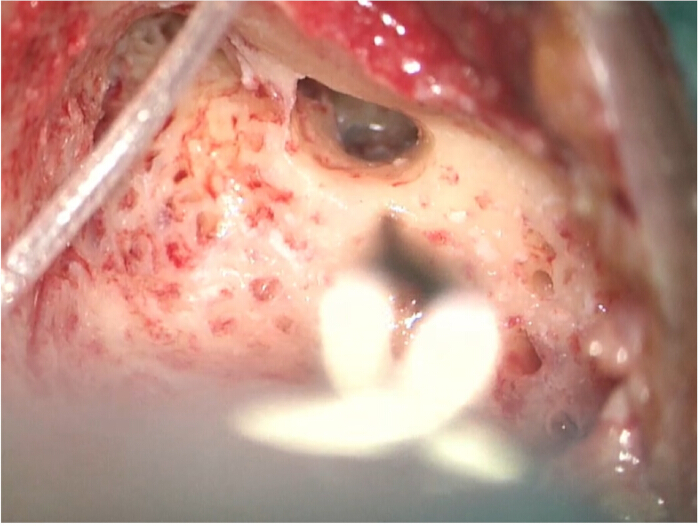
Figure 3: Wide posterior tympanotomy with the facial nerve prepared yet left with an intact protective bony shell. In the upper left, a part of the CI electrode lead is visible. Directly beneath is the short process of the incus and the buttress. This is the superior vertical limit of the posterior tympanotomy. The OTODRIVE forceps are visible (out of focus) in the center foreground, at this time still without the CI electrode mounted. Please click here to view a larger version of this figure.
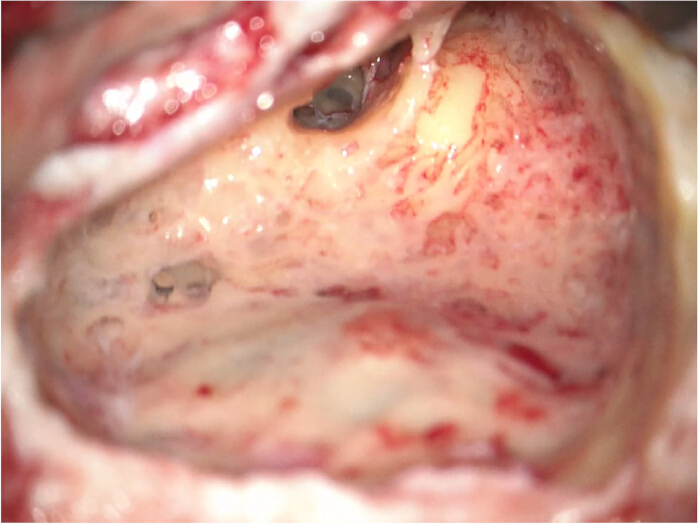
Figure 4: Preparation of the middle ear through the posterior tympanotomy with a large round window exposure. Through the large posterior tympanotomy, the bony lip over the round window membrane has been extensively removed, together with the false round window membrane. Notice the exposed stapedius muscle at the level of the pyramidal eminence, which is sometimes necessary to achieve this extended drilling at the round window site. Please click here to view a larger version of this figure.
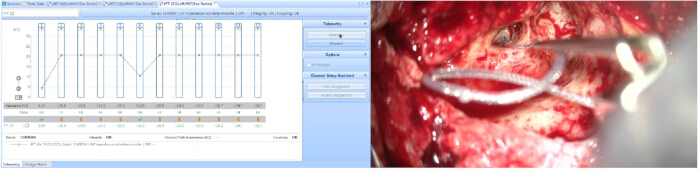
Figure 5: Electrode contact impedance measurement with the CI electrode mounted in the forceps, the round window membrane opened, and the electrode tip placed in the very entrance of the cochlea at the round window. The electric impedance of contact no. 1 is below 5 kΩ. Contact no. 6 shows an impedance of about 10 kΩ, likely due to contact with the facial recess, which is not relevant or detrimental to CMP recordings from electrode no. 1. Please click here to view a larger version of this figure.
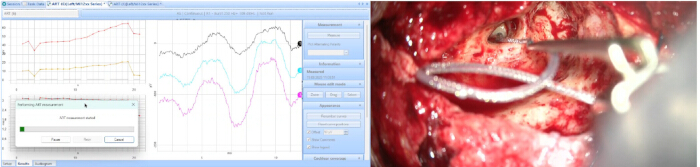
Figure 6: CMP recordings from the entry of the cochlea (round window opened) with a stimulation frequency of 250 Hz and substantial amplitudes of more than 60 µA. The upper left panel shows the development of CMP amplitudes over a time course of ca. 20 s; in red, the first harmonic (250 Hz) component, in yellow, the second harmonic (500 Hz). If required, the electrode can be held in place for an extended period with the OTODRIVE forceps. By setting the OTODRIVE to a specific numerical value (via foot pedal and in coordination with the audiologist), the electrode position can be reproduced. Please click here to view a larger version of this figure.
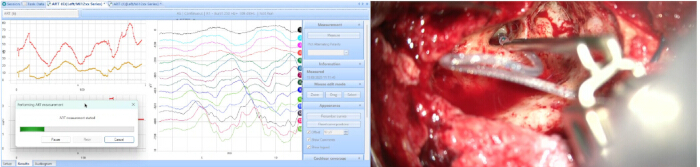
Figure 7: Continued CMP recordings during the robotic electrode insertion. This study shows measurements over a time course of ca. 190 s. On the right, the CI electrode (FLEXSoft) has almost reached its final position. During robotic insertion, manual corrections to the electrode's entrance into the cochlea, e.g., the point of entry or the insertion angle, are possible. CMP amplitudes (upper-left panel) change accordingly and were used to guide electrode placement. In the right software panel, latency increases during insertion. Also, the signal's distortion components increase. You can control insertion, holding, or retraction directly with the foot pedal. The insertion speed has to be set in the OTODRIVE control software and can be modified during insertion. However, this is possible only when the OTODRIVE is holding the position, i.e., both foot pedals are released. Please click here to view a larger version of this figure.
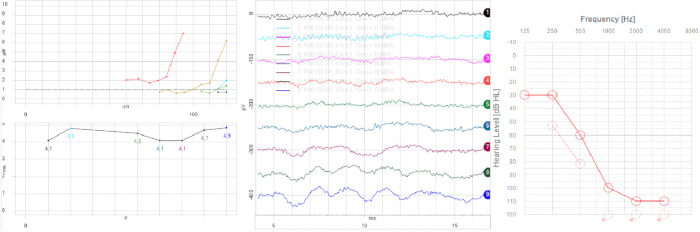
Figure 8: Postoperative CMP recordings via the CI, 12 months after implantation, using a similar foam eartip stimulation setup as during surgery. With the patient awake and possibly able to hear, mixed-frequency acoustic compound stimuli are used to estimate audiogram-like objective hearing thresholds. Stimulation levels are increased in steps (center panel), and CMPs are recorded via the CI and analyzed for the corresponding frequency components. The upper-left panel shows amplitude growth functions (AGFs), with colors encoding frequencies. Threshold values derived from the AGFs are displayed in an audiogram-like manner (right panel; dashed lines and circles are derived from CMPs; solid lines and circles show the regular preoperative pure-tone audiogram). Please click here to view a larger version of this figure.
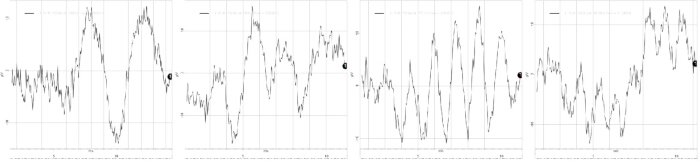
Figure 9: Individual, non-averaged frequency-specific CMP recordings via the CI 12 months after implantation. Stimulation frequencies are 250 Hz, 500 Hz, 750 Hz, and 1 kHz. The patients subjectively listened to these signals. Please click here to view a larger version of this figure.
Discussion
For the CM measurements, the acoustic stimulation signal and the CI’s recording time window are synchronized via a trigger signal24. Both the MAXbox interface and the Dataman signal generator are connected to the control computer via USB and controlled by the research-only software (see Table of Materials). For CMP recordings, this study uses the first (tip, distal) cochlear implant electrode contact, no. 1, unless specific requirements dictate otherwise25. All implants in our cases were Synchrony 2 by Med-El with different lateral wall electrode arrays: Standard, FLEXSoft, FLEX28, FLEX26, and FLEX24. In these cases, the aim was optimal cochlear coverage based on OTOPLAN cochlear duct length (CDL) estimates and the individual patient’s history of hearing loss26. In electric-acoustic stimulation (EAS) cases, electrode selection depends on the available residual acoustic frequency range and must be carefully considered by the surgeon and clinical audiologist27.
For the stimulus frequency, select the one with the best residual hearing based on the preoperative pure-tone audiogram thresholds. Most of the times this will be 250 Hz or 500 Hz. 125 Hz is possible; however, it requires longer recording time. If unclear, use 500 Hz. The stimulus level should be set to 30 dB above the preoperative pure-tone threshold at the established frequency, with a minimum of 80 dB HL. The stimulus is a pure tone burst with a default duration of 8 ms.
The robotic system OTOARM/OTODRIVE comprises a flexible mechanical arm, an electromagnetic actuator with a forceps mounted at the tip of a magnetic rod (handpiece tip), and an aligner for setting the electrode insertion trajectory28. The forceps can be moved back and forth on the handpiece tip by a foot pedal over a range of 40 mm. The speed can be set from 1.0 mm/s down to 0.1 mm/s, in 0.1 mm/s steps, and can be modified at any time during insertion. The speed is set by the surgeon and manually entered in the OTOARM steering software (Oto 1.0). For this step, an assisting person other than the surgeon is required, as well as to change the insertion speed if necessary. For faster adjustment when setting the trajectory and defining the cochlear entrance point, set this to 1.0 mm/s. For electrode insertion intended to preserve residual hearing, set this to 0.1 mm/s. For more frequent insertions, in gusher cases, or when the insertion angle is difficult, set this to 0.3 mm/s or 0.5 mm/s.
The trajectory of the forceps is set using the aligner, which has 5 degrees of freedom (3 translational, 2 rotational), and the surgeon manually adjusts it. Preset the aligner to a back-end position regarding the forward/backward axial translational freedom, thus allowing forward spare latitude. Preset the aligner to a lower-end position regarding the upward/downward translational freedom, thus allowing some upward spare latitude. The robotic system tends to let down after button release, which you can compensate for with some upward spare latitude.
Depending on the operation table, an extension rail may be helpful to mount the arm above the patient’s head (see Table of materials). As the literature indicates, CMPs do not always correlate with preoperative pure-tone audiometry results. Thus, CMP responses could not always be detected when performing intraoperative measurements. In particular, patients with poor residual hearing, e.g., higher than 80 dB HL threshold, rarely exhibit CMP responses. A necessary precondition for recording CMPs is a reliable acoustic stimulation. Proper placement of the foam eartip is crucial, and kinking of the sound delivery tube must be strictly avoided.
If during electrode insertion the CMP signal suddenly drops, consider stopping or retracting, optionally with increased speed29, about 3 electrode contacts. Ideally, the signal recovers. If the CMP signal drops moderately, you can go on, perhaps manually guiding the exact electrode angle and entrance point through the RW. Changes in CMP amplitudes may be due to changes in the proximity of the recording electrode to the generating area in the cochlea. There can be large signal variations during the measurement30. With the robotic insertion, this variation tends to be smaller than with manual insertion. Care should be taken so that the patient does not move while recording; deep anesthesia is required during the measurement and insertion procedure31.
The software currently used for CMP measurements is limited to research use only and is not approved for regular clinical application. The method for measuring CMPs is fast but also very sensitive, e.g., to electrode or patient movements. Compared with manual insertion, especially with longer recordings in a single position, the robotic arm helps stabilize the electrode, resulting in fewer movement artifacts. However, artifacts can still occur, for instance, when guiding the electrode insertion with a claw. In cases where the robotic insertion stalls, e.g., due to a gusher or an unexpected anatomical peculiarity, the surgeon can always take over and immediately revert to manual insertion.
A difficulty in interpreting CMPs lies in multiple possible causes for changes. Stimulating with an acoustic pure tone activates a specific region that generates the CMPs. The extent of this region depends on the level of stimulation. Also, the CMP amplitude depends on hair cell survival. When inserting the recording electrode into the cochlea, mechanical damping of the basilar membrane and a decrease in CMP amplitude may occur. However, decreasing amplitudes can also be caused by inserting past this region, thereby increasing the distance from the generating area. Observing the morphology, e.g., the amplitudes of the 2nd and higher harmonics, and the phase shift, may help in interpreting CMPs.
The technique only guides toward structure and hearing preservation, but obviously does not guarantee it. It should be viewed as one component of a more complex approach in this direction. The robotic insertion also standardizes the insertion process to some degree. However, as every cochlea is different, manual guidance, the experienced human eye, and the surgeon’s decisions remain indispensable.
The method combines existing techniques but offers additional benefits not previously available. Recording of CMPs was already possible using commercially available clinical ECochG recording machines. Recording via the implant is provided by the major CI manufacturers and uniquely allows measuring in close proximity to the CMP generating region24. Robotic insertions have also been described before32, but in this context, they allow the CI electrode to be kept stable in any given state of insertion and perform extensive CMP recordings when required. The slow insertion increases the chance of hearing and structure preservation. A speed of down to 0.1 mm/s is utterly impossible to achieve with manual insertion only.
Currently, during insertion, there is still a latency between the insertion and feedback on CMP changes, whether verbal from the audiologist or via a picture-in-picture visualization. With robotic insertion, a direct automated effect of CMP changes on insertion progress or speed would, in principle, be possible. However, such decision-making processes by the robotic system need to be firmly grounded in sufficient clinical research, which is not yet available. By using drug-eluting electrodes, residual acoustic hearing may be better preserved over time, allowing more and larger CMPs to be observed at 6 months or later. This way, hearing preservation with long electrodes may become more likely. Using computer-based models to determine the optimal trajectory for the robotic arm system and evaluating the electrode by its possible cochlear position rather than its length may offer further benefits.
Disclosures
The authors declare that they have clinically initiated research projects that are partially funded by Med-El Germany. The first author, IB, who is the surgeon in this study, is married to the last author, SB, who performed the intraoperative measurements and operated the robotic arm together with SH. Both SH and SB are employees of Med-El Germany. The manuscript was prepared by IB and SB with proofreading by SD. The research-use-only version of the clinical fitting software presented here is not yet approved for clinical use, either diagnostic or therapeutic. We used this software solely in a research context to investigate the effects of various surgical steps, such as opening the round window membrane, on CMPs.
Acknowledgements
We thank Joe Guerin for proofreading the manuscript.
Materials
| Name | Company | Catalog Number | Comments |
|---|---|---|---|
| AWG Dataman 530 Type: 531 | Dataman, UK | Acoustic signal wave generator | |
| Computer | X13 Yoga, Lenovo | Regular state of the art notebook Intel or AMD > 1.5 GHz, > 8 GB RAM, MS Windows system | |
| Gauze balls | Nobamed | 877020 | Sterile, 3 cm diameter |
| Electrode array | Med-El | E.g. Standard, FLEXSoft, FLEX28, FLEX26 and FLEX24 | |
| external transmitter coil | Med-El | ||
| insert earphone | ER-3C, Etymotic, USA) | 2-61000179 | Connected to a sound delivery tube and foam eartip |
| Maestro | Med-El | Control software for fitting of CI, measuring electrode contact impedances, CAPs etc. | |
| MAXbox interface | Med-El | Connects to the CI via the external transmitter coil | |
| Octeniderm farblos | schülke | 118211 | Colourfree skin antiseptic solution |
| software research-only version (9.0) | Med-El | Controlled by a research-only version (9.0) of the clinical CI fitting software MAESTRO 9.0.3 (Med-El, Innsbruck, Austria) | |
| Xylonest 1% | aspen | diff. providers | Local anesthetic |
| Drapes for OTOARM/OTODRIVE | Med-El | ||
| OTOARM and aligner | Med-El | Mechanical part of the system | |
| OTODRIVE with forceps and foot pedal | Med-El | Active part of the system | |
| Software | Med-El | Speed control | |
| Table extension | Maquet, Getinge AB, Stockholm, Sweden | diff. providers |
References
- Pickles, J. An introduction to the physiology of hearing. , Emerald Publishing. Leeds, UK. (2014).
- Tasaki, I., Davis, H., Eldredge, D. H. Exploration of cochlear potentials in guinea pig with a microelectrode. Journal of the Acoustical Society of America. 26, 765-773 (1954).
- Honrubia, V., Ward, P. H. Longitudinal distribution of the cochlear microphonics inside the cochlear duct (guinea pig). Journal of the Acoustical Society of America. 44, 951-958 (1968).
- Forgues, M., et al. Distinguishing hair cells from neural potentials recorded at the round window. Journal of Neurophysiology. 111 (3), 580-593 (2014).
- Cumpson, E., Totten, D. J., Hohman, M. H. Electrocochleography. , StatPearls Publishing LLC. Treasure Island, USA. (2025).
- Gibson, W. P. The clinical uses of electrocochleography. Frontiers in Neuroscience. 11, 274(2017).
- De Siati, R. D., et al. Auditory neuropathy spectrum disorders: from diagnosis to treatment: literature review and case reports. Journal of Clinical Medicine. 9 (4), 1074(2020).
- Ruben, R. J., Bordley, J. E., Lieberman, A. T. Cochlear potentials in man. Laryngoscope. 71, 1141-1164 (1961).
- Adunka, O., Roush, P., Grose, J., Macpherson, C., Buchman, C. A. Monitoring of cochlear function during cochlear implantation. Laryngoscope. 116 (6), 1017-1020 (2006).
- Calloway, N., et al. Intracochlear electrocochleography during cochlear implantation. Otology & Neurotology. 35 (8), 1451-1457 (2014).
- Campbell, I., Kaicer, A., Briggs, R., O’Leary, S. Cochlear response telemetry: intracochlear electrocochleography via cochlear implant neural response telemetry pilot study results. Otology & Neurotology. 36 (3), 399-405 (2015).
- Bester, W. C., Campbell, L., Dragovic, A., Collins, A., O’Leary, S. J. Characterizing electrocochleography in cochlear implant recipients with residual low-frequency hearing. Frontiers in Neuroscience. 11, 141(2017).
- O’Leary, S., et al. Monitoring cochlear health with intracochlear electrocochleography during cochlear implantation: findings from an international clinical investigation. Ear and Hearing. 44 (2), 358-370 (2023).
- Gifford, R. H., et al. Cochlear implantation with hearing preservation yields significant benefit for speech recognition in complex listening environments. Ear and Hearing. 34 (4), 413-425 (2013).
- Lenarz, T., et al. European multi-center study of the Nucleus Hybrid L24 cochlear implant. International Journal of Audiology. 52 (12), 838-848 (2013).
- Loiselle, L. H., Dorman, M. F., Yost, W. A., Cook, S. J., Gifford, R. H. Using ILD or ITD cues for sound source localization and speech understanding in a complex listening environment by listeners with bilateral and with hearing-preservation Cochlear Implants. Journal of Speech, Language, and Hearing Research. 59 (4), 810-818 (2016).
- Gifford, R. H., Stecker, G. C. Binaural cue sensitivity in cochlear implant recipients with acoustic hearing preservation. Hearing Research. 390, 107929(2020).
- Mangan, A. R., et al. Assessing patient barriers to cochlear implantation. Otology & Neurotology. 43 (10), e1090-e1093 (2022).
- Rajan, G. P., Kontorinis, G., Kuthubutheen, J. The effects of insertion speed on inner ear function during cochlear implantation: a comparison study. Audiology and Neurotology. 18 (1), 17-22 (2013).
- Nguyen, S., et al. Outcomes review of modern hearing preservation techniques in cochlear implants. Auris Nasus Larynx. 43 (5), 485-488 (2016).
- Barriat, S., Peigneux, N., Duran, U., Camby, S., Lefebvre, P. P. The use of a robot to insert an electrode array of cochlear implants in the cochlea: a feasibility study and preliminary results. Audiology and Neurotology. 26 (5), 361-367 (2021).
- Miroir, M., et al. Friction force measurement during cochlear insertion: application to a force-controlled insertion tool design. Otology & Neurotology. 33 (6), 1092-1100 (2012).
- Aebischer, P., Anschuetz, L., Caversaccio, M., Mantokoudis, G., Weder, S. Quantitative in vitro assessment of a novel robot-assisted system for cochlear implant electrode insertion. International Journal of Computer Assisted Radiology and Surgery. 20 (2), 323-332 (2024).
- Schuerch, K., et al. Performing intracochlear electrocochleography during cochlear implantation. Journal of Visualized Experiments. (181), e63153(2022).
- Kim, J. -S. Electrocochleography in cochlear implant users with residual acoustic hearing: a systematic review. International Journal of Environmental Research and Public Health. 17 (19), 7043(2020).
- Timm, M. E., et al. Patient-specific selection of lateral wall cochlear implant electrodes based on anatomical indication ranges. PLoS One. 13 (10), e0206435(2018).
- Van de Heyning, P., Kleine Punte, A. Electric acoustic stimulation: a new era in prosthetic hearing rehabilitation. Advances in Oto-Rhino-Laryngology. 67, 1-5 (2010).
- Oetiker, Y., et al. Hearing preservation outcomes with motorized cochlear implant electrode insertion: matched-cohort observations. Frontiers in Surgery. 12, 1700744(2025).
- Eichler, T., et al. Impact of two visualization methods for electrocochleographic potentials on hearing and vestibular function during cochlear implantation. Otology & Neurotology. 46 (4), e98-e104 (2025).
- Fontenot, T. E., et al. Residual cochlear function in adults and children receiving cochlear implants: correlations with speech perception outcomes. Ear and Hearing. 40 (3), 577-591 (2019).
- Brill, I. T. Effect of round window opening on cochlear microphonics in humans. XII Hearing and Structure Preservation Workshop, October 23-25, Niagara Falls, Canada, , (2025).
- Caversaccio, M., et al. Robotic cochlear implantation for direct cochlear access. Journal of Visualized Experiments. (184), e64047(2022).
Reprints and Permissions
This article has been published
Video Coming Soon