This protocol describes a visual assay using split Broccoli RNA reporters to detect and quantify intermolecular base pairing in RNA clusters in vitro.
Method Article
Visualization and Quantification of Intermolecular RNA Base Pairing in in vitro RNA Clusters Using Split Broccoli RNA Reporters
In This Article
Summary
Abstract
RNA clustering, driven by multivalent intermolecular RNA–RNA interactions, can occur in vitro in the absence of proteins. While chemical probing and computational simulations have been used to predict these interactions, methods for directly assessing intermolecular base pairing in RNA clusters remain limited. This study presents a visual assay based on split Broccoli RNA reporters conjugated to fluorescently labeled RNAs of interest. The assay enables the detection and quantification of intermolecular base pairing in RNA clusters. The split Broccoli system contains complementary reporter sequences that dimerize to form the Broccoli RNA aptamer. The resulting dimerized RNA structure binds DFHBI-1T, a fluorophore that emits green fluorescence upon binding. Upon RNA clustering, the appearance of green fluorescence reports base pairing mediated by the complementary reporter sequences among the RNAs of interest. Measurement of DFHBI-1T fluorescence enables quantitative assessment of how in vitro RNA clustering conditions influence intermolecular base pairing between these reporter sequences.
Introduction
In vitro transcribed RNAs can self-assemble into visible clusters upon the addition of salts and molecular crowding reagents1,2,3,4,5. Notably, these RNA clusters can form in the absence of other cellular components, including proteins, indicating that under specific conditions, intermolecular RNA–RNA interactions are sufficient to drive RNA condensation in vitro.
Among the various types of intermolecular RNA–RNA interactions, intermolecular base pairing has received substantial attention in the condensate field1,2,4,6,7,8,9,10. These interactions can be driven by exposed complementary sequences (“zipcodes”) between transcripts, as demonstrated by co-clustering of BNI1 and SPA2 mRNAs in the filamentous fungus Ashbya gossypii2 or oligomerization of oskar mRNA in Drosophila melanogaster 6,7. Alternatively, intermolecular base pairing can be promoted by remodeling of RNA secondary structures, exposing complementary sequences that are otherwise structurally embedded. This mechanism has been observed in repeat RNAs in silico9 and guanidine riboswitches in vitro10. Both exposed complementary sequences and RNA structural remodeling can be measured using chemical probing11,12 or simulation approaches4,9,13,14. However, methods that directly visualize intermolecular base pairing in in vitro RNA clustering assays remain limited.
RNA pull-down assays using base-pairing crosslinkers15,16,17and gel electrophoresis4,6,7are commonly used to study intermolecular RNA base pairing in vitro. However, these methods lack the spatial resolution to distinguish base pairing within clusters from that outside them. Moreover, isolating RNA clusters for downstream analysis is technically challenging, as it requires preservation of cluster stability while ensuring buffer compatibility with subsequent assays.
A visual assay based on split Broccoli RNA reporters18 conjugated to fluorescently labeled RNAs of interest has previously been employed to enable direct detection of intermolecular base pairing during RNA condensation in vitro4. In this context, the split Broccoli system reports on the likelihood of intermolecular interactions between reporters or between RNAs carrying them under defined in vitro clustering conditions. Thus, the assay probes how sequence context and environmental factors influence the propensity for intermolecular base pairing within an RNA cluster-like environment.
The split Broccoli system consists of two complementary RNA sequences, top and bottom, that dimerize to reconstitute the Broccoli RNA aptamer (Figures 1A–C)18. Upon dimerization, the aptamer binds the fluorophore DFHBI-1T, resulting in green fluorescence (Figures 1A–C)18. Using this system, the extent of intermolecular base pairing between reporter complementary sequences within RNA clusters is shown to depend on RNA folding. By comparing the ratio of DFHBI-1T fluorescence to RNA levels across different experimental conditions, the influence of in vitro conditions on reporter-mediated intermolecular base pairing within RNA clusters can be quantitatively assessed.
This assay complements RNA pull-down and gel electrophoresis approaches for studying intermolecular base pairing in RNA clusters. However, robust signal detection may require molecular crowding reagents, and sensitivity is limited by the efficiency of dimerization and folding of the split Broccoli top and bottom RNAs.
Protocol
This protocol provides a step-by-step method for implementing this assay and discusses its applications. The reagents and equipment used are listed in the Table of Materials.
1. Preparation of DNA templates for in vitro RNA transcription
- Append a T7 promoter sequence to the 5′ end of each DNA template containing the split Broccoli aptamer sequences for in vitro RNA transcription. Use the split Broccoli aptamer sequences (top and bottom) alone or insert them at any position downstream of the T7 promoter, with or without an additional RNA sequence of interest.
NOTE: The sequences for the T7 promoter, split Broccoli reporters, and primers used to amplify the DNA templates are listed in Table 1.
NOTE: T7 RNA polymerase strongly prefers to initiate transcription with a “G” at the +1 position. The presence of additional Gs immediately downstream at the +2 and +3 positions can increase transcription yield19. However, when the downstream sequence begins with G, as in the top and bottom constructs that begin with two Gs, transcription can initiate at different positions20. As a result, transcripts may carry one, two, or three Gs at the 5′ end (e.g., GATCC, GGATCC, or GGGATCC), which may affect the interpretation of base pairing in the designed constructs. - Use commercially synthesized gene blocks, plasmids, or DNA fragments as templates for PCR. If the original template does not contain a T7 promoter, use a forward primer with a 5′ T7 promoter overhang together with the appropriate reverse primer.
- Prepare a 50 µL PCR reaction in a 200 µL PCR tube containing 2.5 µL each of 10 µM forward and reverse primers, 20 ng DNA template, 25 µL 2× high-fidelity master mix, and nuclease-free water. Mix thoroughly by pipetting up and down and centrifuge at 2,000 × g for 2 s.
- Run the PCR reaction in a thermal cycler using the following program: 98 °C for 30 s (1 cycle); 98 °C for 10 s, optimized annealing temperature for 30 s, and 72 °C for 30 s per kilobase (35 cycles); 72 °C for 2 min (1 cycle).
NOTE: Determine the optimized annealing temperature using an online tool such as a Tm calculator. PCR products may be stored at 4 °C after completion. - Mix 2 µL PCR product with 8 µL nuclease-free water and 2 µL 6× loading dye. Load the mixture onto a 1% agarose gel for electrophoresis.
NOTE: The PCR product should appear as a single band. If multiple bands are observed, excise the correct band and purify it using a gel extraction kit before proceeding. - Purify the PCR product or gel-extracted DNA using a DNA purification kit and elute in 20–30 µL nuclease-free water into a 1.5 mL microcentrifuge tube.
- Measure DNA concentration and purity using a microvolume spectrophotometer. Ensure that A260/A280 is approximately 1.8 and A260/A230 is greater than 2.0.
NOTE: If A260/A230 is below 2.0, perform an additional purification step. - Store the DNA template at −20 °C until use.
2. Preparation of in vitro RNA transcription reaction
- Wipe the working surface, tube racks, and pipettes with RNase decontamination solution. Use RNase-free, filtered tips.
- Thaw reaction buffer and nucleotide solutions (ATP, CTP, GTP, UTP) supplied with the T7 transcription kit, along with UTP-Cy5, on ice. Centrifuge all tubes at 2,000 × g for 2 s prior to use.
NOTE: Protect UTP-Cy5 from light. - Calculate the number of thymine bases in the DNA template (excluding the T7 promoter) and determine the required volumes of UTP and UTP-Cy5 for a 20 µL transcription reaction. Maintain consistent labeling density across RNA species.
NOTE: For example, to label an RNA containing 100 uracil bases with approximately three Cy5-labeled uracils, add 4.5 µL of 1 mM UTP-Cy5 and 1.9 µL of 75 mM UTP. - Prepare a 20 µL transcription reaction by combining 2 µL each of ATP, CTP, and GTP, calculated volumes of UTP (all supplied with the kit) and UTP-Cy5, 2 µL 10× reaction buffer, 2 µL enzyme mix, 200 ng DNA template, and nuclease-free water. Mix thoroughly by pipetting up and down and centrifuge at 2,000 × g for 2 s.
- Incubate the reaction at 37 °C for 6 h.
- Add 1 µL DNase supplied with the kit. Mix thoroughly by pipetting up and down and centrifuge at 2,000 × g for 2 s.
- Incubate at 37 °C for an additional 15 min.
- Transfer the reaction (~20 µL) to a 1.5 mL tube. Add 115 µL nuclease-free water and 15 µL ammonium acetate stop solution supplied with the kit. Mix thoroughly by pipetting up and down and centrifuge at 2,000 × g for 2 s.
NOTE: A commercial RNA purification kit may be used instead of Steps 2.9–3.7. - Add 150 µL phenol/chloroform and mix gently.
CAUTION: Handle phenol/chloroform in a chemical fume hood. - Centrifuge at 16,000 × g for 10 min at 4 °C.
- Transfer the upper aqueous phase to a new tube.
NOTE: Avoid disturbing the interphase; the lower layer may appear blue due to unincorporated dye. - Add an equal volume of chloroform and mix thoroughly.
CAUTION: Handle chloroform in a chemical fume hood. - Centrifuge at 16,000 × g for 2 min at 4 °C.
- Repeat Steps 2.11–2.13.
- Transfer the aqueous layer (~100–150 µL) to a new tube. Add 900 µL isopropanol and mix thoroughly.
- Aliquot into three equal volumes in separate tubes.
NOTE: Each aliquot is sufficient for multiple RNA clustering reactions. - Store at −20 °C overnight or up to one month.
3. Purification of in vitro transcribed RNA
- Centrifuge the RNA sample in isopropanol at 16,000 × g for 15 min at 4 °C.
- Carefully remove the isopropanol without disturbing the RNA pellet.
- Add 1 mL of 70% ethanol prepared in nuclease-free water.
- Centrifuge at 16,000 × g for 2 min at 4 °C.
- Remove the ethanol and repeat Steps 3.3–3.4.
- During the final ethanol wash, remove most of the ethanol using a 1000 µL pipette. Briefly centrifuge at 2,000 × g for 2 s in a benchtop minicentrifuge and remove any remaining ethanol using a 20 µL pipette.
- Air-dry the RNA pellet for 1–2 min at room temperature (RT).
- Resuspend the RNA pellet in 20 µL nuclease-free water. Keep the sample on ice and protect it from light.
- Measure RNA concentration and purity using a microvolume spectrophotometer. Ensure that A260/A280 is approximately 2.0 and A260/A230 is greater than 2.0.
4. Preparation of in vitro RNA clustering reaction
NOTE: In this protocol, induction of RNA clustering requires spermine and PEG 8000, based on previous studies2,4,5. Specifically, a 100 mM spermine tetrahydrochloride stock solution prepared in nuclease-free water was aliquoted into multiple 1.5 mL microcentrifuge tubes and stored at −20 °C.
- Thaw a tube of 100 mM spermine solution and 50% PEG 8000 on ice.
NOTE: After opening, 50% PEG 8000 should be used for no longer than two months due to potential degradation. - To prepare 500 µL freshly made 10× RNA refolding buffer, combine 50 µL 2M KCl, 50 µL 1M MgCl2, 50 µL 1M Tris (pH 7.0), and 350 µL nuclease-free water. Mix thoroughly by pipetting up and down. Centrifuge at 2,000 × g for 2 s in a benchtop minicentrifuge.
NOTE: The refolding buffer should be prepared on the day of the RNA clustering experiment.
NOTE: Steps 4.3-4.4 depend on the experimental conditions and may be adjusted as needed. Two example conditions for RNA clustering used in this study are described below. The co-folding condition is adapted from a method used to anneal antisense oligonucleotides to RNA2. In this method, RNAs are mixed in a salt buffer and heated together to promote intermolecular base pairing between RNAs carrying complementary sequences. In contrast, for the separate folding condition, each RNA is folded individually prior to mixing. This condition is intended to approximate a cellular scenario in which RNAs are folded prior to interacting. - Co-folding
NOTE: This condition promotes intermolecular base pairing between RNAs containing the top and bottom sequences. It serves as a positive control for reporter-driven intermolecular base pairing under the RNA clustering condition.- In a 200 µL PCR tube, combine 16 pmol of each in vitro transcribed RNA carrying either top or bottom sequence, 2 µL of 10× refolding RNA buffer, and nuclease-free water to a final volume of 14 µL. Mix thoroughly by pipetting up and down. Centrifuge at 2,000 × g for 2 s in a benchtop minicentrifuge.
NOTE: To calculate the RNA mass corresponding to 16 pmol. - Heat the RNA sample at 90 °C for 2 min.
- Immediately transfer the sample to RT and protect it from light. Incubate the reaction at RT for 1 h.
- In a 200 µL PCR tube, combine 16 pmol of each in vitro transcribed RNA carrying either top or bottom sequence, 2 µL of 10× refolding RNA buffer, and nuclease-free water to a final volume of 14 µL. Mix thoroughly by pipetting up and down. Centrifuge at 2,000 × g for 2 s in a benchtop minicentrifuge.
- Separate folding
- Heat the RNA sample at 90 °C for 2 min and then immediately place it on ice for at least 15 min.
- In a 200 µL PCR tube, combine 16 pmol of in vitro transcribed RNA carrying either top or bottom sequence, 1 µL of 10× refolding RNA buffer, and nuclease-free water to a final volume of 7 µL.
NOTE: To calculate the RNA mass corresponding to 16 pmol. - Incubate the reaction at RT for 30 min, protected from light.
- Combine the RNA samples containing the top and bottom sequences into a single PCR tube. Mix thoroughly by pipetting up and down. Centrifuge at 2,000 × g for 2 s in a benchtop minicentrifuge. Incubate at RT for 30 min.
- Add 6 µL of a 1:2 (v/v) premix of 100 mM spermine and 50% PEG 8000. Mix thoroughly by pipetting up and down. Centrifuge at 2,000 × g for 2 s in a benchtop minicentrifuge.
NOTE: 50% PEG 8000 is highly viscous. Pipette slowly and carefully. - Add 2 µL of 1 mM DFHBI-1T to the reaction. Mix thoroughly by pipetting up and down. Centrifuge at 2,000 × g for 2 s in a benchtop minicentrifuge. The reaction should appear yellow-green.
NOTE: To prepare a 20 mM DFHBI-1T stock solution from 1 mg of DFHBI-1T (MW: 320.21) lyophilized dye, add 156 µL of molecular biology-grade anhydrous DMSO. Aliquot the stock in small amounts in multiple microcentrifuge tubes and store in -20 °C. Avoid repetitive freeze-thaw cycles for the dye. Prepare a freshly diluted 1 mM DFHBI-1T working solution by diluting the 20 mM stock in nuclease-free water and storing it on ice. - Load the reaction into a glass chambered coverglass.
- Incubate the chamber at RT for 4 h in the dark with the cover on to minimize evaporation.
5. Preparing for imaging
- Acquire three-dimensional images using a structured illumination or confocal microscope equipped with appropriate lasers and objectives.
NOTE: Confocal microscopy is required to minimize out-of-focus light. - Configure the microscope to image each region of interest (ROI) with the Cy5 channel first at each z-plane, followed by imaging the same ROI using the GFP channel.
- Set exposure time to 500 ms for all channels. Set laser power to 80% for GFP and 40% for Cy5.
- Image a coverslip region outside the reaction droplet at RT using a z-step size of 150 nm.
6. Quantification of intermolecular base pairing
- Import images into image analysis software21. Identify GFP (DFHBI-1T) and Cy5 (RNA) channels.
- Draw a 5 × 5 pixel ROI within an RNA cluster and measure integrated density for both channels at the same z-plane. Select 5–8 ROIs from different RNA clusters in each image.
NOTE: Adjust ROI size depending on camera setup, but maintain consistency across experiments. - Select 5–8 ROIs outside the reaction droplet for background measurement and calculate the average integrated density for both channels.
- Calculate normalized DFHBI-1T intensity for each ROI using:

7. Common problems and troubleshooting
- If no RNA pellet is observed after centrifugation, consider RNA degradation, insufficient transcription time, inactive polymerase, residual salts, or low RNA concentration. Use RNase-free reagents, extend transcription time, use fresh enzyme, and purify templates.
- If no Cy5-labeled RNA clusters are observed, consider RNA degradation or degraded PEG 8000 or UTP-Cy5. Use fresh reagents and RNase-free conditions.
- If no DFHBI-1T signal is observed under co-folding conditions, consider poor dye quality, lack of Broccoli structure formation, or truncated transcripts. Use fresh dye, ensure proper buffer composition, and verify transcript size by gel analysis.
- If fluorescence signal bleaches, reduce laser power and exposure time, minimize imaging steps, and protect samples from light during incubation.
Results
In this demonstration experiment, the ability of the top and bottom RNA reporters alone to base pair and form the Broccoli structure was first evaluated using the previously described in vitro RNA clustering protocol4. Base pairing between top and bottom generates two Broccoli arms, each capable of intercalating one DFHBI-1T molecule (Figures 1A–C)18,22.
Upon induction of RNA clustering with spermine and PEG 8000, both RNAs formed clusters either individually or together (Figures 1D–Eii). When top or bottom RNAs were examined in isolation, DFHBI-1T fluorescence within RNA clusters was substantially lower than in the co-folding condition, in which the two RNAs were combined prior to heat denaturation and refolding (Figure 1F). In the co-folding condition, the molar ratio of DFHBI-1T (0.1 mM) to top (0.8 µM) and bottom (0.8 µM) was estimated to be 125:1:1. This corresponds to an approximately 62.5-fold excess of DFHBI-1T relative to the maximum number of potential Broccoli structures.
The low but non-zero DFHBI-1T signal observed for top and bottom alone is consistent with previous reports showing minimal DFHBI-1T fluorescence when each reporter is expressed individually18. DFHBI-1T also exhibited very low but detectable background fluorescence in the absence of RNA (Figure 1F). Together, these results demonstrate that DFHBI-1T is compatible with the in vitro RNA clustering assay and that co-folding enhances intermolecular base pairing between top and bottom RNAs.
After normalization to RNA intensity, the normalized DFHBI-1T fluorescence intensity in the co-folding condition reached 1.03, which was significantly higher than that of top and bottom alone (0.054 and 0.023, respectively) (Figure 1D, Figure 1Ei, and Figure 1F). RNA clusters formed by mixing top and bottom RNAs that were folded separately prior to clustering were then examined (Figure 1D, Figure 1Eii, and Figure 1F). In this separate folding condition, the normalized DFHBI-1T signal was 0.031, comparable to baseline levels observed in the negative controls (top or bottom alone) (Figure 1F). These results indicate that co-folding promotes intermolecular base pairing between top and bottom RNAs, whereas separate folding restricts such interactions.
The top and bottom sequences were next inserted into the 3′ untranslated region (UTR) of Drosophila melanogaster shutdown (shu), a germ granule mRNA4,23,24, and its antisense counterpart (shuanti). The shu 3′ UTR was selected because previous work demonstrated that this RNA predominantly exists as a monomer in Drosophila melanogaster and does not dimerize even at high molar concentrations in RNA gel assays4,24. In addition, shu-top and shu-bottom do not form homodimers in RNA gels4, allowing more direct assessment of intermolecular interactions between top and bottom and the influence of flanking sequences derived from shu.
The DNA templates for shu-top, shu-bottom, shuanti-top, and shuanti-bottom are listed in Table 2. The top and bottom sequences were inserted into the middle of the shu or shuanti 3′ UTR, requiring structural remodeling to facilitate interaction and better mimic physiological RNA–RNA interactions, in which interacting regions are typically embedded within transcripts4.
Upon induction of RNA clustering, shu-top, shu-bottom, shuanti-top, and shuanti-bottom individually exhibited minimal DFHBI-1T fluorescence, similar to top and bottom alone (Figures 2A and 2B). Consistently, co-folding of shu-top with shu-bottom or shuanti-top with shuanti-bottom produced higher DFHBI-1T signal than separate folding (Figures 2Ci and Cii). After normalization to RNA intensity and negative controls (defined as the average normalized DFHBI-1T signal from each RNA alone), co-folding of shu-top and shu-bottom resulted in a 5.63-fold increase in normalized DFHBI-1T fluorescence (Figures 2Di and 2Dii). In contrast, separate folding showed only a 1.04-fold increase, comparable to baseline levels observed for shu-top and shu-bottom individually. Similar trends were observed for shuanti-top and shuanti-bottom under co-folding and separate folding conditions (Figures 2Di and 2Dii). These results indicate that separate folding does not promote intermolecular base pairing between shu-top and shu-bottom or shuanti-top and shuanti-bottom, whereas co-folding enhances these interactions, likely due to the inserted reporter sequences.
To test whether shu and shuanti can base pair, shu-top was mixed with shuanti-bottom, and shuanti-top was mixed with shu-bottom. Both combinations exhibited higher DFHBI-1T fluorescence under both co-folding and separate folding conditions compared to shu-top with shu-bottom or shuanti-top with shuanti-bottom (Figures 2Ci and 2Cii). After normalization, co-folding of shu-top with shuanti-bottom and shuanti-top with shu-bottom resulted in 61.86- and 82.60-fold increases in DFHBI-1T fluorescence, respectively (Figures 2Di and 2Dii). In contrast, separate folding yielded only 2.69- and 4.94-fold increases, respectively (Figures 2Di and 2Dii). Although substantially lower than under co-folding conditions, these values were higher than those observed for shu-top with shu-bottom or shuanti-top with shuanti-bottom (1.04 and 1.16, respectively).
Together, these results indicate that reporters carrying additional complementary sequences have a greater capacity to base pair than those without such sequences. This effect is further enhanced under the co-folding condition, which promotes intermolecular interactions.
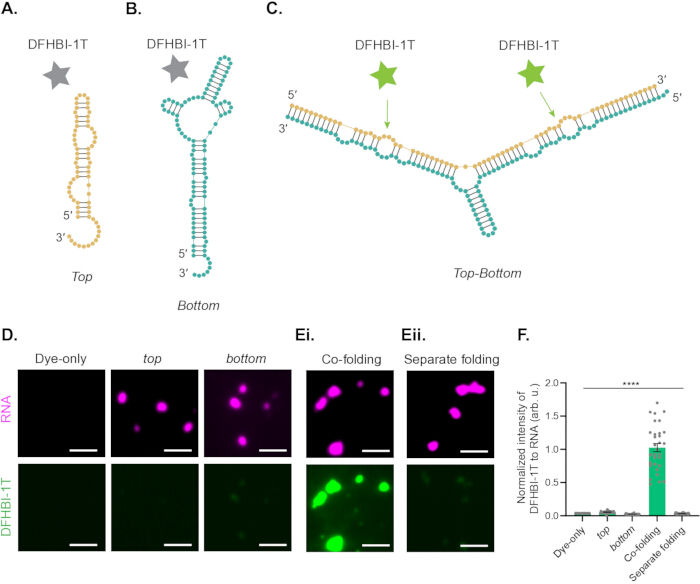
Figure 1: Predicted secondary structures of top and bottom RNAs and quantification of their intermolecular base pairing in in vitro RNA clusters. (A–B) Examples of secondary structures of top (A) and bottom (B) folded individually, as predicted by RNAfold25. When folded separately, top and bottom do not reconstitute the Broccoli aptamer, and DFHBI-1T (gray star) produces minimal fluorescence. (C) Example of the secondary structure of base-paired top and bottom RNAs, as predicted by RNAcofold25. Intermolecular base pairing between the two RNAs reconstitutes two Broccoli arms18, enabling DFHBI-1T binding and resulting in strong green fluorescence (green stars). (D) Images of DFHBI-1T alone (dye-only control) and in vitro RNA clusters (magenta) formed by top and bottom RNAs in the presence of DFHBI-1T (green). (Ei, ii) In vitro RNA clusters (magenta) formed by top and bottom RNAs under co-folding (i) and separate folding (ii) conditions in the presence of DFHBI-1T (green). For panels D and E, RNAs were labeled with Cy5 such that, on average, approximately one-third of RNAs contain a single Cy5-labeled uracil, while the remaining two-thirds are unlabeled. Images represent average Z-projections of 27 slices acquired with a 150 nm step size, using the same exposure and laser power for each channel across all conditions. DFHBI-1T fluorescence was normalized to the same intensity range across conditions. Scale bars: 2 µm. (F) DFHBI-1T intensity was normalized to RNA abundance, as measured by Cy5 fluorescence. Data are presented as mean ± SEM. P-values for two-tailed t-test (**** vs. co-folding): 1.0 × 10⁻22 (dye-only), 2.3 × 10⁻22 (top), 4.9 × 10⁻23 (bottom), and 7.0 × 10⁻23 (separate folding). n = 30 regions for the dye-only condition and 30–31 RNA clusters for all other conditions. Please click here to view a larger version of this figure.
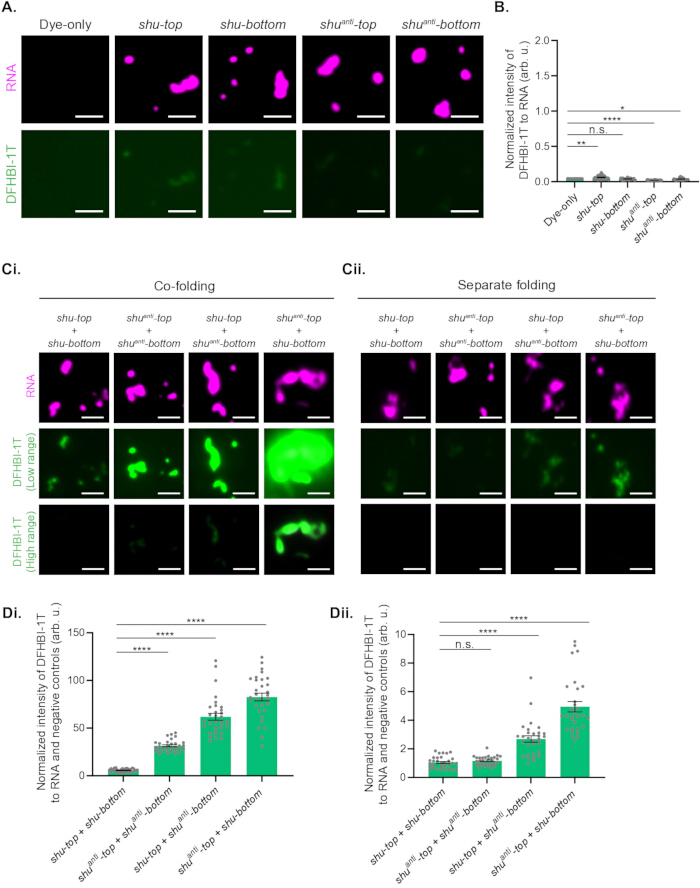
Figure 2: Representative images and quantification of intermolecular base pairing for shu and shuanti carrying top and bottom reporters. (A) Images of DFHBI-1T alone (dye-only control) and in vitro RNA clusters (magenta) formed by shu-top, shu-bottom, shuanti-top, and shuanti-bottom RNAs in the presence of DFHBI-1T (green). RNAs were labeled with Cy5 such that, on average, three UTP-Cy5 uracils were incorporated during in vitro transcription. Images represent average Z-projections of 27 slices acquired with a 150 nm step size, using the same exposure and laser power for each channel across all conditions. DFHBI-1T fluorescence was normalized to the same intensity range across conditions. Scale bars: 2 µm. (B) DFHBI-1T intensity was normalized to RNA abundance, as measured by Cy5 fluorescence. Data are presented as mean ± SEM. n.s., not significant. P-values for two-tailed t-test (vs. dye-only): 3.1 × 10⁻3 (**; shu-top), 1.7 × 10⁻1 (n.s.; shu-bottom), 2.9 × 10⁻35 (***; shuanti-top), and 2.2 × 10⁻2 (; shuanti-bottom). n = 30 regions for the dye-only condition and 30–32 RNA clusters for all other conditions. (Ci, ii) Images of in vitro RNA clusters (magenta) formed by mixing shu-top with shu-bottom, shuanti-top with shuanti-bottom, shu-top with shuanti-bottom, and shuanti-top with shu-bottom in the presence of DFHBI-1T (green) under co-folding (i) and separate folding (ii) conditions. Images represent average Z-projections of 27 slices acquired with a 150 nm step size, using the same exposure and laser power for each channel across all conditions. For the low range, DFHBI-1T fluorescence was normalized to the same intensity range as Figure 1D–Eii and Figure 2A. For the high range, DFHBI-1T fluorescence was normalized to a higher but consistent intensity range across all conditions in panels Ci and Cii. Scale bars: 2 µm. (Di, ii) DFHBI-1T intensity was normalized first to RNA intensity and then to negative controls, defined as the average normalized DFHBI-1T signal from each RNA alone. Data are presented as mean ± SEM. n.s., not significant. (i) P-values for two-tailed t-test (**** vs. shu-top + shu-bottom): 1.1 × 10⁻31 (shuanti-top + shuanti-bottom), 1.1 × 10⁻22 (shu-top + shuanti-bottom), and 4.3 × 10⁻27 (shuanti-top + shu-bottom). (ii) P-values for two-tailed t-test (vs. shu-top + shu-bottom): 2.2 × 10⁻1 (n.s.; shuanti-top + shuanti-bottom), 1.9 × 10⁻9 (; shu-top + shuanti-bottom), and 1.3 × 10⁻15 (; shuanti-top + shu-bottom). n = 29–32 RNA clusters for all conditions. Please click here to view a larger version of this figure.
| Name | Sequences (5′-3′) |
| T7 promoter | TAATACGACTCACTATAG |
| top | GGATGATGGAGACGGTCGGGTC CAGGATCATTCATGGCAAGAGAC GGTCGGGTCCAGATGATGCGGAT |
| bottom | GGATCCGCATCATCTGTCGAGTAG AGTGTGGGCTCTTGCCATGTGTAT GTGGGTCAACCCACATACTCTGAT GATCCTGTCGAGTAGAGTGTGGGC TCCATCATCC |
| top-T7 forward | TAATACGACTCACTATAG GGATGATGGAGACGGTCG |
| top-Reverse | ATCCGCATCATCTGGACCC |
| bottom-T7 forward | TAATACGACTCACTATAGG GATCCGCATCATCTGTCGA |
| bottom-Reverse | GGATGATGGAGCCCACACT |
| The forward primers contain a T7 promoter sequence overhang (bolded), followed by sequences targeting the 5′ end of the RNA. | |
Table 1: Sequences of T7 promoter, split Broccoli reporters, and primers used to amplify DNA templates for T7 transcription. The listed primers were used to generate DNA templates for in vitro transcription of the top and bottom RNAs, which were subsequently used in RNA clustering assays described in this study.
| Name | Sequences (5′-3′) | ||
| shu-top | GCTTACTAAGAAGCCCCAGTATTTCATATTTCATATCTTACTCAAAAAGGATGATGGAG ACGGTCGGGTCCAGGATCATTCATGGCAAGAGACGGTCGGGTCCAGATGATGCGGA TAAAAAACATACCAAACATGAAGGTAATTTAGTTCCAAGTTCTAGAAGAGCAGTATCATT AGTTATTTCGATATTAGCAACATGAATATCGTAAGCCCAGACGAATGTTAACGTTTTTTGT TATTTAGAGCAACGTAGACCTTAAGTTGTTAAAAACCACAATAAAAGTAATGCACGGCAGCTACAT | ||
| shu-bottom | GCTTACTAAGAAGCCCCAGTATTTCATATTTCATATCTTACTCAAAAAGGATCCGCATCATC TGTCGAGTAGAGTGTGGGCTCTTGCCATGTGTATGTGGGTCAACCCACATACTCTGATG ATCCTGTCGAGTAGAGTGTGGGCTCCATCATCCAAAAAACATACCAAACATGAAGGTAAT TTAGTTCCAAGTTCTAGAAGAGCAGTATCATTAGTTATTTCGATATTAGCAACATGAATATCG TAAGCCCAGACGAATGTTAACGTTTTTTGTTATTTAGAGCAACGTAGACCTTAAGTTGTTAA AAACCACAATAAAAGTAATGCACGGCAGCTACAT | ||
| shuanti-top | ATGTAGCTGCCGTGCATTACTTTTATTGTGGTTTTTAACAACTTAAGGTCTACGTTGCTCTAA ATAACAAAAAACGTTAACATTCGTCTGGGCTTACGATATTCATGTTGCTAATATCGAAATAAC TAATGATACTGCTCTTCTAGAACTTGGAACTAAATTACCTTCATGTTTGGTATGTTTTTTGGA TGATGGAGACGGTCGGGTCCAGGATCATTCATGGCAAGAGACGGTCGGGTCCAGATGAT GCGGATTTTTTGAGTAAGATATGAAATATGAAATACTGGGGCTTCTTAGTAAGC | ||
| shuanti-bottom | ATGTAGCTGCCGTGCATTACTTTTATTGTGGTTTTTAACAACTTAAGGTCTACGTTGCTCTA AATAACAAAAAACGTTAACATTCGTCTGGGCTTACGATATTCATGTTGCTAATATCGAAATA ACTAATGATACTGCTCTTCTAGAACTTGGAACTAAATTACCTTCATGTTTGGTATGTTTTTT GGATCCGCATCATCTGTCGAGTAGAGTGTGGGCTCTTGCCATGTGTATGTGGGTCAAC CCACATACTCTGATGATCCTGTCGAGTAGAGTGTGGGCTCCATCATCCTTTTTGAGTAA GATATGAAATATGAAATACTGGGGCTTCTTAGTAAGC | ||
| shu-top or shu-bottom-T7 forward | TAATACGACTCACTATAGGGCTTACTAAGAAGCCCCAGT | ||
| shu-top or shu-bottom-Reverse | ATGTAGCTGCCGTGCATTAC | ||
| shuanti-top or shuanti-bottom-T7 forward | TAATACGACTCACTATAGGGATGTAGCTGCCGTGCATTA | ||
| shuanti-top or shuanti-bottom-Reverse | GCTTACTAAGAAGCCCCAGTA | ||
| The forward primers contain a T7 promoter sequence overhang (bolded), followed by sequences targeting the 5′ end of the RNA. One or two additional Gs were included between the T7 promoter and shu-top and shu-bottom or shuanti-top and shuanti-bottom, respectively. This is because having Gs at the +2 and +3 positions can significantly increase the transcription yield19. However, these additional Gs may potentially affect the interpretation of base pairing in the designed constructs. See note in step 1.1. | |||
Table 2: Sequences of shu-top, shu-bottom, shuanti-top, shuanti-bottom, and primers used to amplify DNA templates for T7 transcription. The listed primers were used to generate DNA templates for in vitro transcription of shu and shuanti RNAs carrying the top and bottom reporters, which were subsequently used in RNA clustering assays described in this study.
Discussion
In this study, the split Broccoli aptamer system18 was adapted for direct visualization and quantification of intermolecular base pairing under in vitro RNA clustering conditions. This approach enables assessment of intermolecular base pairing across different in vitro conditions and complements downstream biochemical assays, such as RNA pull-down experiments using base-pairing crosslinkers15,16,17 and gel electrophoresis4,6,7. Unlike these biochemical methods, which lack the spatial resolution to distinguish base pairing within RNA clusters from that occurring outside them, this approach enables direct spatial visualization of these interactions within clusters. Specifically, it allows monitoring of base pairing between top and bottom RNAs, or RNAs carrying these reporters, under defined RNA clustering conditions. In addition, it provides a real-time, quantitative readout of base pairing between reporter RNAs without requiring crosslinking or RNA extraction, thereby minimizing sample loss and buffer incompatibility.
Using fluorescence microscopy, intermolecular base pairing between the split Broccoli aptamer sequences was quantitatively measured through DFHBI-1T signal, demonstrating compatibility of DFHBI-1T with the in vitro RNA clustering protocol. The extent of intermolecular base pairing varied depending on RNA folding conditions, as observed under co-folding and separate folding conditions (Figure 1F and Figure 2Di–2Dii). These findings indicate that RNA folding conditions critically influence intermolecular RNA interactions and should be carefully considered when interpreting experimental results.
This assay also provides a platform to evaluate whether sequences flanking the top and bottom reporters enhance intermolecular base pairing, as demonstrated using shu. DFHBI-1T fluorescence was higher for shu-top with shuanti-bottom and shuanti-top with shu-bottom than for shu-top with shu-bottom or shuanti-top with shuanti-bottom, indicating that intermolecular interactions involving shu and shuanti further enhance the Broccoli signal. These observations suggest that the DFHBI-1T fluorescence signal obtained from the co-folding of the top and bottom reporters alone does not represent the upper limit of the assay.
DFHBI-1T fluorescence measured in these experiments spanned a broad dynamic range, from a 1.04-fold increase (shu-top with shu-bottom under separate folding) to an 82.60-fold increase (shuanti-top with shu-bottom under co-folding conditions). This dynamic range enables the detection of differences in intermolecular RNA interactions among RNAs carrying these reporters.
Several steps in this protocol are critical for the successful detection of intermolecular RNA base pairing between split Broccoli top and bottom RNAs in RNA clusters. Fresh aliquots of PEG 8000 should be used to reliably induce RNA clustering, and repeated freeze–thaw cycles should be minimized due to reagent instability. DFHBI-1T should be aliquoted and stored at −20 °C to preserve fluorescence properties. In vitro transcription products should be analyzed on a denaturing RNA gel prior to clustering to confirm the correct transcript size. In addition, maintaining RNase-free conditions, including a clean working environment and imaging chamber, is essential because RNA droplets are incubated at room temperature for extended periods prior to imaging.
One limitation of this assay is that DFHBI-1T specifically reports intermolecular base pairing mediated by the top and bottom sequences. Other intermolecular base pairing events occurring in different RNA regions cannot be detected. In addition, the Broccoli structure formed by base pairing between the top and bottom strands is thermodynamically stable26 and may not fully reflect weaker or transient interactions, such as those formed by scattered, surface-exposed bases, as observed in Drosophila germ granule mRNA clusters4.
Furthermore, intermolecular RNA–RNA interactions can be promiscuous and non-specific, and sequences flanking the top and bottom reporters may influence DFHBI-1T fluorescence. These flanking regions may directly interact with the reporter sequences, inhibiting Broccoli formation or altering RNA structure, thereby affecting interactions between RNAs carrying the reporters. Accordingly, the assay reflects the combined effects of RNA structure, top–bottom base pairing, interactions among flanking sequences, and interactions between flanking sequences and the reporters.
This assay provides opportunities for future investigation. For example, altering RNA sequences flanking the reporters, introducing RNA helicases or chaperones, or modifying salt conditions may influence intermolecular base pairing in RNA clusters. Such effects can be assessed by measuring the DFHBI-1T signal under co-folding and separate folding conditions. Given that similar RNA aptamers have been used in cells, bacteria, and yeast26,27,28,29,30, this approach may be extended to in cellulo systems or model organisms to examine intermolecular base pairing in mRNA clusters.
Disclosures
The authors declare no competing interests.
Acknowledgements
During the preparation of this work, the authors used ChatGPT 5.2 to improve the readability and language of the manuscript. This research was supported by the NIGMS R35GM142737 grant awarded to T.T.
Materials
| Name | Company | Catalog Number | Comments |
|---|---|---|---|
| 1M MgCl2 | Millipore Sigma | M1028 | Used for preparation of 10× RNA refolding buffer. |
| 2M KCl | Thermo Fisher Scientific | AM9640G | Used for preparation of 10× RNA refolding buffer. |
| 50% PEG 8000 | NEB | M0204S | Component of T4 RNA ligase kit; used as a molecular crowding reagent to induce RNA clustering. |
| Absolute ethanol, 200 proof | Thermo Fisher Scientific | T038181000CS | Used for preparation of RNA wash buffer. |
| Acid phenol:chloroform, pH 4.5 (with IAA, 125:24:1) | Thermo Fisher Scientific | AM9722 | Used for RNA purification. |
| Aminoallyl-UTP-Cy5 | Jena Bioscience | NU-821-CY5 | Used for RNA labeling during in vitro transcription. |
| Chambered coverglass | Thermo Fisher Scientific | 155409PK | Imaging chamber for RNA clustering reactions. |
| Chloroform | Thermo Fisher Scientific | C298-500 | Used for RNA purification. |
| DFHBI-1T | Lucerna | 410 | Used as a fluorophore for detection of Broccoli RNA aptamer. |
| DMSO | Thermo Fisher Scientific | D12345 | Anhydrous; molecular biology grade; used for DFHBI-1T preparation. |
| DNA Clean & Concentrator Kit | Zymo | D4014 | Used for cleanup of DNA products prior to T7 transcription. |
| DNA Gel Extraction Kit | NEB | T1020L | Used for gel extraction. |
| Dry bath | Benchmark Scientific | BSH1001 | Used for heating RNA samples in microcentrifuge tubes. |
| FIJI/ImageJ | NIH (National Institutes of Health) | N/A | Open-source image analysis software; used for quantification of fluorescence intensity and ROI analysis. |
| Gel electrophoresis system | Thermo Fisher Scientific | B2-BP | Used for running DNA gel electrophoresis. |
| Gel loading dye, purple (6×) | NEB | B7024S | Used as a loading dye for DNA gel electrophoresis. |
| Instant structured illumination microscope | VisiTech international | VT-iSIM | A confocal microscope capable of imaging GFP and Cy5 fluorescence. |
| Isopropanol | Thermo Fisher Scientific | 327272500 | Used for RNA purification. |
| MEGAscript T7 Transcription Kit | Thermo Fisher Scientific | AM1334 | Used for in vitro T7 transcription. The kit includes nucleotide solutions (ATP, CTP, GTP, UTP) and DNase. |
| Microcentrifuge tubes | Genesee Scientific | 22-284 | 1.5mL tube; used for storing DNA templates for in vitro transcription, RNA products, and aliquots of spermine and DFHBI-1T. |
| Mini centrifuge | Benchmark Scientific | Z763845 | Used for brief centrifugation. |
| Nanodrop One Spectrophotometer | Thermo Fisher Scientific | 13-400-518 | Microvolume spectrophotometer for measuring DNA and RNA concentration and quality. |
| Nuclease-free water | Thermo Fisher Scientific | AM9937 | Used for resuspension of RNA pellets, preparation of RNA wash and refolding buffers, and dilution of spermine and DFHBI-1T. |
| Online molar mass calculator | New England Biolabs (NEB) | N/A | Online tool used to calculate RNA mass from molar quantity (e.g., pmol). |
| Polypropylene PCR tubes | Corning | 3745 | 200 μL PCR tubes used for PCR, in vitro transcription, and RNA clustering reactions |
| PowerPac Basic Power Supply | Bio-rad | 1645050 | Used for running DNA gel electrophoresis. |
| Proflex PCR thermal cycler | Thermo Fisher Scientific | 44-840-73 | Used for PCR, in vitro transcription and heating RNA samples in PCR tubes. |
| Q5 High-Fidelity 2× Master Mix | NEB | M0492S | Used as 2× high-fidelity master mix. |
| Refrigerated centrifuge | Eppendorf | 5424R | Used for RNA purification and pelleting. |
| RNase Decontamination Solution | Thermo Fisher Scientific | AM9782 | Used for cleaning lab benches and surfaces to minimize RNase contamination. |
| Spermine tetrahydrochloride | Sigma-Aldrich | S1141-1G | Used for inducing RNA clustering. |
| Tris Base | Millipore Sigma | T1503-1KG | Used for preparation of Tris buffer (pH 7.0). |
| Ultrapure agarose | Thermo Fisher Scientific | 16500500 | Used for DNA gel electrophoresis. |
References
- Jain, A., Vale, R. D. RNA phase transitions in repeat expansion disorders. Nature. 546, 243-247 (2017).
- Langdon, E. M., et al. mRNA structure determines specificity of a polyQ-driven phase separation. Science. 360, 922-927 (2018).
- Tauber, D., et al. Modulation of RNA condensation by the DEAD-box protein eIF4A. Cell. 180, 411-426 (2020).
- Tian, S., et al. Controlling intermolecular base pairing in Drosophila germ granules by mRNA folding and its implications in fly development. Nat Commun. 16, 8135 (2025).
- Van Treeck, B., et al. RNA self-assembly contributes to stress granule formation and defining the stress granule transcriptome. Proc Natl Acad Sci U S A. 115, 2734-2739 (2018).
- Bose, M., Rankovic, B., Mahamid, J., Ephrussi, A. An architectural role of specific RNA–RNA interactions in oskar granules. Nat Cell Biol. 26, 1934-1942 (2024).
- Jambor, H., Brunel, C., Ephrussi, A. Dimerization of oskar 3′ UTRs promotes hitchhiking for RNA localization in the Drosophila oocyte. RNA. 17, 2049-2057 (2011).
- Majumder, S., Coupe, S., Fakhri, N., Jain, A. Sequence-encoded intermolecular base pairing modulates fluidity in DNA and RNA condensates. Nat Commun. 16, 4258 (2025).
- Nguyen, H. T., Hori, N., Thirumalai, D. Condensates in RNA repeat sequences are heterogeneously organized and exhibit reptation dynamics. Nat Chem. 14, 775-785 (2022).
- Poudyal, R. R., et al. RNA sequence and structure control assembly and function of RNA condensates. RNA. 27, 1589-1601 (2021).
- Smola, M. J., et al. Selective 2′-hydroxyl acylation analyzed by primer extension and mutational profiling (SHAPE-MaP) for direct, versatile and accurate RNA structure analysis. Nat Protoc. 10, 1643-1669 (2015).
- Zubradt, M., et al. DMS-MaPseq for genome-wide or targeted RNA structure probing in vivo. Nat Methods. 14, 75-82 (2017).
- Nguyen, H. T., Hori, N., Thirumalai, D. Theory and simulations for RNA folding in mixtures of monovalent and divalent cations. Proc Natl Acad Sci U S A. 116, 21022-21030 (2019).
- Maity, H., Nguyen, H. T., Hori, N., Thirumalai, D. Odd–even disparity in the population of slipped hairpins in RNA repeat sequences with implications for phase separation. Proc Natl Acad Sci U S A. 120, e2301409120 (2023).
- Liao, J. N., et al. Characterization of intermolecular base pairing using AMT crosslinking in mammalian cells during oxidative stress. bioRxiv. , (2025).
- Kirsch, R., et al. A streamlined protocol for the detection of mRNA–sRNA interactions using AMT-crosslinking in vitro. Biotechniques. 67, 178-183 (2019).
- Aw, J. G., et al. In vivo mapping of eukaryotic RNA interactomes reveals principles of higher-order organization and regulation. Mol Cell. 62, 603-617 (2016).
- Alam, K. K., et al. A fluorescent split aptamer for visualizing RNA–RNA assembly in vivo. ACS Synth Biol. 6, 1710-1721 (2017).
- Conrad, T., et al. Maximizing transcription of nucleic acids with efficient T7 promoters. Commun Biol. 3, 439 (2020).
- Imburgio, D., Rong, M., Ma, K., McAllister, W. T. Studies of promoter recognition and start site selection by T7 RNA polymerase using a comprehensive collection of promoter variants. Biochemistry. 39, 10419-10430 (2000).
- Schneider, C. A., Rasband, W. S., Eliceiri, K. W. NIH Image to ImageJ: 25 years of image analysis. Nat Methods. 9, 671-675 (2012).
- Shanaa, O. A., Rumyantsev, A., Sambuk, E., Padkina, M. In vivo production of RNA aptamers and nanoparticles: problems and prospects. Molecules. 26, (2021).
- Rangan, P., DeGennaro, M., Jaime-Bustamante, K., Coux, R. X., Martinho, R. G., et al. Temporal and spatial control of germ-plasm RNAs. Curr Biol. 19, 72-77 (2009).
- Trcek, T., et al. Sequence-independent self-assembly of germ granule mRNAs into homotypic clusters. Mol Cell. 78, 941-950 (2020).
- Lorenz, R., et al. ViennaRNA package 2.0. Algorithms Mol Biol. 6, 26 (2011).
- Filonov, G. S., et al. Broccoli: rapid selection of an RNA mimic of green fluorescent protein by fluorescence-based selection and directed evolution. J Am Chem Soc. 136, 16299-16308 (2014).
- Song, W., Strack, R. L., Svensen, N., Jaffrey, S. R. Plug-and-play fluorophores extend the spectral properties of Spinach. J Am Chem Soc. 136, 1198-1201 (2014).
- Guet, D., et al. Combining Spinach-tagged RNA and gene localization to image gene expression in live yeast. Nat Commun. 6, 8882 (2015).
- You, M., Litke, J. L., Jaffrey, S. R. Imaging metabolite dynamics in living cells using a Spinach-based riboswitch. Proc Natl Acad Sci U S A. 112, E2756-E2765 (2015).
- Zinskie, J. A., Roig, M., Janetopoulos, C., Myers, K. A., Bruist, M. F. Live-cell imaging of small nucleolar RNA tagged with the broccoli aptamer in yeast. FEMS Yeast Res. 18, (2018).
Reprints and Permissions
