This nonrandomized controlled study evaluated a visualized, standardized narrative nursing communication training (SNNCT) program for outpatient nurses. SNNCT was associated with improvements in empathy, reflective practice, communication fidelity, and patient communication experience. The findings support the potential of structured visual communication pathways to strengthen humanistic care in high-volume outpatient settings.
Research Article
Visualized Standardized Narrative Communication Training for Empathy and Reflective Practice Among Outpatient Nurses: A Nonrandomized Controlled Study
In This Article
Summary
Abstract
Outpatient nurses frequently work under substantial time constraints and high emotional demands, making consistent empathic and reflective communication difficult. This nonrandomized controlled pre–post study evaluated whether a visualized, standardized narrative nursing communication technique (SNNCT) was associated with improvements in empathy, reflective practice, communication performance, and patient communication experience among outpatient nurses. Sixty-eight outpatient nurses at a tertiary hospital in Nanchong, Sichuan, China, were assigned nonrandomly to the intervention group (n = 38) or the control group (n = 30). The intervention combined standardized narrative communication training with visual workflow tools, including flowcharts, and structured reflective debriefing. Outcomes included nurse-reported empathy, reflective practice, communication self-efficacy, patient-centered values, patient-reported communication experience, implementation fidelity, and observer-rated communication quality. Mixed-effects models and mediation analyses evaluated intervention effects. Compared with the control group, nurses receiving SNNCT showed greater improvements in empathy, reflective practice, communication self-efficacy, reflective competence, implementation fidelity, observer-rated communication quality, and patient-reported communication experience. Mediation analyses indicated that improvements in empathy and reflective practice partially explained improvements in patient communication experience. These findings suggest that visualized, standardized narrative communication training may strengthen humanistic communication and support high-quality outpatient nursing care in busy clinical settings.
Introduction
Outpatient nursing is one of the most frequently encountered components of healthcare services and directly influences patient experience1,2. With the widespread adoption of patient-centered care models, the objectives of nursing communication have expanded beyond information transmission to fostering understanding and trust, supporting shared decision-making, enhancing compliance behaviors, and alleviating emotional distress3,4,5. In recent years, mainstream improvement approaches in clinical and nursing education have focused primarily on communication skills training, situational simulation, and feedback-based supervision6, with increasing integration of narrative nursing methodologies. These approaches prioritize meaning-making within patient narratives to foster empathic engagement7,8,9.
Empathy-based communication training has been implemented across diverse clinical populations to enhance clinician–patient relationships and patient-reported outcomes10,11. Reflective practice is also recognized as a means of improving healthcare providers’ sensitivity to complex situations and their capacity for self-calibration12,13. These advances provide important guidance for improving communication quality among outpatient nurses. However, sustainable frameworks are required to address the challenges posed by high-pressure outpatient environments14.
In outpatient settings, nurses typically face multiple pressures, including high patient volumes, short consultation times, information overload, and substantial emotional demands15,16. Patients often arrive with uncertainty, anxiety, or distress and expect to be heard, understood, and provided with clear, actionable treatment plans17. In practice, communication is frequently disrupted by procedural tasks, resulting in fragmented narratives, missed emotional cues, and responses that tend to be directive or explanatory18. These issues may impair patients’ understanding of and trust in treatment protocols, increase the risk of repeated inquiries and disputes, and contribute to healthcare provider burnout19,20.
From the practical perspective of narrative nursing, many implementation barriers arise not from conceptual deficiencies but from the lack of structured tools to translate concepts into clinical behaviors, the lack of sustainable supervision and review mechanisms to reinforce skills, and the lack of quantifiable process indicators to monitor implementation quality21. Although reflective practice is essential for continuous improvement, it may not become a stable habit in high-volume outpatient settings without concise frameworks and feedback loops22. No pre-implementation measure of nurses’ perceived need for or acceptability of SNNCT was documented. During clinical integration and at the post-training and follow-up assessments, acceptability was evaluated through participation and completion rates, 5-point ratings of satisfaction, usefulness, ease of use, and confidence, the System Usability Scale (SUS), continued-use intention, reported barriers, fatigue, and training-related adverse events.
Current approaches continue to have important limitations in their adaptation to outpatient practice. First, some evidence is derived primarily from studies of nursing students or interns or from inpatient and specialty settings, limiting generalizability to outpatient contexts23. Second, many narrative and empathy training programs remain limited to conceptual lectures, writing exercises, or one-time courses24. Although these approaches may improve attitudes and cognition, they may not translate into repeatable, observable behaviors in real-world outpatient settings because they lack modular communication checklists and behavioral evaluation systems25. Third, nurses with different experience levels, specialties, and workloads face different communication demands and time pressures; these differences were treated as an a priori rationale for examining effect modification rather than as an established causal claim. Similarly, the possibility that intervention effects would be diluted without process monitoring and stratified implementation was an a priori implementation rationale. Finally, systematic reviews have described heterogeneous training approaches, limited evidence of transfer to routine practice, and frequent reliance on self-report outcomes21,24, supporting the inclusion of fidelity and independent behavioral measures in the present study.
Accordingly, this study developed a visualized, standardized narrative nursing communication technique (SNNCT) pathway for outpatient settings. The pathway integrates narrative guidance, empathic responses, and reflective calibration into a trainable, executable, and assessable technical package. Key steps are embedded within outpatient workflows through flowcharts and decision trees to support the translation into clinical practice. The prespecified hypothesis was that, relative to usual outpatient training, SNNCT would produce greater improvements from baseline (T0) to immediate post-training (T1) and follow-up (T2) in nurses’ empathy and reflective practice and that higher implementation fidelity would be associated with better observed communication quality and patient-reported communication experience.
Protocol
This study was conducted in accordance with the institutional guidelines governing research involving human participants. It was approved by the Medical Ethics Committee of Beijing Anzhen Nanchong Hospital of Capital Medical University & Nanchong Central Hospital (Approval No. 2026 Ethics Review No. 159). Written informed consent was obtained from all nurse and patient participants before data collection.
Study design
This study was conducted in the outpatient department of a tertiary hospital in Sichuan Province using a nonrandomized, parallel-group controlled training design to evaluate the effect of a visualized, SNNCT practice pathway on communication-related outcomes among outpatient nurses. The sequential protocol comprised recruitment, baseline assessment, intervention implementation, immediate post-training assessment, and follow-up, with emphasis on training transfer and process quality control in routine outpatient practice. Frontline outpatient nurses responsible for communication and health education were recruited continuously from the opening of a single prespecified enrollment window to the close of that window. Participants were assigned nonrandomly according to work arrangements to reduce cross-group contamination; allocation was performed at the primary-clinic/work-roster level using pre-existing schedules, and nurses working in the same clinic followed the same study condition. The content and structure of the SNNCT intervention are summarized in Table 1.
| Module | Primary aim | Standardized key behaviors | Example prompts | Visual tools/materials | Dose and delivery | Fidelity indicators per encounter/week |
| 1. Opening and permission (M1) | Establish rapport quickly and legitimize the patient narrative | Introduce role; confirm identity; ask permission to discuss concerns; set the agenda in 1–2 sentences | “Hi, I’m your outpatient nurse today. Is it okay if we talk for a few minutes about what matters most to you right now?” | One-page workflow map; “30-second opening” card | 18-min microlecture and 9-min demonstration; two role-plays | Opening completed within 45 s; permission requested; agenda stated |
| 2. Narrative elicitation (M2) | Invite the patient’s story within time constraints | Use an open-ended question; avoid early interruption; ask one follow-up question about the timeline or impact | “Can you tell me in your own words what brought you in today?” “What has been hardest for you since this started?” | “Story → key information” decision tree; question-bank card | 26-min simulation; on-site clinical coaching during one shift | At least one open-ended narrative question used; interruption avoided during the first 20 s; one clarifying follow-up question asked |
| 3. Emotion cue recognition (M3) | Detect and identify emotional cues quickly | Identify verbal and nonverbal cues; label the emotion tentatively; pause before offering advice | “It sounds like you’ve been really worried about this.” “I notice this is stressful to talk about.” | Emotion-cue checklist; brief cue examples | 14-min microlecture; 11 min of video cases | At least one emotional cue documented; labeling attempted when a cue is present |
| 4. Empathic validation (M4) | Provide an empathic response that reduces distress | Validate feelings; normalize the response; avoid minimizing concerns; use supportive silence | “Given what you’ve been through, it makes sense that you feel this way.” “You’re not alone in this.” | Empathy phrase set (pocket card) | 22-min role-play; 12 min of peer feedback | Validation provided after an emotional cue; no dismissive phrases used; patient acknowledgment documented |
| 5. Reflective listening and summarization (M5) | Ensure accuracy and promote shared understanding | Reflect content and emotion; summarize in 2–3 points; check for accuracy | “Let me make sure I understood.” “So, the main concerns are A, B, and C, and you’re feeling…” | “2-minute summary” template | 24-min simulation; on-site clinical coaching during 2–3 encounters | Summary completed within 120 s; patient confirms or corrects the summary; key points documented |
| 6. Meaning-making and reframing (M6) | Help the patient connect concerns with coping strategies and goals | Elicit values and goals; reframe concerns toward controllable steps; avoid premature reassurance | “What outcome matters most to you?” “What would feel like a good next step today?” | Values-prompt card; brief goal sheet | 16-min microlecture; 15 min of practice | Values/goals question used when appropriate; next step stated by the patient |
| 7. Shared planning and teach-back (M7) | Convert the dialogue into an actionable plan | Co-create the plan; provide 2–4 clear steps; use teach-back; confirm potential barriers | “To be sure I explained this clearly, can you tell me how you’ll do this at home?” “What might get in the way?” | Teach-back checklist; planning box in the workflow | 8-min demonstration; 19-min role-play | Teach-back performed; at least two steps documented; barrier check completed |
| 8. Safety boundaries and escalation (M8) | Maintain safety and manage high-risk signals | Screen for red flags; escalate when needed; document actions; ensure privacy | “If you have chest pain or severe shortness of breath, please seek urgent care immediately.” | Red-flag decision tree | 13-min microlecture; 17-min scenario drill | Red-flag check completed for relevant cases; escalation documented when triggered |
| 9. Brief reflective debriefing (M9) | Consolidate learning and reduce burnout | Conduct a 60–90-s debrief; identify one success and one area for improvement; record reflections in the diary | “What went well in this conversation?” “What will I try differently next time?” | Weekly reflection diary; peer-review sheet | 21-min weekly huddle; 6–8 min/day of diary completion | At least four diary entries per week; one peer-feedback session per week; debriefing completion rate documented |
| 10. Implementation package (IP) | Ensure consistent delivery in routine clinical practice | Use the workflow map, decision tree, fidelity checklist, and feedback loop | “Use the map for the first 2 weeks, then transition to the quick-reference card only.” | Workflow map; decision tree; fidelity checklist | On-the-job integration for 3.5 weeks | Encounter-checklist completion ≥85%; coaching attendance ≥78% |
Table 1: Content and structure of the Standardized Narrative Nursing Communication Technique intervention. The table summarizes the objectives, standardized communication behaviors, representative communication prompts, visual support materials, training dose and delivery, and implementation fidelity indicators for each intervention module. M1–M9 denote the individual communication modules, and IP denotes the implementation package. Abbreviations: IP, implementation package; M, module; SNNCT, Standardized Narrative Nursing Communication Technique. Please click here to download this Table.
The study protocol is illustrated in Figure 1. Of 131 outpatient nurses assessed, 63 were excluded because they were ineligible, declined participation, or did not complete the baseline assessment; the analysis dataset retained only the aggregate exclusion total, so the three reasons are reported collectively rather than as reconstructed category counts. The remaining 68 nurses completed the baseline assessment (T0) and were assigned to the SNNCT group (n = 38) or the usual-training control group (n = 30); these numbers are consistent across the Abstract, Results, Figure 1, and Table 2. The intervention combined nine standardized communication modules with visual workflow tools. It was implemented over 3.5 weeks, with a mean formal training dose of 3.5 ± 0.6 h, a median of four simulation/OSCE sessions, a mean of 2.7 ± 0.8 on-site coaching encounters, weekly huddles, and reflection diaries. Training was delivered through group microlectures, demonstrations, simulation, role-play, drills, on-site coaching, and debriefing. It was delivered by the project nursing team, comprising senior outpatient nurse educators with training in simulation and narrative communication. Practical exercises were organized in small groups, with approximately one instructor per 8–10 nurses. The control group continued routine outpatient training covering workflow, safety, patient education, and standard service communication, without SNNCT modules, visual tools, structured SNNCT debriefing, or fidelity feedback. Routine education continued during the same 3.5-week period through regular staff meetings and on-shift guidance; no additional study-specific contact hours were prescribed. T1 was conducted immediately after the 3.5-week implementation period, and T2 was conducted 8–12 weeks after training. Process measures included training dose, simulation/OSCE participation, coaching encounters, huddles, diary completion, checklist completion, core-step completion, teach-back use, reflective summaries, visual-tool use, supervisor spot checks, independent ratings, and data completeness. Training feasibility, implementation process measures, nurse-reported acceptability, usability of the visual communication tools, perceived implementation barriers, and training-related adverse events are summarized in Table 3.
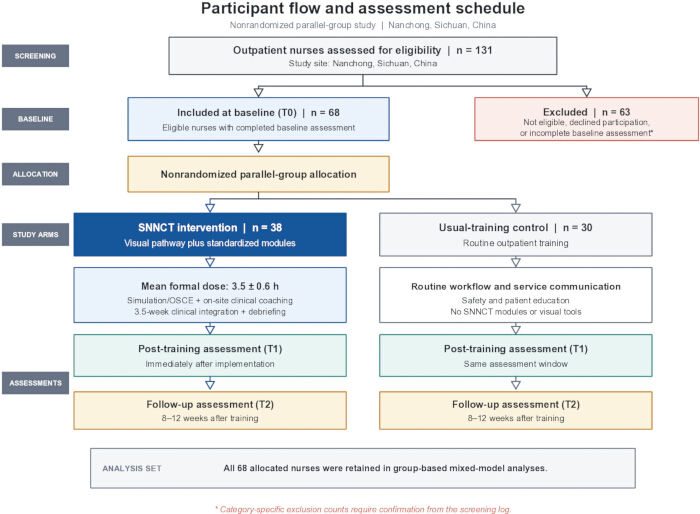
Figure 1. Participant flow and assessment schedule. Of 131 outpatient nurses assessed for eligibility in Nanchong, Sichuan, China, 63 were excluded because they were ineligible, declined participation, or did not complete the baseline assessment. Sixty-eight nurses completed the baseline assessment (T0) and were assigned nonrandomly to the SNNCT group (n = 38) or the usual-training group (n = 30). T1 was conducted immediately after the 3.5-week implementation period, and T2 was conducted 8–12 weeks after training. All 68 allocated nurses were retained in the group-based mixed-model analyses using available repeated observations. The analysis dataset retained only the aggregate exclusion total; therefore, category-specific exclusion counts were not reconstructed. Please click here to view a larger version of this figure.
| Characteristic | SNNCT (n = 38) | Control (n = 30) | P value |
| Demographic and professional characteristics | |||
| Age, years (mean ± SD) | 32.0 ± 6.1 | 31.6 ± 6.4 | 0.812 |
| Female, n (%) | 34 (89.5) | 27 (90.0) | 0.945 |
| Body mass index (BMI), kg/m² (mean ± SD) | 22.5 ± 2.6 | 22.0 ± 2.9 | 0.458 |
| Highest education, n (%) | 0.931 | ||
| Associate diploma | 7 (18.5%) | 6 (20.0%) | |
| Bachelor's degree | 30 (78.9) | 23 (76.7) | |
| Master's degree or above | 1 (2.6%) | 1 (3.3%) | |
| Married, n (%) | 23 (60.5) | 19 (63.3) | 0.811 |
| Total nursing experience, years (median [IQR]) | 8.4 (5.2–12.8) | 8.1 (4.9–12.4) | 0.756 |
| Outpatient nursing experience, years (median [IQR]) | 4.2 (2.1–7.5) | 4.0 (2.0–7.0) | 0.842 |
| Professional title, n (%) | 0.911 | ||
| Junior | 16 (42.1) | 12 (40.0) | |
| Intermediate | 18 (47.4) | 14 (46.7) | |
| Senior | 4 (10.5) | 4 (13.3) | |
| Permanent employment, n (%) | 30 (78.9) | 23 (76.7) | 0.824 |
| Rotating shift pattern, n (%) | 12 (31.6) | 10 (33.3) | 0.874 |
| Prior formal communication training (past 12 months), n (%) | 14 (36.8) | 10 (33.3) | 0.770 |
| Prior exposure to narrative nursing concepts, n (%) | 7 (18.4) | 6 (20.0) | 0.864 |
| Primary clinic assignment, n (%) | 0.988 | ||
| Internal medicine | 12 (31.6) | 9 (30.0) | |
| Surgery | 9 (23.7) | 7 (23.3) | |
| Pediatrics | 5 (13.2) | 4 (13.3) | |
| Obstetrics and gynecology | 4 (10.5) | 3 (10.0) | |
| Oncology | 4 (10.5) | 4 (13.3) | |
| Other clinics | 4 (10.5) | 3 (10.0) | |
| Baseline nurse-reported outcomes (T0) | |||
| Empathy score (mean ± SD) | 105.1 ± 10.6 | 104.3 ± 11.4 | 0.777 |
| Reflective practice score (mean ± SD) | 3.44 ± 0.40 | 3.38 ± 0.44 | 0.563 |
| Humanistic care ability score (mean ± SD) | 127.3 ± 12.3 | 126.1 ± 13.5 | 0.702 |
| Communication self-efficacy score (mean ± SD) | 72.2 ± 8.5 | 71.4 ± 9.2 | 0.705 |
| Patient-centered professional values (mean ± SD) | 4.13 ± 0.45 | 4.08 ± 0.49 | 0.648 |
| Emotional exhaustion (median [IQR]) | 21 (16–26) | 22 (15–29) | 0.689 |
| Baseline encounter characteristics | |||
| Patients managed per shift (mean ± SD) | 38.5 ± 9.1 | 37.8 ± 10.4 | 0.792 |
| Average encounter duration, min (median [IQR]) | 4.6 (3.9–5.4) | 4.5 (3.6–5.5) | 0.840 |
| High-emotion encounters per shift, % (median [IQR]) | 22.0 (15.4–30.1) | 23.6 (14.8–31.0) | 0.761 |
| Follow-up contacts per week (telephone/online) (median [IQR]) | 6.1 (3.1–9.1) | 5.4 (2.9–8.2) | 0.556 |
| Baseline patient communication experience score (mean ± SD) | 78.4 ± 7.6 | 79.5 ± 8.3 | 0.588 |
| Baseline observed encounters per nurse (mean ± SD) | 3.2 ± 0.8 | 3.0 ± 0.9 | 0.410 |
Table 2: Baseline demographic, professional, clinical, and outcome characteristics of outpatient nurses in the Standardized Narrative Nursing Communication Technique (SNNCT) and control groups. Continuous variables are presented as the mean ± standard deviation (SD) or median (interquartile range [IQR]), as appropriate according to data distribution. Categorical variables are presented as number (%). P values represent between-group comparisons at baseline. Abbreviations: BMI, body mass index; IQR, interquartile range; SD, standard deviation; SNNCT, Standardized Narrative Nursing Communication Technique; T0, baseline assessment. Please click here to download this Table.
| Domain/Indicator | Value |
| Training feasibility | |
| Completed baseline assessment (T0), n (%) | 38 (100) |
| Completed the training curriculum, n (%) | 37 (97.4) |
| Attended ≥80% of training sessions, n (%) | 33 (86.8) |
| Overall attendance rate, % (mean ± SD) | 92.4 ± 7.9 |
| Total training dose received, h (mean ± SD) | 3.5 ± 0.6 |
| Simulation/OSCE cases completed per nurse (median [IQR]) | 4.0 (3.0–5.0) |
| On-site clinical coaching encounters completed per nurse (mean ± SD) | 2.7 ± 0.8 |
| Participation in weekly reflective debriefings, n (%) | 32 (84.2) |
| Reflection diary entries per week (median [IQR]) | 4.0 (3.0–6.0) |
| Additional time per encounter attributable to SNNCT, min (median [IQR]) | 0.8 (0.5–1.3) |
| Implementation feasibility (process measures) | |
| Fidelity checklist completion rate, % (mean ± SD) | 85.2 ± 9.1 |
| Encounters completing all core steps (opening, empathic response, and shared planning/teach-back), n (%) | 29 (76.3) |
| Teach-back performed at least once per shift, n (%) | 31 (81.6) |
| Reflective summary documented in encounters, % (mean ± SD) | 70.6 ± 13.8 |
| Supervisor spot-checks per nurse (median [IQR]) | 2.0 (1.0–3.0) |
| Data completeness across T0, T1, and T2, n (%) | 36 (94.7) |
| Acceptability (nurse-reported) | |
| Overall satisfaction with SNNCT training (1–5), mean ± SD | 4.39 ± 0.55 |
| Perceived usefulness for outpatient practice (1–5), mean ± SD | 4.53 ± 0.47 |
| Ease of learning the pathway (1–5), mean ± SD | 4.16 ± 0.63 |
| Confidence in applying the pathway in routine practice (1–5), mean ± SD | 4.11 ± 0.64 |
| Would recommend SNNCT to colleagues, n (%) | 34 (89.5) |
| Intention to continue using SNNCT at 8–12 weeks, n (%) | 32 (84.2) |
| System Usability Scale (SUS) score (0–100), mean ± SD | 83.1 ± 8.4 |
| Acceptability of specific visual tools (1–5, mean ± SD) | |
| Workflow map pocket card | 4.48 ± 0.56 |
| Decision tree for narrative and emotion cues | 4.31 ± 0.62 |
| Empathy phrase bank | 4.19 ± 0.69 |
| Teach-back checklist | 4.35 ± 0.60 |
| Brief reflective debriefing template | 4.07 ± 0.72 |
| Fidelity checklist (per encounter) | 3.88 ± 0.79 |
| Common barriers (multiple responses allowed), n (%) | |
| Time pressure during peak clinic hours | 20 (52.6) |
| Patient impatience or interruptions | 14 (36.8) |
| Difficulty maintaining reflective practice under workload | 12 (31.6) |
| Limited private space for sensitive narrative discussions | 10 (26.3) |
| Adverse events related to training | |
| Training-related adverse events, n (%) | 0 (0) |
| Reported increased emotional fatigue during early implementation, n (%) | 6 (15.8) |
Table 3: Feasibility, implementation, and nurse-reported acceptability of the Standardized Narrative Nursing Communication Technique intervention. The table summarizes training completion, implementation feasibility, process measures, nurse-reported acceptability, usability of the visual communication tools, perceived barriers, and training-related adverse events among participants assigned to the Standardized Narrative Nursing Communication Technique (SNNCT) intervention. Continuous variables are presented as the mean ± standard deviation (SD) or median (interquartile range [IQR]), as appropriate, and categorical variables are presented as number (%). Percentages are based on participants in the intervention group unless otherwise indicated. Abbreviations: IQR, interquartile range; OSCE, Objective Structured Clinical Examination; SD, standard deviation; SNNCT, Standardized Narrative Nursing Communication Technique; SUS, System Usability Scale; T0, baseline; T1, post-training; T2, follow-up. Please click here to download this Table.
To minimize inter-group contamination and enhance implementation consistency, uniform training materials, scenario simulations, feedback procedures, and documentation were used. Fidelity was monitored with a per-encounter SNNCT Implementation Fidelity Checklist containing predefined criteria for each communication component (Tables 1 and 4). Key thresholds included visual-tool use in at least 80% of encounters and completion of at least six core components in at least 70% of encounters. Supervisors conducted documented spot checks, and independent raters applied the structured 0–10-per-module Narrative Communication Coding Protocol (total score: 0–70; Table 5). Unit nurse supervisors trained in the checklist conducted monitoring at least weekly during the 3.5-week implementation period (median: two spot checks per nurse). Because use of the visual tools was directly observable, supervisors were not blinded. Two independent raters assessed coded audio/video recordings sampled at T0, T1, and T2 and were masked to group allocation and time point.
| Indicator (nurse level) | SNNCT (n = 38), n (%) | Control (n = 30), n (%) | P value |
| Opening and permission adherence (≥70% of encounters) | 34 (89.5) | 19 (63.3) | 0.002 |
| Narrative elicitation adherence (≥70% of encounters) | 31 (81.6) | 12 (40.0) | <0.001 |
| Emotion cue recognition adherence (≥70% of encounters) | 29 (76.3) | 11 (36.7) | <0.001 |
| Empathic validation adherence (≥70% of encounters) | 28 (73.7) | 10 (33.3) | <0.001 |
| Reflective summarization adherence (≥70% of encounters) | 30 (78.9) | 13 (43.3) | <0.001 |
| Shared planning and teach-back adherence (≥70% of encounters) | 25 (65.8) | 11 (36.7) | 0.004 |
| Safety boundaries adherence (≥70% of encounters) | 26 (68.4) | 14 (46.7) | 0.024 |
| Use of visual tools (≥80% of encounters) | 31 (81.6) | 4 (13.3) | <0.001 |
| Full sequence completed (≥6 core modules in ≥70% of encounters) | 28 (73.7) | 9 (30.0) | <0.001 |
| Mean fidelity score (0–100), mean ± SD | 82.6 ± 9.4 | 63.8 ± 11.5 | <0.001 |
| Mean encounter duration, min (mean ± SD) | 7.9 ± 1.2 | 7.6 ± 1.3 | 0.219 |
Table 4: Implementation fidelity and adherence to the Standardized Narrative Nursing Communication Technique during outpatient encounters. The table compares adherence to individual communication modules, use of visual tools, overall implementation fidelity, and encounter duration between the Standardized Narrative Nursing Communication Technique (SNNCT) and control groups. Adherence was calculated at the nurse level according to the proportion of observed outpatient encounters meeting the predefined criteria for each communication module. Continuous variables are presented as the mean ± standard deviation (SD), and categorical variables are presented as number (%). P values represent between-group comparisons. Abbreviations: SD, standard deviation; SNNCT, Standardized Narrative Nursing Communication Technique. Please click here to download this Table.
| Module (0–10) | SNNCT, mean ± SD | SNNCT, median (IQR) | Control, mean ± SD | Control, median (IQR) | Mean difference | P value | ICC (95% CI) |
| Opening and permission | 7.9 ± 1.1 | 8.0 (7.2–8.7) | 6.6 ± 1.3 | 6.6 (5.8–7.5) | 1.3 | <0.001 | 0.86 (0.78–0.91) |
| Narrative elicitation | 7.6 ± 1.2 | 7.6 (6.8–8.5) | 5.7 ± 1.5 | 5.6 (4.7–6.8) | 1.9 | <0.001 | 0.83 (0.74–0.89) |
| Emotion cue recognition | 7.2 ± 1.3 | 7.3 (6.3–8.2) | 5.4 ± 1.4 | 5.3 (4.5–6.3) | 1.8 | <0.001 | 0.81 (0.71–0.88) |
| Empathic validation | 7.4 ± 1.2 | 7.5 (6.6–8.2) | 5.1 ± 1.6 | 5.0 (4.0–6.2) | 2.3 | <0.001 | 0.85 (0.77–0.91) |
| Reflective summarization | 7.5 ± 1.1 | 7.6 (6.9–8.3) | 5.5 ± 1.4 | 5.4 (4.5–6.6) | 2 | <0.001 | 0.84 (0.75–0.90) |
| Shared planning and teach-back | 6.9 ± 1.4 | 7.0 (6.1–7.9) | 5.2 ± 1.5 | 5.1 (4.1–6.2) | 1.7 | <0.001 | 0.79 (0.67–0.87) |
| Safety boundaries | 7.1 ± 1.2 | 7.1 (6.3–8.0) | 5.9 ± 1.3 | 5.8 (5.0–6.8) | 1.2 | <0.001 | 0.82 (0.72–0.89) |
| Total quality score (0–70) | 52.6 ± 6.3 | 52.9 (48.6–56.8) | 39.4 ± 7.8 | 39.1 (34.4–44.8) | 13.2 | <0.001 | 0.88 (0.81–0.93) |
Table 5: Independent ratings of narrative communication quality during outpatient encounters. The table compares communication quality scores between the Standardized Narrative Nursing Communication Technique (SNNCT) and control groups for each communication module and the overall communication quality score. Continuous variables are presented as the mean ± standard deviation (SD) and median (interquartile range [IQR]). Mean differences represent between-group differences. Intraclass correlation coefficients (ICCs) with 95% confidence intervals (CIs) indicate inter-rater reliability. Abbreviations: CI, confidence interval; ICC, intraclass correlation coefficient; IQR, interquartile range; SD, standard deviation; SNNCT, Standardized Narrative Nursing Communication Technique. Please click here to download this Table.
Setting and participants
This study was conducted in the outpatient department of a tertiary hospital in Sichuan Province. The research setting comprised the routine outpatient nursing workflow, including triage and pre-visit communication, health education, examination and treatment scheduling, medication counseling, and follow-up guidance. The department was characterized by high patient volume, limited communication time, and a substantial information load. Training and evaluation were therefore implemented under routine clinical workloads to support practical applicability.
The study participants were frontline outpatient nurses, who were continuously recruited for eligibility assessment and enrollment. Inclusion criteria included nurses who were responsible for patient communication and education, were expected to remain on duty throughout the study period, and were able to complete the training and follow-up assessments. Exclusion criteria included nurses who were undergoing clinical rotations or extended leave, were not primarily engaged in frontline communication, had recently participated in similar intensive communication training that could introduce intervention contamination, or were unable to complete the study assessments. A total of 131 outpatient nurses were assessed for eligibility, of whom 63 were excluded, resulting in 68 nurses completing baseline measurements (T0). According to the study protocol, 38 participants were assigned to the intervention group and 30 to the control group.
Baseline data collection included demographic and occupational characteristics for both groups, including age, sex, education level, outpatient experience, specialty, daily patient volume, and previous communication training. Nurses completed the same nurse-reported outcome assessments at T0, T1, and T2. Patient communication experience was measured immediately after eligible outpatient encounters using the study-specific Patient Communication Experience Questionnaire. The questionnaire assessed feeling heard, emotional support, information clarity, and shared decision-making. Domain scores were transformed to a 0–100 scale, with higher scores indicating a better communication experience. Cognitive pilot testing supported the questionnaire’s clarity and feasibility, but no external validation is claimed. Responses were recorded using coded identifiers. The questionnaire was administered immediately after the encounter by a trained research assistant and was primarily self-completed in paper format; when assistance was needed, the items were read verbatim. It contained eight items (two per domain) with 5-point response options ranging from 1 (strongly disagree) to 5 (strongly agree). Domain scores were calculated as (mean item score − 1)/4 × 100, and the overall score was calculated as the mean of the four domain scores. Encounter responses were aggregated within each nurse and assessment window; therefore, the longitudinal analysis used up to 38 intervention-group and 30 control-group nurse-level aggregate scores per assessment window. Patients with acute critical conditions or substantial cognitive or communication impairments were excluded.
Intervention
The intervention consisted of group-based SNNCT training for outpatient nurses over 3.5 weeks, with empathy and reflective practice as its core principles. The nine modules standardized narrative elicitation, emotional cue recognition, empathic validation, reflective listening and summarization, collaborative planning, teach-back, safety boundaries, and implementation routines. Visual flowcharts, decision trees, pocket cards, phrase banks, and checklists embedded these behaviors into the outpatient workflow. The mean formal training dose was 3.5 ± 0.6 h and included microlectures, demonstrations, simulation, role play, drills, and OSCE practice. Clinical transfer was reinforced through a mean of 2.7 ± 0.8 on-site coaching encounters, weekly huddles, reflection diaries, feedback, and structured debriefing. Training was delivered by the project nursing team, including senior outpatient nurse educators trained in simulation and narrative communication, with approximately one instructor per 8–10 nurses.
Each module contained observable behavioral indicators, representative prompts, visual supports, and predefined fidelity criteria. After formal training, nurses in the intervention group used the SNNCT toolkit during routine outpatient communication. Adherence was documented using the encounter checklist, reflection diaries, teach-back records, supervisor spot checks, and independent ratings; checklist completion and core-step thresholds are reported in Tables 3 and 4. The control group continued routine training in outpatient workflow, safety, patient education, and standard service communication during the same study period, without SNNCT modules, visual workflow tools, structured SNNCT debriefing, or fidelity feedback. Routine education was delivered over the same 3.5-week period through the department’s regular staff meetings and on-shift guidance, with no additional study-specific contact hours. Nurse-reported empathy, reflective practice, and secondary outcomes were assessed at T0, T1, and T2, whereas patient-reported and observer-rated encounter outcomes were collected during the corresponding assessment windows.
Visual pathway
This study institutionalized the SNNCT as a visualized, executable outpatient communication pathway to assist nurses in performing consistent and reproducible narrative communication behaviors in time-constrained, high-workload clinical settings. The overall framework is illustrated in Figure 2, following the sequence of training input, implementation adherence, empathy and reflective practice mechanisms, and nurse- and patient-level outcomes. This framework modularizes the key communication steps and integrates them into the routine outpatient workflow.
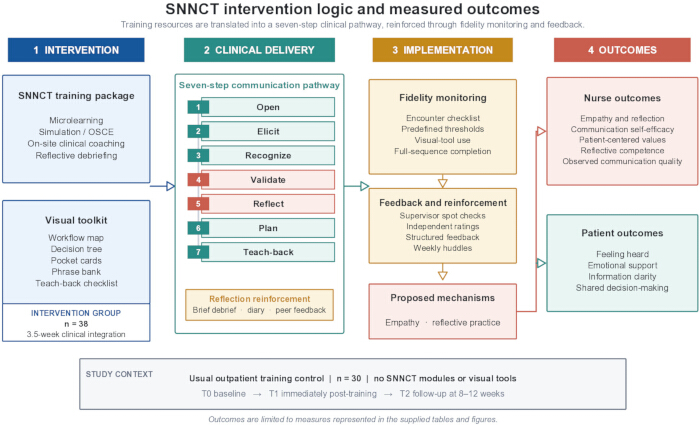
Figure 2. SNNCT visual pathway, implementation mechanisms, and measured outcomes. The schematic illustrates the SNNCT training package, seven-step clinical communication pathway, reflective debriefing, fidelity monitoring, supervisor and independent-rater feedback, proposed empathy and reflective-practice mechanisms, and the nurse- and patient-level outcomes evaluated in this study. Outcomes are limited to those reported in the accompanying tables and figures. T0, baseline; T1, immediate post-training; T2, 8–12-week follow-up; OSCE, Objective Structured Clinical Examination; SNNCT, Standardized Narrative Nursing Communication Technique. Please click here to view a larger version of this figure.
As illustrated in Figure 2, the visualization toolkit centers on workflow maps and decision trees and is supported by pocket cards, phrase banks, teach-back checklists, and structured debriefing templates. SNNCT standardizes outpatient communication into seven clinical steps: opening and permission, narrative elicitation, emotional cue recognition, empathic validation, reflective summarization, collaborative planning, and teach-back. Per-encounter adherence was assessed against module-specific criteria using the SNNCT Implementation Fidelity Checklist, supervisor spot checks, reflection records, and independent ratings. Visual-tool use in at least 80% of encounters and completion of at least six core components in at least 70% of encounters were predefined implementation thresholds. The revised figure depicts only the outcomes presented in the accompanying tables and figures: nurse empathy, reflective practice, communication-related competence, observed communication quality, and patient-reported communication experience.
Measures
The measurement framework followed the intervention logic model and included nurse competence, patient experience, and implementation process quality. Nurse outcomes were measured at T0, T1, and T2. Empathy was assessed with the 20-item Jefferson Scale of Empathy–Health Professionals (JSE-HP), using 7-point response options and a total score ranging from 20 to 140; higher scores indicate greater empathy. The validated Chinese Healthcare Providers version described by Cheng et al.26 was used in this study, and no alternative or abbreviated JSE form was administered. Reflective practice was assessed with the Reflective Practice Questionnaire (RPQ). The original instrument contains 40 items rated on a 6-point scale and yields mean scores ranging from 1 to 6, with higher scores indicating greater reflective capacity27. The original 40-item version was administered in Chinese following independent forward translation by two bilingual nursing researchers, reconciliation, back-translation, and clinical review before pilot testing. Secondary nurse outcomes included humanistic care competence, communication self-efficacy, patient-centered professional values, and reflective communication competence. The supplied materials indicate that study-specific pretested instruments were used for several secondary outcomes. Humanistic care ability was summarized using the study’s 37-item, 7-point composite scale (total score: 37–259). Communication self-efficacy was scored from 0 to 100. Patient-centered professional values were reported as the mean of 1–5 item scores and linearly transformed to a 0–100 scale for graphical presentation. Reflective communication competence comprised four domains—reflective listening, emotion labeling and validation, summarization and teach-back, and boundary setting—plus an overall score ranging from 0 to 100. The locally developed instruments underwent content review and cognitive pilot testing before participant enrollment; no external validation is claimed.
Patient outcomes evaluated communication experiences during outpatient encounters, including feeling heard, emotional support, information clarity, and shared decision-making. Immediately after eligible encounters, patients completed the study-specific Patient Communication Experience Questionnaire using anonymous or coded identifiers. Domain scores were transformed to a 0–100 scale, with higher values indicating more favorable communication experiences. Cognitive pilot testing supported the questionnaire’s clarity and feasibility, but no external validation is claimed. The instrument contained eight items (two per domain), each rated from 1 (strongly disagree) to 5 (strongly agree). Domain scores were calculated as (mean item score − 1)/4 × 100, and the overall score was calculated as the mean of the four domain scores. A trained research assistant distributed and collected primarily self-completed paper questionnaires immediately after the encounter. Encounter responses were averaged within each nurse and assessment window, yielding up to 38 intervention-group and 30 control-group nurse-level aggregate scores per assessment window. When patients required assistance, the items were read verbatim and responses were recorded without interpretation.
Process indicators evaluated implementation intensity and fidelity. Operational measures included formal training hours, simulation/OSCE sessions, on-site coaching encounters, huddle participation, diary entries, checklist completion, completion of core communication steps, visual-tool use, teach-back, reflective summaries, supervisor spot checks, independent ratings, and data completeness. Encounter behaviors were scored using the structured Narrative Communication Coding Protocol, which assigns 0–10 points to each of seven modules (total score: 0–70). Module-specific intraclass correlation coefficients (ICCs) with 95% confidence intervals quantified inter-rater reliability (Table 5). Acceptability was assessed using study-specific 5-point ratings and the 10-item SUS, scored from 0 to 10028. Two trained nurse researchers independently scored de-identified, randomly ordered recordings following standardized calibration using practice recordings. Inter-rater reliability was summarized using a two-way random-effects, absolute-agreement, single-rater intraclass correlation coefficient [ICC(2,1)] with a 95% confidence interval. Raters were masked to group allocation and time point, and scores were entered into a password-protected electronic case-report form with independent verification.
Statistical analysis
This study used descriptive statistics to summarize participant characteristics. Continuous variables were expressed as means and standard deviations or medians and interquartile ranges, as appropriate based on data distribution, whereas categorical variables were presented as frequencies and percentages. Baseline comparability between groups was evaluated using independent-samples tests, nonparametric tests, or chi-square tests, as appropriate for the variable type and distribution.
Primary intervention effects were evaluated using linear mixed-effects models or generalized linear mixed-effects models, as appropriate. Fixed effects included group, time, and the group × time interaction, with years of service, outpatient specialty, and workload included as covariates. A nurse-level random intercept accounted for repeated measurements within nurses, and encounter-level patient observations were modeled as clustered within nurses. Model selection was based on the outcome distribution and link-function requirements. No additional unit- or shift-level random effect was fitted; outpatient specialty/clinic was included as a fixed covariate. Continuous outcomes were analyzed using Gaussian identity-link models estimated by restricted maximum likelihood, whereas binary or ordinal outcomes were analyzed using generalized mixed-effects models estimated by maximum likelihood with the appropriate link function. Repeated observations were modeled as conditionally independent after accounting for the nurse-level random intercept.
Mechanism testing used a serial multiple-mediator framework for the pathway SNNCT → empathy → reflective practice → patient-reported communication outcome. Total, direct, empathy-specific, reflection-specific, serial indirect, and total indirect effects were estimated with bootstrap confidence intervals (Table 6). Serial mediation effects were estimated using robust maximum likelihood with bias-corrected 95% bootstrap confidence intervals based on 5,000 resamples, adjusting for the baseline outcome value, years of service, outpatient specialty, and workload. The mediation analysis was performed using the lavaan and boot packages in R version 4.6.0. Patient outcomes were analyzed using mixed-effects models for continuous outcomes and generalized mixed-effects models with appropriate link functions for binary or ordinal outcomes. Prespecified robustness analyses examined heterogeneity according to specialty, experience, and workload.
| Effect | Estimate (β) | SE | 95% CI | P value |
| Total effect of SNNCT on patient-reported communication outcomes | 9.98 | 1.36 | 7.18 to 12.61 | <0.001 |
| Direct effect (controlling for mediators) | 4.78 | 1.44 | 1.92 to 7.58 | 0.001 |
| Indirect effect via empathy | 2.64 | 0.7 | 1.33 to 4.16 | <0.001 |
| Indirect effect via reflective practice | 1.58 | 0.6 | 0.62 to 2.87 | 0.003 |
| Serial indirect effect (SNNCT → empathy → reflective practice → outcome) | 0.98 | 0.37 | 0.30 to 1.81 | 0.006 |
| Total indirect effect (sum of indirect pathways) | 5.2 | 1 | 3.30 to 7.34 | <0.001 |
| Proportion mediated, % | 52.6 | — | — | — |
Table 6: Mediation analysis of the association between the Standardized Narrative Nursing Communication Technique intervention and patient-reported communication outcomes. The table presents the total, direct, and indirect effects of the intervention, including mediation through empathy and reflective practice. Regression coefficients (β), standard errors (SEs), 95% confidence intervals (CIs), and P values are reported. The proportion mediated represents the percentage of the total intervention effect explained by the indirect pathways. Abbreviations: β, regression coefficient; CI, confidence interval; SE, standard error; SNNCT, Standardized Narrative Nursing Communication Technique. Please click here to download this Table.
Missing data were summarized by proportion and pattern. Maximum-likelihood estimation within the mixed-effects models retained participants with incomplete repeated observations under the missing-at-random assumption. No separate multiple-imputation analysis was documented in the supplied tables; instead, sensitivity analyses evaluated subgroup consistency and additional adjustment for burnout (Table 7). All statistical tests were two-sided with α = 0.05, and effect estimates were reported with 95% confidence intervals. Analyses were performed using R version 4.6.0 with the lme4, lmerTest, emmeans, lavaan, boot, and performance packages.
| Stratum | SNNCT (n = 38) | Control (n = 30) | Adjusted effect (β) | 95% CI | P value |
| Overall (primary adjusted model) | 38 | 30 | 9.41 | 6.28 to 12.22 | <0.001 |
| Medical clinics | 12 | 9 | 10.18 | 5.62 to 14.77 | <0.001 |
| Surgical clinics | 10 | 8 | 8.64 | 3.21 to 13.11 | 0.003 |
| Pediatrics and other clinics | 16 | 13 | 9.02 | 3.74 to 14.35 | 0.002 |
| Seniority <5 years | 20 | 16 | 9.88 | 5.43 to 14.09 | <0.001 |
| Seniority ≥5 years | 18 | 14 | 8.97 | 4.06 to 13.52 | <0.001 |
| Workload ≤30 visits/day | 19 | 16 | 10.07 | 5.44 to 14.38 | <0.001 |
| Workload >30 visits/day | 19 | 14 | 8.53 | 3.78 to 12.97 | 0.001 |
| Excluding participants with prior formal communication training (past 12 months) | 26 | 21 | 9.16 | 5.75 to 12.41 | <0.001 |
| Additional adjustment for burnout score | 38 | 30 | 8.92 | 5.98 to 11.71 | <0.001 |
Table 7: Sensitivity and subgroup analyses of the effects of the Standardized Narrative Nursing Communication Technique intervention on the primary outcome. The table presents adjusted intervention effects estimated using prespecified subgroup and sensitivity analyses according to outpatient specialty, nursing experience, workload, previous communication training, and adjustment for burnout. Adjusted regression coefficients (β), 95% confidence intervals (CIs), and P values are reported. Abbreviations: β, adjusted regression coefficient; CI, confidence interval; SNNCT, Standardized Narrative Nursing Communication Technique. Please click here to download this Table.
Results
Baseline
A total of 68 outpatient nurses were enrolled, including 38 in the SNNCT group and 30 in the control group. All 68 allocated nurses were retained in the group-based mixed-model analyses using available repeated observations, whereas intervention process data were complete for 36 of the 38 nurses in the intervention group. The groups were similar in demographic and occupational characteristics, including age, sex, body mass index (BMI), marital status, education level, nursing experience, professional title, employment type, previous communication training, and prior exposure to narrative nursing concepts.
The distribution of participants across outpatient specialties, including internal medicine, surgery, pediatrics, obstetrics and gynecology, oncology, and other clinics, was balanced between the two groups, suggesting no systematic differences in communication demands across clinical settings. Baseline nurse-reported outcomes were likewise comparable, with no statistically significant between-group differences in empathy, reflective practice, humanistic care ability, communication self-efficacy, patient-centered professional values, or emotional exhaustion. Workload-related characteristics, including the number of patients managed per shift, average encounter duration, frequency of emotionally challenging encounters, weekly follow-up contacts, baseline patient communication experience scores, and the number of observed encounters, were also similar between groups, indicating comparable clinical workloads at study entry. Detailed baseline characteristics are presented in Table 2.
Feasibility
The feasibility of the SNNCT intervention was evaluated with respect to training implementation, implementation fidelity, and nurse-reported acceptability. Nurses assigned to the intervention group demonstrated high participation, attendance, curriculum completion, and follow-up assessment completion rates. Participants completed the prescribed microlecture sessions, simulation training, on-site clinical coaching, and structured reflective debriefing while maintaining their routine outpatient responsibilities. These findings indicate that the intervention was feasible in routine outpatient practice. Detailed feasibility measures are presented in Table 3.
Implementation process measures demonstrated consistent application of the SNNCT communication pathway during routine outpatient encounters. High completion rates were observed for fidelity checklists, implementation of core communication behaviors, teach-back practices, and reflective documentation, while supervision and spot-check procedures supported implementation consistency. The additional time required per encounter remained limited, suggesting that integration of the visual communication pathway did not substantially disrupt routine outpatient workflows. Additional implementation fidelity measures are presented in Table 4.
Nurse-reported acceptability of the SNNCT intervention was high. Participants reported favorable satisfaction, perceived usefulness, ease of learning, confidence in applying the communication pathway during routine outpatient practice, and willingness to recommend the intervention to colleagues. Workflow pocket cards, decision trees, empathy phrase libraries, and teach-back checklists were rated as the most useful visual support tools, whereas documentation-related activities, including fidelity checklists and reflective diaries, were perceived as more challenging to sustain during periods of high clinical workload. Time pressure during busy outpatient clinics, patient interruptions, limited opportunities for private communication, and maintaining reflective practice under heavy workloads were the most frequently reported implementation barriers. No training-related adverse events were reported, and a small proportion of participants described transient increases in emotional fatigue during the early implementation period. Detailed acceptability outcomes are summarized in Table 3.
Overall, the baseline comparability of the intervention and control groups supports the validity of subsequent between-group comparisons. The high levels of training completion, implementation fidelity, and nurse acceptability further demonstrate that the SNNCT intervention was feasible for delivery within routine outpatient nursing practice under real-world clinical conditions.
Primary outcomes
Empathy and reflective practice were evaluated as the primary outcomes. At baseline, the SNNCT and control groups demonstrated comparable scores for both measures. Following the intervention, the SNNCT group exhibited greater improvements in empathy and reflective practice than the control group. Both within-group pre–post comparisons and between-group comparisons indicated improved performance among nurses receiving the SNNCT intervention. These findings suggest that SNNCT training enhanced nurses’ ability to recognize and respond to patient narratives during brief, high-volume outpatient encounters while supporting more consistent empathic communication and structured reflective practice. Detailed results for empathy and reflective practice are presented in Figure 3A and Figure 3B, respectively.
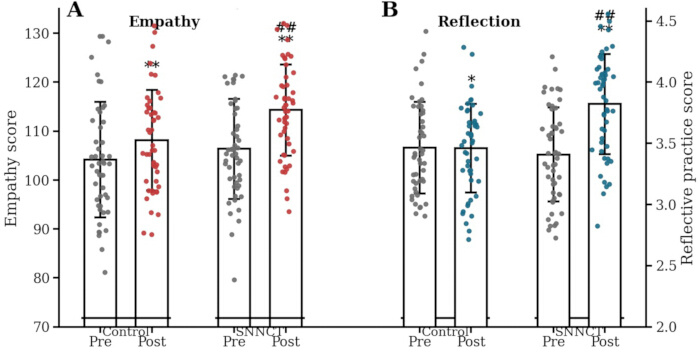
Figure 3. Pre–post changes in empathy and reflective practice. Individual nurse observations and group summaries are shown for the control group (n = 30) and the SNNCT group (n = 38). (A) Empathy. (B) Reflective practice. Bars represent group means, and error bars represent standard deviations (SDs). P < 0.05 and P < 0.01 versus baseline within the same group; #P < 0.05 and ##P < 0.01 versus the control group at the corresponding time point. Please click here to view a larger version of this figure.
To further illustrate individual-level variability and score distributions, empathy and reflective practice outcomes were visualized using raincloud plots. The SNNCT group demonstrated an upward shift in both the overall score distribution and group mean after the intervention, indicating that improvements occurred across the study population rather than being driven by a small number of participants. In contrast, the control group demonstrated only modest changes in score distributions over time. Individual variability remained evident after the intervention, suggesting that implementation fidelity and mastery of the communication modules may have contributed to differences in participant outcomes. These distributional changes for empathy and reflective practice are illustrated in Figure 4A and Figure 4B, respectively.
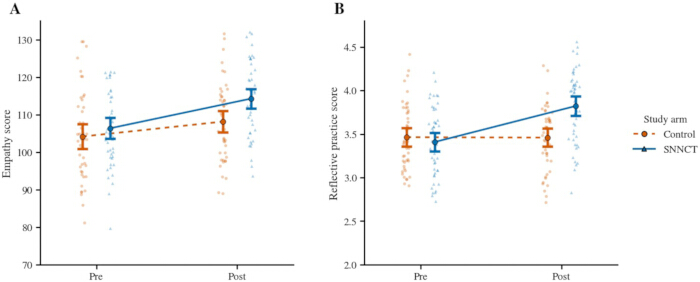
Figure 4. Group-by-time changes in empathy and reflective practice. Individual nurse observations and estimated group means are shown for the control group (n = 30) and the SNNCT group (n = 38) at baseline and post-training. (A) Empathy. (B) Reflective practice. Symbols represent individual observations, lines connect estimated group means, and error bars represent 95% confidence intervals (CIs). Please click here to view a larger version of this figure.
Patient experience
Patient-reported outcomes demonstrated improved communication experiences following implementation of the SNNCT intervention. Compared with the control group, patients cared for by nurses in the SNNCT group reported more favorable communication experiences after the intervention, including greater perceptions of being heard, improved emotional support, clearer communication regarding treatment plans, and stronger participation in shared decision-making. Overall, post-intervention scores in the SNNCT group shifted toward higher values with reduced dispersion of individual observations, suggesting more consistent communication performance during routine outpatient encounters. Detailed patient-reported outcomes are presented in Figure 5A–D.
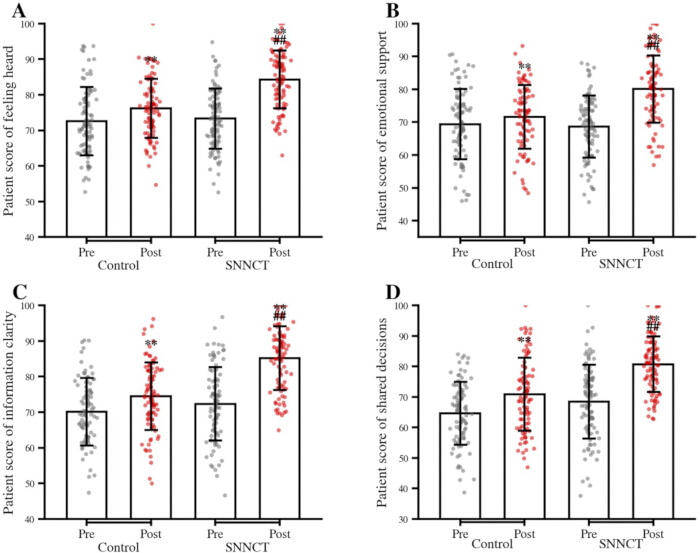
Figure 5. Pre–post changes in patient-reported communication experience. Individual encounter observations and group summaries are shown for encounters involving nurses in the control and SNNCT groups. (A) Feeling heard. (B) Emotional support. (C) Information clarity. (D) Shared decision-making. Bars represent group means, and error bars represent standard deviations (SDs). P < 0.01 versus baseline within the same group; ##P < 0.01 versus the control group at the corresponding time point. Please click here to view a larger version of this figure.
Secondary outcomes
Secondary outcomes included communication self-efficacy, confidence in difficult conversations, patient-centered professional values, shared decision orientation, and the total secondary outcome score. Baseline values were comparable between the SNNCT and control groups. Following the intervention, both groups demonstrated improvements; however, the SNNCT group showed greater and more consistent increases in communication self-efficacy and patient-centered professional values than the control group. These findings indicate that standardized narrative communication training was associated with greater confidence in managing complex outpatient communication while reinforcing patient-centered professional values. Detailed results for communication self-efficacy (Figure 6A), confidence in difficult conversations (Figure 6B), patient-centered professional values (Figure 6C), shared decision orientation (Figure 6D), and the total secondary outcome score (Figure 6E) are presented in Figure 6.
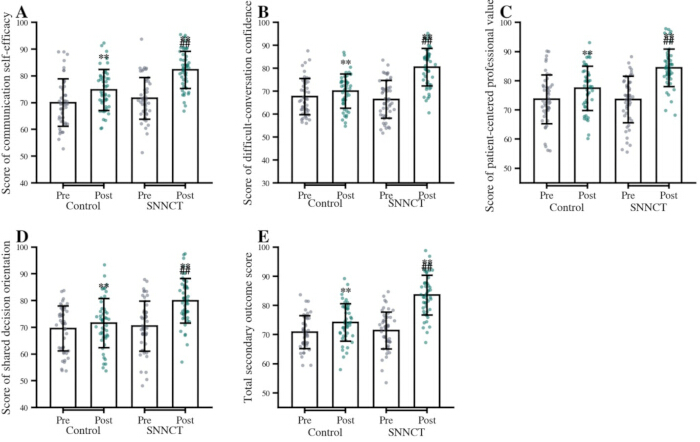
Figure 6. Pre–post changes in nurse-reported secondary outcomes. Individual nurse observations and group summaries are shown for the control group (n = 30) and the SNNCT group (n = 38). (A) Communication self-efficacy. (B) Confidence in difficult conversations. (C) Patient-centered professional values. (D) Shared decision orientation. (E) Total secondary outcome score. Bars represent group means, and error bars represent standard deviations (SDs). P < 0.01 versus baseline within the same group; ##P < 0.01 versus the control group at the corresponding time point. Please click here to view a larger version of this figure.
Reflective communication competence also improved following the intervention. Compared with baseline and with the control group, nurses receiving SNNCT training demonstrated greater improvements in reflective listening, emotion recognition and validation, summarization, teach-back, and boundary-setting skills during follow-up assessments. Improvements were observed across multiple communication domains, suggesting that the structured visual communication pathway supported the development of transferable communication strategies applicable to routine outpatient practice. Detailed results for reflective listening, emotion recognition and validation, summarization, teach-back, and boundary-setting are presented in Figure 7A–E, respectively.
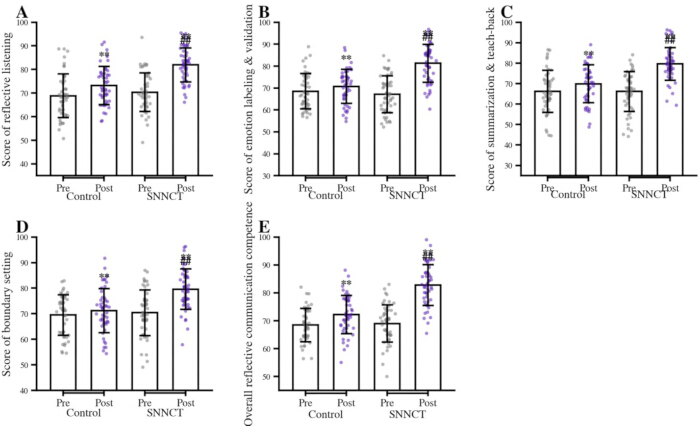
Figure 7. Pre–post changes in reflective communication competence. Individual nurse observations and group summaries are shown for the control group (n = 30) and the SNNCT group (n = 38). (A) Reflective listening. (B) Emotion labeling and validation. (C) Summarization and teach-back. (D) Boundary setting. (E) Overall reflective communication competence. Bars represent group means, and error bars represent standard deviations (SDs). P < 0.01 versus baseline within the same group; ##P < 0.01 versus the control group at the corresponding time point. Please click here to view a larger version of this figure.
Overall, the primary, patient-reported, and secondary outcome findings consistently favored the SNNCT intervention over standard outpatient training. Improvements were observed across nurse-reported outcomes, patient-reported communication experiences, and communication competence assessments, supporting the study hypothesis that a standardized visual narrative communication pathway can enhance outpatient nursing communication performance under routine clinical conditions.
Predictors
To further investigate factors associated with high-quality narrative communication following implementation of the SNNCT, a multivariable mixed-effects regression model was constructed incorporating nurse characteristics, workload measures, and implementation process indicators. The analysis demonstrated that implementation-related factors showed the strongest associations with communication quality. Higher implementation fidelity, greater use of the visual communication tools during outpatient encounters, and participation in reflective debriefing were each associated with higher narrative communication quality scores. These findings suggest that consistent implementation of the communication pathway, rather than training alone, was associated with improved communication performance. Detailed regression results are presented in Figure 8.
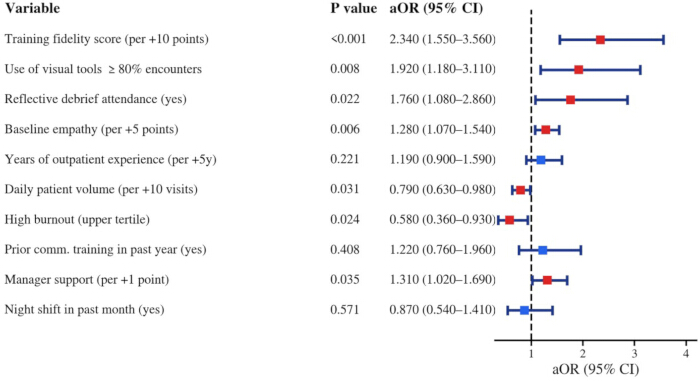
Figure 8. Factors associated with high-quality narrative communication performance. Adjusted odds ratios (aORs) and 95% confidence intervals (CIs) are shown for training fidelity, visual-tool use, reflective-debrief attendance, baseline empathy, outpatient experience, daily patient volume, burnout, previous communication training, manager support, and night-shift work. The dashed vertical line indicates an aOR of 1.0. Red squares indicate statistically significant associations (P < 0.05), whereas blue squares indicate non-significant associations (P ≥ 0.05). Estimates were obtained using a multivariable mixed-effects logistic regression model with encounters nested within nurses and a nurse-level random intercept. High-quality narrative communication performance was defined a priori as a total Narrative Communication Coding Protocol score of at least 49 of 70 (70% of the maximum score). All variables were entered simultaneously into the model. Outpatient specialty was included as a fixed covariate, and no additional shift-level random effect was fitted. Please click here to view a larger version of this figure.
Baseline empathy was also positively associated with post-intervention communication quality, suggesting that nurses with stronger baseline empathic abilities demonstrated greater communication performance following the intervention. In contrast, higher clinical workload, including greater patient volume, and less favorable psychological work conditions were negatively associated with communication quality, indicating that demanding outpatient environments may reduce the consistency of reflective listening and empathic communication.
Process and mechanism
Process evaluation demonstrated higher implementation quality in the SNNCT group than in the control group during routine outpatient practice. Nurse-level implementation summaries showed greater adherence to the core communication modules and more frequent use of the visual communication tools among nurses receiving the intervention. High adherence was observed for narrative elicitation, emotional cue recognition, empathic validation, reflective summarization, and other key communication components, accompanied by higher overall implementation fidelity scores. These findings indicate that the intervention was successfully integrated into routine outpatient workflows. Detailed implementation fidelity outcomes are presented in Table 4.
Independent behavioral assessments further demonstrated higher communication quality among nurses in the SNNCT group. Structured ratings performed by independent evaluators showed consistently higher scores across individual communication modules and for the overall communication quality score compared with the control group, with excellent inter-rater reliability. Improvements were particularly evident for empathic validation, reflective summarization, and shared planning and teach-back behaviors, indicating more consistent demonstration of these communication skills following the intervention. Detailed communication quality ratings are presented in Table 5.
Mediation analysis demonstrated that the SNNCT intervention was associated with improved patient-reported communication outcomes. After empathy and reflective practice were incorporated into the mediation model, the direct intervention effect remained statistically significant but was attenuated, whereas significant indirect effects were observed through empathy, reflective practice, and their combined pathway. Collectively, the indirect pathways accounted for more than half of the total intervention effect, indicating that improvements in empathy and reflective practice were associated with improved patient-reported communication experiences. Detailed mediation analysis results are presented in Table 6.
Sensitivity analyses demonstrated that the observed intervention effects remained consistent across outpatient specialties, nurse experience levels, and workload categories. Similar adjusted intervention effects were observed after additional adjustment for burnout, indicating that the findings were robust across the evaluated sensitivity analyses. Detailed subgroup and sensitivity analyses are presented in Table 7.
Overall, the process evaluation, behavioral assessments, mediation analysis, and sensitivity analyses consistently supported the implementation of the SNNCT intervention. Higher implementation fidelity and improved communication behaviors were associated with favorable nurse- and patient-reported outcomes, while the robustness analyses demonstrated that these findings were generally consistent across the evaluated outpatient settings and participant subgroups.
Data Availability:
The de-identified datasets underlying the tables and figures, together with the accompanying data dictionary and codebook, are publicly available in the Zenodo repository at https://zenodo.org/records/21355169.
Discussion
This study proposed a SNNCT that integrates standardized narrative communication modules with visual implementation tools to support outpatient nurses during routine clinical practice. The findings demonstrated improvements in nurses’ empathy, reflective practice, communication self-efficacy, patient-centered professional values, and patient-reported communication experiences following implementation of the intervention. These observations are consistent with previous studies suggesting that narrative communication training and structured reflective practice facilitate recognition of patients’ emotional and experiential cues while promoting more supportive communication behaviors29. By embedding empathy and reflective practice into standardized, workflow-oriented communication steps, SNNCT extends these concepts into a structured approach suitable for high-volume outpatient settings30.
A notable feature of the proposed approach is the transformation of narrative communication principles into visual pathways and standardized behavioral prompts that can be incorporated into routine outpatient workflows. Previous studies of narrative medicine and reflective communication have reported improvements in clinician-patient interactions and emotional awareness but have also identified challenges related to implementation consistency in busy clinical environments21. The present findings suggest that standardized visual communication pathways may facilitate implementation by supporting key communication behaviors, including narrative elicitation, emotional cue recognition, empathic validation, reflective summarization, and shared planning. These observations are consistent with previous reports that structured visual tools may reduce cognitive demands during complex clinical communication while supporting more consistent behavioral performance31.
The observed improvements in patient-reported communication experiences further support the potential value of this approach for outpatient nursing practice. Patients reported greater perceptions of being heard and understood, clearer communication regarding treatment plans, improved emotional support, and stronger participation in shared decision-making. These findings are consistent with previous studies demonstrating that communication quality influences patient experience, information clarity, emotional support, and collaborative care32,33. The results suggest that standardized narrative communication techniques can be incorporated into brief outpatient encounters while maintaining patient-centered communication within routine clinical workflows.
Implementation process analyses demonstrated that higher implementation fidelity, consistent use of the visual communication tools, and participation in reflective debriefing were associated with higher communication quality, whereas heavier clinical workloads and less favorable psychological work conditions were associated with lower communication performance. These findings are consistent with previous reports describing the influence of workload and burnout on communication quality and nursing performance19,34. The findings therefore suggest that successful implementation depends not only on the training content but also on organizational support, reinforcement strategies, supervision, and opportunities for ongoing reflective practice35,36. These observations may inform the design of future communication training programs by emphasizing sustained implementation rather than one-time educational interventions.
This study has several strengths. It evaluated a workflow-integrated intervention in routine outpatient practice; triangulated nurse-reported, patient-reported, and independently rated outcomes; measured implementation dose, fidelity, and acceptability; and examined both intervention effects and the proposed mechanisms. The findings should nevertheless be interpreted in light of several important limitations. The single-center, modest-sized, nonrandomized sample permits residual confounding and limits generalizability. In addition, the groups may have differed in attention because the control training was less structured. Follow-up was limited to 8–12 weeks. Several secondary and patient-reported instruments were study-specific and lacked documented external validation, and the locally developed independent-rating protocol may limit external reproducibility despite the use of masked raters. Self-report measures may have been affected by social desirability bias, some repeated measurements were incomplete, and acceptability was not measured before implementation. Future research should use adequately powered multicenter cluster-randomized designs, longer follow-up, validated and culturally adapted instruments, prespecified qualitative implementation evaluations, and explicit testing of organizational workload and support as implementation moderators.
In conclusion, this study demonstrates the feasibility of implementing the Standardized Narrative Nursing Communication Technique in outpatient nursing practice and suggests that the intervention is associated with improvements in nurse communication behaviors and patient-reported communication experiences. Process evaluation further indicates that implementation fidelity and consistent application of the communication modules are associated with the observed outcomes. Collectively, these findings support the potential application of standardized visual narrative communication pathways as a reproducible approach for outpatient nursing communication and provide a foundation for future evaluation in broader clinical settings.
Disclosures
Conflict of Interest: The authors have nothing to disclose.
Acknowledgements
We sincerely thank the participating outpatient nurses and patients for their valuable contributions to this study. This work was supported by the 2021 Sichuan Provincial Nursing Research Project (Project: Research on the influence of psychological intervention from the perspective of positive psychology on the brain function and psychology of standardized training nurses). We also gratefully acknowledge the Department of Nursing at Beijing Anzhen Nanchong Hospital of Capital Medical University & Nanchong Central Hospital for their administrative support.
Materials
| Name | Company | Catalog Number | Comments |
|---|---|---|---|
| Audio/video Recording Equipment | Research site (institutional audio/video recording equipment) | Not applicable; no specific make or model identified in the manuscript | Used to record nurse–patient communication encounters at T0, T1, and T2 for masked independent behavioral assessment. |
| Communication Self-Efficacy Scale | Department of Nursing, Beijing Anzhen Nanchong Hospital of Capital Medical University & Nanchong Central Hospital | Study-specific, content-reviewed and cognitively pilot-tested version; 0–100 scoring | Locally developed nurse-reported outcome measuring communication self-efficacy. Higher scores indicate greater self-efficacy; no external validation is claimed. |
| Empathy Script Library | Department of Nursing, Beijing Anzhen Nanchong Hospital of Capital Medical University & Nanchong Central Hospital | Custom-developed | Standardized phrase bank supporting emotional cue recognition, empathic validation, reflective listening, and summarization during outpatient encounters. |
| Jefferson Scale of Empathy–Health Professionals (JSE-HP) | Thomas Jefferson University; validated Chinese Healthcare Providers version described by Cheng et al. (2011) | Validated Chinese JSE-HP Healthcare Providers version; 20 items; 7-point responses | Measures nurse empathy. Total scores range from 20 to 140, with higher scores indicating greater empathy. No alternative or abbreviated JSE form was used. |
| Microlecture Training Modules | Department of Nursing, Beijing Anzhen Nanchong Hospital of Capital Medical University & Nanchong Central Hospital | Version 1.0 | Instructional modules used during the 3.5-week SNNCT program together with demonstrations, simulation, role play, drills, and OSCE practice. |
| Narrative Communication Coding Protocol | Department of Nursing, Beijing Anzhen Nanchong Hospital of Capital Medical University & Nanchong Central Hospital | Custom-developed; seven modules scored 0–10 each (total score: 0–70) | Used by two trained independent raters to assess de-identified recordings presented in random order; raters were masked to group allocation and time point. |
| Patient-Centered Care Values Inventory | Department of Nursing, Beijing Anzhen Nanchong Hospital of Capital Medical University & Nanchong Central Hospital | Study-specific, content-reviewed and cognitively pilot-tested version; 1–5 item-mean scoring | Assesses patient-centered professional values. Scores were reported as a 1–5 item mean and linearly transformed to a 0–100 scale for graphical presentation; no external validation is claimed. |
| Patient Communication Experience Questionnaire | Department of Nursing, Beijing Anzhen Nanchong Hospital of Capital Medical University & Nanchong Central Hospital | Study-specific, cognitively pilot-tested 8-item version; four domains; 5-point responses | Assesses feeling heard, emotional support, information clarity, and shared decision-making. Domain scores were calculated as (mean item score − 1)/4 × 100; the overall score is the mean of the four domain scores. No external validation is claimed. |
| Pocket Cards (Quick-reference Guides) | Department of Nursing, Beijing Anzhen Nanchong Hospital of Capital Medical University & Nanchong Central Hospital | Version 1.0 | Quick-reference visual guides supporting use of the seven-step SNNCT pathway during routine outpatient communication. |
| Reflective Practice Questionnaire (RPQ) | Priddis and Rogers (2018); doi:10.1080/14623943.2017.1379384 | Original 40-item, 6-point version; Chinese study translation prepared by forward translation, reconciliation, and back-translation | Measures reflective practice. Mean scores range from 1 to 6, with higher scores indicating greater reflective capacity. The Chinese study translation underwent clinical review before pilot testing. |
| R Statistical Software | R Foundation for Statistical Computing, Vienna, Austria | R version 4.6.0; lme4, lmerTest, emmeans, lavaan, boot, and performance packages | Used for descriptive analyses, linear and generalized linear mixed-effects models, serial mediation with 5,000 bootstrap resamples, and robustness analyses. |
| Situational Simulation Scenarios | Department of Nursing, Beijing Anzhen Nanchong Hospital of Capital Medical University & Nanchong Central Hospital | Version 1.0 | Role-play and OSCE scenarios used for practice, calibration, feedback, and transfer of SNNCT behaviors to outpatient encounters. |
| SNNCT Implementation Fidelity Checklist | Department of Nursing, Beijing Anzhen Nanchong Hospital of Capital Medical University & Nanchong Central Hospital | Custom-developed per-encounter checklist | Contains predefined criteria for each communication component. Key thresholds included visual-tool use in at least 80% of encounters and completion of at least six core components in at least 70% of encounters. |
| Structured Reflective Debriefing Templates | Department of Nursing, Beijing Anzhen Nanchong Hospital of Capital Medical University & Nanchong Central Hospital | Version 1.0 | Templates supporting structured post-encounter reflection, feedback, reflective summaries, and weekly debriefing. |
| Teach-Back Checklists | Department of Nursing, Beijing Anzhen Nanchong Hospital of Capital Medical University & Nanchong Central Hospital | Version 1.0 | Checklists used to document teach-back and verify patient understanding of treatment and follow-up information. |
| Visualized Standardized Narrative Nursing Communication Technique (SNNCT) Toolkit (Flowcharts and Decision Trees) | Department of Nursing, Beijing Anzhen Nanchong Hospital of Capital Medical University & Nanchong Central Hospital | Version 1.0 | Core intervention package comprising workflow maps, decision trees, pocket cards, phrase banks, teach-back checklists, and structured debriefing templates. |
References
- Battaglia R, Start R, Morin M. Ambulatory care nurse-sensitive indicators series: Starting with low-hanging fruit: Proposing the adaptation of health care measures to the role of the nurse in ambulatory care. Nurs Econ. 2016;34(4):199-205.
- Manary MP, Boulding W, Staelin R, Glickman SW. The patient experience and health outcomes. N Engl J Med. 2013;368(3):201-203.
- Kwame A, Petrucka PM. A literature-based study of patient-centered care and communication in nurse-patient interactions: Barriers, facilitators, and the way forward. BMC Nurs. 2021;20(1):158.
- Zolnierek KB, DiMatteo MR. Physician communication and patient adherence to treatment: A meta-analysis. Med Care. 2009;47(8):826-834.
- Claramita M, Susilo AP. Bridging the Communication Gap in Health Care. Cham: Springer; 2024.
- Cant RP, Cooper SJ. Simulation-based learning in nurse education: A systematic review. J Adv Nurs. 2010;66(1):3-15.
- Charon R. The Principles and Practice of Narrative Medicine. New York, NY: Oxford University Press; 2017.
- Egnew TR. The meaning of healing: Transcending suffering. Ann Fam Med. 2005;3(3):255-262.
- Chu SY, Wen CC, Lin CW. A qualitative study of clinical narrative competence of medical personnel. BMC Med Educ. 2020;20(1):415.
- Hojat M, et al. Physicians’ empathy and clinical outcomes for diabetic patients. Acad Med. 2011;86(3):359-364.
- Derksen F, Bensing J, Lagro-Janssen A. Effectiveness of empathy in general practice: A systematic review. Br J Gen Pract. 2013;63(606):e76.
- Mann K, Gordon J, MacLeod A. Reflection and reflective practice in health professions education: A systematic review. Adv Health Sci Educ Theory Pract. 2009;14(4):595-621.
- Miraglia R, Asselin ME. Reflection as an educational strategy in nursing professional development: An integrative review. J Nurses Prof Dev. 2015;31(2):62-72.
- May C, Finch T, Rapley T. Normalization Process Theory. In: Nilsen P, Birken SA, eds. Handbook on Implementation Science. Cheltenham: Edward Elgar Publishing; 2020:144-167. doi:10.4337/9781788975995.00013.
- Siaki LA, et al. Ambulatory care nurse-sensitive indicators: A scoping review of the literature, 2006-2021. J Nurs Care Qual. 2023;38(1):76-81.
- Delgado C, et al. Nurses’ resilience and the emotional labour of nursing work: An integrative review of empirical literature. Int J Nurs Stud. 2017;70:71-88.
- Kim D, Sung NJ. Types of usual source of care and patient-centered communications. Korean J Fam Med. 2022;43(6):353.
- Foronda C, MacWilliams B, McArthur E. Interprofessional communication in healthcare: An integrative review. Nurse Educ Pract. 2016;19:36-40.
- Dall’Ora C, Ball J, Reinius M, Griffiths P. Burnout in nursing: A theoretical review. Hum Resour Health. 2020;18(1):41.
- Cavanagh N, et al. Compassion fatigue in healthcare providers: A systematic review and meta-analysis. Nurs Ethics. 2020;27(3):639-665.
- Milota MM, van Thiel GJ, van Delden JJM. Narrative medicine as a medical education tool: A systematic review. Med Teach. 2019;41(7):802-810.
- Briceland LL, Caimano Tackes C, Veselov M. A structured self-reflection approach to improve reflection quality and assessment of advanced pharmacy practice experience professionalization. J Am Coll Clin Pharm. 2022;5(5):516-523.
- Jiao JR, Zheng YX, Hao WN. Empathy ability of nursing students: A systematic review and meta-analysis. Medicine (Baltimore). 2022;101(32):e30017.
- Venktaramana V, et al. A systematic scoping review of communication skills training in medical schools between 2000 and 2020. Med Teach. 2022;44(9):997-1006.
- Mehner L, Rothenbusch S, Kauffeld S. How to maximize the impact of workplace training: A mixed-method analysis of social support, training transfer and knowledge sharing. Eur J Work Organ Psychol. 2025;34(2):201-217.
- Cheng JF, Lai YM, Livneh H, Tsai TY. Establishing reliability and validity of the Chinese version of the Jefferson Scale of Empathy (Healthcare Providers version). Hu Li Za Zhi. 2011;58(2):41-48.
- Priddis L, Rogers SL. Development of the Reflective Practice Questionnaire: Preliminary findings. Reflect Pract. 2018;19(1):89-104.
- Brooke J. SUS: A quick and dirty usability scale. In: Jordan PW, Thomas B, McClelland IL, Weerdmeester BA, editors. Usability Evaluation in Industry. London: Taylor & Francis; 1996. p. 189-194.
- Fioretti C, et al. Research studies on patients’ illness experience using the narrative medicine approach: A systematic review. BMJ Open. 2016;6(7):e011220.
- Müller M, et al. Impact of the communication and patient hand-off tool SBAR on patient safety: A systematic review. BMJ Open. 2018;8(8):e022202.
- Sweller J, van Merriënboer JJG, Paas F. Cognitive architecture and instructional design: 20 years later. Educ Psychol Rev. 2019;31(2):261-292.
- Iacorossi L, et al. Patient-nurse communication in an oncology hospital setting: A qualitative study. Healthcare (Basel). 2025;13(1):50.
- Assaye AM, Wiechula R, Schultz TJ, Feo R. Impact of nurse staffing on patient and nurse workforce outcomes in acute care settings in low- and middle-income countries: A systematic review. JBI Evid Synth. 2021;19(4):751-793.
- Molina-Mula J, Gallo-Estrada J. Impact of nurse-patient relationship on quality of care and patient autonomy in decision-making. Int J Environ Res Public Health. 2020;17(3):835.
- Nilsen P, Ståhl C, Roback K, Cairney P. Never the twain shall meet? A comparison of implementation science and policy implementation research. Implement Sci. 2013;8:63.
- Ivers N, et al. Audit and feedback: Effects on professional practice. Cochrane Database Syst Rev. 2025;3:CD000259.