This study evaluates the association between immunological markers and infection risk after ureteroscopic lithotripsy in patients with upper urinary tract calculi, providing evidence for risk stratification and clinical decision support.
A subscription to JoVE is required to view this content. Sign in or start your free trial.
Research Article
Immunological Markers Associated with Postoperative Infection After Ureteroscopic Lithotripsy in Patients With Upper Urinary Tract Calculi
* These authors contributed equally
In This Article
Summary
Abstract
Postoperative infection is a severe complication of ureteroscopic lithotripsy for upper urinary tract calculi. This study aimed to analyze the association of immunological markers, including C-reactive protein (CRP), albumin (ALB), and heparin-binding protein (HBP), with postoperative infection. A total of 177 patients who underwent surgery between June 2020 and June 2024 were enrolled. Patients were classified into an infection group (41 cases) and a non-infection group (136 cases) based on postoperative infection status. Multivariate logistic regression and receiver operating characteristic (ROC) curve analyses were performed. Results showed that postoperative HBP, CRP, and ALB levels were independent factors associated with postoperative infection (p < 0.05). The optimal cutoff values were 19.56 mg/L for CRP, 40.7 g/L for ALB, and 79.05 ng/mL for HBP, with area under the curve (AUC) values of 0.684, 0.654, and 0.733, respectively. Combined detection of the three indicators yielded an AUC of 0.803 (p < 0.05). In conclusion, postoperative CRP, ALB, and HBP are associated with postoperative infection after ureteroscopic lithotripsy and may aid in risk assessment. Further validation is needed before clinical application.
Introduction
Calculus of the upper urinary tract is a common urological disease, primarily referring to stone lesions occurring in the kidneys and ureters. Statistics show that the global incidence of upper urinary tract calculi ranges from 2% to 20%, with rates of up to 12% in American men and 6% in women, and this incidence is on the rise year by year1,2,3. China is one of the three major global regions with a high incidence of urinary stones. A recent systematic review and meta-analysis including 46 studies from 22 provinces reported a pooled prevalence of urolithiasis of 8.1% in China, with the highest rates observed in Guangdong (12.7%) and Guangxi (10.3%), and the prevalence is increasing over time, posing a significant threat to patients' health4. Surgery is one of the main treatments for urinary tract stones. Traditional open surgery for stone removal is highly invasive and associated with numerous postoperative complications, and is thus gradually being abandoned5. With the development of minimally invasive techniques and medical equipment, extracorporeal shock wave lithotripsy, ureteroscopic lithotripsy, and percutaneous nephrolithotomy have been widely used in clinical practice. According to the American Urological Association (AUA) guidelines, ureteroscopic lithotripsy is recommended as a first-line treatment for patients with upper urinary tract calculi due to its minimal invasiveness, high stone fragmentation rate, and favorable postoperative recovery6,7. However, residual stones during and after surgery may not be rapidly expelled, leading to ureteral obstruction, pain, and especially postoperative infection8. Foreign studies have shown that severe infections after ureteroscopic lithotripsy can lead to septic shock, which is life-threatening9. Therefore, early monitoring of postoperative infections is of great significance for improving treatment outcomes and reducing the risk of complications.
With advances in medical science and technology, an increasing number of biomarkers and new detection technologies have been introduced into the diagnosis and treatment of upper urinary tract calculi complicated by infection, enabling precision medicine. Identifying immunological markers associated with postoperative ureteroscopic lithotripsy infection in patients with upper urinary tract calculi is critical for early detection and improved cure rates. Postoperative biomarkers measured within 24 h after surgery may reflect early host immune responses before clinical symptoms manifest, potentially serving as early indicators for risk assessment. However, the expression of immunological markers in the peripheral blood of these patients and their predictive value for ureteroscopic lithotripsy postoperative infection remain unclear. This study retrospectively analyzed the clinical data of 177 patients with upper urinary tract calculi who underwent ureteroscopic lithotripsy, exploring the relationship between immunological markers (HBP, CRP, ALB) and postoperative infection, to provide new ideas and methods for clinical prediction and prevention of postoperative infection in this patient population.
Access restricted. Please log in or start a trial to view this content.
Protocol
Study design and ethics statement
This retrospective study was conducted in accordance with the Declaration of Helsinki. Approval was obtained from the Ethics Committee of The Second Hospital of Nanjing (Approval No. [2026-LS-ky054]) before data collection and analysis.
Patient selection
The electronic medical records of consecutive patients diagnosed with upper urinary tract calculi who underwent ureteroscopic lithotripsy at the Department of Urology of The Second Hospital of Nanjing between June 2020 and June 2024 were reviewed. The inclusion criteria were as follows: diagnosis of upper urinary tract calculi confirmed by computed tomography (CT) or ultrasonography; presence of preoperative stone-related symptoms, including frequent urination, urgency, or dysuria (not attributed to infection); clear surgical indications based on preoperative evaluation; and no history of immunosuppressive agent or broad-spectrum antimicrobial use within the past month. The exclusion criteria were as follows: presence of other infectious diseases before surgery; concurrent serious medical conditions affecting immune status; pregnancy or lactation; unsuccessful surgical procedures; cognitive impairment, mental disorders, substance abuse, or alcohol dependence; history of cerebral hemorrhage or concurrent malignancy; and other conditions causing abdominal pain, such as cholecystitis or appendicitis. and receipt of antibiotic therapy within two weeks before surgery. A total of 246 patients were initially screened. After excluding 69 patients, 177 were included in the final analysis. The patient selection process is illustrated in Figure 1.
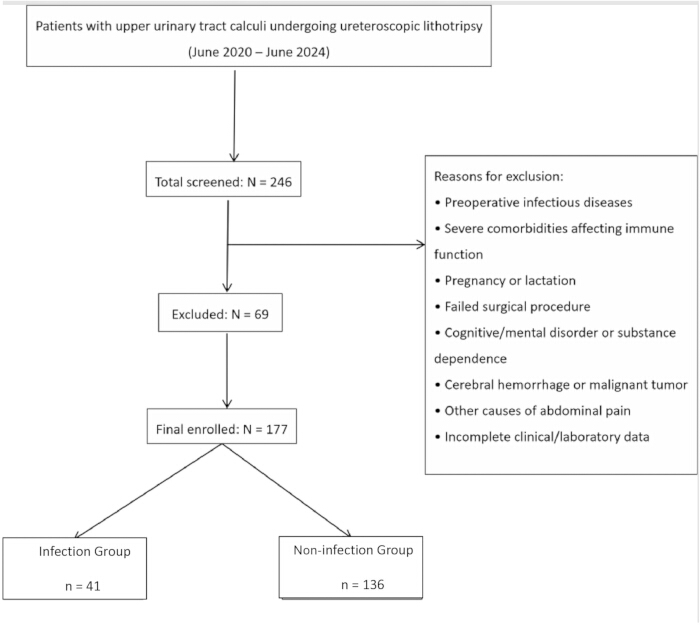
Figure 1: Flowchart of patient selection. A total of 246 patients were initially screened. After excluding 69 ineligible patients, 177 patients were finally enrolled, including 41 in the infection group and 136 in the non-infection group. Please click here to view a larger version of this figure.
Surgical procedures
All patients underwent flexible ureteroscopic lithotripsy under general or spinal anesthesia. A flexible ureteroscope (7.5 Fr) was used to access the renal pelvis and calyces. Stone fragmentation was performed using a holmium: YAG laser (0.6–1.0 J, 10–15 Hz). A ureteral access sheath was used when necessary. A double-J stent was placed postoperatively in cases of ureteral injury, significant edema, or suspected residual fragments. All patients received prophylactic antibiotics (first- or second-generation cephalosporin) within 30–60 min before incision.
Postoperative infection definition
Postoperative infection was defined according to the European Association of Urology (EAU) guidelines on urological infections (2024)10, based on the presence of any of the following criteria within 30 days after surgery: body temperature > 38 °C or < 36 °C; new-onset urinary symptoms including frequent urination, urgency, dysuria, or lower abdominal tenderness; urinalysis showing ≥ 10 white blood cells per high-power field in female patients or ≥ 5 in male patients; positive urine culture (≥ 105 colony-forming units/mL) as recommended by the EAU guidelines; and initiation of antibiotic therapy for suspected urinary tract infection. Clinical adjudication was performed by two independent urologists, and any disagreement was resolved by consensus.
Data collection
Demographic and clinical data extracted from the electronic medical record system included: age, gender, comorbidities (hypertension, diabetes), stone location (left renal, right renal, left ureter, or right ureter), stone size (mm), operation time (minutes), and hospital stay (days). Laboratory results for serum albumin (ALB) and C-reactive protein (CRP) were retrieved from the clinical laboratory database for blood samples collected within 24 h before and after surgery. Urinalysis results were also retrieved, and white blood cell counts were recorded. Heparin-binding protein (HBP) levels were measured using stored plasma samples with a commercial ELISA kit (see Table of Materials), following the manufacturer's instructions. Data extraction was performed by two independent investigators, and any discrepancies were resolved by consensus.
Statistical analysis
Patients with incomplete data were excluded during the selection process. Thus, all 177 included patients had complete data for all key variables (CRP, ALB, HBP, and clinical characteristics). All statistical analyses were performed using SPSS version 24.0 (Table of Materials). Categorical variables were expressed as frequencies and percentages [n (%)] and compared using the chi-square (χ2) test. Continuous variables were tested for normal distribution using the Shapiro-Wilk test. Normally distributed continuous variables were expressed as mean ± standard deviation (x̄ ± s) and compared using the independent two-sample t-test. Non-normally distributed continuous variables were reported as medians with interquartile ranges [M(P25–P75)] and compared using the Mann-Whitney U test. Statistical significance was defined as p < 0.05. Multivariate logistic regression analysis was performed to identify independent risk factors for postoperative infection using the forward stepwise method. Results were reported as odds ratios (OR) with 95% confidence intervals (CI). Receiver operating characteristic (ROC) curves were constructed to evaluate the predictive performance of postoperative CRP, ALB, HBP, and their combination. The combined prediction value was generated using the predicted probability from a binary logistic regression model that included postoperative CRP, ALB, and HBP as covariates. The area under the curve (AUC) was recorded, and the optimal cutoff value was determined based on the maximum Youden index (sensitivity + specificity - 1).
Access restricted. Please log in or start a trial to view this content.
Results
Incidence of postoperative infection and univariate analysis
Among the 177 patients who underwent ureteroscopic lithotripsy, 41 (23.16%) developed postoperative infection and formed the infection group, while the remaining 136 patients (76.84%) constituted the non-infection group. Univariate statistical analysis showed significant differences in postoperative CRP, ALB, and HBP levels between the infection and non-infection groups (p < 0.05). No statistically significant differences were f...
Access restricted. Please log in or start a trial to view this content.
Discussion
In recent years, amid changes in lifestyle and dietary habits, the incidence of upper urinary tract calculi has been on the rise. Patients with upper urinary tract calculi often experience symptoms such as flank pain and abdominal pain. Without timely and effective intervention, the disease can progress to obstruction and infection, leading to renal insufficiency and severely compromising the patient's quality of life11,12. Although there are various treatmen...
Access restricted. Please log in or start a trial to view this content.
Disclosures
The authors declare that they have no financial conflicts of interest.
Acknowledgements
This study received no external funding. The authors thank the medical staff of the Department of Urology at The Second Hospital of Nanjing for their assistance in collecting clinical data.
Access restricted. Please log in or start a trial to view this content.
Materials
| Name | Company | Catalog Number | Comments |
|---|---|---|---|
| Automated biochemical analyzer | Beckman Coulter | AU5800 | For serum albumin (ALB) and C-reactive protein (CRP) measurement |
| Centrifuge | Eppendorf | 5810R | For plasma separation, 1,500 × g, 10 min, 4 °C |
| EDTA blood collection tubes | BD | 367861 | For peripheral venous blood collection |
| ELISA plate washer | Bio-Rad | 157510 | For automated washing of ELISA plates |
| Heparin-binding protein (HBP) ELISA kit | Hycult Biotech | HK330 | For quantitative detection of HBP in plasma |
| Micropipettes | Eppendorf | 3120000020 | For precise liquid handling (10 µL, 100 µL, 1000 µL) |
| Microplate reader | Bio-Rad | iMark | For absorbance measurement at 450 nm |
| Refrigerator | Haier | DW-86L486 | For sample storage at −80 °C |
| SPSS software | IBM | N/A | Version 24.0, for statistical analysis |
| Vortex mixer | IKA | MS 3 Basic | For mixing samples and reagents |