In this article, we present the preparation of MOF-gelatin hydrogels that benefit from the thermoreversible properties of gelatin, associated with its phase separation by coacervation. These hydrogel composites exhibit high MOF loading, large porosity, and a good spatial distribution of MOF particles within the gelatin matrix.
A subscription to JoVE is required to view this content. Sign in or start your free trial.
Method Article
Preparation of Metal-Organic Framework-Gelatin Hydrogels Through Coacervation
In This Article
Summary
Abstract
An original and reproducible strategy is presented for the synthesis of green and environmentally benign gelatin–Zr(IV) Metal-Organic Framework (MOF) hydrogel composites, and is described in a step-by-step manner throughout the article. The approach exploits the thermo-reversible nature of gelatin and its ability to undergo phase separation through coacervation, combined with the in situ formation of UiO-66–type MOFs under mild conditions. Using this methodology, the present work demonstrates the preparation of a bionanocomposite based on gelatin and the chemically stable Zr4⁺ dicarboxylate UiO-66 MOF. Importantly, this strategy can be extended to a broader family of Zr(IV) dicarboxylate and fumarate MOFs (UiO-66–type MOFs and MOF-801, respectively), selected to span a wide range of hydrophilic–hydrophobic balance and organic linker functionalizations. The resulting hydrogel composites display key features such as high MOF loadings (exceeding 50 wt%), high accessible porosity, and a homogeneous dispersion of MOF nanoparticles within the gelatin network. These properties arise from the strong interfacial compatibility between gelatin and MOF nanoparticles, as evidenced by complementary advanced characterization techniques. Owing to their robust mechanical behavior under ambient conditions, the composites can be processed at the gram scale into various macroscopic forms, such as coatings or monoliths, enabling their use in diverse applications, including the capture or catalytic conversion of pollutants in water or air under ambient conditions.
Introduction
Metal–organic frameworks (MOFs) constitute a family of porous, crystalline hybrid materials built from metal ions interconnected by polydentate organic ligands. Owing to their well-defined pore architectures, high internal surface areas, and tunable chemical functionalities, MOFs have attracted considerable scientific attention for diverse applications, including gas storage and separation, sensing, catalysis, biomedicine, and so on1. Despite this strong potential, several limitations still significantly restrict the large-scale transfer of MOFs toward industrial implementation. One of the major challenges lies in the shaping of such materials2. Indeed, conventional MOF syntheses typically yield brittle powders, whose inherent fragility, poor processability, and limited handling properties severely hinder their practical deployment. To address these issues, MOFs have been processed into pellets, granules, beads, fibers, or membranes; however, such shaping procedures often result in a partial or complete loss of accessible porosity2.
A widely explored strategy to overcome these drawbacks involves integrating MOFs with supporting matrices, particularly polymers or carbon-based materials such as carbon nanotubes, graphene, and graphene oxide3,4,5,6. This approach has led to the development of multifunctional composites that combine the intrinsic advantages of MOFs (porosity, crystallinity) with the mechanical robustness and processability of the host materials. In addition, hybridization can introduce new functionalities, including enhanced chemical stability, improved electrical conductivity, or hierarchical porosity3,4,5,6. As a result, MOF-based composites have been extensively investigated for gas adsorption and separation, water purification, catalysis, and bioapplications3,4,5,6,7,8. Nevertheless, a recurring limitation of such composites is the pronounced aggregation of MOF particles, which is generally attributed to poor interfacial compatibility between the MOFs and the supporting matrix. This issue is particularly prevalent in composites prepared by physically blending pre-synthesized MOF particles with polymers or graphene oxide and becomes increasingly severe at high MOF loadings, which are typically required to optimize performance3,4,5,6. To mitigate these challenges, numerous alternative strategies have been proposed to improve the physico-chemical affinity between MOFs and polymeric or carbon-based matrices while preserving MOF porosity. These include surface functionalization of MOF particles, covalent grafting of polymers onto MOF surfaces, in situ growth of MOFs within polymer matrices, polymer-directed MOF crystallization, or the use of polymeric ligands to construct polyMOFs3,4,5,6,7,8,9. Despite these advances, many MOF-polymer composites still suffer from reduced surface areas due to pore blockage by polymer chains and from inhomogeneous MOF dispersion. Moreover, their preparation often relies on multi-step, time-intensive synthetic routes, and the use of petrochemical-derived synthetic polymers raises concerns related to toxicity, sustainability, and environmental impact3,4,5,6.
The purpose of this article is to share the details of the preparation of a hydrogel composite based on a Zr4⁺ dicarboxylate UiO-66–type MOF (UiO = University of Oslo)10and gelatin. This system is selected as a representative example to illustrate a general synthetic strategy that can be extended to a broader family of polycarboxylate porous MOFs, including functionalized UiO-66 derivatives and MOF-801(Zr). Gelatin is a widely employed protein-based biopolymer in industrial applications such as drug and cosmetic microencapsulation, owing to its low cost, biodegradability, non-toxicity, and renewable origin11. In the past few years, MOF-gelatin hydrogels have been primarily investigated for bio-related applications such as tissue engineering, wound healing, drug delivery, and bioimaging12,13,14,15,16,17. These composites were generally prepared by impregnating preformed MOF particles into functionalized gelatin scaffolds or physical gelatin gels. While such materials exhibit promising biological performance, they typically contain very low MOF contents (below 10 wt%), resulting in limited porosity and consequently, restricting the exploitation of MOF-related physicochemical properties12,13,14,15,16,17. The present article describes a completely different strategy that exploits the thermoreversible properties of gelatin and its ability to undergo liquid-liquid phase separation18,19 associated with the room temperature (RT) in-situ formation of MOFs. In the protocol described in this article, critical steps in preparing the UiO-66/gelatin composites will be covered, including the preparation of gelatin solution, the gelatin coacervation process, the RT crystallization of UiO-66 within gelatin, and the shaping of the resulting composites. Such composites have been recently reported by some of us to develop adsorbents for cultural heritage preservation, but their protocol of synthesis was not described in detail20. We hope that the concepts and methodology presented in this article will motivate the research community to explore and develop a wider class of MOF-biopolymer composites. These materials simultaneously exhibit high MOF loadings (exceeding 80 wt%), large accessible porosity, homogeneous dispersion of MOF particles within the gelatin matrix, and tunable hydrophilic-hydrophobic characteristics20. A key advantage of employing biomacromolecules such as gelatin lies in their intrinsic chemical complexity, multifunctionality, and polyelectrolyte nature, which have no direct synthetic equivalents. This unique combination enables the effective integration of both hydrophilic and hydrophobic MOFs within a water-soluble biopolymer matrix.
Access restricted. Please log in or start a trial to view this content.
Protocol
1. Preparation of gelatin solutions
- Use commercial gelatin extracted from porcine skin (type A), with a Bloom of 175 g, an average molecular weight of approximately 40,000 g·mol⁻1, and an isoelectric point (IEP) of 8.
- Prepare an aqueous gelatin gel at 10 wt% concentration by swelling the gelatin granules in ultrapure water for a minimum duration of 3 h at 5 °C.
- Then, prepare an aqueous gelatin solution by heating the gelatin gel at 50 °C. Stir the gelatin solution using a magnetic stirrer for 30 min at 300 rpm. Once a clear gelatin solution is obtained, keep it at a temperature of 50 °C (Figure 1).
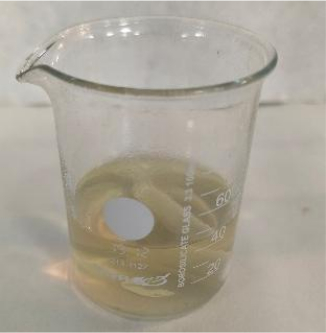
Figure 1: Photograph of an aqueous gelatin solution at a concentration of 10 wt%. Please click here to view a larger version of this figure.
2. Synthesis of UiO-66-gelatin hydrogel composite
- Synthesis of [Zr6O4(OH)4(OAc)12] (OAc = acetate) oxo cluster
- In a 20 mL scintillation vial, add 71 µL of a 70% zirconium propoxide solution in 1-propanol [Zr(OPrⁿ)₄] (0.0519 g, 0.158 mmol) to 7 mL of dimethylformamide (DMF) and 4 mL of acetic acid (4.196 g, 70 mmol) (Figure 2A).
- Heat the resulting mixture in an aluminum block on a hot plate at 130 °C for 2 h, during which a distinct color change from colorless to yellow is observed (Figure 2B).
- Leave the solution to cool at RT.
- In situ synthesis of UiO-66(Zr) in the presence of gelatin coacervate
- Mix 11 mL of the {Zr₆} oxo-cluster solution (0.158 mmol) obtained in step 2.1 with 0.5 mmol (84 mg) of 1,4-benzene dicarboxylic acid (1,4-bdc) organic linker.
- Stir the mixture for 15 min until a homogeneous dispersion is obtained.
- Then, add 2 mL of a 10 wt% gelatin solution, prepared in task 1 at 50 °C to this solution. (Figure 3).
- Stir the mixture at RT for 10 min, followed by the addition of 2 mL of ethanol.The solution turns turbid and white.
- Stir the resulting mixture at RT (20 °C) for 24 h. A liquid-liquid phase separation takes place progressively over time.
NOTE: Just after the addition of ethanol, the initial solution is white and turbid (Figure 4A) and then evolves with time to a macroscopically biphasic sample composed of a dilute solution of gelatin floating above a denser white viscous phase (Figure 4B–F). - For a complete phase separation, add 10 mL of ethanol to this mixture. After stirring the solution, extract the viscous phase from the supernatant solution in order to obtain the hydrogel composite (Figure 5).
- Leave this composite to dry at room temperature and further characterize it by combining powder X-ray diffraction (PXRD), thermogravimetric analysis, Fourier Transform Infrared (FT-IR) spectroscopy, N2 porosimetry, scanning and transmission electron microscopy (SEM and TEM), solid state nuclear magnetic resonance (NMR) and inductively coupled plasma atomic emission spectroscopy (ICP-AES) as previously reported20 (Figure 6).
- Shaping of UiO-66(Zr) /gelatin into monoliths
- Heat the viscous phase obtained in step 2.2.6, along with its supernatant, at 70 °C for 15 min, followed by 90 °C for 5 min.
NOTE: This treatment aimed to transform the MOF-gelatin hydrogel into a homogeneous liquid and viscous mixture that can be readily poured into a mold. - Then, pour the hydrogel without its supernatant solution into the mold thermalized at 70 °C.
- Form a monolith by cooling at RT for 15 min, then keep it at 2 °C for 1 day (Figure 7).
- Heat the viscous phase obtained in step 2.2.6, along with its supernatant, at 70 °C for 15 min, followed by 90 °C for 5 min.
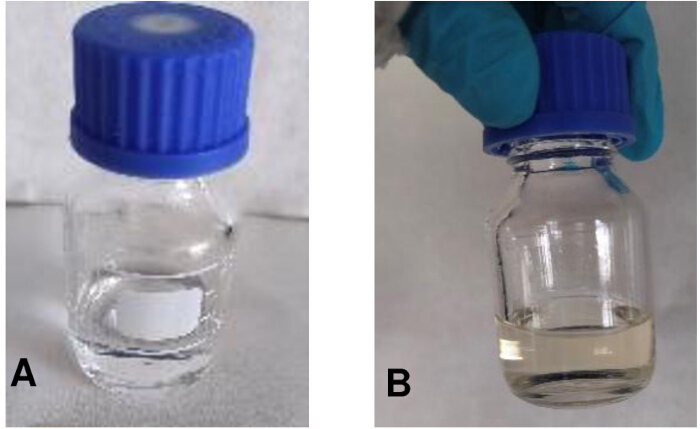
Figure 2: Photographs of a solution containing 71 µL of a 70% zirconium propoxide solution in 1-propanol [Zr(OPrⁿ)₄] (0.0519 g, 0.158 mmol), 7 mL of DMF, and 4 mL of acetic acid. (A) Before and (B) after heating at 130 °C for 2 h. Please click here to view a larger version of this figure.
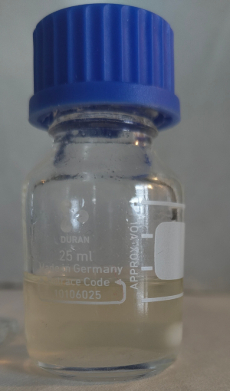
Figure 3: Photograph of the sample obtained after mixing 11 mL of the [Zr6O4(OH)4(OAc)12] oxo cluster (0.158 mmol), the 1,4-bdc linker (0.5 mmol), and 2 mL of the 10 wt% aqueous gelatin solution at RT. Please click here to view a larger version of this figure.
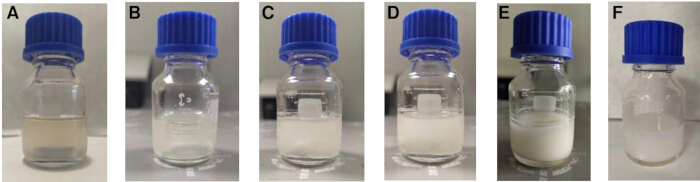
Figure 4: Photographs of samples containing the [Zr6O4(OH)4(OAc)12] oxo cluster, 1,4-bdc linker, and the 10 wt% aqueous gelatin solution at RT after the addition of 2 mL of ethanol. The photographs show the progressive liquid-liquid phase separation of gelatin upon aging the samples at different times: (A) 0 min, (B) 15 min, (C) 1 h, (D) 2 h, (E)18 h, (F) 24 h. Simultaneously, the reaction between [Zr6O4(OH)4(OAc)12] oxo cluster and 1,4-bdc linker gave rise to the formation of UiO-66(Zr) nanoparticles. Please click here to view a larger version of this figure.
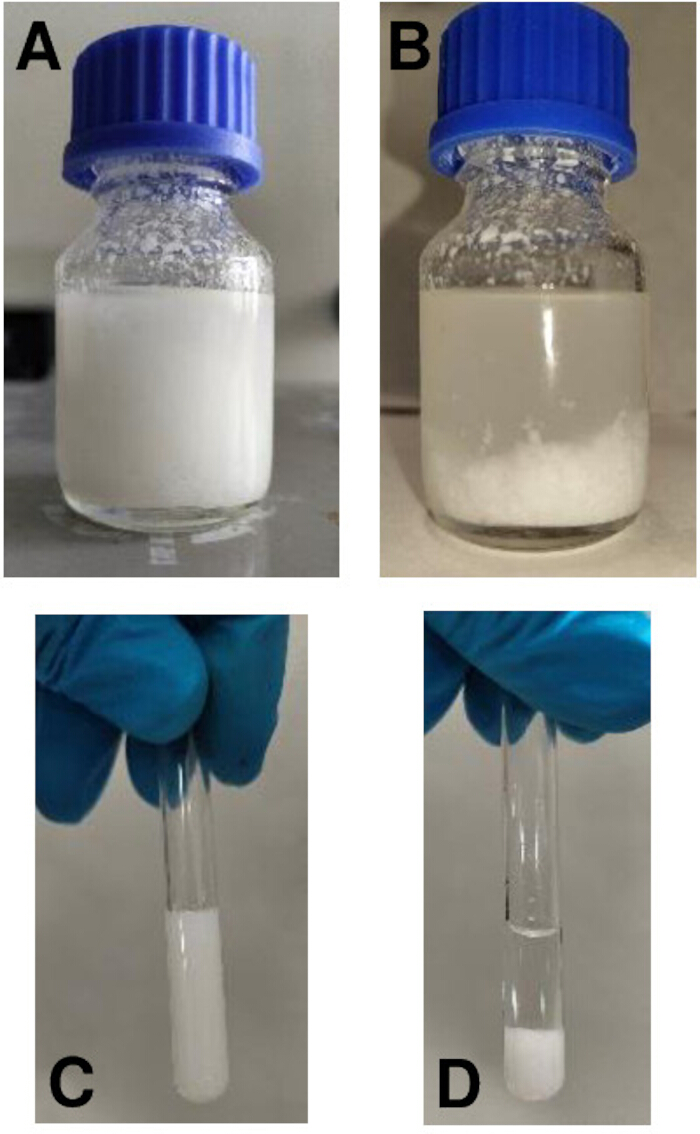
Figure 5: Photographs of samples containing gelatin and UiO-66(Zr). (A–D) Before (A,C) and after (B,D) adding 10 mL of ethanol. The solution initially white and turbid (A,C) turns into macroscopically biphasic samples containing a diluted gelatin solution and a viscous hydrogel (B,D). Please click here to view a larger version of this figure.
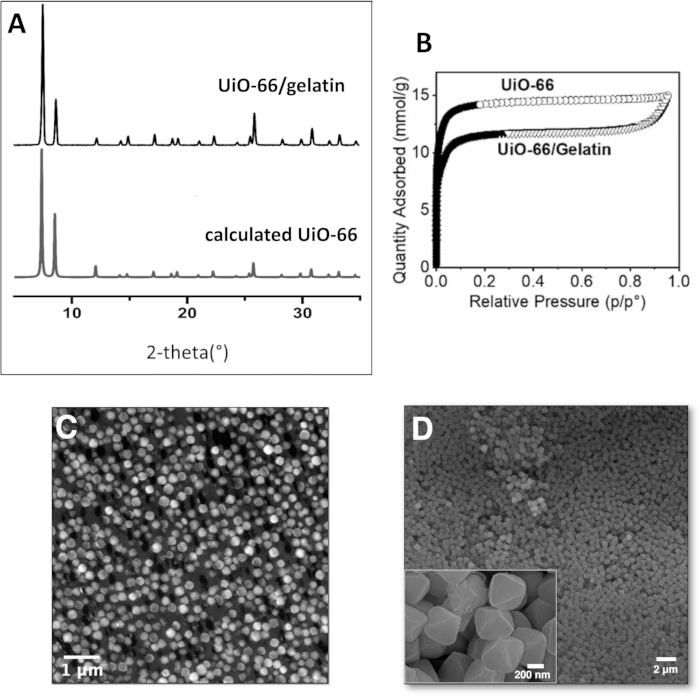
Figure 6: Characterization of UiO-66/gelatin hydrogel. (A) Experimental PXRD pattern of UiO-66/gelatin in comparison to the calculated pattern of UiO-66. (B) N2 porosimetry (adsorption, filled symbols; desorption, empty symbols) of UiO-66/gelatin in comparison to pure UiO-66 nanoparticles at 77 K (p°=1 atm). (C) TEM image of an 80 nm ultramicrotomed slice of the UiO-66/gelatin hydrogel. (D) SEM images of the UiO-66/gelatin hydrogel after washing in water. This figure has been reprinted (adapted) with permission from Biswas et al.20. Please click here to view a larger version of this figure.
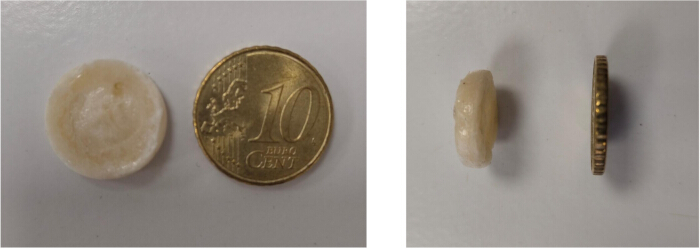
Figure 7: Photograph of shaped UiO-66/gelatin composite. Please click here to view a larger version of this figure.
Access restricted. Please log in or start a trial to view this content.
Results
The UiO-66(Zr)/gelatin hydrogel composite was synthesized by coupling the simple coacervation of gelatin with the in situ formation of UiO-66(Zr) nanoparticles. The synthetic protocol was repeated multiple times to ensure robustness, consistently yielding reproducible results (i.e., structural and physico-chemical characteristics of the composites) under identical experimental conditions. UiO-66(Zr) nanoparticles were prepared at RT following a previously reported two-step protocol, which involves the synthesis ...
Access restricted. Please log in or start a trial to view this content.
Discussion
Composites combining gelatin with inorganic materials such as metal oxides, hydroxyapatite, and layered double hydroxides have attracted significant interest due to their ability to integrate the biocompatibility and processability of gelatin with the functional properties of inorganic phases24,25. Gelatin provides a versatile organic matrix that can be easily shaped, crosslinked, and processed in aqueous media, while inorganic components impart mechan...
Access restricted. Please log in or start a trial to view this content.
Disclosures
The authors have nothing to disclose.
Acknowledgements
SB and NS acknowledge the financial support from the European Union’s Horizon 2020 program (Nemosine Project, grant agreement N°760801). SB and NS acknowledge the financial support from the ANR-11-LABEX-0039 (LabEx charmmmat). IM and NS acknowledge the financial support from l’École Universitaire de Recherche PSGS-HCH Humanités, Création, Patrimoine, Investissement d’Avenir ANR-17-EURE-0021 – Fondation des Sciences du Patrimoine. NNG and NS acknowledge the financial support from the French National Research Agency through the Domino grant no. ANR-22-CE08-0007.
Access restricted. Please log in or start a trial to view this content.
Materials
| Name | Company | Catalog Number | Comments |
|---|---|---|---|
| 1,4 benzene dicarboxylic acid | Acros Organics. | 180720010 | |
| 70% zirconium propoxide [Zr(OPrn)4] solution in 1-propanol | Sigma-Aldrich | 333972-100ML | |
| Acetic acid | Carlo Erba | 524520 | |
| Avance-NEO spectrometer | Bruker | NMR | |
| Dimethyl formamide | Carlo Erba | 528221 | |
| Ethanol | Carlo Erba | 528131 | |
| Gelatin | Sigma-Aldrich | G2625-100G | |
| Magna 550 Nicolet spectrophotometer | Nicolet | 550 series | FTIR |
| Scanning electron microscope | Jeol | JSM-7001F | SEM |
| Thermogravimetric analyzer | Model Perkin Elmer SDA 6000 | ||
| Trasmission electron microscope | Jeol | 2100F | TEM |
| X’Pert MDP diffractometer | Siemens | D5000 | XRD |
References
- Behera, N., Duan, J., Jin, W., Kitagawa, S. The chemistry and applications of flexible porous coordination polymers. EnergyChem. 3, 100067(2021).
- Liu, X. -M., Xie, L. -H., Wu, Y. Recent advances in the shaping of metal–organic frameworks. Inorg Chem Front. 7 (15), 2840-2866 (2020).
- Schmidt, B. V. K. J. Metal-organic frameworks in polymer science: polymerization catalysis, polymerization environment, and hybrid materials. Macromol Rapid Commun. 41 (1), 1900333(2020).
- Ma, K., et al. Fiber composites of metal–organic frameworks. Chem Mater. 32 (17), 7120-7140 (2020).
- Kalaj, M., et al. MOF-polymer hybrid materials: from simple composites to tailored architectures. Chem Rev. 120 (16), 8267-8302 (2020).
- Dassouki, K., Dasgupta, S., Dumas, E., Steunou, N. Interfacing metal organic frameworks with polymers or carbon-based materials: from simple to hierarchical porous and nanostructured composites. Chem Sci. 14, 12898-12925 (2023).
- Sun, Z., et al. Nanoscale MOFs in nanomedicine applications: from drug delivery to therapeutic agents. J Mater Chem B. 11, 3273-3294 (2023).
- Cheng, Y., Datta, S. J., Zhou, S., Jia, J., Shekhah, O., et al. Advances in metal-organic frameworks-based membranes. Chem Soc Rev. 51, 8300-8350 (2022).
- Mondal, P., Sensharma, D., Cohen, S. M. Tailoring polymer-metal-organic frameworks (polyMOFs) using telechelic poly(octenamer)s. Chem Sci. 16, 21842-21851 (2025).
- Cavka, J. H., et al. A new zirconium inorganic building brick forming metal organic frameworks with exceptional stability. J Am Chem Soc. 130, 13850-13851 (2008).
- Jonker, A. M., Löwik, D. W. P. M., Van Hest, J. C. M. Peptide-and protein-based hydrogels. Chem Mater. 24, 759-773 (2012).
- Deng, Z., et al. Injectable biomimetic hydrogels encapsulating gold/metal–organic frameworks nanocomposites for enhanced antibacterial and wound healing activity under visible light actuation. Chem Eng J. 420, 129668(2021).
- Hsieh, C. T., Ariga, K., Shrestha, L. K., Hsu, S. H. Development of MOF reinforcement for structural stability and toughness enhancement of biodegradable bioinks. Biomacromolecules. 22, 1053-1064 (2021).
- Jiang, Y., et al. Bioinspired adhesive and tumor microenvironment responsive nanoMOFs assembled 3D-printed scaffold for anti-tumor therapy and bone regeneration. Nano Today. 39, 101182(2021).
- Li, J., et al. Cobalt-based metal–organic framework as a dual cooperative controllable release system for accelerating diabetic wound healing. Nano Res. 13, 2268-2279 (2020).
- Sun, Y., et al. Tunable and controlled release of cobalt ions from metal-organic framework hydrogel nanocomposites enhances bone regeneration. ACS Appl Mater Interfaces. 13, 59051-59066 (2021).
- Tang, L., et al. Mechanically strong metal–organic framework nanoparticle-based double network hydrogels for fluorescence imaging. ACS Appl Nano Mater. 5, 1348-1355 (2022).
- Veis, A., Aranyi, C. Phase separation in polyelectrolyte systems. I. complex coacervates of gelatin. J Phys Chem. 64, 1203-1210 (1960).
- Carn, F., Steunou, N., Djabourov, M., Coradin, T., Ribot, F., et al. First example of biopolymer-polyoxometalate complex coacervation in gelatin mixtures. Soft Matter. 4, 735-738 (2008).
- Biswas, S., et al. Engineering of metal–organic frameworks/gelatin hydrogel composites mediated by the coacervation process for the capture of acetic acid. Chem Mater. 34, 9760-9774 (2022).
- DeStefano, M. R., Islamoglu, T., Garibay, S. J., Hupp, J. T., Farha, O. K. Room-temperature synthesis of UiO-66 and thermal modulation of densities of defect sites. Chem Mater. 29, 1357-1361 (2017).
- Khan, S. A., Schneider, M. Improvement of nanoprecipitation technique for preparation of gelatin nanoparticles and potential macromolecular drug loading. Macromol Biosci. 13, 455-463 (2013).
- Joly-Duhamel, C., Hellio, D., Djabourov, M. All gelatin networks: 1. biodiversity and physical chemistry. Langmuir. 18, 7208-7217 (2002).
- Utech, S., Boccaccini, A. R. A review of hydrogel-based composites for biomedical applications: enhancement of hydrogel properties by addition of rigid inorganic fillers. J Mater Sci. 51, 271-310 (2016).
- Steunou, N. Interfacing Gelatin with (Hydr)oxides and Metal Nanoparticles: Design of Advanced Hybrid Materials for Biomedical Engineering Applications. Advanced Materials Interfaces. , John Wiley & Sons. Hoboken, NJ, USA. (2016).
- Carn, F., et al. Assembling vanadium(V) oxide and gelatin into novel bionanocomposites with unexpected rubber-like properties. Chem Mater. 22, 398-408 (2010).
- Christodoulou, J., et al. Screening of aluminium based MOFs for effective in situ immobilization of biomolecules. Inorg Chem. 64, 2545-2553 (2025).
- Zhao, H., et al. Hierarchical superparamagnetic metal-organic framework nanovectors as anti-inflammatory nanomedicines. J Mater Chem B. 11, 3195-3211 (2023).
Access restricted. Please log in or start a trial to view this content.
Reprints and Permissions
