This protocol presents a microfluidic system for studying the microbial precipitation of manganese oxide minerals. Biomineral formation is measured in situ with optical microscopy and image analysis. This approach can be adapted to investigate the precipitation of other distinctively colored biogenic minerals in porous environments.
Method Article
A Microfluidic Platform to Investigate Microbial Precipitation of Metal Oxides in Porous Media
In This Article
Summary
Abstract
Microorganisms commonly precipitate metal oxide nanoparticles in soils, sediments, and other environmentally relevant porous media. However, the formation and reactivity of manganese (Mn) and iron (Fe) oxides remain poorly characterized in physically complex environments. While laboratory systems can incorporate porous media as a substrate, they require destructive sampling and are not readily amenable to pore-scale analyses. The dynamic yet inaccessible nature of porous media, therefore, requires the ability to resolve microbially mediated mineral precipitation in situ and in real time. To close this gap, a microfluidic platform is developed to evaluate microbial precipitation of metal oxides in a model pore space. This platform is validated with the Mn-oxidizing bacterium Pseudomonas putida GB-1. Biofilm development and associated Mn oxide precipitation are visualized under continuous flow with time-lapse color brightfield microscopy. An image subtraction algorithm is then combined with endpoint mass measurements to estimate the rate of Mn oxide precipitation. This approach provides a tool to systematically test how microbial precipitation of metal oxides varies in response to changing physical and chemical conditions.
Introduction
Metal oxide minerals play a critical role in biogeochemical cycling1. Manganese (Mn) and iron (Fe) oxides are negatively charged at circumneutral pH and readily sorb cationic metals2,3,4,5,6,7,8, regulating micronutrient availability and contaminant mobility in the rhizosphere and hyporheic zone. These minerals influence the stability and degradation of organic matter9,10,11,12, dictating carbon uptake by plants and soil microbes. In engineered systems (e.g., water treatment filters, constructed wetlands), metal oxide precipitation is directly leveraged for Mn or Fe removal and remediation of co-occurring contaminants13,14,15,16,17. These metal oxides are identifiable by their characteristic colors, which range from ochre to dark brown to black18,19.
The precipitation of metal oxides is commonly facilitated by microorganisms in a process known as biomineralization20,21,22. Numerous Mn-oxidizing bacteria and fungi synthesize multicopper oxidases and peroxidases that catalyze electron transfer from Mn(II) to Mn(III) and Mn(IV) under aerobic conditions, resulting in the precipitation of birnessite-like Mn(III, IV) oxide minerals2,23,24. Additionally, diverse Fe-oxidizing bacteria enzymatically oxidize Fe(II) to Fe(III) in circumneutral or acidic environments limited in oxygen, producing Fe(II, III) (oxyhydr)oxides, including ferrihydrite and magnetite25,26,27,28. These biogenic minerals precipitate adjacent to cell surfaces and accumulate on extracellular polymers, sheaths, and other cellular structures, forming microbe-mineral assemblages2,23,25,27,29,30.
Despite the ubiquity of Mn and Fe biomineralization in complex environments, pore-scale insights are lacking. Pore spaces are structurally heterogeneous, exhibiting preferential fluid flow and nonuniform reactant transport that dictate the distribution of biogeochemical reactions31,32,33,34,35. Further, microbial activity may generate local geochemical gradients that promote or limit biomineralization, while fluctuations in pore fluid chemistry (e.g., pH, dissolved oxygen, redox potential) may enhance mineral precipitation or facilitate dissolution34,35. Studies of Mn and Fe biomineralization typically rely either on well-mixed batch conditions30,36,37,38,39,40 or columns41,42,43,44 to quantify oxidation kinetics or characterize biomineral precipitates. However, batch experiments lack the spatial heterogeneity inherent to porous systems. Columns containing packed granular media provide relevant physical architecture but are limited in their utility because they require destructive sampling at static timepoints, which halts the experiment progression and prevents unperturbed pore-scale observations. Therefore, new experimental approaches are needed to investigate the microbial precipitation of metal oxides in porous media.
Microfluidic systems are a tool to study biogeochemical reactions in situ and in real time. Microfluidic reactors can be fabricated rapidly and at low cost with reproducible and customizable geometries that simulate natural or idealized porous media45. The resulting devices are optically transparent, facilitating non-destructive visualization and quantification of pore-scale processes, including biofilm formation46,47,48,49, hotspot development50,51, abiotic metal precipitation52,53, and calcite biomineralization34,54,55,56. Additionally, microfluidic systems allow users to control and systematically vary boundary conditions, including metal concentration, presence or absence of dissolved oxygen, and fluid flow rate. Finally, depending on the reactor substrate material, direct measurements of microbe-mineral-fluid interactions can be acquired using X-ray, Raman, or infrared spectroscopy57. The development of such a microfluidics-based platform to study the microbial precipitation of metal oxides thus provides an avenue for novel research on the formation and reactivity of Mn or Fe mineral phases that drive carbon, nutrient, and contaminant cycling in porous environments.
This work uses Mn biomineralization as a case study to quantify the microbial precipitation of metal oxides in a dynamic porous environment. The following protocol demonstrates how to fabricate and inoculate a microfluidic reactor with Pseudomonas putida GB-1, a model bacterium known to oxidize Mn(II) to Mn(III, IV) at its stationary phase of growth58,59. Using a pressure-based flow control system, nutrient-rich growth medium and minimal salt solution are sequentially injected to promote biofilm formation and induce Mn oxide precipitation, respectively. High-resolution color brightfield images of the microfluidic pore space are collected at regular time intervals, capturing the color contrast between P. putida GB-1 biofilms and accumulating Mn oxides. At the end of each experiment, all Mn oxides contained within the reactor are digested, and the total mass is measured with inductively coupled plasma mass spectrometry (ICP-MS). The rate of Mn oxide precipitation is estimated as a function of time by integrating these endpoint mass measurements with an image subtraction algorithm. This workflow can be readily adapted to investigate other organisms or metal oxide precipitation processes under a variety of environmental conditions.
Protocol
NOTE: This protocol makes several assumptions about users' background knowledge and available instrumentation. First, users should either have access to a cleanroom and be familiar with photolithography procedures to fabricate a microfluidic mold or purchase a commercial mold. Next, users should be familiar with basic microbiology methods, such as using aseptic technique, preparing stock solutions, and streaking plates. Users also need access to an autoclave, microcentrifuge, shaker incubator, and mass spectrometer. Finally, users should be proficient with optical microscopy and image analysis.
1. Microfluidic reactor fabrication and assembly
NOTE: The microfluidic reactors used in this protocol are designed in AutoCAD with a sand grain geometry adapted from Wang et al.55. Each mold produces six replicate channels with a 15 mm × 10 mm pore space, porosity of 0.41, and pore volume of 2.3 µL. Except for plasma treatment, reactors are fabricated in a laminar flow cabinet to maintain a low-dust environment.
- Cast the microfluidic channels in polydimethylsiloxane (PDMS) using soft lithography.
- In a plastic cup, weigh elastomer base and curing agent in a 10:1 ratio (here, 25 g and 2.5 g, respectively).
- Using a plastic knife, mix the elastomer base and curing agent thoroughly for 10 min.
- Degas the PDMS in the cup using a vacuum desiccator for 1 h to remove air bubbles.
- Pour the PDMS into the mold and degas for 30 min to remove any residual air.
- Place the mold on a hot plate and cure for 3 h at 95 °C.
- Once cured and cooled, use a scalpel to cut out the PDMS and peel it from the mold.
- On a cutting mat, cut the six microfluidic channels apart with a razor blade, leaving 2–3 mm around the edge of each channel. Punch inlet and outlet holes in each channel with a biopsy punch.
- Cover both sides of each microfluidic channel with a strip of clear tape to prevent dust accumulation and store in a 100-mm Petri dish.
- One day prior to the experiment, assemble the final microfluidic reactor with air plasma.
- Remove the clear tape from one microfluidic channel, then rinse the PDMS and a glass cover slip with 70% ethanol and dry with compressed nitrogen.
CAUTION: Ethanol is flammable. Handle and store according to the safety data sheet. - Place the microfluidic channel and cover slip face-up in a plasma cleaner. Evacuate the chamber for 1 min, then apply plasma for 1 min (18 W and ~0.5 torr).
- Remove the microfluidic channel and cover slip from the plasma cleaner and place the cover slip onto the PDMS, tapping gently to ensure bonding. Store the assembled reactor in a 100-mm Petri dish overnight.
- Remove the clear tape from one microfluidic channel, then rinse the PDMS and a glass cover slip with 70% ethanol and dry with compressed nitrogen.
2. Microfluidic flow control system
NOTE: A modular system from Elveflow is used to facilitate sequential fluid injection with minimal disruptions to pressure and flow rate. System components include an air compressor, flow controller, distribution valve, flow sensor, fluid reservoir rack (for 15-mL conical tubes), and Elveflow Smart Interface (ESI) software (Figure 1). Other flow control systems, such as syringe pumps, can be used either in infusion or withdrawal modes, with dedicated syringes or reservoirs for each influent solution and a low dead volume splitter valve to facilitate sequential fluid injection through a single tubing line. However, care should be taken with syringe pumps to minimize pressure fluctuations that may dislodge biofilms.
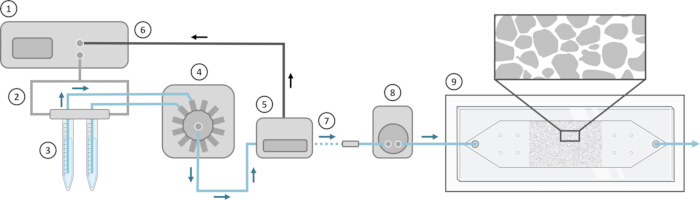
Figure 1: Flow control system and microfluidic reactor geometry. The experimental system consists of a flow controller (1) connected via pneumatic tubing (2) to a fluid reservoir rack (3) a distribution valve to provide sequential injection of growth medium (GMMn) and salt solution (SSMn) (4) a flow sensor (5) connected to the flow controller to provide real-time feedback and flow adjustment (6) PEEK tubing with a small inner diameter to provide fluidic resistance (7) a bubble trap (8) upstream of the microfluidic reactor (9). System schematic not to scale. Please click here to view a larger version of this figure.
- Set up and calibrate all hardware per the manufacturer's instructions.
NOTE: The fluid reservoir rack, distribution valve, and flow sensor are installed inside a custom-built microscope incubator to maintain the experiment at 30 °C. - Set the air compressor pressure regulator to 3 bar and connect the air compressor outlet to the flow controller inlet with pneumatic polyurethane tubing.
- Attach a hydrophobic filter to the flow controller outlet to prevent fluid backflow, then connect the flow controller to two inlet ports of the fluid reservoir rack with pneumatic polyether polyurethane tubing using a manifold and barbed adapters.
- Connect the fluid reservoir rack, distribution valve, and flow sensor with tubing as follows, using flangeless fittings for 1/16-in outer diameter tubing unless otherwise noted.
- Connect two outlet ports of the fluid reservoir rack to the first two inlet ports of the distribution valve with 80 cm of 1/32-in inner diameter (ID) polytetrafluoroethylene (PTFE) tubing.
- Connect the outlet port of the distribution valve to the inlet port of the flow sensor with 15 cm of 500-µm ID PTFE tubing and an adapter fitting.
- Attach 60 cm of 63.5-µm ID polyether ether ketone (PEEK) tubing to the outlet port of the flow sensor using an adapter fitting.
NOTE: For experiments requiring different flow rates, adjust the PEEK tubing length as needed to provide sufficient fluidic resistance for flow stability. - Connect the PEEK tubing to 10 cm of 500-µm ID PTFE tubing using a union fitting.
- Attach the PTFE tubing to the inlet port of a microfluidic bubble trap fitted with a PTFE membrane filter (pore size ~10 µm).
- Attach 75 cm of 200-µm ID PTFE tubing to the bubble trap outlet port to create back pressure for effective bubble removal. This tube will attach to the microfluidic reactor inlet hole.
- Before every experiment, sterilize the flow control system with all tubing and hardware connected by flushing a 1% bleach solution for three times the system volume (~4 h per tubing line at 7.0 µL·min-1), followed by sterile ultrapure water for the same duration.
- Between experiments, clean the flow control system as follows.
- Rinse the distribution valve and flow sensor by flushing 100% isopropanol and sterile ultrapure water to prevent buildup of residues or precipitates.
CAUTION: Isopropanol is flammable. Handle and store according to the safety data sheet. - Autoclave the bubble trap.
- Replace the bubble trap membrane filter and 200-µm ID PTFE tubing after each experiment to prevent clogging (membrane filter) or bacterial colonization (tubing).
- Rinse the distribution valve and flow sensor by flushing 100% isopropanol and sterile ultrapure water to prevent buildup of residues or precipitates.
3. Experimental media and solutions
- Prepare liquid Luria Broth (LB, Miller's formulation) medium by autoclaving 2.5% LB powder in ultrapure water at 121 °C for 20 min. For LB agar plates, autoclave 2.5% LB powder and 1.5% agar in ultrapure water at 121 °C for 20 min, then pour into 100-mm Petri dishes (~20 mL per dish) and let cool until solid.
- From filter-sterilized stock solutions prepared with American Chemical Society (ACS) or bacteriological grade reagents in ultrapure water, make 30 mL of each of the following. Salt solution and growth medium composition are adapted from Gehin et al.59.
- Prepare salt solution without Mn(II) (SS0): 0.4 mM CaCl2·2H2O, 0.25 mM MgSO4·7H2O, 0.25 mM Na2HPO4·2H2O, 0.15 mM KH2PO4, 1:2 Fe(III)-EDTA (20 µM FeCl3·6H2O and 40 µM EDTA adjusted to pH 6.5 with 1M NaOH), 10 mM HEPES buffer (adjusted to pH 7.0 with 1M NaOH), 5 mM (NH4)2SO4, and trace metals (40 nM CuSO4·5H2O, 273 nM ZnSO4·7H2O, 84 nM CoCl2·6H2O, 53.7 nM Na2MoO4·2H2O) in sterile ultrapure water.
- Prepare salt solution with Mn(II) (SSMn): Same as SS0 with 50 µM MnCl2·4H2O added.
- Prepare growth medium without Mn(II) (GM0): Same as SS0 with 1.5 g·L-1 yeast extract and 1.5 g·L-1 casamino acid added.
- Prepare growth medium with Mn(II) (GMMn): Same as GM0 with 50 µM MnCl2·4H2O added.
CAUTION: Salt solutions and growth media contain metals with both health and environmental hazards. Handle and store according to the safety data sheets.
- Prepare an acid solution containing 40 mM oxalic acid dihydrate and 2% nitric acid in ultrapure water for the digestion of the Mn oxides inside the microfluidic reactor.
CAUTION: Oxalic acid dihydrate and nitric acid are corrosive, and nitric acid is a strong oxidizer. Handle and store according to the safety data sheets. - Prepare a 1% nitric acid solution in ultrapure water for ICP-MS sample dilution.
4. Bacterial culturing
NOTE: Bacterial culturing is performed with aseptic technique on the benchtop using a Bunsen burner. Materials are sterile unless otherwise noted. Incubation durations are specific to P. putida GB-1 and may need to be adjusted for other microorganisms.
- From a -80 °C stock, streak P. putida GB-1 on an LB agar plate. Incubate the plate for approximately 20 h at 30 °C to allow growth of bacterial colonies.
- The evening before the experiment, add 10 mL of LB medium to a 50-mL conical tube and inoculate with one plate colony. Incubate the LB preculture in a shaker incubator at 30 °C and 180 rpm for 16 h to reach the stationary phase.
- After 16 h of incubation, aliquot 1 mL of LB preculture into a 1.5-mL microcentrifuge tube and centrifuge for 1 min at 8,000 x g to pellet the bacteria.
- Wash the aliquot three times to remove spent LB medium by discarding the supernatant, resuspending the cell pellet in 1 mL of SS0, and centrifuging for 1 min at 8,000 x g. Resuspend the final pellet in 1 mL of SS0.
- Measure the optical density (OD600) of the washed cell suspension in a nonsterile cuvette with a cell density meter. Expected OD600 for P. putida GB-1 is 3.6–3.8 at this step, so at least a 5-fold dilution in SS0 is required.
- Inoculate 20 mL of GM0 with washed cell suspension to an initial OD600 of 0.01 in a 50-mL Erlenmeyer flask. Incubate at 30 °C and 180 rpm for 6 h to reach mid-exponential phase.
5. Biomineralization experiment
- The morning of the experiment, prime the flow control system.
- Pre-heat the microscope incubator to 30 °C.
- Pour 10 mL of GMMn and SSMn into two 15-mL conical tubes and connect the tubes to the fluid reservoir rack. Flush SSMn for approximately three times the system volume (~4 h at 7.0 µL·min-1), followed by GMMn for the same duration.
- Saturate the prepared microfluidic reactor 5 h after inoculating the mid-exponential culture.
NOTE: Reactor saturation and inoculation are performed with aseptic technique on the benchtop using a Bunsen burner. Materials are sterile unless otherwise noted.- Degas the reactor in a vacuum desiccator for 20 min.
- While the reactor is degassing, draw 1–2 mL of SS0 into a 3-mL plastic syringe, then attach a blunt-tip needle and 20 cm of 0.02-in ID Tygon tubing. Press the syringe plunger until the tubing is fully saturated.
- Remove the reactor from the desiccator, then attach the tubing to the reactor outlet hole with angled tweezers and manually saturate the reactor with the syringe until a droplet forms at the reactor inlet hole.
- Attach 20 cm of 0.02-in ID Tygon tubing to the reactor inlet hole. Continue dispensing SSMn into the reactor until all air bubbles are removed (200–300 µL).
- Prepare the reactor inoculum and inoculate the microfluidic reactor.
- Remove the mid-exponential culture from the shaker incubator 6 h after inoculation and measure the OD600. Expected OD600 is 1.6–1.8 at this step, so a 4-fold dilution in SS0 is recommended.
- Dilute the mid-exponential culture in 2 mL of SSMn to an initial OD600 of 0.005 in a 2-mL microcentrifuge tube. Invert the tube several times to mix.
- Place the reactor inlet tubing in the microcentrifuge tube, ensuring that a droplet of fluid contacts the inoculum to prevent air introduction in the tubing. Partially close the microcentrifuge tube and secure the lid with tape to prevent contamination.
- Withdraw 4–5 mL of SSMn into a 5-mL glass gas-tight syringe to wet the barrel, then dispense until 0.5 mL remains in the syringe. Load the syringe into a syringe pump.
- Remove the needle from the plastic syringe and attach it to the glass syringe, taking care not to trap air in the needle hub.
- Inoculate the reactor with the syringe pump by withdrawing the inoculum into the reactor for 20 min at a flow rate of 8.33 µL·min-1 (~70 pore volumes).
- Following inoculation, turn off the syringe pump and allow the bacteria to settle and attach for 1 h with no flow.
- After 1 h, remove the syringe from the syringe pump but leave it connected to the outlet tubing.
- Connect the inoculated microfluidic reactor to the flow control system.
- Move the reactor and syringe from the benchtop to the microscope incubator.
- On the microscope stage, remove the inlet tubing from the reactor.
- Push gently on the syringe plunger to create a droplet at the reactor inlet hole.
- Manually bend the PTFE tubing from the flow control system at a right angle (~1 cm from the end of the tubing) so that it interfaces perpendicular to the PDMS surface, minimizing lateral forces and air intrusion into the reactor inlet hole.
- Dip the end of the PTFE tubing into a solution of 1% polyethylene glycol diacrylate (PEG-DA) to wet the hydrophobic tubing exterior. Ensure a droplet of GMMn at the end of the PTFE tubing, and attach the tubing to the reactor inlet hole.
- Disconnect the syringe and place the outlet tubing into a nonsterile 5-mL microcentrifuge tube to collect the reactor effluent.
- Set the flow rate to 1.33 µL·min-1 in the flow control system software. Set up a program to supply GMMn for 15 h (~500 pore volumes) to promote biofilm formation, followed by SSMn for 28.5 h (~1,000 pore volumes) to induce Mn biomineralization.
- Mount the microfluidic reactor in the microscope stage insert.
NOTE: A custom-built ultraviolet-C (UVC) irradiation system attached to the microscope stage insert is used to mitigate unwanted bacterial growth and mineral precipitation outside of the microfluidic pore space (Figure 2). This design is adapted from Ramos et al.60 and can be controlled with an automated program. See Fadely et al.61 for details.- Place a sample frame underneath the reactor for stability, then rigidly mount the frame and reactor in the stage insert, ensuring that they are fully immobilized.
- Affix the PTFE tubing to the stage insert with a piece of tape to prevent the tubing from detaching from the reactor inlet hole.
- Align the UVC arms to a distance of 3 mm from the pore space edge on the inlet side and 2 mm on the outlet side to minimize scattering of ultraviolet light and biofilm damage within the pore space.
NOTE: Proper UVC alignment will result in little to no biomass accumulation in the reactor inlet region (Figure 3A). Alignment of the UVC arms too far from the inlet edge of the pore space (Figure 3B) or an absence of irradiation (Figure 3C) results in mineral precipitation upstream of the pore space. - Set up a program for reactor irradiation. Treat the reactor inlet and outlet regions for 5 min at t = 0 h to inactivate bacteria deposited during inoculation, then treat the outlet region only for 5 min at t = 17.5 h to inactivate any remaining biofilms.
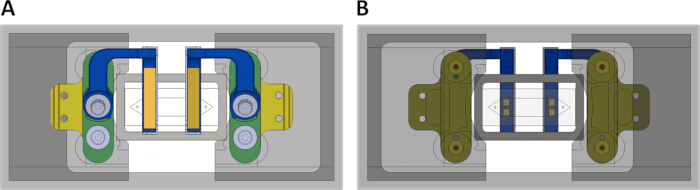
Figure 2: Custom-built ultraviolet-C (UVC) irradiation system for microfluidic reactors. (A). Top view of the system mounted on the microscope stage insert showing posable arms (blue) with attached UVC light-emitting diode (LED) arrays (yellow rectangles) and a microfluidic reactor mounted on a sample frame (small gray rectangle). (B). Bottom view of the system showing UVC LEDs (tan squares) embedded in the posable arms. Please click here to view a larger version of this figure.
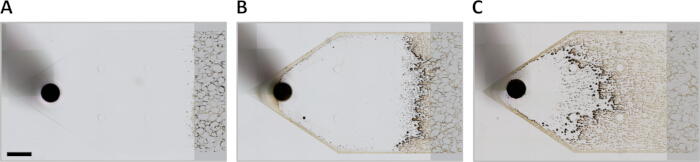
Figure 3: Effect of UVC irradiation on the microfluidic reactor inlet region. (A). Reactor inlet region with a 5-min UVC treatment at t = 0 h showing proper alignment for complete removal of unwanted biofilms. (B). Reactor inlet region with an improperly aligned UVC array, which left residual biofilms in the inlet hole and outside of the pore space, allowing Mn oxides to precipitate upstream. (C). Reactor inlet region with no UVC treatment, leading to extensive biofilm growth and mineral precipitation. Gray shading delineates the pore space. Scale bar is 2 mm. Please click here to view a larger version of this figure.
6. Optical time-lapse microscopy
NOTE: A Nikon Ti2 Eclipse inverted epifluorescence microscope equipped with a digital camera (2304 x 2304 pixels per field of view), white light engine, 4x objective (1.62 µm·pixel-1), and NIS Elements software is used for color brightfield imaging. Other optical microscopes capable of color imaging are also suitable. The use of color imaging improves sensitivity to low Mn oxide mass. If time-lapse automation is not an option, users can collect images manually and post-process them as a time series.
- For high-quality images, perform the following alignment and correction steps:
- To ensure even illumination, manually adjust the Köhler alignment following the manufacturer's instructions.
- Optimize the brightfield illumination to prevent image under- or over-saturation (Fusion Pad > Color > Auto Brightness and Fusion Pad > Color > Auto White).
NOTE: It is best to optimize the brightfield illumination only once on a reactor that already contains biofilms and Mn oxides, then apply the same exposure time and color balance to all subsequent experiments for consistent illumination. Here, a 5 ms illumination with red at 97.58%, green at 44.76%, and blue at 100% is used. - To prevent quilting artifacts when acquiring stitched images of the microfluidic pore space, apply a shading correction (Acquire > Shading Correction Panel).
- Set the center coordinate of the stitched image (ND Acquisition > XY).
- Set up the stitched image scan area (here, 5 x 4 fields of view) and apply a 1% overlap (ND Acquisition > Large Image).
- Set up acquisition of color brightfield images with the 4x objective (ND Acquisition > λ).
- Set up the imaging frequency with intervals of 1 h for 15 h (growth phase) and 0.5 h for 28.5 h (mineralization phase) (ND Acquisition > Time), then run the time-lapse program.
NOTE: The duration of the growth and mineralization phases is specific to P. putida GB-1 and can be adjusted as needed for other microorganisms. - When the experiment is complete, export the images as Tagged Image File Format (TIFF) (Macro Panel > Export Images to TIFF).
7. Acid digestion and Mn mass measurement
NOTE: An ICP-MS is used to measure Mn mass retained in the microfluidic reactor, but other instruments, such as optical emission spectrometers (ICP-OES), are also acceptable. If analytical instrumentation is not available, acid-digested samples may be sent to a commercial laboratory.
- At the end of the experiment, remove the reactor from the microscope stage insert and disconnect the inlet and outlet tubing.
- Withdraw 1.5 mL of acid solution into a 5-mL glass gas-tight syringe (separate from the inoculation syringe). Attach a blunt-tip needle and 20 cm of 1/32-in ID PTFE tubing to the syringe and manually dispense acid until a droplet forms at the end of the tubing.
- On the benchtop, load the syringe into a syringe pump and connect the tubing to the reactor inlet hole, taking care not to trap air bubbles, which may prevent the acid solution from permeating all pores. Connect 30 cm of 1/32-in ID PTFE tubing to the reactor outlet hole and place the end of the outlet tubing into a 2-mL microcentrifuge tube.
- Inject acid solution into the reactor for 10 min at a flow rate of 100 µL·min-1.
- Following acid solution injection, disconnect the blunt-tip needle from the glass syringe. Fill a 10-mL plastic syringe with air and connect to the blunt-tip needle, then manually dispense all the air in the syringe to drain the remaining acid from the reactor and tubing into the 2-mL microcentrifuge tube.
NOTE: While a small volume of acid solution may remain trapped within the pore space after air injection, it is negligible relative to the total injected volume. Users working with lower-porosity geometries may consider flushing additional volumes of air to remove fluid films and residual acid from poorly connected pores. - Dilute the digested sample in 1% nitric acid according to the ICP-MS calibration range. Here, prepare a 100x dilution (5 mL total volume) in a 15-mL conical tube.
- Measure the Mn concentration in the diluted sample with ICP-MS. Correct the measured concentration with the dilution factor and total sample volume to determine the Mn mass retained in the reactor.
8. Image analysis
NOTE: MATLAB is recommended due to its built-in functions for image analysis, which are included in the text. However, other tools such as ImageJ or Python's image analysis libraries can also be used to perform comparable analyses. Key image analysis steps are shown in Figure 4. All image analysis scripts are provided as Supplemental Files (Supplementary File 1, Supplementary File 2, and Supplementary File 3).
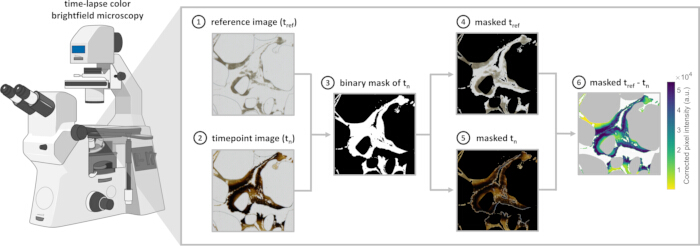
Figure 4: Image subtraction workflow to isolate Mn oxide precipitates. From time-lapse color brightfield images, a reference image (tref) (1) was identified to remove the intensity of the underlying stationary phase biofilms from all subsequent timepoint images (tn) (2) Binary masks of all tn were generated (3) and multiplied by both tref (4) and the corresponding tn (5) to capture biofilm-biomineral extent. Finally, the masked tn were subtracted from the masked tref (6). The resulting intensity-corrected matrices quantify the decrease in intensity (a.u.) due to Mn oxide accumulation at each pixel. Please click here to view a larger version of this figure.
- Load a high-resolution TIFF of the microfluidic pore space geometry (exported from AutoCAD) into the workspace to use as a grain mask (imread).
- Straighten and register the color brightfield images to effectively apply the grain mask.
- Generate a registration binary of the first timepoint image (t = 0 h).
- Load the color brightfield TIFF into the workspace (imread).
- Crop the image slightly larger than the size of the pore space (imcrop).
- Sharpen the image to improve the resolution of grain boundaries (imsharpen).
- Binarize the image using an adaptive threshold that prioritizes dark features (rgb2gray, adaptthresh with foreground polarity = "dark" and sensitivity adjusted as needed, imbinarize, imcomplement).
- Fill the grains of the resulting registration binary to make solid features (imfill with "holes" specified). Note that not all grains may be filled.
- Erode the registration binary as needed to remove background noise, then dilate to replace lost pixels at grain edges (imerode, imdilate).
- Use a scale-invariant feature transform (SIFT) registration algorithm to calculate the transformation matrix needed to align the registration binary to the grain mask (detectSIFTFeatures, extractFeatures, matchFeatures, estgeotform2d with transform type = "affine").
- Apply this transformation matrix to the registration binary and first timepoint image, then overlay them with the grain mask to assess fit (imwarp, imshowpair).
- If poor alignment persists after the SIFT registration, apply local registration as needed (cpselect, fitgeotform2d with transform type = "lwm", imwarp).
- Crop the registered image and grain mask as needed to remove registration artifacts at the matrix edges, then resize to the pore space dimensions (15 mm x 10 mm) (imcrop, imresize).
- Loop through all the color brightfield images to apply the same registration (imwarp).
- Generate a registration binary of the first timepoint image (t = 0 h).
- Visually identify a reference image (tref, Panel 1 in Figure 4) when biofilms first enter stationary phase, determined as a lack of continued movement or growth (here, t = 18.5 h).
- Binarize each timepoint image (tn, Panel 2 in Figure 4) (rgb2gray, adaptthresh with foreground polarity = "dark" and sensitivity adjusted as needed, imbinarize, imcomplement) such that biofilm-biomineral assemblages = 1 and grains and empty pores = 0. Multiply each timepoint mask by the inverted grain mask (imcomplement) to remove residual grain boundaries.
- Multiply tn by its corresponding timepoint mask (Panel 3 in Figure 4) to isolate the biofilm-biomineral region of interest (Panel 5 in Figure 4), then multiply tref by each timepoint mask to isolate the same region (Panel 4 in Figure 4).
- Subtract all masked tn from the masked tref to quantify the decrease in pixel intensity associated with Mn oxide accumulation at each timepoint (imsubtract), then convert to composite intensity-corrected matrices (rgb2gray, Panel 6 in Figure 4).
- To evaluate the mineral spatial distribution across the pore space (a.u.), sum along the columns (sum with dimension = 1) of each intensity-corrected matrix.
- To estimate the rate of Mn oxide precipitation over time (µg·h-1):
- Sum each intensity-corrected matrix (sum with dimension = "all") to quantify the total corrected intensity at each timepoint.
- Divide the total corrected intensity at each timepoint by the total corrected intensity at the final timepoint such that the final timepoint = 1 and all preceding values are fractional. Rescale to µg by multiplying by the Mn mass measured with ICP-MS.
- Take the derivative with respect to time by dividing the increase in mass (µg) between sequential timepoints (diff) by the time interval between images (0.5 h).
Results
This protocol provides an experimental platform for spatiotemporally resolved imaging of biofilm formation and Mn biomineralization. Color brightfield images demonstrated that P. putida GB-1 biofilms were uniformly distributed throughout the microfluidic pore space at t = 18.5 h prior to the onset of Mn oxide precipitation (Figure 5A). Subsequently, Mn oxides preferentially accumulated on the inlet side of the pore space closest to the influent Mn(II) source (Figure 5B). The difference between the reference image and subsequent image timepoints revealed the isolated contribution of Mn oxide precipitates to the overall image intensity (Figure 5C) and enabled quantification of the observed reactor-scale gradient in mineral accumulation (Figure 5D). At the biofilm scale, this image subtraction approach captured the gradual precipitation of Mn oxides on biofilm surfaces and accumulation of minerals at the edges of biofilms in contact with pore fluid (Figure 6).
The protocol further provides a workflow to estimate the kinetics of Mn oxide precipitation from image subtraction and ICP-MS measurements. Triplicate microfluidic reactors contained 4.29 ± 0.22 µg Mn at the final experimental timepoint. Acid digestion of the reactor contents was validated previously using synchrotron-based measurements of Mn oxide mass and found to result in less than 18% error61. Therefore, the intensity-corrected matrices were rescaled to this final mass. The resulting estimated rate of Mn oxide precipitation was non-monotonic, increasing steeply between t = 19.5 h and t = 21 h, before peaking at 0.29 ± 0.04 µg·h-1 and decelerating gradually until t = 43.5 h (Figure 7). It should be noted that this rate calculation does not account for any nanoparticulate Mn oxides below the resolution of the optical microscope or for any oxide mass lost due to transport over the experiment duration, which is expected to be minimal. This approach therefore takes advantage of accessible microscopy techniques to semi-quantitatively evaluate temporal trends in biomineralization kinetics.
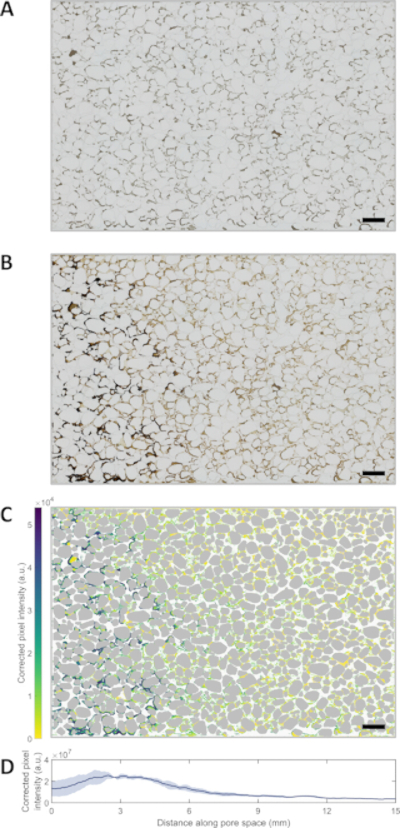
Figure 5: Reactor-scale distribution of biofilms and Mn oxides. (A). Color brightfield image of P. putida GB-1 biofilms within the microfluidic pore space at the onset of the stationary phase (t = 18.5 h, tref). (B). Color brightfield image of Mn oxide precipitates on and around P. putida GB-1 biofilms at the final experimental timepoint (t = 43.5 h). (C). Intensity-corrected matrix of mineral accumulation at the final experimental timepoint (t = 43.5 h), with grains shown in gray and pores shown in white. Scale bar is 1 mm. (D). One-dimensional spatial distribution of total corrected intensity from the inlet (left) to the outlet (right) side of the pore space (t = 43.5 h). The solid line represents a 1-mm moving average along the pore space from inlet to outlet averaged over triplicate experiments, and the shading represents the standard deviation. Please click here to view a larger version of this figure.
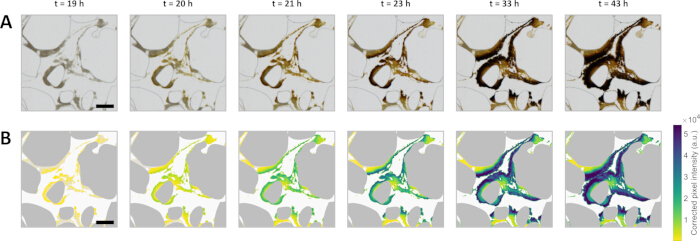
Figure 6: Biofilm-scale Mn oxide accumulation. (A). Select color brightfield images of representative P. putida GB-1 biofilms. Manganese oxides were detectable first as a color change from gray to brown on biofilm surfaces (shown at t = 20 h and t = 21 h) and later as an accumulation of dark brown precipitates at biofilm edges (shown at t = 33 h and t = 43 h). (B). Intensity-corrected matrices of mineral accumulation with grains in dark gray, pores in white, and underlying biofilms in light gray. Scale bar is 150 µm. Please click here to view a larger version of this figure.
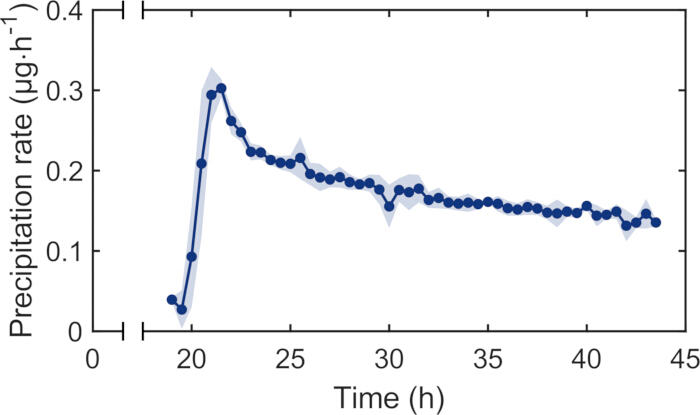
Figure 7: Estimation of Mn oxide precipitation rate over time. The rate (µg·h-1) was quantified by rescaling the total corrected intensity at each timepoint to the endpoint Mn mass measured with ICP-MS, then taking the derivative with respect to time. Markers represent the average of triplicate experiments, and the shading represents the standard deviation. Please click here to view a larger version of this figure.
Supplementary File 1: Step1_ImageRegistration.m.Please click here to download this file.
Supplementary File 2: Step2_ImageSubtraction.m.Please click here to download this file.
Supplementary File 3: Step3_Figures.m.Please click here to download this file.
Discussion
This experimental platform offers unique opportunities for investigating spatiotemporal dynamics of biogeochemical processes in porous environments free of artifacts that prevent the acquisition of high-fidelity data. This approach is particularly well-suited for Mn and Fe biomineralization, which produce mineral precipitates with characteristic ochre, brown, and black hues that can be readily segmented with optical microscopy and image analysis. Using Mn biomineralization as a case study, it is possible to evaluate patterns and rates of mineral precipitation in situ with high spatial and temporal resolution.
Several aspects of this protocol enabled the collection of reproducible measurements of biogeochemical transformations. First, using a sequential injection valve with low dead volume facilitated experiments with multiple fluids without perturbing the biofilms within the microfluidic pore space. This setup preserved the initial biofilm spatial distribution by preventing pressure surges that can lead to sloughing or displacement of biofilms when switching injected fluids, which may occur with other instruments such as syringe pumps. This component further provides the user with the flexibility to customize the geochemical conditions imposed on the resident microorganisms. Finally, because it preserves initial biofilm distribution, this setup allows the user to systematically test how different biofilm morphologies or biomass amounts influence the distribution and rate of Mn oxide precipitation.
Second, mitigating the formation and intrusion of bubbles in the microfluidic pore space allowed for multi-day experiments that captured the environmentally relevant timescales of Mn biomineralization. Bubbles, a common and often inevitable issue in long experiments above room temperature62,63, can fragment and block individual pores, reroute fluid flow, and disrupt reaction progress. To prevent bubble trapping in the pore space, the reactor was fully saturated prior to inoculation. To minimize the introduction of bubbles through the flow control system, the microscope incubator was set to 30 °C well in advance of the experiment, and multiple volumes of influent solution were flushed prior to attaching the inoculated reactor. This step removed trapped air from the tubing and fittings and minimized the risk of fluid outgassing during the experiment. A bubble trap was also integrated into the flow control system to capture any residual bubbles, with a length of 200-µm ID PTFE tubing attached to the trap outlet to increase resistance and enhance bubble removal efficiency. Finally, to prevent air trapping or leaking at the interface between the influent tubing and reactor inlet hole, all connections were made with droplets of fluid on both ends of the tubing and the punched hole, the hydrophobic PTFE tubing was coated with 1% PEG-DA, and the end of the inserted tubing was kept perpendicular to the PDMS surface throughout the experiment.
Third, incorporating a custom-built UVC irradiation system into the experimental platform maintained a defined geochemical boundary condition and reproducibly constrained Mn biomineralization within the microfluidic pore space. Pilot experiments showed that extraneous biofilms in the reactor inlet region precipitated Mn oxides upstream of the pore space, restricting the downstream availability of Mn(II). Briefly irradiating the reactor inlet and outlet regions with proper alignment following the no-flow settling period, prevented biofilm development from any initially deposited bacteria. Continuous unidirectional fluid flow prevented recolonization of the reactor inlet region following this initial UVC treatment. Irradiating the reactor outlet region at t = 17.5 h prior to the onset of the stationary phase and visible Mn oxide precipitation minimized the amount of mineral accumulation downstream of the pore space. This facilitated direct comparison of color brightfield image data with Mn mass digested and measured with ICP-MS.
The combination of image subtraction and endpoint mass measurements provided a semi-quantitative method for evaluating the kinetics of Mn oxide precipitation in situ. However, it is important to note that pixel intensity ceases to be directly proportional to Mn oxide mass at very high mineral density due to limited camera sensitivity to dark colors61. Evaluation of this non-linear behavior could be improved by acid-digesting samples at defined timepoints and comparing the digested mass to the original mass scaled by the final experimental timepoint. If exact quantification of mineral mass is required, users can develop a calibration curve using mineral samples of known intensity and mass, which has been demonstrated previously in Fadely et al.61, or make direct measurements with synchrotron-based X-ray fluorescence.
The microfluidic platform presented here can be applied to investigate biomineralization processes under a wide range of environmental conditions. While representative experiments were optimized for P. putida GB-1, this setup can be used to systematically test a range of influent solution chemistries (e.g., Mn or Fe concentration, carbon source, presence of co-occurring metals), flow rates, temperatures, or the presence of a microbial consortium. Specific acidic or suboxic conditions, such as those favorable to Fe-oxidizing bacteria, can be simulated by decreasing influent pH or coating the PDMS with an oxygen-impermeable polymer. Insights into the microbial controls on biomineralization can be obtained by implementing reporter gene fusion strains and tracking the resulting optical fluorescence59,64. Microfluidic reactors can be redesigned to simulate a range of porous environments by changing the particle size distribution, particle shape, or porosity, or by functionalizing the PDMS to mimic the surface charge of clay particles or natural organic matter. With additional modifications (e.g., replacing the glass reactor substrate with plastic), reactors can support direct spectroscopic measurements of metal oxidation state, mineralogy, organo-mineral associations, or the sorption or co-precipitation of secondary metals. Finally, this experimental platform can be expanded to investigate precipitation of other metal biominerals (e.g., phosphates, carbonates, sulfides), provided their optical properties are sufficiently distinct to allow for image segmentation. This protocol therefore offers a framework to comprehensively investigate biomineralization and microbe-mineral-fluid interactions in relevant porous environments.
Disclosures
The authors declare no conflicts of interest.
Acknowledgements
This project was supported by the U.S. National Science Foundation Center for Bio-mediated and Bio-inspired Geotechnics (ERC-1449501), the Swiss National Science Foundation (200021_188546), and the U.S National Science Foundation (MCA-2322428, EAR-1847689, DMR-2003849). Part of this study was carried out at the UC Davis Center for Nano and Micro Manufacturing (CNM2). We thank Steven Lucero and the UC Davis Tech Foundry for the design and fabrication of the microscope incubator and UVC irradiation system. We also thank Dr. Yuze Wang and Dr. Jason DeJong for providing the porous medium geometry used for microfluidic reactor fabrication, and Dr. Arunima Bhattacharjee, Dr. Noah Goshi, Dr. Gregory Girardi, and Dr. Hyehyun Kim for useful discussions and/or providing training on photolithography and soft lithography. Finally, we thank Dr. Gaitan Gehin, Dr. Tonya Kuhl, Dr. Filippo Miele, and Dr. Charles Graddy for valuable discussions on experimental design and image analysis.
Materials
| Name | Company | Catalog Number | Comments |
|---|---|---|---|
| Adapter fitting (Elveflow, 6-40 to 1/4-28) | Darwin Microfluidics | LVF-KFI-08 | Used to interface between flow sensor and flangeless fittings. |
| Agar (Fisher BioReagents) | Fisher Scientific | BP9744 | Used to pour plates for streaking frozen stocks. |
| Air compressor (Jun-Air) | Elveflow | KCP-110 | Used to pressurize flow controller. |
| Ammonium sulfate ((NH4)2SO4, CAS: 7783-20-2) | Sigma-Aldrich | A4915 | Used for experimental media and solutions. |
| Angled tweezers | TDI International | 7-SA | Used to attach tubing to microfluidic reactor. |
| AutoCAD software | Autodesk | -- | Used to design microfluidic reactor geometry. |
| Autoclave | Steris | -- | Used to sterilize materials and liquids. |
| Balance | Mettler Toledo | ME2002T | Used to weigh PDMS elastomer base and curing agent. |
| Barbed adapter (1/4-28 swivel to 3/32-in barbed) | Elveflow | KFI-06 | Used to connect polyether polyurethane tubing to manifold and fluid reservoir rack. |
| Biopsy punch (Rapid-Core, 1.2-mm diameter) | Darwin Microfluidics | PT-T983-12-25 | Used to punch inlet/outlet holes in PDMS microfluidic channels. |
| Bleach (Chlorox) | ULINE | S-19719 | Used to sterilize flow control system. Dilute to 1% in ultrapure water. |
| Blunt-tip needle (Jensen Global, 21-gauge) | QSource | JG21-10HPX-J004 | Used to connect tubing to syringes. Sterilized by autoclaving for 30 min. |
| Bunsen burner | Humboldt | H-5970 | Used to maintain a sterile experimental workspace. |
| Calcium chloride dihydrate (CaCl2·2H2O, Fisher Chemical, CAS: 10035-04-8) | Fisher Scientific | C79 | Used for experimental media and solutions. |
| Casamino acid (Fisher BioReagents, acid casein peptone) | Fisher Scientific | BP1424 | Used for experimental media. |
| Cell density meter (WPA Biowave CO8000) | Avantor | 490005-906 | Used to measure OD600 of bacterial cultures. |
| Clear tape (Scotch Magic) | ULINE | S-10223 | Used to keep dust from sticking to PDMS microfluidic channels. |
| Cobalt(II) chloride hexahydrate (CoCl2·6H2O, CAS: 7791-13-1) | Sigma-Aldrich | 255599 | Used for experimental media and solutions. |
| Compressed nitrogen | Airgas | NIUHP300 | Used to dry microfluidic reactor components. |
| Conical tube (Falcon, 15-mL volume, polypropylene) | Fisher Scientific | 14-959-49B | Used for influent solutions and ICP-MS samples. Pre-sterilized. |
| Conical tube (Falcon, 50-mL volume, polypropylene) | Fisher Scientific | 14-432-22 | Used for LB preculture. Pre-sterilized. |
| Copper(II) sulfate pentahydrate (CuSO4·5H2O, CAS: 7758-99-8) | Sigma-Aldrich | C8027 | Used for experimental media and solutions. |
| Cutting mat | ULINE | S-18543 | Used to cut apart PDMS microfluidic channels and punch inlet/outlet holes. |
| Cuvette (Fisherbrand, 1.5-mL volume, polystyrene) | Fisher Scientific | 14-955-127 | Used to measure OD600 of bacterial cultures. |
| Digital camera (Hamamatsu ORCA-Fusion) | Nikon | 77054115 | Used for time-lapse color brightfield imaging of microfluidic experiments. |
| Distribution valve (MUX) | Elveflow | MUX-D-12 | Used to sequentially inject multiple fluids. |
| Elveflow Smart Interface (ESI) software | Elveflow | -- | Used to control flow rate/pressure feedback between flow controller and flow sensor and perform distribution valve switching. |
| Erlenmeyer flask (Fisherbrand, 50-mL volume) | Fisher Scientific | FB50050 | Used for mid-exponential culture. Sterilized by autoclaving for 30 min. |
| Ethanol (Fisher Chemical, reagent alcohol, 90% purity, CAS: 64-17-5) | Fisher Scientific | A962P-4 | Used to clean PDMS and cover slips for reactor fabrication. Diluted to 70% in ultrapure water. |
| Ethylenediaminetetraacetic acid (EDTA, CAS: 60-00-4) | Sigma-Aldrich | EDS | Used for experimental media and solutions. |
| Flangeless fitting (1/4-28 for 1/16-in OD tubing) | Elveflow | KFI-17 | Used to connect tubing to Elveflow hardware components. Kit includes ferrules and threaded nuts. |
| Flow controller (OB1 MK3+) | Elveflow | OB1-2000 | Used to provide flow rate/pressure feedback for controlled fluid injection. |
| Flow sensor (MFS2) | Elveflow | MFS-D-2 | Used to maintain stable flow for microfluidic experiments using pressure feedback from flow controller. |
| Fluid reservoir rack | Elveflow | KPT-4S | Used to pressurize influent fluids. Compatible with 15-mL Falcon conical tubes. |
| Glass cover slip (1.42-in x 2.36-in, #1 thickness) | Ted Pella | 260460-100 | Plasma bonded to PDMS channel as a substrate for microfluidic reactors. |
| Glass gas-tight syringe (5-mL volume, Luer-Lock) | Hamilton | 81520 | Used for reactor inoculation and acid digestion (separate syringes). Inoculation syringe sterilized by autoclaving for 30 min. |
| HEPES buffer (CAS: 7365-45-9) | Sigma-Aldrich | H3375 | Used for experimental media and solutions. |
| Hot plate | Corning | 6795-420D | Used to cure PDMS. |
| Hydrophobic filter (Elveflow, 0.2-µm) | Darwin Microfluidics | LVF-KXX-14 | Used to prevent liquid backflow into the flow controller. |
| Inductively coupled plasma mass spectrometer (ICP-MS, 7900) | Agilent | -- | Used to measure Mn concentration in microfluidic reactor digest. |
| Inverted epifluorescence microscope (Nikon Ti2 Eclipse) | Nikon | MEA54000, MEE59925, MEL51920, MEP59394, MEC56130 | Used for time-lapse color brightfield imaging of microfluidic experiments. Basic setup includes body, diascopic pillar, condenser turret, nosepiece, and stage. |
| Iron(III) chloride hexahydrate (FeCl3·6H2O, CAS: 10025-77-1) | Sigma-Aldrich | 44944 | Used for experimental media and solutions. |
| Isopropanol (Fisher Chemical, 100% purity, CAS: 67-63-0) | Fisher Scientific | A416P-4 | Used to clean flow control system. |
| Laminar flow cabinet (Air Science Purair FLOW Vertical, 48-in) | Fisher Scientific | NC0875829 | Used to maintain a low-dust environment for soft lithography, reactor assembly, and reactor degassing. |
| Light engine (LIDA) | Lumencor | 77060081 | Used for time-lapse color brightfield imaging of microfluidic experiments. |
| Luria Broth powder (LB, Invitrogen, Miller's formulation) | Fisher Scientific | 12-795-027 | Used to culture P. putida GB-1 from frozen stocks. Sterilized by autoclaving for 20 min. |
| Magnesium sulfate (MgSO4 7H2O; CAS: 10034-99-8) | Sigma-Aldrich | 230391 | Used for experimental media and solutions. |
| Manganese(II) chloride tetrahydrate (MnCl2·4H2O, CAS: 13446-34-9) | Sigma-Aldrich | 221279 | Used for experimental media and solutions. |
| Manifold | Elveflow | KM9 | Used to distribute pressure from air compressor into fluid reservoir rack. |
| MATLAB software | Mathworks | -- | Used for image analysis. |
| Microcentrifuge | Eppendorf | 5418 | Used to wash LB preculture. |
| Microcentrifuge tube (Fisherbrand, 1.5-mL volume) | Fisher Scientific | 02-681-5 | Used to wash LB preculture. Sterilized by autoclaving for 30 min. |
| Microcentrifuge tube (Fisherbrand, 2-mL volume) | Fisher Scientific | 02-681-271 | Used to prepare reactor inoculum. Sterilized by autoclaving for 30 min. |
| Microcentrifuge tube (Labcon, 5-mL volume) | Sigma-Aldrich | LABC-3048-860-000-9 | Used to collect reactor effluent during time-lapse experiments. |
| Microfluidic bubble trap (25-µL internal volume, EZMount) | PreciGenome | PG-BT-REC25UL | Used to remove bubbles upstream of microfluidic reactor. Sterilized by autoclaving for 30 min. |
| Microscope incubator | -- | -- | Designed and fabricated by the UC Davis Tech Foundry. |
| Microscope stage insert (TI2-S-HU universal holder) | Nikon | MEC59140 | Used to mount UVC irradiation system and hold microfluidic reactors during time-lapse experiments. |
| NIS Elements software | Nikon | -- | Used to automate time-lapse image acquisition. |
| Nitric acid (Fisher Chemical, 70% purity, CAS: 7697-37-2) | Fisher Scientific | A200-212 | Used for acid digestion of Mn oxides in microfluidic reactor and ICP-MS sample dilution. |
| Objective (Plan Apo λD 4x/0.20) | Nikon | MRD70040 | Used for time-lapse color brightfield imaging of microfluidic experiments. |
| Oxalic acid dihydrate (CAS: 6153-56-6) | Sigma-Aldrich | 247537 | Used for acid digestion of Mn oxides in microfluidic reactor. |
| PEEK tubing (63.5-µm ID, 1/16-in OD) | IDEX | 1560XL | Used to provide fluidic resistance in flow control system. Connected to flow sensor outlet. |
| Petri dish (Fisherbrand, 100-mm diameter) | Fisher Scientific | FB0875712 | Used to pour agar plates and to store PDMS microfluidic channels/assembled microfluidic reactors. |
| Plasma cleaner | Harrick Plasma | PDC-32G, PDC-VPE, PDC-VCG | Used to bond PDMS microfluidic channels to glass cover slips. Basic setup includes cleaner, vacuum pump, and vacuum gauge. |
| Plastic cup | ULINE | S-22541 | Used to mix PDMS elastomer base and curing agent. |
| Plastic knife | ULINE | S-7304B | Used to mix PDMS elastomer base and curing agent. |
| Plastic syringe (10-mL volume, Luer-Lock) | U.S. Plastic Corporation | 87368 | Used to recover acid solution from reactor and tubing. Pre-sterilized. |
| Plastic syringe (3-mL volume, Luer-Lock) | U.S. Plastic Corporation | 87366 | Used to saturate microfluidic reactor. Pre-sterilized. |
| Plate incubator (VWR) | Avantor | 97025-630 | Used to grow bacterial colonies on agar plates at a stable temperature. |
| Pneumatic polyurethane tubing (4-mm ID, 6-mm OD) | Legris-Pneumatics | 1025U0601 | Used to connect air compressor to flow controller. |
| Pneumatic polyether polyurethane tubing (2.5-mm ID, 4-mm OD) | Legris-Pneumatics | 1025U04R08 | Used to connect flow controller to manifold and fluid reservoir rack. |
| Polydimethylsiloxane (PDMS, Dow Corning, Sylgard 184) | Ellsworth Adhesives | 4019862 | Used to fabricate microfluidic reactors via soft lithography. Kit contains elastomer base and curing agent. |
| Polyethylene glycol diacrylate (PEG-DA, M.W. 700, CAS: 26570-48-9) | Sigma-Aldrich | 455008 | Used to wet PTFE tubing when attaching to reactor inlet. Diluted to 1% in ultrapure water and filter sterilized. |
| Potassum phosphate monobasic (KH2PO4, CAS: 7778-77-0) | Sigma-Aldrich | P0662 | Used for experimental media and solutions. |
| PTFE membrane filter for bubble trap | PreciGenome | PG-BT-FLT-Q5 | Compatible with microfluidic bubble trap. |
| PTFE tubing (200-µm ID, 1/16-in OD) | Darwin Microfluidics | BL-PTFE-1602-20 | Used to connect bubble trap outlet to microfluidic reactor. |
| PTFE tubing (500-µm ID, 1/16-in OD) | Darwin Microfluidics | BL-PTFE-1605-20 | Used to connect distribution valve to flow sensor and PEEK tubing to bubble trap inlet. |
| PTFE tubing (Elveflow, 1/32-in ID, 1/16-in OD) | Darwin Microfluidics | LVF-KTU-15 | Used to connect fluid reservoir rack to distribution valve. |
| Razor blade | ULINE | H-595B | Used to cut apart PDMS microfluidic channels. |
| Sample frame (steel, outer: 35 x 60 mm, inner: 25 x 50 mm, 1 mm thickness) | -- | -- | Designed and fabricated by the UC Davis Tech Foundry. |
| Scalpel (Integra Miltex) | Fisher Scientific | 12-460-456 | Used to cut cured PDMS out of microfluidic mold. |
| Shaker incubator (Excella) | New Brunswick | E24 | Used to grow bacterial cultures at a constant temperature and speed. |
| Sodium hydroxide (NaOH, 1 M, CAS: 1310-73-2) | Sigma-Aldrich | 109137 | Used to adjust pH of Fe-EDTA and HEPES stock solutions. |
| Sodium molybdate dihydrate (Na2MoO4·2H2O, CAS: 10102-40-6) | Sigma-Aldrich | 331058 | Used for experimental media and solutions. |
| Sodium phosphate dibasic dihydrate (Na2HPO4·2H2O, Fisher Chemical, CAS: 10028-24-7) | Fisher Scientific | S472 | Used for experimental media and solutions. |
| Syringe filter (Fisherbrand, PES, 0.22-µm) | Fisher Scientific | 09-720-511 | Used to filter sterilize stock solutions. Pre-sterilized. |
| Syringe pump (New Era) | SyringePump | NE-4002X | Used for reactor inoculation. |
| Tape | Fisher Scientific | 15-953 | Used to secure tube lid and tubing. |
| Tygon tubing (Masterflex Microbore, ND-100-80, 0.02-in ID, 0.06-in OD) | Avantor | MFLX06419-01 | Used for reactor inoculation and as outlet tubing during experiment. Sterilized by autoclaving for 30 min. |
| Ultrapure water (Milli-Q) | Millipore Sigma | -- | Used to prepare experimental media/solutions and clean flow control system. Sterilized by autoclaving for 30 min. |
| Ultraviolet-C (UVC) irradiation system | -- | -- | Designed and fabricated by the UC Davis Tech Foundry. |
| Union fitting (Elveflow, 1/4-28 to 1/4-28) | Darwin Microfluidics | LVF-KFI-10 | Used to connect PEEK and PTFE tubing. |
| Vacuum desiccator (Bel Art) | Fisher Scientific | 08-594-16C | Used for PDMS and reactor degassing. |
| Vacuum pump for desiccator (Welch DryFast) | Fisher Scientific | 1257156 | Used to maintain vacuum pressure in desiccator. |
| Yeast extract (Fisher BioReagents) | Fisher Scientific | BP1422 | Used for experimental media. |
| Zinc sulfate heptahydrate (ZnSO4·7H2O, CAS: 7446-20-0) | Sigma-Aldrich | 221376 | Used for experimental media and solutions. |
References
- Scheinost, A. C., Singh, B., Goss, M. J., Oliver, M. Metal oxides. Encyclopedia of soils in the environment. , (2023).
- Tebo, B. M., et al. Biogenic manganese oxides: properties and mechanisms of formation. Annu Rev Earth Planet Sci. 32, 287-328 (2004).
- Droz, B., Dumas, N., Duckworth, O. W., Peña, J. A comparison of the sorption reactivity of bacteriogenic and mycogenic Mn oxide nanoparticles. Environ Sci Technol. 49, 4200-4208 (2015).
- Holguera, J. G., Etui, I. D., Jensen, L. H. S., Peña, J. Contaminant loading and competitive access of Pb, Zn and Mn(III) to vacancy sites in biogenic MnO₂. Chem Geol. 502, 76-87 (2018).
- Peña, J., et al. Mechanisms of nickel sorption by a bacteriogenic birnessite. Geochim Cosmochim Acta. 74, 3076-3089 (2010).
- Toner, B., Manceau, A., Webb, S. M., Sposito, G. Zinc sorption to biogenic hexagonal-birnessite particles within a hydrated bacterial biofilm. Geochim Cosmochim Acta. 70, 27-43 (2006).
- Castro, L., Blázquez, M. L., González, F., Muñoz, J. A., Ballester, A. Heavy metal adsorption using biogenic iron compounds. Hydrometallurgy. 179, 44-51 (2018).
- Whitaker, A. H., Duckworth, O. W. Cu, Pb, and Zn sorption to biogenic iron (oxyhydr)oxides formed in circumneutral environments. Soil Syst. 2, 18 (2018).
- Brüggenwirth, L., et al. Interactions of manganese oxides with natural dissolved organic matter: implications for soil organic carbon cycling. Geochim Cosmochim Acta. 366, 182-200 (2024).
- Li, H., Santos, F., Butler, K., Herndon, E. A critical review on the multiple roles of manganese in stabilizing and destabilizing soil organic matter. Environ Sci Technol. 55, 12136-12152 (2021).
- Li, Q., Hu, W., Li, L., Li, Y. Interactions between organic matter and Fe oxides at soil micro-interfaces: quantification, associations, and influencing factors. Sci Total Environ. 855, 158710 (2023).
- Song, X., et al. Towards a better understanding of the role of Fe cycling in soil for carbon stabilization and degradation. Carbon Res. 1, 5 (2022).
- Hennebel, T., De Gusseme, B., Boon, N., Verstraete, W. Biogenic metals in advanced water treatment. Trends Biotechnol. 27, 90-98 (2009).
- Marsidi, N., Abu Hasan, H., Sheikh Abdullah, S. R. A review of biological aerated filters for iron and manganese ions removal in water treatment. J Water Process Eng. 23, 1-12 (2018).
- Li, Y., Xu, Z., Ma, H., Hursthouse, A. S. Removal of manganese(II) from acid mine wastewater: a review. Water. 11, 2493 (2019).
- Li, S., et al. Biomineralization mediated by iron-oxidizing microorganisms. Minerals. 15, 868 (2025).
- Skousen, J., et al. Review of passive systems for acid mine drainage treatment. Mine Water Environ. 36, 133-153 (2017).
- Post, J. E. Manganese oxide minerals: crystal structures and economic and environmental significance. Proc Natl Acad Sci U S A. 96, 3447-3454 (1999).
- Cornell, R. M., Schwertmann, U. . The iron oxides: structure, properties, reactions, occurrences and uses. , (2003).
- Cosmidis, J., Benzerara, K. Why do microbes make minerals?. C R Geosci. 354, 1-39 (2022).
- Ehrlich, H., Bailey, E., Wysokowski, M., Jesionowski, T. Forced biomineralization: a review. Biomimetics. 6, 46 (2021).
- Hoffmann, T. D., Reeksting, B. J., Gebhard, S. Bacteria-induced mineral precipitation: a mechanistic review. Microbiology. 167, 001049 (2021).
- Hansel, C. M., Learman, D. R., Ehrlich, H. L., Newman, D. K., Kappler, A. Geomicrobiology of manganese. Ehrlich's geomicrobiology. , (2015).
- Tebo, B. M., Johnson, H. A., McCarthy, J. K., Templeton, A. S. Geomicrobiology of manganese(II) oxidation. Trends Microbiol. 13, 421-428 (2005).
- Kappler, A., Emerson, D., Gralnick, J. A., Roden, E. E., Muehe, E. M., Ehrlich, H. L., Newman, D. K., Kappler, A. Geomicrobiology of iron. Ehrlich's geomicrobiology. , (2015).
- Emerson, D., Fleming, E. J., McBeth, J. M. Iron-oxidizing bacteria: an environmental and genomic perspective. Annu Rev Microbiol. 64, 561-583 (2010).
- Fortin, D., Langley, S. Formation and occurrence of biogenic iron-rich minerals. Earth Sci Rev. 72, 1-19 (2005).
- Konhauser, K. O. Bacterial iron biomineralisation in nature. FEMS Microbiol Rev. 20, 315-326 (1997).
- Toner, B., et al. Spatially resolved characterization of biogenic manganese oxide production. Appl Environ Microbiol. 71, 1300-1310 (2005).
- Miot, J., et al. Extracellular iron biomineralization by photoautotrophic bacteria. Appl Environ Microbiol. 75, 5586-5591 (2009).
- Bottero, S., Storck, T., Heimovaara, T. J., van Loosdrecht, M. C. M., Enzien, M. V., et al. Biofilm development and the dynamics of preferential flow paths in porous media. Biofouling. 29, 1069-1086 (2013).
- Dentz, M., Le Borgne, T., Englert, A., Bijeljic, B. Mixing, spreading and reaction in heterogeneous media: a brief review. J Contam Hydrol. 120-121, 1-17 (2011).
- Gerke, H. H. Preferential flow descriptions for structured soils. J Plant Nutr Soil Sci. 169, 382-400 (2006).
- Jimenez-Martinez, J., Nguyen, J., Or, D. Controlling pore-scale processes to tame subsurface biomineralization. Rev Environ Sci Biotechnol. 21, 27-52 (2022).
- Or, D., Smets, B. F., Wraith, J. M., Dechesne, A., Friedman, S. P. Physical constraints affecting bacterial habitats and activity in unsaturated porous media: a review. Adv Water Resour. 30, 1505-1527 (2007).
- Toyoda, K., Tebo, B. M. The effect of Ca2+ ions and ionic strength on Mn(II) oxidation by spores of the marine Bacillus sp. SG-1. Geochim Cosmochim Acta. 101, 1-11 (2013).
- Toyoda, K., Tebo, B. M. Kinetics of Mn(II) oxidation by spores of the marine Bacillus sp. SG-1. Geochim Cosmochim Acta. 189, 58-69 (2016).
- Learman, D. R., Wankel, S. D., Webb, S. M., Martinez, N., Madden, A. S., et al. Coupled biotic–abiotic Mn(II) oxidation pathway mediates the formation and structural evolution of biogenic Mn oxides. Geochim Cosmochim Acta. 75, 6048-6063 (2011).
- Bargar, J. R., et al. Biotic and abiotic products of Mn(II) oxidation by spores of the marine Bacillus sp. strain SG-1. Am Mineral. 90, 143-154 (2005).
- Mao, Q., Qin, W., Yan, B., Luo, L. Ferrous iron oxidation efficiency and kinetics by indigenous iron-oxidizing bacteria in acid mine drainage. Environ Technol Innov. 36, 103785 (2024).
- Farnsworth, C. E., Voegelin, A., Hering, J. G. Manganese oxidation induced by water table fluctuations in a sand column. Environ Sci Technol. 46, 277-284 (2012).
- Haukelidsaeter, S., et al. Efficient chemical and microbial removal of iron and manganese in a rapid sand filter and impact of regular backwash. Appl Geochem. 162, 105904 (2024).
- Li, C., et al. Immobilization of iron- and manganese-oxidizing bacteria with a biofilm-forming bacterium for effective removal of iron and manganese from groundwater. Bioresour Technol. 220, 76-84 (2016).
- Breda, I. L., Søborg, D. A., Ramsay, L., Roslev, P. Manganese removal processes during start-up of inoculated and non-inoculated drinking water biofilters. Water Qual Res J. 54, 47-56 (2019).
- Zhu, X., Wang, K., Yan, H., Liu, C., Zhu, X., et al. Microfluidics as an emerging platform for exploring soil environmental processes: a critical review. Environ Sci Technol. 56, 711-731 (2022).
- Scheidweiler, D., Peter, H., Pramateftaki, P., de Anna, P., Battin, T. J. Unraveling the biophysical underpinnings to the success of multispecies biofilms in porous environments. ISME J. 13, 1700-1710 (2019).
- Aufrecht, J. A., Fowlkes, J. D., Bible, A. N., Morrell-Falvey, J., Doktycz, M. J., et al. Pore-scale hydrodynamics influence the spatial evolution of bacterial biofilms in a microfluidic porous network. PLoS ONE. 14, e0218316 (2019).
- Kurz, D. L., et al. Competition between growth and shear stress drives intermittency in preferential flow paths in porous medium biofilms. Proc Natl Acad Sci U S A. 119, e2122202119 (2022).
- Kurz, D. L., Secchi, E., Stocker, R., Jimenez-Martinez, J. Morphogenesis of biofilms in porous media and control on hydrodynamics. Environ Sci Technol. 57, 5666-5677 (2023).
- Borer, B., Tecon, R., Or, D. Spatial organization of bacterial populations in response to oxygen and carbon counter-gradients in pore networks. Nat Commun. 9, 769 (2018).
- Ceriotti, G., Borisov, S. M., Berg, J. S., de Anna, P. Morphology and size of bacterial colonies control anoxic microenvironment formation in porous media. Environ Sci Technol. 56, 17471-17480 (2022).
- Park, S., Anggraini, T. M., Chung, J., Kang, P. K., Lee, S. Microfluidic pore model study of precipitates induced by pore-scale mixing of an iron sulfate solution with simulated groundwater. Chemosphere. 271, 129857 (2021).
- Wielinski, J., et al. Spatiotemporal mineral phase evolution and arsenic retention in microfluidic models of zerovalent iron-based water treatment. Environ Sci Technol. 56, 13696-13708 (2022).
- Elmaloglou, A., et al. Microfluidic study in a meter-long reactive path reveals how structural heterogeneity shapes MICP-induced biocementation. Sci Rep. 12, 19553 (2022).
- Wang, Y., Soga, K., DeJong, J. T., Kabla, A. J. A microfluidic chip and its use in characterising particle-scale behaviour of microbial-induced calcium carbonate precipitation. Géotechnique. 69, 1086-1094 (2019).
- Wang, Y., et al. Microscale investigations of temperature-dependent microbially induced carbonate precipitation in the range 4–50 °C. Acta Geotech. 18, 2239-2261 (2023).
- Pucetaite, M., Ohlsson, P., Persson, P., Hammer, E. Shining new light into soil systems: spectroscopy in microfluidic soil chips reveals microbial biogeochemistry. Soil Biol Biochem. 153, 108078 (2021).
- Geszvain, K., McCarthy, J. K., Tebo, B. M. Elimination of manganese(II,III) oxidation in Pseudomonas putida GB-1 by a double knockout of two putative multicopper oxidase genes. Appl Environ Microbiol. 79, 357-366 (2013).
- Gehin, G., et al. Population-level control of two manganese oxidases expands the niche for bacterial manganese biomineralization. NPJ Biofilms Microbiomes. 11, 1-12 (2025).
- Ramos, G., Toulouze, C., Rima, M., Liot, O., Duru, P., et al. Ultraviolet control of bacterial biofilms in microfluidic chips. Biomicrofluidics. 17, 024107 (2023).
- Fadely, E. C., et al. Enhanced manganese oxidation at the biofilm–fluid interface drives pore-scale patterns in mineral precipitation. Environ Sci Technol. 60, 654-663 (2026).
- Lochovsky, C., Yasotharan, S., Günther, A. Bubbles no more: in-plane trapping and removal of bubbles in microfluidic devices. Lab Chip. 12, 595-601 (2012).
- Pereiro, I., Khartchenko, A. F., Petrini, L., Kaigala, G. V. Nip the bubble in the bud: a guide to avoid gas nucleation in microfluidics. Lab Chip. 19, 2296-2314 (2019).
- Gehin, G., et al. Pseudomonas putida coordinates the expression of two manganese oxidases and optimizes manganese oxide precipitation in response to aqueous Mn(II). Environ Sci Technol. 59, 13777-13786 (2025).
Reprints and Permissions
