This study presents a control-aware digital twin framework for monitoring and optimization of oil and gas systems using machine learning and physics-informed models, evaluated on simulated and benchmark datasets.
A subscription to JoVE is required to view this content. Sign in or start your free trial.
Research Article
Development of a Control-Aware Digital Twin Framework for Real-Time Monitoring and Optimization of Oil and Gas Production Systems
In This Article
Summary
Abstract
A control-aware digital twin framework for tracking and improving oil and gas production systems is suggested in this paper. The method combines spatiotemporal graph neural networks, neural 4D-Var data assimilation, reinforcement learning-based control, and physics-informed neural operators (FNO and Neural operator model). Benchmark cyber-physical system datasets (SWaT and WADI) and a simulated oil and gas dataset are used to assess the framework. The results, which were confirmed by several independent runs using average measures, demonstrate enhanced performance in state estimation, anomaly detection, and control optimization. However, the assessment is restricted to benchmark and simulated datasets; additional validation using actual industry data is needed to verify practical applicability.
Introduction
The need for safe and effective oil and gas transportation networks has increased due to the world's growing energy demand. However, sustaining pipeline reliability is severely hampered by deteriorating infrastructure and growing system complexity. In this regard, digital twin (DT) technology has drawn interest as a data-driven lifecycle management strategy that permits risk assessment, predictive maintenance, and system optimization in industrial settings1,2,3,4,5. From reactive maintenance to intelligent, data-driven decision-making, digital transformation in industrial systems has increased anomaly detection, failure prediction, and system reliability6,7,8. DT applications in process optimization, predictive maintenance, and smart manufacturing have been the subject of numerous research. For example, DT-based models have been suggested for predictive failure analysis10 and green performance evaluation11, and deep learning-based production optimization. DTs have been used in the oil and gas industry to improve monitoring and anomaly identification through system modeling, performance assessment, and multi-sensor data integration12,13,14,15.
Despite these developments, the majority of current DT techniques concentrate on discrete features like monitoring, modeling, or anomaly detection, with little integration of real-time synchronization and control. Many systems lack bidirectional interaction and adaptive learning capabilities, functioning as digital shadows with unidirectional data flow. In oil and gas systems, where dynamic conditions and intricate fault patterns necessitate ongoing learning and control, this constraint is especially important. Additionally, real-time closed-loop control in complicated industrial processes is not supported by current cyber-physical system techniques, which are mostly limited to offline analysis16. Additionally, in order to describe distributed sensor interactions, current approaches mostly rely on traditional machine learning and filtering techniques, with little usage of sophisticated models like spatio-temporal graph neural networks. Additionally, there is a lack of research on the use of operator learning techniques to capture nonlinear physical dynamics, especially in oil and gas production systems17. Because of this, existing DT systems are unable to incorporate real-time data assimilation and adaptive control while modeling intricate spatiotemporal connections.
Because they mimic industrial control settings, benchmark datasets like SWaT and WADI are frequently used to validate DT-based techniques in cyber-physical systems18. Additionally, DTs provide more general benefits, such as increased productivity, better knowledge exchange, and safe data transfer throughout industrial processes19,20. Particularly in high-risk industries like oil and gas21,22,23, their potential in safety management, real-time monitoring, and industrial automation is becoming more widely acknowledged. Nevertheless, more complete and integrated solutions that integrate modeling, monitoring, and control capabilities are still needed for practical deployment. By demonstrating the uses and benefits of DTs in improving efficiency in operations and the way decisions are made, evaluation studies such as those cited in24,25 have laid the foundation. Table 1 shows the comparison of existing methods about oil and gas manufacture and control management26,27,28,29. Due to the high operational risks and complicated dynamics of oil and gas production systems, traditional maintenance methods are frequently inadequate for prompt anomaly identification and reaction30,31,32,33. Even though safety management and remote monitoring have improved recently, intelligent systems that can continuously sense, learn, and control in real time are still required.
This paper suggests a control-aware digital twin architecture that combines spatiotemporal graph neural networks, neural 4D-Var data assimilation, physics-informed neural operators, and reinforcement of learning-based control to overcome these difficulties. A single pipeline for data collection, state estimation, anomaly detection, and control optimization is established by the suggested system. While spatiotemporal graph neural networks record interactions among distributed sensors, physics-informed neural operators, such as Fourier Neural Operator and Deep Operator Network (Neural operator model), are used to represent complex nonlinear system dynamics. Reinforcement learning allows for adaptive, closed-loop control, while neural data assimilation improves state estimate accuracy. The suggested method's generalizability across industrial settings is demonstrated by evaluating it using benchmark cyber-physical system datasets (SWaT and WADI) and simulated oil and gas data. This work overcomes major shortcomings of current DT systems and offers a scalable and adaptable solution for real-time monitoring and optimization in oil and gas production systems by combining modeling, learning, and control into a unified framework.
Access restricted. Please log in or start a trial to view this content.
Protocol
This study does not involve any human participants or animal subjects. The datasets used (SWaT and WADI) are publicly available benchmark datasets, and no sensitive or personal data is involved.
The proposed approach establishes a control-conscious digital twin enabling the incorporation of cutting-edge deep learning algorithms, data assimilation, and continuous evaluation and optimization of the oil and gas extraction systems and control. First, real-time multi-modal sensor data from geographically distributed production infrastructure are gathered and modeled using a graph structure that defines connectivity and interactions between production components. Then, physics-informed neural operators are leveraged for the construction of operator-level approximations of the governing equations governing non-linear multiphase flow, facilitating scalable simulation within the digital twin. In the research, the term ‘Neural operator model’ has been used to refer to the Deep Operator Network. In order to incorporate spatial and temporal dependencies among geographically distributed production assets, spatio-temporal graph neural networks are trained using within the physics-informed representations. A differentiable data assimilation approach leveraging neural 4DVAR is applied for maintaining the digital twin simulation predictions consistent and synchronized with real-time monitoring data, even with noisy and spatially irregular measurements. On top of the real-time synchronized digital twin, a reinforcement learning-driven optimization tool is trained using for real-time control. Finally, the digital twin remains equipped for continuous updating of models and adapted scalability over a prolonged duration based on continuous refreshes from new available measurements.
The proposed digital twin architecture enhances the conventional digital twin architecture by adding intelligence, adaptability, and control-awareness to it. The entire pipeline is composed of four modules: (i) data acquisition/graph construction, (ii) state estimation by means of neural operators and ST-GNN, (iii) anomaly detection by means of residual-based analysis, and (iv) reinforcement learning-based control.
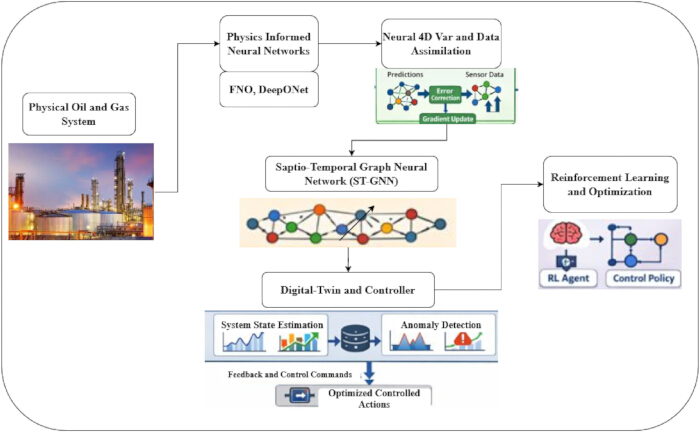
Figure 1: Overall Control-Aware Digital-Twin Architecture. Anomaly detection, spatiotemporal graph neural networks, neural 4D-Var synchronization, physics-informed neural operators, and reinforcement learning-based closed-loop control for oil and gas production systems are all integrated into the proposed control-aware digital twin model. Please click here to view a larger version of this figure.
Figure 1 represents the functional process of an oil and gas production control-aware digital twin as a closed-loop cyber-physical system. The functional process begins at the oil and gas production system level, in which different sensors distributed on wells, pipelines, valves, and processing units’ capture data on pressure, rate of flow, temperature, and controls at an instant in time. The various sensors capture data in various formats, and the data is sent to the digital twin, and this constructs the foundation of organization awareness at the instant.
The proposed methodology involves subsequent steps:
Data collection
Real-time information from sensors regarding pressure, flow rate, temperature, and control inputs is taken from oil and gas production environments. Other available benchmark datasets like SWAT and WADI are used for robustness and generalization capabilities. To ensure reproducibility, each step of the suggested methodology is specified using technical details.
[Please refer to Supplementary File (S1) for Dataset Generation and Simulation.]
Two public benchmark industrial control system datasets from the research domain for industrial control systems are used to prove the capability of the conceptual digital twin with respect to complex and high-dimensional time-series data as well as unusual events: The Secure Water Treatment (SWaT), and the Water Distribution (WADI) benchmark datasets34. Both datasets are derived from realistic cyber physical testbeds and include multivariate sensor and actuator operation data for both normal and anomalous/attack scenarios triggered on such systems. By using SWaT and WADI datasets, it is possible to do cross-domain testing and prove generalizability beyond cyber physical testbeds to broader distributed industrial systems with location and time-related dependencies. The Dataset Description is displayed in Table 2.
The proposed research makes use of three different data sets for the extensive evaluation of the developed digital twin methodology shown in Table 2. The base data set is comprised of simulated data relating to the production organization in oil and gas manufacturing and is intended to reproduce real operational measurements sensed by the system, as well as control and/or fault conditions. Furthermore, the Secure Water Treatment (SWaT) data set is introduced as an example of a reduced-scale physical system, comprising measurements from 51 sensors and actuators across the course of about 11 days, including both normal and artificially created anomalies and attacks. The data set is widely considered as the standard benchmark for research. Another set is the Water Distribution (WADI) data set, whose measurements capture the behavior of the reduced-scale water distribution system comprising about 123 variables over the course of 16 days including both different attacks and normal operating conditions. The data set contains a total of 15 different attacks. The two data sets above revolve mostly around high-dimensional series over time and spatial relationships as in industrial control systems.
Data preprocessing
Before model training, all datasets undergo a thorough pretreatment procedure to guarantee data quality, consistency, and reproducibility. Missing value management, noise filtering, normalization, and feature scaling are among the preprocessing procedures. The detailed preprocessing Pipeline is described in Supplementary File (S2).
System graph construction
In the proposed methodology, the physical production system for oil and gas is represented in the form of a graph, which serves as a mathematical structure for the description of spatial correlations between assets together with the dynamics of the state of the system over time (refer to the Supplementary File (S3) for System graph Construction Formulations).
Physics learning using neural operators
For the correct representation of the nonlinear and multidimensional characteristics of multiphase flow systems, the proposed approach uses physics-informed operators in the form of Fourier Neural Operators (FNO) and Neural operator model. Unlike the traditional method of representing neural networks as pointwise mappings, the concept of operators allows for generalization in terms of different boundary conditions. This feature makes this method more appropriate for multiphase flow systems used in the production of oil and gas since the physical phenomena occur continuously. Please refer to Supplementary File (S4) for neural operators’ mathematical equations.
To further evaluate the validity of the physics-informed neural operators, additional experiments were performed to assess their capacity to approximate nonlinear operator mappings under different flow states and control inputs. The results show that the operators can accurately approximate the mapping of the nonlinear operator, thereby validating the operators’ capacity to accurately model the dynamics of the system, especially in the presence of high dimensionality, at a lower computational cost than other solvers. Quantitative evaluation of operator learning accuracy is performed using mean squared error between predicted and simulated system states, demonstrating consistent approximation performance across different flow conditions.
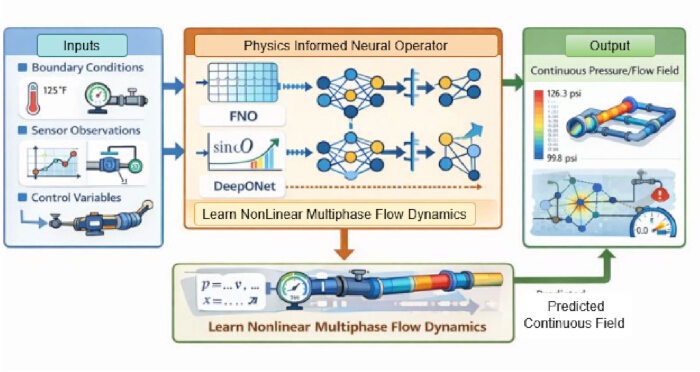
Figure 2: Workflow of the physics-informed neural operator framework. An example of the physics-informed neural operator workflow demonstrates how control inputs, sensor data, and boundary conditions are used to learn nonlinear multiphase flow dynamics and produce quick, operator-level system predictions. Please click here to view a larger version of this figure.
In the PINO working process presented in Figure 2, the learning process of physically complex nonlinear multiphase flows in oil and gas processes takes place in a continuous manner. This starts at the input layer where the model receives heterogeneous data about the physically evolving system. This input takes the form of boundary conditions, ranging from pressure, temperature, and velocity, as well as real-time data from sensors positioned within the oil and gas system, as well as control variables like the opening of valves, speed of pumps, or opening of chokes. All these inputs define the operation of the physically evolving system.
The key component within the workflow is that of the PINO, realized through FNO and Neural operator model. The proposed method is different and distinct in the sense that it uses neural operators to learn operators between function spaces, as opposed to traditional neural networks, which tend to focus on pointwise mapping between inputs and outputs. At this level, FNO is able to capture the global spatial relationships using the Fourier domain, and Neural operator model is able to learn operator representations using both branch and trunk networks. The learned model is guided by physical constraints to ensure the predicted dynamics behave as expected in the multiphase flow. The outcome of the neural operator takes the form of the continuous field solution of the important physical variables like pressure, flow rates, and phase distribution for the whole production network. Moreover, the output values are accurate for the whole field, including the wells, pipelines, and other connected units, rather than being measured at specific points like sensors. This way, the output of the neural operator provides the capability to rapidly produce highly accurate simulations that can approximate the solution to partial differential equations without necessarily solving them. This solution acts as the fast solution in the digital twin.
The neural operator learning process takes function-level and system-level features, which are extractions from oil and gas production processes. The features consist largely of the physical state variables for oil and gas production, which are continuous fields, temperature, flow rate, pressure, and phase fractions for oil, gas, and water. The features also include boundary conditions, which involve inlet pressures, flow rates, and valve positions. Control inputs, which involve positions for choke valves and pump speed, are also considered for predicting responses under different operational scenarios. The Neural operator model neural operator receives the physical features and parameters for control, which are processed by the trunk and branch networks. The features provide sufficient information for neural operators to predict accurate operator relationships that depend on both physical processes and operational factors for fast digital twin simulations.
Fourier neural operator (FNO)
In this research, a Fourier Neural Operator (FNO)36 is used to effectively estimate the operator mappings that describe the nonlinear multiphase flow dynamics of oil and gas production systems. Contrary to traditional neural networks, which approximate input-output mappings for a specific set of points, the proposed FNO approximates mappings between function spaces, thereby enabling generalization over various scales and configurations of a system. In this case, FNO works by moving the system state representations from the original space to the Fourier domain, where the spectral convolutions can be applied effectively for the purpose of capturing the global spatial dependencies existing within the systems. In this case, the input state representation is projected into a higher-dimensional latent space, and the transforms and activations are applied iteratively using Fourier transforms, spectral kernels, and activations. Please refer Supplementary File (S4.1) for Fourier neural operator mathematical evaluations.
Neural operator model
Neural operator model37 acts as an alternative approach within the neural operator process for approximating a nonlinear physical operator that defines oil and gas production dynamics. The detailed description of Neural operator model is described in Supplementary File (S4.2) (Refer Supplementary File S10 for Algorithm 1: Physics Learning with Neural Operators for Digital Twin Algorithm).
The proposed approach of using neural operators, therefore, commences with gathering paired examples of inputs and outputs, wherein the inputs are examples of system conditions in the form of system boundary values, control variables, or physical characteristics. The neural operator is trained in an iterative phase involving predicting responses to an input function with subsequent improvement of deviations between predictions and actual responses using a mean squared error function. This approach leads to optimization based on gradients, whereby a neural operator discovers systemic physics operators that define system behavior. The trained system can thus efficiently predict system responses to different input conditions.
Spatio-temporal system modeling
In the proposed digital twin architecture38, the oil and gas production process has been represented by a spatio-temporal graph. This has been done to conceptualize the connectivity as well as the time-evolution process of the distributed production resources.
The oil and gas production process inherently has a distributed structure in terms of wells, pipeline infrastructure, and sensors. To efficiently capture spatial/temporal relationships for such a process, the digital twin approach developed in this paper makes use of spatio-temporal graph neural networks (ST-GNN). In this approach, system entities are represented in terms of graph nodes, and system spatial/functional relationships are denoted by graph edges. Temporal relationships are expressed in terms of windowing functions in order to efficiently predict system state transitions and anomalies. Please refer Supplementary File (S5) for detailed description of Spatio-Temporal Graph Neural Network (ST-GNN).
Digital twin synchronization using Neural 4D VAR
Digital twin synchronization can be defined as continuous synchronization of the virtual twin with an ever-changing physical oil and gas production environment based upon real-time sensor readings. In practice, digital twins make predictions about states in a system, such as pressure, flow rate, and temperature, based upon an understanding of physical system dynamics. Nevertheless, due to uncertainties and sensor noise, an inevitable discrepancy arises between predictions and measurements. For this reason, in order to synchronize predictions with actual measurements, another method known as ‘data assimilation’ in this work it introduced to make predictions self-consistent with physical measurements. To ensure synchronization of the physical process and the digital twin during noisy and sparse sensor observations, a neural 4D-Var data assimilation method is incorporated. The added component aims at reducing the gap between sensor measurements and model predictions within an assimilation window. Utilizing differentiability, the neural 4D-Var method provides end-to-end learning and allows the digital twin state to be corrected online (Refer to Supplementary File (S6) for Neural 4D-Var Data Assimilation, Supplementary File (S10) for Algorithm 2: Digital Twin Synchronization Using Neural 4D-Var and refer to Supplementary File (S11) for hyper parameters and training details).
Anomaly detection and diagnosis
In the simulated oil and gas data set, anomalies were injected by introducing controlled perturbations like pressure drops exceeding 15%, abnormal flow spikes, and valve malfunctions. Data points that exceeded a set threshold value or deviated from a baseline statistical distribution are identified as anomalies. For the mathematical formulation of Anomaly Detection Framework (Supplementary File, S7).
Closed-loop optimization and control
In the proposed system, closed-loop control can be achieved by incorporating the harmonious DT and the reinforcement learning module for optimization. In the part of digital twins, the digital twin predicts the future behavior of the oil and gas production process under various conditions such as the positioning of different valves, pump rates, or flow control. This allows the development of a safety area where the control agent can evaluate the result of desired actions without having them materialized in the real-world process. Thus, by exploiting the forecasts offered by the digital twin, the reinforcement learning module can optimize operating goals, including the efficiency of the process, energy use, and process stability, without being limited by process constraints. Please refer to Supplementary File (S8) for Closed-loop Optimization and Control mathematical description.
Continuous learning and adaptation
Industrial systems face non-stationary environments with aging equipment, time-varying operating conditions, and unforeseen disturbances. To design an approach for this, the digital twin model proposed includes an ever-learning component that upgrades neural operators, graph models, and policies based on incremental learning. Upon observing major variations and unidentified patterns, learning is facilitated by incorporating new data and adjusting parameters associated with the digital twin model.
Continuous learning is also improving the robustness of both control policies and detection of anomalies since it helps the system identify new or novel patterns of behavior. Feedback from control result anomalies is applied to adjust models and optimize a reinforcement learning policy that will ensure effective decision-making processes as the system continues to change and evolve. This adaptive learning process changes a digital twin from being a passive observer to an intelligent system that can sustain real-time optimization processes of complex oil and gas production systems over an extended period using a technological infrastructure environment that is rigorous and effective. In Table 3, shows the model architecture and hyperparameters.
Please refer to Supplementary File (S9) for Continuous Learning Adaptation mathematical formulation.
The data preprocessing module is responsible for transforming raw sensor data into structured and normalized inputs suitable for downstream learning modules. Specifically, it aggregates historical sensor measurements, removes noise, and standardizes features to ensure consistent data quality. The processed data, along with boundary conditions and control inputs, is then provided as input to the physics-informed neural operator module (FNO/Neural operator model), which learns the underlying nonlinear physical relationships and generates a continuous system state estimate. This estimated system state is subsequently utilized by the control optimization module to update control strategies in a dynamic manner. The optimized control outputs are then forwarded to the decision-making module, which interprets the results and generates actionable decisions for system operation. A feedback mechanism is incorporated to continuously update the system based on newly observed data, thereby improving adaptability and performance over time. To enhance clarity and reproducibility, a system-level architecture is presented to illustrate the interaction among the modules. The proposed system consists of four main components, namely data preprocessing, physics-informed neural operator modeling, control optimization, and decision-making. These modules are interconnected through well-defined input–output interfaces, ensuring seamless data flow, iterative learning, and coordinated operation across the entire digital twin system.
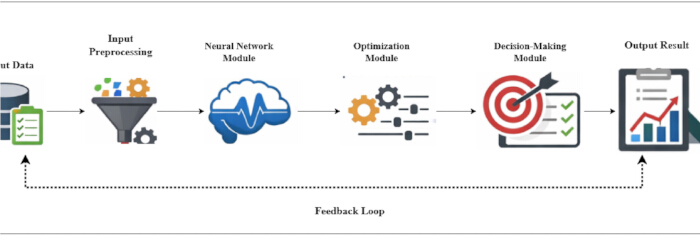
Figure 3: Overall System-Level Control Optimization Architecture Flowchart. It shows the overall system architecture of the proposed work. Please click here to view a larger version of this figure.
The system architecture shows a complete picture of the model that can be used for modeling and optimizing complex nonlinear physical dynamics in oil and gas production systems. This starts with the input data, which includes the parameters used for the simulation and the boundary conditions used to represent the physical environment. This data first passes through the data preprocessing module, where normalization and feature extraction are done. This prepares the data for the next module, where the neural operator, FNO, and Neural operator model are used. These models are used to predict the system states, and this information is used to optimize the system parameters using the optimization module. The optimized results are then used to make decisions using the decision-making module. This module helps determine the efficiency of the system. The framework also includes the output results, where the optimization process results are shown in Figure 3. In addition, a feedback loop is included, where the data passes through the preprocessing module after the output results.
Access restricted. Please log in or start a trial to view this content.
Results
In order to test the validity of the physics-informed neural operators, additional performance tests were conducted to compare the performance of FNO and Neural operator model in modeling the dynamics of the nonlinear multiphase flow system. The results showed that FNO performs better in global spatial consistency, while Neural operator model performs better in adaptability to heterogeneous inputs.
To guarantee effective training and assessment of the suggested digital twin framework, all expe...
Access restricted. Please log in or start a trial to view this content.
Discussion
The findings from this research demonstrate the effectiveness of the developed control-aware digital twin in terms of its ability to improve real-time monitoring, detection, and control optimization for a wide range of CPS. Compared to the traditional models for monitoring, the combination of the PINO and the graph neural networks is more effective in terms of accuracy for state estimation, even for a noisy system. This finding is true because an advanced machine learning model in the digital twin is more effective in te...
Access restricted. Please log in or start a trial to view this content.
Disclosures
The authors have no conflicts of interest.
Acknowledgements
The authors acknowledge the technical and institutional support provided by the Data Company and Production Command Department of Xinjiang Oilfield Company, CNPC, Karamay, China, during the completion of this research. No external funding was received for this study.
Access restricted. Please log in or start a trial to view this content.
Materials
| Name | Company | Catalog Number | Comments |
|---|---|---|---|
| CPU (Intel Xeon / AMD Ryzen) | Intel / AMD | Xeon / Ryzen Series | Used for system simulation, data preprocessing, and general computation |
| Deep Learning Framework (PyTorch 2.0) | Meta AI (PyTorch) | https://pytorch.org RRID:SCR_018536 | Used for implementing neural networks, optimization, and training pipelines |
| Deep Neural Network Library (cuDNN 8.x) | NVIDIA cuDNN | cuDNN 8.x | Provides optimized primitives for deep learning operations on GPU |
| DeepONet | Not Applicable | https://arxiv.org/abs/1910.03193 | In the script, it is refered as "neural operator model" |
| GPU (NVIDIA RTX 4090) | NVIDIA | RTX 4090 | Used for training deep learning models including neural operators, ST-GNN, and reinforcement learning components |
| GPU Acceleration (CUDA 11.8) | NVIDIA CUDA | CUDA 11.8 RRID:SCR_018131 | Enables GPU-based parallel computation for high-performance model training |
| Linux distribution (version 22.04 LTS) | Canonical (Ubuntu) | https://ubuntu.com/download; RRID:SCR_018127 | Operating system used for executing experiments and model deployment |
| Operating System (Ubuntu 22.04 LTS) | Canonical (Ubuntu) | https://ubuntu.com/download RRID:SCR_018127 | Provides execution environment for all experiments and model deployment |
| Optimization Algorithm (Adam Optimizer) | Not Applicable | https://arxiv.org/abs/1412.6980 | Used for training models with adaptive learning rate optimization |
| optimized deep neural network library (version 8.x) | NVIDIA cuDNN | https://developer.nvidia.com/cudnn RRID:SCR_018131 | Provides optimized GPU-accelerated primitives for deep neural network operations |
| Programming Language (Python 3.10) | Python Software Foundation | https://www.python.org/downloads RRID:SCR_008394 | Core programming language used for implementation and experimentation |
| System Memory (≥ 64 GB RAM) | Corsair / Kingston / Crucial | https://www.corsair.com / https://www.kingston.com / https://www.crucial.com | Supports handling of high-dimensional multivariate time-series data and large model training |
References
- Rebello CM, Jäschke J, Nogueira IBR. Digital twin framework for optimal and autonomous decision-making in cyber-physical systems: Enhancing reliability and adaptability in the oil and gas industry. arXiv preprint arXiv:2311.12755. 2023. https://doi.org/10.48550/arXiv.2311.12755
- Priyanka EB, Thangavel S, Gao XZ, Sivakumar N. Digital twin for oil pipeline risk estimation using prognostic and machine learning techniques. J Ind Inf Integr. 2022;26:100272. https://doi.org/10.1016/j.jii.2021.100272
- Xu X, Liu B, Guo J. Asset management of oil and gas pipeline systems based on digital twin. IFAC Pap OnLine. 2020;53:715–719. https://doi.org/10.1016/j.ifacol.2020.12.123
- Shen F, Ren SS, Zhang XY. A digital twin-based approach for optimization and prediction of oil and gas production. Math Probl Eng. 2021;2021:3062841. https://doi.org/10.1155/2021/3062841
- Wanasinghe TR, et al. Digital twin for the oil and gas industry: Overview, research trends, opportunities, and challenges. IEEE Access. 2020;8:104175–104197. https://doi.org/10.1109/ACCESS.2020.2999087
- Wang B, Tao F, Fang X. Smart manufacturing and intelligent manufacturing: A comparative review. Engineering. 2021;7:738–757. https://doi.org/10.1016/j.eng.2020.07.017
- Wang C, Wang C, Wang K. Technology research and standard development of predictive maintenance for intelligent manufacturing equipment. China Standardization. 2021;2:15–21.
- Ren S, Zhang Y, Huang B. Lifecycle big-data-driven smart manufacturing services for complex products. J Mech Eng. 2018;54:194–203.
- Li L, Lei B, Mao C. Digital twin in smart manufacturing. J Ind Inf Integr. 2022;26:100289. https://doi.org/10.1016/j.jii.2021.100289
- Grieves M, Vickers J. Digital twin: Mitigating unpredictable, undesirable emergent behavior in complex systems. In: Transdisciplinary perspectives on complex systems. Cham: Springer; 2017. p. 85–113. https://doi.org/10.1007/978-3-319-38756-7_4
- Yang M, et al. A novel embedding model based on a transition system for building industry-collaborative digital twin. Appl Sci. 2022;12:553. https://doi.org/10.3390/app12020553
- Wang T, Feng K, Ling J. Pipeline condition monitoring towards digital twin systems: A case study. J Manuf Syst. 2024;73:256–274. https://doi.org/10.1016/j.jmsy.2023.12.005
- Malek NG, et al. Live digital twin for smart maintenance in structural systems. IFAC Pap OnLine. 2021;54:1047–1052. https://doi.org/10.1016/j.ifacol.2021.10.146
- Yun J, Kim S, Kim J. Digital twin technology in the gas industry: A comparative simulation study. Sustainability. 2024;16:5864. https://doi.org/10.3390/su16145864
- Bhowmik S. Digital twin for offshore pipeline corrosion monitoring: A deep learning approach. In: Proc Offshore Technology Conf. 2021. D041S049R003.
- Hamidishad N, et al. Digital twin frameworks for oil and gas processing plants: A comprehensive literature review. Processes. 2025;13:3488. https://doi.org/10.3390/pr13123488
- Homaei M, et al. Causal digital twins for cyber-physical security: A framework for robust anomaly detection in industrial control systems. arXiv. 2025.
- Ahmed CM, Palleti VR, Mathur AP. WADI: A water distribution testbed for research in secure cyber-physical systems. In: Proc Int Workshop Cyber-Physical Systems Smart Water Networks. 2017.
- Sudhakar R. Robust digital twin approach towards operational excellence and sustainability goals. In: Proc Abu Dhabi Int Petroleum Exhibition Conf. 2023.
- Knebel FP, et al. Cloud and edge computing for implementation of digital twins in oil and gas industries. Comput Ind Eng. 2023;182:109363. https://doi.org/10.1016/j.cie.2023.109363
- Daher E. Digital safety trends in oil and gas. In: Proc SPE Asia Pacific Oil and Gas Conf. 2023.
- Tao F, et al. Digital twin in industry: State-of-the-art. IEEE Trans Ind Inform. 2019;15:2405–2415. https://doi.org/10.1109/TII.2018.2873186
- Sircar A, et al. Digital twin in the hydrocarbon industry. Pet Res. 2023;8:270–278. https://doi.org/10.1016/j.ptlrs.2023.03.002
- Li G, et al. Intelligent drilling and completion: A review. Engineering. 2022;18:33–48. https://doi.org/10.1016/j.eng.2021.12.004
- Hammerschmid M, et al. Development of virtual representations for energy plants: From digital model to predictive twin. Energies. 2023;16:2641. https://doi.org/10.3390/en16062641
- Lu L, Jin P, Karniadakis GE. Deep operator network: Learning nonlinear operators for identifying differential equations. arXiv. 2019.
- Lin M, et al. Reinforcement learning-based model predictive control for discrete-time systems. IEEE Trans Neural Netw Learn Syst. 2023;35:3312–3324. https://doi.org/10.1109/TNNLS.2022.3140110
- Huang Z, et al. Survey on AI-driven digital twins in Industry 4.0. Sensors. 2021;21:6340. https://doi.org/10.3390/s21196340
- Wang Y, et al. Structural health monitoring of oil and gas pipelines. Ocean Eng. 2024;308:118293. https://doi.org/10.1016/j.oceaneng.2024.118293
- Khisty VH. SCADA systems in oil and gas: Driving innovation and efficiency. Int J Res Appl Sci Eng Technol. 2024;12:96–107.
- Ma Z, Hao Z, Zhao Z. Energy-saving scheduling algorithm of wireless monitoring sensors. Energy Inform. 2024;7:104. https://doi.org/10.1186/s42162-024-00264-4
- Aba EN, et al. Petroleum pipeline monitoring using IoT platform. SN Appl Sci. 2021;3:180. https://doi.org/10.1007/s42452-021-04180-5
- Gulzar Q, Mustafa K. Cyber-attack detection in industrial control systems. Sci Rep. 2025;15:26575. https://doi.org/10.1038/s41598-025-26575-0
- Bloemheuvel S, et al. Graph construction for spatiotemporal data in GNNs. Int J Data Sci Anal. 2024;18:157–174. https://doi.org/10.1007/s41060-024-00423-7
- Li Z, et al. Fourier neural operator for parametric PDEs. arXiv. 2020.
- Yu B, Yin H, Zhu Z. Spatio-temporal graph convolutional networks. arXiv. 2017.
- Wu H, et al. Review of digital twins across processes. Sensors. 2023;23:8306. https://doi.org/10.3390/s23198306
- Xu Q, Ali S, Yue T. Digital twin-based anomaly detection. ACM Trans Softw Eng Methodol. 2023;32:1867–1878. https://doi.org/10.1145/3583555
- Ogbodo CO, et al. Adaptive sensor steering using reinforcement learning. Proc R Soc A. 2026;482:2329.
- Tao F, Qi Q, Liu A, Kusiak A. Data-driven smart manufacturing. J Manuf Syst. 2018;48:157–169. https://doi.org/10.1016/j.jmsy.2018.01.006
Access restricted. Please log in or start a trial to view this content.