This prospective cohort study found that intimate partner violence was associated with poorer psychological adaptation, persistently elevated cortisol, reduced early stoma perfusion, lower nursing adherence, and more postoperative complications among women with enterostomies. Early screening and tailored cross-departmental support may improve recovery and quality of life.
Research Article
Impact of Intimate Partner Violence on Postoperative Psychological Adaptation and Nursing Outcomes in Female Enterostomy Patients: A Cohort Study
* These authors contributed equally
In This Article
Summary
Abstract
To assess the impact of intimate partner violence (IPV) on postoperative psychological adaptation and nursing outcomes in female patients with enterostomy across multiple departments, a prospective cohort study was conducted. Between January and December 2024, 188 women who underwent enterostomy in the Departments of Obstetrics and Gynecology, Colorectal Surgery, and General Surgery were enrolled and followed for 11 months. IPV exposure was evaluated within 1 week after surgery, and participants were categorized as an IPV group (n = 54) or a non-IPV group (n = 134). The IPV exposure rate was 28.7%. Compared with the non-IPV group, the IPV group had higher anxiety and depression scores, persistently higher serum cortisol levels at each postoperative time point, and lower early stoma mucosal blood supply scores. By the end of follow-up, the IPV group showed higher rates of stoma complications (38.9%) and readmission (24.1%), alongside poorer stoma-care compliance, lower nursing compliance scores, and lower scores across quality-of-life domains. Multivariable logistic regression analysis indicated that IPV exposure was independently associated with stoma complications (OR = 3.764, 95% CI 1.133 – 12.505, p = 0.030). These findings suggest that IPV amplifies postoperative stress responses and undermines rehabilitation in female enterostomy patients. Clinically, a cross-departmental screening pathway and tailored postoperative support for IPV-exposed patients may help improve recovery and nursing outcomes.
Introduction
Enterostomy is a critical therapeutic intervention for life-threatening intestinal conditions managed across various surgical specialties, including Obstetrics and Gynecology (e.g., gynecologic malignancies with bowel involvement), Colorectal Surgery (e.g., colorectal cancer), and General Surgery (e.g., severe intestinal obstruction)1. By altering normal defecatory physiology and necessitating long-term use of stoma appliances, enterostomy can lead to psychological distress, including anxiety and depression, as well as difficulties in psychosocial adjustment—factors that may impede postoperative recovery and rehabilitation2. Intimate partner violence (IPV) represents a significant global public health concern, capable of exacerbating symptom burden through chronic psychological stress and disruption of health-promoting behaviors. For women undergoing enterostomy, the postoperative period constitutes a particularly vulnerable phase, during which exposure to IPV may have an amplified impact on psychological adaptation and nursing-sensitive outcomes3.
Previous research has demonstrated that postoperative maladaptation is associated with diminished quality of life among patients with enterostomies2; reviews and editorials have also emphasized the substantial physical and psychological burden of IPV among women4,5,6. Nevertheless, several knowledge gaps persist. Most existing studies have focused on single-department cohorts, limiting their ability to capture cross-departmental variations in the underlying indications for enterostomy7. Moreover, the association between IPV and postoperative outcomes in female enterostomy patients remains underexplored, with a paucity of prospective data available8. Finally, many published reports rely primarily on narrative descriptions, with insufficient incorporation of visual representations that could enhance the communication of recovery trajectories and key clinical outcomes9. Accordingly, this study aimed to characterize the dynamic association between IPV exposure and postoperative psychological adaptation in female enterostomy patients from a cross-departmental perspective and to examine its relationship with nursing outcomes. To facilitate clinical interpretation, the cohort construction, follow-up process, and time-course changes in key indicators were presented using flowcharts and trend graphs. The results are intended to inform collaborative identification of high-risk patients across departments and to support the development of targeted postoperative nursing strategies to strengthen psychological adaptation and improve rehabilitation outcomes.
Protocol
Statement of ethics
The study was approved by the ethics committee of First Affiliated Hospital of Xiamen University (Approval No. [2024]152). All the materials used in this study are listed in the Table of Materials.
Study design
A single-center, cross-departmental prospective cohort study was conducted in the Departments of Obstetrics and Gynecology, Colorectal Surgery, and General Surgery of First Affiliated Hospital of Xiamen University. Female patients who underwent enterostomy between January and December 2024 were eligible. Within 1 week after surgery, IPV exposure was assessed using the victimization items of the revised Conflict Tactics Scales (CTS2) together with a structured interview. Occurrence and frequency were analyzed separately. For occurrence scoring, each victimization item was coded as 0 when the act had not occurred and 1 when it had occurred at least once during the preceding 12 months; endorsement of at least one CTS2 victimization item, or disclosure of economic control during the structured interview, defined IPV exposure. Medical records of violence-related injuries, photographs, and police records were used as corroborative evidence but were not required for classification. The two researchers independently reached the same baseline classification for all 188 participants. Fifty-four participants met the binary exposure definition and were assigned to the IPV group, whereas 134 reported no qualifying exposure and were assigned to the non-IPV group; the resulting IPV exposure rate was 28.7% (54/188). For frequency scoring, the CTS2 response categories were converted to estimated frequencies of 0, 1, 2, 4, 8, 15, and 25 and summed across the victimization items. Among the 54 IPV-exposed participants, the observed frequency score ranged from 9 to 44; scores < 15, 15–30, and >30 were described as low, intermediate, and high frequency, respectively. These study-defined categories were used only for descriptive presentation and did not determine group assignment. Baseline group membership was retained throughout follow-up, irrespective of subsequent changes in reported IPV exposure. The study flow, cohort assembly, and follow-up schedule were summarized in Figure 1.
Sample size calculation
Sample size was estimated using PASS 15.0 software. Based on prior studies10, the authors assumed that the proportion of good stoma adaptation at 6 months would be 65% in the non-IPV group and 35% in the IPV group. With a two-tailed α of 0.05, power (1−β) of 0.90, and a 15% allowance for potential attrition, the minimum required sample size was 168.
Study participants
During the study period, 188 women who underwent enterostomy for colorectal cancer, gynecologic tumors involving the intestinal tract, intestinal obstruction, intestinal perforation, or other indications were assessed for eligibility. None was excluded because of a severe psychiatric or cognitive disorder (n = 0), severe major-organ dysfunction or an anticipated survival of less than 11 months (n = 0), a severe postoperative complication requiring emergency reoperation (n = 0), previous enterostomy or major organ transplantation (n = 0), or refusal or inability to complete the required follow-up and objective assessments (n = 0); consequently, all 188 women were enrolled. All 188 enrolled participants completed the 11-month follow-up, yielding an observed attrition rate of 0%. These patients were treated between January and December 2024 in the Departments of Obstetrics and Gynecology, Colorectal Surgery, and General Surgery; 30 participants were recruited from Obstetrics and Gynecology, 82 from Colorectal Surgery, and 76 from General Surgery. Potential participants were initially identified through screening of electronic medical records. Trained researchers then conducted face-to-face interviews to explain the study objectives and procedures. After providing written informed consent, eligible participants were enrolled, categorized according to their intimate partner violence (IPV) exposure status, and assigned individual follow-up files. Data on demographic characteristics, disease- and surgery-related variables, psychological assessments, objective physiological indicators, and nursing outcomes were systematically collected throughout the follow-up period.
Inclusion and exclusion criteria
Inclusion criteria: Age ≥18 years; conscious and oriented; capable of verbal communication and reading comprehension sufficient to complete questionnaires, assessments, and follow-up procedures; Undergoing first-time enterostomy (either permanent or temporary), with stable stoma morphology postoperatively and no immediate severe complications; Currently in an intimate partner relationship (married or cohabiting), with potential exposure to IPV; Willingness to participate and provision of written informed consent.
Exclusion criteria: Preoperative diagnosis of severe psychiatric disorders (e.g., schizophrenia, major depressive disorder) or cognitive impairment; Severe dysfunction of major organs (e.g., heart, liver, kidney) with an anticipated survival duration of less than 11 months; Presence of severe postoperative complications (e.g., stoma necrosis, severe infection) necessitating emergency reoperation; History of previous enterostomy or major organ transplantation; Refusal to participate, inability to comply with follow-up requirements, or unwillingness to undergo assessment of objective indicators.
Grouping
Within 1 week after surgery, IPV exposure was assessed using the revised Conflict Tactics Scales (CTS2)11 combined with structured interviews. Where available, supporting materials (e.g., medical records documenting violence-related injuries and photographs of physical injuries) were collected. Baseline exposure status was determined from the participant’s CTS2 occurrence responses and disclosures made during the structured interview, whereas medical records, photographs, and police records were used solely as corroborative evidence and were not required for classification. Patients reporting any form of violence (physical violence, emotional violence, economic control, etc.) were allocated to the IPV group, while those reporting no IPV were allocated to the non-IPV group. The two researchers independently reached the same baseline exposure classification for all 188 participants; consequently, no case required consensus adjudication. Ultimately, 54 patients were included in the IPV group and 134 patients in the non-IPV group.
Outcome measures
Baseline data comparison table: Collected within 1 week after surgery. Objective indicators included age, surgical duration, intraoperative blood loss, stoma diameter, primary disease type, and surgical approach; subjective indicators included educational level and economic income. These variables were used to evaluate baseline comparability between groups. IPV occurrence and objective evidence table: Collected at baseline (within 1 week after surgery) and at 6 months postoperatively. In addition to IPV incidence and type, objective indicators (number of medical visits for violence-related injuries, cases with photographic evidence of injury, and records of police involvement) were recorded to strengthen the assessment.
Longitudinal psychological adaptation and objective physiological indicators: Collected at 1, 3, 6, 9, and 11 months postoperatively. Psychological outcomes were assessed using the 20-item self-rating anxiety scale (SAS) and the 20-item self-rating depression scale (SDS), both of which use four-point response options; higher standard scores indicate greater symptom burden, and scores of ≥50 and ≥53 were used to identify clinically relevant anxiety and depressive symptoms, respectively12. Because only total scores were retained in the analytic dataset, cohort-specific internal-consistency coefficients were not calculated. Physiological indicators included serum cortisol (Cor) levels and stoma mucosal blood supply scores (0–3 points; 3 indicating normal blood supply, with lower scores indicating poorer perfusion).
Subjective and objective nursing outcome indicators: Collected at the 11-month follow-up endpoint. Objective outcomes included stoma complication incidence, readmission rate, stoma-care compliance rate (assessed by on-site evaluation; 1 = compliant, 0 = non-compliant), time to first postoperative ambulation, and length of hospital stay. Subjective outcomes included adherence to the postoperative nursing plan, assessed using a study-specific 12-item scale with four response options per item and a total score range of 12–48; scores ≥36 indicated higher adherence. The scale had not undergone formal external psychometric validation; therefore, the outcome was treated as exploratory. Quality of life was assessed using the EORTC QLQ-C3013 (five functional dimensions, including physical, emotional, and social functioning; higher scores indicate better quality of life).
Association between IPV frequency and objective stress indicators: CTS2 frequency scores were analyzed in relation to contemporaneous serum cortisol concentrations at 1, 3, 6, 9, and 11 months postoperatively among participants classified as IPV-exposed at baseline.
Objective diagnosis and intervention of stoma complications: Collected from 1 to 11 months postoperatively. The number and proportion of complications, diagnostic basis (physical examination and/or imaging), and the number of interventions for each complication type (e.g., peristomal dermatitis, stoma prolapse) were recorded.
Department-level comparisons of IPV exposure and objective stress indicators: Collected within 1 week after surgery to compare IPV exposure rates and mean Cor levels among departments.
Risk factors for adverse outcomes: Collected at the 11-month follow-up endpoint. Objective risk factors and IPV exposure status were included to estimate odds ratios (ORs) and 95% confidence intervals (CIs) for adverse nursing outcomes (defined as the occurrence of complications).
Quality control
All researchers received standardized training on assessment tools and objective indicator testing procedures. Data were double-entered and cross-checked to improve accuracy. Outcome assessors were not formally blinded to IPV status; however, serum cortisol measurements were obtained using standardized laboratory procedures, and stoma complications were assessed according to prespecified clinical criteria. Follow-up completion was supported through text-message reminders and dedicated follow-up staff; all 188 participants completed the 11-month follow-up, and no participant was lost to follow-up. Objective indicator testing adhered to laboratory standards and clinical assessment criteria to reduce measurement error.
Statistical analysis
SPSS 26.0 was used for statistical analyses with a two-tailed α of 0.05. Categorical variables are presented as n (%) and compared using the χ2 test. Continuous variables are presented as mean ± standard deviation (SD). Independent-samples t-tests were applied to normally distributed, homoscedastic data; the Mann-Whitney U test was used for non-normally distributed data. Repeated-measures analysis of variance was used to compare longitudinal changes in SAS, SDS, and serum cortisol, with group, time, and group-by-time effects evaluated. Residual distributions were examined graphically, homogeneity of variance was assessed using Levene’s test, and sphericity was evaluated using Mauchly’s test; Greenhouse–Geisser corrections were applied when sphericity was violated. When an omnibus longitudinal effect was significant, Bonferroni correction was applied to the five time-specific between-group comparisons within that outcome. The same correction was applied to the five correlations between CTS2 frequency scores and serum cortisol concentrations. No global adjustment was applied across distinct prespecified secondary outcomes, which were interpreted separately using exact two-sided p values. Because the stoma mucosal blood supply score was an ordinal measure ranging from 0 to 3, between-group comparisons at each postoperative time point were performed using the Mann–Whitney U test. Pearson correlation analysis was used to assess associations between CTS2 frequency scores and serum cortisol concentrations. Multivariate logistic regression was used to identify independent risk factors for adverse postoperative outcomes. All baseline and longitudinal variables included in the final analyses were complete for the 188 participants. Blank entries in conditional fields, such as complication type among participants without a stoma complication or supporting evidence among participants without IPV exposure, represented absence or non-applicability rather than missing data; therefore, no statistical imputation was performed.
Results
Comparison of baseline data between groups
Baseline characteristics are summarized in Table 1. No statistically significant between-group differences were observed in age, surgical duration, intraoperative blood loss, stoma diameter, patient source, surgical approach, or educational level; however, the distribution of monthly household income differed significantly between the groups (p < 0.05). Most baseline characteristics were comparable between the groups, although monthly household income differed significantly between groups.
Comparison of IPV occurrence and objective evidence between groups
At baseline, emotional violence was the most frequently reported IPV subtype in the IPV group, followed by physical violence and economic control; 16.7% of patients reported exposure to all three forms. No IPV was reported in the non-IPV group. Regarding supporting evidence, 14 cases (25.9%) in the IPV group had medical records of violence-related injuries, 10 cases (18.5%) provided photographic evidence of physical injury, and 4 cases (7.4%) had police involvement, whereas no such evidence was identified in the non-IPV group. At 6 months postoperatively, 45 of the 54 participants in the baseline IPV group (83.3%) reported ongoing IPV, whereas 9 participants (16.7%) did not; all 54 participants nevertheless remained in the baseline IPV group for the longitudinal analyses. The three participants reporting new forms of violence were already members of the baseline IPV group, and no participant in the baseline non-IPV group reported IPV or changed groups during follow-up (Table 2).
Dynamic changes in postoperative psychological adaptation and objective physiological indicators between groups
SAS and SDS scores were higher in the IPV group at all five postoperative assessments, as were serum cortisol concentrations (all Bonferroni-adjusted p < 0.05); the highest mean cortisol concentration in the IPV group was observed at 1 month postoperatively (270.0 ± 46.1 ng/mL). Stoma mucosal blood supply scores were lower in the IPV group at 1 and 3 months (both Bonferroni-adjusted p < 0.05), whereas the differences at 6, 9, and 11 months were not statistically significant (Figure 2). Mauchly’s test indicated violations of sphericity for SAS (W = 0.903, p = 0.026) and serum cortisol (W = 0.883, p = 0.006), but not for SDS (W = 0.959, p = 0.553); Greenhouse – Geisser-corrected results were therefore reported for SAS and serum cortisol. Significant group-by-time interactions were observed for SAS (F[3.81, 708.00] = 3.200, p = 0.014) and serum cortisol (F[3.76, 699.35] = 7.204, p < 0.001), whereas the interaction for SDS was not significant (F[4, 744] = 1.999, p = 0.093).
Comparison of postoperative subjective and objective nursing outcomes between groups
The incidence of stoma complications was higher in the IPV group than in the non-IPV group (p < 0.01). The IPV group also showed higher readmission rates, longer time to first postoperative ambulation, longer hospital stays, and lower stoma-care compliance (p < 0.05). Subjective outcomes were similarly poorer in the IPV group, including a lower nursing compliance score (33.9 ± 4.5 vs. 39.0 ± 3.5, p < 0.05) and lower quality-of-life scores across domains (p < 0.05) (Table 3).
Correlation between CTS2 frequency scores and serum cortisol concentrations
Pearson correlation analysis showed positive associations between CTS2 frequency scores and serum cortisol concentrations at 1, 3, 6, 9, and 11 months postoperatively (r = 0.535, 0.704, 0.745, 0.672, and 0.604, respectively; all Bonferroni-adjusted p < 0.001) (Figure 3).
Differences in objective diagnosis and intervention of stoma complications between groups
Peristomal dermatitis was the most common complication in the IPV group (22.2%), followed by stoma prolapse (9.3%) and stoma stenosis (7.4%); peristomal dermatitis was also the most common complication in the non-IPV group (6.7%). Most complications were diagnosed by physical examination, with 4 cases of stoma prolapse in the IPV group additionally confirmed by abdominal ultrasound. The mean number of complication-related interventions was higher in the IPV group (1.9 ± 0.6 vs. 1.2 ± 0.5, p < 0.05), and the proportion requiring surgical intervention was also higher (13.0% vs. 3.7%, p < 0.05) (Table 4).
Differences in IPV exposure rate and objective stress indicators across departments
The IPV exposure rate was highest among patients from Obstetrics and Gynecology (12/30, 40.0%), followed by Colorectal Surgery (22/82, 26.8%) and General Surgery (20/76, 26.3%); the difference in IPV exposure rates across departments was not statistically significant (χ2 = 2.222, p = 0.329). Within each department, mean Cor levels were higher in the IPV group than in the non-IPV group at all five postoperative time points (p < 0.05). Among IPV-exposed patients, Cor levels differed across departments at 1 month (F = 5.656, p = 0.006), but not at 3, 6, 9, or 11 months (p > 0.05) (Table 5).
Risk factors for adverse postoperative nursing outcomes
Multivariate logistic regression was conducted with adverse postoperative nursing outcomes (occurrence of complications) as the dependent variable and age, stoma type, Cor level, IPV exposure status, and other candidate factors as independent variables (Table 6). IPV exposure was independently associated with stoma complications (OR = 3.764, 95% CI 1.133 – 12.505, p = 0.030), whereas the other predictors included in the model were not statistically significant (Table 7).
DATA AVAILABILITY:
Raw data for this study are provided in Supplementary Table 1.
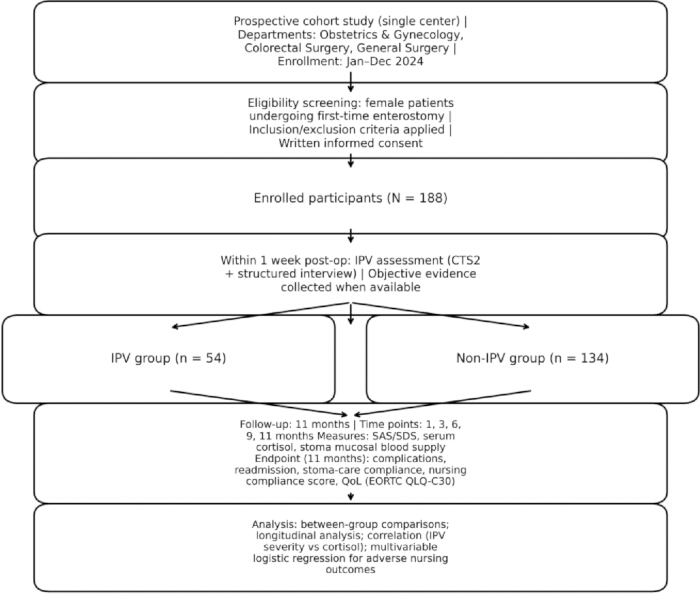
Figure 1: Flow diagram of the prospective cohort study. Shows participant screening, IPV assessment, group allocation, follow-up time points, outcome collection, and statistical analyses in the prospective cohort study. Please click here to view a larger version of this figure.
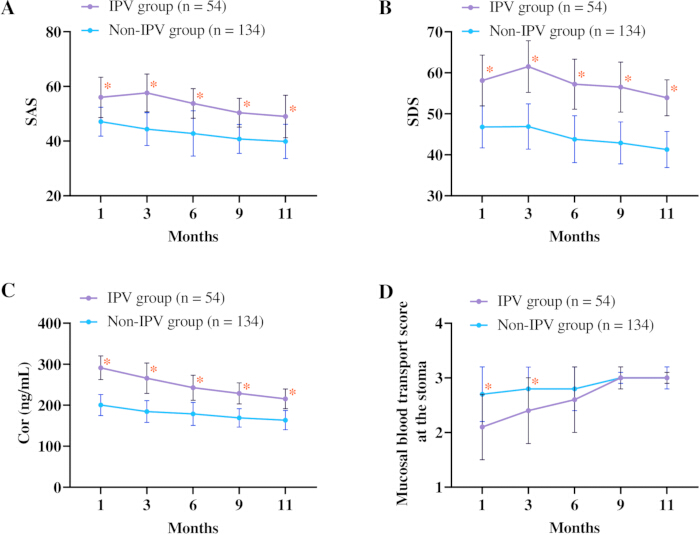
Figure 2: Dynamic changes in psychological adaptation and objective physiological indicators postoperatively. (A) Changes in SAS. (B) Changes in SDS. (C) Changes in Cor. (D) Changes in the mucosal blood transport score at the stoma. * indicates p < 0.05 compared with the non-IPV group. Compares postoperative trajectories of anxiety, depression, serum cortisol, and stoma mucosal blood-supply scores between the IPV and non-IPV groups. Please click here to view a larger version of this figure.
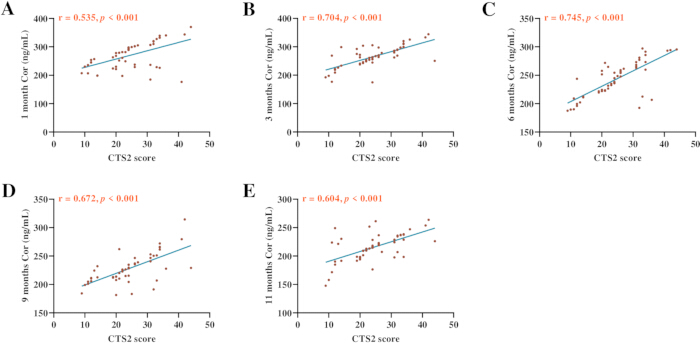
Figure 3: Correlation between CTS2 frequency score and Serum Cortisol Levels. (A) Relationship between Cor and IPV at 1 month. (B) Relationship between Cor and IPV at 3 months. (C) Relationship between Cor and IPV at 6 months. (D) Relationship between Cor and IPV at 9 months. (E) Relationship between Cor and IPV at 11 months. Displays correlations between CTS2-based IPV severity scores and serum cortisol levels at 1, 3, 6, 9, and 11 months after surgery. Please click here to view a larger version of this figure.
Table 1: Comparison of baseline characteristics between the IPV group and the non-IPV group. Summarizes baseline demographic, perioperative, departmental, socioeconomic, and surgical characteristics, together with IPV severity in the IPV group. Please click here to download this file.
Table 2: Occurrence of intimate partner violence and objective supporting evidence in the IPV group. Summarizes IPV types, violence-related injuries, objective supporting evidence, sustained violence, and newly reported forms of violence at 6 months. Please click here to download this file.
Table 3: Comparison of postoperative subjective and objective nursing outcomes between groups. Compares stoma complications, readmission, recovery indicators, care compliance, nursing compliance, and quality-of-life outcomes between the two groups. Please click here to download this file.
Table 4: Objective diagnosis and intervention of stoma complications between groups. Compares the incidence of major stoma complications, the number of complication-related interventions, and the need for surgical intervention between groups. Please click here to download this file.
Table 5: IPV exposure rate and serum cortisol levels across different departments. Shows IPV and non-IPV group sizes and serial serum cortisol levels across colorectal surgery, obstetrics and gynecology, and general surgery. Please click here to download this file.
Table 6: Assignment of variables for multivariate logistic regression analysis. Lists the coding rules and variable assignments used in the multivariate logistic regression analysis. Please click here to download this file.
Table 7: Multivariate logistic regression analysis of risk factors for adverse postoperative nursing outcomes. Reports regression coefficients, significance tests, odds ratios, and confidence intervals for predictors of adverse postoperative nursing outcomes. Please click here to download this file.
Supplementary Table 1: Raw data. All the raw data values used to plot the graphs and perform the analysis are listed in this table. Please click here to download this file.
Discussion
This prospective cohort study investigated the association between intimate partner violence (IPV) exposure and postoperative recovery among female enterostomy patients across multiple departments. IPV exposure was identified in 28.7% of participants. Compared with the non-IPV group, individuals in the IPV group exhibited significantly higher anxiety and depression scores, elevated serum cortisol (Cor) levels at postoperative time points, and lower early stoma mucosal blood supply scores. By 11 months post-surgery, the IPV group experienced a greater incidence of stoma-related complications and hospital readmissions, along with poorer nursing compliance and reduced quality of life. Notably, IPV remained an independent risk factor for adverse postoperative outcomes in multivariable analyses.
Regarding psychological adaptation, SAS and SDS scores in the IPV group were consistently higher throughout the follow-up period, peaking at 3 months. This pattern is consistent with evidence that women exposed to psychological or physical IPV experience a greater burden of anxiety and depressive symptoms than women without such exposure14. In the context of postoperative recovery following enterostomy, the present findings further indicate that the impact of IPV on psychological adjustment is time-dependent, with the effect most pronounced during the early phase of stoma recovery. From a physiological standpoint, serum cortisol concentrations remained elevated in the IPV group and were positively associated with the CTS2 frequency score, consistent with previous reports of altered cortisol regulation among women exposed to IPV15. These findings, extended to female enterostomy patients, support a mechanistic pathway whereby violence-related chronic stress may impair early physiological recovery, including compromised stoma mucosal perfusion.
Nursing outcomes were also significantly worse among patients exposed to IPV. The IPV group had a higher rate of stoma complications than the non-IPV group, extending broader nursing discussions that have called for stronger identification of and responses to IPV16. The lower stoma-care and nursing adherence observed in the IPV group may have contributed to the higher complication rate, although the present observational design cannot establish mediation or causality. This interpretation is consistent with evidence that structured ostomy education and greater self-care proficiency are associated with fewer ostomy-related complications17,18. In addition, delayed ambulation and longer hospital stay in the IPV group suggest inhibited participation in rehabilitation behaviors and higher utilization of healthcare resources. From a cross-departmental perspective, IPV exposure appeared most frequent in Obstetrics and Gynecology, whereas cortisol levels among IPV-exposed patients differed across departments at 1 month but were similar thereafter. This pattern suggests that IPV may exert a broadly consistent physiological stress effect across primary disease departments, supporting the rationale for coordinated screening and response pathways. Most previous studies were limited to a single department and failed to reflect such common characteristics across departments19,20. However, some studies have suggested that the effect of IPV on outcomes may be moderated by social support21, but this moderating variable was not included in this study and warrants further exploration.
Based on these results, a cross-departmental IPV screening mechanism may be considered for routine care, ideally initiated within 1 week of surgery. Enhanced psychological support during the first 3 postoperative months, together with individualized stoma-care education and adherence support, may be particularly relevant for IPV-exposed patients. This study has several limitations. As a single-center cohort, external generalizability may be limited. IPV assessment relied on self-report supplemented by partial objective evidence, leaving potential for underreporting and recall bias. In addition, the absence of formal assessor blinding may have introduced measurement bias, particularly for questionnaire-based outcomes. The 11-month follow-up does not capture longer-term outcomes beyond 1 year. Potential mediators or moderators (e.g., social support and coping style) were not evaluated. Although Bonferroni correction was applied to repeated time-specific comparisons within each longitudinal outcome and to the five correlation analyses, no global adjustment was made across all distinct secondary outcomes; a residual risk of type I error should therefore be considered when interpreting the secondary findings. The study-specific nursing-adherence scale has not undergone formal external psychometric validation, which limits the comparability and interpretation of this exploratory outcome. Future studies should consider multicenter designs with larger samples, longer follow-up, and additional psychosocial variables to refine causal pathways and intervention targets.
In conclusion, IPV was associated with greater postoperative psychological stress, impaired physiological recovery, and poorer nursing outcomes in female enterostomy patients, and it remained an independent risk factor for adverse postoperative outcomes. Integrating IPV screening and targeted support into cross-departmental postoperative care pathways may improve rehabilitation and quality of life in this population.
Disclosures
The authors declare that they have no known competing financial interests or personal relationships that could have influenced the work reported in this paper.
Acknowledgements
This study was supported by the Xiamen Science and Technology Project (Grant No. 3502Z20254ZD1085).
Materials
| Name | Company | Catalog Number | Comments |
|---|---|---|---|
| Medical Stoma Assessment Scale | Self-developed (validated) | N/A | Assessment of stoma mucosal blood supply |
| Microplate Reader | BioTek Instruments (Agilent) | ELx800 | Used for ELISA absorbance measurement |
| Refrigerated Centrifuge | Eppendorf | 5810R | Serum separation |
| Revised Conflict Tactics Scales (CTS2) | Western Psychological Services (WPS) | CTS2-Manual | Used to assess intimate partner violence exposure |
| Self-Rating Anxiety Scale (SAS) | Chinese Academy of Medical Sciences | N/A | Standardized questionnaire |
| Self-Rating Depression Scale (SDS) | Chinese Academy of Medical Sciences | N/A | Standardized questionnaire |
| Serum Cortisol ELISA Kit | Elabscience Biotechnology (China) | E-EL-H1585 | Quantification of cortisol levels |
| Statistical Analysis Software | IBM SPSS Statistics | Version 26.0 | Data analysis |
References
- Ko HF, Wu MF, Lu JZ. A randomized control study: The effectiveness of multimedia education on self-care and quality of life in patients with enterostomy. Int Wound J. 2023;20(10):4244-52.
- Liao Y, et al. Social isolation profiles and conditional process analysis among postoperative enterostomy patients with colorectal cancer. BMC Psychol. 2024;12(1):782.
- Kyle J. Intimate Partner Violence. The Medical Clinics of North America. 2023;107(2):385-95.
- Halloran EC, Ho TF. Intimate Partner Violence. Am Fam Physician. 2025;112(1):62-71.
- Ali T, et al. Intimate partner violence against women: a comprehensive depiction of Pakistani literature. East Mediterr Health J. 2021;27(2):183-94.
- The Lancet P. Intimate partner violence and trauma. Lancet Psychiatry. 2022;9(6):423.
- Scott S, Brameier DT, Tryggedsson I, Suneja N, Stenquist DS, Weaver MJ, et al. Intimate partner violence: An updated review of prevalence, identification, and screening tools for orthopedic surgeons and training in medical education. Injury. 2024;55(10):111800.
- Mojahed A, et al. Intimate partner violence against women in the Arab countries: a systematic review of risk factors. Trauma Violence Abuse. 2022;23(2):390-407.
- Osborn M, Rajah V. Understanding formal responses to intimate partner violence and women's resistance processes: a scoping review. Trauma Violence Abuse. 2022;23(5):1405-19.
- Smith C, Murray A. Addressing caregiver intimate partner violence in the pediatric emergency department. Pediatr Emerg Care. 2025;41(6):489-95.
- Capinha M, Rijo D, Matos M, Pereira M. Interpartner agreement on intimate partner violence reports: evidence from a community sample of different-sex couples. Assessment. 2024;31(5):980-93.
- Dunstan DA, Scott N. Assigning clinical significance and symptom severity using the Zung scales: levels of misclassification arising from confusion between index and raw scores. Depress Res Treat. 2018;2018:9250972.
- Cocks K, Wells JR, Johnson C, Schmidt H, Koller M, Oerlemans S, et al. Content validity of the EORTC quality of life questionnaire QLQ-C30 for use in cancer. Eur J Cancer. 2023;178:128-38.
- Stefania C, Rogier G, Beomonte Zobel S, Velotti P. The relation of anxiety and avoidance dimensions of attachment to intimate partner violence: A meta-analysis about victims. Trauma Violence Abuse. 2023;24(2):1047-62.
- Romero-Martinez A, et al. Hormonal differences in intimate partner violence perpetrators when they cope with acute stress: a pilot study. Int J Environ Res Public Health. 2021;18(11).
- Jack SM, Wilson D, Bradbury-Jones C. Advancing nursing's response to the wicked problem of intimate partner violence. J Adv Nurs. 2023;79(4):e18-e20.
- Yeo H, Park H. Benefits of a single-session, in-hospital preoperative education program for patients undergoing ostomy surgery: a randomized controlled trial. J Wound Ostomy Continence Nurs. 2023;50(4):313-318.
- Wang Y, et al. Effect of enterostomal therapist-led visual health education combined with peer education on the self-nursing ability, quality of life, and peristomal complications in patients with a permanent colostomy. Patient Prefer Adherence. 2024;18:1271-1280.
- Barez MA, Goudarzi F, Sharifi N, Ahmadi A, Sharifi A, Moradi M, et al. Investigating the relationship between intimate partner violence, reproductive health, and pregnancy outcome: a systematic review. Reprod Health. 2025;22(1):255.
- Kifle ME, Aychiluhm SB, Anbesu EW. Global prevalence of intimate partner violence during the COVID-19 pandemic among women: systematic review and meta-analysis. BMC Women's Health. 2024;24(1):127.
- Davies RL, Rice K, Rock AJ. The extended social network-oriented support model for intimate partner violence survivors. Int J Ment Health Nurs. 2024;33(6):2394-9.