This protocol presents the Grid Learning Task (GLT), a behavioral paradigm designed to examine how different types of overlap (i.e., object versus location) between consecutive learning episodes facilitate or interfere with new learning, as indexed by changes in learning performance across grids.
A subscription to JoVE is required to view this content. Sign in or start your free trial.
Method Article
The Grid Learning Task: Examining the Effects of Overlap Type on New Learning Within Healthy Adult Participants
In This Article
Summary
Abstract
In everyday life, people often need to remember the locations of objects, such as where a car was parked on a given day. A key question is whether a similar prior experience (e.g., parking in the same lot the previous day) facilitates or interferes with memory for a new event. The Grid Learning Task (GLT) was developed to address this question. In this task, participants study a set of objects arranged on a grid and are then asked to place them in their correct locations on an empty version of the grid. Two overlap conditions are of primary interest: the Location overlap condition and the Object overlap condition. In the Location overlap condition, different objects are presented in the same spatial configuration as the previous grid. In the Object overlap condition, the same objects are presented in a different spatial configuration. The current protocol modifies the original task to a within-subjects design in which participants experience all overlap types. By comparing learning attempts across the Location overlap and Object overlap conditions, the GLT provides insight into how different forms of overlap with prior experiences influence new learning. Findings from this task generally show that overlapping object identities increase the number of attempts required to learn a subsequent grid, reflecting memory interference. In contrast, overlapping object locations reduce the number of attempts required to learn a subsequent grid, reflecting memory facilitation. Overall, the GLT provides a framework for examining how prior experiences influence new learning by revealing both interfering and facilitatory effects.
Introduction
Our everyday experiences often contain overlapping information. Prior knowledge can sometimes support new learning by providing a scaffold, but it can also interfere with learning, creating confusion and hindering performance1,2,3,4. For example, when visiting a new grocery store, people can readily locate carts or checkout counters by relying on knowledge acquired from previous grocery store layouts. However, remembering the exact location of a specific item may be more difficult when its placement differs from that in a familiar store. This illustrates a broader question: under what conditions does prior experience facilitate new learning, and when does it interfere with it?
Researchers have long investigated how prior knowledge affects learning, but evidence for its facilitatory and interfering effects has often emerged from distinct experimental paradigms1,2,3,4. Consequently, developing a coherent account of how prior knowledge influences the acquisition of new information remains challenging. Interference effects are typically examined using word-pair learning tasks1,2,5,6,7. In these tasks, participants first learn a set of word pairs (e.g., A-B), then learn a second list in which some pairs share an item with the first list (e.g., A-C), along with control pairs without overlap (e.g., D-E). When the shared item (A) is used as a retrieval cue, recall of the second-list pair (C) is often impaired, a phenomenon known as proactive interference6. This effect is commonly attributed to competition between the previously learned association (A-B) and the newer association (A-C), reducing the likelihood of retrieving the latter5.
In contrast, facilitation effects have been observed in object-location learning tasks3,8. In these tasks, participants learn the positions of multiple objects on a grid, and learning is enhanced when a new set of objects is presented within a previously learned spatial layout rather than a novel one. This beneficial effect of overlapping spatial structure has been demonstrated in both humans and rodents3,8, highlighting how prior knowledge can support new learning. Importantly, prior spatial knowledge represents only one form of schematic knowledge that can influence behavior9. Schemas may also include semantic knowledge (e.g., grocery stores sell food but may also carry household items), which can facilitate the acquisition of new information and guide behavior more broadly9. For example, if someone wishes to purchase an apple, they may rely on an existing schema that it is more likely to be found in a grocery store than in a hardware store.
The Grid Learning Task (GLT)10 was developed to provide a unified framework for examining how prior knowledge influences new learning by incorporating both facilitation and interference within a single task. In the GLT, participants learn multiple object-location grids, repeating the learning process until all object locations are remembered. Crucially, the type of overlap between consecutive grids is manipulated. In the Location overlap condition, different objects are presented within the same spatial layout. In the Object overlap condition, the same objects are presented in different locations. Previous findings showed that learning is facilitated when spatial layouts overlap but impaired when object identities overlap10. However, initial applications of the GLT compared overlap conditions across participants10, raising the possibility that these opposing effects reflected individual differences rather than overlap type itself.
The present protocol describes a modified within-subjects version of the GLT in which each participant experiences all overlap conditions. This methodological modification reduces between-subject variability and allows facilitation and interference to be measured within the same individual. As a result, the design more directly tests whether different forms of prior knowledge exert distinct influences on new learning. Collectively, these findings suggest that the type of prior knowledge may determine whether prior experience facilitates or hinders subsequent learning.
The objective of the GLT is to quantify how prior experience influences new learning in human participants by measuring learning attempts within a within-subject grid-learning paradigm that systematically manipulates overlap types, thereby assessing facilitation and interference effects on learning performance. By enabling the measurement of both facilitation and interference within a single paradigm, the GLT provides a unified framework for studying how prior experience shapes new learning. Unlike existing paradigms that typically examine facilitation or interference in isolation1,2,3,5,6,7,8, the GLT systematically manipulates overlap while maintaining a consistent task structure. This approach allows direct comparison of how different forms of prior information influence learning within individuals. One potential limitation is that facilitation and interference effects may vary with the order in which overlap conditions are presented, leading to under- or overestimation. Nevertheless, the GLT remains a versatile tool for investigating the mechanisms underlying memory, learning, generalization, and interference, as well as individual differences in susceptibility to prior-knowledge effects across learning contexts.
Access restricted. Please log in or start a trial to view this content.
Protocol
All procedures involving human participants were approved by the University of California, Riverside Institutional Review Board (Protocol #30014). Written informed consent was obtained from all participants prior to participation. All methods were performed in accordance with relevant institutional guidelines and regulations.
1. Consent and instructions
- Give participants a consent form that explains participant rights and provides a general overview of the study. Obtain written informed consent from all participants before participation.
- After participants sign the consent form, verbally explain that the task involves memorizing object locations and placing objects on the correct tiles during the test phase across four different grids, with a math distractor task presented between grids.
- Briefly describe the overall task structure, including the practice and studied grid phases. Ask participants to repeat the task instructions back to the researcher and provide clarification as needed.
2. Grid learning task
- Open the Grid Learning Task program (Supplementary File 1 and Supplementary Figure 1) using PsychoPy11. Click the "Run" button, ensuring the program is not in pilot testing mode.
- A prompt requesting a participant identification number will appear. The participant identification number is used to maintain participant anonymity. Instruct participants to enter their pre-assigned participant identification number and continue by clicking the "OK" button.
- Start the program. The screen prompts participants to use the space bar to advance through the instructions.
- Instruct participants to adjust the screen size by simultaneously pressing the Command (Mac) or Control (Windows) key and the "+" or "-" key until all four corners of the grid are visible on the screen.
NOTE: Ensure that all four corners of the grid are visible before beginning the task. Improper screen scaling may affect stimulus presentation and participant performance. - Practice Phase
- Begin the practice phase. Figure 1 illustrates the "Study – Fixation – Test – Feedback" cycle. For the first practice phase, present a small 3 × 3 grid containing one object.
- Display the study screen for 4 s. Present a 3 s retention interval immediately afterward, during which the grid disappears, and a fixation cross is displayed before the test screen appears.
- Display an empty grid with the object positioned below the grid. Prompt participants to drag and drop the object to its original location.
- Use colored everyday object images with white backgrounds from the Bank of Standardized Stimuli (BOSS)12,13. Across the four studied grids, use three object sets and three location sets to create nine unique 8 × 8 grids.
- Randomly select each object set from a fixed pool of 24 objects spanning 12 categories (e.g., outdoor activities and sports, stationery, kitchen utensils, decorations, musical instruments, games, household tools, furniture, and clothing) (Supplementary Figure 2).
- After participants submit their response by pressing the space bar, display a feedback screen indicating whether the placement was correct. Allow participants to press "y" to repeat the trial or "n" to proceed. Participants may repeat this first practice phase up to 10 times.
NOTE: Use this practice phase to familiarize participants with dragging and dropping objects onto the grid. - Begin the second practice phase. Present a full-sized 8 × 8 grid containing two objects.
- Use the same "Study – Fixation – Test – Feedback" cycle and timing as in the first practice phase, except that the study screen is displayed for 8 s.
- After participants submit their response, display a feedback screen indicating whether all object locations were placed correctly. If at least one object is incorrect, inform participants that one or more placements were incorrect without identifying specific objects.
- If the response is incorrect, prompt participants to press the space bar to try again. If all placements are correct, prompt participants to proceed to the next stage of the task.
- Prompt participants to press "y" to repeat the practice phase or "n" to continue. Participants may repeat this second practice grid up to 10 times.
NOTE: Use this practice phase to familiarize participants with the full-sized 8 × 8 grid. Objects and locations used during practice do not appear during the studied grid phase.
- Studied grid phase
- Display the instruction screen indicating the start of the studied grid phase. Have participants begin the studied grid phase by pressing the space bar and following the on-screen instructions.
- Present screens using the same "Study – Fixation – Test – Feedback" cycle and timing as in the second practice phase. Unlike the practice phase, participants learn four different grids, each containing eight objects.
NOTE: Ensure that participants understand that each grid must be learned to criterion before advancing. Failure to learn one grid may affect performance on subsequent grids. - Present a study screen containing eight different objects arranged on an 8 × 8 grid. Display the study screen for 8 s, then instruct participants to memorize the locations of the objects.
- Use everyday objects displayed on a white background.
- Arrange objects according to one of the predefined object-location sets.
- Create three location sets by pseudorandomly assigning object locations such that objects are not placed along grid edges and do not occupy adjacent cells. Corner-sharing tiles are permitted.
- Present a retention interval screen displaying a fixation cross for 3 s.
- Present a test screen prompting participants to place each object in its remembered location. Display an empty 8 × 8 grid with object images randomly arranged below the grid.
- Have participants drag and drop each object onto the grid to indicate its remembered location. Automatically center each object within the selected grid tile. Allow participants to reposition objects an unlimited number of times before submitting a response.
- Once participants are satisfied with their placements, instruct them to press the space bar to submit their response. The test phase is self-paced and has no time limit.
- Display a feedback screen indicating the number of correctly placed objects. Do not identify which objects were placed correctly.
- Repeat the "Study – Fixation – Test – Feedback" cycle until all eight objects are placed correctly or until 10 study-test cycles have been completed, whichever occurs first. The program then automatically advances to the math distractor task.
- Math distractor task
- Begin the math distractor task. Instruct participants to read the on-screen instructions and complete simple arithmetic problems before proceeding to the next grid.
- Present simple arithmetic problems involving addition or subtraction one at a time on the screen. Instruct participants to indicate whether each equation is correct or incorrect by pressing "T" for true or "F" for false.
- For example, when presented with the equation 2 + 4 = 6, instruct participants to press "T". When presented with the equation 2 + 5 = 10, instruct participants to press "F".
- Display a feedback screen after each response.
- Indicate whether the response was correct or incorrect. If no response is made within 4 s, automatically advance to the feedback screen and display a message prompting participants to respond more quickly.
- Allow the feedback screen to remain visible for 2 s. After 2 s, the program automatically advances to the next trial.
- Require participants to complete 20 arithmetic questions before proceeding to the next grid. Completion of the distractor task typically requires approximately 1 min.
NOTE: Use this task to prevent active rehearsal of the previous grid and to maintain participant engagement. Although overall accuracy is not provided as feedback during the experiment, exclude participants from analysis if accuracy is below 75%10.
- Overlap manipulation
- After completion of the math distractor task, display on-screen instructions indicating that the next grid will begin. Instruct participants to press the space bar to start the next trial. Repeat the "Study – Fixation – Test – Feedback" cycle for the subsequent grid. Across the task, participants learn four different grids separated by math distractor tasks.
- Configure the four grids such that two consecutive grids share the same object images but different locations, whereas another pair of consecutive grids shares the same spatial layout but different object images (Figure 2).
- Construct the four studied grids from the predefined object and location sets described in Steps 2.5.3.1–2.5.3.2 and 2.6.3.3. Grids will be randomly selected such that one transition represents the Object overlap condition, one transition represents the Location overlap condition, and one transition represents the No overlap condition.
- For the Object overlap condition, use the same object set across two consecutive grids while assigning different location sets. For the Location overlap condition, use the same location set across two consecutive grids while assigning different object sets. For the No overlap condition, use different object sets and different location sets across consecutive grids.
- Randomly assign and fully counterbalance overlap-condition order across participants, resulting in six possible overlap orders.
NOTE: Fully counterbalance the overlap-condition order across participants to minimize order effects and ensure valid estimates of facilitation and interference. - Present a different set of 20 arithmetic questions during each distractor phase, resulting in three unique question sets across the experiment.
- After completion of the fourth grid, display an end-of-task screen. Instruct participants to press the space bar to exit the program.
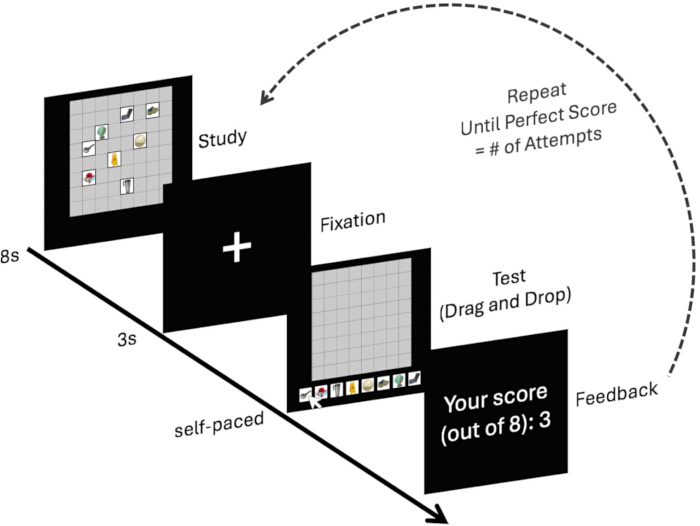
Figure 1: Order and timing of screens in the Grid Learning Task. Each learning trial consists of a repeating “Study – Fixation – Test – Feedback” cycle. During the Study phase, participants view eight objects arranged on an 8 × 8 grid and memorize their locations. The 8s Study phase is followed by a 3s fixation screen and a self-paced Test phase, during which participants drag and drop objects onto an empty grid to indicate remembered locations. After participants submit their response, a Feedback screen displays the number of correctly placed objects. This cycle repeats until all objects are placed correctly or until a maximum of 10 learning attempts has been completed, whichever occurs first. Please click here to view a larger version of this figure.
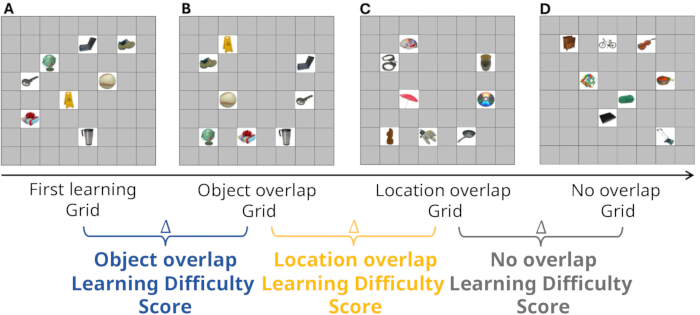
Figure 2: Overlap conditions in the Grid Learning Task. Participants learn four different grids. (A) The first grid serves as a baseline for calculating the Learning Difficulty Score between consecutive grids. Beginning with the second grid, participants experience either (B) the Object overlap condition, (C) the Location overlap condition, or (D) the No overlap condition across consecutive grids. The example shown illustrates the overlap order Object overlap → Location overlap → No overlap. Overlap-condition order is counterbalanced across participants. Images shown are unaltered stimuli from the Bank of Standardized Stimuli (BOSS) set12,13 and are used under the Creative Commons Attribution License (http://creativecommons.org/licenses/by-sa/3.0/). Please click here to view a larger version of this figure.
3. Optional forms
- Administer the feedback form. Ask participants what they believe the experiment investigated and which strategies they used during the task. Invite additional feedback and suggestions for improvement.
- Administer the demographic form. Collect demographic information, including age and ethnicity. Inform participants that all information will be reported in aggregate form to maintain anonymity.
- Provide participants with a paper copy of the debriefing form. The debriefing form explains the study's purpose and the rationale for the task.
Access restricted. Please log in or start a trial to view this content.
Results
Participants were excluded based on the following criteria: (a) failure to learn any grid within 10 attempts or (b) accuracy below 75% on the math distractor task. These criteria were adopted from a previous study using the Grid Learning Task (GLT)10. Of the 46 participants who completed the GLT, 1 was excluded under the first criterion, and none were excluded under the second. All statistical tests were evaluated using a two-tailed α level of .05.
Across the four grids...
Access restricted. Please log in or start a trial to view this content.
Discussion
The Grid Learning Task (GLT)10 provides a flexible behavioral protocol for examining how overlap between prior knowledge and new information shapes learning. In this task, participants repeatedly study object-location associations on a grid until all object locations are learned, and learning effects are quantified using the Learning Difficulty Score, which measures the difference in the number of attempts required to learn two consecutive grids. A critical feature of the protocol is the manipulat...
Access restricted. Please log in or start a trial to view this content.
Disclosures
The authors declare no competing interests.
Materials
| Name | Company | Catalog Number | Comments |
|---|---|---|---|
| Bank of Standardized Stimuli (BOSS) set | Bank of Standardized Stimuli (BOSS) | N/A | (Stimuli) Standardized set of object images used for stimulus presentation. See References 12–13. |
| Computer (desktop or laptop) | Any manufacturer | N/A | (Equipment) Standard desktop or laptop computer used to run PsychoPy. No specialized hardware required. |
| Consent form | Author-generated | N/A | (Participant materials) IRB-approved consent document used to obtain written informed consent prior to participation. |
| Debriefing form | Author-generated | N/A | (Participant materials) Post-experiment debriefing document explaining study purpose and procedures. |
| Demographic form | Author-generated | N/A | (Participant materials) Questionnaire used to collect age and demographic information. Data were reported in aggregate to maintain anonymity. |
| Feedback form | Author-generated | N/A | (Participant materials) Post-task questionnaire assessing participant strategies and subjective experience during the task. |
| Grid Learning Task program (PsychoPy script) | Author-generated | N/A | (Software) Custom PsychoPy-based task implementing the Grid Learning Task. Version used in this study corresponds to Supplementary File S1. Executed using PsychoPy v2024.2.4. Available at https://www.psychopy.org. |
| Monitor / display | Any manufacturer | N/A | (Equipment) Standard computer monitor used to present the 8 × 8 grid stimuli. Screen size adjusted to ensure full grid visibility. |
| Mouse / trackpad | Any manufacturer | N/A | (Equipment) Standard input device used for drag-and-drop placement of objects within the grid. |
| PsychoPy | Open Science Tools Ltd. | Version 2024.2.4 | (Software) Open-source experiment control software used to run task. Available at https://www.psychopy.org. |
References
- Anderson MC, Neely JH. Interference and inhibition in memory retrieval. In: Bjork EL, Bjork RA, editors. Memory. 2nd ed. San Diego (CA): Academic Press; 1996. p. 237-313.
- Kliegl O, Bäuml KHT. Buildup and release from proactive interference-Cognitive and neural mechanisms. Neurosci Biobehav Rev. 2021;120:264-278.
- Tse D, et al. Schemas and memory consolidation. Science. 2007;316(5821):76-82.
- Bein O, et al. Predictions transform memories: How expected versus. unexpected events are integrated or separated in memory. Neurosci Biobehav Rev. 2023;153:105368.
- Postman L, Underwood BJ. Critical issues in interference theory. Mem Cognit. 1973;1(1):19-40.
- Underwood BJ. Interference and forgetting. Psychol Rev. 1957;64(1):4-60.
- McGeoch JA. The psychology of human learning. London: Longmans, Green and Co.; 1942.
- van Buuren M, et al. Initial investigation of the effects of an experimentally learned schema on spatial associative memory in humans. J Neurosci. 2014;34(50):16662-16670.
- Farzanfar D, Spiers HJ, Moscovitch M, Rosenbaum RS. From cognitive maps to spatial schemas. Nat Rev Neurosci. 2023;24(2):63-79.
- Chaloupka B, Zeithamova D. Differential effects of location and object overlap on new learning. Front Cognit. 2024;2:1325246.
- Peirce J, et al. PsychoPy2: Experiments in behavior made easy. Behav Res Methods. 2019;51(1):195-203.
- Brodeur MB, et al. The Bank of Standardized Stimuli (BOSS), a new set of 480 normative photos of objects to be used as visual stimuli in cognitive research. PLoS One. 2010;5(5):e10773.
- Brodeur MB, Guérard K, Bouras M. Bank of Standardized Stimuli (BOSS) phase II: 930 new normative photos. PLoS One. 2014;9(9):e106953.
- Chanales AJ, et al. Interference between overlapping memories is predicted by neural states during learning. Nat Commun. 2019;10:5363.
- Ritvo VJ, Turk-Browne NB, Norman KA. Nonmonotonic plasticity: How memory retrieval drives learning. Trends Cogn Sci. 2019;23(9):726-742.
- Zeithamova D, Bowman CR. Generalization and the hippocampus: More than one story? Neurobiol Learn Mem. 2020;175:107317.
- Gilboa A, Marlatte H. Neurobiology of schemas and schema-mediated memory. Trends Cogn Sci. 2017;21(8):618-631.
- Mitchell TM, Keller RM, Kedar-Cabelli ST. Explanation-based generalization: A unifying view. Mach Learn. 1986;1(1):47-80.
- Liao Z, Losonczy A. Learning, fast and slow: Single- and many-shot learning in the hippocampus. Annu Rev Neurosci. 2024;47(1):187-209.
- Tompary A, Zhou W, Davachi L. Schematic memories develop quickly, but are not expressed unless necessary. Sci Rep. 2020;10(1):16968.
- Umanath S, Marsh EJ. Understanding how prior knowledge influences memory in older adults. Perspect Psychol Sci. 2014;9(4):408-426.
- Yassa MA, Stark CE. Pattern separation in the hippocampus. Trends Neurosci. 2011;34(10):515-525.
- Hunsaker MR, Kesner RP. The operation of pattern separation and pattern completion processes associated with different attributes or domains of memory. Neurosci Biobehav Rev. 2013;37(1):36-58.
Access restricted. Please log in or start a trial to view this content.
Reprints and Permissions
This article has been published
Video Coming Soon