This protocol provides a simple, low-cost procedure to quantify the rate of embryonic lethality in Caenorhabditis elegans. It enables straightforward detection of embryonic abnormalities across populations without specialized equipment or worm-picking expertise. The protocol can be used to quantify the effects of genetic mutations, RNA interference-mediated gene knockdowns, and diet.
A subscription to JoVE is required to view this content. Sign in or start your free trial.
Method Article
Quantifying Embryonic Lethality Rate in Caenorhabditis elegans
In This Article
Summary
Abstract
Embryonic lethality is a cornerstone phenotype used in Caenorhabditis elegans research to characterize developmental defects arising from factors such as toxic exposures and genetic mutations. Therefore, accurately quantifying the penetrance of embryonic lethality is critical for understanding the mechanisms and impact of these perturbations on animal development. Although automated scoring platforms exist, these approaches often require substantial financial investment and specialized hardware or software. This article describes a low-tech, low-cost assay that quantifies embryonic lethality by measuring the percentage of embryos that successfully fail to hatch. Notably, this version of the assay eliminates the need for a worm pick, making it exceptionally suitable for beginners. An additional advantage of this approach is that each technical replicate assays progeny from multiple animals, avoiding the potential biases of single-worm assays. This protocol includes a discussion of critical parameters, such as the minimum number of progeny required to accurately capture phenotype penetrance and the rationale for the methodology. Finally, we provide guidance on adapting the assay to assess the effects of gene knockdown via RNA interference, pharmacological treatments, or nutritional supplementation, adding a versatile and accessible tool to the toolkit of C. elegans researchers.
Introduction
Embryonic lethality is a critical phenotype for assessing the roles of genes and environmental factors in early development. C. elegans is a powerful model for studying developmental processes because of its invariant cell lineage, transparent body, and rapid life cycle1. C. elegans embryonic lethality can be used to assess developmental integrity under chemical, pharmacological, nutritional, and genetic perturbations2,3,4,5. Therefore, accessible and versatile methods for accurately quantifying embryonic lethality rate would benefit the research community.
Advanced high-throughput and high-content methods that study embryogenesis rely on specialized imaging systems and software, often requiring substantial financial investment4,6,7, whereas simpler high-throughput approaches provide primarily qualitative readouts8,9. Classical methods, by contrast, use a manual, low-cost approach that typically involves repeated transfer of individual hermaphrodites with a worm pick to assess embryonic lethality of the whole brood2,10. However, this method can be technically challenging for beginners and has limited scalability. In addition, classical brood-size-based assays quantify embryonic viability in the progeny of a single mother, which may introduce unintentional bias.
The overall goal of this method is to provide an alternative, simple, cost-effective, and versatile approach for quantifying embryonic viability at medium throughput. This method measures rates of embryonic lethality in the progeny of multiple animals per replicate, does not require the use of a worm pick, and avoids any specialized or costly equipment. The study also shows how the method can be applied to common perturbations, such as RNA interference and drug or nutrient testing.
Access restricted. Please log in or start a trial to view this content.
Protocol
1. C. elegans maintenance
NOTE: Detailed guidance on C. elegans husbandry can be found in WormBook11.
- Prepare maintenance Nematode Growth Medium (NGM) plates.
- To make 1 L of NGM, combine 3 g NaCl, 2.5 g bacteriological peptone, and 17 g agar in a 2 L bottle. Add 975 mL of distilled water and a stir bar, then autoclave for 20 min at 121 °C.
- Allow the medium to cool to 55 °C in a water bath. Place the bottle on a stir plate and, using aseptic technique, add 25 mL of 1 M potassium phosphate buffer and 1 mL each of the following: 1 M MgSO4, 1 M CaCl2, and 5 mg/mL cholesterol. Pour approximately 25 mL into each 100 mm plate.
- Prepare overnight E. coli OP50 cultures.
- Using aseptic technique, fill a 1 L Erlenmeyer flask to one-fifth of its volume (200 mL) with LB medium. Inoculate the medium with a single colony of E. coli OP50 using a sterile inoculating loop. Incubate overnight at 37 °C on an orbital shaker at 200 rpm.
- Seed NGM maintenance plates with E. coli OP50 (Figure 1A).
- Transfer the E. coli OP50 culture into autoclaved centrifuge bottles and centrifuge for 30 min at 3,500 x g at room temperature. Resuspend the bacterial pellet in one-twentieth of the original volume. Use 1–1.5 mL of concentrated culture to seed each 100 mm NGM plate.
- Incubate the plates overnight at room temperature to allow the bacteria to grow.
NOTE: These maintenance plates have a high density of bacteria to support up to 4,000 worms per plate, which is desirable when performing a large number of assays or working with a slow-growing strain of C. elegans. Seeded maintenance plates can be stored in the refrigerator at 4 °C for up to 1 month.
- Establish a primary C. elegans culture (Figure 1A).
- Use a sterile pipette tip to cut out a small chunk of agar containing ~1,000 worms from a starved maintenance plate. Place the agar chunk onto a seeded NGM plate.
- Place the new plate in a plastic container and incubate at 20 °C for 3 days, until worms are gravid and laying eggs. Ensure that the bacterial lawn is sufficient, and that the worm population does not starve. At this point, the worm population is ready for the experiment.
2. Preparation of experimental media and bacterial cultures
NOTE: At this step, proceed with either Method 1 to test the effect of RNAi-mediated gene knockdown or Method 2 to investigate dietary supplements.
- Method 1: Prepare experimental NGM plates for RNAi by feeding.
- Prepare 1 L of NGM as described in step 1.1, then, using aseptic technique, add 1 mL of 1 M IPTG and 1 mL of 50 mg/mL ampicillin. Pour approximately 5 mL into each 35 mm plate.
- Inoculate the desired number of E. coli HT115 RNAi feeding clones carrying L4440 plasmids targeting C. elegans genes of interest, together with the empty vector control. Pick a single colony with an inoculating loop and transfer it into 1.5 mL of LB containing 50 μg/mL ampicillin. Incubate for 18 h at 37 °C on an orbital shaker at 200 rpm.
- Seed 35 mm NGM plates containing ampicillin and IPTG with 100 µL of overnight E. coli HT115 culture, preparing two technical replicates per condition. Incubate the plates overnight at room temperature to allow bacterial growth and induce double-stranded RNA production. Store an equal number of unseeded plates at 4 °C for later use in egg transfer.
- Method 2: Prepare experimental NGM plates with a nutritional or drug supplement.
- Prepare 1.5x concentrated NGM by following the instructions in step 1.1, but add 642 mL of distilled water instead of 975 mL. Keep the prepared medium in a 55 °C water bath.
- Prepare a water-based stock of the supplement of interest at 3x the target concentration (for example, to prepare plates containing 40 mM sodium formate, make a 120 mM stock). Calculate the required stock volume by multiplying the number of experimental plates by 1.666 mL (one-third of the plate volume). Use a syringe filter to filter-sterilize the stock, then warm it to 55 °C in a water bath.
- In a 50 mL conical tube, mix 2 parts 1.5x NGM with 1 part supplement stock. For no supplement control, mix 2 parts 1.5x NGM with 1 part hot sterile water. Gently mix by inverting the tube 10 times, then, using aseptic technique, quickly pour approximately 5 mL of medium into each 35 mm plate.
NOTE: 1.5x NGM is used to compensate for medium dilution when large amounts of supplement are added. However, if the drug or metabolite stock is concentrated to 100× or more of the final concentration, regular NGM can be used instead of 1.5× NGM. When supplementing with an organic acid, using its sodium salt form will help prevent a drop in medium pH. - Using aseptic technique, fill a 50 mL Erlenmeyer flask to one-fifth of its volume (10 mL) with LB medium. Inoculate with a colony of E. coli OP50 and incubate overnight at 37 °C on an orbital shaker at 200 rpm.
- Seed 35 mm NGM plates with 100 µL of overnight E. coli OP50 culture, preparing two technical replicates per condition. Incubate the plates overnight at room temperature. Store an equal number of unseeded plates at 4 °C for later use in egg transfer.
3. Obtaining a synchronized population of L1 larvae
- Prepare alkaline bleach solution by combining 7 mL of sterile water, 2 mL of 5% sodium hypochlorite solution, and 1 mL of 5 N NaOH.
- Prepare M9 buffer by dissolving 3 g of KH2PO4, 6 g of Na2HPO4, and 5 g of NaCl in 1 L of distilled water, then adjust the pH to 6.5. Autoclave for 20 min at 121 °C, allow the solution to cool, and then aseptically add 1 mL of 1 M MgSO4.
- Wash gravid adult worms (step 1.4.2) off the plate with M9 buffer and transfer them into a 15 mL conical tube. Centrifuge at 350 x g for 2 min, aspirate the supernatant, and fill the tube with fresh M9 buffer. Repeat the wash two times.
- Add 2 mL of M9 buffer and 2 mL of alkaline bleach solution to the worm pellet. Vortex and shake vigorously, periodically checking under the microscope until nearly all worms are dissolved.
- Fill the tube with M9 buffer and centrifuge at 350 x g for 2 min. Remove the supernatant by inverting the tube, then wash four times with M9 buffer. Make sure the first wash is performed immediately after the worms are lysed to prevent overbleaching. After the last wash, fill the tube with 8 mL of M9 buffer and incubate on a rocker for 18–20 h, until the eggs hatch.
4. Cultivating maternal populations
- Place five 3 µL drops of worm suspension on a glass slide and count the number of hatched L1 larvae under a microscope. Divide the total count by 15 to obtain the concentration per microliter.
- Plate 30 L1 larvae onto each seeded 35 mm plate and incubate at 20 °C for 72 h. If the experimental conditions induce developmental delay, extend the incubation time until the worms become gravid and begin laying eggs (Figure 1B).
5. Transferring embryos to hatching plates
- Remove the unseeded 35 mm plates from the refrigerator and allow them to come to room temperature.
- Examine the worm plates under a microscope and confirm that they contain more than 100 embryos, with no hatched L1 larvae present.
- Carefully fill the plate with M9 buffer. Use a vacuum line to aspirate the liquid and remove the maternal population. Ensure that no adult worms remain on the plate.
- Fill a micropipette tip with 200 µL of M9 buffer and pipette up and down forcefully to detach embryos from the bacterial lawn. While viewing through the microscope, guide the pipette tip toward embryo-dense areas.
- Take an unseeded plate and pipette a drop of embryo suspension into the center. Examine the droplet under the microscope. If it does not contain 100–300 embryos, add more embryo suspension until this range is reached. Make sure that no worms from the parental population are transferred with the embryos.
- Allow the liquid to dry, then incubate the transfer plates at 20 °C for at least 24 h.
NOTE: If L1 larvae are already present on the experimental plate, use a vacuum line instead of an M9 wash to remove the entire maternal population one by one. This prevents washing away L1 hatchlings, which do not stick to the bacterial lawn as embryos do. Proceed with progeny transfer, which will now include both embryos and L1 larvae. Ensure that the same approach is applied to all conditions.
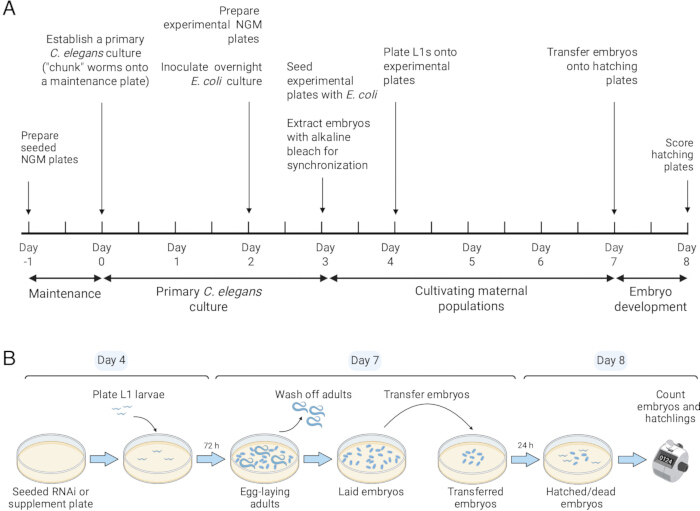
Figure 1: Experimental timeline and schematic of key steps in the embryonic lethality assay. (A) Flow chart timeline representing the full duration of the experimental protocol, from maintenance media preparation to scoring hatching plates. Key procedures are indicated for the corresponding days of the experiment. (B) Schematic of the embryonic lethality assay (steps 4–6). On Day 4, synchronized L1 larvae are added to the experimental RNAi or supplement plates to establish a maternal population. After 72 h, on Day 7, once worms have laid eggs, the maternal population is washed away while embryos remain attached to the bacterial lawn. Embryos are then washed off the lawn with a pipette and transferred onto a hatching plate, with at least 100 embryos per plate. After 24 h of incubation, hatched larvae and unhatched embryos are counted. Please click here to view a larger version of this figure.
6. Scoring plates
- Use a permanent marker to draw a roughly 4 mm × 4 mm grid on the lid of a 35 mm Petri dish, then place the lid under the plate. Use the grid as a guide and, under a microscope, count the number of L1 larvae and unhatched embryos with a handheld click counter.
- Combine counts from technical replicates to ensure appropriate weighting of each replicate based on its progeny count. Specifically, sum the numbers of unhatched embryos and hatched larvae across technical replicates.
- Calculate one embryonic lethality rate per biological replicate by dividing the number of embryos (unhatched worms) by the total number of worms and embryos, then multiplying by 100 to express the value as a percentage.
NOTE: If a plate contains only hatched larvae or only embryos, this counting step can be skipped, as the embryonic lethality rate is 0 (0%) or 1 (100%), respectively.
7. Statistical analysis
- Repeat the entire experiment at least three times to obtain independent biological replicates. For each biological replicate, use two technical replicate plates per condition, with a minimum of 100 embryos per technical replicate.
- Determine whether embryonic lethality rates differ significantly among conditions using one-way ANOVA, followed by post hoc pairwise Student’s t-tests with multiple-testing correction, such as the Benjamini-Hochberg method.
NOTE: Combining two technical replicates yields a minimum of 200 embryos per biological replicate. This satisfies the sample size requirement (~184 embryos/condition) estimated by the R base function power.prop.test to detect a 15 percent difference in lethality (e.g., 20% vs. 35%) with 90% power and a significance level of α = 0.05.
Access restricted. Please log in or start a trial to view this content.
Results
The embryonic lethality assay was performed in two strains: wild-type N2 and the RNAi-hypersensitive strain rrf-3(pk1426). Using RNAi by feeding, we knocked down genes previously reported to cause embryonic lethality in high-throughput screens9,12. Figure 2 provides a representative demonstration of assay performance. T04G9.4 knockdown produced nearly fully penetrant embryonic lethality in both rrf-3(pk1426) and N2 ...
Access restricted. Please log in or start a trial to view this content.
Discussion
Several steps are critical for assay reproducibility and accuracy. First, the bleaching step must be carefully timed to dissolve adult worms without damaging the embryos. Another important point is transferring a sufficient number of embryos for counting: too few will reduce the precision, whereas too many will make counting unnecessarily tedious. Next, embryo transfer should be performed before the embryos begin hatching. Otherwise, hatchlings will be washed away together with adults, which can skew hatching rates towar...
Access restricted. Please log in or start a trial to view this content.
Disclosures
The authors declare no competing interests.
Acknowledgements
All strains were provided by the CGC, which is funded by NIH Office of Research Infrastructure Programs (P40 OD010440). Figure 1 was created with BioRender.com. This work was supported by the National Institutes of Health grant R35GM162174.
Access restricted. Please log in or start a trial to view this content.
Materials
| Name | Company | Catalog Number | Comments |
|---|---|---|---|
| Ampicillin sodium salt | Sigma-Aldrich | A9518 | |
| Bacteriological peptone | Fischer Scientific | DF0118-17-0 | |
| C. elegans N2 | Caenorhabditis Genetics Center | N2 | wild type |
| C. elegans NL2099 | Caenorhabditis Genetics Center | NL2099 | rrf-3(pk1426) II. RNAi hypersensitive |
| Calcium chloride, anhydrous | Sigma-Aldrich | 746495 | |
| Cholesterol | Sigma-Aldrich | C3045 | |
| Conical tubes, 15 mL | VWR | 60818-725 | |
| Culture tubes, 14 mL | VWR | 470150-966 | |
| Diaphragm vacuum pump | Amazon | TC-100 | |
| Dissecting microscope | AmScope | SM-2 | |
| Escherichia coli HT115 | Caenorhabditis Genetics Center | RNAse III-deficient, used for RNAi by feeding experiments | |
| Escherichia coli OP50 | Caenorhabditis Genetics Center | ||
| Granulated agar | Fischer Scientific | BP97445 | |
| Handheld tally counter | LabDepot | HTCP01 | |
| IPTG, dioxane free (Isopropyl-b-D-thiogalactoside) | US Biological | I8500 | |
| LB Broth (Miller) | US Biological | L1520 | To make LB medium dissolve 25 g of LB powder in 1 L of distilled water. Autoclave for 20 min at 121.1 °C. |
| Luer Lok disposable syringe | BH Supplies | BH20LL | |
| Magnesium sulfate | Sigma-Aldrich | M2643 | |
| Microscopy slides | Sail Brand | 7101 | |
| Petri dishes, 100 mm | Tritech Research | T3371 | |
| Petri dishes, 35 mm | Tritech Research | T3501 | |
| Potassium Phosphate Buffer (PPB) | To make potassium phosphate buffer (1 M), dissolve 98 g of potassium phosphate monobasic and 48 g of potassium phosphate dibasic in 1 L of distilled water. Adjust the pH to 6. Autoclave for 20 min at 121 °C. | ||
| Potassium phosphate dibasic | Sigma-Aldrich | 795496 | |
| Potassium phosphate monobasic | Sigma-Aldrich | 529568 | |
| Rocker (nutating mixer) | Corning LSE | 6720 | |
| Serological pipettes, 25 mL | Corning | 4489 | |
| Serological pipettes, 5 mL | Celltreat | 229235 | |
| Shaking incubator Infors Multitron | INFORS HT | NA | |
| Sodium chloride | Sigma-Aldrich | S9888 | |
| Sodium hydroxide solution, 5 N | Fisher Scientific | SS256-500 | |
| Sodium hypochlorite, 5% | LabDepot | LC246302 | |
| Sodium phosphate dibasic | Sigma-Aldrich | S9763 | |
| Sorvall ST1 Plus Centrifuge | Thermo Scientific | 75016030 | |
| Stir plate | ONilab | ONi28-S | |
| Syringe filters | Semmerfeld | JQP033022QE1 | |
| Water bath | FOUR E's Scientific | WB401 |
Reprints and Permissions
This article has been published
Video Coming Soon