This protocol describes a standardized, non-invasive method for assessing systemic microvascular function in human cutaneous microcirculation using laser speckle contrast imaging combined with pharmacological iontophoresis and physiological stimuli to evaluate microvascular reactivity in clinical research settings.
A subscription to JoVE is required to view this content. Sign in or start your free trial.
Method Article
Protocol for Standardized Assessment of Systemic Microvascular Function in Human Cutaneous Microcirculation Using Laser Speckle Contrast Imaging
In This Article
Summary
Abstract
Laser speckle contrast imaging (LSCI) is a high-resolution, non-invasive optical technique that enables real-time, full-field visualization of microvascular blood perfusion. This protocol presents a standardized methodology for evaluating systemic microvascular function in human cutaneous microcirculation using LSCI. Because measurements obtained with this technique are highly sensitive to environmental and physiological confounders, the protocol emphasizes strict standardization procedures to improve reproducibility and experimental reliability. The protocol details essential environmental controls, including room temperature stabilization at 23°C ± 1°C, participant positioning, acclimatization procedures, and minimization of external interference during image acquisition. The methodology integrates LSCI with two complementary provocative maneuvers to evaluate cutaneous microvascular reactivity. Post-occlusive reactive hyperemia is used to assess integrated microvascular reactivity, whereas iontophoresis-driven pharmacological challenges are used to evaluate endothelial function. Specifically, Acetylcholine is administered to assess endothelium-dependent vasodilation, and sodium nitroprusside is administered to assess endothelium-independent vasodilation. This step-by-step visualized protocol is intended to facilitate the adoption of standardized LSCI methodologies in clinical and translational research settings. The approach has been successfully applied to identify microvascular impairment in several clinical conditions, including resistant hypertension, diabetes, and coronary artery disease. By enabling reproducible and non-invasive assessment of microvascular reactivity, this methodology provides a valuable tool for investigating systemic vascular health, monitoring disease progression, and evaluating the efficacy of interventions targeting the microvasculature.
Introduction
The primary goal of this protocol is to provide a standardized, reproducible methodology for assessing systemic microvascular function and reactivity using laser speckle contrast imaging (LSCI) coupled with physiological and pharmacological provocative maneuvers. The microcirculation, comprising terminal blood vessels—arterioles, capillaries, and venules—smaller than approximately 100 µm in diameter1, is the primary site of metabolic exchange and a critical determinant of peripheral vascular resistance2. Endothelial dysfunction in these small vessels often precedes macrovascular alterations and serves as an early biomarker for cardiovascular diseases, including hypertension, diabetes, and coronary artery disease3. Importantly, while microvascular impairment contributes significantly to end-organ damage, it acts in conjunction with macrovascular atherosclerosis and systemic chronic inflammation within a multifactorial disease process. Therefore, non-invasive assessment of microvascular reactivity is essential for both early diagnosis and monitoring of therapeutic efficacy in translational research4.
The rationale for using the cutaneous microcirculation as a surrogate for systemic vascular health lies in its accessibility and its role as a representative window into global endothelial function5,6. Traditionally, laser Doppler flowmetry (LDF) has been considered the gold standard for non-invasive cutaneous assessment7. However, LDF is limited by poor spatial resolution because it provides point-wise measurements that are highly sensitive to the inherent heterogeneity of skin perfusion8. In contrast, LSCI offers significant advantages by providing full-field, real-time visualization of tissue perfusion with high temporal and spatial resolution9. By analyzing the interference pattern generated by laser light scattering, LSCI enables simultaneous assessment of multiple vascular regions without requiring physical contact or exogenous dyes10,11.
Within the broader literature, the integration of LSCI with iontophoresis-driven pharmacological provocations, such as acetylcholine (ACh) and sodium nitroprusside (SNP), has been validated as a robust approach for evaluating endothelium-dependent and endothelium-independent vasodilatory pathways12,13. Furthermore, post-occlusive reactive hyperemia (PORH) provides an integrated assessment of microvascular reactivity involving endothelial mediators, neurogenic sensory nerves, and vascular smooth muscle function12. Despite its advantages, the high sensitivity of LSCI to environmental and physiological variability necessitates strict standardization procedures. This protocol addresses these challenges by detailing critical environmental controls, including room temperature stabilization at 23°C ± 1°C and standardized participant positioning, to improve intrasubject and intersubject reproducibility10. This methodology is appropriate for clinical and translational researchers seeking a methodologically grounded, non-invasive approach for investigating microvascular pathophysiology across diverse patient populations.
Access restricted. Please log in or start a trial to view this content.
Protocol
All procedures involving human participants were performed in accordance with the ethical standards of the National Institute of Cardiology (Ministry of Health, Brazil), in compliance with national regulations (The National Ethics Committee for Research – INAEP – according to Law No. 14,874, May 2024) and the Declaration of Helsinki (revised 2024).
1. Participant Preparation and Environmental Control
- Stabilize the examination environment
- Stabilize the examination room temperature (RT; 23°C ± 1°C) using a dedicated thermostat to maintain a stable thermal environment.
- Monitor the RT every 10 min using a calibrated digital thermometer (accuracy of ±0.1°C).
NOTE: Cutaneous microvascular function is highly sensitive to temperature fluctuations.
- Prepare the participant before assessment
- Instruct participants to refrain from smoking, consuming caffeine or alcohol, and performing vigorous exercise for 24 h before the assessment.
- Instruct participants to fast for at least 2 h before the assessment while allowing water intake.
NOTE: The abstinence from caffeine and vigorous exercise minimizes external interference with cutaneous vascular tone. Caffeine, as an adenosine receptor antagonist, and exercise, through effects on sympathetic drive and thermoregulation, can induce sustained alterations in microvascular reactivity that persist for several hours after exposure4,14.
- Position the participant for image acquisition
- Position the participant’s non-dominant arm at heart level using body cushions to maintain the forearm in a horizontal and stable position.
- Use the ventral surface of the forearm as the assessment site.
NOTE: The non-dominant forearm minimizes the influence of lateralized vascular remodeling associated with daily activities. The ventral forearm provides favorable anatomical characteristics for optical imaging, including lower hair density and reduced skin thickness, thereby minimizing signal artifacts and improving the reproducibility of iontophoretic drug delivery.
- Allow cardiovascular stabilization
- Maintain the participant at rest for at least 20 min before starting the microvascular recordings.
- Restrict the participant from talking, moving the assessed limb, or using electronic devices during the rest period.
NOTE: The stabilization period minimizes autonomic and cardiovascular fluctuations before baseline acquisition.
- Minimize motion artifacts
- Place the participant’s non-dominant forearm on a vacuum-cushion system.
- Adjust the cushion to maintain the ventral forearm surface in a stable horizontal position throughout image acquisition.
- Prepare the skin surface
- Select skin sites without visible hair for all measurements.
- Remove hair using a surgical clipper 24 h before the assessment when necessary.
CAUTION: Do not use a razor for hair removal because skin irritation may interfere with microvascular measurements.
- Measure arterial blood pressure
- Select the cuff size according to the participant’s arm circumference.
- Perform three consecutive blood pressure measurements using a calibrated automated oscillometric device with a 1-min interval between measurements.
- Discard the first measurement and calculate the mean of the final two measurements to determine the mean arterial pressure (MAP), according to ESC/ESH and AHA cardiovascular guidelines.
2. LSCI System Setup and Software Configuration
- Prepare the LSCI system
- Switch on the LSCI system at least 10 min before image acquisition to allow stabilization of the laser source.
- Verify laser stabilization using the software status indicator before starting the recording.
- Position the laser head
- Position the laser head directly above the participant’s forearm.
- Adjust the laser head to a distance of exactly 15 cm from the skin surface using the manufacturer-provided distance-measuring tool (Figure 1A)
NOTE: Maintaining a fixed acquisition distance ensures optimal image focus and a consistent field of view between participants.
- Configure the acquisition software
- Launch the image acquisition software and create a new study file.
- Enter the participant’s demographic information and the previously calculated MAP.
NOTE: Include detailed software operation instructions and representative screenshots as supplementary material when applicable.
- Configure the acquisition parameters
- Set the acquisition sampling rate to 1 image/s (1 Hz).
- Adjust the spatial resolution to approximately 0.1 mm/pixel for the target acquisition area.
NOTE: A sampling rate of 1 Hz provides an appropriate balance between temporal resolution and signal-to-noise ratio while adequately capturing hyperemic and pharmacological response kinetics.
- Minimize ambient light interference
- Perform a background noise check or dark-frame subtraction according to the system requirements before image acquisition.
- Dim the room lights and block external sunlight using blackout curtains during all recordings when dark-frame subtraction is unavailable.
NOTE: Standardized ambient lighting minimizes optical interference and improves signal reproducibility.
- Define the regions of interest (ROIs)
- Create at least three circular ROIs of approximately 80 mm2 on the live preview screen within the acquisition software.
- Position two ROIs over the iontophoresis electrode sites and one ROI over the PORH assessment site.
- Place all ROIs on the ventral forearm approximately 5 cm distal to the antecubital fossa while avoiding visible superficial veins.
NOTE: Standardizing the ROI area minimizes the influence of spatial heterogeneity in cutaneous perfusion and reduces edge artifacts associated with drug-delivery chambers.
- Acquire the baseline perfusion recording
- Record resting cutaneous blood perfusion continuously for 5 min before vascular stimulation.
- Monitor the real-time perfusion signal and confirm the absence of motion-induced spikes during the baseline acquisition.
- Define baseline stability as a perfusion signal variation of <10% during a continuous 2-min interval.
- Enable cutaneous vascular conductance (CVC) analysis
- Input the participant’s MAP into the acquisition software.
- Enable the automatic calculation of CVC within the software settings.
- Record perfusion and conductance data
- Configure the software to calculate CVC automatically by dividing real-time perfusion values (APU) by MAP.
- Record both raw perfusion units (PU) and calculated CVC values simultaneously throughout the protocol.

NOTE: Expressing microvascular perfusion as CVC minimizes the confounding influence of systemic blood pressure fluctuations and enables more reliable comparisons between participants with different hemodynamic profiles.
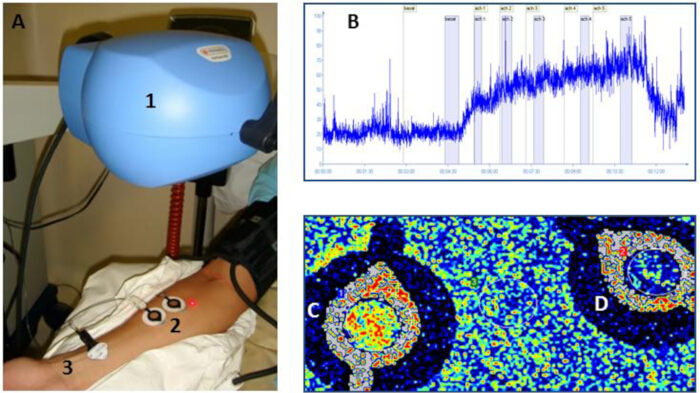
Figure 1. Experimental setup for the assessment of cutaneous microvascular perfusion using laser speckle contrast imaging (LSCI) combined with iontophoresis. (A) Representative experimental setup used for cutaneous microvascular assessment using laser speckle contrast imaging and iontophoresis of vasodilator agents. (B) Representative microvascular perfusion response during transdermal iontophoretic delivery of cumulative doses of acetylcholine (ACh). (C) Representative image of ACh iontophoresis. (D) Representative image of a vehicle-containing control electrode. Labels indicate the following components: (1) imager head; (2) iontophoresis drug-delivery electrodes; and (3) dispersive electrode. Please click here to view a larger version of this figure.
3. Iontophoresis and Pharmacological Provocation
- Prepare the skin for iontophoresis
- Clean the selected ventral forearm skin sites using an alcohol-free saline solution or a mild skin cleanser.
- Gently pat the skin dry before electrode placement.
NOTE: Avoid excessive mechanical stimulation during skin preparation because mechanically induced vasodilation may interfere with baseline measurements.
- Position the drug-delivery electrodes
- Attach two drug-delivery electrodes to the prepared skin sites using double-sided adhesive discs (Figure 1A).
- Maintain an inter-electrode distance of approximately 5 cm to prevent electrical current interference.
- Prepare the ACh solution
- Fill the first electrode chamber with 200 µL of a 2% ACh solution prepared in 0.9% saline14,15.
- Use the ACh electrode to evaluate endothelium-dependent vasodilation.
NOTE: The selected drug concentration was optimized to induce a robust dose-dependent microvascular response while minimizing nonspecific irritation and galvanic artifacts.
- Prepare the SNP solution
- Fill the second electrode chamber with 200 µL of a 2% SNP solution prepared in 0.9% saline.
- Use the SNP electrode to evaluate endothelium-independent vasodilation.
CAUTION: SNP is light-sensitive. Protect the solution from light exposure using aluminum foil and use the solution within 4 h of preparation to maintain pharmacological stability.
NOTE: The selected SNP concentration facilitates stable plateau vasodilation while minimizing nonspecific electrical effects.
- Remove trapped air bubbles
- Inspect the electrode chambers for trapped air bubbles before skin attachment.
- Remove visible air bubbles by gently tapping the electrode chamber or using a sterile plastic syringe tip.
NOTE: Air bubbles may obstruct current flow and produce nonhomogeneous drug delivery.
- Position the reference electrode
- Attach the reference (neutral) electrode approximately 15 cm proximal to the drug-delivery electrodes using conductive gel or adhesive (Figure 1A).
- Confirm stable electrode contact before initiating iontophoresis.
NOTE: Spatial separation between pharmacological and PORH assessment regions minimizes confounding interactions and prevents overlap of the ACh-induced axon reflex flare with the PORH measurement area.
- Connect the iontophoresis system
- Connect all electrodes to the iontophoresis delivery unit before current application.
- Confirm electrode polarity before starting the protocol (anodal for ACh; cathodal for SNP).
CAUTION: Incorrect electrode polarity may impair drug delivery efficiency and alter vascular responses.
- Administer the iontophoresis current protocol
- Deliver six incremental current doses of 30, 60, 90, 120, 150, and 180 µA for both pharmacological agents.
- Apply each current dose for 10 s.
NOTE: The incremental current protocol enables construction of a dose-response curve and facilitates assessment of microvascular sensitivity and plateau responses11. The combination of low current amplitudes and short stimulation intervals minimizes nonspecific galvanic vasodilation.
- Maintain the interval between stimulations
- Maintain a 60 s interval between consecutive current applications.
- Monitor the perfusion signal during the stabilization period between doses.
NOTE: The selected interval allows stabilization of the microvascular response while maintaining local drug delivery without systemic effects.
- Record the microvascular response
- Record the microvascular perfusion signal continuously throughout all iontophoresis stimulations.
- Continue the recording for at least 10 min after the final current application to capture the maximal plateau response. A representative dose-dependent response is shown in Figure 2A.
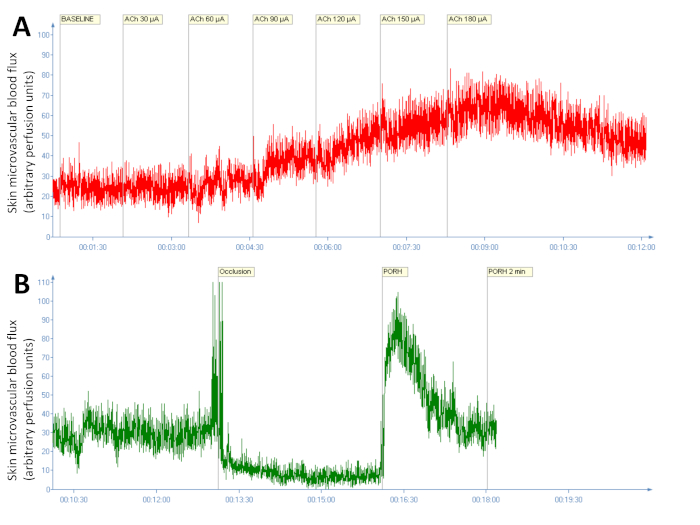
Figure 2. Representative recordings of cutaneous microvascular perfusion during iontophoresis and post-occlusive reactive hyperemia (PORH). (A) Representative recording of cutaneous microvascular blood flux obtained using LSCI during iontophoresis of 2% ACh delivered using increasing anodal currents of 30, 60, 90, 120, 150, and 180 µA for 10 s intervals separated by 1 min. (B) Representative recording obtained during PORH assessment. Please click here to view a larger version of this figure.
4. Post-Occlusive Reactive Hyperemia (PORH)
- Position the occlusion cuff
- Position a standard pneumatic cuff (width approximately 12 cm) on the upper arm of the same limb used for the LSCI recording.
- Place the cuff proximal to the selected microvascular assessment site.
- Define the PORH assessment region
- Create a third ROI on the ventral forearm adjacent to the iontophoresis electrode sites.
- Position the ROI within a treatment-free skin area to avoid pharmacological interference.
NOTE: Maintain spatial separation between pharmacological stimulation sites and the PORH assessment region to preserve independent vascular responses.
- Acquire the PORH baseline recording
- Record resting cutaneous perfusion continuously for 5 min before arterial occlusion.
- Monitor the baseline perfusion signal to confirm signal stability before cuff inflation.
- Induce arterial occlusion
- Inflate the pneumatic cuff rapidly within < 5 s using an automated inflator or manual inflation bulb.
- Increase cuff pressure to 50 mmHg above the participant’s previously measured systolic blood pressure (SBP).
CAUTION: Confirm complete arterial occlusion before initiating the occlusion period because incomplete occlusion may compromise the hyperemic response.
- Maintain the occlusion period
- Maintain arterial occlusion continuously for exactly 3 min.
- Verify complete occlusion by confirming that the LSCI signal decreases to a biological zero plateau (< 10 APU).
NOTE: The biological zero signal reflects residual movement of blood cells independent of directed blood flow, including Brownian motion.
- Release the occlusion cuff
- Release cuff pressure instantaneously using the rapid-exhaust valve.
- Allow immediate restoration of blood flow to initiate the reactive hyperemic response.
- Record the hyperemic response
- Continue the LSCI recording for at least 5 min after cuff release.
- Capture the peak perfusion response and the subsequent return toward baseline perfusion levels. A representative PORH response is shown in Figure 2B.
- Quantify the PORH response
- Calculate the peak CVC within the image acquisition software.
- Calculate the area under the curve (AUC) of the hyperemic response signal using the analysis software.
5. Data Extraction and Statistical Analysis
- Open and verify the recorded data
- Open the recorded acquisition files using the image analysis software.
- Verify that all predefined ROIs remain correctly positioned over the corresponding measurement sites.
NOTE: Reposition ROIs only when motion artifacts or acquisition drift compromise the original placement.
- Define the analysis intervals
- Identify the specific analysis intervals on the perfusion and CVC trend graphs.
- Select a continuous 60 s baseline interval immediately preceding the first vascular stimulus.
- Select the final 30 s of each 60 s interval following iontophoresis stimulation to capture the plateau microvascular response.
NOTE: Define baseline stability as a coefficient of variation (CV) < 5% in the perfusion signal to minimize the influence of vasomotor oscillations and motion artifacts before data analysis.
- Identify PORH response variables
- Identify the biological zero signal during the arterial occlusion phase of the PORH protocol.
- Identify the peak CVC value immediately after cuff release.
- Calculate the interval mean values
- Calculate the mean CVC value for each predefined analysis interval using the image analysis software.
- Verify the absence of motion artifacts before confirming the final calculated values.
- Organize the extracted data
- Export or manually transcribe the mean raw PU and mean CVC values into a structured spreadsheet.
- Organize the dataset according to study groups and vascular stimuli, including acetylcholine, sodium nitroprusside, and PORH responses.
NOTE: Maintain consistent file naming and participant identification codes throughout data processing to minimize transcription errors.
- Calculate secondary vascular outcomes
- Calculate the percentage increase from baseline perfusion or CVC values to determine vascular reactivity.
- Calculate the AUC when required for secondary endpoint analysis.
- Perform statistical analysis
- Analyze the data using statistical analysis software.
NOTE: Include representative screenshots or workflow instructions for software-based analyses as supplementary material when applicable. - Assess data distribution
- Assess data normality using the Shapiro-Wilk test.
- Express normally distributed data as mean ± standard deviation (SD).
- Express non-normally distributed data as median and interquartile range (IQR).
- Compare microvascular responses
- Compare two-group datasets using an independent t-test when normality assumptions are satisfied.
- Compare multiple groups using one-way ANOVA followed by Tukey’s post-hoc test.
- Define statistical significance criteria
- Define statistical significance as p < 0.05.
- Handle missing data caused by motion artifacts using pairwise deletion or exclusion from the affected analysis.
NOTE: Apply the same missing-data strategy consistently across all study groups to preserve analytical integrity.
- Analyze the data using statistical analysis software.
Access restricted. Please log in or start a trial to view this content.
Results
A successful application of this protocol yields a stable baseline followed by clear and distinguishable microvascular responses to each vascular stimulus. In a technically successful experiment, the baseline recording demonstrates a stable perfusion signal with minimal fluctuations, defined as a SD of < 10% of the mean signal. During iontophoresis of ACh and SNP, a stepwise increase in APU is expected, reflecting dose-dependent vasodilation. A successful PORH response is characterized by a rapid reduction in perfusio...
Access restricted. Please log in or start a trial to view this content.
Discussion
LSCI provides a standardized and non-invasive approach for evaluating systemic microvascular function with high spatial and temporal resolution. Compared with LDF, which is limited to single-point measurements and is highly sensitive to the spatial heterogeneity of skin perfusion, LSCI enables full-field imaging and simultaneous assessment of multiple ROIs. This characteristic substantially improves measurement reproducibility and reduces the coefficient of variation in clinical microvascular studies. Furthermore, the co...
Access restricted. Please log in or start a trial to view this content.
Disclosures
The authors declare no relevant financial or non-financial conflicts of interest.
Acknowledgements
This work was supported by the National Institute of Cardiology (INC/MS), the Carlos Chagas Filho Foundation for Research Support of the State of Rio de Janeiro (FAPERJ), and the National Council for Scientific and Technological Development (CNPq), Brazil. The authors thank nurse Marcio Marinho Gonzalez and technician Maira Duque for their excellent technical assistance during the microcirculation assessments.
Access restricted. Please log in or start a trial to view this content.
Materials
| Name | Company | Catalog Number | Comments |
|---|---|---|---|
| Equipment | |||
| Automated Oscillometric BP Monitor | Omron Healthcare | HEM-7120 | Used for baseline mean arterial pressure (MAP) assessment (3 measurements) |
| Digital Calibrated Thermometer | Delta OHM | HD2301.0 | Accuracy ± 0.1°C for room temperature monitoring |
| Dispersive (Reference) Electrode | Perimed AB | PF 384 | Large surface-area neutral electrode |
| Drug Delivery Electrodes | Perimed AB | PF 383 / LI 611 | Non-invasive iontophoresis chambers (approximately 80 mm²) |
| Iontophoresis Power Controller | Perimed AB | PeriIont Microvascular Diagnosis System | Dual-channel current controller (up to 200 µA) |
| Laser Speckle Contrast Imaging (LSCI) System | Perimed AB | PeriCam PSI NR | High-resolution blood perfusion imager |
| Medical-grade Vacuum Cushion | AB Germa | N/A | Used for stable forearm positioning at heart level |
| One Hand Operated Vacuum Pump | AB Germa | N/A | Used for evacuation of vacuum cushions |
| Rapid Cuff Inflator | D.E. Hokanson, Inc. | E20 Rapid Cuff Inflator | Used for standardized 3 min arterial occlusion |
| Reagents and Consumables | |||
| Acetylcholine Chloride (ACh) | Sigma-Aldrich | A6625 | Endothelium-dependent vasodilator prepared at 2% |
| Alcohol Prep Pads | Becton Dickinson | 326895 | 70% isopropyl alcohol pads for skin preparation |
| Deionized Water | Sigma-Aldrich | 38796 | Used for final rinsing of electrodes |
| Sodium Chloride (0.9% Saline) | Local Supplier | N/A | Solvent for drug preparation and skin cleaning |
| Sodium Nitroprusside (SNP) | Sigma-Aldrich | S0501 | Endothelium-independent vasodilator prepared at 2% |
| Sterile Gauze | Local Supplier | N/A | Used for drying the skin surface after cleaning |
| Software | |||
| Perfusion Analysis Software | Perimed AB | PIMSoft | Software for LSCI data acquisition and ROI analysis |
| Statistical Analysis Software | GraphPad Software | Prism 10 | Used for dose-response curve fitting and area under the curve (AUC) calculation |
Reprints and Permissions
This article has been published
Video Coming Soon