This protocol describes a reproducible cross-sectional survey workflow for assessing protection intention and recent self-reported protective behavior among residents and farmers in an agricultural heritage tourism system.
A subscription to JoVE is required to view this content. Sign in or start your free trial.
Research Article
Cross-Sectional Survey Protocol for Assessing Protection Intention and Self-Reported Behavior in Agricultural Heritage Tourism in Xiajin, China
In This Article
Summary
Abstract
Agricultural heritage tourism sustainability depends not only on ecological and cultural preservation, but also on the continued participation of local residents in protection-related practices. This protocol describes a reproducible cross-sectional survey and statistical analysis workflow for assessing protection intention and recent self-reported protective behavior among residents and farmers in the Xiajin Yellow River Old Course Ancient Mulberry Grove System in China. The workflow is grounded in the Theory of Planned Behavior and examines how attitude toward the behavior (ATB), subjective norms (SN), and perceived behavioral control (PBC) are associated with protection intention (PI), and how PI is associated with farmers’ behavioral response (FBR). The questionnaire uses standardized construct blocks, fixed response anchors, predefined coding rules, and a sequential analysis procedure covering data screening, reliability testing, common method variance assessment, correlation analysis, regression modeling, cross-sectional mediation analysis, and robustness checks. A total of 400 questionnaires were distributed in communities surrounding the heritage area, and 375 valid responses were retained after quality-control screening. In the representative application of this protocol, ATB, SN, and PBC were positively associated with PI, with PBC showing the strongest association. PI was also positively associated with FBR and showed statistically significant indirect associations between the antecedent constructs and FBR within the cross-sectional mediation model. Because PI refers to intention for the next planting season whereas FBR refers to self-reported behavior during the previous planting season, the results should be interpreted as a cross-sectional association structure rather than as evidence of strict temporal causality. This protocol provides a reusable framework for examining resident participation in agricultural heritage protection and for identifying whether protective behaviors are embedded in feasible agricultural, community, and tourism-related practices.
Introduction
The Xiajin Yellow River Old Course Ancient Mulberry Grove System is not simply a heritage attraction for display. It is a living agricultural landscape in which ecological regulation, traditional cultivation, and local livelihoods remain closely intertwined. According to the Food and Agriculture Organization description of the site, the system developed on the sandy land left by the ancient Yellow River course, where mulberry-based agroforestry has long been used to control sand movement, improve site conditions, and support continued agricultural production1. In this sense, the continuity of the system depends not only on formal recognition or administrative protection, but also on whether local residents and farmers continue to engage in everyday practices that sustain the agricultural landscape.
This issue has become increasingly important as agricultural heritage is more closely linked to ecological sustainability, rural revitalization, and heritage-based tourism development. Recent evidence from China suggests that the protection of important agricultural heritage sites can contribute to greener agricultural development2, while studies of agricultural heritage tourism have also shown that farmer participation remains essential if conservation and tourism development are expected to reinforce one another in practice3. Unlike conventional rural tourism resources, agricultural heritage systems depend on the continued use of traditional ecological knowledge, production routines, and community-based stewardship4. When these practices weaken, the heritage value itself may decline, even if the site remains formally recognized. Recognition alone is therefore not sufficient. Once agricultural heritage enters a tourism and rural-development context, its long-term viability still depends on whether local actors are willing and able to translate heritage recognition into protection-related action.
Existing studies have offered useful insights into agricultural heritage identity, resident participation, and value co-creation in tourism settings. Chen et al.5, for example, showed that agricultural heritage identity can stimulate residents’ willingness to co-create value in heritage tourism. However, less attention has been given to the operational pathway through which favorable evaluations of heritage protection are connected with concrete protection-related practices. This distinction matters because, in community-based agricultural heritage systems, positive attitudes are not the endpoint. What ultimately sustains the heritage system is whether residents engage in practical behaviors such as environmentally responsible farming, agricultural-waste handling, participation in local conservation routines, and support for heritage-related production and tourism services.
For this reason, the present protocol adopts the Theory of Planned Behavior as its main analytical foundation. The Theory of Planned Behavior proposes that behavioral intention is shaped by attitude toward the behavior, subjective norms, and perceived behavioral control, and that intention is closely related to subsequent behavior6. This framework is appropriate for the present study because the questionnaire was designed to measure residents’ evaluative judgment, perceived social expectation, perceived capacity to act, protection intention, and self-reported behavioral response. Recent studies in conservation and agricultural management contexts have also shown that this framework provides a practical structure for examining participation-related intention and behavior among farmers. Valizadeh et al.7applied an extended TPB framework to farmers’ intention to participate in wetland conservation, and Ma et al.8 used an expanded TPB model to explain farmers’ participation in agricultural nonpoint source pollution control. These studies are especially relevant here because protection behavior in agricultural heritage systems requires both individual willingness and practical conditions that make participation possible.
The contribution of this protocol is not limited to applying an established behavioral model to a new site. The Xiajin case is useful because it represents a productive agricultural heritage system in which conservation, farming routines, local service structures, and tourism development overlap. In this type of setting, protective behavior may not depend only on personal attitudes or general support for heritage preservation. It may also depend on whether protection-related actions are embedded in familiar agricultural services, community expectations, and feasible local routines. This makes the Xiajin case especially useful for examining whether protective behavior is driven primarily by individual intention or by the availability of concrete action channels, such as agricultural technical services, waste-treatment routines, tourism volunteer opportunities, and links to heritage-related processing enterprises. In this respect, the site allows the protocol to move beyond a simple “new case” application and to examine how protective behavior is shaped by the practical conditions under which residents are asked to act.
At the same time, this protocol does not assume that protection intention and protective behavior are identical. Recent research in rural tourism has shown that residents’ ecological conservation behavior is shaped through a broader process in which intention is important but does not fully explain action9. Related pro-environmental behavior research has also shown that an intention-behavior gap may persist even when respondents express favorable attitudes and strong stated willingness10. This issue is particularly important in the present study because PI refers to respondents’ intention for the next planting season, whereas FBR records self-reported participation in protection-related behaviors during the previous planting season. Therefore, the model is interpreted as a cross-sectional association structure linking intention and recent behavioral response, rather than as a strict longitudinal causal model.
To make the analytical workflow explicit and reproducible, the protocol pre-specified five related hypotheses. The first hypothesis proposed that attitude toward the behavior would be positively associated with protection intention. The second hypothesis proposed that subjective norms would be positively associated with protection intention. The third hypothesis proposed that perceived behavioral control would be positively associated with protection intention. The fourth hypothesis proposed that protection intention would be positively associated with farmers’ self-reported behavioral response. The fifth hypothesis proposed that protection intention would statistically mediate the associations between attitude toward the behavior, subjective norms, perceived behavioral control, and farmers’ self-reported behavioral response within the cross-sectional model. These hypotheses were used to organize the questionnaire structure, construct coding, regression models, and mediation analysis. The purpose of the protocol was therefore not only to report one case-specific survey result, but also to provide a reproducible workflow for studying how protection intention and self-reported protective behavior can be measured, screened, validated, and analyzed in agricultural heritage tourism settings. Using the Xiajin agricultural heritage system as a representative case, the protocol also allows researchers to examine whether protection-related behavior is more likely to occur when it is embedded in practical agricultural services, local routines, and visible participation channels.
Access restricted. Please log in or start a trial to view this content.
Protocol
This study involved an anonymous, minimal-risk paper-based questionnaire survey among adult residents in China. No names, identity numbers, telephone numbers, addresses, biological samples, clinical information, or other directly identifiable personal information were collected. According to the institutional policy issued by the University Ethics Committee for Research Involving Human Subjects (JKEUPM), Universiti Putra Malaysia, research involving anonymous human-subject surveys conducted entirely outside UPM/Malaysia did not require formal JKEUPM ethics approval under the policy effective from September 01, 2023.
Participation was voluntary and anonymous throughout the study. Before completing the questionnaire, each respondent received a consent statement explaining the study purpose, voluntary participation, anonymous data handling, and the right to discontinue before submission. Consent was recorded through a tick-box confirmation on the first page of the paper questionnaire. Records without consent confirmation were excluded before case-level screening. Completed paper questionnaires were stored in a locked cabinet accessible only to the research team. After data entry, de-identified electronic datasets were stored in password-protected folders. Consent confirmation pages and response data were stored separately, and only de-identified data were exported for statistical analysis.
Study area and study design
This study was conducted from February to March 2026 in the Xiajin Yellow River Old Course Ancient Mulberry Grove System in Shandong Province, China. The target population consisted of residents aged 18 years and above living in the 14 villages within the heritage system. The 14 villages were Houtun, Qiantun, Liudi, Dongyan, Xiyan, Wenxinzhuang, Nanshuangmiao, Houguantun, Houzilitun, Zuodi, Dongyang, Liliuzhuang, Shengzhuang, and Xiaoxinzhuang. The combined population of these villages was 14,896 residents.
The study used a cross-sectional questionnaire survey to examine protection intention and recent self-reported protective behavior among residents and farmers embedded in the agricultural heritage tourism context. A proportionate village-based sampling strategy was used. The sample quota for each village was calculated according to that village’s share of the total population across the 14 villages, so that larger villages contributed more respondents while smaller villages remained represented.
Using Krejcie and Morgan’s sample-size table, a population exceeding 10,000 requires a minimum of 366 respondents at a 95% confidence level and a 5% margin of error11. To allow for incomplete or unusable questionnaires, 400 paper questionnaires were distributed. After consent verification, duplicate checking, cross-section matching, response-range validation, and case-level quality screening, 375 valid questionnaires were retained. The final valid sample exceeded the minimum requirement and accounted for approximately 2.52% of the total population of the 14 villages. Village-level population, population proportion, and valid sample allocation are provided in Supplementary Table 1. The overall study workflow is shown in Figure 1.
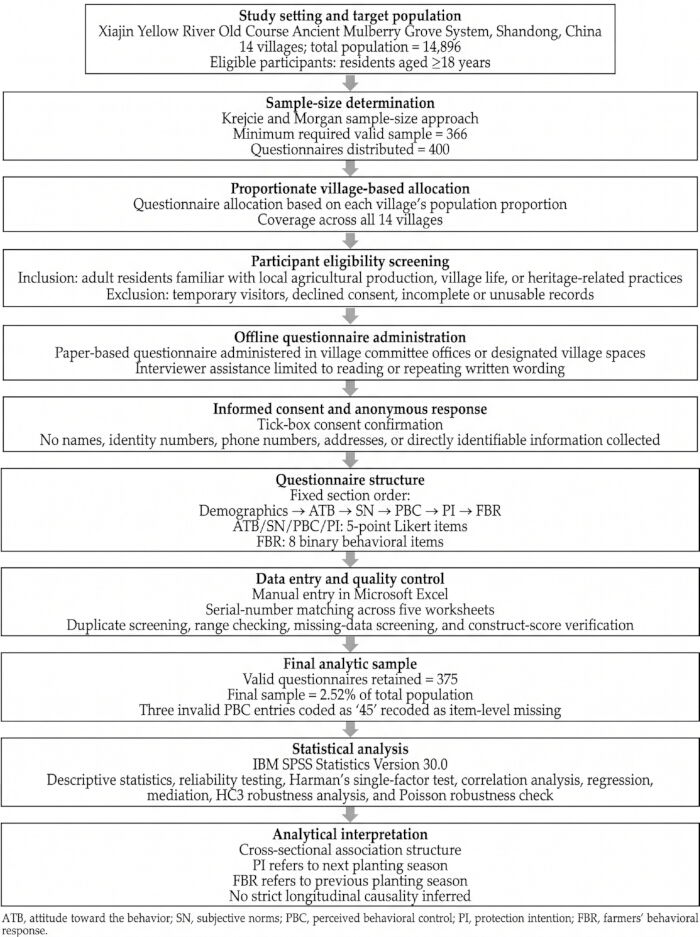
Figure 1. Overall workflow of participant recruitment, paper-based questionnaire administration, data screening, and statistical analysis. This figure summarizes the cross-sectional survey workflow, including village-level sampling, participant recruitment, offline paper-based questionnaire administration, consent confirmation, data entry, quality control, construct scoring, and statistical analysis. The framework evaluates the relationships among ATB, SN, PBC, PI, and FBR. Please click here to view a larger version of this figure.
Participant eligibility and recruitment
Eligible participants were residents aged 18 years or above from one of the 14 villages within the Xiajin Yellow River Old Course Ancient Mulberry Grove System. They also needed sufficient familiarity with local agricultural production, village life, or heritage-related practices to answer the questionnaire meaningfully. This familiarity was defined as meeting at least one of the following conditions: residence in one of the selected villages during the previous planting season, involvement in local agricultural or household production activities, awareness of mulberry-based agricultural practices, participation in village community life, or familiarity with local agricultural heritage protection and tourism-related practices.
Individuals were excluded if they were temporary visitors, declined consent, were younger than 18 years old, could not complete the questionnaire meaningfully, submitted duplicate questionnaires, or had records that could not be matched across the dataset structure. Records were also excluded if one or more core construct sections were missing, if more than 20% of core construct items were missing or invalid, if identical responses were given across all Likert-scale items without plausible variation, or if response values fell outside the permitted coding range and could not be verified.
Recruitment was implemented through village-based contact channels. The research team entered each village with assistance from the village committee. Village committees helped identify distribution locations and contact eligible residents, but they did not collect responses or influence questionnaire answers. Questionnaires were distributed to eligible residents through village committee offices. Respondents completed the questionnaire individually in the village committee office or another designated village-level space.
The survey used paper-based questionnaires only. Interviewer assistance was provided when needed, mainly for respondents who had difficulty reading the questionnaire independently. Field personnel received standardized instructions before questionnaire distribution. They explained only the study purpose, voluntary participation, anonymity, and response format. When respondents requested assistance, field personnel read aloud or repeated the written wording of the item without adding examples, explanations, or suggested answers. No online questionnaire platform, digital survey link, adaptive branching, item randomization, or alternate questionnaire version was used.
Questionnaire structure and instrument development
The instrument was designed to test a five-part behavioral framework comprising attitude toward the behavior (ATB), subjective norms (SN), perceived behavioral control (PBC), protection intention (PI), and farmers’ behavioral response (FBR). Questionnaire development was guided primarily by the Theory of Planned Behavior and by previous applications of behavioral-intention models in heritage tourism, conservation, and agricultural participation research12. The final analytical model was based on TPB. The Health Belief Model and PERMA were not retained as separate theoretical frameworks because their constructs were not independently operationalized as standalone variables in the final analysis.
The initial item pool was developed through literature-based screening and contextual adaptation to the Xiajin agricultural heritage tourism setting. The item wording was reviewed by two experts, namely the corresponding author and the third author. Both reviewers had experience relevant to rural tourism, agricultural heritage, environmental behavior, and survey-based behavioral analysis. They evaluated the items for construct relevance, wording clarity, contextual suitability, and respondent comprehensibility. Ambiguous, repetitive, or poorly aligned items were revised before final administration.
A pilot test involving 30 residents was conducted outside the main sampling frame before the main survey. The pilot test assessed item clarity, cultural appropriateness, questionnaire length, response-anchor comprehension, and the suitability of the temporal references used in the PI and FBR sections. Pilot feedback indicated that some respondents were uncertain about the term “conservation.” To improve local comprehensibility, the wording was supplemented with the local meaning of “protecting farming traditions.” Three items were revised for simpler wording after the pilot test.
Pilot reliability analysis showed acceptable internal consistency across the measured dimensions. Cronbach’s alpha values were 0.838 for Meaning/Cognitive Evaluation, 0.834 for Positive Emotion/Affective Attitude, 0.766 for Perceived Severity/Risk Appraisal, 0.783 for Injunctive Norms, 0.782 for Descriptive Norms, 0.747 for Referent-Specific Pressure, 0.843 for Capacity/Self-Efficacy, 0.723 for Resources/Expected Benefits, 0.862 for Opportunities/External Conditions, 0.789 for PI, and 0.880 for Conservation Behavior. As a preliminary check of item suitability, the pilot data showed a Kaiser-Meyer-Olkin value of 0.722 and a significant Bartlett’s test of sphericity, χ2 = 118.041, df = 10, p < 0.001. These results supported continued use of the questionnaire after minor wording revisions.
The final survey instrument contained five construct blocks arranged in a fixed order. ATB was measured through cognitive evaluation, affective attitude, and perceived risk appraisal. SN was measured through injunctive norms, descriptive norms, and referent-specific social pressure. PBC was measured through self-efficacy, perceived benefits, and external opportunity conditions. PI was measured with reference to the next planting season, whereas FBR was measured with reference to the previous planting season. The structure of the survey instrument is summarized in Table 1.
| Construct | Section | Conceptual domain | Time frame | Response format | Item count | Score range | Scoring rule |
| Attitude toward the Behavior (ATB) | Part I | Cognitive evaluation, affective attitude, and perceived severity/risk appraisal toward agricultural heritage protection | Current evaluation | 5-point Likert scale, 1 = strongly disagree to 5 = strongly agree | 17 | 1.000–5.000 | Mean of 17 items |
| Subjective Norms (SN) | Part II | Injunctive norms, descriptive norms, and referent-specific social pressure | Current perceived social expectation | 5-point Likert scale, 1 = strongly disagree to 5 = strongly agree | 11 | 1.000–5.000 | Mean of 11 items |
| Perceived Behavioral Control (PBC) | Part III | Self-efficacy, expected benefits, and external opportunity conditions | Current perceived ability and control | 5-point Likert scale, 1 = strongly disagree to 5 = strongly agree | 13 | 1.000–5.000 | Mean of 13 items |
| Protection Intention (PI) | Part IV | Intended agricultural heritage protection actions | Next planting season | 5-point Likert scale, 1 = strongly disagree to 5 = strongly agree | 11 | 1.000–5.000 | Mean of 11 items |
| Farmers’ Behavioral Response (FBR) | Part V | Self-reported enacted protection-related practices | Previous planting season | Binary response, yes/no | 8 | 0-8 | Sum of 8 items |
Table 1: Structure of the survey instrument and construct composition. This table summarizes the five questionnaire sections corresponding to ATB, SN, PBC, PI, and FBR, including conceptual domains, temporal references, response formats, item counts, score ranges, and scoring rules. ATB, SN, PBC, and PI were scored as mean values across valid items within each construct, whereas FBR was scored as a summed behavioral count, with higher values indicating greater reported participation in protection-related practices.
The full questionnaire is provided in Supplementary File 1. The item-to-construct mapping, variable coding rules, and composite-score definitions are summarized in Supplementary Table 2. The materials and analytical resources are summarized in the Table of Materials.
Item format, response anchors, and construct coding
Sections corresponding to ATB, SN, PBC, and PI used a 5-point Likert response format coded as 1 = strongly disagree, 2 = disagree, 3 = neither agree nor disagree, 4 = agree, and 5 = strongly agree. The ATB section contained 17 items, the SN section contained 11 items, the PBC section contained 13 items, and the PI section contained 11 items.
The FBR section contained eight behavioral items referring to the previous planting season. These items were coded dichotomously as 1 = yes and 0 = no. This coding rule was fixed before analysis and applied consistently to all eight behavioral-response items13. No reverse coding was used because all retained items were oriented in the same substantive direction.
For analysis, ATB, SN, PBC, and PI were calculated as mean scores across all valid items within each construct. A construct score was computed when at least 80% of the items in that construct had valid responses. If a respondent had fewer valid responses than this threshold, the construct score was treated as missing for analyses involving that construct. FBR was calculated as a summed behavioral score ranging from 0 to 8, with higher values indicating greater reported participation in protection-related practices.
Demographic variables
The demographic section was placed at the beginning of the questionnaire and recorded sex, years of farming experience, age, and education level. Sex was coded as 1 = male and 2 = female. Farming experience was coded as 1 = 0-2 years, 2 = 3-10 years, 3 = 11-25 years, and 4 = above 25 years. Age was coded as 1 = 18-30 years, 2 = 31-44 years, and 3 = over 45 years. Education level was coded as 1 = primary school, 2 = middle school, and 3 = college or university.
Demographic variables were used for respondent description and data profiling and were not merged into the composite construct scores. Sex was treated as categorical. Farming experience, age, and education level were treated as ordered categorical variables for descriptive profiling.
Survey administration procedure
The paper questionnaire was administered in a standardized sequence. Each participant first read the study information and consent statement, confirmed voluntary participation, completed demographic items, and then answered the five construct sections in the fixed order of ATB, SN, PBC, PI, and FBR. This order was fixed to preserve the intended measurement structure across respondents.
Respondents completed the questionnaire individually in village committee offices or other designated village-level spaces. When several respondents were present in the same location, they were asked not to discuss their answers with others. A standardized written instruction was provided at the beginning of the questionnaire, and field personnel gave the same brief verbal explanation before completion. Interviewer assistance was limited to reading or repeating the written wording for respondents who needed help.
No monetary payment, gift, reimbursement, transportation support, refreshments, or other non-monetary incentive was provided. No questionnaire was included in the analytical dataset unless consent had been confirmed and all five construct sections had been returned in analyzable form. A questionnaire was classified as analyzable when consent was confirmed, all five construct sections were present, no construct block was completely missing, and the proportion of missing or invalid responses across the core construct items did not exceed 20%. The behavioral wording in the final section referred to the immediately preceding planting season, which improved recall specificity and reduced vague attitudinal responding14.
Data entry and quality control
All returned paper questionnaires were entered into a master dataset using the respondent serial number as the sole linkage key across the five questionnaire-based data sheets. Responses were manually entered into Microsoft Excel and checked against the original paper questionnaires. The dataset was initially organized into five worksheets corresponding to ATB, SN, PBC, PI, and FBR. This structure preserved the questionnaire architecture and allowed section-level verification before the worksheets were merged into a master dataset.
Each record was screened in four steps. First, respondent serial numbers were checked for duplication. Duplicate checking was based on serial numbers and manual comparison of questionnaire records. Second, cross-sheet matching was verified so that only records present in all five questionnaire-based worksheets were retained. Third, item responses were checked against allowable coding values. Only values 1-5 were accepted for ATB, SN, PBC, and PI items, and only values 0 or 1 were accepted for FBR items. Fourth, construct means and FBR totals were recomputed from the raw item values and compared with the working dataset to identify entry errors.
Spreadsheet formulas were used to recompute construct scores. Spreadsheet filters and frequency checks were used to identify missing values, duplicate records, and out-of-range codes. After spreadsheet-level screening, the dataset was imported into IBM SPSS Statistics, version 30.0, for additional frequency checks and statistical analysis.
After case-level screening, 375 questionnaires were retained in the final analytic sample. During item-level range checking, three out-of-range entries coded as “45” were identified in one PBC item. These values were treated as manual data-entry errors because they were outside the allowable 1-5 response range for Likert-scale items. The three invalid values were recoded as item-level missing values before construct scoring. Because the affected respondents otherwise had complete matched records and still met the 80% valid-item requirement for the PBC construct, they were retained in construct-level analyses. The complete-case Harman single-factor test was conducted on 372 Likert-type records because the three invalid PBC entries had been recoded as missing. The cleaning logic and statistical decision criteria are summarized in Table 2. The cleaned de-identified respondent-level analytic dataset used for statistical analysis is provided in Supplementary Table 3.
| Stage | Item | Operational rule | Decision criterion | Action taken |
| Consent screening | Tick-box consent confirmation | A questionnaire was eligible for screening only when consent was confirmed before item completion. | Consent box completed | Records without consent confirmation were excluded. |
| Case matching | Respondent identifier across five data blocks | A case was retained only when the same respondent serial number appeared once in all five worksheets. | Exact one-to-one match across ATB, SN, PBC, PI, and FBR sections | 375 matched cases retained. |
| Duplicate screening | Duplicate respondent number | Duplicated respondent serial numbers were not permitted in the analytic file. | No duplicate identifier within or across sections | Only the first complete record was retained if duplication occurred. |
| Missing-data screening | Core construct items | A questionnaire was classified as analyzable only when all five construct sections were present. | No construct block completely missing; missing or invalid core construct responses ≤20% | Records exceeding the threshold were excluded. |
| Range check for Likert items | ATB, SN, PBC, and PI items | Legal values were restricted to integers from 1 to 5. | Any value outside 1–5 treated as invalid entry | Three out-of-range values coded as “45” in one PBC item were recoded as missing before construct averaging. |
| Range check for binary items | FBR items | Final coding was harmonized to 1 = yes and 0 = no. | Only 0 or 1 accepted | Eight FBR items were recoded consistently before scoring. |
| Construct scoring | ATB, SN, PBC, and PI | Composite score calculated as the mean of valid items within the construct. | At least 80% valid items required within each construct | Mean scores used for construct-level analysis. |
| Construct scoring | FBR | Composite score calculated as summed behavioral participation. | Binary items summed across 8 actions | Total score ranged from 0 to 8. |
| Internal consistency | Multi-item constructs | Reliability assessed using Cronbach’s alpha. | α ≥ 0.70 acceptable; α ≥ 0.80 good; α > 0.95 possible redundancy | All constructs retained; SN interpreted cautiously because α was slightly below 0.70. |
| Common method variance | Likert-type items | Harman’s single-factor test applied to all ATB, SN, PBC, and PI items. | First unrotated factor of <40% of total variance | CMV not judged dominant. |
| Regression assumptions | Predictor collinearity | Tolerance and VIF assessed before model interpretation. | Tolerance > 0.20; VIF < 5.00 | All predictors acceptable. |
| Regression assumptions | Residual and influence diagnostics | Standardized residuals and Cook’s distance inspected. | Standardized residuals within ±3.00; Cook’s distance of <1.00 | No influential case removed. |
| Robustness analysis | HC3 standard errors | Heteroskedasticity-consistent HC3 standard errors estimated for main regression models. | Main predictors remained statistically significant | HC3 results reported as robustness estimates. |
| Robustness analysis | Poisson regression | FBR treated as a count outcome ranging from 0 to 8. | Log link; Poisson distribution; model fit and overdispersion checked | Poisson results reported as robustness check. |
| Statistical significance | Hypothesis tests | Two-tailed significance testing applied throughout. | p < 0.05 | Threshold fixed before analysis. |
Table 2: Data-cleaning rules, coding principles, and statistical decision criteria. This table summarizes the predefined rules for consent screening, case matching, duplicate screening, missing-data handling, response-range validation, construct scoring, reliability assessment, common method variance assessment, regression diagnostics, HC3 robustness analysis, Poisson robustness analysis, and significance testing. Composite scores for ATB, SN, PBC, and PI were calculated as mean values across valid items within each construct, whereas FBR was calculated as a summed behavioral count ranging from 0 to 8. All analyses were conducted using the cleaned analytic dataset.
Statistical analysis
All analyses were conducted in IBM SPSS Statistics, version 30.0. Descriptive statistics were first calculated for demographic variables and questionnaire items. Internal consistency reliability was then assessed for each multi-item construct using Cronbach’s alpha, with α ≥ 0.70 defined as acceptable, α ≥ 0.80 defined as good, and α > 0.95 treated as possible item redundancy15.
Because the FBR items were dichotomous, their internal consistency was interpreted as KR-20 equivalent to Cronbach’s alpha for binary items. FBR was treated primarily as a summed behavioral participation index rather than as a purely reflective psychometric scale because the eight items represented different forms of protection-related action. The SN construct was retained despite an α value slightly below 0.70 in the main dataset because the value was close to the conventional threshold, the items were theoretically aligned with TPB, and retaining the full construct block preserved the pre-specified questionnaire structure. Results involving SN were interpreted cautiously.
Construct validation followed the observed composite-score design of the protocol. Because the study did not estimate a full latent-variable structural equation model, composite reliability, average variance extracted, and HTMT were not used as primary measurement-model criteria. Construct adequacy was evaluated through literature-based item-to-construct mapping, expert review, pilot testing, internal consistency reliability, item-level range checking, and pre-specified scoring rules. This approach was selected because the protocol aimed to provide a reproducible survey and composite-score analysis workflow rather than a full SEM measurement model.
Common method variance was examined using Harman’s single-factor test16. This test used complete Likert-type item records after item-level range correction. Because three invalid PBC entries were recoded as missing, the common method variance test was performed on 372 complete Likert-type records. Common method bias was considered not severe when the unrotated first factor explained less than 40% of the total variance.
Bivariate correlations were calculated among the five construct scores. Multiple linear regression was then conducted in two stages. In Model 1, PI was entered as the dependent variable, and ATB, SN, and PBC were entered simultaneously as predictors. In Model 2, FBR was entered as the dependent variable, and PI was entered as the focal predictor. Because PI referred to the next planting season and FBR referred to the previous planting season, these models were interpreted as cross-sectional association models rather than strict causal prediction models.
Mediation analysis was conducted using the PROCESS macro for SPSS, version 4.2, Model 4. Separate mediation models were estimated for ATB, SN, and PBC, with PI as the mediator and FBR as the outcome. Indirect effects were estimated using 5,000 bootstrap resamples and 95% bootstrap confidence intervals. An indirect effect was considered statistically significant when the confidence interval did not include zero. Mediation results were interpreted as statistical indirect associations within the cross-sectional model rather than evidence of longitudinal causality.
Regression assumptions were evaluated using pre-specified criteria. Multicollinearity was assessed using tolerance > 0.20 and VIF < 5.00. Influential observations were screened using standardized residuals within ±3.00 and Cook’s distance < 1.00. Linearity and homoscedasticity were assessed through residual scatterplots. Normality of residuals was examined using histograms and normal probability plots. Independence of errors was evaluated using the Durbin-Watson statistic. Statistical significance was evaluated using two-tailed tests at p < 0.0517. No additional cases were excluded after residual and influence diagnostics.
Because FBR was a summed behavioral participation score, the primary model treated it as a composite outcome. Because the same score also represented a count of endorsed protective behaviors from 0 to 8, Poisson regression was conducted as a robustness check. Heteroskedasticity-consistent HC3 standard errors were also estimated for the main regression models because the robustness analyses included HC3 regression estimates. HC3 estimates were reported as B, HC3 SE, t, p, and 95% confidence intervals. Poisson regression was estimated using the generalized linear model procedure in SPSS, with a Poisson distribution, log link function, and maximum-likelihood estimation. Incidence rate ratios, robust standard errors, 95% confidence intervals, and model-fit indicators were reported. Potential overdispersion was evaluated using the Pearson chi-square/degrees-of-freedom ratio. The Poisson model was used only as a robustness check and did not replace the primary linear construct-level analysis.
Access restricted. Please log in or start a trial to view this content.
Results
Data entry and quality control
A total of 375 matched questionnaires were retained across the five questionnaire-based data groupings. During item-level range checking, three out-of-range entries coded as “45” were identified in one PBC item. These values were treated as manual data-entry errors because they fell outside the allowable 1-5 response range for Likert-scale items. The three values were recoded as item-level missing values before construct averaging. Because each a...
Access restricted. Please log in or start a trial to view this content.
Discussion
The present study applied a reproducible cross-sectional survey protocol to examine how attitude toward the behavior, subjective norms, and perceived behavioral control were associated with protection intention, and how protection intention was associated with farmers’ self-reported behavioral response in the Xiajin agricultural heritage tourism context. The results showed a consistent pattern. All three antecedent constructs were positively associated with protection intention, and protection intention was positiv...
Access restricted. Please log in or start a trial to view this content.
Disclosures
Conflicts of Interest:
The authors declare that they have no financial or personal relationships that could have influenced the work reported in this paper.
Acknowledgements
We sincerely thank all the residents and farmers who participated in this study for their time, cooperation, and valuable responses. We also thank the local communities for their support during the survey process.
Access restricted. Please log in or start a trial to view this content.
Materials
| Name | Company | Catalog Number | Comments |
|---|---|---|---|
| Ballpoint pens | Local stationery supplier | Not applicable | Used by respondents to complete paper questionnaires during village-based data collection and onsite survey administration. |
| IBM SPSS Statistics, Version 30.0 | IBM Corporation | SPSS Statistics 30.0 | Used for descriptive statistics, reliability analysis, common method variance testing, correlation analysis, linear regression, mediation analysis, HC3 robustness analysis, and Poisson regression robustness analysis. |
| Locked storage cabinet | Local office equipment supplier | Not applicable | Used to store completed paper questionnaires securely before and after data entry. |
| Microsoft Excel | Microsoft Corporation | CFQ7TTC0PBMF | Used for raw-data organization, worksheet matching, item-level range checking, duplicate screening, preliminary coding, and recomputation of construct scores before formal statistical analysis. |
| Participant information and consent sheet | Self-prepared by the research team | Not applicable | Provided at the beginning of the questionnaire. Respondents confirmed voluntary participation through a tick-box consent item before answering the survey. |
| Password-protected data-analysis workstation | Self-managed research workstation | Not applicable | Used to store de-identified electronic datasets and conduct statistical analysis. |
| Printed questionnaire forms | Self-prepared by the research team | Not applicable | Used for offline paper-based questionnaire administration in the 14 villages within the Xiajin Yellow River Old Course Ancient Mulberry Grove System. |
| PROCESS macro for SPSS, Version 4.2 | Andrew F. Hayes | PROCESS v4.2 | Used for bootstrap mediation analysis and heteroskedasticity-consistent HC3 standard-error estimation. |
| Respondent serial-number labels | Self-prepared by the research team | Not applicable | Used to assign each questionnaire a unique respondent serial number for matching the five questionnaire groupings during data entry and screening. |