This study presents a reproducible clinical protocol evaluating integrated traditional Chinese medicine, mili-fire needle therapy, and light-emitting diode (LED) phototherapy for the treatment of cystic acne and post-acne sequelae.
Research Article
Integrated Traditional Chinese Medicine, Mili-Fire Needle, and Light-Emitting Diode Phototherapy for Cystic Acne and Post-Acne Sequelae
In This Article
Summary
Abstract
Moderate-to-severe cystic acne is difficult to manage because active inflammatory lesions often coexist with a risk of persistent erythema, scarring, and acne-related quality-of-life impairment. This study evaluated an integrated traditional Chinese medicine regimen combined with mili-fire needle therapy and light-emitting diode red-blue phototherapy for short-term lesion control and post-treatment sequelae outcomes. Sixty patients with moderate-to-severe cystic acne were enrolled in a single-center, parallel-group clinical study and randomly assigned to a control group or treatment group. The control group received oral isotretinoin and red-blue light irradiation, while the treatment group received modified Zhibai Dihuang Wan combined with Erzhi Wan, mili-fire needle therapy, and the same red-blue light irradiation. Both groups used topical adapalene and received identical skin-care and lifestyle guidance. Outcomes were assessed at baseline, after three treatment courses, and after six treatment courses. A post-treatment responder follow-up cohort included only patients who achieved cure or marked improvement and therefore did not preserve the original randomized comparison. Both regimens reduced Global Acne Grading System scores, lesion counts, and Acne Disability Index scores; between-group values favored the integrated-regimen group after three and six courses. The cure-plus-marked-response proportions were 46.67% in the control group and 76.67% in the treatment group; the ordinal clinical-response distribution differed between groups, whereas adverse-event rates did not differ significantly. In the selected responder cohort, the treatment group had lower acne scar, Vancouver Scar Scale, and imaging-based erythema scores during months 1–3. The randomized short-term findings support further evaluation of the integrated regimen, while the responder-only follow-up findings should be considered exploratory and require confirmation in studies that follow the full randomized cohort.
Introduction
Acne vulgaris is a common inflammatory disorder of the pilosebaceous unit and remains a major clinical concern among adolescents and young adults. Recent epidemiological evidence indicates that the burden of acne among individuals aged 10–24 years has continued to rise globally, with the highest prevalence reported in the 15–19-year age group1. Although acne is often treated as a visible skin disease, its impact extends beyond lesion count. Persistent inflammatory activity may lead to atrophic scarring, post-inflammatory erythema, and prolonged impairment of self-image, social functioning, and health-related quality of life2,3. These sequelae are especially relevant in patients with moderate-to-severe cystic acne, in whom nodules, cysts, and recurrent inflammation create a higher risk of residual tissue damage even after active lesions begin to subside.
Current clinical guidelines support oral isotretinoin as an important option for severe acne, particularly when the disease is associated with scarring risk, psychosocial burden, or poor response to previous therapies4. However, isotretinoin-centered treatment does not fully resolve the clinical question of how to control active inflammation while also reducing the downstream burden of erythema and scar formation. This issue is particularly important in Asian populations, where post-acne erythema, pigmentary change, and scarring often become major determinants of patient satisfaction after inflammatory lesions improve5. As a result, acne management has gradually shifted from a narrow endpoint of lesion clearance to a broader therapeutic framework that encompasses inflammatory control, patient-reported burden, tolerability, and the prevention of visible sequelae.
Light-based treatment has become one of the adjunctive approaches explored within this broader framework. Red and blue visible light may reduce inflammatory lesion activity and can be combined with pharmacological or procedural interventions, although comparative evidence remains heterogeneous and optimal treatment combinations have not yet been fully established6. In parallel, traditional Chinese medicine-based acne treatment often interprets recurrent cystic inflammatory lesions through patterns involving yin deficiency, internal heat, and local stagnation7. From this perspective, systemic regulation, local lesion intervention, and anti-inflammatory phototherapy may be combined to address both active cystic lesions and subsequent tissue remodeling.
Global epidemiological studies provide context for acne's burden8, and recent treatment reviews describe a widening range of therapeutic options9. Studies of severity and scar development underscore the need to assess risk of lasting sequelae10. Guidance on acne-associated scarring11, reviews of atrophic post-acne scar treatment12, and practical scar-management recommendations13 address outcomes beyond active lesion clearance. Post-acne erythema has also been evaluated in a dedicated treatment review14. Photodynamic therapy has been systematically reviewed for acne15, although its findings should not be assumed to apply to the LED protocol used here. A separate systematic review of acne epidemiology16 and a network meta-analysis of acne-scar interventions17 further situate this protocol within the broader disease burden and the management of established sequelae.
Based on this rationale, the present study evaluated a predefined multimodal treatment package. The modified Zhibai Dihuang Wan plus Erzhi Wan prescription served as the systemic, syndrome-directed traditional Chinese medicine component; mili-fire needle therapy served as a lesion-directed procedure for selected comedones, nodules, cysts, and raised scar-like lesions; and red-blue light-emitting diode (LED) phototherapy served as an adjunctive light-based treatment applied in both study groups. The control group received oral isotretinoin together with the same LED schedule and topical adapalene used in both groups. This design was intended to compare the complete clinical regimens rather than estimate the independent effect of any single treatment component. The study therefore focused on reproducible delivery of the integrated protocol, short-term acne outcomes, safety, and exploratory post-treatment outcomes among clinical responders.
Existing literature provides clinical context for the component choices but does not establish the efficacy of this specific combination18. Systematic reviews have reported potentially favorable acne outcomes with fire-needle approaches and with herbal interventions, while also emphasizing heterogeneity, variable study quality, and the need for more rigorous trials19. These findings support evaluating the components within a reproducible regimen, but they do not justify attributing any observed effect in the present study to one component in isolation.
Protocol
The study was performed in accordance with the ethical requirements for clinical research involving human participants and was approved by the Ethics Committee of the Fifth People’s Hospital of Changshu (approval no. TZ029371; approved on January 5, 2022). Written informed consent was obtained from all adult participants before enrollment. For participants younger than 18 years, written informed consent was obtained from a legal guardian, and participant assent was obtained before study procedures were performed. The study was not prospectively registered in a public clinical trial registry before participant enrollment began in January 2022; consequently, no trial registration number or registration date is available. The absence of prospective registration is acknowledged as a limitation of study transparency. Representative clinical photographs used for reporting were cropped to the affected cheek region to remove identifiable full-face features; no retouching, lesion removal, or intensity adjustment was applied.
Clinical study design and recruitment
A single-center, parallel-group clinical study was conducted in the outpatient dermatology clinic of the Fifth People’s Hospital of Changshu. The study population consisted of patients with moderate-to-severe cystic acne who required both active inflammatory lesion control and prevention of post-acne sequelae. The study compared an integrated traditional Chinese medicine regimen combined with mili-fire needle therapy and light-emitting diode red-blue phototherapy with an isotretinoin-based control regimen.
Eligible patients were recruited consecutively from the outpatient dermatology clinic between January 2022 and June 2022. Sixty patients who met the diagnostic, inclusion, and exclusion criteria were enrolled and assigned in a 1:1 ratio to the treatment or control group. A total of 60 participants were included in the study, with 30 participants in each group. The available study records did not contain a formal a priori sample-size calculation; therefore, no power-based sample-size claim was made.
The full recruitment and allocation process, including screening, enrollment, treatment allocation, completion of six treatment courses, short-term outcome assessment, and entry into the follow-up cohort, was documented. Figure 1 summarizes the complete clinical workflow, including outpatient screening, eligibility assessment, random allocation, six-course treatment, short-term outcome assessment, and entry into the sequelae-focused follow-up cohort.
Diagnostic and severity assessment
The Western medicine diagnosis of acne was confirmed according to the diagnostic criteria described in Clinical Dermatology, 5th edition20. Acne was diagnosed when patients presented with typical onset, a chronic or recurrent course, and lesions distributed symmetrically in sebaceous gland-rich areas, including the face, upper chest, or back. Typical lesion types included follicular papules, comedones, pustules, nodules, cysts, and acne-related scars.
Disease severity was classified using the modified acne grading criteria21. Moderate acne was defined as widespread papules and pustules with occasional large inflammatory lesions, a total lesion count of 51-100, and fewer than three nodules. Severe acne was defined as nodulocystic or conglobate acne with pain, cyst formation, a total lesion count greater than 100, or more than three nodules or cysts. Only patients with moderate-to-severe cystic acne were included in the study cohort.
Traditional Chinese medicine syndrome differentiation
Traditional Chinese medicine syndrome differentiation was performed for each potentially eligible patient using predefined syndrome criteria based on published consensus and guidance7. Patients were included when their principal syndrome was yin deficiency with internal heat. This pattern was identified by the presence of multiple facial follicular papules, inflammatory erythematous papules, pustules, and, in some patients, violaceous nodules or cysts. Accompanying symptoms such as mild pruritus or pain, fatigue, anxiety, poor sleep, dry stool, red tongue tip, thin white tongue coating, and thready pulse were recorded.
Additional accompanying patterns, including lung-stomach heat, damp-heat in the gastrointestinal tract, or phlegm-blood stasis, were recorded when present. These accompanying patterns were used only to guide prescription adjustment within the predefined treatment framework. Patients were not enrolled when the principal traditional Chinese medicine syndrome pattern was inconsistent with yin deficiency with internal heat.
Eligibility and withdrawal criteria
Patients were included if they met all of the following criteria: clinically confirmed moderate-to-severe cystic acne; traditional Chinese medicine syndrome differentiation consistent with yin deficiency with internal heat as the principal syndrome; age between 16 and 35 years; and willingness to participate and provide written informed consent.
Patients were excluded if they had a known allergy to any study medication, endocrine disorders such as polycystic ovary syndrome or diabetes mellitus, occupational acne, drug-induced acneiform eruption, or use of immunosuppressants, systemic corticosteroids, antibiotics, or acne-related medications within 1 month before enrollment. Patients were also excluded if they were pregnant or lactating; had hepatic or renal insufficiency or failure, other endocrine or hematologic diseases, any malignant tumor, psychiatric disorders, or other clinical conditions that could interfere with treatment completion or follow-up.
The predefined withdrawal criteria included poor adherence, development of a serious intercurrent illness during treatment, voluntary withdrawal of consent, failure to complete the six-course treatment schedule, or failure to complete the required assessment procedures. No participants met these criteria before the six-course assessment; had a withdrawal occurred, its timing and reason would have been recorded in the case report form.
Treatment allocation
Eligible patients were randomly allocated in a 1:1 ratio to either the treatment group or the control group, with 30 patients assigned to each group. Allocation was performed only after eligibility confirmation and enrollment. The study records reported random allocation and the final group sizes, but did not document the method used to generate the allocation sequence or whether allocation concealment was implemented; these unrecorded details were therefore not inferred. The same baseline data collection, visit schedule, concomitant topical treatment, and outcome-assessment schedule were maintained in both groups.
After completion of six treatment courses, patients who achieved clinical cure or a marked response were identified, and only these responders entered the post-treatment follow-up cohort to evaluate post-acne sequelae, including scar formation and persistent erythema. Because follow-up eligibility was determined by a post-randomization outcome, this responder cohort did not preserve the original randomized comparison. All analyses from this selected cohort were therefore treated as exploratory rather than as confirmatory randomized treatment-effect estimates.
Treatment-group intervention
Patients assigned to the treatment group received the integrated regimen, which consisted of oral modified Zhibai Dihuang Wan combined with Erzhi Wan, mili-fire needle therapy, and red-blue phototherapy.
The core herbal prescription was prepared using Anemarrhena asphodeloides 10 g, Phellodendron chinense 10 g, Ligustrum lucidum 15 g, Eclipta prostrata 15 g, Rehmannia glutinosa 15 g, Prunella vulgaris 10 g, Taraxacum mongolicum 15 g, Forsythia suspensa 15 g, Salvia miltiorrhiza 25 g, and Glycyrrhiza uralensis 5 g. The prescription was modified in accordance with the accompanying traditional Chinese medicine syndrome patterns while preserving the principal treatment rationale. The decoction was prepared using a standardized decoction procedure. Patients received 200 mL per dose twice daily, using one prepared decoction per day.
Mili-fire needle therapy was performed under clinical aseptic conditions by trained personnel. The facial treatment area was cleaned and disinfected with 75% alcohol. A sterile mili-fire needle was heated before lesion treatment, and selected comedones, nodules, or cystic lesions were rapidly punctured according to lesion size and clinical presentation. Small lesions received one puncture, whereas multiple punctures were used for larger lesions when clinically necessary. After needling, lesion contents were gently expressed with a disinfected comedone extractor when appropriate. For raised, scar-like lesions, point needling was applied to the lesion base, with approximately 1.0 mm spacing between points.
At treatment-group procedure visits, mili-fire needle therapy and any clinically indicated comedone extraction were performed first. After visible bleeding had stopped and the treated skin had been cleaned, red-blue LED phototherapy was initiated during the same visit. The treatment area was irradiated for 20 min once every 14 days. Patients were instructed to avoid water contact with the treated area for 24 h after comedone extraction and to report any pain, erythema, swelling, persistent bleeding, suspected infection, or other unexpected reactions.
Control-group intervention
Patients assigned to the control group received oral isotretinoin soft capsules at a fixed total daily dose of 20 mg (10 mg per capsule, one capsule twice daily). The dose was not adjusted according to body weight. This treatment was combined with the same red-blue LED phototherapy schedule used in the treatment group. At control-group phototherapy visits, the skin was cleansed and LED irradiation was administered for 20 min once every 14 days; mili-fire needling and comedone extraction were not performed as part of the assigned control regimen.
Patients were monitored for expected mucocutaneous and gastrointestinal adverse events, including skin dryness, lip cracking, gastrointestinal discomfort, fatigue, appetite change, dry mouth, nausea, vomiting, abdominal pain, or diarrhea. All adverse events were recorded in the same manner as in the treatment group.
Concomitant treatment and skin-care instructions
Both groups received topical adapalene gel once nightly as spot treatment for raised acne lesions. All participants were instructed to maintain a light diet, reduce spicy and sweet food intake, maintain regular sleep habits, avoid staying up late, and refrain from manually squeezing facial lesions.
Participants were instructed not to use any other therapeutic drugs, anti-acne skin-care products, or cosmetics with anti-acne effects during the study period. The same explanation and written guidance were provided to both groups to reduce behavioral differences that could affect clinical outcomes.
Treatment course and follow-up schedule
One treatment course was defined as 2 weeks. All participants underwent six consecutive courses, corresponding to a total active treatment period of 12 weeks. Short-term efficacy was assessed at baseline, after three treatment courses, and after six treatment courses.
After completion of six treatment courses, patients who achieved clinical cure or a marked response were identified and entered into a responder-only post-treatment follow-up cohort to evaluate post-acne sequelae, including scar formation and persistent erythema. This selection was based on post-randomization treatment response and therefore broke the original randomized comparison; follow-up comparisons were interpreted as exploratory.
The original project protocol scheduled follow-up at 1, 3, and 6 months after treatment completion. The analyzed responder-cohort data contained assessments at 1, 2, and 3 months after treatment completion; the present report therefore used these available time points. The study records did not document the operational reason for this schedule deviation, so no reason was inferred, and no 6-month outcome was claimed. Follow-up information was collected through telephone contact, mobile messaging, and regular patient feedback.
Short-term clinical efficacy assessment
Short-term efficacy was evaluated using lesion count reduction, Global Acne Grading System score, Acne Disability Index score, overall clinical response, and safety outcomes.
The lesion improvement rate was calculated using the following formula:

Clinical response was classified according to the criteria in the Guiding Principles for Clinical Research of New Chinese Medicines22. Cure was defined as lesion resolution greater than 90% or complete lesion disappearance. Marked response was defined as a 60%–90% reduction in lesion count, improvement as a 20%–59% reduction, and no response as a reduction of less than 20% or worsening. The overall response rate was calculated as the proportion of patients who achieved a cure or a marked response.
Acne severity was assessed using the Global Acne Grading System (GAGS)23. Higher scores indicated more severe acne. Scores of 1–18 were classified as mild acne, 19–30 as moderate acne, 31–38 as severe acne, and greater than 39 as very severe acne.
Acne-related quality of life was assessed using the Acne Disability Index (ADI; five-item Cardiff instrument)24. Each of the five items was scored from 0 to 3, giving a total score range of 0–15. Higher scores indicated greater acne-related impairment in quality of life.
Post-treatment scar and erythema assessment
Post-acne sequelae were evaluated in the responder-only post-treatment follow-up cohort. The assessment focused on scar formation, scar severity, and persistent erythema. Because this cohort excluded nonresponders, these outcomes were not interpreted as preserving the randomized group comparison.
Scar severity was assessed using the Vancouver Scar Scale (VSS)25. Vascularity, pigmentation, pliability, and scar height were recorded. The original VSS ranges from 0 to 13, with higher scores indicating greater scar severity. Because the VSS was originally developed for burn scars, its use for post-acne scars was approached with caution and in conjunction with the acne-specific ECCA scale.
Acne scar burden was assessed using the ECCA acne scar grading scale26. The ECCA scoring framework shown in Table 1 was used to classify scar morphology and scar quantity before the final ECCA score was calculated. The final ECCA score was calculated by multiplying the weighted scar category score by the quantitative scar score. Lower ECCA scores were interpreted as indicating less severe post-acne scarring and a more favorable scar-related outcome.
Persistent erythema was assessed using a standardized skin imaging analysis system. Erythema scores were recorded at each follow-up visit. Vancouver Scar Scale scores, ECCA scores, and erythema scores were compared between groups at each follow-up time point and across time within each group.
Safety monitoring
Safety was evaluated through laboratory monitoring and clinical symptom recording. Liver function, renal function, and blood lipid tests were performed at baseline, after three treatment courses, and after six treatment courses.
Clinical symptoms of interest, including fatigue, appetite change, dry mouth, nausea, vomiting, abdominal pain, and diarrhea, were recorded. Every adverse event or serious adverse event was recorded in the case report form, including the event name, onset and end times, severity, treatment adjustment, outcome, and judged relationship to study treatment. Predefined safety countermeasures were applied according to clinical severity: skin dryness or lip cracking was managed with barrier moisturizer or lip emollient and reassessment; gastrointestinal symptoms were evaluated and appropriate supportive care was provided, with temporary interruption or withdrawal if clinically indicated; mild procedure-related erythema or pain was managed with local cooling and skin care, and the next procedure was postponed if symptoms persisted; puncture-site bleeding was controlled with local compression and hemostasis; suspected infection was evaluated promptly and treated as clinically indicated; and abnormal laboratory tests were repeated, with study treatment withheld or adjusted when judged necessary by the treating clinician. For any serious adverse event, the assigned study treatment was stopped when appropriate, necessary medical care was provided, the event was documented, and it was reported to the ethics committee according to institutional requirements.
Adverse-event rates were compared between groups at the end of treatment. Serious adverse events were reported separately if they occurred.
Data collection and quality control
Baseline characteristics were collected for all patients in the short-term cohort, including age, sex, disease duration, and acne severity grade. For patients entering the responder follow-up cohort, pretreatment Global Acne Grading System score was also recorded. Responder-cohort baseline characteristics were reported separately, and apparent baseline similarity was not considered to restore randomization after conditioning follow-up eligibility on treatment response.
The study database was built using the predefined case report forms. Double data entry, computer-assisted checking, and manual verification were applied. The database was locked only after missing values, inconsistent entries, and obvious input errors had been resolved. The locked database was used for the final statistical analysis.
Statistical analysis
Continuous variables were analyzed as mean ± standard deviation. Baseline continuous variables were compared between groups using the independent-samples t-test. Categorical variables were compared using the chi-square test or Fisher’s exact test when appropriate.
For GAGS score, lesion count, and ADI score, the reported repeated-measures analysis of variance was used to evaluate change over time within each treatment group; these F tests were reported explicitly as within-group time effects. Independent-samples t tests were used for prespecified between-group comparisons at the same time point. The same distinction was applied to ECCA, Vancouver Scar Scale, and erythema outcomes in the responder follow-up cohort. Ordered clinical efficacy categories were compared using the rank-sum test, and binary adverse-event rates were compared using Fisher’s exact test when appropriate. The reported within-group repeated-measures analyses and separate time-specific between-group tests did not estimate a group-by-time interaction and therefore did not constitute a formal longitudinal treatment-effect model. Participant-level repeated observations required to fit a valid group-by-time mixed-effects or repeated-measures model were not available for the present analysis, and aggregate means and standard deviations did not permit reconstruction of within-subject covariance. Longitudinal interpretation was therefore restricted to within-group time effects and time-specific between-group comparisons.
All tests were conducted as two-sided tests. Statistical significance was defined as p < 0.05. Statistical software was used, with the software name and manufacturer listed in the Table of Materials rather than repeated in the protocol text.
Results
Baseline comparability of the enrolled cohort
A total of 60 patients with moderate-to-severe cystic acne were included in the short-term treatment analysis. Thirty patients were assigned to the control group and 30 to the treatment group. Verified pre-randomization screening totals, exclusion counts, and exclusion reasons were not available and therefore were not reconstructed. Before treatment, the two groups were comparable in demographic and disease-related characteristics. The mean age was 24.30 ± 4.89 years in the control group and 24.57 ± 3.77 years in the treatment group. Sex distribution was 18 male/12 female in the control group and 16 male/14 female in the treatment group. Mean disease duration was 3.90 ± 2.71 years in the control group and 3.93 ± 2.18 years in the treatment group. The distribution of moderate/severe acne was 22/8 in the control group and 21/9 in the treatment group. None of these baseline variables differed significantly between groups.
Among patients who achieved cure or marked improvement, 14 control-group patients and 23 treatment-group patients entered the responder follow-up cohort. Age, sex distribution, disease duration, acne severity grade, and pretreatment Global Acne Grading System (GAGS) score did not show statistically significant between-group differences within this selected subset. However, because entry into follow-up depended on post-randomization response and the proportions entering follow-up differed by randomized group, these baseline comparisons do not re-establish randomization. The responder follow-up findings are therefore exploratory and potentially affected by selection bias. Baseline data for the full short-term cohort and the selected responder cohort are presented in Table 2 and Figure 2.
Short-term efficacy after six treatment courses
At baseline, GAGS scores were similar between the two groups (28.17 ± 8.91 in the control group and 29.67 ± 9.40 in the treatment group; p = 0.528). The within-group repeated-measures analyses showed change over time in both groups (both p < 0.001). After three courses, mean GAGS scores were 18.17 ± 8.91 and 11.63 ± 5.93, respectively (between-group p = 0.001); after six courses, they were 12.80 ± 8.33 and 8.20 ± 6.27 (p = 0.019). These are time-specific between-group comparisons and should not be interpreted as a group-by-time interaction test.
Lesion counts were similar at baseline (86.97 ± 18.16 in the control group and 86.50 ± 19.11 in the treatment group; p = 0.923). The within-group repeated-measures analyses showed change over time in both groups (both p < 0.001). After three courses, mean lesion counts were 51.57 ± 18.33 and 33.13 ± 14.76, respectively (between-group p < 0.001); after six courses, they were 36.63 ± 22.17 and 19.90 ± 16.61 (p = 0.002). These comparisons describe differences at individual assessment times.
Baseline Acne Disability Index (ADI) scores were 11.18 ± 1.58 in the control group and 11.97 ± 1.25 in the treatment group (p = 0.652). The within-group repeated-measures analyses showed change over time in both groups (both p < 0.001). After three courses, ADI scores were 8.43 ± 2.05 and 4.03 ± 1.43, respectively (between-group p < 0.001); after six courses, the corresponding values were 5.50 ± 1.78 and 2.73 ± 1.11 (p < 0.001). Complete short-term efficacy results, including time-specific between-group tests and within-group repeated-measures F tests, are summarized in Table 3 and Figure 3.
Overall clinical response and safety profile
At the end of six treatment courses, the distribution of clinical response differed between groups (rank-sum p = 0.006). In the control group, 1 patient was classified as cured, 13 as markedly improved, 12 as improved, and 4 as non-responsive; in the treatment group, the corresponding counts were 6, 17, 6, and 1. The cure-plus-marked-response proportions were 46.67% (14/30) and 76.67% (23/30), respectively. These response proportions also determined which participants were eligible for the subsequent responder-only follow-up cohort.
Adverse events were recorded in 5/30 control-group patients (16.67%) and 2/30 treatment-group patients (6.67%); the between-group difference was not statistically significant (Fisher’s exact p = 0.228). Reported events were mainly skin dryness, lip cracking, and gastrointestinal discomfort in the control group and mild erythema or pain in the treatment group. Thus, the observed response distribution favored the integrated-regimen group, whereas the available data did not show a statistically significant difference in adverse-event incidence. Table 4 and Figure 4 summarize the response and safety outcomes.
Responder follow-up: scar scores, erythema, and representative imaging
The responder-only follow-up cohort comprised 14 control-group responders and 23 treatment-group responders. Within this selected subset, scar- and erythema-related scores decreased over months 1–3 in both groups, and time-specific mean values were lower in the treatment group. Because follow-up inclusion depended on post-randomization clinical response, these comparisons are exploratory and do not provide an unbiased estimate of the randomized treatment effect during follow-up.
For ECCA, the control-group mean declined from 57.14 ± 25.85 at month 1 to 43.21 ± 14.62 at month 2 and 30.00 ± 12.25 at month 3 (within-group F = 7.498, p = 0.002). The treatment-group means were 41.09 ± 17.84, 29.13 ± 16.83, and 19.13 ± 12.85, respectively (F = 10.878, p < 0.001). Time-specific between-group p values were 0.032, 0.014, and 0.016. These values describe differences within the selected responder cohort rather than a preserved randomized comparison.
For the Vancouver Scar Scale, control-group means were 10.43 ± 2.38, 6.50 ± 1.87, and 4.36 ± 1.82 at months 1, 2, and 3 (within-group F = 31.927, p < 0.001). Treatment-group means were 8.57 ± 1.34, 5.00 ± 1.28, and 2.13 ± 1.06 (F = 157.339, p < 0.001). Time-specific between-group p values were 0.004, 0.006, and < 0.001, respectively. These exploratory comparisons should be interpreted in light of responder selection.
For imaging-based erythema, control-group means were 19.79 ± 6.36, 15.86 ± 3.86, and 10.43 ± 4.13 at months 1, 2, and 3 (within-group F = 12.803, p < 0.001). Treatment-group means were 15.48 ± 4.93, 12.26 ± 3.62, and 6.52 ± 2.52 (F = 32.418, p < 0.001). Time-specific between-group p values were 0.027, 0.007, and 0.001, respectively. These data indicate a different observed recovery profile among responders but cannot establish a randomized post-treatment effect.
Representative serial clinical images illustrate the types of changes observed during treatment and follow-up, but they are descriptive examples and are not substitutes for group-level inference. Table 5 and Figure 5 summarize the responder-cohort quantitative outcomes and representative images. The follow-up results should be considered hypothesis-generating because only participants who achieved cure or marked improvement were included.
DATA AVAILABILITY:
All data generated and/or analyzed during this study have been deposited in Figshare and can be accessed at https://doi.org/10.6084/m9.figshare.34001673.v1
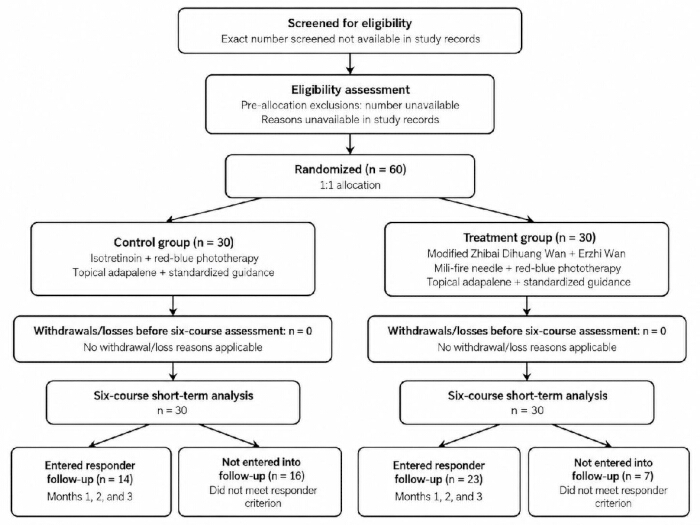
Figure 1: Study workflow and patient flow. Sixty participants were allocated 1:1 (30 per group). All 30 participants in each group were included in the six-course short-term analysis; no withdrawals or losses were recorded before that assessment. After six treatment courses, 14/30 control participants (46.67%) and 23/30 treatment participants (76.67%) met the responder criterion and entered follow-up; 16/30 and 7/30, respectively, did not meet the responder criterion and therefore did not enter the responder-only follow-up cohort. Verified pre-randomization screening totals and exclusion counts/reasons were not available in the study records and are labeled as unavailable in the figure. Please click here to view a larger version of this figure.
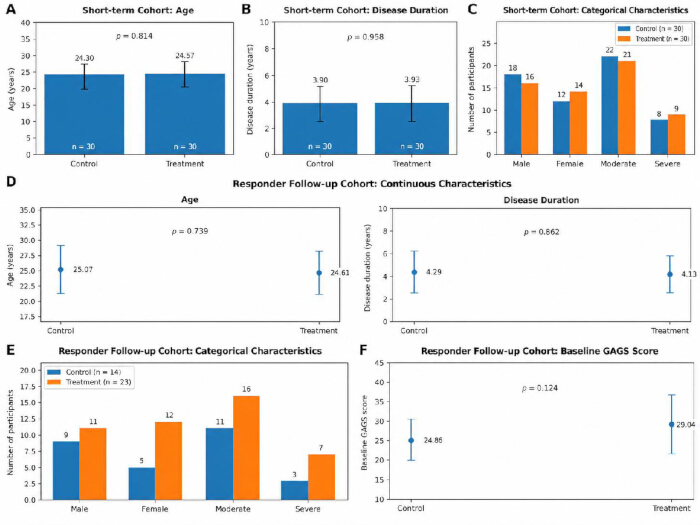
Figure 2: Baseline characteristics of the enrolled and responder follow-up cohorts. (A) Age in the short-term treatment cohort. (B) Disease duration in the short-term treatment cohort. (C) Sex distribution and acne severity grade in the short-term treatment cohort (n = 30/group). (D) Age and disease duration in the selected responder follow-up cohort. (E) Sex distribution and acne severity grade in the selected responder follow-up cohort. (F) Pretreatment GAGS score in the selected responder follow-up cohort (control n = 14; treatment n = 23). The responder follow-up cohort was defined by post-randomization response and does not preserve the randomized comparison. Please click here to view a larger version of this figure. Abbreviations: SD, standard deviation; ANOVA, analysis of variance.
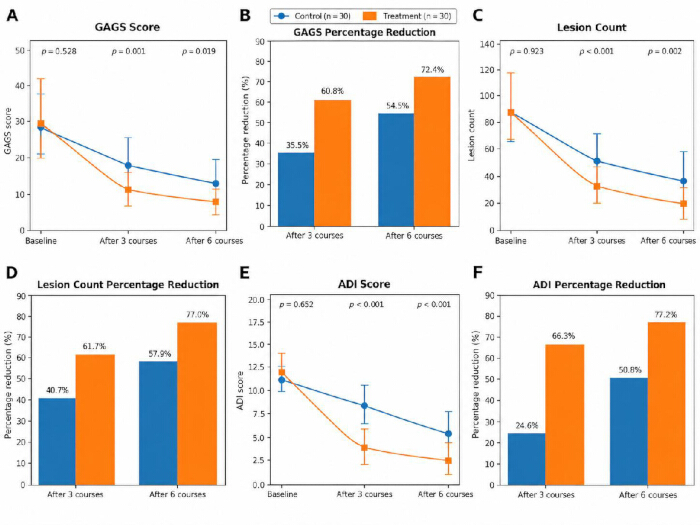
Figure 3: Short-term efficacy during the 12-week treatment period. (A) Global Acne Grading System (GAGS) score; (B) descriptive GAGS percentage reduction calculated from group means; (C) lesion count; (D) descriptive lesion-count percentage reduction calculated from group means; (E) Acne Disability Index (ADI) score; and (F) descriptive ADI percentage reduction calculated from group means. Biological n = 30 participants per group. In panels A, C, and E, data points and error bars represent the mean ± standard deviation, and the displayed p-values represent between-group independent-samples t tests at the corresponding time point. Panels B, D, and F are descriptive summaries derived from group means and do not display separate inferential tests. Within-group repeated-measures ANOVA results are reported in Table 3. One treatment course = 2 weeks. Please click here to view a larger version of this figure. Abbreviations: ECCA, Échelle d’Évaluation Clinique des Cicatrices d’Acné (Clinical Evaluation Scale for Acne Scars); SD, standard deviation; ANOVA, analysis of variance.
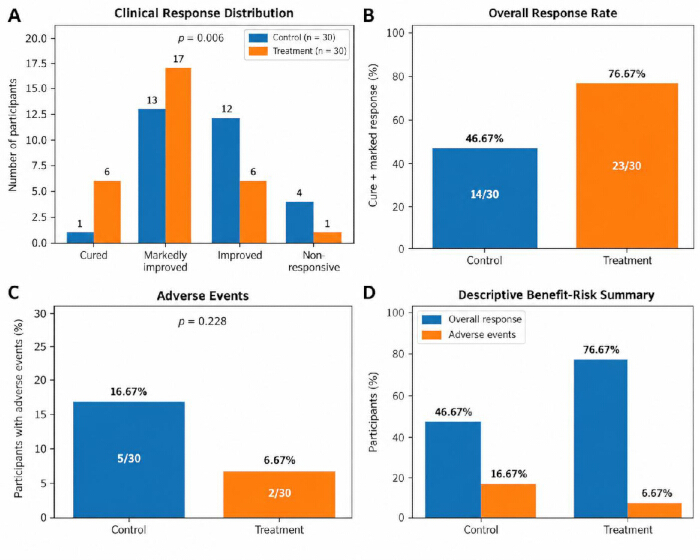
Figure 4: Overall clinical response and safety profile after six treatment courses. (A) Distribution of clinical response categories, analyzed using a rank-sum test. (B) Cure-plus-marked-response proportion, shown descriptively; no separate inferential test was performed for this dichotomized proportion. (C) Incidence of adverse events, compared using Fisher’s exact test. (D) Descriptive benefit-risk summary. Biological n = 30 participants per group. Panels B and D are descriptive summaries without error bars. Displayed statistical probabilities refer only to the statistical comparisons specified above. Please click here to view a larger version of this figure.
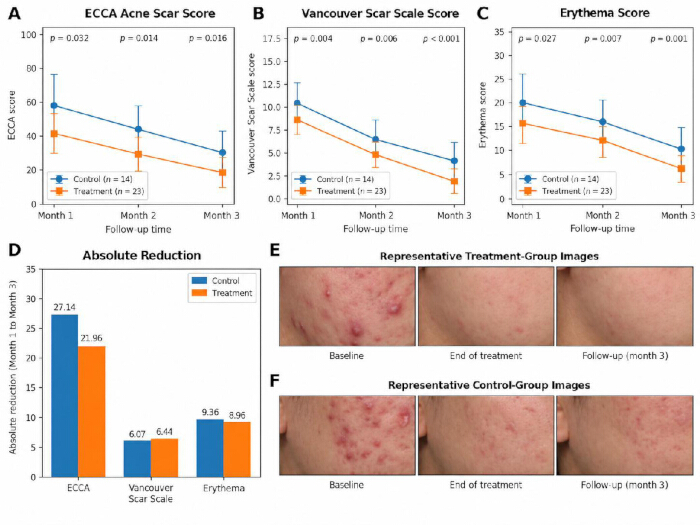
Figure 5: Follow-up scar recovery, erythema reduction, and representative imaging findings. (A) ECCA acne scar score. (B) Vancouver Scar Scale score. (C) Imaging-based erythema score. (D) Descriptive absolute reduction from month 1 to month 3. (E, F) Representative serial cheek-region clinical images from the treatment and control groups. The photographs were cropped for de-identification only; no retouching, lesion removal, or intensity adjustment was applied. The follow-up cohort includes only patients with cure or marked response after six courses (biological n: control = 14; treatment = 23). Quantitative data are shown as mean ± SD. Within-group time effects were evaluated using repeated-measures ANOVA, and between-group values at each month were compared using independent-samples t tests. These tests do not estimate a group-by-time interaction. Representative photographs are descriptive examples. Explicit written consent for publication of the facial photographs shown in Figure 5 was obtained from the participants. Please click here to view a larger version of this figure. Abbreviations: SD, standard deviation; ANOVA, analysis of variance.
| Category | Scar description | Score |
| Weighted score (a) | V-shaped scars, punctate atrophic scars, diameter < 2 mm | 15 |
| Weighted score (a) | U-shaped scars with sharp edges, diameter 2–4 mm | 20 |
| Weighted score (a) | M-shaped scars, diameter > 4 mm, usually with irregular borders | 25 |
| Weighted score (a) | Superficial atrophic scars related to elastolysis | 30 |
| Weighted score (a) | Hypertrophic scars with disease duration < 2 years | 40 |
| Weighted score (a) | Keloids or hypertrophic scars with disease duration > 2 years | 50 |
| Quantitative score (b) | No scar | 0 |
| Quantitative score (b) | A small number of scars, number of scars ≤ 5 | 1 |
| Quantitative score (b) | A limited number of scars, number of scars ≤ 20 | 2 |
| Quantitative score (b) | A large number of scars, number of scars > 20 | 3 |
| Final score | ECCA total score | a × b |
Table 1: ECCA acne scar weight scoring system used for post-treatment evaluation of post-acne scarring. The table shows the ECCA scoring framework used to assess post-acne scar burden. Scar morphology was assigned a weighted score, and scar quantity was assigned a quantitative score. The final ECCA score was calculated as the weighted score multiplied by the quantitative score. Lower scores indicate less severe post-acne scarring. Abbreviations: ECCA, Échelle d’Évaluation Clinique des Cicatrices d’Acné (Clinical Evaluation Scale for Acne Scars).
Short-term cohort (n = 30/group)
| Cohort / variable | Control group | Treatment group | Test statistic | p value |
| Age, years | 24.30 ± 4.89 | 24.57 ± 3.77 | -0.237 | 0.814 |
| Sex, male/female | 18/12 | 16/14 | 0.271 | 0.602 |
| Disease duration, years | 3.90 ± 2.71 | 3.93 ± 2.18 | -0.053 | 0.958 |
| Acne severity, moderate/severe | 22/8 | 21/9 | 0.082 | 0.774 |
| Responder follow-up cohort (control n = 14; treatment n = 23) | ||||
| Age, years | 25.07 ± 4.39 | 24.61 ± 3.86 | 0.336 | 0.739 |
| Sex, male/female | 9/5 | 11/12 | 0.949 | 0.33 |
| Disease duration, years | 4.29 ± 3.07 | 4.13 ± 2.30 | 0.175 | 0.862 |
| Acne severity, moderate/severe | 11/3 | 16/7 | 0.358 | 0.55 |
| Baseline GAGS score | 24.86 ± 5.53 | 29.04 ± 8.92 | -1.576 | 0.124 |
Table 2: Baseline characteristics of the short-term treatment cohort and responder follow-up cohort. The table summarizes baseline demographic and disease-related characteristics of the full short-term cohort and the selected responder follow-up cohort. Variables include age, sex distribution, disease duration, acne severity grade, and baseline GAGS score where applicable. The responder follow-up cohort consists only of participants with cure or marked response and therefore does not preserve the original randomized comparison. Continuous variables are mean ± SD; categorical variables are counts. Baseline continuous variables were compared with independent-samples t tests; categorical variables used chi-square or Fisher’s exact tests as appropriate. The responder follow-up cohort includes only participants with cure or marked response: control 14/30 (46.67%) and treatment 23/30 (76.67%). Because cohort entry depended on a post-randomization outcome, these responder-subset comparisons do not preserve the original randomized comparison. Abbreviations: GAGS, Global Acne Grading System; SD, standard deviation.
| Outcome | Time point | Control group (n = 30) | Treatment group (n = 30) | Between-group t | p value |
| GAGS score | Baseline | 28.17 ± 8.91 | 29.67 ± 9.40 | −0.634 | 0.528 |
| GAGS score | After 3 courses | 18.17 ± 8.91 | 11.63 ± 5.93 | 3.344 | 0.001 |
| GAGS score | After 6 courses | 12.80 ± 8.33 | 8.20 ± 6.27 | 2.416 | 0.019 |
| GAGS score | Within-group repeated-measures ANOVA | F = 23.990; p < 0.001 | F = 73.489; p < 0.001 | — | — |
| Lesion count | Baseline | 86.97 ± 18.16 | 86.50 ± 19.11 | 0.097 | 0.923 |
| Lesion count | After 3 courses | 51.57 ± 18.33 | 33.13 ± 14.76 | 4.290 | < 0.001 |
| Lesion count | After 6 courses | 36.63 ± 22.17 | 19.90 ± 16.61 | 3.309 | 0.002 |
| Lesion count | Within-group repeated-measures ANOVA | F = 51.973; p < 0.001 | F = 130.241; p < 0.001 | — | — |
| ADI score | Baseline | 11.18 ± 1.58 | 11.97 ± 1.25 | −0.453 | 0.652 |
| ADI score | After 3 courses | 8.43 ± 2.05 | 4.03 ± 1.43 | 9.664 | < 0.001 |
| ADI score | After 6 courses | 5.50 ± 1.78 | 2.73 ± 1.11 | 7.231 | < 0.001 |
| ADI score | Within-group repeated-measures ANOVA | F = 23.187; p < 0.001 | F = 466.372; p < 0.001 | — | — |
Table 3: Short-term efficacy outcomes during treatment. The table presents Global Acne Grading System score, lesion count, and Acne Disability Index score at baseline, after three courses, and after six courses. The reported analyses do not provide a formal group-by-time interaction test. Values are mean ± SD unless otherwise indicated. Between-group comparisons at each time point used independent-samples t tests. Within-group repeated-measures ANOVA F tests describe change over time within each treatment group. These separate analyses do not estimate a group × time interaction and therefore should not be interpreted as a formal longitudinal treatment-effect test. One treatment course = 2 weeks. Abbreviations: GAGS, Global Acne Grading System; ADI, Acne Disability Index; SD, standard deviation; ANOVA, analysis of variance.
| Section / variable | Control group (n = 30) | Treatment group (n = 30) | Test statistic | p value |
| Clinical response distribution | ||||
| Cured, n | 1 | 6 | Rank-sum z = −2.757 | 0.006 |
| Markedly improved, n | 13 | 17 | — | — |
| Improved, n | 12 | 6 | — | — |
| Non-responsive, n | 4 | 1 | — | — |
| Cure + marked response, n (%) | 14 (46.67%) | 23 (76.67%) | — | — |
| Safety | ||||
| Patients with adverse events, n (%) | 5 (16.67%) | 2 (6.67%) | — | 0.228 |
| Patients without adverse events, n | 25 | 28 | — | — |
| Main adverse events | Skin dryness; lip cracking; gastrointestinal discomfort | Mild erythema; mild pain | — | — |
Table 4: Overall clinical response and adverse events after six treatment courses. The table summarizes clinical response categories, overall response rate, and adverse events after six treatment courses. The overall response rate was defined as the proportion of patients achieving a cure or a marked response. Adverse events were recorded by group and event type. Overall response rate = cure + marked response. The ordinal clinical response distribution was compared with a rank-sum test. The cure-plus-marked-response proportion is presented descriptively; no separate inferential test was performed for this dichotomized proportion. Adverse-event incidence was compared with Fisher’s exact test.
| Outcome / time point | Control group (n = 14) | Treatment group (n = 23) | Between-group t | p value |
| ECCA acne scar score | ||||
| Month 1 | 57.14 ± 25.85 | 41.09 ± 17.84 | 2.238 | 0.032 |
| Month 2 | 43.21 ± 14.62 | 29.13 ± 16.83 | 2.589 | 0.014 |
| Month 3 | 30.00 ± 12.25 | 19.13 ± 12.85 | 2.539 | 0.016 |
| Within-group repeated-measures ANOVA | F = 7.498; p = 0.002 | F = 10.878; p < 0.001 | — | — |
| Vancouver Scar Scale score | ||||
| Month 1 | 10.43 ± 2.38 | 8.57 ± 1.34 | 3.058 | 0.004 |
| Month 2 | 6.50 ± 1.87 | 5.00 ± 1.28 | 2.9 | 0.006 |
| Month 3 | 4.36 ± 1.82 | 2.13 ± 1.06 | 4.719 | < 0.001 |
| Within-group repeated-measures ANOVA | F = 31.927; p < 0.001 | F = 157.339; p < 0.001 | — | — |
| Imaging-based erythema score | ||||
| Month 1 | 19.79 ± 6.36 | 15.48 ± 4.93 | 2.307 | 0.027 |
| Month 2 | 15.86 ± 3.86 | 12.26 ± 3.62 | 2.858 | 0.007 |
| Month 3 | 10.43 ± 4.13 | 6.52 ± 2.52 | 3.588 | 0.001 |
| Within-group repeated-measures ANOVA | F = 12.803; p < 0.001 | F = 32.418; p < 0.001 | — | — |
Table 5: Post-treatment scar- and erythema-related outcomes in the responder follow-up cohort. The table presents ECCA acne scar score, Vancouver Scar Scale score, and erythema score at months 1, 2, and 3 after treatment completion in the responder-only follow-up cohort (control n = 14; treatment n = 23). Lower scores indicate more favorable scar- and erythema-related outcomes. Because follow-up eligibility depended on treatment response, between-group comparisons in this table are exploratory and do not preserve the original randomized comparison. This is a responder-only follow-up cohort, not the full randomized cohort: control 14/30 (46.67%) and treatment 23/30 (76.67%). Values are mean ± SD. Between-group comparisons at each month used independent-samples t tests; within-group time effects used repeated-measures ANOVA. Because follow-up eligibility depended on a post-randomization response, these between-group comparisons are exploratory and do not preserve randomization. The reported tests do not estimate a group × time interaction. Abbreviations: ECCA, Échelle d’Évaluation Clinique des Cicatrices d’Acné (Clinical Evaluation Scale for Acne Scars); GAGS, Global Acne Grading System; ADI, Acne Disability Index; SD, standard deviation; ANOVA, analysis of variance.
Discussion
This study presents a reproducible protocol for comparing an integrated traditional Chinese medicine and mili-fire needle regimen plus red-blue LED phototherapy with an isotretinoin-based regimen using the same LED schedule and topical adapalene. During the 12-week randomized treatment phase, time-specific between-group comparisons showed lower GAGS scores, lesion counts, and ADI scores in the integrated-regimen group after three and six courses, and the clinical response distribution differed between groups. These findings concern the complete assigned treatment packages. They should not be interpreted as evidence that any individual component—herbal therapy, mili-fire needling, isotretinoin, LED phototherapy, or adapalene—independently caused the observed differences. Current acne guidance emphasizes control of inflammatory disease together with scarring risk, tolerability, adherence, and psychosocial burden, supporting the inclusion of both clinical severity and patient-reported outcomes in treatment evaluation27. The between-group differences were already evident at the mid-treatment assessment. Persistent inflammatory acne is associated with subsequent scarring and erythematous sequelae, providing a clinical rationale for timely inflammatory control28. However, the present statistical approach uses within-group repeated-measures tests together with separate between-group comparisons at each time point. Without a formal group-by-time interaction in a participant-level longitudinal model, the current results establish time-specific differences but do not quantify whether the trajectories differed between groups over time. A mixed-effects or other appropriate repeated-measures model incorporating group, time, and their interaction would provide stronger longitudinal inference if the original participant-level data are available.
The post-treatment findings require substantially more caution than the randomized short-term results. Only participants who achieved a cure or marked improvement were eligible for follow-up, yielding 14 responders from the control group and 23 from the treatment group. Conditioning follow-up on a post-randomization outcome creates selection bias and breaks the original randomized comparison; apparent baseline similarity within the responder subset cannot remove that bias. Consequently, lower ECCA, Vancouver Scar Scale, and erythema scores observed in treatment-group responders at months 1–3 should be treated as exploratory descriptions of selected responders rather than as unbiased evidence of superior treatment efficacy during follow-up. Future studies should follow all randomized participants irrespective of early response and use prespecified longitudinal analyses.
Erythema, scarring, and quality-of-life impairment remain clinically relevant even after active lesions improve. Light-based and procedural approaches have been investigated for acne and post-acne sequelae, but protocols, devices, and evidence certainty vary29. In the present trial, LED phototherapy was administered to both groups, while the integrated-regimen group additionally received syndrome-directed herbal treatment and mili-fire needling instead of isotretinoin. Because multiple components differed simultaneously between regimens, the study cannot identify which component, interaction among components, or difference in systemic therapy accounts for the observed group differences. Mechanistic explanations for individual components should therefore be regarded as hypotheses rather than conclusions from this design.
The rationale for including fire-needle and herbal components is also consistent with prior complementary-medicine literature, but that literature should be interpreted cautiously. A meta-analysis of randomized trials of fire-needle therapy for moderate-to-severe acne reported potential clinical benefit but substantial heterogeneity and called for larger, rigorously designed studies18. A systematic review of herbal clinical trials likewise found promising acne outcomes while noting heterogeneous interventions and limitations in evidence quality19. These studies provide background for the regimen design; they do not validate the specific prescription, needling technique, or the contribution of any component used here.
Several limitations should be acknowledged. First, this was a single-center study with 60 participants, and no formal a priori power calculation was available in the study records; the modest sample size limits precision and generalizability. Second, although the study reports 1:1 random allocation with 30 participants per group, the random-sequence generation and allocation-concealment procedures were not documented in the available records, which limits assessment of selection-bias risk. Third, the responder-only follow-up cohort was selected on the basis of a post-randomization outcome, substantially limiting causal interpretation of the month 1–3 scar and erythema comparisons. Fourth, the analyzed 1-, 2-, and 3-month visits differed from the originally planned 1-, 3-, and 6-month schedule; the available records do not document the operational reason for this deviation, and the observed follow-up is too short to characterize mature scar remodeling. Fifth, the reported repeated-measures analyses do not include a formal group-by-time interaction because participant-level repeated observations required for a valid mixed-effects reanalysis were not available; conclusions are therefore limited to within-group time effects and time-specific between-group comparisons. Sixth, the multimodal design cannot separate the contributions of herbal therapy, mili-fire needling, LED phototherapy, isotretinoin, or their interactions. Seventh, the study was not prospectively registered in a public clinical trial registry before enrollment began in January 2022, which limits protocol transparency and independent verification of prespecified outcomes and analyses. Finally, assessor blinding was not described. Future work should use prospectively registered multicenter designs, prespecified sample-size calculations, clearly concealed randomization, blinded outcome assessment where feasible, follow-up of the entire randomized cohort, longer observation, longitudinal mixed-effects models, and component-specific or factorial comparisons when clinically and ethically appropriate.
Overall, the randomized 12-week data showed lower post-baseline GAGS scores, lesion counts, and ADI scores at the prespecified mid- and end-treatment assessments in the integrated-treatment group than in the isotretinoin-based control group, together with a different ordinal clinical-response distribution and no statistically significant difference in adverse-event incidence in this sample. Because the current analyses do not include a formal group-by-time interaction, these findings should be interpreted as time-specific between-group differences rather than proof of different longitudinal trajectories. The month 1–3 scar and erythema findings among responders are exploratory because follow-up selection did not preserve randomization. These results justify further evaluation of the complete integrated regimen in larger, prospectively registered studies with full-cohort follow-up and longitudinal models, but they do not establish the independent efficacy or mechanism of any single component.
Disclosures
The authors declare no competing interests. Generative AI (OpenAI ChatGPT) was used solely for English-language polishing.
Author Contributions:
Yaping Zhong, Hua Xia, Yuejun Zou, Danfeng Ying, and Niannian Liu contributed to patient recruitment, treatment administration, and clinical data collection. Xuesong Wang designed the study, supervised the project, and performed data analysis. All authors contributed to manuscript writing, revision, and approved the final version.
Acknowledgements
This study was supported by the Changshu Municipal Health Commission Key Funded Project (CSWS202123). The authors thank all patients who participated in this study and the clinical staff for their assistance in treatment administration and data collection.
Materials
| Name | Company | Catalog Number | Comments |
|---|---|---|---|
| 75% alcohol disinfectant | Shandong Lircon Medical Technology Co., Ltd., Dezhou, Shandong, China | LIRCON 75% alcohol disinfectant; 500 mL | Used for skin disinfection before mili-fire needle treatment and comedone extraction. |
| Acne Disability Index questionnaire | None (study document) | Five-item instrument; study copy | Used to assess acne-related quality-of-life impairment. |
| Adapalene gel, 0.1%, 30 g/tube | Laboratoires GALDERMA, Alby-sur-Chéran, France | Differin; 0.1%, 30 g/tube; NMPA registration no. HJ20160022 | Used in both groups as nightly topical spot treatment. |
| Anemarrhena asphodeloides rhizome | Nanjing Heling Pharmaceutical Services Co., Ltd., Nanjing, Jiangsu, China | Chinese herbal decoction piece; 10 g per daily prescription | Treatment-group prescription. |
| Case report form | None (study document) | Study document | Used for screening, allocation, treatment completion, adverse-event recording, and follow-up data capture. |
| Clinical laboratory safety tests | The Fifth People's Hospital of Changshu Clinical Laboratory, Changshu, Jiangsu, China | Routine clinical chemistry testing for liver function, renal function, and blood lipids | Liver function, renal function, and blood lipid monitoring at baseline, after three courses, and after six courses. |
| Disposable medical gloves | Winner Medical Co., Ltd., Shenzhen, Guangdong, China | Single-use medical examination gloves; powder-free; size as required | Used during disinfection, needling, lesion expression, and post-treatment care. |
| Disposable sterile acupuncture needle | Suzhou Medical Appliance Factory (HWATO), Suzhou, Jiangsu, China | Single-use sterile acupuncture needle; 0.25 × 25 mm; 100 needles/box | Used for mili-fire needle puncture under aseptic conditions. |
| ECCA acne scar scoring sheet | None (study document) | Study assessment form based on the ECCA grading scale | Used to assess post-acne scar burden during follow-up. |
| Eclipta prostrata | Nanjing Heling Pharmaceutical Services Co., Ltd., Nanjing, Jiangsu, China | Chinese herbal decoction piece; 15 g per daily prescription | Treatment-group prescription. |
| Forsythia suspensa fruit | Nanjing Heling Pharmaceutical Services Co., Ltd., Nanjing, Jiangsu, China | Chinese herbal decoction piece; 15 g per daily prescription | Treatment-group prescription. |
| Global Acne Grading System assessment sheet | None (study document) | Study assessment form | Used at baseline, after three courses, and after six courses. |
| Glycyrrhiza uralensis root | Nanjing Heling Pharmaceutical Services Co., Ltd., Nanjing, Jiangsu, China | Chinese herbal decoction piece; 5 g per daily prescription | Treatment-group prescription. |
| Isotretinoin soft capsules, 10 mg | Shanghai Xinyi Wanxiang Pharmaceutical Co., Ltd., Shanghai, China | NMPA approval no. H10930210; 10 mg | Control group: one capsule twice daily (fixed total dose 20 mg/day). |
| Ligustrum lucidum fruit | Nanjing Heling Pharmaceutical Services Co., Ltd., Nanjing, Jiangsu, China | Chinese herbal decoction piece; 15 g per daily prescription | Treatment-group prescription. |
| Modified Zhibai Dihuang Wan combined with Erzhi Wan decoction | Nanjing Heling Pharmaceutical Services Co., Ltd., Nanjing, Jiangsu, China; dispensed via hospital pharmacy | Individualized decoction prepared from the listed herbal pieces; 200 mL/dose, twice daily | Prepared from individual herbal decoction pieces for the treatment group. |
| Phellodendron chinense bark | Nanjing Heling Pharmaceutical Services Co., Ltd., Nanjing, Jiangsu, China | Chinese herbal decoction piece; 10 g per daily prescription | Treatment-group prescription. |
| Prunella vulgaris | Nanjing Heling Pharmaceutical Services Co., Ltd., Nanjing, Jiangsu, China | Chinese herbal decoction piece; 10 g per daily prescription | Treatment-group prescription. |
| Red-blue light-emitting diode phototherapy device | Shenzhen Lifotronic Technology Co., Ltd., Shenzhen, China | Model JY-A; medical device registration no. 20172090677 | Used for 20 min once every 14 days in both groups. |
| Rehmannia glutinosa | Nanjing Heling Pharmaceutical Services Co., Ltd., Nanjing, Jiangsu, China | Chinese herbal decoction piece; 15 g per daily prescription | Treatment-group prescription. |
| Salvia miltiorrhiza root | Nanjing Heling Pharmaceutical Services Co., Ltd., Nanjing, Jiangsu, China | Chinese herbal decoction piece; 25 g per daily prescription | Treatment-group prescription. |
| Skin imaging analysis system | Canfield Scientific, Inc., Parsippany, NJ, USA | VISIA 7 complexion analysis system | Used for standardized facial imaging and imaging-based erythema assessment during follow-up. |
| SPSS statistical software | SPSS Inc., Chicago, IL, USA | SPSS Statistics version 13.0 | Used for the statistical analyses described in the manuscript. |
| Stainless-steel comedone extractor | The Fifth People's Hospital of Changshu, Department of Dermatology, Changshu, Jiangsu, China | Reusable stainless-steel comedone extractor; dermatology clinic instrument stock | Used to express lesion contents after needling when clinically appropriate. |
| Sterile cotton swabs | Winner Medical Co., Ltd., Shenzhen, Guangdong, China | Sterile medical cotton swab; 10 cm | Used for skin disinfection and local cleaning. |
| Sterile gauze pads | Winner Medical Co., Ltd., Shenzhen, Guangdong, China | Sterile gauze swab; 7.5 × 7.5 cm, 8-ply; REF 201064 | Used for local cleaning and compression after puncture or extraction. |
| Taraxacum mongolicum | Nanjing Heling Pharmaceutical Services Co., Ltd., Nanjing, Jiangsu, China | Chinese herbal decoction piece; 15 g per daily prescription | Treatment-group prescription. |
| Vancouver Scar Scale assessment sheet | None (study document) | Study assessment form | Used to assess scar characteristics during follow-up. |
References
- Zhu Z et al. Global, regional and national burdens of acne vulgaris in adolescents and young adults aged 10–24 years from 1990 to 2021: a trend analysis. Br J Dermatol. 2025;192(2):228–237.
- Eichenfield DZ, Sprague J, Eichenfield LF. Management of acne vulgaris: a review. JAMA. 2021;326(20):2055–2067.
- Hu JK, Quinonez RL, Antasiuk V, Waibel J. Treatment of acne vulgaris-associated post-inflammatory dyschromia with combination of non-ablative laser therapy and topical antioxidants. J Drugs Dermatol. 2024;23(9):769–773.
- Reynolds RV et al. Guidelines of care for the management of acne vulgaris. J Am Acad Dermatol. 2024;90(5):1006.e1–1006.e30.
- Issa N et al. Recommendations to improve outcomes in acne and acne sequelae: a focus on trifarotene and other retinoids. Dermatol Ther (Heidelb). 2025;15(3):563–577.
- Akuffo-Addo E, Ramsay K, Mohsen S, Boisvert J, Mukovozov I. Visible light in the treatment of acne vulgaris. J Cutan Med Surg. 2024;28(6):567–571.
- Subcommittee on Dermatology of Integrated Traditional Chinese and Western Medicine, China Dermatologist Association. Chinese patent medicine for the treatment of acne vulgaris: an expert consensus statement (2016). Chin J Dermatol. 2016;49(8):533–536.
- Tan JKL, Bhate K. A global perspective on the epidemiology of acne. Br J Dermatol. 2015;172 Suppl 1:3–12.
- Li Y, Hu X, Dong G, Wang X, Liu T. Acne treatment: research progress and new perspectives. Front Med (Lausanne). 2024;11:1425675.
- Etgu F, Sekerlisoy Tatar G. Risk factors and epidemiology of acne severity and acne scar development: a comprehensive clinical study. Dermatol Pract Concept. 2025;15(4):e20256108.
- National Guideline Alliance (UK). Management of acne vulgaris-associated scarring: acne vulgaris: management: evidence review M. London: National Institute for Health and Care Excellence; 2021.
- Attia E. Atrophic postacne scar treatment: narrative review. JMIR Dermatol. 2024;7:e49954.
- Tahiliani S et al. Practical aspects of acne scar management: ASAP 2024. Cureus. 2024;16(3):e56485.
- Kalantari Y, Dadkhahfar S, Etesami I. Post-acne erythema treatment: a systematic review of the literature. J Cosmet Dermatol. 2022;21(4):1379–1392.
- Qureshi S, Rehan Z, Ao A, Mukovozov I. Photodynamic therapy in acne vulgaris: a systematic review. J Cutan Med Surg. 2025;29(1):69–73.
- Heng AHS, Chew FT. Systematic review of the epidemiology of acne vulgaris. Sci Rep. 2020;10(1):5754.
- Wu B, Gao M, Zhang Y, Bai X. Optimal treatment options for acne scars in patients with historic acne: a systematic review and network meta-analysis. PeerJ. 2025;13:e19938.
- Xing M et al. Fire needle therapy for moderate-severe acne: a PRISMA systematic review and meta-analysis of randomized controlled trials. Complement Ther Med. 2019;44:253–260.
- Proença AC, Luís Â, Duarte AP. The role of herbal medicine in the treatment of acne vulgaris: a systematic review of clinical trials. Evid Based Complement Alternat Med. 2022;2022:2011945.
- Weller RB, Hunter HJA, Mann MW. Clinical dermatology. 5th ed. Oxford: Wiley-Blackwell; 2015.
- Working Group for Acne Diseases, Chinese Society of Dermatology. Guideline for diagnosis and treatment of acne (the 2019 revised edition). J Clin Dermatol. 2019;48(9):583–588.
- Zheng XY, editor. Guiding principles for clinical research of new Chinese medicines (trial). Beijing: China Medical Science and Technology Press; 2002. Chinese.
- Doshi A, Zaheer A, Stiller MJ. A comparison of current acne grading systems and proposal of a novel system. Int J Dermatol. 1997;36(6):416–418.
- Motley RJ, Finlay AY. Practical use of a disability index in the routine management of acne. Clin Exp Dermatol. 1992;17(1):1–3.
- Sullivan T, Smith J, Kermode J, McIver E, Courtemanche DJ. Rating the burn scar. J Burn Care Rehabil. 1990;11(3):256–260.
- Dreno B et al. ECCA grading scale: an original validated acne scar grading scale for clinical practice in dermatology. Dermatology. 2007;214(1):46–51.
- Layton AM et al. The Personalized Acne Treatment Tool — recommendations to facilitate a patient-centered approach to acne management from the Personalizing Acne: Consensus of Experts. JAAD Int. 2023;12:60–69.
- Jennings T et al. Acne scarring—pathophysiology, diagnosis, prevention and education: Part I. J Am Acad Dermatol. 2024;90(6):1123–1134.
- Ziebart RL, Antezana LA, Crum OM, Lynch M, Wyles SP. Laser and energy treatments for acne scarring: a review of clinical trials. J Drugs Dermatol. 2024;23(12):1058–1062.