This protocol provides a practical and reproducible workflow for synchronizing cultured cells, performing staggered time-course sampling over 24–72 h without overnight collection, and analyzing circadian clock gene expression.
A subscription to JoVE is required to view this content. Sign in or start your free trial.
Method Article
Circadian Rhythms in a Petri Dish: Synchronizing Mouse Hypothalamic mHypoE-42 Cells for Circadian Clock Gene Expression Analysis
In This Article
Summary
Abstract
Circadian rhythms are endogenous oscillations of approximately 24 h that regulate a wide range of cellular and physiological processes, including gene expression, metabolism, and behavior. These rhythms arise from interconnected transcriptional–translational feedback loops that respond to temporal and environmental cues. Because circadian regulation is highly dynamic, even minor experimental variations can influence phase, amplitude, and rhythmicity, making standardized experimental workflows essential for generating reliable and reproducible results. The goal of the present protocol is to provide a practical and reproducible workflow for synchronizing cultured cells, performing time-course sampling, and analyzing circadian clock gene expression under standard laboratory conditions. The protocol describes serum shock-based synchronization, staggered sample collection over 24–72 h to avoid overnight sampling, ribonucleic acid extraction, complementary deoxyribonucleic acid synthesis, quantitative real-time polymerase chain reaction, and circadian rhythm analysis using appropriate statistical approaches. The workflow also highlights critical experimental considerations, including synchronization conditions, sample quality assessment, reference gene selection, and data analysis, to improve reproducibility across experiments. This method provides an accessible approach for investigating molecular circadian mechanisms and evaluating rhythmic gene expression in cultured cells, facilitating studies of circadian regulation in physiological and disease-related experimental models.
Introduction
Circadian rhythms are endogenous cycles with a period of approximately 24 h that regulate a wide range of physiological, metabolic, and cellular processes1. In mammalian systems, these rhythms are coordinated by a central clock located in the suprachiasmatic nucleus (SCN) of the hypothalamus and by self-sustained molecular clocks at the cellular level. These clocks consist of interlocked transcriptional–translational feedback loops involving core clock genes, including circadian locomotor output cycles protein kaput (Clock), basic helix-loop-helix aryl hydrocarbon receptor nuclear translocase-like 1 (Bmal1), period (Per), and cryptochrome (Cry)2. Given the central role of the circadian clock in diverse biological processes, in vitro cell models have become important tools for investigating the molecular mechanisms of temporal regulation under controlled experimental conditions.
The goal of the present protocol is to provide a reliable, practical, and reproducible workflow for synchronizing cultured cells using a serum shock protocol, performing staggered time-course sampling, and analyzing circadian clock gene expression while avoiding overnight sample collection. By improving the feasibility of circadian sampling without compromising data quality, this workflow is intended to facilitate studies of rhythmic biological processes using standard laboratory techniques.
Circadian studies have been performed in a wide range of in vitro models, including human cancer cell lines3, rat-1 fibroblasts4, SCN explants5, and organoids6. Although most mammalian cells possess functional circadian clocks, the absence of synchronizing cues, such as light, rapidly leads to desynchronization in culture, limiting the study of circadian rhythms in vitro7. Therefore, synchronization techniques are essential for investigating molecular clock mechanisms and their implications in health and disease.
Several synchronization strategies have been developed for cultured mammalian cells. Glucocorticoid-based synchronization using dexamethasone is among the most widely used approaches because it robustly resets circadian rhythms in many cell types while reducing some of the variability associated with serum stimulation8. Similarly, forskolin-mediated activation of cyclic adenosine monophosphate signaling has been successfully used to synchronize peripheral clocks in selected cellular models9. Other approaches include treatment with blood-borne signals4, different chemical compounds8,10, medium exchange3, temperature shock11, oxygen cycles12, and mechanical stimulation13. Collectively, these methods have substantially advanced circadian research; however, they may require specialized equipment, specific experimental conditions, or additional optimization, making it important to validate the selected synchronization strategy for each biological model and experimental application14.
Serum shock is one of the most widely established synchronization approaches and consists of exposing cultured cells to a short-term, high-serum stimulus4. Because the stimulus is transient, prolonged perturbation of cellular signaling pathways is minimized4, reducing potential confounding effects on downstream analyses. Consequently, serum shock is particularly suitable for studies of circadian gene expression and molecular clock function. In addition, the procedure is straightforward to implement and does not require specialized equipment, making it accessible and readily reproducible across laboratories. A practical limitation of serum shock experiments, however, is the intensive sampling schedule required to characterize circadian rhythmicity accurately. Reliable rhythm analysis typically requires sample collection at regular intervals, usually every 2–6 h over one or more circadian cycles (24–72 h)14, often necessitating overnight collections.
The workflow described here addresses this logistical challenge by staggering the initiation of synchronization across multiple culture plates, thereby enabling complete circadian sampling during standard working hours while avoiding overnight sample collection. Rather than introducing a new synchronization strategy, this protocol provides a detailed and reproducible implementation of an established serum shock method combined with a practical sampling schedule and downstream gene expression analysis. This workflow is particularly appropriate for studies of circadian gene expression in cultured cells using widely available laboratory techniques. When adapting the protocol to additional cellular models, experimental parameters, including cell density, synchronization conditions, sampling intervals, and reference gene selection, should be optimized and validated for the specific cell type before implementation.
Access restricted. Please log in or start a trial to view this content.
Protocol
The following protocol describes a validated synchronization method for the mHypoE-42 embryonic mouse hypothalamic cell line. Validate and optimize the synchronization protocol independently before applying it to other cultured cell types. See Figure 1 for an overview of the workflow and Supplementary Figure 1 for the weekly sampling schedule. Refer to the Table of Materials for all reagents, equipment, and instruments used in this protocol. Perform all cell culture procedures in a certified biosafety cabinet using sterile reagents and equipment.
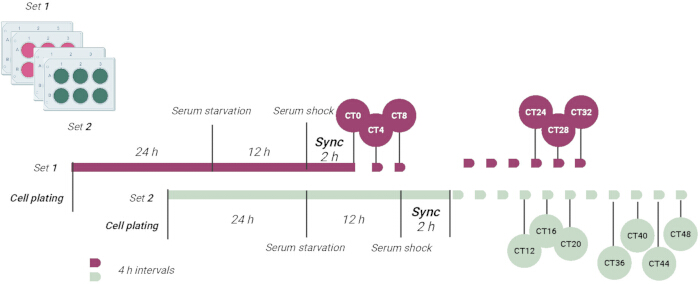
Figure 1. Schematic overview of the staggered serum shock synchronization protocol. Schematic illustrating the workflow used to synchronize mHypoE-42 cells by serum shock in two staggered experimental sets. The staggered design enables circadian sample collection during standard working hours while avoiding overnight sampling. Samples are subsequently processed for RNA extraction, quantitative real-time polymerase chain reaction (qRT-PCR), and circadian rhythm analysis. Created with Biorender.com. Please click here to view a larger version of this figure.
1. Cell culture
- Culture adherent mHypoE-42 cells in Dulbecco’s Modified Eagle Medium (DMEM), high glucose (4500 mg/L), supplemented with 10% (v/v) heat-inactivated fetal bovine serum (FBS), 3.7 g/L sodium bicarbonate, and 1% antibiotic solution.
- Maintain the cells at 37°C in a humidified incubator containing 95% air and 5% carbon dioxide (CO2) using T75 culture flasks with a final culture volume of 10 mL.
NOTE: Test each new batch of FBS before beginning experiments because serum batches may vary. - Subculture the cells when they reach approximately 80%–90% confluence. Wash the cells with sterile 1× phosphate-buffered saline (PBS; pH 7.4), add 3 mL of 0.5% trypsin solution, and incubate for 3–5 min to detach the cells.
- Add at least twice the trypsin volume of complete culture medium containing 10% (v/v) FBS to neutralize the trypsin.
- Dilute the cells with fresh growth medium at a ratio of up to 1:2.
NOTE: Avoid using cells that have undergone excessive passaging (e.g., passages greater than 40 for mHypoE-42 cells). Prewarm all solutions before use. Regularly test cultures for mycoplasma contamination. - Proceed with synchronization assays 24 h after seeding the cells at 2.0 × 10⁵ cells per well, as described in Step 2. Maintain routine cell cultures at approximately 80%–90% confluence before passaging.
2. Synchronization of mHypoE-42 Cell Line
- Cell preparation
- After trypsinization, centrifuge the cells at 700 × g for 5 min.
- Discard the supernatant and resuspend the cell pellet in 10 mL of fresh culture medium.
- Mix the cell suspension with trypan blue dye at a 1:1 ratio (20 μL total volume) and determine the cell concentration using a hemocytometer.
NOTE: Dispose of trypan blue-containing solutions according to institutional chemical waste disposal guidelines. Do not discard unused dye into the sink.
- Cell plating and staggered experimental design
- Plate 2.0 × 10⁵ cells per well in either 6-well plates or 35-mm culture dishes. Incubate the cultures at 37°C for 24 h.
NOTE: Initiate serum synchronization 24 h after cell seeding. Therefore, a predefined cell confluence is not required before synchronization. Instead, examine the cultures microscopically to confirm that the cells are fully attached and display appropriate morphology before beginning the synchronization procedure. - Divide the culture plates randomly into two experimental sets. Use the first set to generate circadian timepoints (CT) CT0, CT4, CT8, CT24, CT28, and CT32. Use the second set to generate CT12, CT16, CT20, CT36, CT40, CT44, and CT48 (Figure 1; Supplementary Figure 1).
- Increase the number of wells or plates as needed to include technical replicates.
NOTE: Minimize variability by preparing all plates from the same cell suspension, maintaining identical seeding densities and culture conditions, and performing synchronization using the same reagents and experimental settings. Adjust culture vessel format and plating density as needed for other cell types. When using 6-well plates, combine CTs collected simultaneously to optimize plate usage.
- Plate 2.0 × 10⁵ cells per well in either 6-well plates or 35-mm culture dishes. Incubate the cultures at 37°C for 24 h.
- Synchronization
- After 24 h, aspirate the medium from the first set of plates and add 1 mL of serum-free DMEM. Incubate for 12 h to induce serum starvation.
- Prepare a 50% (v/v) horse serum solution in high-glucose DMEM immediately before use.
- Aspirate the starvation medium from the first set and expose the cells to 1 mL of the freshly prepared 50% horse serum solution for 2 h.
- Simultaneously aspirate the medium from the second set of plates and replace it with 1 mL of serum-free DMEM. Incubate for 12 h.
- After the 2-h serum shock, aspirate the medium and add 1 mL of high-glucose DMEM supplemented with 10% (v/v) heat-inactivated FBS. Designate this time point as CT0.
- Sample collection
- Place the culture plates on ice. Aspirate the medium, wash the cells twice with 1 mL of cold sterile 1× PBS, discard the wash solution, and lyse the cells mechanically using up to 1 mL of lysis reagent.
CAUTION: The lysis reagent contains hazardous chemicals. Perform all handling steps in a certified chemical fume hood while wearing appropriate personal protective equipment. Dispose of waste according to institutional chemical safety guidelines. - Transfer each lysate to a sterile tube and store the samples at −80°C until RNA extraction.
- Repeat Steps 2.4.1 and 2.4.2 to collect samples at CT4 and CT8.
- At CT8, repeat Step 2.3.2 for the second experimental set to synchronize the other cells.
- After 2 h of serum shock, terminate synchronization of the second experimental set by replacing the medium with 1 mL of high-glucose DMEM supplemented with 10% (v/v) heat-inactivated FBS.
- Collect samples alternately from the two experimental sets to obtain CT12, CT24, CT16, CT28, CT20, and CT32. On the following day, repeat the collection procedure to obtain CT36, CT40, CT44, and CT48.
NOTE: Serum starvation and synchronization were initiated according to the experimental timeline after cell seeding rather than at a predefined cell confluence. Confirm that cells are fully attached and exhibit appropriate morphology before beginning synchronization. Although consecutive CTs differ by 4 h, collections are not performed at 4-h intervals. Refer to Supplementary Figure 1 for the complete weekly collection schedule.
- Place the culture plates on ice. Aspirate the medium, wash the cells twice with 1 mL of cold sterile 1× PBS, discard the wash solution, and lyse the cells mechanically using up to 1 mL of lysis reagent.
3. Sample Processing: RNA Extraction
NOTE: Protocols may vary depending on the experimental context and application. The following workflow describes an example of an effective procedure for RNA extraction, complementary DNA (cDNA) synthesis, and quantitative real-time polymerase chain reaction (qRT-PCR). Extract total RNA using a combined phenol-based lysis and phase separation method followed by purification with silica spin columns.
- Sample preparation and phase separation
- Thaw the samples, re-homogenize the lysates, and incubate them at room temperature for 5 min.
- Add 200 μL of chloroform for every 1 mL of lysis reagent.
CAUTION: Chloroform is volatile and toxic. Perform all procedures involving chloroform in a certified chemical fume hood while wearing appropriate personal protective equipment. - Shake the tubes vigorously for 15 s and incubate them at room temperature for 3 min.
- Centrifuge the samples at 12,000 × g for 15 min at 4°C. Allow the samples to separate into three phases: a lower phenol-chloroform phase containing proteins, a white interphase containing DNA, and an upper aqueous phase enriched in RNA.
- Carefully transfer the aqueous phase to a new sterile tube without disturbing the interphase. Store the organic phase at 4°C if subsequent protein or DNA isolation is planned.
NOTE: Perform protein or DNA isolation according to the appropriate protocol if these biomolecules will be recovered from the organic phase.
- RNA purification
- Add an equal volume of 70% ethanol (prepared with RNase-free water) to the aqueous phase and vortex twice for 15 s to promote RNA binding.
- Load the sample onto a silica spin column and purify the RNA according to the column purification workflow.
- Digest contaminating genomic DNA with DNase for 15 min at room temperature.
- Wash the column using the supplied wash buffers.
- Perform an additional wash with 100 μL of wash buffer and centrifuge at 11,000 × g for 2 min to dry the silica membrane.
- Transfer the spin column to a clean microcentrifuge tube. Elute the RNA with 40–60 μL of RNase-free water by applying the water directly to the center of the silica membrane and centrifuging at 11,000 × g for 1 min.
NOTE: Select the elution volume according to the desired RNA yield and concentration. An elution volume of 60 μL generally provides more complete RNA recovery from the silica membrane but produces a more dilute RNA solution. In contrast, an elution volume of 40 μL yields a more concentrated RNA preparation but may reduce total RNA recovery. Optimize the elution volume according to the manufacturer’s recommendations and the requirements of the downstream application.
- RNA quality assessment
- Place the RNA samples on ice and transfer 5 μL of each sample to a new sterile microcentrifuge tube for quality assessment.
- Evaluate RNA integrity using either 1.5% agarose gel electrophoresis or capillary electrophoresis. Confirm the presence of distinct 28S and 18S ribosomal RNA bands.
- Determine RNA concentration and purity by measuring absorbance with a spectrophotometer.
NOTE: Dispose of phenol-containing waste according to institutional chemical waste disposal guidelines. Do not dispose of hazardous chemical waste in the sink. For cultured cell samples, RNA concentrations typically range between 200 and 1000 ng/μL and are suitable for cDNA synthesis and qRT-PCR. Accept RNA samples with an A260/230 ratio between 2.0 and 2.2 and an A260/280 ratio of approximately 2.0 (see Supplementary Table 1).
- RNA storage
- Store purified RNA samples at −80°C until cDNA synthesis.
4. Sample Processing: cDNA Synthesis
NOTE: Synthesize cDNA from 1 μg of total RNA using a first-strand cDNA synthesis kit. Adjust reaction volumes and incubation conditions according to the manufacturer’s instructions.
- Reverse transcription
- Thaw the RNA samples on ice. Prepare a 20 μL reverse transcription reaction containing 1 μg of total RNA, 10 μL of 2× Master Mix (containing ribonuclease inhibitor, random hexamers, oligo(deoxythymidine) primers, magnesium ions [Mg2+], and deoxynucleotide triphosphates), 2 μL of enzyme mix (containing reverse transcriptase), and diethyl pyrocarbonate-treated water to a final volume of 20 μL.
- Incubate the reaction in a thermal cycler for 10 min at 25°C to anneal the primers, followed by 30 min at 50°C for cDNA synthesis. Inactivate the reverse transcriptase by incubating the reaction at 85°C for 5 min.
- Add 1 μL of RNase H and incubate the reaction for 20 min at 37°C to degrade the RNA strand of the RNA–DNA hybrid.
- Dilute the cDNA preparation up to 1:20 with sterile water, according to assay optimization requirements, and store the diluted cDNA at −20°C until quantitative real-time polymerase chain reaction (qRT-PCR) analysis.
5. Sample Processing: Real-Time Quantitative Polymerase Chain Reaction (qRT-PCR)
NOTE: Measure the expression of circadian clock genes using qRT-PCR. Refer to Supplementary Table 2 for validated primer sequences, annealing temperatures, and primer concentrations.
- Assay optimization
- Validate and optimize the primer concentration, annealing temperature, and cDNA input using pooled cDNA samples and a standard curve before analyzing experimental samples. Perform assay optimization and validation as previously described15,16.
- Reaction setup
- Prepare each 10 μL qRT-PCR reaction by combining 5 μL of 2× master mix, 0.4 μL each of the forward and reverse primers, 0.2 μL of diethyl pyrocarbonate-treated water, and 4 μL of cDNA template in a 96-well PCR plate.
- Seal the plate with an optically clear sealing film or sealing mat. Centrifuge the plate at 700 × g for up to 5 min at 4°C to remove bubbles and collect the reaction mixture at the bottom of each well.
- Analyze all cDNA samples to determine the expression of the target genes Bmal1 and Per2.
- Analyze the selected reference gene (B2m) using the same cDNA dilution to normalize gene expression across samples.
- Thermal cycling
- Perform qRT-PCR using the following cycling conditions: initial denaturation and activation of the hot-start DNA polymerase at 95°C for 2 min, followed by 39 cycles of 95°C for 5 s and 60°C for 30 s.
- Perform melt curve analysis by heating the reactions to 95°C for 5 s, followed by incremental increases of 0.5°C to 95°C, holding for 5 s at each increment.
NOTE: Adjust hold times and melt curve settings according to the master mix recommendations when required.
- Reference gene validation
NOTE: In serum synchronization experiments, evaluate candidate reference genes because serum treatment may alter housekeeping gene expression17. Assess expression stability using methods such as BestKeeper18, geNorm19, NormFinder20, or the comparative ΔCt method21. Select the most stable gene(s) for normalization. In this study, β-actin (Actb) and β-2-microglobulin (B2m) were evaluated using RefFinder software22, which integrates multiple reference gene validation algorithms. B2m exhibited the greatest expression stability across the circadian time course and was therefore selected for normalization. - Product verification
- Verify amplification specificity by analyzing the PCR products using 2% agarose gel electrophoresis.
NOTE: Determine the optimal annealing temperature by testing multiple temperatures (e.g., 58 °C, 60°C, and 62°C). Select the temperature that produces the lowest quantification cycle (Cq) value while maintaining a single melt curve peak without evidence of primer-dimer formation.
NOTE: Accept assays with amplification efficiencies between 90% and 110% and a coefficient of determination (R2) of 0.99 or greater. Confirm that melt temperatures differ by no more than 0.5°C between technical replicates. Accept only technical replicates with a Cq difference of ≤0.5 for analysis and use these values to calculate mean expression levels. Perform all reactions in technical replicates (e.g., triplicates) and include both a non-template control and a no-reverse-transcription control.
- Verify amplification specificity by analyzing the PCR products using 2% agarose gel electrophoresis.
6. Data Analysis
- Gene expression analysis
- Average the technical replicates for each sample before downstream analysis.
- Calculate the ΔCq value for each sample and time point using the following equation:
ΔCq = Cqtarget gene - Cqhousekeeping gene - Calculate the ΔΔCq value for each sample and time point using the following equation:
ΔΔCq = ΔCqsample - ΔCqcontrol
NOTE: For the calculation of ΔΔCq, ΔCqcontrol was defined as the mean ΔCq value obtained by averaging all control samples across all CTs. - Evaluate the circadian parameters, including the midline estimating statistic of rhythm (MESOR), amplitude, peak, and phase, using CircaCompare23. Perform the analysis using either the online application or the R package implementation.
- Online CircaCompare analysis
NOTE: The online implementation reports complete circadian parameter estimates only when the dataset satisfies the statistical criteria for rhythmicity. When rhythmicity is weak or not statistically significant, use the R implementation to obtain parameter estimates for all datasets.- Prepare a comma-separated values (.csv) file.
- Enter the time variable (numeric; hours) in Column 1.
- Enter the grouping variable (two experimental groups only) in Column 2.
- Enter the outcome variable (numeric; ΔΔCq) in Column 3.
- Upload the .csv file to the online CircaCompare application.
- Assign the time, group, and outcome variables to the corresponding columns.
- Select Run to perform the analysis.
- Prepare a comma-separated values (.csv) file.
- CircaCompare analysis in R
- Perform the analysis using R version 4.5.1 and CircaCompare package version 0.2.024.
- Install the required R packages.
- Install the devtools package (version 2.5.2).
- Install the circacompare package (version 0.2.0).
- Install the ggplot2 package (version 4.0.3).
- Install the svglite package (version 2.2.2).
- Upload the input .csv file.
- Execute the CircaCompare analysis after setting alpha_threshold = 1.
NOTE: Setting alpha_threshold = 1 reports circadian parameter estimates for all fitted oscillations regardless of statistical significance. However, only oscillations with a p-value < 0.05 should be interpreted as rhythmic and statistically significant. - Customize Supplementary File 1 before executing the script.
- Replace “XXX.csv” with the input data file name.
- Replace “YYY.csv” with the desired results file name.
- Replace “ZZZ.svg” with the desired plot file name.
- Adjust the y-axis limits (ylim) and any additional plotting parameters according to the dataset.
- Refer to Supplementary Table 3 for an example input file.
Access restricted. Please log in or start a trial to view this content.
Results
Successful synchronization is indicated by statistically significant circadian rhythmicity of the analyzed clock genes under the control condition (p < 0.05). In this study, three independent biological experiments were performed, with 0.1% dimethyl sulfoxide serving as the negative control. Bmal1 and Per2 were selected as representative circadian markers because they are core components of the molecular circadian clock and exhibit a well-characterized antiphasic expression pattern. Represen...
Access restricted. Please log in or start a trial to view this content.
Discussion
Circadian rhythms are endogenous cycles of approximately 24 h that regulate a wide range of physiological, metabolic, and cellular processes through conserved molecular clock mechanisms1,2. In vitro synchronization models provide a controlled experimental environment for investigating these mechanisms and have become valuable tools for studying circadian regulation under normal and pathological conditions, including exposure to environmental contaminants...
Access restricted. Please log in or start a trial to view this content.
Disclosures
The authors declare no conflicts of interest.
Acknowledgements
This work was co-funded by the European Union (EU) Recovery and Resilience Facility and Portuguese national funds through FCT – Fundação para a Ciência e a Tecnologia under projects LA/P/0058/2020 (DOI: 10.54499/LA/P/0058/2020), UID/04539/2025, UID/PRR/04539/2025 (DOI: 10.54499/UID/PRR/04539/2025), and UID/PRR2/04539/2025 (DOI: 10.54499/UID/PRR2/04539/2025); by the European Regional Development Fund (ERDF) through the Centro 2030 Regional Operational Programme under project CENTRO2030-FEDER-02360200; and by Portuguese national funds through FCT under grants 2023.17896.ICDT (DOI: 10.54499/2023.17896.ICDT), 2023.12355.PEX (DOI: 10.54499/2023.12355.PEX), 2021.02220.CEECIND/CP1656/CT0008 (DOI: 10.54499/2021.02220.CEECIND/CP1656/CT0008), 2020.04850.BD (DOI: 10.54499/2020.04850.BD), and 2021.05334.BD (DOI: 10.54499/2021.05334.BD).
Access restricted. Please log in or start a trial to view this content.
Materials
| Name | Company | Catalog Number | Comments |
|---|---|---|---|
| 6-well cell culture plate | Nest Biotechnology | 15140122 | Cell culture plate |
| Agarose | NZYtech | MB02702 | RNA quality assessment |
| Antibiotic mixture (penicillin/streptomycin) | Gibco, Thermo Fisher Scientific | D5648 | Cell culture supplement |
| cDNA synthesis kit (first-strand) | NZYtech | MB12502 | Reverse transcription |
| Chloroform | Sigma-Aldrich | A5256701 | Phase separation reagent |
| DMEM, high glucose (4500 mg/L glucose, L-glutamine) | Sigma-Aldrich | 26050088 | Cell culture medium |
| Eppendorf microcentrifuge tubes | Eppendorf | 30120086 | Sample storage |
| Ethanol (96%) | Fisher Bioreagents | 15552393 | RNA purification |
| Fetal bovine serum, heat-inactivated | Gibco, Thermo Fisher Scientific | J62692.K7 | Cell culture supplement |
| Hard-shell 96-well PCR plate | Bio-Rad Laboratories | HSP9601 | qRT-PCR plate |
| Horse serum, heat-inactivated | Gibco, Thermo Fisher Scientific | 15400054 | Serum shock synchronization |
| mHypoE-42 cell line (CVCL_D443) | CELLutions Biosystems Inc. | MB13402 | Embryonic mouse hypothalamic cell line |
| Oligonucleotide primers | NZYtech | MB12501 | qRT-PCR primers |
| Phosphate-buffered saline (PBS) | Thermo Fisher Scientific | MB18502 | Cell washing |
| qPCR Green Master Mix (2×) | NZYtech | MB22403 | qRT-PCR reagent |
| Real-time PCR detection system | Bio-Rad Laboratories | EP0030108116 | qRT-PCR instrument |
| RNA isolation kit | NZYtech | 288306 | Silica spin-column purification |
| RNA lysis reagent | NZYtech | MB18502 | Phenol-based RNA extraction reagent |
| Sodium bicarbonate | Sigma-Aldrich | MB22401 | Cell culture medium supplement |
| Sterile 35-mm culture dish | Thermo Fisher Scientific | 121V | Cell culture dish |
| T100 thermal cycler | Bio-Rad Laboratories | 1861096 | cDNA synthesis |
| T75 tissue culture flask | Corning | 430641U | Cell culture vessel |
| Trypan blue solution (0.4%) | Gibco, Thermo Fisher Scientific | 15250061 | Cell counting |
| Trypsin-EDTA (0.5%) | Gibco, Thermo Fisher Scientific | 15400054 | Cell dissociation |
References
- Fuhr L, Abreu M, Pett P, Relógio A. Circadian systems biology: When time matters. Comput Struct Biotechnol J. 2015;13:417-426.
- Albrecht U. Timing to perfection: The biology of central and peripheral circadian clocks. Neuron. 2012;74(2):246-260.
- Relógio A, et al. Ras-mediated deregulation of the circadian clock in cancer. PLoS Genet. 2014;10(5):e1004338.
- Balsalobre A, Damiola F, Schibler U. A serum shock induces circadian gene expression in mammalian tissue culture cells. Cell. 1998;93(6):929-937.
- Hughes ATL, et al. Constant light enhances synchrony among circadian clock cells and promotes behavioral rhythms in VPAC2-signaling deficient mice. Sci Rep. 2015;5:12092.
- Fuhr L, et al. The circadian clock regulates metabolic phenotype rewiring via HKDC1 and modulates tumor progression and drug response in colorectal cancer. EBioMedicine. 2018;33:105-121.
- Nagoshi E, et al. Circadian gene expression in individual fibroblasts: Cell-autonomous and self-sustained oscillators pass time to daughter cells. Cell. 2004;119(5):693-705.
- Balsalobre A, et al. Resetting of circadian time in peripheral tissues by glucocorticoid signaling. Science. 2000;289(5488):2344-2347.
- Kaneko H, Kaitsuka T, Tomizawa K. Response to stimulations inducing circadian rhythm in human induced pluripotent stem cells. Cells. 2020;9(3):732.
- Chalmers JA, et al. Vascular circadian rhythms in a mouse vascular smooth muscle cell line (Movas-1). Am J Physiol Regul Integr Comp Physiol. 2008;295:R1529-R1538.
- Brown SA, et al. Rhythms of mammalian body temperature can sustain peripheral circadian clocks. Curr Biol. 2002;12(18):1574-1583.
- Adamovich Y, et al. Rhythmic oxygen levels reset circadian clocks through HIF1α. Cell Metab. 2017;25(1):93-101.
- Rogers EH, et al. Comparing circadian dynamics in primary derived stem cells from different sources of human adult tissue. Stem Cells Int. 2017;2017:2057168.
- Gaspar LS, et al. The importance of determining circadian parameters in pharmacological studies. Br J Pharmacol. 2019;176(16):2827-2847.
- Nolan T, Hands RE, Bustin SA. Quantification of mRNA using real-time RT-PCR. Nat Protoc. 2006;1(3):1559-1582.
- Derveaux S, Vandesompele J, Hellemans J. How to do successful gene expression analysis using real-time PCR. Methods. 2010;50(4):227-230.
- Livak KJ, Schmittgen TD. Analysis of relative gene expression data using real-time quantitative PCR and the 2−ΔΔCT method. Methods. 2001;25(4):402-408.
- Pfaffl MW, Tichopad A, Prgomet C, Neuvians TP. Determination of stable housekeeping genes, differentially regulated target genes and sample integrity: BestKeeper—Excel-based tool using pair-wise correlations. Biotechnol Lett. 2004;26(6):509-515.
- Vandesompele J, et al. Accurate normalization of real-time quantitative RT-PCR data by geometric averaging of multiple internal control genes. Genome Biol. 2002;3(7):research0034.1-research0034.11.
- Andersen CL, Jensen JL, Ørntoft TF. Normalization of real-time quantitative reverse transcription-PCR data: a model-based variance estimation approach to identify genes suited for normalization. Cancer Res. 2004;64(15):5245–5250.
- Silver N, Best S, Jiang J, Thein SL. Selection of housekeeping genes for gene expression studies in human reticulocytes using real-time PCR. BMC Mol Biol. 2006;7:33.
- Xie F, Wang J, Zhang B. RefFinder: a web-based tool for comprehensively analyzing and identifying reference genes. Funct Integr Genomics. 2023;23:125.
- Parsons R, Garner N, Oster H, Rawashdeh O. CircaCompare: A method to estimate and statistically support differences in mesor, amplitude and phase between circadian rhythms. Bioinformatics. 2020;36(4):1208-1212.
- Parsons R. circacompare: Analyses of circadian data. R package version 0.2.0. 2021. Available at: https://CRAN.R-project.org/package=circacompare
- Di Nisio A, et al. Impairment of human dopaminergic neurons at different developmental stages by perfluoro-octanoic acid (PFOA) and differential human brain areas accumulation of perfluoroalkyl chemicals. Environ Int. 2022;158:106982.
- Xiang S, et al. Oscillation of clock and clock-controlled genes induced by serum shock in human breast epithelial and breast cancer cells: Regulation by melatonin. Breast Cancer (Auckl). 2012;6:155-168.
- Chang HC, Guarente L. SIRT1 mediates central circadian control in the SCN by a mechanism that decays with aging. Cell. 2013;153(7):1448-1460.
- Yoo SH, et al. PERIOD2::LUCIFERASE real-time reporting of circadian dynamics reveals persistent circadian oscillations in mouse peripheral tissues. Proc Natl Acad Sci U S A. 2004;101(15):5339-5346.
- Ueda HR, et al. System-level identification of transcriptional circuits underlying mammalian circadian clocks. Nat Genet. 2005;37(2):187-192.
- Beaulé C, Granados-Fuentes D, Marpegan L, Herzog ED. In vitro circadian rhythms: Imaging and electrophysiology. Essays Biochem. 2011;49(1):103-117.
- Ribeiro RFN, et al. Circadian rhythms are disrupted in patients and preclinical models of Machado-Joseph disease. Brain. 2025;148(11):4127-4142.
- Masri S, Sassone-Corsi P. The emerging link between cancer, metabolism, and circadian rhythms. Nat Med. 2018;24(12):1795-1803.
- Ribeiro RFN, Cavadas C, Silva MMC. Small-molecule modulators of the circadian clock: Pharmacological potentials in circadian-related diseases. Drug Discov Today. 2021;26(7):1620-1641.
Access restricted. Please log in or start a trial to view this content.
Reprints and Permissions
This article has been published
Video Coming Soon