This two-phase protocol develops and validates the Fathers’ Acceptance of Children with Special Needs Scale and evaluates a six-week cognitive-behavioral psychoeducational program designed to improve behavioral, internal, and emotional acceptance among fathers of children with intellectual disabilities.
Research Article
Assessing Acceptance in Turkish Fathers of Children with Intellectual Disabilities: A Two-Phase Protocol
In This Article
Summary
Abstract
Fathers of children with intellectual disabilities remain underrepresented in disability and family research and in parent-support interventions. This article presents a two-phase protocol for developing the Fathers’ Acceptance of Children with Special Needs Scale (FACSNS) and evaluating a manualized psychoeducational program for fathers in Türkiye. Phase 1 involved the development and psychometric validation of the FACSNS using data from 220 fathers of children with moderate or severe intellectual disabilities. Exploratory and confirmatory factor analyses supported a three-factor structure comprising behavioral, internal, and emotional acceptance. The scale accounted for 71.25% of the total variance and demonstrated high internal consistency (α = 0.917). Phase 2 evaluated the effects of a six-week cognitive-behavioral psychoeducational program on fathers’ acceptance of their children with intellectual disabilities. A quasi-experimental pretest, post-test, and follow-up design was used with an experimental group (n = 20) and a control group (n = 20). Repeated-measures analyses showed greater increases in FACSNS scores in the experimental group than in the control group across the three acceptance dimensions, and post-test scores were broadly maintained at follow-up. Because group allocation was not randomized, the findings indicate an association between program participation and improved paternal acceptance, not definitive causal evidence. The protocol may support replication, adaptation, and further validation of father-inclusive family-support programs.
Introduction
Families are the basic social groups through which cultural values, emotional security, and developmental support are transmitted. Historically, psychological and educational research has focused on the mother-child relationship, with fathers assigned a more peripheral role1. Recent research, however, indicates that father involvement can significantly influence children’s peer functioning, emotional regulation, and academic achievement1. Children’s sense of security and competence is further developed when fathers contribute positively to caregiving, play, and learning2,3.
When a child is diagnosed with an intellectual disability, fathers may confront multiple simultaneous psychological, social, and practical challenges, including grief, guilt, denial, stigma, isolation, economic strain, and caregiving responsibilities. Acceptance of the child’s condition may contribute to the family’s adjustment trajectory4. In this context, acceptance extends beyond recognition and involves the integration of emotional, cognitive, and behavioral mechanisms that enable meaningful engagement with the child’s experiences and needs. Research indicates that unresolved paternal grief may contribute to withdrawal, overprotection, or rejection, potentially disrupting child development and marital harmony5,6.
The study makes three principal contributions to the literature. First, it examines an underexplored population by focusing on fathers of children with intellectual disabilities, who remain underrepresented in family research. Second, it combines psychometric scale development with intervention evaluation, providing both an assessment instrument and a structured program for family-support services. Third, it contributes to cross-cultural research by examining paternal acceptance within Turkiye's sociocultural context.
The protocol addresses these limitations by combining scale development with a structured psychoeducational intervention. The objectives are to generate and validate a culturally relevant measure of paternal acceptance, describe a replicable cognitive-behavioral psychoeducational program for fathers, and evaluate whether participation in the program is associated with changes in behavioral, internal, and emotional acceptance. The study hypothesis was that fathers participating in the six-week program would demonstrate greater increases in Fathers’ Acceptance of Children with Special Needs Scale (FACSNS) scores from pretest to posttest and follow-up than fathers in the control group. The study was conducted in two sequential phases. Phase 1 involved the development and validation of the FACSNS, whereas Phase 2 evaluated a six-week cognitive-behavioral psychoeducational program designed to improve acceptance levels measured using the validated scale. The study examined the underlying dimensions of paternal acceptance measured by the FACSNS, whether the psychoeducational program increased behavioral, internal, and emotional acceptance, and whether the intervention effects were maintained over time.
Parental Acceptance-Rejection Theory (PART) provides the main conceptual framework for assessing parental emotions toward children. PART conceptualizes parenting practices along a continuum ranging from warm, loving, and nurturing behaviors to hostile, neglectful, and rejecting behaviors7. Children who perceive their parents as accepting may experience greater emotional security, self-esteem, and social adaptation, whereas perceived parental rejection may contribute to anxiety, behavioral difficulties, and psychological distress7,8. In the context of childhood disability, parental acceptance may involve additional psychological and practical processes. Parents may need to adjust expectations regarding the child’s development while managing grief, guilt, and uncertainty about the future. Acceptance therefore represents a multidimensional construct involving cognitive appraisal, behavioral engagement, and emotional adjustment.
Parental acceptance is considered an important component of child development and family adjustment. Research based on PART suggests that children benefit from parental warmth, responsiveness, and acceptance across cultural contexts7,8. In families of children with intellectual disabilities, acceptance may require parents to adjust expectations, manage grief or guilt, respond to social stigma, and reorganize family routines around the child’s developmental needs. Existing parental acceptance measures provide broad conceptual frameworks but may not fully reflect the experiences of fathers raising children with intellectual disabilities. Paternal acceptance may involve behavioral, cognitive, and emotional dimensions. A father-specific measure was therefore developed to assess this multidimensional construct. The FACSNS conceptualizes paternal acceptance as comprising behavioral, internal, and emotional acceptance.
Research concerning families affected by disability has historically focused more extensively on mothers. Recent theoretical work, however, indicates that fathers occupy distinct and important roles in the lives of children with intellectual and developmental disabilities. Fathers may contribute through direct care, play, educational support, and communication with professionals involved in the child’s education and treatment9,10. Despite this involvement, fathers remain underrepresented in family-support programs and intervention research. Father-focused intervention studies have demonstrated the need for research that incorporates fathers into both assessment and intervention design11.
Fathers of children with disabilities may also experience challenges that differ from those experienced by mothers. These challenges may include role conflict, emotional restraint, social stigma, financial pressure, limited help-seeking for mental health concerns, and uncertainty regarding how best to support the child during distressing events or situations12,13,14. Cultural expectations that fathers remain strong, practical, and solution-oriented may further reduce the visibility of their emotional experiences. Father-inclusive research may therefore help prevent assumptions that fathers are uninvolved or emotionally disengaged. Paternal acceptance, responsibility, and emotional adjustment may be expressed differently from maternal responses and require specific examination.
Father involvement has been associated with positive emotional, cognitive, and social outcomes in children, including peer relationships, academic achievement, emotional regulation, and school participation1. Despite increasing recognition of these contributions, fathers remain underrepresented in research involving families raising children with disabilities. Much of the earlier literature focused on mothers as primary caregivers and gave limited attention to fathers’ psychological experiences and caregiving behaviors. Emerging research indicates that fathers of children with intellectual disabilities may experience distinct pressures, including helplessness, social stigma, and conflict between expectations associated with financial provision and caregiving responsibilities.
Adjustment to a child’s disability involves interrelated emotional processes within the family system. Parental acceptance may function as a relational phenomenon that influences marital relationships, parenting practices, and the family's overall emotional climate. Marital accord refers to the extent to which parents agree on the child’s condition and caregiving responsibilities. Substantial differences in parental acceptance may increase family stress and complicate consistency in parenting practices.
Fatherhood in Türkiye is shaped by cultural norms and expectations associated with honor, protection, and responsibility within a collectivist social context. The birth of a child with an intellectual disability may challenge this self-concept and established expectations of masculinity. Some fathers may consequently experience social shame and silence15. Fathers may also experience conflict between social expectations and personal responses to the child’s condition. Understanding these cultural dynamics is important for designing interventions that support paternal psychological adaptation and promote more equitable family involvement.
Protocol
The study protocol was approved by the European University of Lefke Ethics Committee under approval number 25.10.2022-BAYEK015.08. Written informed consent was obtained from all participants before data collection. Participants were informed about the purpose of the study, the voluntary nature of participation, the confidentiality of their responses, and their right to withdraw without penalty. The research tools used in this protocol are listed in the Table of Materials.
1. Research design
A two-phase, quasi-experimental design was used. Phase 1 involved the development and psychometric validation of the Fathers’ Acceptance of Children with Special Needs Scale (FACSNS) using a quantitative survey approach. Phase 2 involved evaluation of a six-week psychoeducational program using a quasi-experimental design with experimental and control groups. The overall study design and procedures are presented in Figure 1 and Figure 2.
2. Phase 1: Scale development and validation
- Rationale
A culturally and contextually appropriate measurement instrument was developed prior to the implementation of the intervention. The scale was designed to assess three domains of paternal acceptance: behavioral acceptance, referring to actions and involvement; internal acceptance, referring to beliefs and cognitive reframing; and emotional acceptance, referring to affective responses. The scale-development process is presented in Figure 1. - Item generation process
The initial item pool was generated through a review of the literature on parental acceptance7,8, fatherinvolvement16, and disability studies4. Semi-structured interviews were also conducted with fathers of children with intellectual disabilities to obtain qualitative information reflecting lived experiences. Following screening for redundancy and ambiguity, the preliminary items were submitted for expert review. An expert panel with relevant expertise in clinical psychology, special education, and psychometrics reviewed the preliminary items for clarity and relevance using the Delphi technique. Based on the expert feedback, items were revised and refined, resulting in a 22-item pilot version. The resulting scale used a 5-point Likert response format ranging from 1, strongly disagree, to 5, strongly agree. - Participants
The validation sample included 220 fathers recruited through special education practice schools at Levels I to III in Tekirdag Province, Turkey. The participants’ children ranged in age from 5–16 years, with a mean age of 9.8 years and a standard deviation of 2.7 years. The fathers ranged in age from 26–56 years, with a mean age of 39.4 years and a standard deviation of 7.1 years. Educational backgrounds included primary school for 40% of participants, high school for 35%, and university for 25%. - Data collection
Data were collected between September and December 2024. Questionnaires were completed either online or on paper, with assistance from trained research staff when required. Missing responses accounted for less than 2% of the total dataset. Before imputation, missing responses were examined to confirm that they were infrequent and did not follow a systematic pattern across participants, items, or subscales. Mean imputation was applied only at the item level for isolated missing responses. This approach was used to preserve the sample size for psychometric analyses and avoid unnecessary case deletion. Participants with substantial missing responses were excluded from the scale analysis. The FACSNS was developed by the authors of the present study. The scale may be used for non-commercial academic and research purposes without a separate licensing fee, provided that the original publication is appropriately cited and the instrument is not modified or presented as a validated adaptation without additional validation. - Exploratory factor analysis
Exploratory factor analysis was conducted using principal component extraction with varimax rotation. The Kaiser-Meyer-Olkin value was 0.81, and Bartlett’s test of sphericity was significant, χ2 = 4394.14, p < 0.001, confirming sampling adequacy. Three components with eigenvalues greater than 1 were retained, explaining 71.25% of the total variance.
Principal component analysis was used as an initial item-reduction and structure-exploration procedure rather than as the sole basis for establishing the latent construct. The analysis was used to identify clusters of strongly related items, reduce the preliminary item pool, and determine whether the items grouped meaningfully into the proposed behavioral, internal, and emotional acceptance dimensions. The use of principal component analysis rather than common factor extraction was recognized as a methodological limitation. Re-examination of the factor structure using common factor extraction methods in independent samples was identified as a requirement for future research. - Confirmatory factor analysis
Confirmatory factor analysis was used to test the three-factor model. Model fit was evaluated using the chi-square to degrees-of-freedom ratio, goodness-of-fit index, comparative fit index, and root mean square error of approximation. The model produced χ2/df = 3.61, GFI = 0.96, CFI = 0.95, and RMSEA = 0.097. Although the GFI and CFI indicated favorable comparative fit, the RMSEA value of .097 indicated less-than-optimal approximate model fit. Accordingly, the three-factor solution should be interpreted as providing preliminary rather than definitive evidence of structural validity. The model was retained because of its theoretical interpretability, exploratory structure, and internal-consistency results, but independent replication and further psychometric testing are required. - Reliability and validity
Internal consistency was assessed using Cronbach’s alpha, and split-half reliability was calculated for the total scale. Cronbach’s alpha was 0.917 for the total scale, and split-half reliability was 0.78. The subscale alpha coefficients were 0.90 for behavioral acceptance, 0.89 for internal acceptance, and 0.86 for emotional acceptance.
The factor loadings and explained variance for the FACSNS are presented in Table 1.
The final scale represented a three-factor model of paternal acceptance encompassing action, cognition, and emotion. The factor structure aligned with Rohner’s framework7 and reflected the sociocultural context of fathers in Turkey.
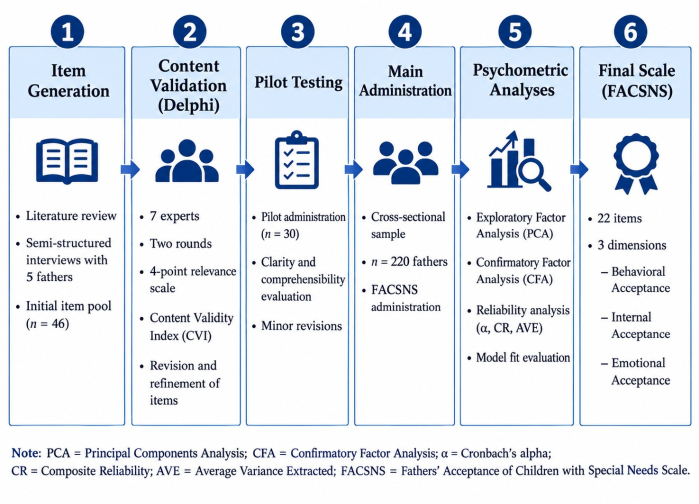
Figure 1: Scale development and validation process (Phase 1). Overview of the sequential steps used to develop and validate the Fathers’ Acceptance of Children with Special Needs Scale (FACSNS), including item generation, expert content validation, pilot testing, administration to the validation sample, psychometric analyses, and finalization of the scale. PCA, principal component analysis; CFA, confirmatory factor analysis; α, Cronbach’s alpha; CR, composite reliability; AVE, average variance extracted; FACSNS, Fathers’ Acceptance of Children with Special Needs Scale. Please click here to view a larger version of this figure.
| Factor | Items | Value | % Variance | α | Example Item |
| Behavioral Acceptance | 11 | 7.92 | 41.7 | 0.90 | “I actively participate in my child's daily care.” |
| Internal Acceptance | 6 | 3.11 | 16.4 | 0.89 | “I have accepted my child's condition as part of our life.” |
| Emotional Acceptance | 4 | 2.51 | 13.2 | 0.86 | “I feel emotionally connected to my child regardless of challenges.” |
| Total variance explained: 71.25%; total α = .917 FACSNS, Fathers' Acceptance of Children with Special Needs Scale. | |||||
Table 1: Factor loadings and explained variance for the Fathers’ Acceptance of Children with Special Needs Scale (FACSNS). Factor structure of the FACSNS showing the number of items, component values, percentage of explained variance, internal consistency coefficients, and representative items for the behavioral, internal, and emotional acceptance dimensions.
3. Phase 2: Development and evaluation of the psychoeducational program
- Research design
A quasi-experimental pretest, post-test, and follow-up design was used with one experimental group and one control group. Participation in the six-week psychoeducational program was defined as the independent variable. Scores on the behavioral, internal, and emotional FACSNS subscales were defined as the dependent variables. The study design and procedure are presented in Figure 2. - Rationale for program development
Following validation of the FACSNS, a structured psychoeducational program was developed to address cognitive, emotional, and behavioral barriers associated with acceptance of a child’s intellectual disability. The program integrated cognitive-behavioral therapy principles with elements of family systems theory and social support theory. The program was designed to support cognitive reframing, empathy, adaptive parenting behaviors, and emotional regulation. - Theoretical basis and program goals
The program was based on three conceptual components. Cognitive restructuring focused on replacing dysfunctional beliefs with more balanced appraisals. Behavioral activation focused on increasing involvement in caregiving and play to strengthen connection and competence. Emotional regulation focused on identifying and managing grief, guilt, and frustration to reduce avoidance or aggression.
The program was designed to strengthen behavioral engagement with children, promote internal cognitive acceptance of disability, enhance emotional bonding and empathy, and reduce stress and social isolation through peer interaction. - Participants and group allocation
Forty fathers of children with moderate to severe intellectual disabilities were recruited from Tekirdag Special Education Practice School. Eligibility criteria included being the biological father, living with the child, and agreeing to participate voluntarily. Exclusion criteria included current psychiatric treatment or previous participation in psychoeducational training.
Participants were allocated using a nonrandomized availability-based procedure. Eligible fathers who were able and willing to attend the scheduled six-week psychoeducational program were assigned to the experimental group (n = 20). Eligible fathers who did not participate in the program during the intervention period formed the control group (n = 20). Assignment was therefore not based on random allocation. Although the groups did not differ significantly on the reported baseline demographic characteristics, the availability-based allocation procedure may have introduced systematic differences between participants who were able to attend the program and those who were not.
Both groups completed the same pretest, posttest, and six-week follow-up assessments. Baseline comparisons showed no statistically significant differences between groups in fathers’ age, educational level, or children’s age, p > 0.05. Detailed participant characteristics are presented in Table 2. - Program delivery
The psychoeducational program was delivered in a group format over six weekly sessions. Each session lasted approximately 90 min and was conducted at Tekirdag Special Education Practice School. Sessions were facilitated by trained professionals with expertise in psychology, psychoeducation, and special education support.
Each session included brief psychoeducational instruction, guided discussion, practical exercises, and homework tasks. The session structure and objectives are presented in Table 3. - Intervention Fidelity
Intervention fidelity was monitored using session plans, attendance records, facilitator checklists, and session-evaluation forms completed after each meeting. Attendance was recorded throughout the six-week program. - Study Instruments
The FACSNS was administered before the intervention, immediately after completion of the six-week program, and at the six-week follow-up. A demographic questionnaire was used to collect socioeconomic and family information. Session evaluation forms were used to document engagement and to obtain brief reflections after each meeting.
The FACSNS was originally developed and administered in Turkish. For publication and editorial review, an English-language translation of the final Turkish instrument was prepared and is provided together with the original Turkish version in the Supplementary Materials. The English version represents a direct translation prepared to facilitate international readership and replication of the study procedures. It did not undergo an independent cross-cultural adaptation, forward–back translation, or psychometric validation procedure. Accordingly, the English-language version should not be regarded as an independently validated form of the FACSNS. The psychometric findings reported in this study apply to the original Turkish version administered to participants.
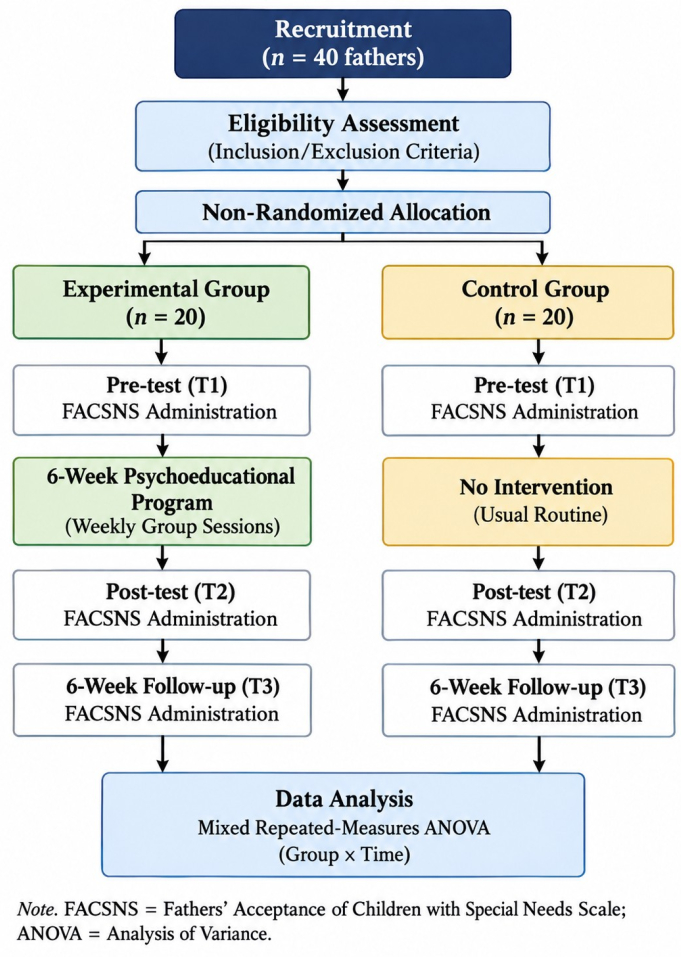
Figure 2: Study design and procedure for the psychoeducational intervention (Phase 2). Flow diagram showing recruitment, eligibility assessment, nonrandomized allocation to experimental and control groups, pretest assessment, delivery of the 6-week psychoeducational program to the experimental group, post-test and 6-week follow-up assessments, and mixed repeated-measures ANOVA of group × time effects. FACSNS, Fathers’ Acceptance of Children with Special Needs Scale; ANOVA, analysis of variance. Please click here to view a larger version of this figure.
| Variable | Experimental (n = 20) | Control (n = 20) | Total (n = 40) |
| Mean age | 38.9 (6.5) | 40.1 (7.2) | 39.5 (6.8) |
| Education (%), Primary / High / Univ. | 40 / 40 / 20 | 45 / 35 / 20 | 42.5 / 37.5 / 20 |
| Child's age, M ± SD | 9.7 ± 2.9 | 9.9 ± 2.5 | 9.8 ± 2.7 |
Table 2: Participant characteristics. Demographic characteristics of fathers in the experimental and control groups, including age, education level, and child age.
| Week | Main Theme | Cognitive-Behavioral Focus | Example Activity |
| 1 | Understanding Disability and Acceptance | Psychoeducation on acceptance stages | Group discussion of initial diagnosis experiences |
| 2 | Parental Roles and Communication | Behavioral rehearsal, active listening | Role-plays of child–father dialogue |
| 3 | Empathy and Emotional Awareness | Identifying feelings, reattribution | Emotion-tracking diary |
| 4 | Stress and Problem Behavior | CBT coping model | Cognitive restructuring of “trigger” thoughts |
| 5 | Social Support and Spousal Cooperation | Family-systems perspective | Designing a joint activity plan |
| 6 | Legal Rights and Future Planning | Information sharing, goal setting | Action plan for continued involvement |
Table 3: Session structure and objectives of the 6-week psychoeducational program. Summary of the weekly themes, cognitive-behavioral focus, and example activities included in each session of the psychoeducational intervention.
4. Statistical analysis
Exploratory factor analysis, confirmatory factor analysis, and reliability analyses were used during Phase 1. Repeated-measures analysis of variance was used only during Phase 2.
Each acceptance outcome was analyzed separately using a 2 × 3 mixed repeated-measures analysis of variance. Group was entered as the between-subjects factor with two levels, experimental and control. Time was entered as the within-subjects factor with three levels: pretest, post-test, and six-week follow-up. Separate models were conducted for behavioral, internal, and emotional acceptance.
The group × time interaction was examined to determine whether changes across the three measurement points differed between the experimental and control groups. Normality was assessed using skewness and kurtosis values within the range of -1 to +1. Mauchly’s test was used to assess sphericity. When the assumption of sphericity was violated, Greenhouse-Geisser corrected degrees of freedom were reported. Effect sizes were reported using partial eta squared, and Bonferroni-adjusted pairwise comparisons were used to examine differences between measurement points. The significance level was set at p = 0.05.
Results
Descriptive statistics
The descriptive statistics are presented in Table 4. At pretest, the experimental and control groups showed similarly low levels of behavioral acceptance, with mean scores of 2.65 and 2.60, respectively. Following the six-week psychoeducational program, the mean behavioral acceptance score of the experimental group increased to 4.10, whereas the control group showed only a slight increase to 2.75. At the six-week follow-up, the experimental group’s mean score remained high at 4.05, suggesting that the observed improvement in behavioral acceptance was largely maintained over time. In contrast, the control group demonstrated minimal change across the three measurement points.
A similar pattern was observed for internal acceptance. At pretest, both groups had modest internal acceptance scores, with the experimental group scoring 2.50 and the control group scoring 2.42. After the intervention, the experimental group’s mean internal acceptance score increased to 4.08, while the control group showed a smaller increase to 2.62. At follow-up, the experimental group’s mean score remained relatively stable at 4.00.
Emotional acceptance showed a similar pattern of change. At baseline, emotional acceptance was the lowest among the three acceptance dimensions, with the experimental group reporting a mean score of 2.33 and the control group reporting 2.57. After the intervention, the experimental group’s mean emotional acceptance score increased to 3.92, indicating a marked improvement in fathers’ emotional orientation toward their children. This score remained relatively stable at the six-week follow-up, with a mean of 3.88. In contrast, the control group showed only minor changes across the three measurement points, increasing from 2.57 at pretest to 2.80 at posttest and 2.73 at follow-up.
| Dimension | Group | Pretest, M (SD) | Posttest, M (SD) | Follow-up, M (SD) |
| Behavioral Acceptance | Experimental | 2.65 (0.30) | 4.10 (0.19) | 4.05 (0.23) |
| Control | 2.60 (0.33) | 2.75 (0.62) | 2.68 (0.55) | |
| Internal Acceptance | Experimental | 2.50 (0.64) | 4.08 (0.59) | 4.00 (0.63) |
| Control | 2.42 (0.72) | 2.62 (0.77) | 2.55 (0.70) | |
| Emotional Acceptance | Experimental | 2.33 (0.46) | 3.92 (0.30) | 3.88 (0.33) |
| Control | 2.57 (0.64) | 2.80 (0.70) | 2.73 (0.67) | |
| M, mean; SD, standard deviation. | ||||
Table 4: Mean FACSNS scores by group and assessment time. Mean and standard deviation values for behavioral, internal, and emotional acceptance in the experimental and control groups at pretest, post-test, and 6-week follow-up. M, mean; SD, standard deviation; FACSNS, Fathers’ Acceptance of Children with Special Needs Scale.
The experimental group’s mean scores increased by approximately 1.5 – 1.8 points across all three domains, while the control group showed an increase of only 0.1 – 0.2 points across the same range of measures.
Inferential findings
The principal inferential test for each FACSNS outcome was the group × time interaction from the 2 × 3 mixed repeated-measures analysis of variance. This interaction tested whether the pattern of change across pretest, posttest, and six-week follow-up differed between fathers in the experimental and control groups.
For behavioral acceptance, the group × time interaction was statistically significant, F(2, 78) = 94.54, p < .001, ηp2 = .71, indicating that changes in behavioral acceptance across the three measurement occasions differed substantially between the two groups. As shown by the descriptive means, behavioral acceptance increased considerably in the experimental group from pretest to posttest and remained comparatively high at follow-up, whereas only limited change was observed in the control group.
For internal acceptance, the group × time interaction was also statistically significant, F(2, 78) = 17.60, p < .001, ηp2 = 0.31. Thus, the pattern of change in internal acceptance differed between the experimental and control groups. The experimental group demonstrated a larger increase between pretest and posttest, with scores remaining comparatively stable at the six-week follow-up.
Similarly, emotional acceptance demonstrated a statistically significant group × time interaction, F(2, 78) = 35.79, p < .001, ηp2 = 0.48. Emotional acceptance increased more markedly over time among fathers who participated in the psychoeducational program than among fathers in the control group, and the higher posttest scores in the experimental group were broadly maintained at follow-up.
Bonferroni-adjusted follow-up comparisons showed no statistically significant decline from posttest to the six-week follow-up within the experimental group (p > .05). Taken together, these analyses indicate that the trajectories of behavioral, internal, and emotional acceptance differed between the two groups over the study period. Given the nonrandomized allocation procedure, these findings should be interpreted as an association between program participation and differential changes in acceptance scores, rather than as definitive evidence of a causal effect of the intervention.
Behavioral acceptance
Effect sizes for the group × time interactions were reported consistently using partial eta squared (ηp2). The group × time interaction for behavioral acceptance was associated with a large effect size, F(2, 78) = 94.54, p < .001, ηp2 = 0.71. A substantial interaction effect was also observed for internal acceptance, F(2, 78) = 17.60, p < .001, ηp2 = 0.31, while the interaction for emotional acceptance was likewise large, F(2, 78) = 35.79, p < .001, ηp2 = 0.48. These effect sizes indicate that the magnitude of the differences in change over time between the experimental and control groups was substantial across all three dimensions of paternal acceptance, with the largest interaction effect observed for behavioral acceptance.
Internal acceptance:
Internal acceptance had a statistically significant but weaker effect. Here, η2 = 0.32 indicates a moderate-to-large effect, with roughly 32% of the variance attributable to the program. The fathers’ cognitive restructuring, in which they sought to view the child’s disability as part of life rather than as a failing, changed significantly in a positive direction in the experimental group, but less so than behavioral acceptance.
Emotional acceptance:
Emotional acceptance also showed a highly significant increase and a large effect size (η2 = 0.49). Fathers demonstrated greater empathy, warmth, and ease in interactions with their children. Personal transformation occurred in the progression from shame, anger, or heartbreak to compassion and pride.
Accordingly, follow-up comparisons revealed no significant decline from posttest to follow-up (p > 0.05), demonstrating the durability of the observed gains.
Participants were enrolled and assigned to the experimental or control groups. Both groups completed a pretest assessment using the FACSNS, while only the experimental group received the six-week psychoeducational intervention. After the training, both groups completed the posttest, and 6 weeks later, both groups completed the follow-up test.
DATA AVAILABILITY:
The de-identified participant-level datasets underlying the findings of this study, including the scale-development data, psychoeducational intervention data, and source data for the reported tables and figures, are provided in Supplementary File 1.
Supplementary File 1: Study Documentation, Participant Consent Materials, and De-identified Raw Data. Please click here to download this file.
Discussion
This study consisted of two major components: development and validation of the Fathers’ Acceptance of Children with Special Needs Scale (FACSNS) and evaluation of a six-week cognitive-behavioral psychoeducational program for fathers of children with intellectual disabilities. The study also contributed to research on father-inclusive family support by examining behavioral, internal, and emotional dimensions of paternal acceptance. This focus was necessary because fathers have received comparatively limited attention in disability-related health research and intervention programs, despite their important roles in caregiving, emotional support, decision-making, and family adaptation9,11,12,13.
A major finding was that paternal acceptance appeared to be multidimensional, comprising behavioral, internal, and emotional components. This structure was consistent with Parental Acceptance-Rejection Theory, which emphasizes the importance of warm, responsive, and accepting parenting for children’s psychological adjustment7,8. The study extended this theoretical framework by applying it specifically to fathers of children with intellectual disabilities. The three-dimensional structure suggested that paternal acceptance should not be evaluated only as an emotional attitude. Fathers may demonstrate acceptance by meeting children’s physical needs, adjusting cognitively to the child’s disability, and developing emotional closeness. This distinction is important because culturally shaped expectations may lead fathers to express care through responsibility, protection, and practical support rather than through emotional expressiveness. Behavioral acceptance referred to fathers’ involvement in their children's daily lives and included observable activities such as caregiving, play, education, learning, routines, participation, and interaction. The emergence of behavioral acceptance as a distinct factor was consistent with recent studies showing that fathers of children with intellectual and developmental disabilities may contribute through both direct and indirect forms of involvement9,10. Fathers may contribute not only through direct engagement with the child but also through organizing support, communicating with professionals, practical involvement, emotional support, decision-making, and maintenance of broader family functioning9,10. The present findings supported the interpretation of behavioral acceptance as a central component of paternal adjustment. Behavioral acceptance showed the largest improvement during the intervention phase, suggesting that fathers responded particularly well to the tangible and behavior-focused components of the psychoeducational program. This finding also emphasized the importance of identifying specific behavioral changes that fathers can implement in daily family life.
Internal acceptance was defined as the ability to reinterpret the child’s disability within a more realistic, supportive, and adaptive framework. This finding was consistent with previous studies concerning psychological acceptance and paternal adjustment in families of children with intellectual disabilities17. It was also consistent with the cognitive-behavioral basis of the psychoeducational program. The cognitive component focused on identifying inaccurate thoughts, challenging maladaptive beliefs, and developing more balanced interpretations of difficult life events. The increase in internal acceptance suggested that the program may have helped reduce self-blame, denial, avoidance, and hopelessness. Systematic evidence has also indicated that psychological interventions for parents of children with intellectual disabilities may improve parental well-being and child outcomes, although effect sizes vary across studies and intervention types18. The present study contributed to this literature by focusing specifically on fathers rather than combining fathers and mothers within a single parental category.
Fathers who participated in the six-week psychoeducational program showed greater increases in behavioral, internal, and emotional acceptance than fathers in the control group. A substantial proportion of these gains was maintained at the six-week follow-up. These preliminary findings suggested that structured psychoeducational support may assist fathers in developing more active, reflective, and emotionally responsive relationships with their children. The findings were consistent with evidence indicating that psychological and parent-child relationship interventions may improve outcomes for parents and children in families affected by intellectual disability18,19. These findings are also consistent with evidence that fathers’ distinct parenting experiences should be considered when designing and delivering evidence-based parenting interventions20. The present study added to this literature by reporting father-specific outcomes across behavioral, internal, and emotional domains.
Emotional acceptance represented the affective component of paternal adaptation and included warmth, empathy, emotional closeness, and regulation of difficult emotions such as grief, frustration, shame, and sadness. This dimension was particularly important because fathers’ emotional experiences in the context of disability may receive limited attention in both research and practice. Previous qualitative studies have suggested that fathers of children with disabilities may experience tension between emotional vulnerability and social expectations of strength, responsibility, and control12,13,14. These findings supported the importance of directly addressing fathers’ emotional adaptation. Emotional acceptance increased after the intervention and remained relatively stable at follow-up. This pattern suggested that the group-based program may have provided a structured and socially acceptable setting in which difficult emotions could be identified, expressed, and managed. However, emotional acceptance was assessed through self-report. Future studies should therefore include additional data sources, such as spouse or coparental reports20, teacher reports, facilitator ratings, and direct observations of father-child interactions21.
The study addressed two key gaps in research on fathers within disability-related family studies. First, the FACSNS was developed, and preliminary psychometric evidence was obtained for a father-specific instrument designed to measure behavioral, internal, and emotional dimensions of paternal acceptance. Second, a manualized psychoeducational protocol for fathers of children with intellectual disabilities was described and evaluated. Although fathers have increasingly been recognized as important contributors to child development, family functioning, and caregiving, research involving families of children with disabilities has primarily emphasized assessment and intervention resources for mothers9,12,22. Previous work has similarly highlighted the need for more effective father involvement in interventions involving children with developmental disabilities22. Recent systematic reviews have supported this observation by showing that fathers are often included within general parental samples, while father-specific outcomes are reported less frequently11. This practice limits understanding of fathers’ well-being, experiences, and support needs. The present study, therefore, examined paternal acceptance as a multidimensional construct and provided a replicable intervention protocol for future testing. Because a nonrandomized quasi-experimental design was used during the intervention phase, the association between program participation and paternal acceptance was interpreted as correlational rather than as definitive evidence of intervention effectiveness.
Recognition of behavioral acceptance as a separate dimension was also consistent with contemporary concepts of father involvement. Traditional perspectives have often defined fathers primarily through financial provision or disciplinary roles. More recent research has emphasized fathers as active parents who contribute directly to children’s cognitive, emotional, and social development through interaction, caregiving, play, academic participation, and emotional support3,23. Fathers of children with intellectual and developmental disabilities may also assume responsibilities involving communication with professionals, advocacy, service coordination, and maintenance of family functioning9,10. The identification of behavioral acceptance as a distinct dimension was therefore theoretically consistent with current understandings of father involvement. Rather than treating acceptance solely as an emotional construct, the findings suggested that active engagement may represent an important and independently measurable aspect of paternal acceptance.
The psychometric findings provided preliminary support for the FACSNS as a father-specific measure of acceptance. Exploratory analysis supported a three-dimensional structure, and high internal consistency was observed for the total scale and subscales. Confirmatory factor analysis also produced acceptable comparative fit indices. However, the elevated root mean square error of approximation indicated that model fit was not optimal. The three-factor model was therefore considered promising but not definitive. The model was retained because it was theoretically supported, the exploratory findings were consistent with the proposed structure, and the reliability coefficients were satisfactory. Further testing of the FACSNS on larger, independent samples remains necessary. Future validation should examine convergent validity, discriminant validity, test-retest reliability, and measurement invariance across groups of fathers. The use of principal component analysis for initial item reduction and structure exploration represented an additional methodological concern. Principal component analysis was used to identify clusters of related items and reduce the preliminary item pool. However, common factor analysis is often more appropriate when the purpose is to identify latent constructs. Future studies should therefore re-examine the FACSNS using common factor extraction methods and compare alternative factor structures.
The findings have potential implications for practitioners, school counselors, psychologists, special education personnel, and family-support services. The FACSNS may assist professionals in identifying fathers who experience difficulty in specific domains of acceptance. For example, a father may participate actively in daily caregiving but remain emotionally distant, whereas another may demonstrate emotional concern but remain uncertain about involvement in daily care. A multidimensional scale may help distinguish these patterns and support more targeted intervention planning.
The six-session psychoeducational program may also have applications in school-based and community-based settings. Its relatively brief structure may be feasible for fathers facing work-related or time-related barriers. The combination of psychoeducation, guided discussion, cognitive reframing, emotional processing, practical exercises, and homework tasks may provide a useful model for supporting paternal adaptation. Father-focused intervention studies often provide limited information regarding intervention context, facilitator qualifications, session structure, fidelity monitoring, and father-specific outcomes11. Detailed reporting of the present protocol may therefore support replication and later application. Future implementation should retain attendance records, fidelity checklists, facilitator training procedures, and participant feedback to strengthen intervention quality.
Disclosures
The authors declare no competing financial interests or conflicts of interest.
Acknowledgements
This article is based on a PhD dissertation completed at the European University of Lefke. The fathers who voluntarily participated in the study and shared their experiences are gratefully acknowledged. Appreciation is also extended to the administrators, teachers, and staff of Tekirdag Special Education Practice School for their support during participant recruitment, data collection, and implementation of the psychoeducational program. No external funding was received for this study.
Materials
| Name | Company | Catalog Number | Comments |
|---|---|---|---|
| Assessment tools | Developed by the authors | NA | To measure study outcomes, including fathers' acceptance levels before, after, and at follow-up. |
| Camera | Canon EOS 250D Camera | EOS 250D | To document intervention sessions and support procedural fidelity (used only if participants provided consent). |
| Consent form | Developed by the authors | NA | To obtain written informed consent from all participants before data collection, in accordance with ethical guidelines. |
| Demographic questionnaire | Developed by the authors | NA | To collect participants' background characteristics (e.g., age, education, occupation, child's disability information) and describe the study sample. |
| FACSNS | Developed by the authors | NA | The primary outcome measure developed and validated in Phase I and administered during the intervention phase to assess behavioural, internal, and emotional acceptance. |
| Fidelity tools | Developed by the authors | NA | To monitor whether the psychoeducational program was delivered consistently according to the intervention manual across all sessions. |
| Intervention materials | Developed by the authors | NA | To deliver the psychoeducational program, including presentation slides, handouts, worksheets, homework activities, and facilitator guides. |
| Questionnaires | Developed by the authors | NA | To administer the FACSNS and any additional study forms, including demographic information and evaluation forms. |
| Session evaluation forms | Developed by the authors | NA | To obtain participant feedback regarding each intervention session and assess participant satisfaction and perceived usefulness. |
| Software packages | IBM - SPSS | Version 27 | IBM SPSS Statistics was used for descriptive statistics, reliability analyses, and repeated-measures ANOVA, while IBM AMOS was used for confirmatory factor analysis (CFA). |
| Voice Recorder | Sony | ICD-PX470 | To record the preliminary semi-structured interviews conducted during the scale development phase, ensuring accurate transcription and item generation. |
References
- Flouri E, Buchanan A. The role of mother and father involvement in adolescent bullying. Journal of Interpersonal Violence. 2003;18(6):634-644.
- Rohner RP. Father love and child development: History and current evidence. Current Directions in Psychological Science. 1998;7(5):157-161.
- Sarkadi A, Kristiansson R, Oberklaid F, Bremberg S. Fathers’ involvement and children’s developmental outcomes: A systematic review of longitudinal studies. Acta Paediatrica. 2008;97(2):153-158.
- Bakir D, Ozdemir S, Aydin B. The level of acceptance and related factors among fathers of children with Down syndrome. Anatolian Journal of Nursing and Health Sciences. 2020;23(2):139-145.
- Aydin A, Yamac A. The relations between the acceptance and child-rearing attitudes of parents of children with mental disabilities. Eurasian Journal of Educational Research. 2014;54:79-98.
- Isiklar A, Bilgin M, Bilgin M. Investigation of primary school students’ social adjustment and parents’ stress levels. Recep Tayyip Erdogan Universitesi Social Sciences Journal. 2016;2(3):113-127.
- Rohner RP. The parental “acceptance-rejection syndrome”: Universal correlates of perceived rejection. American Psychologist. 2004;59(8):830-840.
- Khaleque A, Rohner RP. Pancultural associations between perceived parental acceptance and psychological adjustment of children and adults: A meta-analytic review. Journal of Cross-Cultural Psychology. 2012;43(5):784-800.
- Langley E. Father involvement in the lives of their children with intellectual and/or developmental disabilities in the UK. Journal of Applied Research in Intellectual Disabilities. 2025;38(4):e70091. doi: 10.1111/jar.70091.
- Hemdan A, Opoku MP, Safi M, Xie Q. Fatherhood in disability rehabilitation in the United Arab Emirates: Exploring fathers’ involvement in raising children with disabilities. Research in Developmental Disabilities. 2024;152:104809. doi: 10.1016/j.ridd.2024.104809.
- An ZG, Xu Z, Dai R. A comprehensive literature review of interventions for fathers of young children with disabilities. Journal of Child and Family Studies. 2025;34:3012-3027.
- Davies A, Rix J, Robb M. Fathers’ relationships with their disabled children: A literature review. Disability Studies Quarterly. 2024;43(3).
- Vatne TM, Dahle SS, Haukeland YB, Fjermestad KW. A qualitative study of men’s experience of being a father in families with childhood disability. Journal of Developmental and Physical Disabilities. 2023;35(1):111-131.
- Zahl E, Dale SS, Fjermestad KW, Vatne TM. Parenting a child with a disability: Fathers’ perceptions of the couple relationship. Journal of Social and Personal Relationships. 2024;41(9):2548-2568.
- Bourke-Taylor HM, et al. Fathers of children with a disability: Health, work, and family life issues. Disability and Rehabilitation. 2022;44(16):4441-4451.
- Flouri E. Fathering and adolescents’ psychological adjustment: The role of fathers’ involvement, residence and biology status. Child: Care, Health and Development. 2008;34(2):152-161.
- MacDonald EE, Hastings RP, Fitzsimons E. Psychological acceptance mediates the impact of the behaviour problems of children with intellectual disability on fathers’ psychological adjustment. Journal of Applied Research in Intellectual Disabilities. 2010;23(1):27-37.
- Ranta K, et al. Psychological interventions for parents of children with intellectual disabilities to enhance child behavioral outcomes or parental well-being: A systematic review, content analysis and effects. Journal of Intellectual Disabilities. 2025;29(2):500-535.
- Westlake F, Westlake M, Totsika V. A systematic review and meta-analysis of the effectiveness of interventions targeting the parent-child relationship in families of children with an intellectual disability. Journal of Applied Research in Intellectual Disabilities. 2024;37(6):e13273. doi: 10.1111/jar.13273.
- Sanders MR, et al. What are the parenting experiences of fathers? The use of household survey data to inform decisions about the delivery of evidence-based parenting interventions to fathers. Child Psychiatry & Human Development. 2010;41(5):562-581.
- Markman HJ, Hahlweg K. The prediction and prevention of marital distress: An international perspective. Clinical Psychology Review. 1993;13(1):29-43.
- Flippin M, Crais ER. The need for more effective father involvement in early autism intervention: A systematic review and recommendations. Journal of Early Intervention. 2011;33(1):24-50.
- Cabrera NJ, Volling BL, Barr R. Fathers are parents, too! Widening the lens on parenting for children’s development. Child Development Perspectives. 2018;12(3):152-157.