This retrospective study evaluated an automated systolic blood pressure (SBP)-responsive pneumatic tourniquet in 203 upper-extremity procedures. The system provided reliable hemostasis with individualized cuff pressures, stable perioperative hemodynamics, and no observed postoperative neurovascular or cutaneous complications.
Research Article
Clinical Use of an Automated SBP-Responsive Pneumatic Tourniquet: A Single-Center Retrospective Study
* These authors contributed equally
In This Article
Summary
Abstract
Conventional pneumatic tourniquets typically rely on fixed empirical pressures that do not account for patient-specific vascular characteristics or dynamic hemodynamic changes, potentially exposing tissues to unnecessary mechanical and ischemic stress. This single-center retrospective cohort study evaluated the clinical performance and safety of an automated systolic blood pressure (SBP)-responsive pneumatic tourniquet in 203 consecutive eligible patients who met the predefined inclusion and exclusion criteria and underwent upper-extremity surgery between January 2023 and September 2024. Continuous or high-frequency SBP measurements were synchronized with cuff-pressure waveforms to characterize real-time closed-loop pressure modulation. Primary outcomes included hemostatic effectiveness and breakthrough bleeding, while secondary outcomes included cuff-pressure behavior, the relationship between SBP and cuff pressure, perioperative hemodynamic stability, and postoperative neurologic or cutaneous complications. The mean tourniquet cuff pressure was 39.61 ± 2.41 kPa (approximately 297 ± 18 mmHg), with values ranging from 34 to 46 kPa. A significant positive correlation was observed between preoperative SBP and cuff pressure (r = 0.706, p < 0.001). Hemostasis was consistently effective, with no breakthrough bleeding observed (0%; 95% CI, 0%–1.8%). Perioperative blood pressure showed only modest fluctuations, and no postoperative neurologic deficits, paresthesia, skin injury, or distal perfusion abnormalities were identified. These findings suggest that a fully automated SBP-responsive tourniquet can provide reliable hemostasis, dynamically maintain physiologically appropriate occlusion pressures, and achieve a favorable short-term safety profile without Doppler-based calibration or manual pressure adjustment, supporting its potential as an individualized and workflow-efficient approach to surgical tourniquet management.
Introduction
Tourniquets are indispensable in orthopedic, hand, and reconstructive surgery, where a bloodless operative field enhances visualization, facilitates precision, and reduces operative time1. Despite their ubiquity, modern tourniquet practice still relies largely on empirically fixed inflation pressures, typically 250–350 mmHg for upper-limb procedures2. These values are simple to apply but are inherently insensitive to individual vascular anatomy, limb geometry, soft-tissue compliance, and real-time hemodynamic variability3. A substantial body of experimental and clinical literature has demonstrated that such non-personalized pressures frequently exceed the true occlusion requirement, generating steep pressure gradients that predispose peripheral nerves and soft tissues to mechanical compression, ischemia–reperfusion injury, and postoperative pain or dysesthesia4,5.
To mitigate these risks, several physiologic strategies, most notably limb occlusion pressure (LOP), have been introduced to individualize tourniquet pressure according to the vascular occlusion threshold6. LOP-guided titration can meaningfully reduce cuff pressure while preserving hemostasis, representing an important conceptual step toward personalized practice7. However, LOP is fundamentally static: it reflects vascular status at a single moment and cannot adapt to dynamic fluctuations in systolic blood pressure (SBP) that commonly occur with anesthesia induction, analgesia, surgical stimulation, or patient positioning8,9. LOP measurement also requires Doppler or photoplethysmography, adds workflow complexity, and may be unreliable in patients with edema, obesity, or vascular disease7. Consequently, LOP has achieved limited penetration in the routine surgical workflow, and fixed-pressure protocols remain dominant despite these limitations.
Recent engineering advances have introduced automated SBP-responsive pneumatic tourniquet systems that adjust cuff pressure according to changes in systolic blood pressure rather than relying on a fixed preset pressure2. By dynamically modifying cuff pressure in response to SBP, these systems are intended to reduce unnecessary pressure when blood pressure decreases and to maintain adequate occlusion when blood pressure rises2. Previous clinical studies have demonstrated the feasibility of SBP-synchronized tourniquet systems and have reported generally favorable hemostatic and safety outcomes. However, the available clinical evidence remains limited in both sample size and scope, and quantitative data describing the relationship between SBP and cuff pressure, as well as perioperative hemodynamic patterns, remain insufficient10,11.
To extend the existing clinical evidence, a single-center retrospective cohort study evaluated the clinical performance of an automated SBP-responsive pneumatic tourniquet in 203 upper-extremity procedures. The study assessed hemostatic effectiveness, perioperative blood pressure changes, tourniquet cuff-pressure characteristics, and short-term neurovascular and cutaneous safety. The association between preoperative SBP and tourniquet cuff pressure was also quantified, and perioperative hemodynamic variability was characterized. The resulting data provide incremental real-world evidence regarding the clinical performance of automated SBP-responsive tourniquet management rather than establishing superiority over existing tourniquet strategies.
Protocol
Ethical approval was obtained from the Institutional Review Board of The First Affiliated Hospital, Zhejiang University School of Medicine (Approval No. IIT20251355B). Given the retrospective nature of the study and the use of de-identified data collected from existing medical records, the requirement for written informed consent was waived by the Institutional Review Board. The tools used in the protocol are listed in the Table of Materials.
1. Study design and setting
This retrospective cohort study was conducted at The First Affiliated Hospital, Zhejiang University School of Medicine, a high-volume tertiary referral center where both conventional pneumatic tourniquets and automated SBP-responsive pneumatic tourniquet systems are routinely used for upper-extremity procedures. All procedures conformed to the principles of the Declaration of Helsinki.
All eligible operations performed between January 2023 and September 2024 were identified through an integrated case-retrieval workflow combining electronic medical records with paper-based anesthesia and operative documentation. The study adhered to STROBE reporting guidelines, and all data were de-identified prior to analysis.
2. Patient eligibility and case identification
Patients aged ≥16 years who underwent upper-extremity surgery requiring tourniquet-assisted hemostasis under nerve block anesthesia were screened consecutively during the study period. Patients were excluded from the analytic cohort for active dermal lesions at the cuff site because such lesions could interfere with cuff placement and confound the assessment of tourniquet-related cutaneous complications; known peripheral vascular disease because impaired baseline arterial perfusion could affect tourniquet tolerance and confound postoperative assessment of distal perfusion; uncontrolled hypertension or clinically significant cardiovascular instability, as documented in the preoperative anesthetic assessment, because marked hemodynamic instability could substantially influence perioperative blood pressure and cuff-pressure measurements; pre-existing peripheral neuropathy because baseline neurologic abnormalities could confound attribution of postoperative sensory or motor findings to tourniquet use; or insufficient perioperative blood pressure or cuff-pressure documentation for inclusion in the analytic dataset.
Uncontrolled hypertension or clinically significant cardiovascular instability was determined according to the documented preoperative anesthetic assessment and the treating anesthesiologist’s clinical judgment; no uniform retrospective numeric threshold was applied. These exclusion criteria were used to define the analytic cohort and should not be interpreted as absolute contraindications to the use of an automated SBP-responsive pneumatic tourniquet. The safety and effectiveness of the system in patients with marked cardiovascular instability, peripheral vascular disease, or pre-existing neurologic impairment were not evaluated in the present study. For patients with multiple eligible procedures, only the earliest operation was included to avoid correlated observations.
3. Perioperative tourniquet procedure and data collection
- Device preparation
Before each procedure, the automated SBP-responsive pneumatic tourniquet system was connected to the anesthesia vital-sign monitor and the pneumatic tubing and cuff connections were checked to ensure proper function. An appropriately sized pneumatic cuff was selected according to the patient's upper-arm circumference. The system was activated before tourniquet inflation, and communication between the blood-pressure monitor and the tourniquet controller was confirmed before surgery. - Cuff placement
The tourniquet cuff was positioned circumferentially around the proximal upper arm of the operative extremity. Soft padding was placed beneath the cuff to protect the skin, and care was taken to ensure that the padding and cuff were applied smoothly without folds. The cuff was secured sufficiently to prevent displacement during surgery. Before skin incision, the operative upper extremity was elevated and exsanguinated, after which the pneumatic tourniquet was inflated. - SBP-responsive pressure-control process
The tourniquet controller received systolic blood pressure values from the anesthesia monitor and automatically adjusted cuff pressure in response to the measured SBP. The target cuff pressure was determined relative to the contemporaneous SBP rather than by maintaining a fixed pressure throughout surgery. During tourniquet use, cuff-pressure settings were automatically updated in response to newly acquired SBP measurements.
Once the tourniquet was inflated, pressure was adjusted automatically during tourniquet use. The operator monitored the surgical field and the tourniquet system throughout the procedure. Manual adjustment was not routinely required. Cuff-pressure values, pressure waveforms, and inflation duration were recorded for subsequent analysis. - Timing of blood-pressure and cuff-pressure measurements
Blood pressure was documented at four predefined perioperative stages: on admission, immediately before surgery, intraoperatively, and after surgery. During tourniquet inflation, repeated blood-pressure measurements were obtained using the anesthesia monitor, and newly acquired SBP values were transmitted to the tourniquet controller for corresponding pressure adjustment.
The cuff-pressure waveform was recorded throughout the inflation period. For the statistical analysis, preoperative SBP and the corresponding available cuff-pressure measurements were paired at the patient level. Complete paired SBP and cuff-pressure measurements were available for 178 patients. - Intraoperative and postoperative assessments
During surgery, the quality of the bloodless operative field was assessed by the operating surgeon, and breakthrough bleeding or any requirement for additional manual cuff-pressure adjustment was recorded.
After completion of surgery, the tourniquet was deflated and postoperative blood pressure recovery was documented. The cuff site and distal extremity were examined for skin injury and abnormalities of distal perfusion. Sensory and motor function were assessed for evidence of paresthesia, neuropraxia, or motor weakness. Patient-reported pain and comfort were recorded when available. A standardized sensory and motor neurologic examination was performed again on postoperative Day 1.
4. Data quality assurance
Two trained investigators independently reviewed all medical records, anesthesia logs, and tourniquet waveform files. Discrepancies were resolved through consensus with a senior reviewer. Tourniquet pressure traces were cross-validated with anesthesia monitor outputs to ensure consistency of time-stamped physiologic data. Neurologic assessments were performed using a standardized institutional protocol to minimize interobserver variability. Patient-reported outcomes, when available, were collected using uniform structured forms. Available data were analyzed using a complete-case approach where required.
5. Statistical analysis
Continuous variables were assessed for normality using the Shapiro–Wilk test and summarized as mean ± standard deviation or median with interquartile range, as appropriate. Categorical variables were summarized as frequencies and percentages. For comparisons of perioperative blood pressure measurements between two time points within the same patients, a paired Student’s t-test was used for normally distributed data, and the Wilcoxon signed-rank test was used for non-normally distributed paired data. The association between preoperative systolic blood pressure and tourniquet cuff pressure was assessed using Pearson correlation analysis, with Pearson’s correlation coefficient (r) and the corresponding two-sided p value reported.
Multivariable linear regression analysis was performed to evaluate factors associated with tourniquet cuff pressure. Candidate variables included age, sex, body mass index (BMI), and baseline blood pressure measurements. Regression coefficients (β) and model fit statistics were reported, as appropriate. All statistical tests were two-sided, and a p-value < 0.05 was considered statistically significant. Analyses were performed using SPSS and R version 4.3.1.
Results
During the study period, 221 consecutive patients undergoing upper-extremity surgery with the automated SBP-responsive pneumatic tourniquet were screened for eligibility. Of these, 18 were excluded: 2 because of active dermal lesions at the cuff site, 4 because of peripheral vascular disease, 5 because of uncontrolled hypertension or clinically significant cardiovascular instability, 3 because of pre-existing peripheral neuropathy, and 4 because of incomplete perioperative hemodynamic or cuff-pressure documentation. The remaining 203 eligible patients constituted the final analytic cohort. The cohort had a mean age of 52.2 ± 15.4 years, with a sex distribution of 55.2% male and 44.8% female, and a mean body mass index (BMI) of 23.47 ± 3.45 kg/m2. Surgical indications included carpal tunnel syndrome, palmar fascial contracture, digital nerve tumors, tendon injuries, and trauma-related soft-tissue disorders (Table 1).
Perioperative Blood Pressure Trends
Perioperative hemodynamics remained stable throughout the operative course. Mean systolic blood pressure (SBP) and diastolic blood pressure (DBP) at admission were 129.17 ± 22.46 mmHg and 75.49 ± 11.24 mmHg, respectively. Before surgery, SBP and DBP were 133.97 ± 27.41 mmHg and 72.43 ± 13.84 mmHg, respectively. Intraoperative values were 127.42 ± 23.81 mmHg and 70.22 ± 12.75 mmHg, respectively, and postoperative values were 129.46 ± 22.39 mmHg and 69.86 ± 11.65 mmHg, respectively (Table 2).
Patient-level paired differences demonstrated modest mean perioperative changes but substantial interindividual variability. The mean ΔSBP was +4.61 ± 28.90 mmHg from admission to pre-surgery, −6.54 ± 23.37 mmHg from pre-surgery to the intraoperative period, and +2.03 ± 18.31 mmHg from the intraoperative to postoperative period. The corresponding mean ΔDBP values were −3.00 ± 13.28 mmHg, −2.21 ± 14.03 mmHg, and −0.36 ± 11.18 mmHg, respectively (Table 3). These low-magnitude shifts were consistent with anticipated sympathetic activation before anesthesia and the vasodilatory effects of anesthesia, indicating that the SBP-controlled system did not induce abnormal or clinically meaningful hemodynamic perturbations.
Tourniquet Pressure Characteristics
The automated SBP-responsive pneumatic tourniquet system maintained the recorded tourniquet cuff pressure without requiring manual recalibration. Among the 178 patients with complete paired cuff-pressure and preoperative SBP data, the mean tourniquet cuff pressure was 39.61 ± 2.41 kPa (approximately 297 ± 18 mmHg), with a range of 34–46 kPa (approximately 255–345 mmHg). Pearson correlation analysis demonstrated a significant positive correlation between preoperative SBP and tourniquet cuff pressure (r = 0.706, p < 0.001; n = 178), indicating that higher preoperative SBP was associated with higher cuff pressure (Figure 1).
Multivariable regression analysis was performed to further evaluate factors associated with cuff inflation pressure. Admission SBP was identified as a positive predictor of cuff pressure (β = +0.185 kPa/mmHg), whereas age, sex, and BMI exhibited minor negative associations, and admission DBP exerted negligible influence. The adjusted R2 of 0.167 indicated that baseline demographic and anthropometric variables explained only a small proportion of the variance in cuff pressure. This finding was consistent with the expected influence of dynamic intraoperative factors, such as moment-to-moment blood pressure fluctuations, on the closed-loop modulation process, although these factors were not explicitly modeled in the regression analysis (Figure 2).
Hemostatic Effectiveness
Hemostatic performance was uniformly excellent across all 203 procedures. No case of breakthrough bleeding occurred (0%; 95% CI, 0–1.8%), and operative field visibility was rated as “excellent” or “good” in all instances. The automated system consistently maintained the minimal effective occlusion threshold throughout the operation without requiring supplemental manual inflation, temporary deflation, or troubleshooting adjustments. These findings demonstrated the high reliability of real-time SBP-modulated control in achieving and sustaining a bloodless operative field under diverse hemodynamic conditions.
Safety and Postoperative Outcomes
The postoperative safety profile was highly favorable. No patients experienced neuropraxia, paresthesia, motor weakness, skin indentation injury, blistering, or distal perfusion deficits. Standardized neurological assessments on postoperative Day 1 confirmed intact sensory and motor function in all individuals. The absence of neurovascular or cutaneous complications, combined with minimal hemodynamic disturbance and physiologically matched cuff-pressure modulation, suggested that the SBP-controlled system avoided excessive tissue compression and ischemic burden associated with conventional fixed-pressure pneumatic devices.
| Characteristic | Value |
| Number of patients, n | 203 |
| Age, mean ± SD (years) | 52.2 ± 15.4 |
| Sex | |
| Male, n (%) | 112 (55.2%) |
| Female, n (%) | 91 (44.8%) |
| Height, mean ± SD (cm) | 165.2 ± 8.23 |
| Weight, mean ± SD (kg) | 64.24 ± 11.69 |
| BMI, mean ± SD (kg/m²) | 23.47 ± 3.45 |
| Primary surgical indications | Carpal tunnel syndrome; palmar fascial contracture; digital nerve tumor; tendon injury; trauma-related soft-tissue conditions |
Table 1: Baseline characteristics of the study population. Demographic and clinical characteristics of the 203 patients included in the study, including age, sex, height, weight, body mass index, and primary surgical indications.
| Stage | SBP, mean ± SD (mmHg) | DBP, mean ± SD (mmHg) | Interpretation |
| Admission | 129.17 ± 22.46 | 75.49 ± 11.24 | Baseline hemodynamics |
| Pre-surgery | 133.97 ± 27.41 | 72.43 ± 13.84 | Mild anticipatory sympathetic rise |
| Intraoperative | 127.42 ± 23.81 | 70.22 ± 12.75 | Expected anesthetic-mediated reduction |
| Postoperative | 129.46 ± 22.39 | 69.86 ± 11.65 | Corrected DBP; stable recovery to baseline |
Table 2: Perioperative blood pressure metrics. Mean SBP and DBP values measured at admission, before surgery, intraoperatively, and postoperatively in 203 patients undergoing upper-extremity surgery with an automated SBP-responsive pneumatic tourniquet.
| Comparison | ΔSBP, mean ± SD (mmHg) | ΔDBP, mean ± SD (mmHg) | Interpretation |
| Pre-surgery vs. Admission | 4.61 ± 28.90 | −3.00 ± 13.28 | Mild sympathetic rise in systolic pressure before surgery, accompanied by a small DBP decrease. |
| Intraoperative vs. Pre-surgery | −6.54 ± 23.37 | −2.21 ± 14.03 | Expected anesthesia-associated reduction in both SBP and DBP. |
| Intraoperative vs. Admission | −1.99 ± 28.76 | −5.22 ± 14.59 | SBP remains broadly stable relative to baseline; DBP shows a moderate anesthetic-related decline. |
| Postoperative vs. Intraoperative | +2.03 ± 18.31 | −0.36 ± 11.18 | Mild recovery in SBP; DBP remains essentially unchanged. |
| Postoperative vs. Admission | 0.07 ± 25.61 | −5.57 ± 12.85 | SBP returns to baseline; DBP remains slightly lower than admission values. |
Table 3: Perioperative hemodynamic stability analysis. Mean changes in SBP and DBP between predefined perioperative time points, illustrating the magnitude and direction of blood pressure variation throughout the perioperative period.
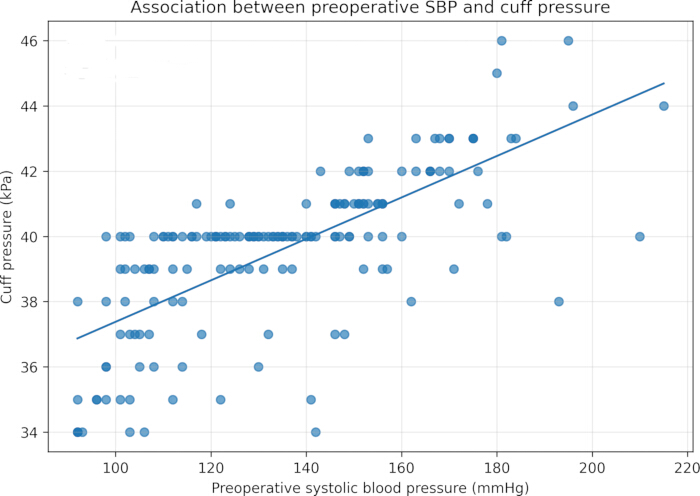
Figure 1: Correlation between preoperative systolic blood pressure and tourniquet cuff pressure. Scatter plot showing the relationship between preoperative SBP and tourniquet cuff pressure in 178 patients with complete paired data. Pearson correlation analysis showed a significant positive correlation between the two variables (r = 0.706, p < 0.001). The fitted regression line illustrates the positive association between preoperative SBP and cuff pressure. Please click here to view a larger version of this figure.
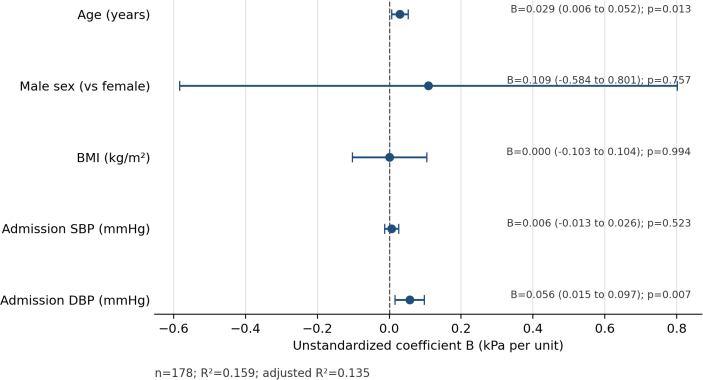
Figure 2: Multivariable linear regression analysis of predictors of tourniquet cuff pressure. Forest plot showing regression coefficients (β) and 95% confidence intervals for variables associated with intraoperative cuff pressure. Admission systolic blood pressure (SBP) showed a modest positive association with cuff pressure, whereas age, sex, and body mass index showed small negative associations, and admission diastolic blood pressure (DBP) had minimal influence. The findings indicate that cuff pressure was influenced predominantly by dynamic SBP-responsive modulation rather than baseline demographic or anthropometric characteristics. Please click here to view a larger version of this figure.
DATA AVAILABILITY:
The de-identified patient-level dataset underlying the findings of this study, including demographic variables, perioperative blood pressure measurements, clinical characteristics, and tourniquet cuff pressure data, is provided in Supplementary File 1.
Supplemental File 1: De-identified patient-level dataset and verified statistical analyses. This Excel workbook contains 203 patient records, including demographic and clinical variables, perioperative blood pressure measurements, tourniquet cuff pressure, hemostatic and operative-field outcomes, cuff-pressure interventions, and postoperative neurologic, cutaneous, distal-perfusion, and postoperative day 1 sensory and motor assessments. It identifies the 178 records included in the paired correlation and multivariable regression analyses and provides a variable dictionary, correlation and regression results, data underlying Figures 1 and 2, and a quality-control log. Please click here to download this File.
Discussion
Conventional fixed-pressure tourniquets remain widely used despite long-standing recognition of their physiologic mismatch with true arterial occlusion requirements. Because fixed thresholds disregard limb-specific vascular properties and intraoperative blood pressure variability, they frequently apply more pressure than necessary, generating steep radial and longitudinal pressure gradients at cuff edges4. These mechanical forces compress peripheral nerves, impair microvascular perfusion, and contribute to ischemia–reperfusion injury, mechanisms that underpin well-documented tourniquet-related neuropraxia, muscle injury, and postoperative discomfort12,13. Although the overall incidence of clinically evident nerve injury is low, subclinical neuromuscular changes are likely more frequent, highlighting the importance of transitioning from empirical to physiologically grounded pressure selection14. Limb occlusion pressure (LOP) was introduced to address these challenges by defining the minimum cuff pressure required to interrupt arterial inflow for an individual limb15. LOP accounts for limb geometry, soft-tissue compliance, vascular tone, and baseline blood pressure, and its use can reduce cuff pressure by 40–80 mmHg without compromising hemostasis16. However, LOP is inherently static8. It captures vascular status at a single time point and does not accommodate dynamic fluctuations in systolic blood pressure (SBP) during anesthesia, analgesia, or surgical stimulation. When SBP decreases under anesthesia, a static LOP-derived pressure may become excessively high; when SBP rises with stimulation, the same pressure may become insufficient to maintain occlusion7. LOP measurement also requires additional equipment, increases setup complexity, and may be unreliable in patients with edema, obesity, or vascular disease9. These practical and physiologic limitations explain the limited real-world adoption of LOP despite its theoretical advantages17.
Consistent with previously described SBP-synchronized tourniquet systems, the automated SBP-responsive pneumatic tourniquet evaluated in this study dynamically adjusts cuff pressure according to changes in SBP rather than relying on a fixed pressure setting. By continuously synchronizing cuff pressure with real-time SBP, the system maintains moment-to-moment alignment with the minimal effective occlusion threshold10. The present findings are consistent with earlier studies of SBP-responsive tourniquet systems. Ishii et al. prospectively evaluated the approach in 100 lower-extremity procedures and reported satisfactory hemostasis in almost all cases without system-related complications. Sato et al. subsequently studied 120 upper-extremity procedures and reported an excellent bloodless field in 119 cases, with no tourniquet-related neurologic, vascular, or cutaneous complications10. The present study extends these observations through a larger upper-extremity cohort of 203 procedures and additional quantitative assessment of cuff-pressure characteristics, perioperative blood-pressure changes, and the association between preoperative SBP and cuff pressure (r = 0.706, p < 0.001; n = 178). These data provide complementary real-world evidence and should not be interpreted as demonstrating superiority over the previously reported systems.
This dynamic coupling offers several mechanistic advantages over fixed-pressure and LOP-guided approaches. It prevents pressure overshoot when SBP decreases under anesthesia, thereby minimizing unnecessary mechanical compression of nerves and soft tissues10; avoids under-occlusion when SBP transiently rises during stimulation or patient movement8; and eliminates manual recalibration and operator variability, reducing cognitive burden and enabling consistent application in high-volume or resource-limited settings10. These characteristics suggest that automated SBP-responsive modulation may provide a dynamic alternative to static pressure-setting approaches. Nevertheless, direct comparative studies are required to determine how its clinical performance compares with LOP-guided management2.
The clinical findings from this cohort of 203 upper-extremity procedures support this mechanistic rationale. Hemostasis was uniformly excellent, with no breakthrough bleeding, indicating reliable maintenance of the occlusion threshold across diverse hemodynamic states. The mean cuff pressure was 39.61 ± 2.41 kPa (approximately 297 ± 18 mmHg), with a range of 34–46 kPa. The significant positive correlation between preoperative SBP and tourniquet cuff pressure (r = 0.706, p < 0.001) indicates that higher preoperative systolic pressure was associated with higher cuff pressure rather than empirical presetting, and the significant positive correlation between preoperative SBP and tourniquet cuff. Perioperative blood pressures exhibited only modest, expected fluctuations under anesthesia, suggesting that continuous pressure adjustments did not induce hemodynamic instability. The absence of postoperative neurologic or cutaneous complications further supports the hypothesis that dynamic physiologic matching may mitigate the mechanical and ischemic stresses associated with fixed-pressure devices. Automated SBP-responsive systems may therefore offer a practical approach to individualized tourniquet pressure adjustment by combining dynamic blood pressure responsiveness with automated pressure control. However, the present study was not designed to determine whether this approach is superior to LOP-guided tourniquet management. Independence from Doppler-based calibration may enhance feasibility in settings where rapid turnover, variable staffing, or limited equipment constrain the use of LOP.
Several limitations should be considered when interpreting these findings. The retrospective, single-center design and absence of a concurrent control group using fixed-pressure or LOP-guided protocols precluded direct comparison with conventional tourniquet strategies. Accordingly, the findings support feasibility, hemostatic effectiveness, and short-term tolerability but do not establish superiority over LOP. Prospective randomized or crossover studies directly comparing automated SBP-responsive and LOP-guided approaches are required to determine relative efficacy, safety, and pressure-reduction benefits. The study population predominantly comprised adults undergoing upper-extremity, moderate-duration procedures under nerve block anesthesia, with only three adolescents aged 16–17 years, and therefore represented a relatively low-risk hemodynamic environment. Generalizability to lower-extremity surgery, prolonged ischemia durations (>120 min), younger pediatric, obese, hypertensive, or vascular-compromised populations, and procedures with substantial blood pressure volatility remains unknown. Although no neurologic or cutaneous complications were observed, surveillance relied on routine postoperative clinical assessments10. Quantitative sensory testing, nerve conduction studies, electromyography, microcirculatory imaging, and serum biomarkers of muscle ischemia were not performed; therefore, subclinical neuropraxia or microvascular perturbation cannot be fully excluded.
Additional limitations relate to system monitoring and modeling. Continuous SBP inputs were obtained from standard anesthesia monitors, but signal fidelity, temporal latency, and frequency-domain characteristics of pressure transmission from the monitor to the closed-loop controller were not independently validated. Engineering-level verification of algorithm responsiveness under abrupt SBP surges, oscillometric measurement pauses, or transient signal dropout was beyond the scope of this retrospective study. Baseline demographic and anthropometric variables explained only a small proportion of the variability in cuff pressure (adjusted R² = 0.135), whereas other dynamic intraoperative factors, including vasodilatory depth, arm position, and sympathetic fluctuations, were neither modelled nor quantified. Device performance was also evaluated using a single brand and configuration of SBP-responsive tourniquet. Performance may vary across manufacturers, cuff widths, limb morphologies, and sensor integration pathways; broader technology-agnostic validation is therefore required before extrapolation to all automated systems. Future research should prioritize multicenter comparative trials, objective subclinical neurovascular assessments, and continued refinement of algorithmic performance. The behavior of the pressure-control algorithm under extreme hemodynamic variability, transient signal dropout, or rapid SBP fluctuations requires prospective engineering validation. Broader assessment is also required in lower-extremity surgery, prolonged occlusion scenarios, and vulnerable populations, including pediatric, obese, and vascular-compromised patients. The absence of direct comparisons with fixed-pressure and LOP-guided strategies limits assessment of the relative magnitude of benefit afforded by dynamic SBP-responsive control. Successful implementation will additionally require workflow integration, targeted staff training, and standardized operating protocols. Based on the population studied, automated SBP-responsive tourniquet systems appear feasible and well tolerated for individualized tourniquet management. Prospective controlled studies are required to determine the comparative efficacy and safety of these strategies relative to conventional fixed-pressure and LOP-guided strategies.
Disclosures
The authors declare no conflict of interest.
Acknowledgements
This work was supported by the Zhejiang Provincial Department of Education General Research Project, Funding No. Y202454990.
Materials
| Name | Company | Catalog Number | Comments |
|---|---|---|---|
| Adhesive fixation tape | 3M Health Care, St. Paul, MN, USA | Micropore Surgical Tape | Secures monitoring cables and tubing |
| Automated SBP-responsive pneumatic tourniquet system (STS-I) | Hangzhou Medic Instrument Co., Ltd., Hangzhou, China | STS-I | Closed-loop automatic pneumatic tourniquet system with LOP measurement and SBP-responsive pressure modulation |
| Disposable non-invasive blood pressure cuff | Mindray Bio-Medical Electronics Co., Ltd., Shenzhen, China | Adult NIBP cuff | Continuous perioperative blood pressure monitoring |
| Elastic limb exsanguination bandage | 3M Health Care, St. Paul, MN, USA | Esmarch Bandage | Used for limb exsanguination before cuff inflation |
| Electronic medical record system | First Affiliated Hospital, Zhejiang University School of Medicine | Institutional platform | Retrieval of perioperative clinical and hemodynamic data |
| High-frequency linear ultrasound probe | FUJIFILM SonoSite, Bothell, WA, USA | HFL38x Linear Probe | Visualization of upper-extremity peripheral nerves |
| Local anesthetic solution (Ropivacaine hydrochloride) | AstraZeneca, Cambridge, UK | Naropin | Peripheral nerve block anesthesia |
| Multiparameter anesthesia monitor | Mindray Bio-Medical Electronics Co., Ltd., Shenzhen, China | BeneVision series | Continuous perioperative monitoring of systolic blood pressure, diastolic blood pressure, heart rate, and oxygen saturation |
| Neurological assessment kit | Wartenberg Neurological Instruments, Germany | Standard neurological kit | Postoperative sensory and motor function assessment |
| Non-invasive blood pressure module | Mindray Bio-Medical Electronics Co., Ltd., Shenzhen, China | Integrated module | Provides real-time systolic blood pressure signals for cuff pressure adjustment |
| Peripheral nerve block needle | B. Braun Melsungen AG, Melsungen, Germany | Stimuplex Ultra 360 | Needle for ultrasound-guided peripheral nerve block |
| Pneumatic upper-extremity tourniquet cuff | Hangzhou Medic Instrument Co., Ltd., Hangzhou, China | Compatible cuff for STS-I system | Sterile-compatible cuff used for upper-extremity arterial occlusion |
| Pulse oximeter | Mindray Bio-Medical Electronics Co., Ltd., Shenzhen, China | Integrated monitor module | Monitoring distal limb perfusion and oxygen saturation |
| Statistical analysis software | IBM Corp., Armonk, NY, USA | SPSS Statistics Version 27.0 | Statistical analysis of perioperative and hemodynamic data |
| Statistical computing software | R Foundation for Statistical Computing, Vienna, Austria | R Version 4.3.1 | Regression analysis and figure generation |
| Sterile gauze pads | Winner Medical Co., Ltd., Shenzhen, China | Sterile gauze | Soft tissue protection and intraoperative assistance |
| Sterile surgical drapes | 3M Health Care, St. Paul, MN, USA | Steri-Drape series | Sterile operative field preparation |
| Sterile surgical gloves | Ansell Healthcare, Melbourne, Australia | GAMMEX Latex Surgical Gloves | Standard sterile surgical protection |
| Sterile ultrasound probe cover | CIVCO Medical Solutions, Coralville, IA, USA | 610-1321 | Maintains sterile conditions during regional anesthesia |
| Surgical hand table | Maquet Getinge Group, Rastatt, Germany | Hand Surgery Table | Provides stable upper-extremity positioning during surgery |
| Surgical marking pen | Viscot Medical, East Hanover, NJ, USA | Viscot Mini XL | Preoperative identification of cuff placement site |
| Surgical suction device | Medela AG, Baar, Switzerland | Dominant Flex | Removal of blood or irrigation fluid if required |
| Tourniquet air tubing connector | Hangzhou Medic Instrument Co., Ltd., Hangzhou, China | STS-I accessory | Connects the cuff to the pneumatic controller |
| Tourniquet pressure waveform recording software | Hangzhou Medic Instrument Co., Ltd., Hangzhou, China | Integrated software | Real-time recording and storage of cuff-pressure waveforms |
| Ultrasound system for regional anesthesia | FUJIFILM SonoSite, Bothell, WA, USA | SonoSite Edge II | Ultrasound-guided peripheral nerve block anesthesia |
References
- Noordin S, McEwen JA, Kragh JF Jr, Eisen A, Masri BA. Surgical tourniquets in orthopaedics. J Bone Joint Surg Am. 2009;91(12):2958-2967.
- Liu HY, Guo JY, Zhang ZB, Li KY, Wang WD. Development of adaptive pneumatic tourniquet systems based on minimal inflation pressure for upper limb surgeries. BioMedical Engineering OnLine. 2013;12(1):92. doi:10.1186/1475-925X-12-92.
- Swain P, McEwen J, Lai T, Hughes L. Tourniquet cuff pressure during blood flow restriction exercise. Frontiers in Sports and Active Living. 2025;7. doi:10.3389/fspor.2025.1582387.
- Masri BA, Eisen A, Duncan CP, McEwen JA. Tourniquet-induced nerve compression injuries are caused by high pressure levels and gradients—a review of the evidence to guide safe surgical, pre-hospital and blood flow restriction usage. BMC Biomed Eng. 2020;2:7. doi:10.1186/s42490-020-00041-5.
- Pedowitz R. Tourniquet-induced neuromuscular injury. Acta Orthopaedica. 1991;62:1-33.
- Morehouse H, et al. Limb occlusion pressure versus standard pneumatic tourniquet pressure in open carpal tunnel surgery—a randomized trial. Cureus. 2021;13(12). doi:10.7759/cureus.20110.
- Tuncali B, Boya H, Kayhan Z, Arac S. Tourniquet pressure settings based on limb occlusion pressure determination or arterial occlusion pressure estimation in total knee arthroplasty A prospective, randomized, double blind trial. Acta Orthop Traumatol Turc. 2018;52(4):256-260.
- Hughes L, et al. Influence and reliability of lower-limb arterial occlusion pressure at different body positions. PeerJ. 2018;6. doi:10.7717/peerj.4697.
- Rolnick N, et al. Challenges in upright limb occlusion pressure determination with the Delfi PTS: pilot data from two independent cohorts. Frontiers in Sports and Active Living. 2025;7. doi:10.3389/fspor.2025.1686040.
- Sato J, Ishii Y, Noguchi H, Takeda M. Safety and efficacy of a new tourniquet system. BMC Surg. 2012;12:17. doi:10.1186/1471-2482-12-17.
- Ishii Y, Noguchi H, Matsuda Y, Takeda M, Higashihara T. A new tourniquet system that determines pressures in synchrony with systolic blood pressure. Arch Orthop Trauma Surg. 2008;128(3):297-300.
- Kam PCA, Kavanaugh R, Yoong FFY. The arterial tourniquet: pathophysiological consequences and anaesthetic implications. Anaesthesia. 2001;56(6):534-545.
- Budic I, et al. Tourniquet-induced ischemia-reperfusion injuries during extremity surgery at children's age: impact of anesthetic chemical structure. Redox Rep. 2013;18(1):20-26.
- Chang J, et al. Management of tourniquet-related nerve injury (TRNI): a systematic review. Cureus. 2022;14(8). doi:10.7759/cureus.27685.
- Hughes L, McEwen J. Investigation of clinically acceptable agreement between two methods of automatic measurement of limb occlusion pressure: a randomised trial. BMC Biomedical Engineering. 2021;3(1):8. doi:10.1186/s42490-021-00053-9.
- Olivecrona C, Ponzer S, Hamberg P, Blomfeldt R. Lower tourniquet cuff pressure reduces postoperative wound complications after total knee arthroplasty: a randomized controlled study of 164 patients. J Bone Joint Surg Am. 2012;94(24):2216-2221.
- Kanchanathepsak T, et al. Limb occlusion pressure versus standard tourniquet inflation pressure in minor hand surgery: a randomized controlled trial. Journal of Orthopaedic Surgery and Research. 2023;18(1):539. doi:10.1186/s13018-023-04000-3.