Technological advancement and regulatory support are associated with circular economy principles in Chinese small and medium-sized enterprises, while market risk hinders them. Circular economy principles are associated with eco-innovation, and both relate to environmental and economic performance. Customer pressure shows no direct economic impact, but market risk reduces economic performance.
A subscription to JoVE is required to view this content. Sign in or start your free trial.
Research Article
Circular Economy Principles and Eco-Innovation on Economic and Environmental Performance in Chinese Small and Medium-sized Enterprises
In This Article
Summary
Abstract
This study examines how circular economy principles and eco-innovation mediate the effects of external factors, customer pressure, market risk, regulatory support, and technological advancement on environmental performance, economic performance, and employee well-being in Chinese small and medium-sized enterprises (SMEs). A quantitative, cross-sectional survey was conducted with 165 Chinese SMEs. The relationships among the constructs were examined using Partial least squares structural equation modeling (PLS-SEM), with each construct assessed through multiple survey items. Regulatory support (β = 0.33) and customer pressure (β = 0.24) were the strongest positive antecedents of circular economy principles, while market risk had a negative effect (β = -0.19). Circular economy principles were strongly associated with eco-innovation (β = 0.52). Eco-innovation was positively associated with employee well-being (β = 0.42), environmental performance (β = 0.38), and economic performance (β = 0.29). Customer pressure and market risk did not significantly affect technological advancement, and their indirect effects on eco-innovation via technological advancement were non-significant. However, circular economy principles mediated the effects of all three external factors on eco-innovation, while technological advancement mediated only the effect of regulatory support. The associations with environmental performance were stronger than those with economic performance. Overall, circular economy principles and eco-innovation help explain how external enablers relate to environmental, economic, and employee well-being outcomes in Chinese SMEs.
Introduction
Global sustainability issues, such as resource scarcity, waste accumulation, and environmental degradation, have forced companies to reconsider their production and consumption patterns1. Firms have been increasingly interested in enhancing their operations and supply chains to achieve sustainability, and this is where the circular economy (CE), with its focus on redesign, reduce, reuse, and recycle, has gained a lot of attention in the academic and management fields in recent years2. Responding to this, eco-innovation is an emerging part of sustainable business strategy as it stimulates the creation and diffusion of products, processes, technologies, and organizational practices that are environmentally friendly3. While it is assumed that CE and eco-innovation work together as complementary strategies to achieve sustainability, the way these two strategies interact in terms of their effects on firm outcomes is not well understood. This issue is particularly pronounced in small and medium-sized enterprises (SMEs), which constitute a theoretically and practically relevant field for exploring the connection between CE and eco-innovation. SMEs are typically less well-resourced, less technologically advanced, less equipped with specialist staff, and less institutionalized in their sustainability systems than larger companies5. Such constraints add complexity to the shift towards CE and eco-innovation, despite the potential gains being evident in the long term6. Amidst this context, SMEs are also of significant relevance to the sustainability transitions, since they exist within the local supply chains, local employment systems, and local economies7. The benefits of adopting CE practices can therefore extend beyond firm-level efficiency to include lower waste, better resource utilization, and better environmental performance.
Although these potential benefits have been identified in the literature, there is still limited understanding of the interrelationship between CE and eco-innovation with regard to their impact on multiple dimensions of SME performance8. First, previous studies have largely ignored the connection between CE and eco-innovation, even though they appear to be distinct concepts, and have not explicitly addressed how these concepts relate to employee-related outcomes. Second, previous studies have concentrated primarily on environmental and economic outcomes and have neglected to consider employee-related outcomes. Third, previous studies have been limited in their consideration of the unique external context in which SMEs operate in emerging economies. Based on previous research, it is inferred that eco-innovation can inspire employee creativity and employee motivation since companies have to find sustainable solutions and restructure their processes9. Other research has shown that CE can help boost economic performance by increasing the efficiency of resources, lowering waste-management costs and prolonging product life cycles. In terms of the environment, CE practices can help reduce resource consumption and waste, and eco-innovation can reinforce these effects by enabling the use of cleaner technologies and more sustainable production processes10. This is particularly relevant in emerging economies, where small and medium-sized enterprises (SMEs) are likely to be operating with a higher degree of uncertainty, less institutional support, less access to finance, and less access to skills11. Moving to CE and eco-innovation generally involves initial investments in new technology, retrofitting existing infrastructure, and training employees. The fact that sustainability investments do not pay off in the near term can pose significant hurdles for many SMEs12. Additionally, firms must keep systems up to date, learn to use new technologies, and build internal knowledge to prevent spending on technologies that may be obsolete before realizing returns13.
The human aspects of this transition are an important yet under-researched area. In addition to the technical resources, the transition to CE must be accompanied by the availability of workers familiar with the values, routines, and skills required to support circular and eco-innovative practices14. Small and medium enterprises (SMEs) may face challenges in providing extensive training or hiring specialized workers due to limited resources15. Therefore, positive outcomes for employees can result from CE and eco-innovation if employees perceive the changes as meaningful and enhance their capabilities; negative outcomes can result if employees perceive the changes in their work as disruptive and stressful. When transitioning to CE and eco-innovation involves changing tasks, responsibilities, or job expectations, it can be challenging for employees accustomed to a traditional way of working16. Thus, studying employee well-being together with the performance of the economic and environmental aspects of SME sustainability yields a more holistic picture of its outcomes. SMEs' capacity to implement CE and eco-innovation is also influenced by external conditions. Regulatory support can help limit uncertainty, offer incentives, and help direct companies to more sustainable practices17. But the new regulations can also pose compliance problems for SMEs, especially if the company lacks the resources and knowledge to adapt rapidly18. Market dynamics create another challenge. While there is growing awareness of the need for sustainability, many customers are price-sensitive and may not be willing to pay for more sustainable products or services. This presents a strategic challenge for SMEs that invest in CE and eco-innovation in markets where customers are not fully aware of, or willing to reward, these investments19.
Literature review
The circular economy (CE) has become a critical paradigm for implementing corporate sustainability, shifting the conventional business "take, make, use, dispose" approach to redesign, reduce, reuse, recycle, and recover resources20. In the context of business activities, CE promotes reducing waste, extending product life cycles, improving the efficiency of product and resource use, and restructuring production and consumption processes21. These practices are particularly relevant to small and medium-sized enterprises (SMEs), which face financial and technological constraints but collectively represent a significant share of employment, production, and environmental impact22. Although CE is widely discussed in the sustainability literature, implementing CE in SMEs is challenging because they may lack formal sustainability systems, specific expertise, and sufficient investment capacity23. Eco-innovation is closely related to CE and can be defined as ‘the development and application of new products, processes, technologies and organizational practices that have positive environmental impacts’24. Eco-innovation allows companies to think outside the box and find innovative ways to address environmental challenges and boost sustainability outcomes, while CE focuses on minimizing resource loops and maximizing material efficiency. Previous studies show that eco-innovation can be a facilitator for cleaner production, reduce emissions, increase energy efficiency, and strengthen firm competitiveness25. However, eco-innovation does not occur automatically; it requires internal development, technological adaptation, employee involvement, and external support. For SMEs, the adoption of eco-innovation is especially difficult because innovation activities require financial resources, technical expertise, and managerial commitment26.
Previous studies suggest that the practices of CE could reinforce eco-innovation, and the latter could drive the former. CE practices may provide an opportunity for the enterprise to rethink the production system, redesign products, reduce waste, and develop new business models27. These shifts can lead to eco-innovation, as firms invest in cleaner technologies and more sustainable processes. Likewise, eco-innovation can support CE implementation through the technological and organizational tools developed to use less material, recover resources, and improve environmental impacts28. SMEs are of great empirical interest as the sustainability transition process is different from that of large firms. Large companies tend to be better resourced, to have their own sustainability departments, and have more developed technological capabilities29. For SMEs, uncertainty in investing in sustainable practices is generally higher, while resources and managerial capacity are generally smaller30. These restrictions can hinder SMEs' uptake of CE and eco-innovation, even though it could lead to long-term economic and environmental gains. Meanwhile, SMEs are adaptable, flexible, and embedded in their local regions, and can rapidly adjust if the right supports are in place31. Hence, the study of the link between CE and eco-innovation and its implications for SME performance is of both theoretical and practical significance.
There is also a need to pay attention to the link between CE, eco-innovation, and employee well-being32. Transitioning towards sustainability may require changes in organizational culture, job role, job routines, and skills33. By offering training and encouraging employees to participate in sustainability efforts, job satisfaction can be enhanced and potentially help to boost CE adoption34. Morale and professional development can be further enhanced through upskilling programs35. Eco-innovation can also boost employee creativity and motivation by providing opportunities to solve environmental issues and improve existing processes36. SMEs are also affected by external factors that bear on their capacity to embrace CE and eco-innovation. Regulatory support could provide incentives, guidance, and legitimacy for sustainability-oriented practices, while weak or unstable regulations can create uncertainty and compliance costs37. The demand for environmentally responsible products and services is on the rise, but many markets remain price-sensitive38. This puts a strain on SMEs that invest in sustainability if they do not secure customer willingness to pay in the short term39. Technological change further complicates matters, as SMEs need to invest in new systems and manage the risk that technology may become obsolete before returns are realized40. Figure 1 depicts the proposed research model. The hypotheses evaluated in the structural model are summarized in Table 1.
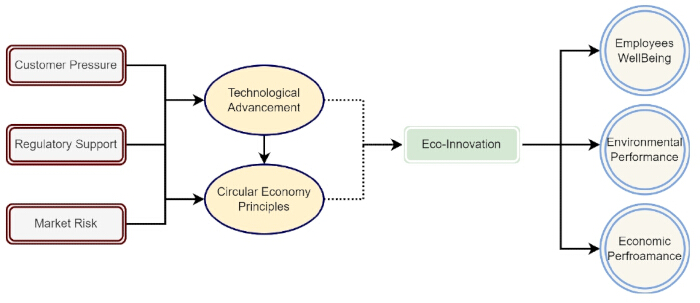
Figure 1: Research model. Proposed research model illustrating the hypothesized relationships. Rectangles on the left represent exogenous constructs: Customer Pressure, Regulatory Support, and Market Risk. Ovals in the middle denote mediating constructs: Technological Advancement and Circular Economy Principles. The rectangle in the center represents the focal construct, Eco-innovation, and circles on the right depict outcome variables: Employee Wellbeing, Environmental Performance, and Economic Performance. Please click here to view a larger version of this figure.
| Hypothesis | Statement | Relationship type |
| H1 | Customer pressure has a positive direct effect on circular economy principles. | Direct effect |
| H2 | Market risk has a negative direct effect on circular economy principles. | Direct effect |
| H3 | Regulatory support has a positive direct effect on circular economy principles. | Direct effect |
| H4 | Customer pressure has a positive direct effect on technological advancement. | Direct effect |
| H5 | Market risk has a negative direct effect on technological advancement. | Direct effect |
| H6 | Regulatory support has a positive direct effect on technological advancement. | Direct effect |
| H7 | Technological advancement has a positive direct effect on eco-innovation. | Direct effect |
| H8 | Circular economy principles have a positive direct effect on eco-innovation. | Direct effect |
| H9 | Eco-innovation has a positive direct effect on employee wellbeing. | Direct effect |
| H10 | Eco-innovation has a positive direct effect on environmental performance. | Direct effect |
| H11 | Eco-innovation has a positive direct effect on economic performance. | Direct effect |
| H12 | Technological advancement mediates the relationship between customer pressure and eco-innovation. | Mediation effect |
| H13 | Technological advancement mediates the relationship between market risk and eco-innovation. | Mediation effect |
| H14 | Technological advancement mediates the relationship between regulatory support and eco-innovation. | Mediation effect |
| H15 | Circular economy principles mediate the relationship between customer pressure and eco-innovation. | Mediation effect |
| H16 | Circular economy principles mediate the relationship between market risk and eco-innovation. | Mediation effect |
| H17 | Circular economy principles mediate the relationship between regulatory support and eco-innovation. | Mediation effect |
Table 1: Hypotheses. This table lists the direct-effect and mediation hypotheses evaluated in the structural model.
Access restricted. Please log in or start a trial to view this content.
Protocol
The study was carried out in accordance with ethical research practices. Ethical approval was not required since this research did not involve invasive procedures, access to sensitive personal data that would require oversight from a medical or clinical ethics committee, or experimental interventions, and did not involve the collection of biological samples. The research was conducted as an anonymous, voluntary survey of businesspeople (owners, senior managers, and decision-makers) regarding their operational and environmental practices. However, ethical considerations were followed during the research process as outlined below. Informed consent was obtained from all participants before data collection. The study purpose, the voluntary nature of participation, and the right to withdraw at any time without consequence were clearly stated at the beginning of the questionnaire. Second, anonymity and confidentiality were guaranteed. No personally identifiable information (e.g., names, addresses, etc., beyond general SME characteristics) was gathered. All responses were pooled for analysis, and no individual response can be singled out from any published findings. Third, participants were assured that there were no right or wrong answers and encouraged to respond truthfully without fear of repercussions. Fourth, data were stored securely on devices protected by passwords accessible only to the research team. Fifth, no deception was used, and participants were not physically, psychologically, or financially harmed. The study fully honored the autonomy and privacy of all the participants and organizations.
Research design
A quantitative, cross-sectional survey design was used in this study to analyze the relationships among customer pressure, market risk, regulatory support, technological advancement, circular economy principles, eco-innovation, and sustainability performance outcomes in Chinese SMEs. A survey approach was deemed suitable, as the study focuses on perceptions of external pressures, organizational practices, technological adoption, eco-innovation, and performance outcomes. The constructs were latent and therefore measured by multi-item scales based on previous research. Data were gathered from December 2024 to March 2025 from different companies at a single time point; therefore, the research design was cross-sectional. The results should be considered as indicators of the relationships between the variables, not as definitive causal relationships. The unit of analysis was the SME. The respondents comprised owners, senior managers, executives, and decision-makers who were directly involved in their companies’ business, sustainability programs, technology adoption, and environmental efforts.
Research context
China is a theoretically significant country in which to study circular economy principles (CEPs) and eco-innovation, since the Chinese government has been promoting environmental governance, industrial upgrading, and sustainable development with a high priority. Chinese SMEs play a significant role in employment, production, supply chain activity, and regional economic growth. Concurrently, they are frequently constrained by resources, lack technology and are under pressure to comply with sustainability measures. This is especially important in the Chinese SME context, which is influenced by regulatory support, customer pressure, market uncertainty, and technological advancement. In addition to environmental regulations and incentives that may benefit SMEs, they may also face challenges, such as inadequate financing, limited knowledge, and the capital costs of implementing cleaner technologies. Thus, the Chinese SMEs are appropriate cases for studying the impact of external pressure and the internal capacity on CE practices, eco-innovation, and sustainability performance.
Survey development and measurement
Measurement items for the questionnaire were adapted from previous research on the circular economy principles, regulatory support, customer pressure, market risk, technological advancement, eco-innovation, and sustainability performance. The items were rated on a 5-point Likert scale (1 = strongly disagree, 5 = strongly agree), and the questionnaire items are provided in Supplemental File 1. The questionnaire was divided into three sections. The first section focused on external pressures and enabling conditions, including customer pressure, market risk, and regulatory support. Technological advancement and principles of the circular economy were assessed in the second section. The third section was dedicated to eco-innovation and sustainability performance outcomes (economic, environmental, and employee well-being).
Circular economy principles were quantified by analyzing reduction, reuse, recycling, waste minimization, and resource efficiency items. Eco-innovation was defined by the creation and implementation of environmentally friendly products, processes, technologies, and organizational practices. Economic performance was measured using perceived improvements in cost reduction, productivity, profitability, and competitiveness. Environmental performance was measured as perceived environmental impacts, energy, emissions, and waste reductions. Employee well-being reflected employee satisfaction, motivation, morale, and perceived benefits from sustainability-related organizational changes. The original questionnaire was examined by academic experts and business stakeholders to clarify, focus, and validate the content. Their comments were incorporated into the refinement of wording and clarity of the items.
Participant recruitment and survey administration
The survey was conducted from December 2024 to March 2025. A quantitative, cross‑sectional design was employed. The target population was small and medium-sized enterprises (SME) owners, senior managers, executives, and decision-makers in China. Two approaches were used: (1) a commercial business database provided by a regional chamber of commerce in Hunan Province and (2) professional networks of the research team, comprising industry and manufacturing contacts, service firm contacts, and alumni associations. The enterprises included in this study met the following criteria: (a) Chinese government definition for SMEs (see below); (b) respondents must have a position within the enterprise that involves direct knowledge of its operating and environmental practices, including the roles of owner, general manager, deputy manager, and department head; (c) the enterprise had operated for at least three years; and (d) has 10 or more employees. The exclusion criteria were: (a) firms with less than 10 employees (micro-enterprises, because of their significant difference in resource profile); (b) firms with less than three years in operation (to ensure stable practices); (c) respondents who were not directly involved in decision making about the operation or sustainability of the firm; and (d) firms with more than 20% missing data.
SME classification criteria followed the official definition of the National Bureau of Statistics of China, which categorizes SMEs based on industry, number of employees, and annual revenue. For manufacturing enterprises, which constituted the majority of our sample (approximately 68%), SMEs are defined as having 20–999 employees and annual revenue between RMB 3 million and RMB 400 million. For service and logistics firms (32% of the sample), the classification required 10–300 employees and an annual revenue of RMB 1,100 million. Questionnaires were distributed through two channels. First, an online version was created using a professional survey platform (Wenjuanxing, the Chinese equivalent of SurveyMonkey). A unique link was sent via email to 320 potential respondents whose contact information was obtained from the chamber of commerce database. Second, paper‑based questionnaires were distributed during three industry networking events organized by the Hunan Provincial SME Association, where research assistants collected responses on‑site. A total of 400 questionnaires were distributed (320 online, 80 paper‑based). After excluding incomplete or ineligible responses, 165 valid questionnaires were retained, yielding an overall response rate of 41.25% (165/400). Of these, 118 were from online distribution (36.9% response rate for online) and 47 from paper‑based distribution (58.8% response rate for paper). The final sample comprised N = 165 Chinese SMEs, with respondents holding titles such as general manager (42%), operations director (28%), owner (18%), and environmental/sustainability manager (12%). All participants provided informed consent prior to completing the questionnaire, and anonymity was guaranteed.
Translation and pretesting
The questionnaire was translated into Chinese to ensure linguistic clarity and contextual relevance, as the empirical study was conducted in China. Two academic experts initially translated the original questionnaire into Chinese. The translated version was then read by two colleagues who were familiar with the Chinese context to ensure the clarity of the translation and the cultural appropriateness and consistency of the words with the original constructs. The translated questionnaire was pretested by a small sample of the SME managers in China prior to the main data collection. The pre-test examined the level of understanding of the questions, whether any items were confusing or ambiguous, and whether the survey length was acceptable. The final questionnaire was modified based on the feedback received, where there was any unclear or culturally inappropriate wording.
Data analysis techniques
The hypothesized relationships between circular economy principles, eco-innovation, technological advancement, external pressures, and sustainability performance outcomes (economic, environmental, and employee well-being) were investigated using Partial least squares structural equation modeling (PLS-SEM) with the data collected from 165 Chinese SMEs. SEM was used because it can estimate several relationships between latent constructs and account for measurement error, which is appropriate to examine complex models with intervening variables. Before evaluating the structural model, the measurement model was assessed to determine whether it is reliable and valid for the constructs. Internal consistency was assessed using Cronbach’s alpha and composite reliability, and convergent validity was assessed using standardized factor loadings and AVEs. The Fornell-Larcker criterion and heterotrait-monotrait ratio were used to test the discriminant validity, which supported the separation of the constructs at an empirical level. The structural model was then tested, and model adequacy was assessed using criteria appropriate to the PLS-SEM approach. Standardized path coefficients, t values and p. values were examined to determine the significance and strength of hypothesized relationships between constructs.
To investigate mediation effects, bootstrapping with 5,000 resamples was used to produce bias-corrected confidence intervals, and the corresponding indirect effects through Technological Advancement and Circular Economy Principles were tested. Common method bias was assessed, as all data were collected from a single respondent per firm using self-reported questionnaires. Harman's single-factor test was performed, and the VIFs were calculated to ensure that no single factor was overwhelming the variance; procedural safeguards were followed by ensuring the anonymity of the respondents, and separating predictor and outcome items. The analysis was performed using PLS 4.2 with bootstrapping to account for Likert-scale data and the possibility that the data were not normally distributed. Listwise deletion was used for missing data, skewness and kurtosis statistics were used to assess normality, and the number of indicators and positive degrees of freedom for each latent construct were used to ensure model identification. The process provided a systematic approach for assessing the direct and indirect relationships among the study's constructs.
Access restricted. Please log in or start a trial to view this content.
Results
Descriptive statistics
This section presents the means, standard deviations, skewness, and kurtosis for all constructs in the research model. The mean values ranged from 3.12 (Market Risk) to 3.94 (Regulatory Support), indicating that, on average, respondents perceived moderate to relatively high levels of external pressures, internal practices, and performance outcomes.
| Const... |
Access restricted. Please log in or start a trial to view this content.
Discussion
This study tested the mediating effect of the circular economy principles and eco-innovation in the relationship between external factors (customer pressure, market risk, regulatory support, and technological advancement) and environmental performance, economic performance, and employee well-being in Chinese small and medium-sized enterprises (SMEs). The results of the structural model (Table 6) provide several insights. First, regulatory support was the most important factor, with a β of 0.33, foll...
Access restricted. Please log in or start a trial to view this content.
Disclosures
The authors have no conflicts of interest to declare.
Materials
| Name | Company | Catalog Number | Comments |
|---|---|---|---|
| Chamber of commerce database | Hunan Provincial Chamber of Commerce (regional, China) | N/A | Commercial business database used for participant recruitment (contact information of SME owners/managers) RRID: N/A |
| Chinese SME classification standard | National Bureau of Statistics of China | SME Standard (2017 revision) | Official classification defining SMEs by industry, employees, and annual revenue (manufacturing: 20-999 employees, RMB 3-400 million; service/logistics: 10-300 employees, RMB 1-100 million) RRID: N/A |
| Harman’s single-factor test (statistical procedure) | N/A (technique implemented in PLS 4.2) | N/A | Post-hoc test for common method bias; complement with full collinearity VIF assessment RRID: N/A |
| Microsoft Excel | Microsoft Corporation | Microsoft 365 (version not specified) | Spreadsheet software for data entry and preliminary cleaning (implied) RRID: SCR_016137 |
| Multi-item scales (Circular Economy Principles) | Adapted from prior literature (not specified) | Items for reduction, reuse, recycling, waste minimisation, resource efficiency | Latent construct measured via multi-item Likert scales; content validity reviewed by academic experts and business professionals RRID: N/A |
| Multi-item scales (Eco-innovation) | Adapted from prior literature | Items for environmentally friendly products, processes, technologies, organisational practices | Measured as adoption or development of green innovations RRID: N/A |
| Multi-item scales (External pressures & enablers) | Adapted from prior literature | Customer pressure, market risk, regulatory support, technological advancement | Measured using adapted items from prior studies on CE and sustainability RRID: N/A |
| Multi-item scales (Sustainability performance) | Adapted from prior literature | Three sub-scales: economic performance, environmental performance, employee wellbeing | Perceived performance outcomes; employee wellbeing captures satisfaction, motivation, morale RRID: N/A |
| Paper-based questionnaire | N/A (printed by research team) | N/A | Physical survey forms distributed during industry networking events; 5-point Likert scale (1=strongly disagree to 5=strongly agree) RRID: N/A |
| PLS 4.2 (SmartPLS) | SmartPLS GmbH | Version 4.2 | Software for Structural Equation Modeling (SEM) with bootstrapping (5,000 resamples) and maximum likelihood estimation RRID: SCR_036419 |
| Translation and pre-testing panel | N/A (human experts) | Two academic experts + two SME-familiar colleagues | Bilingual experts for forward translation and cultural adaptation of questionnaire into Chinese; pre-tested with small group of SME managers RRID: N/A |
| Wenjuanxing (survey platform) | Wenjuanxing (Changsha Ranxing Information Technology Co., Ltd.) | N/A (online platform) | Chinese professional survey platform (equivalent to SurveyMonkey); used for online questionnaire distribution RRID: N/A |