This protocol describes a custom cage system for voluntary, welfare-friendly, simultaneous, and individual fecal sample collection from group-housed mice.
Method Article
Voluntary Group-Housing Compatible Fecal Sample Collection in Mice Using a Custom-Made Cage System
In This Article
Summary
Abstract
Reliable measurement of fecal corticosterone metabolites requires fecal samples that can be assigned to individual animals and collected within a defined time window. This is challenging in group-housed mice, where pooled home-cage samples do not allow individual assignment, and temporary separation may interfere with animal welfare and study outcomes. The goal of this protocol is to present a simple, inexpensive cage system that enables voluntary, simultaneous, and individual fecal sample collection from group-housed mice. The system consists of a wire-topped, polycarbonate home cage connected to three individual collection boxes. After habituation and training, mice voluntarily enter the boxes to access a small food reward. The doors can then be closed without chasing, handling, or forced transfer. Fecal pellets are collected from each box separately, allowing samples to be assigned to individual animals while maintaining social housing outside the sampling period. This protocol supports non-invasive longitudinal sampling and is suitable for studies measuring fecal corticosterone metabolites or other fecal biomarkers. The design is easy to build from standard cage material and acrylic glass, can be disassembled for cleaning, and allows several cages to be sampled in parallel. By reducing handling-related disturbance and improving standardization of the sampling window, the method provides a practical refinement for endocrine monitoring in group-housed mice.
Introduction
A major challenge in assessing plasma corticosterone concentrations is that the sampling procedure itself can induce an acute corticosterone increase, thereby confounding the measurement and potentially affecting the interpretation of the study results1,2,3. Measuring fecal corticosterone metabolites (FCMs) provides a non-invasive alternative, as FCM concentrations reflect circulating glucocorticoid levels several hours before sampling, depending on species, strain, sex, and gut passage time4,5. However, reliable FCM analysis in group-housed mice remains challenging. Pooled fecal samples collected from the home cage cannot be assigned to individual animals and may show high variability due to inter-individual differences in glucocorticoid secretion and uncertainty in the exact sampling window. Separating animals for extended periods may interfere with study objectives, while short-term separation for individual sample collection is labor-intensive, limits throughput, and may itself induce stress2.
To enable individual fecal sample collection from group-housed mice with minimal handling, a custom-made fecal collection cage was developed (Figure 1A-E). The design was adapted from a previously described fecal collection cage for spiny mice6 and modified for use with laboratory mice. The system consists of a standard polycarbonate type III cage connected to three individual collection boxes, which the animals can access voluntarily and close using sliding doors. This setup allows fecal samples to be collected from individual mice without direct handling during the sampling period and enables simultaneous sampling of multiple animals. The cage, therefore, provides a practical approach for non-invasive, individually attributable FCM sampling in group-housed mice.
The following protocol describes a fecal sampling system that allows the collection and identification of fecal samples from individual mice while maintaining a group-housing environment, using custom-made cages for contactless feces sampling.
Protocol
The responsible animal ethics committee of the Medical University of Vienna was consulted before the study was conducted and advised that no formal animal experiment license was required; therefore, no approval or protocol number is available. The study involved established breeding and husbandry practices only, together with non-invasive fecal sample collection. No invasive procedures were performed. In accordance with Directive 2010/63/EU, the expected burden to the animals was assessed as being below the threshold of pain, suffering, distress, or lasting harm equivalent to or higher than that caused by the introduction of a needle in accordance with good veterinary practice. All animals were housed and cared for according to institutional animal welfare standards.
1. Building of the cages (see material list)
- Cut parts 1-4 from 5 mm Plexiglass/acrylic glass according to the templates shown in Figure 2A-C.
NOTE: Templates with exact dimensions can be printed in DIN A3 format (Supplementary Figure 1 and Supplementary Figure 2). - Cut off the bottom of the polycarbonate type II (PTII) cage as indicated in Figure 2D. This part will later serve as the top cover of the fecal collection boxes.
- Drill the holes and slots into the former bottom of the PTII cage as indicated in Figure 2D.
NOTE: Exact dimensions are provided in Supplementary Figure 3. - Drill holes into the front side and short side of the PTIII cage as indicated in Figure 2E.
NOTE: Exact dimensions are provided in Supplementary Figure 4. - Use part 2 as a template to mark the corresponding drill holes on the short side of the PTIII cage and on the long side of the PTII cage.
- Drill the marked holes and attach the PTIII cage, the PTII cage, and part 2 using the threaded screws, as shown in Figure 2F.
- Insert part 1 as the bottom of the PTII cage. Position parts 4a and 4b so that they hold part 1 in place and divide the sampling cage into separate collection boxes. Use the hot glue gun to fix them in place.
- Slide the lower protrusions of parts 4a and 4b into the slots of part 1. These protrusions form the legs of the collection boxes.
- Slide the upper protrusions of parts 4a and 4b through the top cover, the former bottom of the PTII cage, to hold it in place.
- Thread the wooden chopsticks or rods through the holes in the protrusions, using one rod at the top and two rods at the bottom, to stabilize and fix the construction.
NOTE: Wooden materials should only be used in the vivarium if they are disposable, as they are not cleanable. If this is not the case, rods of alternative composition should be used. - Close remaining gaps or minor inaccuracies using a hot glue gun. Use parts 3a, 3b, and 3c (Figure 2B) as sliding doors between the home cage and the collecting boxes.
NOTE: Ensure that no sharp edges, glue residues, or protruding material remain accessible to the animals. The acrylic glass/Plexiglass components used in this prototype are not suitable for steam autoclave sterilization. Therefore, if the system is used in SPF facilities requiring sterilized cage-related material, either an institutionally approved non-autoclave disinfection procedure should be used, or the acrylic components should be replaced by autoclavable material while retaining the same dimensions.
2. Animal preparation and housing
- Obtain the required number of mice of the appropriate strain(s) for the study.
NOTE: The representative data were obtained from 30 eight-week-old C57BL/6J mice comprising 20 females and 10 males. The mice were specific pathogen-free according to FELASA standards and were obtained from Charles River Laboratories, Sulzfeld, Germany. - House animals under conventional conditions in adapted polycarbonate type III cages with a maximum of three adult mice per cage.
NOTE: Separated males were housed in standard polycarbonate type II cages for this study. - Maintain the animal room at 22 ± 2 °C and 55 ± 10% relative humidity under a 12 h light/dark cycle with lights on at 6:00 a.m.
- Provide a standard maintenance diet and water ad libitum.
- Add aspen wood bedding, a paper toilet roll, a red transparent plastic house, and paper towels as nesting material to each cage.
- Identify mice primarily by natural tail markings. Temporarily apply pen markings to animals with similar tail markings during weighing, if required.
3. Habituation and training of the animals
NOTE: The completed cage consists of a home cage, PTIII, connected to a sampling cage with three separate collection boxes, PTII. The home cages can be used like conventional cages, with bedding, cage enrichment, a wire lid without external fasteners, and providing food and water. The system can be disassembled for washing and can be used only during sampling weeks. During weeks without sampling, animals can be housed in standard PTIII cages.
- Place the animals in the cage system at least two weeks before the first planned sampling session.
- Habituate the animals to the collection boxes by removing the sliding doors for one night, allowing the animals to freely explore the boxes.
- Perform three training sessions before the first sampling session. Conduct training under the same light conditions and at the same time of day planned for later sampling, ideally under red light shortly after the beginning of the dark phase.
- Apply a small amount of reward, such as hazelnut cream, peanut butter, malt paste, or a similar palatable food, to the wall opposite the entrance of each collection box.
- On the first training day, leave the doors open and allow the animals to discover and consume the reward voluntarily.
- On the second training day, wait until an animal enters a collection box and starts licking the reward. Carefully close the sliding door behind the animal and release it after 10 min.
- On the third training day, repeat the procedure and gradually extend the time the animals remain in the collection boxes.
NOTE: Training should be calm and consistent. Avoid chasing the animals into the boxes, as this may increase stress and reduce voluntary participation in later sampling sessions.
4. Collection of fecal samples
- Timing of sample collection
- Plan the sampling time according to the biological question and the expected delay between plasma corticosterone and fecal corticosterone metabolite excretion. In mice, fecal corticosterone metabolites typically reflect circulating glucocorticoid levels approximately 8-10 h before sampling.
NOTE: If precise timing is critical, perform a pilot study to determine the time course of FCM excretion in the specific strain, sex, and experimental conditions used. This pilot can be combined with the training sessions. - Schedule sampling during a period of high fecal output. Sampling is usually most efficient at the beginning of the dark and active phase.
- Perform all sampling sessions at the same time of day throughout the study to reduce variation caused by the diurnal rhythm of FCM levels.
NOTE: In our experience, events occurring in the morning around 10:00 a.m. are well reflected when sampling is scheduled between 6:00 p.m. and 8:00 p.m., depending on the light schedule of the animal room.
- Plan the sampling time according to the biological question and the expected delay between plasma corticosterone and fecal corticosterone metabolite excretion. In mice, fecal corticosterone metabolites typically reflect circulating glucocorticoid levels approximately 8-10 h before sampling.
- Sampling procedure and practical advice
- Mark the animals individually before sampling. Use ear marks or individual tail markings.
NOTE: Toe markings and color codes may be difficult to recognize inside the boxes under red light. - Prepare the collection boxes during the light phase by applying the reward to the back wall of each box.
NOTE: Preparing the boxes during the day improves visibility for the experimenter and allows the animals to smell the reward before sampling. - At the planned sampling time, open the collection boxes and wait until the animals enter voluntarily.
- Once a mouse has entered a collection box, carefully close the sliding door behind it.
- After all animals have entered a box, record the identity and position of each mouse in a prepared sampling sheet.
- If more than 10 cages are sampled in one session, involve a second experimenter to support animal identification, door handling, and documentation.
- Keep the animals in the collection boxes for the planned sampling duration, typically 30 min to 2 h, depending on the expected fecal output and study design.
NOTE: Exclude samples if individual identity cannot be assigned with certainty, if fecal pellets are contaminated with urine, bedding, or feces from another animal, if the sampling duration deviates substantially from the planned time window, or if the amount of fecal material is insufficient for FCM analysis.
NOTE: The use of 50 mg is our standard protocol, and this quantity has been used in all the validations and all other papers5,7,8. Normally, it can be easily obtained. - At the end of the sampling period, open the sliding doors and allow the mice to return to the home cage.
- Close the collection boxes immediately after the mice have left to prevent re-entry and cross-contamination of samples.
- Remove fecal pellets from each collection box using long forceps and transfer them into individually labeled collection tubes.
- Store samples at -20 °C until further preparation of the FCM assay.
NOTE: If the boxes are securely closed and cannot be re-entered by the mice, fecal pellet collection can be postponed until the following light phase. However, this should be done consistently within a study. - Keep the animals in the home cage part (PTIII) until the next cage change. Then they can be disassembled and washed in a usual cage washer.
- Mark the animals individually before sampling. Use ear marks or individual tail markings.
Results
Fecal corticosterone metabolites (FCMs) were successfully quantified from samples collected with the custom-made fecal sampling cages in a longitudinal study comparing permanently and intermittently bred mice. The representative FCM analysis included 30 animals: permanently bred group, n = 15 animals in 5 cages; intermittently bred group, n = 10 animals in 5 cages, with 5 males single housed except for 3 breeding events, where they were co-housed with the females. Samples were collected at 19 biweekly time points on days of cage change as well as on weekends. The mean time until most of the animals had entered the box was 7.5 min (SD = 3.07), with most of the animals comprising a mean of 27.6 (SD = 1.44) mice of 30 mice in total. All mice had entered the box after a mean of 11.69 min (SD = 3.29). The mean duration of confinement for all mice was 24.56 min (SD = 15.51), and the mean time from the first mouse entering the box until the start of release was 43.14 min (SD = 8.51). Mean duration of release was 14.86 min (SD = 22.82), and the mean duration of the entire procedure was 68.00 min (SD = 11.87). From 19 samplings (3 trial + 16 regular), expecting 480 samples, two samples were missing because mice didn't defecate during confinement, three samples couldn't be collected because the mice were either highly pregnant or shortly after birth, and 5 mice needed gentle support to enter. Mean weight of samples collected from the first three samplings was 51.16 mg (SD = 25.39). Of all samples collected (475), 473 could be analyzed and yielded results.
Individual animals were considered the biological replicates. Repeated fecal samples collected from the same animals over the eight-week study period were treated as longitudinal repeated measurements and not as independent biological replicates. Analysis was performed using a linear mixed-effects model with sex, breeding group, sampling day, and number of mice per cage as fixed effects, and cage as a random intercept. Interactions between sex, breeding group, and sampling day were included in the model. The number of mice per cage was included as an additional fixed effect but was not tested in interaction terms, because this variable was partly confounded with the experimental design, particularly in intermittently bred males.
The model showed a clear effect of sex on FCM concentrations (Figure 3A-D). Females had higher FCM concentrations than males across breeding conditions and sampling days, estimate = 28.30, SE = 2.58, t = 10.98, P < 0.0001. Post hoc comparisons confirmed this sex difference within both breeding groups and on both sampling days. In permanently bred animals, females had higher FCM concentrations than males on Sundays, estimate = 53.41, SE = 8.28, P < 0.0001, and on Wednesdays, estimate = 55.27, SE = 8.37, P < 0.0001. The same pattern was observed in intermittently bred animals on Sundays, estimate = 58.04, SE = 12.00, P < 0.0001, and on Wednesdays, estimate = 59.68, SE = 9.88, P < 0.0001.
The model also indicated a significant main effect of breeding group, estimate = 11.59, SE = 4.65, t = 2.49, P = 0.0227. However, Tukey-adjusted post hoc comparisons did not reveal significant differences between permanently and intermittently bred animals within the individual sex/day combinations. In females, permanently and intermittently bred animals did not differ significantly on Sundays, estimate = 24.51, SE = 12.20, P = 0.2085, or on Wednesdays, estimate = 17.31, SE = 12.20, P = 0.4950. Similarly, in males, no significant breeding-group difference was detected on Sundays, estimate = 29.14, SE = 14.00, P = 0.1708, or on Wednesdays, estimate = 21.72, SE = 13.30, P = 0.3682. The significant main effect of breeding group should therefore be interpreted as an overall model-level effect, whereas the more specific Tukey-adjusted post hoc comparisons within sex and sampling day did not identify a robust pairwise group difference.
The absence of a significant breeding-group difference in males is particularly important, since males were always single-housed on Sundays. Thus, the Sunday comparison in males shows that the sampling method itself does not increase FCM concentrations, at least in male mice. The fecal sampling cages were also used for another study that compared FCMs in soiled bedding sentinel mice vs. controls9.
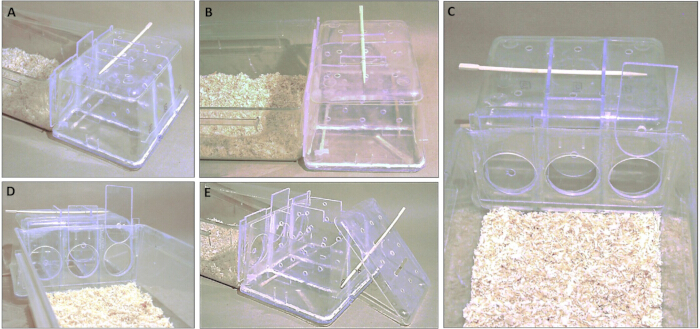
Figure 1: Overview of the custom-made fecal sampling cage. The cage system allows fecal samples to be collected from individual mice housed in a group cage without direct handling during sampling. (A) Fully assembled cage system consisting of a home cage and an attached fecal sampling cage. (B) Side view of the attached sampling cage. (C) Top view showing the three separate entrances to the individual collection boxes. (D) View from inside the home cage toward the entrances of the sampling boxes. (E) Opened sampling cage, allowing access to the collection boxes for fecal pellet removal and cleaning. Please click here to view a larger version of this figure.
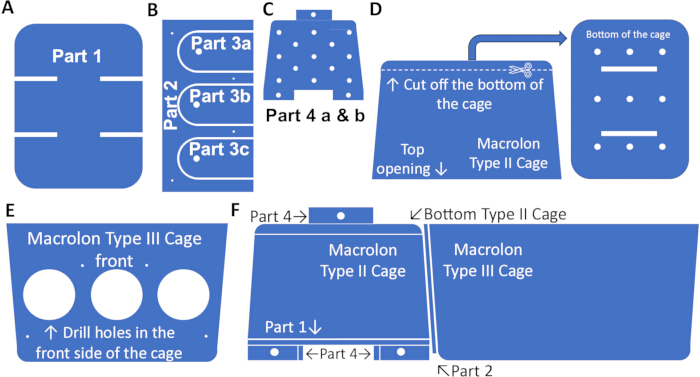
Figure 2: Construction plan and assembly of the fecal sampling cage. (A-C) Acrylic glass parts are used to construct the floor, side walls, sliding doors, and dividers of the sampling cage. (D) Modification of the polycarbonate type II cage by removing the bottom and drilling holes and slots for the collection-box cover. (E) Modification of the polycarbonate type III home cage by drilling three entrance holes into the front side. (F) Schematic side view of the assembled cage system, showing the polycarbonate type III home cage connected to the modified polycarbonate type II sampling cage and the positioning of parts 1, 2, and 4. Please click here to view a larger version of this figure.
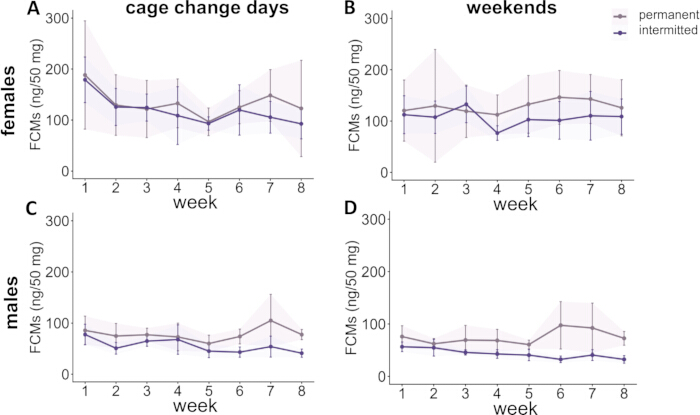
Figure 3: Representative FCM data obtained after fecal sample collection using the custom-made cage. Fecal corticosterone metabolites (FCMs) were measured in fecal samples collected individually from group-housed mice using the custom-made fecal sampling cage. Values are shown across eight weekly sampling time points for permanently and intermittently bred mice. Samples were collected either on cage-change days or on weekends. Points and connecting lines represent group means at each time point. Error bars and shaded ribbons indicate mean ± standard deviation (SD). (A) Females sampled on cage change days. (B) Females sampled during weekends. (C) Males sampled on cage change days. (D) Males sampled during weekends. The figure illustrates that the method produced measurable FCM concentrations across all groups and time points. Females generally showed higher FCM concentrations than males, while differences between breeding groups were less consistent. Please click here to view a larger version of this figure.
Supplementary Figure 1: Templates for acrylic glass components 1-3. Templates for cutting Parts 1, 2, and 3a-c from 5 mm acrylic glass/Plexiglass for the construction of the fecal sampling cage. Part 1 serves as the bottom insert of the modified polycarbonate type II cage. Part 2 is used to connect the polycarbonate type III cage to the polycarbonate type II cage and to mark corresponding drill holes. Parts 3a-c form internal dividers/structural elements of the collection system. White circular markings indicate air holes, and smaller markings indicate screw holes. Please click here to download this File.
Supplementary Figure 2: Templates for acrylic glass components 4a and 4b. Templates for cutting Parts 4a and 4b from 5 mm acrylic glass/Plexiglass. These parts are inserted into Part 1 to hold the bottom insert in place and to divide the sampling cage into separate fecal collection boxes. The lower protrusions form the legs of the collection boxes, whereas the upper protrusions pass through the top cover and are fixed with wooden rods or chopsticks to stabilize the construction. White circles indicate openings for the rods or air holes. Please click here to download this File.
Supplementary Figure 3: Modification of the polycarbonate type II cage. Schematic template for modifying the polycarbonate type II cage. The bottom of the cage is cut off as indicated and later used as the top cover of the fecal collection boxes. Holes and slots are drilled into the removed bottom section to allow insertion and fixation of Parts 4a and 4b. Screw holes are used to attach the polycarbonate type II cage, the polycarbonate type III cage, and Part 2. Please click here to download this File.
Supplementary Figure 4: Modification of the polycarbonate type III cage front. Schematic template for drilling the front side of the polycarbonate type III cage. Three circular openings are drilled into the short side of the cage to allow access between the home cage and the fecal sampling cage. Additional screw holes are used for fixation to Part 2 and the polycarbonate type II cage. Please click here to download this File.
Discussion
This protocol describes a simple cage system for collecting individually assignable fecal samples from group-housed mice. The main advantage of the method is that it combines individual sample attribution with the maintenance of key aspects of social housing, particularly visual and olfactory contact with cage-mates. This is relevant because group housing is often required for animal welfare and may also be part of the experimental design10. In contrast to pooled home-cage sampling, the system allows FCM values to be assigned to individual animals, while avoiding prolonged individual housing before or during sample collection.
Commonly used approaches for fecal sample collection in laboratory mice include pooled home-cage sampling, temporary individual housing in clean cages, metabolic cages, and direct collection after handling or transfer. Pooled home-cage samples are easy to obtain, non-invasive, inexpensive, and compatible with parallel sampling of many cages, but they do not allow individual attribution in group-housed animals. Temporary individual housing or transfer to clean cages enables individual sample assignment, but removes animals from their social group and may introduce acute stress due to handling, novelty, or social separation. This is particularly relevant for FCM analysis, because corticosterone-related measures are sensitive to stress caused by the sampling procedure itself11. Metabolic cages provide controlled sample collection and allow separation of feces and urine, but they require specialized equipment, are less compatible with routine husbandry, and usually involve individual housing. Direct handling-based collection can also provide individually attributable samples, but requires repeated handling or manipulation of the animals and may therefore affect stress-related readouts.
Compared with these existing approaches, the present system was designed as a group-housing compatible refinement for repeated, non-invasive, individual fecal sampling. After habituation and training, mice enter the sampling boxes voluntarily in response to a small food reward. Samples can therefore be collected without chasing, handling, or forced transfer to a separate cage. The system should not be interpreted as proven to improve welfare or reduce stress in a strict experimental sense, because direct welfare measures were not included in the present study. However, it was designed to reduce the degree of social separation during sample collection and may therefore be less disruptive than conventional individual collection methods. In addition, several animals and several cages can be sampled in parallel, helping to standardize the sampling window, which is important because FCM concentrations depend on circadian rhythm and reflect glucocorticoid secretion several hours before sampling5,12.
The representative results demonstrate that the system is suitable for collecting fecal samples that can be analyzed for FCM concentrations. Measurable FCM concentrations were obtained across groups and time points, and the method detected the expected clear sex difference, with higher FCM concentrations in females than in males. The study also included an internal comparison with conventional single housing in males. On Sundays, males in the intermittent breeding group were single-housed, whereas permanently bred males were sampled using the newly developed collection system. FCM concentrations did not differ significantly between these groups on Sundays. This suggests that voluntary entry into the sampling cage and the short-term stay in the collection box did not markedly increase FCM concentrations compared with conventional single-housing collection. Nevertheless, this comparison was limited to males and was not designed as a dedicated equivalence or crossover validation study. Further studies should therefore compare the system with established individual-housing or metabolic cage approaches under balanced experimental conditions and include behavioral indicators of acute stress during sampling.
Beyond the assessment of fecal corticosterone metabolites, the system may also be useful for other applications requiring short-term collection of individual fecal samples. Potential applications include parasitological examinations, microbiota analyses, digestion studies, or other fecal biomarker assays. With minor technical modifications, the system could potentially also be adapted for urine collection, for example, by introducing a perforated floor and a suitable collection tray beneath the animal. For these applications, the possibility of maintaining proximity to cage-mates during sample collection may be advantageous compared with conventional individual housing or metabolic cage approaches. However, the suitability of the system would need to be validated for each specific sample type and downstream analysis, particularly where contamination, sample volume, collection time, or storage conditions are critical.
In general, animals should be habituated to the boxes before the first sampling session, individual markings must be clearly visible under the lighting conditions used, and sampling should be performed at the same time of day throughout a study. Samples should be excluded if individual identity is uncertain, if pellets are contaminated, if the sampling duration differs substantially from the planned time window, or if the fecal material is insufficient for analysis13. Several practical factors may influence the applicability of the sampling system, including dominance hierarchies, aggressive interactions, variability in food motivation, strain differences, and reduced mobility or altered behavior in obese, aged, pregnant, postpartum, or otherwise impaired animals. However, in the present cohort, voluntary entry and sampling success were high. Of 480 expected regular samples, two were missing because mice did not defecate during confinement, and three could not be collected because animals were either highly pregnant or shortly after giving birth. Thus, 475 samples were collected, of which 473 yielded analyzable results. These data indicate that refusal to enter the boxes and failure to obtain samples were rare under the conditions used in this study. Nevertheless, additional habituation or protocol adjustments may be required for other strains, larger groups, or animals with altered mobility, body condition, health status, or social behavior. Further limitations are that the method requires training and is currently designed for small groups of three mice, and that acrylic glass/plexiglass components are not steam autoclavable.
The cage is inexpensive, easy to build from standard cage material and acrylic glass, and does not require electronic components. Its design allows disassembly, cleaning, and integration into regular cage-changing routines, making it suitable for repeated longitudinal sampling. Overall, the system represents a practical, group-housing-compatible approach for non-invasive, individually assignable fecal sampling in mice.
Disclosures
The authors declare that they have no competing financial interests.
Acknowledgements
We thank Prof. Pollak for supporting the publication of this article.
Katharina Tillmann gratefully acknowledges the support of her late grandfather, Bruno Wochner, who, at 99 years of age, contributed to the planning of the cage system, made his wood workshop available, and assisted with sanding and construction. His enthusiasm for craftsmanship and building was a lasting source of inspiration and is gratefully remembered here.
Materials
| Name | Company | Catalog Number | Comments |
|---|---|---|---|
| Drill bit 5 mm | Craftomat | 22380487 | 5mm diameter; Quantity 1 |
| Drill bits 60 mm | Bosch | 32064647 | 60 mm diameter; Quantity 1 |
| Drill bits 7 mm | Craftomat | 22380520 | 7 mm diameter; Quantity 1 |
| Drilling machine | Makita | 25730054 | Standard handheld or bench drill; Quantity 1 |
| Hot glue gun | Einhell | 29051207 | For cage assembly; Quantity 1 |
| Hot glue sticks | Einhell | 29049664 | Compatible with hot glue gun; Quantity 5-10 |
| Makrolon cage | Animalab | 31200129 | Standard Type II cage; Quantity 1 |
| Makrolon cage | Animalab | 31200256 | Standard Type III cage; Quantity 1 |
| Plexiglass / acrylic glass | Bauhaus | 29122352 | Approx. 0.25 m² total; 5 mm thickness; Quantity 2DIN A3 sheets |
| Saw or milling device | Scheppach | 32079641 | Small band saw, jigsaw, or CNC mill; Quantity 1 |
| Threaded screws | Profi Depot | 10807533 | 20 mm × 3 mm; Quantity 4 |
| Wooden chopsticks / rods | Ikea | 903.429.71 | Round wooden rods; Quantity 3 |
References
- Abelson KS, Adem B, Royo F, Carlsson HE, Hau J. High plasma corticosterone levels persist during frequent automatic blood sampling in rats. In vivo (Athens, Greece) 2005; 19(5): 815-819.
- Kim S, Foong D, Cooper MS, Seibel MJ, Zhou H. Comparison of blood sampling methods for plasma corticosterone measurements in mice associated with minimal stress-related artefacts. Steroids 2018; 135: 69-72.
- Teilmann AC, Kalliokoski O, Sorensen DB, Hau J, Abelson KS. Manual versus automated blood sampling: impact of repeated blood sampling on stress parameters and behavior in male NMRI mice. Lab Anim 2014; 48(4): 278-291.
- Thanos PK, Cavigelli SA, Michaelides M, Olvet DM, Patel U, Diep MN et al. A non-invasive method for detecting the metabolic stress response in rodents: characterization and disruption of the circadian corticosterone rhythm. Physiological research 2009; 58(2): 219-228.
- Touma C, Sachser N, Möstl E, Palme R. Effects of sex and time of day on metabolism and excretion of corticosterone in urine and feces of mice. General and Comparative Endocrinology 2003; 130(3): 267-278.
- Frynta D, Nováková M, Kutalová H, Palme R, Sedláček F. Apparatus for Collection of Fecal Samples from Undisturbed Spiny Mice (Acomys cahirinus) Living in a Complex Social Group. Journal of the American Association for Laboratory Animal Science : JAALAS 2009; 48(2): 196-201.
- Meyer N, Kroger M, Thummler J, Tietze L, Palme R, Touma C. Impact of three commonly used blood sampling techniques on the welfare of laboratory mice: Taking the animal's perspective. PLoS One 2020; 15(9): e0238895.
- Touma C, Palme R, Sachser N. Analyzing corticosterone metabolites in fecal samples of mice: a noninvasive technique to monitor stress hormones. Hormones and Behavior 2004; 45(1): 10-22.
- Müller K, Lengheimer T, Kral-Pointner JB, Wojta J, Yeghiazaryan L, Krall C et al. Exposure to soiled bedding reduces abnormal repetitive behaviors in mice. Frontiers in Behavioral Neuroscience 2022; 16.
- Cinque C, Zinni M, Zuena AR, Giuli C, Alemà SG, Catalani A et al. Faecal corticosterone metabolite assessment in socially housed male and female Wistar rats. Endocrine connections 2018; 7(2): 250-257.
- Palme R. Monitoring stress hormone metabolites as a useful, non-invasive tool for welfare assessment in farm animals. Animal Welfare 2012; 21(3): 331-337.
- Kalliokoski O, Jacobsen KR, Teilmann AC, Hau J, Abelson KSP. Quantitative Effects of Diet on Fecal Corticosterone Metabolites in Two Strains of Laboratory Mice. In vivo (Athens, Greece) 2012; 26(2): 213.
- Rowland NE, Toth LA. Analytic and Interpretational Pitfalls to Measuring Fecal Corticosterone Metabolites in Laboratory Rats and Mice. Comparative medicine 2019; 69(5): 337-349.
Reprints and Permissions
This article has been published
Video Coming Soon