This protocol describes a reproducible workflow for capturing, analyzing, and translating embodied Tai Chi movements into dynamic visual designs using markerless motion capture and motion-feature-based visual mapping to support communication of movement-based intangible cultural heritage.
A subscription to JoVE is required to view this content. Sign in or start your free trial.
Method Article
A Motion-Feature-Informed Dynamic Visual Design Protocol for Translating Embodied Tai Chi Knowledge into Intangible Cultural Heritage Communication
In This Article
Summary
Abstract
This protocol describes a reproducible workflow for translating embodied Tai Chi movements into dynamic visual designs to support the communication of movement-based intangible cultural heritage. As a movement-based cultural practice, Tai Chi conveys knowledge through bodily rhythm, trajectory, weight transfer, and balance, aspects that are often difficult to communicate using conventional static or video-based media. The protocol integrates markerless motion capture, motion-feature extraction, and rule-based visual mapping to transform movement characteristics into dynamic visual representations. Eight representative Tai Chi forms were recorded using markerless motion capture. Body keypoints were extracted with MediaPipe Pose and analyzed to derive motion features, including trajectory curvature, movement smoothness, and rhythm stability. These features were systematically mapped to dynamic visual variables through a motion-feature-informed visual translation framework. To evaluate the effectiveness of the approach, a controlled experiment involving 180 participants compared three communication conditions: static graphics, conventional videos, and motion-data-driven dynamic visual designs. Outcome measures included knowledge gain, movement recognition, embodied understanding, and behavioral intentions related to cultural preservation and sharing. Analysis of 264 valid movement sequences revealed substantial variation in motion-feature profiles across Tai Chi forms. The dynamic visual design condition significantly outperformed the static graphic and conventional video conditions in knowledge gain, movement-meaning recognition, and embodied understanding (all p < 0.001). Structural modeling further indicated that perceived design quality influences preservation and sharing intentions primarily through embodied understanding, aesthetic engagement, and emotional resonance. This protocol provides a systematic method for converting embodied movement knowledge into dynamic visual forms for the communication and interpretation of movement-based intangible cultural heritage.
Introduction
Tai Chi, or Taijiquan, is a traditional Chinese movement practice that integrates bodily coordination, circular motion, balance control, and internal regulation. Inscribed on UNESCO’s Representative List of the Intangible Cultural Heritage of Humanity in 2020, its cultural significance relies heavily on living, embodied performance rather than static material artifacts1. This recognition presents a methodological challenge for digital heritage communication: how to translate movement-based heritage without reducing it to static symbols, textual explanations, or superficial visual motifs.
Conventional digital communication typically relies on static text, still imagery, or standard video recordings. While these formats can document the external posture or chronological sequence of a form, they frequently fail to convey the internal bodily logic—such as weight shifts, rhythm control, and movement connectivity—through which the practice becomes culturally meaningful. Recent advancements in motion analysis enable the precise quantification of body-joint coordinates and kinematic patterns using sensor-based or markerless motion-capture methods2,3. However, while these technologies excel in movement recognition and training interventions, their potential for visual cultural communication remains underexplored. Similarly, although digital heritage projects increasingly adopt immersive media and data-driven visualization, many still emphasize presentation quality over structural cultural interpretation4.
Embodied cognition provides a critical perspective for addressing this gap. From this viewpoint, cultural understanding is shaped by bodily perception, sensorimotor simulation, and perception–action coupling rather than merely observing visual surfaces5,6,7. Visual art and cognitive science research further suggest that abstraction can make otherwise invisible physical properties perceptible when it preserves the structural relationships of movement8. Interactive visual communication studies emphasize that visual appeal and user experience influence public engagement and preservation intentions9. Yet, immersive media in heritage projects often prioritize aesthetic attraction, which may attract attention but fail to communicate the underlying cultural structure7. Furthermore, abstracting movement into dynamic visuals risks weakening perceived authenticity if the design logic becomes detached from the original practice10. Therefore, translating embodied knowledge into perceivable forms requires a rigorous, rule-based design logic grounded in empirical movement data rather than purely intuitive graphic styling.
To bridge the gap between motion data and cultural interpretation, this article presents a reproducible protocol for translating embodied Tai Chi knowledge into dynamic visual design. The core scientific objective is to determine whether kinematic features extracted from Tai Chi movements can serve as interpretable design variables that improve public understanding of embodied cultural meaning. Accordingly, the study contributes a motion-feature-informed translation workflow, a rule-based mapping between movement features and dynamic visual variables, and an empirical evaluation comparing static graphics, conventional video, and motion-data-driven dynamic visual design.
This data-driven approach offers distinct advantages over alternative techniques11. Unlike conventional video recordings, which provide only literal representations, or purely decorative animations, which lack cultural grounding, this method maps extracted kinematic features (e.g., trajectory curvature, smoothness, rhythm stability, and balance-shift amplitude) directly onto dynamic visual variables (e.g., circular flow lines, animation rhythm, and visual gravity). This approach is related to earlier media-art explorations of motion visualization, including Tobias Gremmler’s motion-capture-based Kung Fu Motion Visualization, but differs by defining explicit feature-to-visual mapping rules and evaluating their communication effects through a controlled user study12. Consequently, it preserves the empirical structure of the movement while rendering its underlying logic visually accessible.
Finally, this protocol is particularly appropriate for digital humanities researchers, interaction designers, and heritage practitioners seeking to digitize and communicate movement-based intangible cultural heritage. The framework differs from Labanotation, which is a rigorous notation system for recording movement scores for expert interpretation and preservation13. In contrast, the present protocol translates measured movement mechanics into dynamic visual forms intended to support public interpretation, cultural transmission, and heritage preservation. By utilizing an accessible video-based markerless motion-capture system combined with standard data-processing workflows, researchers can adapt this framework not only for Tai Chi but also for other embodied practices, systematically evaluating how motion-informed design influences cultural communication outcomes10.
Access restricted. Please log in or start a trial to view this content.
Protocol
All methods involving human participants were performed in accordance with institutional guidelines and were approved by the Ethics Committee on Human Research Protection, School of Design and Creativity, Guilin University of Electronic Technology (Approval No. 2600AL0621). Written informed consent was obtained from all Tai Chi performers and user-evaluation participants before data collection. Participants were informed that participation was voluntary and that anonymized data would be used for research and publication purposes.
1. Study Setting and Equipment Preparation
- Prepare a marked 3 m × 3 m motion-capture area with a non-reflective background and uniform lighting in a design and digital media laboratory.
NOTE: The overall five-stage workflow for translating embodied Tai Chi movement into dynamic visual communication is illustrated in Figure 1A. The literature-derived methodological chain supporting the protocol, including motion analysis, cultural dissemination, usability assessment, and cognitive workload evaluation, is summarized in Table 1. - Position two synchronized digital cameras to record each Tai Chi sequence from different viewpoints. Place the front-view camera approximately 3.5 m from the center of the capture area.
- Position the side-view camera approximately 3.0 m from the center of the capture area. Mount both cameras on tripods at chest height, as shown in Figure 2A.
- Configure both cameras to record at a resolution of 1920 × 1080 pixels and a frame rate of 30 frames/s. Use manual exposure and fixed focal settings throughout data collection.
- Illuminate the capture area using two diffuse LED panel lights positioned approximately 45° to the front-left and front-right of the performer at chest height. Maintain uniform, non-reflective illumination at 500 lux with a neutral color temperature of 5,600 K throughout data collection.
- Synchronize the two cameras before each trial using a visible two-hand clap performed in the capture area. Align the recordings using the first frame showing hand contact and verify that the synchronization error does not exceed one frame at 30 frames/s.
- Position the front-view camera perpendicular to the performer’s frontal plane and position the side-view camera approximately 90° to the performer’s right side. Use fixed focal settings and ensure that the performer’s entire body remains visible throughout the 3 m × 3 m capture area by aligning both cameras using floor markers placed at the capture-area boundaries.
- Use a plain, non-reflective background and remove reflective objects from the capture area. Before recording, confirm that the performer is fully visible from both camera views, that shadows do not obscure the body outline, and that no furniture, cables, or bystanders occlude the movement trajectory.
- Calibrate the recording space at the beginning of each recording session by filming the marked floor grid and verifying that the capture-area boundaries are visible in both camera views. Because the analysis used markerless two-view video rather than metric three-dimensional reconstruction, calibration consisted of verifying view alignment, body visibility, and scale normalization using shoulder width.
- Save each recording as a 1920 × 1080 pixel, 30 frames/s MP4 video using H.264 compression. Name files using the format M##_P##_T#_view.mp4, where M indicates movement, P indicates performer, T indicates trial, and view indicates the front or side camera.
- Process the motion data on a workstation capable of running the Python 3.11 the programming environment, the OpenCV computer-vision library, MediaPipe Pose markerless pose-estimation pipeline, the NumPy numerical-computing library, the pandas data-management library, and the SciPy signal-processing library. Record the workstation model, operating system, and software package versions used for data processing to ensure computational reproducibility.
NOTE: The overall five-stage workflow for translating embodied Tai Chi movement into dynamic visual communication is illustrated in Figure 1A–E.
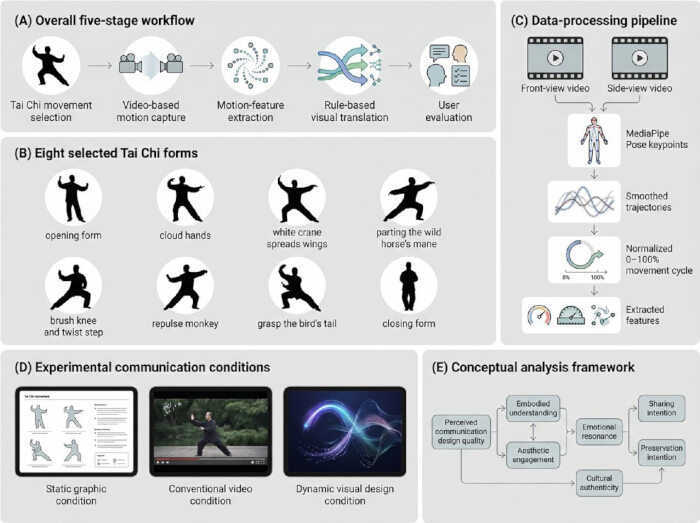
Figure 1. Workflow for translating embodied Tai Chi movement into dynamic visual communication. (A) Five-stage study workflow comprising Tai Chi movement selection, video-based motion capture, motion-feature extraction, rule-based visual translation, and user evaluation. (B) Eight selected Tai Chi forms analyzed in the study. (C) Motion-data processing pipeline, including synchronized video acquisition, pose estimation, trajectory processing, movement-cycle normalization, and feature extraction. (D) Experimental communication conditions: static graphic, conventional video, and motion-data-driven dynamic visual design. (E) Conceptual framework linking perceived communication design quality, embodied understanding, aesthetic engagement, emotional resonance, sharing intention, and preservation intention. Please click here to view a larger version of this figure.
| Reference | Research Area | Data Chain Used in Previous Work | Statistical or Analytical Chain | Methodological Implication for This Study | Data Chain Used in Previous Work |
| Ho et al.2 | Tai Chi motion analysis | Tai Chi movements were recorded using body-joint coordinate tracking, and upper-limb joint positions and elbow angles were quantified. | Quantitative and qualitative movement analyses. | Supports the use of body-joint coordinates, trajectory features, and kinematic indicators to convert Tai Chi movement into analyzable embodied data. | Tai Chi movements were recorded using body-joint coordinate tracking, and upper-limb joint positions and elbow angles were quantified. |
| Li et al.3 | Tai Chi movement recognition | Tai Chi movements were captured using inertial measurement units and time-series movement signals. | Temporal convolutional network-based recognition and intervention feedback. | Supports the extraction of temporal motion features, including rhythm stability, acceleration variation, and movement-sequence structure. | Tai Chi movements were captured using inertial measurement units and time-series movement signals. |
| Yi et al.4 | Digital intangible cultural heritage dissemination | User-experience data were collected from participants exposed to digital intangible cultural heritage experiences. | SmartPLS and fuzzy-set qualitative comparative analysis (fsQCA) were used to examine affective responses and dissemination behavior. | Supports the communication framework linking digital experience, emotional response, cultural identity, and dissemination intention. | User-experience data were collected from participants exposed to digital intangible cultural heritage experiences. |
| Brooke15 | Usability evaluation | Participants completed a standardized 10-item usability questionnaire after interacting with the system. | System Usability Scale (SUS) scores were calculated on a 0–100 scale. | Supports the measurement of perceived usability of the visual communication interface. | Participants completed a standardized 10-item usability questionnaire after interacting with the system. |
| Hart and Staveland16 | Cognitive workload assessment | Participants rated workload dimensions after task completion. | NASA Task Load Index (NASA-TLX) scores were calculated from multidimensional workload ratings. | Supports the evaluation of whether the motion-data-driven dynamic visual prototype improves user understanding without imposing excessive cognitive workload. | Participants rated workload dimensions after task completion. |
Table 1: Literature-derived methodological chain supporting the present study. This table summarizes the key references, research domains, data-acquisition approaches, analytical methods, and methodological contributions used to inform the motion-analysis workflow, visual-translation framework, usability assessment, and cognitive-workload evaluation implemented in the present protocol.
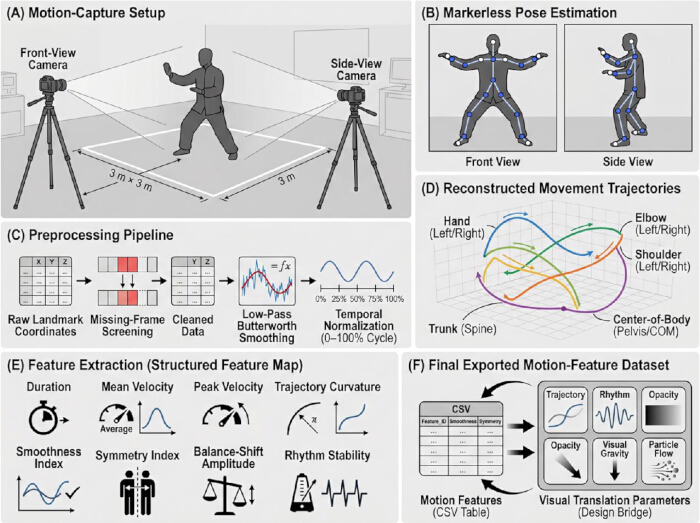
Figure 2. Video-based motion capture and motion-feature extraction procedure. (A) Motion-capture setup using synchronized front-view and side-view cameras within a marked 3 m × 3 m capture area. (B) Markerless pose-estimation outputs showing extracted body landmarks from front-view and side-view recordings. (C) Data-preprocessing workflow including landmark extraction, missing-frame screening, trajectory smoothing, and temporal normalization. (D) Representative reconstructed movement trajectories derived from upper-limb, trunk, and center-of-body keypoints. (E) Motion features extracted from each movement sequence, including duration, mean velocity, peak velocity, trajectory curvature, smoothness index, symmetry index, balance-shift amplitude, and rhythm stability. (F) Exported motion-feature dataset used for visual translation. Please click here to view a larger version of this figure.
2. Selection of Tai Chi Movements and Performer Recruitment
- Select eight representative Tai Chi forms for motion capture to capture different combinations of circular trajectory, weight transfer, upper-limb extension, trunk rotation, balance transition, and rhythm control (Table 2; Figure 1B).
NOTE: The selected forms include Opening Form, Cloud Hands, White Crane Spreads Wings, Parting the Wild Horse’s Mane, Brush Knee and Twist Step, Repulse Monkey, Grasp the Bird’s Tail, and Closing Form. These forms provide a technical basis for analyzing Tai Chi movement as embodied motion data2. - Recruit Tai Chi performers and include both experienced instructors and intermediate practitioners. Define experienced instructors as individuals with more than five years of teaching or performance experience and intermediate practitioners as individuals with at least one year of regular practice.
- Screen all potential performers for eligibility. Include individuals aged 18–60 years who report no musculoskeletal injury within the previous three months and who can complete all selected movements without interruption.
- Obtain written informed consent from all performers before data collection.
- Identify potential performers through university Tai Chi instructors, campus practice groups, and local practitioner networks. Contact candidates by email or in person, screen them using the eligibility criteria, and enroll only those who provide written informed consent.
- Recruit 12 performers in total, including five experienced instructors and seven intermediate practitioners. Use this sample to generate the motion sequences for preprocessing and feature extraction.
- Select movements from the 24-form simplified Yang-style Tai Chi curriculum commonly used in public teaching and cultural demonstration contexts.
- Select the eight forms through discussion among the research team and Tai Chi instructors to cover slow initiation, circular trajectory, asymmetric extension, forward transfer, trunk rotation, backward retreat, multi-stage force integration, and closing stabilization. Use these criteria to ensure that the selected forms represent the movement characteristics targeted by the visual-translation rules in Table 2.
- Record performer demographics and practice characteristics, including age, sex, height, body mass, handedness, years of Tai Chi experience, and instructor or intermediate status.
- Exclude candidates who report neurological disorders, balance disorders, uncorrected visual impairment, recent surgery, inability to complete the full movement sequence, or any condition that makes safe participation inappropriate.
- Do not require prior experience with motion-capture studies or digital recording procedures. Before enrollment, explain the recording workflow to all performers and confirm that they are comfortable being recorded from two camera views.
- Include permission for video recording, markerless motion analysis, anonymized data storage, and publication of aggregated results in the ethics-approved consent procedure.
- Provide performers with the study schedule, recording instructions, warm-up guidance, and opportunities to ask questions before recording.
| Tai Chi Movement | Embodied Movement Feature | Cultural or Bodily Meaning | Extracted Motion Indicators | Dynamic Visual Translation Rule |
| Opening Form | Slow initiation, vertical settling, and controlled arm lifting | Beginning, grounding, and regulation of breath and body state | Duration, smoothness index, rhythm stability | Slow fade-in, gradual vertical expansion, and low-speed particle emergence |
| Cloud Hands | Continuous circular upper-limb movement and lateral body shifting | Circularity, flow, continuity, and coordination between body and intention | Trajectory curvature, balance-shift amplitude, smoothness index | Circular flow lines, side-to-side visual-gravity shifts, and continuous particle trails |
| White Crane Spreads Wings | Asymmetric upper-limb extension, open posture, and trunk rotation | Extension, openness, and balance between upward and downward forces | Symmetry index, peak velocity, upper-limb displacement | Split-layer composition, upward light extension, and asymmetric transparency transitions |
| Parting the Wild Horse’s Mane | Forward stepping, diagonal arm separation, and weight transfer | Directional expansion, separation of force, and forward intention | Balance-shift amplitude, mean velocity, trajectory curvature | Diagonal motion ribbons, a forward-moving visual center, and layered arc expansion |
| Brush Knee and Twist Step | Coordinated stepping, arm brushing, and torso rotation | Protection, redirection, and coordinated lower- and upper-body control | Trunk displacement, symmetry index, smoothness index | Rotating visual field, lower-level sweeping trails, and softened edge transitions |
| Repulse Monkey | Backward stepping, alternating arm movements, and controlled retreat | Retreat without loss of control, alternation, and stability | Rhythm stability, step displacement, bilateral coordination | Alternating visual pulses, backward-flowing particles, and staggered opacity rhythms |
| Grasp the Bird’s Tail | Sequential pushing, warding, rolling, pressing, and closing actions | Integration of multiple Tai Chi forces and continuous body logic | Curvature, smoothness, rhythm stability, balance-shift amplitude | Multi-stage arc sequences, layered force waves, and progressive visual compression and release |
| Closing Form | Slow return, arm lowering, and body stabilization | Completion, return to stillness, and internal settling | Duration, smoothness index, rhythm stability | Gradual fade-out, downward visual settling, and particle convergence toward the center |
Table 2: Tai Chi movement characteristics and corresponding visual translation rules. This table summarizes the embodied movement features, cultural or bodily meanings, extracted motion indicators, and rule-based visual translation mappings used for the eight selected Tai Chi forms. The listed motion indicators informed the generation of dynamic visual variables used in the motion-feature-driven communication design framework.
3. Motion-Capture Procedure
- Instruct each performer to complete a 5 min warm-up and one familiarization round within the capture area before formal recording.
- Instruct each performer to execute each of the eight selected Tai Chi forms three times at a natural Tai Chi pace. Do not use a metronome or externally imposed movement speed.
- Record a visual synchronization gesture at the beginning of each trial to facilitate alignment of the front-view and side-view videos during preprocessing.
- Assign a unique motion identifier to each trial. Include the performer number, movement type, and trial number in the identifier.
- Provide a 10 s rest interval between trials. Provide a longer rest period when a performer reports fatigue.
- Repeat a trial once when the movement is interrupted, performed outside the marked capture area, or affected by an obvious recording error. The complete motion-recording and feature-extraction workflow is illustrated in Figure 2.
NOTE: Figure 2 illustrates the complete motion-recording and feature-extraction workflow. Use a markerless video-based workflow to maintain a reproducible and low-cost data-acquisition pipeline suitable for cultural communication settings where wearable sensors are impractical3. - Use a standardized 5 min warm-up consisting of gentle neck, shoulder, trunk, hip, knee, and ankle mobility exercises followed by slow arm-raising and weight-shifting movements. Begin formal recording only when the performer reports no discomfort and can complete the practice sequence smoothly.
- During familiarization, ask each performer to complete one practice pass of the selected forms inside the marked area while the operator checks body visibility in both camera views. End familiarization when the performer can remain within the capture area and follow the recording cues without interruption.
- Define the natural Tai Chi pace as the self-selected pace normally used by the performer during teaching or practice. Instruct performers not to accelerate for the camera and repeat a trial only if the pace is visibly interrupted or inconsistent with the practice round.
- Use a two-hand clap at chest height as the visual synchronization gesture immediately before movement initiation. Mark the first hand-contact frame in both videos and verify synchronization during preprocessing.
- Use the identifier format M##_P##_T#, where M indicates the movement, P indicates the performer number, and T indicates the trial number. For example, M02-P07-T3 denotes the third Cloud Hands trial performed by performer P07.
- Assess fatigue through performer self-report, visible instability, slowed recovery, or requests for additional rest. Provide an additional 30–60 s rest period when any fatigue indicator is observed.
- Record movements in the fixed order listed in Table 2 to maintain consistency across performers and reduce operator error. Do not randomize the movement order because the objective is motion-feature extraction rather than behavioral treatment comparison.
- Deliver the same instruction before each trial: perform the assigned Tai Chi form at the usual Tai Chi pace, remain inside the marked area, and continue until the form is complete. Read the instruction from a prepared script to maintain consistency across performers.
- Permit one immediate repeat for a trial affected by interruption, occlusion, or performer error. If the repeated trial remains unusable, document the trial as excluded and record the exclusion reason in the preprocessing log.
- Check camera stability, capture-area visibility, lighting consistency, and body visibility before each recording block and after any equipment adjustment. Pause recording and repeat the setup check if shadows, reflections, or occlusions appear.
- Transfer video files to a password-protected project folder immediately after each recording session and back them up to a separate storage drive. Verify file integrity by opening each front-view and side-view recording and checking the recording duration, frame continuity, and file-naming consistency before preprocessing.
- Train recording operators using the same setup checklist, file-naming rules, synchronization procedure, and trial-repeat criteria. Assign one operator to camera setup and recording control and, when staffing permits, assign a second operator to complete the protocol checklist.
4. Motion-Data Preprocessing
- Review all raw video files for camera stability, body visibility, frame continuity, and synchronization before further processing.
- Import each video into the pose-estimation pipeline and extract 33 body landmarks frame by frame using pose-estimation pipeline, as illustrated in Figure 1C and Figure 2B. Export the landmark coordinates for each motion sequence as comma-separated value (CSV) files.
- Process the exported coordinate data in Python using computer-vision library, numerical-computing library, data-management library, and signal-processing library. Screen the data for missing frames, unstable keypoint estimates, and body-tracking errors.
- Exclude a motion sequence if more than 15% of frames contain missing or unstable keypoint estimates, if the performer stops before completing the movement, if the body moves outside the marked capture area, or if camera occlusion prevents reliable trajectory reconstruction.
- Smooth the body-keypoint trajectories of retained sequences using a fourth-order low-pass Butterworth filter with a cutoff frequency of 6 Hz as part of the preprocessing workflow shown in Figure 2C.
- Normalize each retained sequence temporally to 0%–100% of the movement cycle to facilitate comparison across performers with different movement speeds.
- Normalize spatial coordinates using performer-specific body proportions. Use shoulder width as the primary scaling reference for upper-limb trajectory comparisons and reconstruct movement trajectories for subsequent analysis (Figure 2D).
- Assign two trained coders to independently review all excluded sequences and a random 20% sample of retained sequences. Resolve disagreements through discussion with a Tai Chi instructor and evaluate inter-rater agreement.
- Run pose-estimation pipeline within the programming environment and record the exact package version and model configuration in the Table of Materials. Use the 33-landmark full-body pose model to generate landmark coordinates for each video frame.
- Enable landmark smoothing and configure the pose-estimation pipeline with model_complexity = 1, min_detection_confidence = 0.50, and min_tracking_confidence = 0.50, unless different validated settings were used. Apply identical configuration parameters to both front-view and side-view videos.
- Inspect each video for codec compatibility and read frames directly using computer-vision library without spatial cropping when the entire body is visible. Trim only the synchronization segment preceding movement initiation and unused frames after movement completion before landmark extraction.
- Export CSV files with one row per frame and columns containing the motion identifier, frame index, timestamp, landmark name or index, normalized x-, y-, and z-coordinates, and landmark visibility score for each of the 33 body landmarks. Store front-view and side-view files in separate folders using identical motion identifiers.
- Classify a landmark estimate as unstable when its visibility score is below 0.50, when coordinates change by more than three median absolute deviations between adjacent frames, or when the landmark moves outside the visible body region. Flag sequences for review when unstable landmarks affect major upper-limb, trunk, or hip landmarks.
- Detect missing frames from discontinuities in frame indices or timestamps and from absent landmark rows in the exported CSV files. Linearly interpolate isolated gaps of fewer than five consecutive frames before smoothing. Exclude sequences when missing or unstable frames exceed 15% of the total sequence.
- Identify body-tracking errors through visual inspection and automated checks for left-right landmark swaps, implausible joint displacement, sudden full-body position shifts, and body coordinates outside the capture area. Mark affected sequences for coder review and exclude them when reliable trajectory reconstruction is not possible.
- Document all excluded sequences in a preprocessing log containing the motion identifier, performer identifier, movement type, trial number, exclusion reason, percentage of missing keypoints, and reviewer decision. Maintain corresponding sequence-status, missing-keypoint-percentage, and review-flag fields throughout preprocessing.
- Implement the fourth-order 6 Hz Butterworth low-pass filter using the scipy.signal.butter and scipy.signal.filtfilt functions to perform zero-phase filtering of each coordinate trajectory. Use the 30 frames/s sampling rate to determine the Nyquist frequency and apply identical filter parameters to all retained sequences.
- Define movement initiation as the first sustained increase in wrist or body-center velocity exceeding 5% of the sequence-specific peak velocity following the synchronization gesture. Define movement completion as the first point after the final movement phase at which velocity remains below this threshold for at least 10 consecutive frames.
- Resample each retained sequence to 101 equally spaced time points representing 0%–100% of the movement cycle by interpolating the smoothed coordinate trajectories. Use the normalized sequences for cross-performer comparison and subsequent motion-feature extraction.
- Measure shoulder width as the Euclidean distance between the left-shoulder and right-shoulder landmarks. Use the median value across stable frames as the performer-specific scaling reference and apply the resulting scale factor to all retained trials from the same performer.
- Normalize coordinates using the equations
 and
and  , where xc and yc represent the body-center coordinates and Ws represents the performer-specific shoulder width. Apply the same normalization procedure to upper-limb, trunk, and body-center trajectories.
 - Train coders using the predefined exclusion criteria, representative sample videos, and a pilot review set before formal coding. Require coders to demonstrate consistent identification of missing keypoints, occlusion, tracking errors, and interrupted performances before reviewing study data.
- Select the 20% retained-sequence review sample using stratified random sampling by movement type so that each Tai Chi form is represented. Generate the random sample from the retained motion-identifier list before coder review.
- Calculate inter-rater agreement using Cohen’ κ for retain/exclude decisions and percentage agreement for exclusion-reason classifications. Consider κ values ≥ 0.80 acceptable before finalizing the retained dataset.
- Store all preprocessing scripts in a dated project directory together with a requirements file documenting the programming environment and the exact versions of pose-estimation pipeline, computer-vision library, numerical-computing library, data-management library, and signal-processing library. Record any subsequent script revisions in a change log before rerunning feature extraction.
- Maintain quality-control logs throughout preprocessing, including sequence status, missing-keypoint percentage, review flags, and coder decisions. Use these logs to document the progression from 288 recorded motion sequences to 264 retained sequences following quality screening.
5. Motion-Feature Extraction and Visual Translation
- Calculate movement duration as the elapsed time between movement initiation and movement completion. Compute the mean velocity and peak velocity from the displacement of upper-limb and trunk keypoints across consecutive frames. Extract movement duration, velocity, trajectory curvature, smoothness, symmetry, balance-shift amplitude, and rhythm-stability features, as summarized in Figure 2E.
- Calculate trajectory curvature from the circularity of upper-limb movement paths. Derive movement smoothness from frame-to-frame acceleration variation.
- Calculate symmetry by comparing left- and right-side joint movement patterns. Estimate balance-shift amplitude from the horizontal displacement of the body center throughout the movement cycle.
- Calculate rhythm stability from the temporal variation in velocity peaks across the movement cycle.
- Assign a visual translation score to each valid sequence using a weighted combination of trajectory curvature, smoothness, rhythm stability, and balance-shift amplitude. Export the resulting motion-feature dataset for visual translation (Figure 2F).
- Transform the extracted motion features into dynamic visual elements using a rule-based visual translation system. Link each visual variable to a specific embodied movement feature using the translation matrix shown in Figure 3A.
- Translate high trajectory curvature into circular flow lines and arc-shaped particle paths (Figure 3B). Map higher rhythm-stability values to slower and more regular pulsation patterns (Figure 3C).
- Translate larger balance-shift amplitudes into visible movement of the visual center (Figure 3D). Map higher smoothness values to continuous gradient transitions and higher symmetry values to mirrored or counterbalanced visual compositions (Figure 3E).
- Review the visual translation rules with Tai Chi instructors and visual communication design experts. Confirm that the visual mappings preserve embodied movement logic while minimizing decorative distortion14. A representative motion-feature-informed visual prototype generated using these translation rules is shown in Figure 3F.
- Use the same movement-initiation and movement-completion points defined during temporal normalization for duration calculations. Calculate movement duration as (end frame − start frame)/30 frames/s and report the result in seconds.
- Calculate frame-to-frame velocity using the Euclidean displacement of consecutive landmark coordinates:

Here, vt is the instantaneous velocity at frame t, (xt, yt, zt) are the landmark coordinates at frame t, (xt−1, yt−1, zt−1) are the landmark coordinates at the previous frame, and Δt is the time interval between consecutive frames (1/30 s). Use smoothed, shoulder-width-normalized coordinates and report velocity in normalized body-width units per second. - Include the left and right wrists, elbows, shoulders, hips, and the calculated body-center trajectory when estimating upper-limb and trunk velocity. Use wrist and elbow trajectories to characterize upper-limb motion and shoulder–hip center trajectories to characterize trunk movement and balance-related motion.
- Estimate trajectory curvature from consecutive coordinate triplets using:

Average curvature values across the normalized movement cycle and upper-limb trajectories. - Quantify circularity as the min–max-normalized mean curvature of upper-limb trajectories across retained sequences. Higher values indicate more continuous arc-like or circular trajectories and greater suitability for circular flow-line visual translation.
- Calculate smoothness from frame-to-frame acceleration variation after filtering using an inverse normalized acceleration-variation score rescaled to 0–100 for reporting. Higher values indicate smoother movement with fewer abrupt acceleration changes.
- Quantify symmetry as one minus the normalized root-mean-square difference between left- and right-side landmark trajectories after temporal alignment. Higher symmetry values indicate more balanced bilateral movement patterns.
- Calculate the body center as the mean position of the left shoulder, right shoulder, left hip, and right hip landmarks for each frame. Use the resulting body-center trajectory to estimate body translation and balance-shift features.
- Calculate balance-shift amplitude as the range of normalized horizontal body-center displacement across the movement cycle:
B = max (x′center) − min (x′center)
Larger values indicate greater lateral or anteroposterior weight transfer, depending on the camera view. - Identify velocity peaks using a peak-detection procedure applied to the smoothed velocity profile with a minimum prominence of 10% of the sequence-specific peak velocity and a minimum separation of five frames. Visually review detected peaks for sequences flagged during preprocessing.
- Quantify rhythm stability as one minus the coefficient of variation of inter-peak intervals across the movement cycle and rescale the result to 0–100 for reporting. Higher values indicate more regular timing between movement phases.
- Normalize all motion features before combination using min–max scaling:
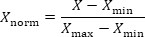
Normalize each feature independently so that no individual feature dominates because of its measurement scale. - Calculate the visual translation score (VTS) as:
VTS = 100 × (0.35Cnorm + 0.30Snorm + 0.20Rnorm + 0.15Bnorm)
Here, C, S, R, and B denote curvature, smoothness, rhythm stability, and balance-shift amplitude, respectively. Interpret higher scores as greater suitability for motion-feature-driven dynamic visual translation rather than superior Tai Chi performance. - Select feature weights through expert discussion among Tai Chi instructors and visual communication design researchers, assigning greater weight to curvature and smoothness because these features most directly influence visible flow and continuity. Verify the resulting score rankings against expert judgments of movement-to-visual suitability before final analysis.
- Perform motion-feature extraction in the programming environment using computer-vision library for frame handling, pose-estimation pipeline for landmark extraction, numerical-computing library and data-management library for coordinate processing, and signal-processing library for filtering and signal analysis. Archive the analysis scripts, package versions, and exported CSV files with the project dataset.
- Implement the rule-based visual translation workflow in the TouchDesigner visual-development platform using normalized CSV motion features as parameter inputs and Adobe After Effects for final compositing, when required. Import each movement feature vector, map motion features to predefined visual parameters, preview the dynamic output, and export the final visual prototype for user evaluation.
- Map normalized motion features continuously to visual parameters and use low (<0.33), medium (0.33–0.66), and high (>0.66) value ranges only during design review. For example, higher curvature increases arc radius and flow-line density, higher rhythm stability reduces pulsation irregularity, and larger balance-shift amplitudes increase visual-center displacement.
- Generate circular flow lines and particle trajectories from the curvature parameter, pulsation timing from rhythm stability, visual-center movement from balance-shift amplitude, gradient continuity from smoothness, and mirrored composition strength from symmetry. Maintain identical color palettes, backgrounds, and typography across all prototypes to minimize confounding effects unrelated to movement-derived dynamics.
- Apply visual mappings continuously during prototype generation so that incremental differences in motion features produce proportional changes in visual behavior. Use categorical labels only during expert review to facilitate discussion of low, medium, and high visual-translation suitability.
- Review the translation rules with two Tai Chi instructors and two visual communication design experts. Evaluate movement-feature alignment, cultural interpretability, visual clarity, and the risk of decorative distortion, and revise the translation rules until consensus is achieved.
- Assess preservation of embodied movement logic by determining whether each visual mapping accurately represents the intended movement characteristics summarized in Table 2 and whether expert reviewers judge alignment and interpretability to be acceptable. Revise mappings considered decorative, misleading, or insufficiently representative of the original movement features before generating the final visual prototypes.
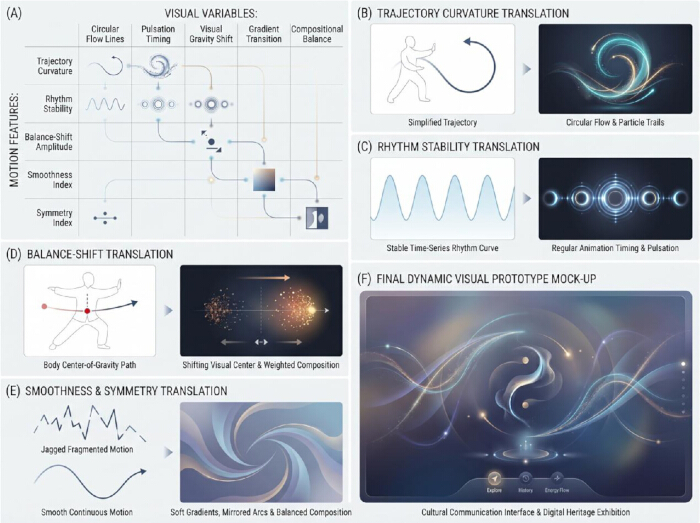
Figure 3. Rule-based translation of Tai Chi motion features into dynamic visual variables. (A) Visual translation matrix linking extracted motion features to corresponding visual variables. (B) Example translation of trajectory curvature into circular flow lines and particle trajectories. (C) Example translation of rhythm stability into animation timing and pulsation patterns. (D) Example translation of balance-shift amplitude into movement of the visual center and weighted composition. (E) Example translation of smoothness and symmetry into gradient continuity and compositional balance. (F) Representative dynamic visual prototype generated from extracted motion features. Please click here to view a larger version of this figure.
6. Prototype Development and User Evaluation Setup
- Develop three communication materials for experimental comparison: a static graphic condition, a conventional video condition, and a motion-data-driven dynamic visual design condition generated from the visual translation system (Figure 1D). The resulting motion-data-driven visual prototype is illustrated in Figure 3F.
- Standardize the three communication materials with respect to exposure duration, information density, movement presentation order, typography, and color palette.
- Recruit 180 eligible participants aged 18–35 years with normal or corrected-to-normal vision and no professional Tai Chi teaching background. Randomly assign participants to the three communication conditions using a 1:1:1 allocation ratio (Table 3).
- Conduct the user evaluation in a dedicated interaction room. Display all experimental materials on the same 24-inch monitor and position participants approximately 70 cm from the screen.
- Maintain consistent room lighting, sound level, viewing distance, screen resolution, and exposure duration throughout all experimental conditions.
- Allow participants to review the assigned material during a 4 min exposure period. Record review behavior, replay behavior, scrolling behavior, and interaction behavior as indicators of behavioral engagement. The conceptual evaluation framework linking perceived communication design quality, embodied understanding, aesthetic engagement, emotional resonance, sharing intention, and preservation intention is shown in Figure 1E.
- Create the static graphic condition as a sequence of still visual panels presenting the eight Tai Chi forms, short movement-meaning labels, and the same explanatory text used in the other conditions. Export the panels at 1920 × 1080 pixels and present them on the same monitor during the 4 min exposure period.
- Create the conventional video condition from the same recorded Tai Chi source material, edited into a 4 min 1920 × 1080 pixel, 30 frames/s H.264 MP4 sequence. Use only conventional video footage and text labels without motion-feature-driven visual overlays.
- Generate the motion-data-driven dynamic visual design condition by importing normalized motion-feature data into the visual-development platform, applying the rule set described in Step 5, and exporting a 4 min prototype with the same movement order and explanatory text as the other two conditions.
- Present the same eight Tai Chi forms in all three conditions: Opening Form, Cloud Hands, White Crane Spreads Wings, Parting the Wild Horse’s Mane, Brush Knee and Twist Step, Repulse Monkey, Grasp the Bird’s Tail, and Closing Form. Each condition includes the movement name, a brief description of its embodied meaning, and the same presentation order.
- Standardize information density by matching exposure duration, movement count, movement order, number of explanatory labels, approximate word count, and screen area devoted to each movement. Review all materials before testing to confirm that no condition contains conceptual information absent from the others.
- Use the same sans-serif typeface, label hierarchy, neutral background, and restrained blue–gray accent palette across all conditions. Keep text size, label placement, and movement titles consistent so that group differences reflect the communication mode rather than unrelated graphic styling.
- Recruit user-evaluation participants through university mailing lists, campus notices, and design-course participant pools. Screen interested volunteers for age, vision status, professional Tai Chi teaching background, and their ability to complete the full evaluation session.
- Set a target sample size of approximately 60 participants per condition to provide adequate statistical power for detecting medium-sized between-group differences in knowledge gain and embodied-understanding outcomes. The final analyzed sample included 180 participants distributed across the three conditions.
- Generate the allocation sequence using computer-based block randomization with a 1:1:1 target ratio across the three conditions. Conceal condition assignment until eligibility screening and baseline measurements have been completed.
- Record participant age, sex, prior Tai Chi familiarity, prior intangible cultural heritage exposure, design background, vision status, and pre-test cultural knowledge score. Use these variables to assess baseline equivalence across the experimental groups.
- Exclude individuals with a professional Tai Chi teaching background, uncorrected visual impairment, self-reported cognitive or neurological conditions that could affect comprehension, prior participation in the prototype-design process, or incomplete survey or task data.
- Present the materials on a Dell P2422H 24-inch monitor at 1920 × 1080 pixel resolution and a 60 Hz refresh rate. Maintain identical display brightness and color settings across all sessions and verify that the complete stimulus area is visible from the 70 cm viewing distance.
- Maintain stable indoor lighting throughout all user-evaluation sessions and avoid direct glare on the monitor. Before each session, verify consistent illumination, minimal background noise, and the absence of visual distractions.
- Provide participants with standardized written and verbal instructions before exposure. Inform participants that they will complete knowledge, recognition, and user-experience assessments immediately after viewing the assigned communication material.
- During the 4 min exposure period, instruct participants to learn the movement names, embodied meanings, and visual cues presented in the assigned material. Do not provide additional explanations during the exposure period.
- Allow participants to review, replay, scroll, or interact only within the capabilities of the assigned condition: still-panel review for the static graphic condition, replay control for the conventional video condition, and feature-linked interaction for the motion-data-driven dynamic visual design condition. Record all permitted actions as behavioral-engagement indicators.
- Record review, replay, scrolling, and interaction behaviors using the presentation computer’s event-logging system. Export participant-level logs as CSV files containing participant ID, experimental condition, dwell time (s), review/replay count, interaction clicks, and voluntary sharing selection.
- Define dwell time as the total viewing or interaction time (s), review/replay count as the number of repeated views or replay actions, and interaction clicks as the number of participant-initiated selections during exposure. Record voluntary sharing selection as a binary (yes/no) outcome following completion of the evaluation.
- Administer a 20-point cultural knowledge assessment immediately before and after exposure. Calculate knowledge gain as the post-test score minus the pre-test score, with higher values indicating greater short-term learning from the assigned communication material.
- Measure movement recognition by asking participants to identify each Tai Chi form from a list of the eight studied movements. Score responses as correct or incorrect and calculate participant-level recognition accuracy.
- Measure movement-meaning recognition by asking participants to match each movement representation with its corresponding embodied meaning (e.g., circularity, grounding, balance shift, or retreat without loss of control). Express performance as the percentage of correctly matched items.
- Measure embodied understanding using Likert-type questionnaire items assessing participants’ perception of bodily rhythm, balance transfer, trajectory flow, and movement logic. Average item scores so that higher values indicate stronger perceived embodied understanding.
- Measure emotional resonance, aesthetic engagement, cultural authenticity, preservation intention, and sharing intention using multi-item 7-point Likert scales adapted from the digital heritage and user-experience literature. Calculate each construct as the mean of the retained items following reliability assessment. Assess perceived usability using the 10-item System Usability Scale (SUS)15.
- Measure cognitive workload using the NASA Task Load Index (NASA-TLX)16 after material exposure and convert the resulting score to a 0–100 scale. Lower scores indicate lower perceived workload during interpretation of the communication material.
- Administer all questionnaires electronically on the presentation computer immediately after the exposure and recognition tasks. Export responses using anonymized participant identifiers.
- Screen participant responses for completeness, duplicate identifiers, implausible values, and missing task outcomes before statistical analysis. Exclude incomplete sessions and retain the final analyzed sample reported in Table 3.
- Store all participant data using anonymized participant identifiers in password-protected research files accessible only to the research team. Remove personal identifiers before analysis and retain study records in accordance with institutional ethics and data-management policies.
| Variable | Static Graphic Group (n = 58) | Conventional Video Group (n = 60) | Dynamic Visual Design Group (n = 62) | Statistical Test | p Value |
| Age (years) | 23.4 ± 3.8 | 23.7 ± 4.1 | 24.0 ± 3.9 | One-way ANOVA | 0.71 |
| Female, n (%) | 33 (56.9) | 35 (58.3) | 37 (59.7) | Chi-square test | 0.95 |
| Design background, n (%) | 19 (32.8) | 21 (35.0) | 22 (35.5) | Chi-square test | 0.94 |
| Prior Tai Chi familiarity (1–7) | 2.8 ± 1.3 | 2.9 ± 1.4 | 3.0 ± 1.3 | One-way ANOVA | 0.68 |
| Prior intangible cultural heritage exposure (1–7) | 3.1 ± 1.4 | 3.2 ± 1.5 | 3.3 ± 1.4 | One-way ANOVA | 0.74 |
| Pre-test cultural knowledge score (0–20) | 6.7 ± 2.4 | 6.9 ± 2.6 | 6.8 ± 2.5 | One-way ANOVA | 0.91 |
| Normal or corrected-to-normal vision, n (%) | 58 (100.0) | 60 (100.0) | 62 (100.0) | Fisher’s exact test | 1 |
| Professional Tai Chi teaching background, n (%) | 0 (0.0) | 0 (0.0) | 0 (0.0) | Not applicable | — |
Table 3: Participant characteristics and experimental group allocation. Baseline demographic characteristics, prior Tai Chi familiarity, prior intangible cultural heritage exposure, and pre-test cultural knowledge scores for participants assigned to the static graphic, conventional video, and dynamic visual design conditions. Data are presented as mean ± standard deviation or n (%). Statistical comparisons were conducted to assess baseline equivalence among groups.
Access restricted. Please log in or start a trial to view this content.
Results
Motion-Feature Characteristics of the Selected Tai Chi Movements
A total of 288 Tai Chi movement sequences were recorded from 12 performers across eight selected Tai Chi forms. After excluding sequences with incomplete execution, excessive missing keypoint estimates, camera occlusion, unstable landmark tracking, or interrupted performance, 264 valid sequences were retained for feature extraction. The number of valid sequences ranged from 31 to 34 for each movement type (Table 4).
Access restricted. Please log in or start a trial to view this content.
Discussion
This study presents and evaluates a robust, motion-feature-informed protocol for translating embodied Tai Chi knowledge into dynamic visual design. The study’s central objective was to determine whether empirically extracted kinematic features could be transformed into interpretable visual variables that improve communication of embodied cultural meaning. The findings demonstrate that movement-based intangible cultural heritage communication requires substantially more than superficial visual beautification. By sys...
Access restricted. Please log in or start a trial to view this content.
Disclosures
The authors declare that they have no competing interests and nothing to disclose.
Acknowledgements
The authors would like to express their gratitude to the Faculty of Innovation and Design at the City University of Macau and the School of Design and Creativity at Guilin University of Electronic Technology for providing the institutional support and digital media laboratory facilities necessary for conducting this study. Special thanks are extended to the Tai Chi instructors, visual communication design experts, and all participants who volunteered for the motion-capture and user-evaluation experiments. This research received no specific grant from any funding agency in the public, commercial, or not-for-profit sectors.
Access restricted. Please log in or start a trial to view this content.
Materials
| Name | Company | Catalog Number | Comments |
|---|---|---|---|
| Adobe After Effects | Adobe Inc. | Adobe After Effects 2024 (v24.6) | Motion graphics and visual-effects software used for final prototype compositing, when required. |
| Computer Workstation | Dell Technologies | Precision 3660 Tower; Intel Core i7-12700 CPU; NVIDIA GeForce RTX 3060 GPU; 32 GB RAM; 1 TB SSD | Workstation used for motion-data processing, feature extraction, visualization generation, and statistical analysis. |
| Dell 24-inch Monitor | Dell Technologies | P2422H | Display monitor used for the controlled user-evaluation experiment (1920 × 1080 pixels, 60 Hz). |
| Digital Video Camera | Sony Corporation | ILCE-7M4 | Synchronized front-view and side-view cameras used for motion capture (1920 × 1080 pixels, 30 frames/s). |
| MediaPipe Pose | Google LLC | MediaPipe 0.10.14 | Markerless pose-estimation pipeline using the 33-landmark full-body pose model (model_complexity = 1, min_detection_confidence = 0.50, min_tracking_confidence = 0.50). |
| NumPy | NumPy Developers | NumPy 1.26.4 | Numerical-computing library used for coordinate processing and motion-feature calculations. |
| OpenCV | OpenCV Team | OpenCV 4.9.0 | Computer-vision library used for video processing, frame extraction, and preprocessing. |
| Operating System | Microsoft | Windows 11 Pro 23H2, 64-bit | Operating system used for motion-data processing and visualization generation. |
| Pandas | Pandas Development Team | Pandas 2.2.2 | Data-management library used for structured data processing and CSV export. |
| Python | Python Software Foundation | Version 3.11 | Programming-language environment used for the data-processing pipeline. |
| Randomization Software | Microsoft Corporation | Microsoft Excel for Microsoft 365, Version 2405 | Used to generate the computer-based block-randomization sequence for participant allocation. |
| SciPy | SciPy Developers | SciPy 1.13.1 | Signal-processing library used for Butterworth filtering and motion-signal analysis. |
| Statistical Analysis Software | IBM Corp. | IBM SPSS Statistics 29.0 | Used for reliability analysis, hypothesis testing, mediation analysis, and structural-equation modeling. |
| Survey Administration Platform | Qualtrics LLC | Qualtrics XM web platform (accessed May 2026) | Platform used to administer questionnaires and collect participant responses electronically. |
| TouchDesigner | Derivative | TouchDesigner 2023.11880 | Visual-development platform used to generate motion-feature-driven dynamic visualizations. |
| Tripod | Manfrotto | MK055XPRO3 | Tripod used to stabilize cameras during motion capture. |
| Video Synchronization Software | Custom Python/OpenCV workflow | OpenCV 4.9.0 | Used to synchronize front-view and side-view recordings during preprocessing using the visual clap event. |
References
- UNESCO. Taijiquan. Representative List of the Intangible Cultural Heritage of Humanity. UNESCO; Paris; 2020. Available from: https://ich.unesco.org/en/RL/taijiquan-00424.
- Ho TJ, et al. Quantitative motion analysis of Tai Chi Chuan: The upper extremity movement. Comput Math Methods Med. 2018;2018:2538765.
- Li X, Zou L, Li H. Tai Chi movement recognition and precise intervention for the elderly based on inertial measurement units and temporal convolutional neural networks. Sensors. 2024;24(13):4208.
- Yi C, Huang J, Song L. Enhancing intangible cultural heritage dissemination through digital experience: An affective events theory approach. Herit Sci. 2025;13:438.
- Chen W, Li T, Zhang Y. Embodied cognition model for museum gamification cultural heritage communication: A grounded theory study. Herit Sci. 2025;13:239.
- Wilson M. Six views of embodied cognition. Psychon Bull Rev. 2002;9(4):625-36.
- Barsalou LW. Grounded cognition. Annu Rev Psychol. 2008;59:617-45.
- Zeki S. Inner Vision: An Exploration of Art and the Brain. Oxford University Press; Oxford, UK and New York, NY; 1999.
- Selmanovic E, et al. Improving accessibility to intangible cultural heritage preservation using virtual reality. J Comput Cult Herit. 2020;13(2):1-19.
- Kico I, Grammalidis N, Christidis Y, Liarokapis F. Digitization and visualization of folk dances in cultural heritage: A review. Inventions. 2018;3(4):72.
- Herrow MFM, Azraai NZ. Digital preservation of intangible cultural heritage of Joget dance movement using motion capture technology. Int J Herit Art Multimed. 2021;4(15):1-13.
- Gremmler T. Hakka Kung Fu Motion Visualization. In: 300 Years of Hakka Kung Fu. EPFL ArtLab; 2018. Available from: https://www.acim.cityu.edu.hk/projects/300-years-hakka-kung-fu.
- Guest AH. Labanotation: The System of Analyzing and Recording Movement. 4th ed. Routledge; New York, NY and London, UK; 2005.
- Yu J. An immersive experience of intangible cultural heritage through virtual reality. J Comput Cult Herit. 2025;18(1):1-15.
- Brooke J. SUS: A “quick and dirty” usability scale. In: Jordan PW, Thomas B, Weerdmeester BA, McClelland IL, editors. Usability Evaluation in Industry. Taylor & Francis; London, UK; 1996. p. 189-94.
- Hart SG, Staveland LE. Development of NASA-TLX Task Load Index: Results of empirical and theoretical research. In: Hancock PA, Meshkati N, editors. Human Mental Workload. North-Holland; Amsterdam, The Netherlands; 1988. p. 139-83.
- Reshma MR, et al. Cultural heritage preservation through dance digitization: A review. Digit Appl Archaeol Cult Herit. 2023;28:e00257.
- Intawong K, Srisongkram W, Chongruksa P. The Lanna XR dance heritage: Safeguarding and revitalizing cultural heritage through motion capture and extended reality. Digit Appl Archaeol Cult Herit. 2025;36:100298.
- Hou Y, et al. Digitizing intangible cultural heritage embodied: State of the art. J Comput Cult Herit. 2023;16(3):1-24.
- Barmpounaki I, et al. CretaDance: A methodology for preserving Cretan folk dances through digitization and semantic annotation. In: Proceedings of the ACM International Conference on Digital Heritage and Interactive Systems; New York, NY; 2025. New York, NY: ACM. Available from: https://doi.org/10.1145/3733155.3733219.
- International Federation of Library Associations and Institutions. Digital Cultural Heritage: Theory and Practice. IFLA; The Hague, The Netherlands; 2024. Available from: https://www.ifla.org/news/digital-cultural-heritage-theory-and-practice/.
- Cheng B, Han W. Double authenticity in digital heritage communication: Examining the interaction effects of virtual cultural ambassadors on tourist behavioral intentions. Asia Pac J Tour Res. 2025;31(2):1-21.
- Wang X. The rhythm of Tai Chi: Revitalizing cultural heritage in virtual reality through interactive visuals. In: 2025 4th International Conference on Image Processing and Media Computing (ICIPMC); 2025 Jun 27; IEEE. p. 40-44. Available from: https://doi.org/10.1109/ICIPMC66319.2025.11170688
- Zhang J. How do museum tourists’ sensory experiences affect place attachment and behavioral intention? J Hosp Tour Manag. 2024;61:41-53.
- Zhao X, Guo Y, Zhang Y. AI-driven Tai Chi mastery using deep learning framework for movement optimization and feedback. Sci Rep. 2025;15:17187.
- Guo W. Research on digital interactive dissemination of intangible cultural heritage. In: Proceedings of the International Conference on Language, Art and Human Development; Paris, France; 2026. Atlantis Press; Paris, France. Available from: https://doi.org/10.2991/978-2-38476-511-9_58.
- UNESCO. What is intangible cultural heritage? UNESCO; Paris; 2024. Available from: https://ich.unesco.org/en/what-is-intangible-heritage-00003.
- International Council on Monuments and Sites. Principles for the Preservation, Conservation and Restoration of Cultural Heritage. ICOMOS; Paris; 2023. Available from: http://www.icomoschina.org.cn/content/details57_1414.html.
Access restricted. Please log in or start a trial to view this content.