This study examines how strategic laziness supports sustainable innovation among Chinese knowledge workers. Based on the Conservation of Resources theory, survey data from 356 valid respondents indicate that strategic laziness indirectly promotes innovative work behavior through cognitive filtering, informal networks, and tacit knowledge integration, particularly in complex tasks and error-tolerant cultures.
A subscription to JoVE is required to view this content. Sign in or start your free trial.
Research Article
The Roles of Tacit Knowledge Integration and Cognitive Resource Conservation in Fostering Sustainable Innovation
In This Article
Summary
Abstract
Sustainable human resource management focuses on creating work systems that support long-term employee effectiveness, knowledge use, and innovation while protecting cognitive resources. This study uses the Conservation of Resources theory to explore whether strategic laziness, deliberately saving mental energy by choosing tasks carefully, encourages innovative work behavior (IWB). The research used structural equation modeling to test a moderated mediation model. Results show that strategic laziness does not have a significant direct effect on IWB (β = 0.071, p = 0.112). Instead, it works indirectly by improving the efficiency of information filtering. Strategic laziness is associated with higher iinformation filtering efficiency (β = 0.146, p = 0.001), which in turn boosts IWB (β = 0.286, p < 0.001). The study also finds that Informal Network Participation helps integrate tacit knowledge (β = 0.400, p < 0.001), which in turn supports IWB (β = 0.333, p < 0.001). The moderation analysis shows that Task Complexity makes the link between information filtering Efficiency and IWB stronger (β = 0.1608, p < 0.001). An Error-Tolerant Culture also strengthens the connection between Informal Network Participation and Tacit Knowledge Integration (β = 0.2475, p < 0.001). The findings show that sustainable human resource management should give employees greater freedom to focus on important tasks, support flexible job design, encourage informal knowledge sharing, and foster a culture that treats mistakes as learning opportunities. These steps help organizations turn saved mental energy into ongoing innovation.
Introduction
In today's hyper-competitive business environment, organizations increasingly depend on employee innovation to sustain competitive advantage1. According to Scott and Bruce2 and later Janssen3, innovative work behavior (IWB), defined as the generation, promotion, and realization of novel ideas, has become a critical driver of organizational performance and long-term survival.
However, the Microsoft Work Trend Index reported that 68% of employees struggle to secure uninterrupted focus time during the workday, which is essential for creative thinking4. This challenge is particularly acute in knowledge-intensive sectors such as information technology, financial services, and research and development, where professionals routinely navigate competing demands on their time while expected to generate novel solutions to complex problems.
These behaviors may represent adaptive strategies for managing limited cognitive resources. Organizations' traditional emphasis on visible productivity may inadvertently deplete the cognitive resources essential for innovation, creating a fundamental tension between management expectations and the psychological conditions necessary for creative work5. Traditionally, behaviors such as delaying tasks, pacing effort, or selectively disengaging from low-value activities have been stigmatized as counterproductive or indicative of low commitment6. Managers often equate continuous engagement with productivity, ignoring the potential strategic function of such behavior in reserving cognitive resources for more challenging tasks7. Could certain behaviors traditionally labeled as “lazy” foster innovation by enabling employees to manage their cognitive resources more effectively
Strategic laziness, conceptualized here as a deliberate pacing of effort to conserve cognitive resources8, represents a relatively nascent concept in organizational behavior literature, with systematic empirical investigations only beginning to emerge. The concept aligns with research on active procrastination9, cognitive offloading by Risko & Gilbert10 and strategic pacing by Gevers et al.11. Strategic laziness is defined as a deliberate work style that postpones low-value activities to preserve cognitive resources for more demanding tasks. Previous studies have linked psychological safety12,13, knowledge sharing14, and error-tolerant cultures15 to employee innovation. From a resource perspective, scholars have drawn on Conservation of Resources (COR) theory to understand how employees acquire and invest resources in innovative activities16,17. However, these studies mainly focus on active resource investment and how employees deploy resources to generate and implement ideas.
Although prior studies have examined strategic pauses18,19, cognitive slack20, and cognitive redundancy21,22, little is known about how resource conservation strategies translate into innovative outcomes. To fill this gap, this study uses the Conservation of Resources (COR) theory to develop a dual-pathway model that links strategic laziness to innovative work behavior through specific cognitive and social processes.
From this perspective, strategic laziness functions as a resource-preserving strategy that supports two complementary pathways to innovation. The first pathway involves cognitive redundancy and information-filtering efficiency22, which preserves the mental capacity needed for novel idea generation23,24. These cognitive mechanisms, in turn, create the mental space and clarity necessary for novel idea generation25.
A critical shortcoming in the existing literature is the lack of attention to how cognitive and social mechanisms jointly influence the relationship between work styles and innovation. Although previous studies have examined cognitive and social mechanisms separately, few have integrated them into a single framework26. This study addresses this gap by proposing that strategic laziness operates through cognitive and social mechanisms that are enabled by task characteristics and organizational climate. Moreover, it unpacks the mediating mechanisms of cognitive redundancy, information filtering efficiency, informal network participation, and tacit knowledge integration through which strategic laziness exerts its effects.
Innovative work behavior is a resource-intensive endeavor within the COR framework27, requiring substantial cognitive effort and involving inherent risks28. Employees are therefore more likely to engage in innovation when they possess sufficient cognitive resources29. Strategic laziness functions not as an indicator of disengagement, but as a proactive strategy for conserving cognitive resources30. These conserved resources facilitate innovation through cognitive redundancy, information filtering efficiency, informal network participation, and tacit knowledge integration. An error-tolerant culture is positioned as an essential contextual resource that bolsters this resource conservation and investment process31. Strategic laziness differs from traditional procrastination32 because it involves the deliberate postponement of low-value activities to conserve cognitive resources rather than irrational delay33,34. Unlike active procrastination or cognitive offloading, its primary purpose is the strategic preservation of mental resources for higher-value tasks35,36.
Task complexity refers to the extent to which a task involves multiple interconnected elements and high information-processing demands37. From a COR perspective, the salience of resource conservation is heightened under conditions of demand. When task complexity is high, the marginal return on effective information filtering is dramatically increased38. Error-tolerant culture is a shared organizational perception that failures inherent in exploratory activities are accepted. Sharing half-formed ideas is socially risky; a high error-tolerant culture protects against the loss of social and psychological resources by destigmatizing failure39. This safety net makes employees more willing to engage in the risky exchange and integration of tacit knowledge40. The conceptual model for this research is presented in Figure 1.
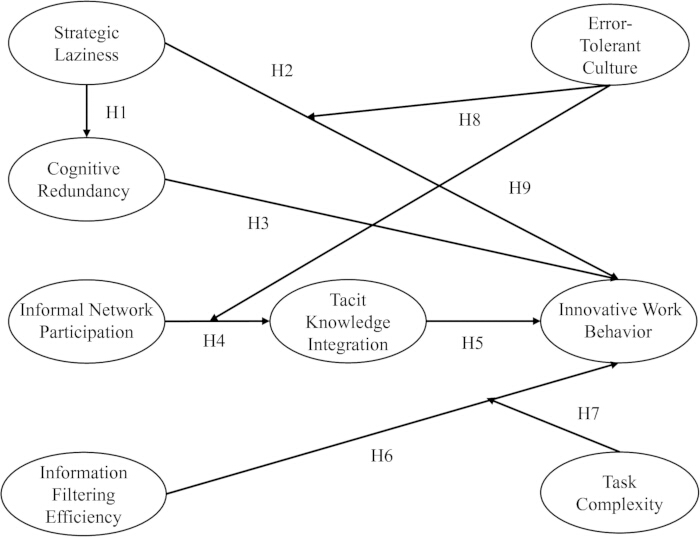
Figure 1: Conceptual Framework. Individual-level enablers (Strategic Laziness, information filtering Efficiency) are distinguished from network-based mechanisms (Informal Network Participation) and emergent organizational outcomes (innovative work behavior, Tacit Knowledge Integration, Error-Tolerant Culture). Arrows or linking lines denote hypothesized directional relationships among these clusters. Please click here to view a larger version of this figure.
Cognitive redundancy originated in cognitive psychology and has recently been applied to organizational behavior as a resource that supports deeper thinking and innovation7,20,34. From a COR perspective, cognitive redundancy represents a resource surplus created through effective resource conservation. When employees practice strategic laziness by reducing engagement in low-value tasks, they preserve cognitive resources, creating cognitive redundancy that supports exploratory thinking and creative problem solving8. This resource-preserving behavior directly enhances the mental slack required for innovative ideation. Regarding the relationship between strategic laziness and innovative work behavior, on the one hand, resource-conservation strategies can theoretically generate sufficient cognitive surplus, thereby directly stimulating innovation. However, COR theory suggests that conserving resources alone is insufficient unless those resources are invested effectively22. It is necessary to strategically invest resources to generate returns. Employees who save resources may not automatically be guided towards innovation; these resources may be redirected towards completing daily tasks or personal recovery. If there is no clear intermediary mechanism to guide the saved resources into creative activities, the direct effect may be weak or non-existent. Cognitive redundancy provides employees with the mental capacity for exploratory thinking and creative ideation8,19.
Cognitive load theory suggests that individuals have limited processing capacity, and when cognitive resources are depleted, higher-order thinking suffers34. Cognitive redundancy alleviates this depletion, allowing employees to engage in the mental simulation, scenario planning, and divergent thinking that are essential for generating novel ideas. From a COR perspective, cognitive redundancy represents a resource surplus that employees can invest in innovation-related activities without fear of depleting their core capabilities22. When employees have abundant cognitive capacity, they are more likely to engage in the creative problem-solving processes that define innovative work behavior. Therefore, the following hypothesis is proposed.
H1: Strategic laziness is positively related to cognitive redundancy.
H2: Cognitive redundancy is positively related to innovative work behavior.
H3: Information filtering efficiency is positively related to innovative work behavior.
Beyond internal cognitive mechanisms, resource conservation also facilitates innovation through social knowledge processes. Informal Network Participation (INP) allows employees to access a wide range of social resources, especially tacit knowledge, which is experiential, challenging to codify, and primarily transmitted through interpersonal interactions14,16. In line with Nonaka's SECI model, informal networks facilitate the socialization process by enabling tacit knowledge sharing through collective experiences41,42. According to the conservation of resources (COR) framework, strategic laziness preserves employees' cognitive resources, thereby enabling greater participation in informal interactions. As a result, employees are better able to acquire, interpret, and integrate knowledge from colleagues, thereby enhancing collaborative knowledge integration and organizational learning27.
Although conserving cognitive resources is essential, resource conservation alone does not guarantee innovation. Conserved resources may instead be redirected toward routine work or personal recovery unless they are effectively allocated to creative activities. Information filtering efficiency (IFE), grounded in information processing theory, enables employees to distinguish relevant information from irrelevant stimuli, thereby reducing cognitive overload and directing conserved cognitive resources toward value-creating activities37,38,41. By functioning as a cognitive filter, IFE ensures that the resources preserved through strategic laziness are invested in innovative problem-solving rather than dissipated through unnecessary information processing.
In line with Nonaka's SECI model, informal networks act as the primary engines of the socialization phase, converting raw personal interactions into integrated collective insights. Under the COR framework, the cognitive bandwidth saved through strategic laziness provides employees with the relational energy needed to actively participate in these informal interactions, enabling them to acquire, interpret, and integrate colleagues' insights into a shared organizational knowledge base. Accordingly, the following structural path hypotheses are formulated.
H4: Informal network participation is positively related to tacit knowledge integration.
H5: Tacit knowledge integration is positively related to innovative work behavior.
H6: Information filtering efficiency mediates the relationship between strategic laziness and innovative work behavior.
Task complexity refers to the extent to which a task involves multiple interconnected elements, uncertain outcomes, and high information-processing demands24,40. Complex tasks rapidly deplete cognitive resources, making efficient resource allocation particularly critical25,43,44,45,46,47,48,49. From a COR perspective, the salience of resource conservation and efficient allocation is heightened under conditions of threat or demand. When task complexity is high, the marginal return from effective information filtering increases dramatically, and efficient filtering becomes essential to preventing cognitive overload and preserving the resources necessary for innovation41,50. Thus, a moderating effect was proposed.
H7: Strategic laziness is positively related to innovative work behavior.
H8: Task complexity positively moderates the relationship between information filtering efficiency and innovative work behavior.
Beyond task characteristics, organizational climate also shapes how employees utilize social resources for innovation. Edmondson defined psychological safety as a shared team-level belief that members will not be punished or humiliated for speaking up with ideas, questions, concerns, or mistakes13. Zhou and Zhang15 conceptualized an error-tolerant culture as one that destigmatizes failures, views them as learning opportunities, and mitigates the perceived psychological cost of making mistakes. Thus, error-tolerant culture is defined as a shared organizational perception that failures inherent in exploratory activities are accepted, provided they are adequately managed and learned from. ETC is a vital contextual resource that creates a “resource safety net”. Sharing half-formed ideas and integrating unproven tacit knowledge during informal interactions is socially risky; a high ETC protects against the loss of these social and psychological resources by destigmatizing failure and encouraging experimentation. This safety net makes employees more willing to engage in risky exchanges and to integrate tacit knowledge, thereby strengthening the link between INP and TKI5. Hence, the following hypotheses are formulated.
H9: Error-tolerant culture positively moderates the relationship between informal network participation and tacit knowledge integration.
Access restricted. Please log in or start a trial to view this content.
Protocol
This study adhered strictly to ethical research principles, including compliance with the Declaration of Helsinki. Ethical approval was granted by the Ethics Committee of the School of Management, North Sichuan Medical College (Approval No. JG2024-0948; Approval Date: March 5, 2025). All research procedures were performed in accordance with relevant ethical guidelines and regulations. Informed consent was obtained from all participants, and they were informed of their right to withdraw at any time without consequence.
Sampling procedure and industry selection
Data were collected through an online survey platform, a widely used professional survey tool in China. The target population consisted of knowledge workers employed in four industries: information technology, finance, education, and healthcare.
These industries were selected based on three criteria. First, they involve substantial cognitive demands that require sustained attention, complex problem-solving, and information processing, making them appropriate contexts for examining strategic laziness as a resource-conservation strategy. Second, they feature informal organizational networks in which tacit knowledge exchange occurs through spontaneous interactions, enabling the examination of the social-knowledge pathway. Third, they represent diverse sectors with varying levels of task complexity, allowing investigation of task complexity as a boundary condition. Information technology workers face rapidly evolving technical challenges; financial professionals navigate complex market uncertainties; educators adapt to diverse learning needs and pedagogical innovations; and healthcare workers manage high-stakes, information-intensive clinical decisions.
A non-probability purposive sampling strategy was employed to select employees in roles that require significant cognitive engagement and innovation. To improve sample diversity across regions and organizational levels, the survey was disseminated through multiple channels: professional networks (e.g., industry-specific online communities), industry associations (e.g., technology associations, financial institutes), and corporate contacts across eastern, central, and western regions of China. A snowball sampling component was also incorporated, in which initial participants were encouraged to share the survey link with eligible colleagues, thereby facilitating access to otherwise hard-to-reach professional networks. Potential participants were invited via email or workplace messaging platforms (e.g., WeChat, DingTalk), with a brief explanation of the study's purpose and a link to the online questionnaire. Before proceeding, participants were required to read an ethical statement outlining the research purpose, procedures, potential benefits, and risks, and to indicate their consent by clicking “I agree to participate.” Participation was entirely voluntary and anonymous, and respondents were assured that their data would be kept confidential and used only for academic research purposes.
Data collection timeline and exclusion criteria
Data collection took place from April 15 to July 20, 2025. A total of 412 questionnaires were returned. After data collection, a systematic screening process was applied to ensure data quality. First, responses with completion times of less than two minutes were excluded, as pilot testing indicated that the questionnaire required approximately 8–10 min to complete thoughtfully; such rapid completion suggested insufficient attention or random responding. Second, incomplete submissions with more than 10% missing responses were removed. Third, responses showing inconsistent patterns, including straight-lining (identical responses across all items), extreme response biases (e.g., all “1” or all “5”), and logically contradictory answers to reverse-coded items, were identified using standardized visual inspection and statistical outlier detection (Mahalanobis distance) and subsequently excluded44,45. Exclusion criteria were established prior to data analysis to reduce the researcher's degrees of freedom. After applying these criteria, 356 valid responses were retained for analysis. The response rate was 86.4%. A post hoc power analysis was conducted using G*Power 3.1. At a significance level of α = 0.05, statistical power of 0.95, and a medium effect size (f2 = 0.15), the minimum required sample size was determined to be 166. The final sample of 356 participants exceeded this threshold, thereby ensuring sufficient statistical power for subsequent analyses.
Single-source data and common method variance
All data were collected from the same respondents (self-report measures), which raises the potential concern of common method variance (CMV). This single-source design was adopted because the study examines individual-level perceptions and behaviors (strategic laziness, cognitive states, network participation, innovative behavior) that are best assessed through self-reports. To assess potential common method variance (CMV), both procedural and statistical remedies were applied. Statistically, Harman's single-factor test was conducted using the initial pool of 54 survey items. An exploratory factor analysis (EFA) with a single unrotated factor showed that the first factor explained 31.8% of the total variance, which is below the commonly accepted 40%–50% threshold46, indicating that CMV is unlikely to be a serious concern. The marker variable technique, using a theoretically unrelated construct (attitude toward the workplace physical environment), also revealed no significant correlations with the study variables, providing further evidence against substantial CMV47. After these assessments, item purification and confirmatory factor analysis (CFA) were conducted, resulting in the removal of 12 items with low factor loadings (λ < 0.50) or high cross-loadings. The final measurement model comprised 42 validated items for subsequent structural equation modeling (SEM).
Variable measurement
The questionnaire consisted of two sections. The first section collected demographic information (gender, age, education, tenure, and position). The second section measured the core constructs of the theoretical model using established scales. All items were rated on a 5-point Likert scale ranging from 1 (“strongly disagree”) to 5 (“strongly agree”), unless otherwise noted. Following standard practices for research conducted in Chinese contexts, a rigorous translation and adaptation process was employed. Given that strategic laziness is a relatively new construct with no established scale in the existing literature, a systematic scale development procedure was undertaken in accordance with established guidelines for new measure development. The process comprised five stages (see Supplementary File 1 and Table 1 for details)
| Construct | Items | Sources | Cronbach's α |
| Strategic Laziness | 6 | Demerouti et al. [43, 51, 52] | 0.92 |
| Information Filtering Efficiency | 6 | Kahneman [37] | 0.9 |
| Innovative Work Behavior | 6 | Scott & Bruce [2] | 0.9 |
| Task Complexity | 6 | Liu & Li [25] | 0.88 |
| Informal Network Participation | 6 | Horak & Suseno [14] | 0.9 |
| Tacit Knowledge Integration | 6 | Nonaka & Takeuchi [42] | 0.9 |
| Error-Tolerant Culture | 6 | Edmondson [13] | 0.9 |
Table 1: Sources of Measurement Items for the Questionnaire. Table 1 summarizes the measurement instrument, listing each of the eight constructs along with the number of items 42 , their adapted sources from prior literature, and the Cronbach’s alpha coefficients. The alpha values, ranging from 0.87 to 0.92, all exceed the 0.80 threshold, confirming strong internal consistency and reliability across all scales used in the study.
Scale adaptation process
To ensure the validity and cultural appropriateness of the measurement instruments in the Chinese context, a rigorous scale adaptation process was undertaken. First, all original English scales were independently translated into Chinese by two bilingual researchers with expertise in organizational behavior. Next, a third researcher, blind to the original versions, performed a back-translation into English. Any discrepancies between the back-translated items and the originals were discussed and resolved by the research team to achieve conceptual equivalence.
The translated Chinese questionnaire was then subjected to a cognitive interviewing phase with a small sample of 15 target respondents (knowledge workers). This step aimed to identify any ambiguous wording, unfamiliar expressions, or contextual misunderstandings. Based on their feedback, minor adjustments were made to improve clarity and relevance. Finally, a pilot test was conducted with 50 employees (not included in the final sample), and an item analysis was performed. All items demonstrated acceptable corrected item-total correlations (greater than 0.40), and no items were deleted at this stage. This multi-step process ensured the content validity and contextual fit of the measurement tools.
Access restricted. Please log in or start a trial to view this content.
Results
Descriptive statistics
The final sample consisted of 356 valid responses. Demographic characteristics are presented in Figure 2. The sample was relatively balanced by gender (52% male, 48% female) and skewed towards a younger, well-educated population, with 71.3% of participants aged 45 or below and 70.8% holding a bachelor's or master's degree. Most respondents were in early to mid-career stages (tenure of 1–10 years: 63.8%) and...
Access restricted. Please log in or start a trial to view this content.
Discussion
This study investigated whether and how strategic laziness, defined as the deliberate conservation of cognitive resources through selective task engagement, contributes to innovative work behavior. Based on the Conservation of Resources (COR) theory, a simplified framework was tested in which strategic laziness influences innovation through an information-filtering pathway and a social-network pathway, with task complexity and an error-tolerant culture establishing the boundary conditions, as depicted in
Access restricted. Please log in or start a trial to view this content.
Disclosures
The authors declare that they have no competing financial or non-financial interests related to this work.
Acknowledgements
The authors sincerely acknowledge the North Sichuan Medical College for providing ethical review and institutional support for this study (Project No. JG2024-0948). The authors also thank all participants for their voluntary involvement and valuable contributions to the research process.
The authors would like to acknowledge the funding support from The Ministry of Education of the People’s Republic of China (Project: National First-Class Course – “Practical Pathways for the Integration of Medical Students’ Innovation and Entrepreneurship”; Project No.: 2023-1598).
Access restricted. Please log in or start a trial to view this content.
Materials
| Name | Company | Catalog Number | Comments |
|---|---|---|---|
| Online Survey Platform | Wenjuanxing | N/A | A professional Chinese online survey tool used for questionnaire distribution and data collection. |
| Questionnaire (Full Set) | N/A (Developed by Authors) | N/A | A self-administered survey composed of two sections: (1) demographics and (2) nine core constructs. All items rated on a 5-point Likert scale. |
| Strategic Laziness Scale | N/A (Newly Developed) | N/A | A new scale developed for this study following a systematic 5-stage procedure to measure the focal construct. Details in supplementary materials. |
| Cognitive States Scale | Adapted from established scales | N/A | Scale(s) measuring relevant cognitive states (e.g., mental fatigue, cognitive engagement). Adapted and validated for the Chinese context. |
| Network Participation Scale | Adapted from established scales | N/A | Scale(s) measuring participation in informal organizational networks for tacit knowledge exchange. Adapted and validated for the Chinese context. |
| Innovative Behavior Scale | Adapted from established scales | N/A | Scale(s) measuring individual innovative behavior at work. Adapted and validated for the Chinese context. |
| Task Complexity Scale | Adapted from established scales | N/A | Scale(s) measuring perceived task complexity, used as a boundary condition. Adapted and validated for the Chinese context. |
| Marker Variable Scale | Adapted from established scales | N/A | Scale measuring attitude toward the workplace physical environment. Used for statistical assessment of Common Method Variance (CMV). |
| Recruitment/Invitation Text | N/A | N/A | Standardized email or messaging platform (e.g., WeChat, DingTalk) text explaining the study's purpose and providing a link to the questionnaire. |
| Ethical Approval Documentation | Ethics Committee of the School of Management, North Sichuan Medical College | Approval No. JG2024-0948 | Official approval document confirming ethical compliance with the Declaration of Helsinki, dated March 5, 2025. |
| Informed Consent Statement | N/A | N/A | An introductory statement within the questionnaire outlining the research purpose, procedures, benefits, risks, and participant rights. Requires active consent ("I agree to participate"). |
| Data Analysis Software | N/A (e.g., SPSS, AMOS, Mplus) | N/A | Statistical software used for data screening (e.g., Mahalanobis distance), Harman's single-factor test, and all subsequent analyses. |
| Cognitive Interviewing Sample | N/A | N/A | A small sample of 15 target respondents (knowledge workers) used to pre-test the translated questionnaire for clarity and relevance. |
| Pilot Test Sample | N/A | N/A | A sample of 50 employees (not included in the final sample) used to conduct an item analysis and check the reliability (corrected item-total correlations) of the survey scales. |
References
- Farida I, Setiawan D. Business strategies and competitive advantage: the role of performance and innovation. J Open Innov Technol Mark Complex. 2022;8(3):163. doi:10.3390/joitmc8030163.
- Scott SG, Bruce RA. Determinants of innovative behavior: a path model of individual innovation in the workplace. Acad Manage J. 1994;37(3):580–607.
- Janssen O. Job demands, perceptions of effort-reward fairness and innovative work behaviour. J Occup Organ Psychol. 2000;73(3):287–302.
- Microsoft. Will AI fix work Work Trend Index annual report. Redmond (WA): Microsoft Corporation; 2023:https://www.microsoft.com/en-us/worklab/work-trend-index/will-ai-fix-work
- Wang Q, Zhang X, Zhang N, Su J. Error management climate, psychological security, and employee bootleg innovation behavior: the moderating role of risk-taking traits. Front Psychol. 2025;16:1538584. doi:10.3389/fpsyg.2025.1538584.
- Srirahayu DP, Ekowati D, Sridadi AR. Innovative work behavior in public organizations: a systematic literature review. Heliyon. 2023;9(2):e13557. doi:10.1016/j.heliyon.2023.e13557.
- Ward TB. Creative cognition as a window on creativity. Methods. 2007;42(1):28–37.
- Zanjani S, Griffin M, Dartnall T. Creative procrastinators: mapping a complex terrain. Pers Individ Dif. 2020;154:109658. doi:10.1016/j.paid.2019.109658.
- Chu AHC, Choi JN. Rethinking procrastination: positive effects of “active” procrastination behavior on attitudes and performance. J Soc Psychol. 2005;145(3):245–264.
- Risko EF, Gilbert SJ. Cognitive offloading. Trends Cogn Sci. 2016;20(9):676–688.
- Gevers J, Mohammed S, Baytalskaya N. The conceptualisation and measurement of pacing styles. Appl Psychol. 2015;64(3):499–540.
- Clausen T, et al. Job autonomy and psychological well-being: a linear or a nonlinear association Eur J Work Organ Psychol. 2022;31(3):395–405.
- Edmondson A. Psychological safety and learning behavior in work teams. Adm Sci Q. 1999;44(2):350–383.
- Horak S, Suseno Y. Informal networks, informal institutions, and social exclusion in the workplace: insights from subsidiaries of multinational corporations in Korea. J Bus Ethics. 2023;186(3):633–655.
- Zhou Q, Zhang H. Error management culture and college students’ self-development: the serial mediating roles of grit and learning from failure. Innov Educ Teach Int. 2024:doi:10.1080/14703297.2024.2417803.
- Hobfoll SE. Conservation of resources: a new attempt at conceptualizing stress. Am Psychol. 1989;44(3):513–524.
- Halbesleben JRB, Neveu JP, Paustian-Underdahl SC, Westman M. Getting to the “COR”: understanding the role of resources in conservation of resources theory. J Manage. 2014;40(5):1334–1364.
- Sonnentag S, Meier LL. Gain and loss cycles revisited: what to consider when testing key assumptions of conservation of resources theory. J Manag Sci Rep. 2024;2(2):154–167.
- Gronau QF, Moran R, Eidels A. Efficiency in redundancy. Sci Rep. 2024;14(1):17109. doi:10.1038/s41598-024-68127-x.
- Albers F, et al. Different types of redundancy and their effect on learning and cognitive load. Br J Educ Psychol. 2023;93(2):339–352.
- Sweller J. Cognitive load during problem solving: effects on learning. Cogn Sci. 1988;12(2):257–285.
- Hobfoll SE, Halbesleben J, Neveu JP, Westman M. Conservation of resources in the organizational context: the reality of resources and their consequences. Annu Rev Organ Psychol Organ Behav. 2018;5:103–128.
- Drody AC, Pereira EJ, Smilek D. Attention in our digital ecosystem: the five interactive components that drive media multitasking. Psychon Bull Rev. 2025;32:2454–2471.
- Wood RE. Task complexity: definition of the construct. Organ Behav Hum Decis Process. 1986;37(1):60–82.
- Liu P, Li Z. Task complexity: a review and conceptualization framework. Int J Ind Ergon. 2012;42(6):553–568.
- Nonaka I. A dynamic theory of organizational knowledge creation. Organ Sci. 1994;5(1):14–37.
- Sun X, et al. On tacit knowledge management in product design: status, challenges, and trends. J Eng Des. 2025;36(3):417–454.
- [28] Zychová K, Fejfarová M, Jindrová A. Job autonomy as a driver of job satisfaction. Cent Eur Bus Rev. 2024;13(2):117–140.
- Utomo HJN, et al. Investigating the role of innovative work behavior, organizational trust, perceived organizational support: an empirical study on SMEs performance. J Law Sustain Dev. 2023;11(2):e417. doi:10.55908/sdgs.v11i2.417.
- Westman M, et al. Organizational stress through the lens of conservation of resources (COR) theory. In: Perrewé PL, Ganster DC, editors. Exploring interpersonal dynamics. Vol. 4. London: Emerald Group Publishing Limited; 2004. p. 167–220.
- Wright TA, Hobfoll SE. Commitment, psychological well-being and job performance: an examination of conservation of resources (COR) theory and job burnout. J Bus Manag. 2004;9(4):389–406.
- Saini A, Rangnekar S. Impact of job demands and resources on idea generation: a COR theory perspective. Acta Univ Bohemiae Meridionalis. 2024;27(2):31–49.
- Hasannejad R, Safania MA, Afarinesh Khaki A. Correlation of organizational laziness with organizational performance mediated by organizational inertia in the staff of the Ministry of Sports and Youth. J Health Promot Manage. 2022;11(1):72–84.
- Sweller J. Cognitive load theory and educational technology. Educ Technol Res Dev. 2020;68(1):1–16.
- Hackman JR, Oldham GR. Motivation through the design of work: test of a theory. Organ Behav Hum Perform. 1976;16(2):250–279.
- Gajendran RS, Harrison DA, Delaney-Klinger K. Are telecommuters remotely good citizens Unpacking telecommuting’s effects on performance via ideals and job resources. Pers Psychol. 2015;68(2):353–393.
- Kahneman D. Attention and effort. Englewood Cliffs (NJ): Prentice-Hall; 1973.
- Chen O, Paas F, Sweller J. A cognitive load theory approach to defining and measuring task complexity through element interactivity. Educ Psychol Rev. 2023;35(2):63. doi:10.1007/s10648-023-09782-w.
- Kim S, et al. Large language models meet collaborative filtering: an efficient all-round LLM-based recommender system [conference paper]. Presented at: 30th ACM SIGKDD Conference on Knowledge Discovery and Data Mining; Barcelona, Spain; 2024. p. 1395–1406. https://doi.org/10.1145/3637528.3671931
- Campbell DJ. Task complexity: a review and analysis. Acad Manage Rev. 1988;13(1):40–52.
- Abdi Tabari M, Hiver P, Norouzian R. Interactions between task complexity, task repetition, and task motivation in L2 writing. Lang Teach Res. 2024:doi:10.1177/13621688241286661.
- Nonaka I, Takeuchi H. The knowledge-creating company: how Japanese companies create the dynamics of innovation. New York: Oxford University Press; 1995.
- Petrou P, et al. Crafting a job on a daily basis: contextual correlates and the link to work engagement. J Organ Behav. 2012;33(8):1120–1141.
- Sonnentag S. Recovery, work engagement, and proactive behavior: a new look at the interface between nonwork and work. J Appl Psychol. 2003;88(3):518–528.
- Zhou J, George JM. When job dissatisfaction leads to creativity: encouraging the expression of voice. Acad Manage J. 2001;44(4):682–696.
- Hair JF Jr, Black WC, Babin BJ, Anderson RE. Multivariate data analysis. 8th ed. Andover (UK): Cengage Learning; 2019.
- Leong LY, Hew TS, Ooi KB, Dwivedi YK. Predicting the determinants of NFC mobile wallet acceptance: a neural networks approach. Expert Syst Appl. 2020;140:112899. doi:10.1016/j.eswa.2019.112899.
- Anderson N, Potočnik K, Zhou J. Innovation and creativity in organizations: a state-of-the-science review, prospective commentary, and guiding framework. J Manage. 2014;40(5):1297–1333.
- Xia Y, Muslim Bin Md Zalli M. Dimensions and determinants of psychological adaptation among Chinese college students. Int J Manag Think. 2025;3(1):38–60.
- Long Chen H. Project technological capacity and project outcomes: the moderating role of team creativity. J Adv Humanit Res. 2022;1(2):69–76.
- DeVellis RF. Scale development: theory and applications. 4th ed. Thousand Oaks (CA): SAGE Publications; 2017.
- Hinkin TR. A brief tutorial on the development of measures for use in questionnaires. Organ Res Methods. 1998;1(1):104–121.
Access restricted. Please log in or start a trial to view this content.