This randomized controlled trial provides a reproducible protocol for standardized acupuncture plus modified Xiaoxuming Decoction as an adjunct to acute ischemic stroke care. The intervention was associated with modest day-28 neurological improvement and selected biomarker differences; participant-level analyses did not support mediation or a causal mediation claim.
Research Article
Standardized Acupuncture Plus Modified Xiaoxuming Decoction for Acute Ischemic Stroke: A Randomized Controlled Trial
* These authors contributed equally
In This Article
Summary
Abstract
Acute ischemic stroke is accompanied by systemic inflammation and intestinal microbial disturbance. This single-center, assessor-blinded randomized controlled trial tested whether standardized acupuncture plus modified Xiaoxuming Decoction, added to standard care, improved early neurological recovery and was associated with predefined gut and inflammatory biomarkers. Adults with imaging-confirmed acute ischemic stroke within 72 h and a National Institutes of Health Stroke Scale (NIHSS) score of 4–15 were randomized 1:1 to standard care or the combined intervention for 28 days, with 64 participants per group. The primary endpoint was day-28 NIHSS adjusted for baseline NIHSS, age, sex, reperfusion therapy, and onset-to-randomization time, with missing outcomes handled by 30-fold multiple imputation. Secondary and exploratory outcomes included the Barthel Index, day-90 modified Rankin Scale (mRS), adverse events, inflammatory markers, lipopolysaccharide (LPS), fecal microbial diversity, selected genera, and short-chain fatty acids. Multiple imputation analysis estimated a lower day-28 NIHSS score in the intervention group (adjusted difference: −1.30 points; 95% confidence interval: −2.36 to −0.24; P = 0.017). Day-28 Barthel Index was higher, whereas day-90 NIHSS, Barthel Index, and observed mRS 0–2 did not differ significantly. At day 28, the intervention group had higher Shannon diversity and fecal butyrate and lower interleukin-6 and LPS. Participant-level changes in butyrate, interleukin-6, LPS, and Shannon diversity were not significantly associated with NIHSS change; therefore, mediation analysis was not performed. No intervention-related serious adverse event was identified. The combined intervention was associated with modest early neurological improvement and selected biomarker differences, but the biological findings are exploratory and do not establish a causal brain–gut pathway.
Introduction
Stroke remains a leading cause of death and long-term disability worldwide, and ischemic stroke accounts for most cases. Standard care emphasizes rapid diagnosis, reperfusion when indicated, antiplatelet therapy, risk-factor management, complication prevention, and rehabilitation1,2. Even with these measures, residual neurological deficits are common, motivating evaluation of reproducible adjunctive interventions.
Post-ischemic inflammation, endothelial and blood–brain barrier stress, peripheral immune activation, and metabolic disturbance contribute to secondary injury and recovery3. Stroke can also alter intestinal motility, permeability, microbial composition, and gut-derived immune signaling, creating bidirectional associations commonly described as the brain–gut axis4.
Clinical studies have associated acute ischemic stroke with gut dysbiosis, altered short-chain fatty acid (SCFA) profiles, and poorer outcomes5. Butyrate is of interest because it supports epithelial barrier integrity and regulates immune signaling6. These observations justify measuring microbial diversity, microbial metabolites, endotoxin exposure, and inflammatory mediators alongside neurological outcomes, while recognizing that parallel changes do not prove mediation.
Acupuncture has been evaluated as adjunctive stroke therapy, but published trials differ in timing, acupoint selection, frequency, and outcome assessment7,8. A reproducible protocol therefore requires explicit needling, stimulation, retention, safety, and adherence procedures. Xiaoxuming Decoction is a classical herbal formula used for stroke-related conditions. Systematic and pharmacological studies report possible benefit, but the clinical evidence remains limited by sample size, heterogeneity, and risk of bias9,10. Its contribution cannot be separated from acupuncture in a two-group combined-intervention design.
This trial evaluated a standardized combined intervention using clinical outcomes and predefined exploratory gut and inflammatory biomarkers11. The hypothesis was that adding standardized acupuncture plus modified Xiaoxuming Decoction to standard care would improve early neurological recovery and favorably alter predefined brain–gut axis-related biomarkers.
Protocol
Ethics approval for this study was issued by the Medical Ethics Committee of the Hospital of Traditional Chinese Medicine and Western Medicine in Dazhou City on June 10, 2025 (approval no. 2025–29; valid through June 9, 2027). Each participant or legally authorized representative provided written informed consent before randomization. Consent covered acupuncture, herbal treatment, blood and fecal collection, microbiome data protection, and withdrawal from biological sampling without loss of standard care. Procedures followed the Declaration of Helsinki. The research tools used in the protocol are listed in the Table of Materials. The trial was not prospectively registered because registration had not been completed before participant recruitment began.
1. Study design and randomization
Participants were recruited from March 1 to December 31, 2025, and each participant was followed for 90 days. The study used a single-center, assessor-blinded, parallel-group design with a 28-day active intervention. Eligible participants were assigned 1:1 to standard care or standard care plus acupuncture and modified Xiaoxuming Decoction. Randomization used computer-generated blocks of 4 or 6 and was stratified by baseline NIHSS score (4–8 vs. 9–15). Allocation was concealed using sequentially numbered, opaque, sealed envelopes.
The final 28-day intervention was completed on January 28, 2026, final follow-up was completed on March 31, 2026, the database was locked on April 15, 2026, and the prespecified analysis was completed by April 30, 2026. The study followed CONSORT principles12; participant flow is shown in Figure 1, and the assessment schedule is provided in Table 1.
2. Participant screening and enrollment
Patients with acute ischemic stroke confirmed by computed tomography or magnetic resonance imaging were screened within 72 h of symptom onset or last known well time. Eligible participants were adults aged 40–80 years with a baseline National Institutes of Health Stroke Scale (NIHSS) score of 4–15, stable vital signs after emergency evaluation, the ability to begin the allocated intervention within 24 h, and willingness to provide blood and fecal samples. NIHSS assessments were performed by trained assessors13.
Exclusion criteria were intracerebral hemorrhage; transient ischemic attack without infarction; coma; planned decompressive surgery; unsafe oral intake; active infection requiring systemic antibiotics; antibiotic, probiotic supplement, or prebiotic supplement use within 4 weeks; inflammatory bowel disease; chronic diarrhea; gastrointestinal surgery within 6 months; malignancy; severe hepatic or renal dysfunction; uncontrolled hypertension; unstable coronary disease; unsuitable arrhythmia; platelet count < 80 × 109/L; contraindication to acupuncture; allergy to the herbal formula; pregnancy or lactation; participation in another interventional trial within 3 months; or inability to complete follow-up. Ordinary plant foods, pickled vegetables, and fermented tofu were not classified as prohibited products because routine Chinese diets could not be fully standardized.
3. Standard care and microbiome-relevant exposures
Both groups received guideline-directed care, including intravenous thrombolysis and/or mechanical thrombectomy when indicated; antiplatelet, lipid-lowering, blood-pressure, and glucose management; hydration and nutrition; dysphagia screening; prevention of pneumonia and deep-vein thrombosis; rehabilitation; and secondary prevention14. Reperfusion therapy was not delayed or replaced because of study participation.
From randomization through day 28, non-study acupuncture, moxibustion, stroke-related herbal prescriptions, probiotic/prebiotic/synbiotic supplements, and microbiota-targeted preparations were prohibited. Participants and caregivers were informed that these restrictions applied to supplements and marketed probiotic products rather than routine foods.
Reperfusion therapy and protocol deviations were recorded. Diet, dysphagia severity, enteral nutrition, post-randomization antibiotics, proton pump inhibitor use, constipation, and length of stay were recorded as potential microbiome-related confounders. These variables were not included as covariates in the microbiome statistical models and were therefore considered residual confounders.
4. Allocation concealment
The randomization sequence was generated by an independent statistician. Sequentially numbered, opaque, sealed envelopes were prepared by a coordinator who was not involved in recruitment, treatment, outcome assessment, laboratory work, or statistical analysis. The next envelope was opened only after informed consent, confirmation of eligibility, and completion of baseline assessments. The randomization sequence was stored in a password-protected file that remained inaccessible to outcome assessors, laboratory personnel, and analysts until completion of the primary analysis.
5. Outcome, laboratory, and analysis blinding
NIHSS, Barthel Index, and modified Rankin Scale (mRS) assessments were conducted by assessors who were separate from treatment delivery. Participants and caregivers were instructed not to disclose treatment allocation to outcome assessors. Biological specimens were labeled using coded identifiers, and laboratory personnel and statisticians remained blinded to group codes until the prespecified analyses were finalized. Accidental unblinding events were documented.
6. Standardized manual acupuncture
Acupuncture was initiated within 24 h after randomization after the treating neurologist confirmed hemodynamic stability and acceptable bleeding risk. Treatment was scheduled as one 30-min session per day, 5 days per week for 4 weeks, for a total of 20 planned sessions.
Participants were positioned safely, and the skin was disinfected before needling. Baihui (GV20), Shuigou (GV26), bilateral Fengchi (GB20), Quchi (LI11), Hegu (LI4), Zusanli (ST36), Yanglingquan (GB34), and Sanyinjiao (SP6) were needled according to the laterality and depth specified in Table 215.
Sterile disposable stainless-steel acupuncture needles measuring 0.25 mm × 40 mm were used. Needles were inserted to depths of 10–25 mm according to the acupoint and body habitus. Manual lifting–thrusting and twirling were applied until deqi or a local needling response was obtained. Needles were retained for 30 min and manually restimulated every 10 min. Electroacupuncture was not used.
Acupuncture was performed by licensed acupuncturists with at least 5 years of clinical experience. Sessions were postponed in the presence of fever, unstable blood pressure, neurological deterioration, active bleeding, severe agitation or fatigue, or participant refusal. The reason for postponement and any associated adverse event were recorded.
7. Modified Xiaoxuming Decoction
Each daily dose contained Ephedrae Herba 6 g, Cinnamomi Ramulus 9 g, Paeoniae Radix Alba 12 g, Saposhnikoviae Radix 9 g, Zingiberis Rhizoma Recens 6 g, Glycyrrhizae Radix et Rhizoma 6 g, Angelicae Sinensis Radix 10 g, Chuanxiong Rhizoma 10 g, Astragali Radix 20 g, Poria 15 g, and Paeoniae Radix Rubra 12 g. The identities of the prescribed crude herbs were verified by the hospital pharmacy prior to preparation, and routine dispensing and decoction procedures were followed. The formula is detailed in Table 39˒16.
Only predefined modifications were permitted. Cannabis Fructus 10 g could be added for constipation, Poria could be increased to 20 g for loose stool, and Astragali Radix could be increased to 30 g for marked spontaneous sweating. Every modification, missed dose, vomiting episode, and treatment interruption was recorded.
One daily dose was decocted in the hospital pharmacy and concentrated to 400 mL. The preparation was divided into two 200 mL portions and administered after breakfast and dinner for 28 days. Administration was withheld in cases of unsafe swallowing, persistent vomiting, allergy, alanine/aspartate aminotransferase >3× the upper limit of normal, estimated glomerular filtration rate <45 mL/min/1.73 m2, uncontrolled blood pressure, clinically important tachyarrhythmia, new chest pain, or investigator-determined risk.
8. Control-group restrictions
Participants assigned to the control group received standard care alone. Non-protocol acupuncture, moxibustion, stroke-related herbal therapy, probiotic/prebiotic/synbiotic supplements, and microbiota-targeted products were prohibited through day 28. Any use of these interventions was recorded as a protocol deviation.
9. Adherence and safety monitoring
Acupuncture adherence was calculated as the number of completed sessions divided by the 20 planned sessions. Herbal adherence was assessed using returned packages and medication diaries. Per-protocol adherence was defined as completion of at least 16 acupuncture sessions and consumption of at least 80% of prescribed decoction doses. Inpatients were observed daily, and outpatients were monitored at scheduled follow-up contacts. Recorded adverse events included local bleeding, hematoma, pain, dizziness, syncope, infection, gastrointestinal symptoms, rash, hepatic or renal abnormalities, palpitations, blood-pressure fluctuation, and allergy. Serious adverse events and their attribution were independently classified by two clinicians as unrelated, possibly related, probably related, or definitely related.
10. Clinical outcome assessment
NIHSS was assessed at baseline and on days 14, 28, and 90. Day-28 NIHSS, adjusted for baseline NIHSS, was the primary endpoint. Barthel Index was assessed at baseline and on days 28 and 90, and mRS was assessed on day 90. Recurrent stroke, all-cause death, and adverse events were recorded through day 9017. Favorable day-90 outcome was defined as mRS 0–2. The clinical and biological outcomes, assessment time points, definitions, and analysis classifications are summarized in Table 4.
11. Blood collection and biomarker assays
Venous blood was collected at baseline before intervention and on days 14 and 28, preferably between 06:30 and 08:30 after overnight fasting. Non-fasting collection was documented when applicable.
Samples were processed within 2 h. Centrifugation was performed at 850 × g for 10 min at 4 °C. Serum and plasma were aliquoted into sterile cryovials and stored at −80 °C. Samples from the same participant were kept within the same assay batch whenever possible.
High-sensitivity C-reactive protein, interleukin-6 (IL-6), tumor necrosis factor-alpha, lipopolysaccharide (LPS), and zonulin were quantified using the specified assays. IL-6, tumor necrosis factor-alpha, LPS, and zonulin were measured in duplicate, and measurements were repeated when the duplicate coefficient of variation exceeded 15%.
Manufacturer-reported catalog specifications, rather than study-specific validation results, were as follows: hs-CRP sensitivity, 5.36 pg/mL; range, 18.75–1,200 pg/mL; serum intra-/inter-assay CVs, 1.4%/4.0%; IL-6 sensitivity, 0.7 pg/mL; range, 3.12–300 pg/mL; serum/plasma intra-assay CV, 1.6%–4.2%; inter-assay CV, 3.3%–6.4%; tumor necrosis factor-alpha sensitivity, 6.23 pg/mL; range, 15.6–1,000 pg/mL; intra-assay CV, 2.2%–3.0%; inter-assay CV, 7.3%–8.4%; and zonulin limit of detection, 0.183 ng/mL; limit of quantification, 0.183 ng/mL; linearity, 3.03–40.25 ng/mL; repeatability CV, 3.5%–6.0%; and reproducibility CV, 7.7%–8.3%. The zonulin limit of detection and limit of quantification were reported by the manufacturer before application of the sample-dilution factor.
LPS concentrations were reported in EU/mL, and plasma trimethylamine N-oxide concentrations were reported in µmol/L. Both measurements were treated as exploratory biomarker outcomes.
12. Fecal collection and 16S rRNA sequencing
Fecal samples were collected at baseline and on day 28 in sterile tubes, and defecation and freezing times were recorded. When a participant could not defecate within the planned collection window, the next spontaneous stool was collected as soon as clinically feasible. All randomized participants ultimately provided fecal samples suitable for microbiome and short-chain fatty acid analyses; delayed collection procedures did not result in missing fecal specimens for the planned fecal-based analyses. Collection delay and constipation status were documented, and laxatives were not administered solely for research sampling.
Fresh stool was transported within 2 h. When immediate transport was not possible, samples were held at 4 °C for no more than 6 h before storage at −80 °C. Repeated freeze–thaw cycles were avoided. DNA was extracted using the specified fecal DNA extraction kit. The V3–V4 region was amplified with primers 338F and 806R, and paired-end 300-bp sequencing was performed. In QIIME 2 version 2024.10.1 (RRID: SCR_021258), reads were demultiplexed and primers were trimmed. DADA2 was used for quality filtering, denoising, paired-read merging, chimera removal, and amplicon sequence-variant inference. Taxonomy was assigned against SILVA release 138.1 (RRID: SCR_006423).
Shannon and Chao1 indices were calculated for alpha diversity. Bray–Curtis distances and principal coordinate analysis were used for beta diversity, and permutational multivariate analysis of variance (PERMANOVA) was used to assess beta-diversity differences18.
13. Fecal short-chain fatty acid quantification
Approximately 100 mg of thawed stool was mixed with 1.0 mL of 0.5% phosphoric acid, vortexed for 60 s, and centrifuged at 14,000 × g for 10 min at 4 °C. The supernatant was extracted with ethyl acetate containing 4-methylvaleric acid as the internal standard.
A 1 µL aliquot was analyzed by gas chromatography coupled with mass-selective detection using a DB-FFAP column measuring 30 m × 0.25 mm × 0.25 µm. Helium was used at 1.0 mL/min with a 10:1 split ratio and electron ionization at 70 eV.
Acetate, propionate, butyrate, isobutyrate, valerate, and isovalerate were quantified, and total short-chain fatty acids were defined as their sum. Analysts remained blinded to treatment allocation, and short-chain fatty acid analyses were treated as exploratory.
14. Exploratory biomarker response
The exploratory composite response was defined as the presence of at least two of four day-28 changes: Shannon index increase > 0.20, fecal butyrate increase > 20%, plasma LPS decrease > 15%, and IL-6 decrease > 20%. These pragmatic thresholds were intended to exceed small analytical fluctuations, were not clinically validated, and were used only for exploratory description. No Shannon threshold of < 1.5 was used.
15. Sample size calculation
The sample size calculation assumed a 1.2-point between-group difference in day-28 NIHSS change, a standard deviation of 2.3, a two-sided alpha level of 0.05, and 80% power. This calculation required 58 participants per group. Allowing for 10% incomplete primary endpoints resulted in a target enrollment of 64 participants per group, for a total of 128 randomized participants19.
16. Data management and quality control
Clinical data were recorded using standardized case-report forms and underwent double data entry. Range and consistency checks were applied before the database lock, and discrepancies were resolved against the source records. Outcome assessors were trained before enrollment. Specimen collection, processing time, storage temperature, freeze–thaw cycle, assay batch, and sequencing batch were tracked using coded identifiers.
17. Statistical analysis
All 128 randomized participants were included in the primary intention-to-treat analysis. The per-protocol population was defined by completion of the day-28 assessment, receipt of at least 80% of assigned intervention exposure, and absence of a major protocol violation. All treated participants were included in safety analyses. Microbiome and short-chain fatty acid analyses were conducted using evaluable fecal specimens collected at baseline and day 28. Because all randomized participants provided analyzable fecal samples, no participants were excluded, and no missing-specimen imputation was required for fecal-based analyses.
Missing day-28 NIHSS values were imputed 30 times under a missing-at-random assumption using chained-equation Bayesian ridge models that included treatment, baseline and day-14 NIHSS, baseline Barthel Index, age, sex, reperfusion therapy, and onset-to-randomization time. Estimates were pooled using Rubin rules, and complete-case analysis was performed as a sensitivity analysis.
Histograms and Q–Q plots were inspected, and Shapiro–Wilk tests were applied to model residuals. Residuals from the primary complete-case ANCOVA were compatible with normality (P = 0.308). Strongly right-skewed biomarkers were transformed before linear modeling when needed. For logistic regression, the distribution of the binary outcome was not required to be normal; linearity of continuous predictors and influential observations were assessed.
Analysis of covariance (ANCOVA) was used for day-28 NIHSS, with treatment, baseline NIHSS, age, sex, reperfusion therapy, and onset-to-randomization time included in the model20. Baseline-adjusted linear models were used for day-28 continuous exploratory outcomes. Chi-square or Fisher exact tests were used for proportions, and PERMANOVA with 9,999 permutations was used for Bray–Curtis distances. Microbiome diversity and community-structure analyses were not adjusted for diet, dysphagia severity, enteral nutrition, post-randomization antibiotics, proton pump inhibitor use, constipation, or length of stay; these factors were considered potential residual confounders.
Benjamini–Hochberg false-discovery-rate correction was applied across the three displayed genera, and both nominal P values and q values were reported. Spearman rho with 5,000 bootstrap resamples was used for participant-level exploratory associations, and Pearson correlation coefficients were not used for inferential interpretation. Mediation analysis was planned only if both exposure–mediator and mediator–outcome associations were supported. A two-sided P < 0.05 was used for the primary and prespecified clinical outcomes.
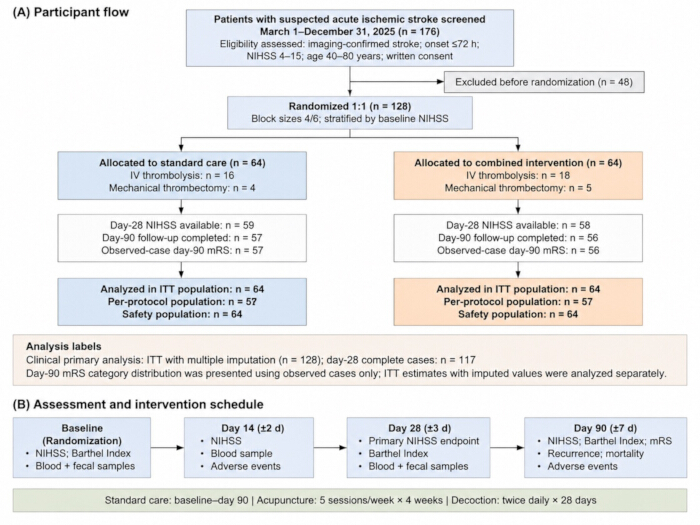
Figure 1: Participant flow and assessment schedule. (A) CONSORT-style flow showing screening (n = 176), exclusions (n = 48), randomization (64/group), intravenous thrombolysis (16 control; 18 intervention), mechanical thrombectomy (4; 5), day-28 NIHSS availability (59; 58), observed day-90 follow-up (57; 56), and analysis populations. (B) Intervention and assessment schedule. NIHSS, National Institutes of Health Stroke Scale; ITT, intention-to-treat; mRS, modified Rankin Scale. Please click here to view a larger version of this figure.
| Study Procedure | Screening | Baseline | Day 1–28 | Day 14 | Day 28 | Day 90 |
| Calendar window | Mar 1–Dec 31, 2025 | Same day as randomization | Mar 2025–Jan 2026 | ±2 days | ±3 days | ±7 days |
| Eligibility assessment | ✓ | |||||
| Written informed consent | ✓ | |||||
| CT/MRI confirmation of ischemic stroke | ✓ | |||||
| Collection of demographic and clinical data | ✓ | |||||
| Randomization | ✓ | |||||
| Standard acute ischemic stroke care | ✓ | ✓ | ✓ | ✓ | ✓ | |
| Standardized manual acupuncture | ✓ | |||||
| Modified Xiaoxuming Decoction | ✓ | |||||
| NIHSS assessment | ✓ | ✓ | ✓ | ✓ | ||
| Barthel Index assessment | ✓ | ✓ | ✓ | |||
| Modified Rankin Scale assessment | ✓ | |||||
| Peripheral blood sample collection | ✓ | ✓ | ✓ | |||
| Fecal sample collection | ✓ | ✓ | ||||
| Adverse event monitoring | ✓ | ✓ | ✓ | ✓ | ✓ | |
| Final clinical follow-up completion | By Mar 31, 2026 | |||||
| Data cleaning and statistical analysis | Apr 1–Apr 30, 2026 |
Table 1: Study schedule, intervention exposure, specimen collection, and outcome assessments. CT, computed tomography; MRI, magnetic resonance imaging; NIHSS, National Institutes of Health Stroke Scale.
| Acupoint | Location category | Laterality | Needle depth | Stimulation method | Retention time | Treatment frequency | Safety precautions |
| Baihui (GV20) | Scalp point | Single | 10–15 mm | Oblique insertion with mild manual stimulation | 30 min | 5 sessions/week for 4 weeks | Avoid excessive stimulation in patients with unstable vital signs |
| Shuigou (GV26) | Facial point | Single | 5–10 mm | Oblique insertion with mild manual stimulation | 30 min | 5 sessions/week for 4 weeks | Avoid needling in patients with local skin injury, infection, or poor cooperation |
| Fengchi (GB20) | Head and neck point | Bilateral | 15–25 mm | Oblique insertion; deep medial needling was avoided | 30 min | 5 sessions/week for 4 weeks | Avoid deep insertion toward the spinal canal or vertebral artery region |
| Quchi (LI11) | Upper-limb point | Bilateral | 15–25 mm | Manual lifting-thrusting and twirling | 30 min | 5 sessions/week for 4 weeks | Avoid needling through bruised, edematous, or infected skin |
| Hegu (LI4) | Upper-limb point | Bilateral | 10–20 mm | Manual lifting-thrusting and twirling | 30 min | 5 sessions/week for 4 weeks | Avoid excessive manipulation in frail patients or patients with pain intolerance |
| Zusanli (ST36) | Lower-limb point | Bilateral | 20–25 mm | Manual lifting-thrusting and twirling | 30 min | 5 sessions/week for 4 weeks | Avoid needling in areas with edema, infection, or local trauma |
| Yanglingquan (GB34) | Lower-limb point | Bilateral | 20–25 mm | Manual lifting-thrusting and twirling | 30 min | 5 sessions/week for 4 weeks | Avoid needling in patients with severe limb pain, trauma, or agitation |
| Sanyinjiao (SP6) | Lower-limb point | Bilateral | 15–25 mm | Manual lifting-thrusting and twirling | 30 min | 5 sessions/week for 4 weeks | Avoid in pregnancy and in patients with local skin lesions |
Table 2: Standardized acupuncture prescription and operational protocol. Operational notes: Sterile disposable stainless-steel needles measuring 0.25 mm × 40 mm were used. Manual stimulation was applied until deqi sensation was reported or a local needling response was observed. Needles were retained for 30 min, and manual stimulation was repeated every 10 min during retention.
| Component | Latin pharmaceutical name | Daily dose | Functional role in the formula | Quality-control and safety notes |
| Ephedra | Ephedrae Herba | 6 g | Wind-dispelling and channel-opening component | Blood pressure, palpitations, chest discomfort, and insomnia were monitored during treatment |
| Cinnamon twig | Cinnamomi Ramulus | 9 g | Warming and circulation-supporting component | Used cautiously in patients with excessive sweating or heat-related symptoms |
| White peony root | Paeoniae Radix Alba | 12 g | Harmonizing and antispasmodic component | Pharmacy authentication and batch documentation were required |
| Saposhnikovia root | Saposhnikoviae Radix | 9 g | Wind-dispelling component | Pharmacy authentication and batch documentation were required |
| Fresh ginger | Zingiberis Rhizoma Recens | 6 g | Gastrointestinal harmonizing component | Administration was withheld if persistent vomiting occurred |
| Licorice root | Glycyrrhizae Radix et Rhizoma | 6 g | Formula-harmonizing component | Electrolyte disturbance and edema were monitored in high-risk patients |
| Angelica root | Angelicae Sinensis Radix | 10 g | Blood-nourishing and circulation-supporting component | Concomitant antiplatelet or anticoagulant use was recorded |
| Chuanxiong rhizome | Chuanxiong Rhizoma | 10 g | Blood-activating component | Bleeding-related adverse events were monitored and recorded |
| Astragalus root | Astragali Radix | 20 g | Qi-supporting component | Could be increased to 30 g for marked spontaneous sweating, if recorded as a protocol-defined modification |
| Poria | Poria | 15 g | Spleen-supporting and dampness-resolving component | Could be increased to 20 g for loose stool, if recorded as a protocol-defined modification |
| Red peony root | Paeoniae Radix Rubra | 12 g | Blood-activating and anti-inflammatory component | Pharmacy authentication and batch documentation were required |
| Hemp seed | Cannabis Fructus | 10 g, if needed | Constipation adjustment only | Added only for constipation and recorded as a protocol-defined modification |
Table 3: Composition and administration protocol of modified Xiaoxuming Decoction. Administration protocol: One daily dose was decocted by the hospital pharmacy and concentrated to 400 mL. The decoction was divided into two 200 mL doses and administered orally after breakfast and dinner for 28 consecutive days. Administration was withheld in patients with unsafe swallowing, persistent vomiting, suspected allergic reaction, alanine aminotransferase or aspartate aminotransferase more than three times the upper limit of normal, estimated glomerular filtration rate below 45 mL/min/1.73 m2, uncontrolled blood pressure after standard management, clinically significant tachyarrhythmia, new chest pain, or any investigator-determined safety concern.
| Outcome category | Variable | Assessment time point | Definition or measurement | Analysis classification |
| Neurological deficit | NIHSS score | Baseline, day 14, day 28, day 90 | National Institutes of Health Stroke Scale assessed by blinded neurologists | Primary clinical outcome at day 28; secondary at day 14/day 90 |
| Daily living function | Barthel Index | Baseline, day 28, day 90 | Activities of daily living score assessed by trained blinded assessors | Secondary clinical outcome |
| Global disability | Modified Rankin Scale | Day 90 | Functional disability score 0–6 | Secondary clinical outcome; observed distribution and separately labeled ITT dichotomy |
| Favorable functional outcome | mRS 0–2 | Day 90 | Participants with mRS 0, 1, or 2 | Secondary clinical outcome |
| Stroke recurrence | Recurrent ischemic stroke | Through day 90 | Neurologist diagnosis with imaging when available | Safety-related outcome |
| Mortality | All-cause death | Through day 90 | Death from any cause | Safety outcome |
| Systemic inflammation | hs-CRP, IL-6, TNF-alpha | Baseline, day 14, day 28 | Serum/plasma concentrations | Exploratory biomarker outcome |
| Endotoxin/barrier markers | LPS, zonulin | Baseline, day 14, day 28 | Blood-based concentrations | Exploratory biomarker outcome |
| Microbial metabolite | TMAO | Baseline, day 28 | Plasma concentration | Exploratory biomarker outcome |
| Gut microbiota diversity | Shannon, Chao1, Bray–Curtis | Baseline, day 28 | 16S rRNA-derived diversity | Exploratory biomarker outcome |
| Microbial composition | Selected genera | Day 28 | Genus-level relative abundance | Exploratory; nominal P and BH-FDR q across three supplied genera |
| Short-chain fatty acids | Acetate, propionate, butyrate, total SCFAs | Day 28 | Fecal concentrations by GC-MS | Exploratory biomarker outcome |
| Exploratory response | Composite response | Day 28 | At least two: Shannon >0.20; butyrate >20%; LPS decrease >15%; IL-6 decrease >20% | Exploratory; thresholds not clinically validated |
| Intervention safety | Adverse and serious adverse events | Day 1–90 | Investigator-recorded events and attribution | Safety outcome |
Table 4: Clinical and biological outcomes, windows, definitions, and analysis classification. This table summarizes the prespecified clinical and biological outcomes, their assessment time points, operational definitions, and analysis classifications. FDR, false discovery rate; hs-CRP, high-sensitivity C-reactive protein; IL-6, interleukin-6; LPS, lipopolysaccharide; mRS, modified Rankin Scale; NIHSS, National Institutes of Health Stroke Scale; SCFA, short-chain fatty acid; TMAO, trimethylamine N-oxide.
Results
Participant flow and analysis populations
Of 176 patients screened, 48 were excluded before randomization, and 128 were randomized (64/group; Figure 1). All randomized participants were included in the intention-to-treat and safety populations. Day-28 NIHSS was observed for 59 control and 58 intervention participants; day-90 follow-up was completed by 57 and 56 participants, respectively. The per-protocol populations comprised 58 and 57 participants (Figure 2).
Baseline characteristics
Baseline characteristics were similar between groups (Table 5). Mean age was 65.1 ± 8.7 versus 64.7 ± 9.1 years, baseline NIHSS was 8.6 ± 2.6 versus 8.4 ± 2.9, and baseline Barthel Index was 43.5 ± 13.2 versus 44.8 ± 12.7. Intravenous thrombolysis was administered to 16/64 (25.0%) control participants, and 18/64 (28.1%) intervention participants; mechanical thrombectomy was performed in 4/64 (6.3%) and 5/64 (7.8%), respectively.
Intervention adherence
In the intervention group, the median number of acupuncture sessions was 18 (interquartile range, 17–20); 57 participants completed ≥ 16 sessions, and 58 consumed ≥ 80% of the decoction. Non-protocol probiotic/prebiotic use occurred in two control participants and one intervention participant; these participants were included in the intention-to-treat analysis but excluded from the per-protocol analysis (Supplementary Table 1).
Clinical outcomes
Observed NIHSS decreased from 8.6 ± 2.6 – 5.5 ± 3.1 in the control group (n = 59 at day 28) and from 8.4 ± 2.9 – 4.1 ± 2.9 in the intervention group (n = 58; Figure 3A). Observed mean changes were −3.34 ± 4.14 and −3.97 ± 4.03 points, respectively (Figure 3B). In the prespecified 30-imputation ANCOVA, adjusted day-28 NIHSS was 1.30 points lower with the intervention (95% confidence interval [CI], −2.36 to −0.24; P = 0.017).
Day-14 NIHSS was 5.49 ± 2.45 versus 4.61 ± 2.23 (baseline-adjusted P = 0.041), and observed day-90 NIHSS was 3.68 ± 2.68 (n = 57) versus 2.88 ± 2.36 (n = 56; P = 0.091; Figure 3A).
Day-28 Barthel Index was 61.39 ± 18.80 versus 68.82 ± 19.36 (baseline-adjusted P = 0.040); observed day-90 values were 75.56 ± 19.22 versus 81.49 ± 17.67 (P = 0.098; Figure 3C). Among participants included in the observed-case day-90 mRS analysis, a favorable outcome occurred in 32/57 controls (56.1%) and 38/56 intervention participants (67.9%; P = 0.200). The complete observed-case mRS category distribution is shown in Figure 3D and Supplementary Table 1. ITT estimates for the dichotomized mRS outcome using multiple imputation (36/64 versus 44/64; P = 0.144) are reported separately.
Brain–gut axis-related biomarkers
Fecal samples were available and successfully analyzed for all randomized participants (64 per group) at the planned analysis time point. Shannon diversity at day 28 was 3.08 ± 0.52 versus 3.31 ± 0.57 (baseline-adjusted P = 0.019; Figure 4A), and fecal butyrate was 10.21 ± 4.27 versus 12.91 ± 5.08 µmol/g (P = 0.002; Figure 4B).
IL-6 was 18.23 ± 9.44 versus 15.62 ± 8.06 pg/mL at day 14 (nominal P = 0.095) and 14.61 ± 8.18 versus 11.84 ± 6.83 pg/mL at day 28 (baseline-adjusted P = 0.041; Figure 4C). LPS was 0.85 ± 0.32 versus 0.78 ± 0.30 EU/mL at day 14 (P = 0.204) and 0.78 ± 0.31 versus 0.66 ± 0.28 EU/mL at day 28 (baseline-adjusted P = 0.023; Figure 4D).
At day 28, Faecalibacterium and Roseburia were more abundant in the intervention group (nominal P = 0.006 and 0.009; both q = 0.013), whereas Bifidobacterium did not meet nominal significance (P = q = 0.056; Figure 4E). Benjamini–Hochberg correction was applied across the three displayed genera.
The exploratory composite response occurred in 21/64 controls (32.8%) and 34/64 intervention participants (53.1%; P = 0.020). Component results are reported in Figure 4F and Supplementary Table 2; the thresholds are exploratory and not clinically validated.
Participant-level exploratory associations
Participant-level exploratory associations were assessed using Spearman's rho with 5,000 bootstrap resamples. Changes in fecal butyrate, IL-6, LPS, and Shannon diversity were not significantly associated with the corresponding neurological or biomarker changes (Figure 5).
Changes in fecal butyrate and NIHSS were not significantly associated (Spearman rho = −0.05; 95% bootstrap confidence interval [CI], −0.23 to 0.13; P = 0.601; n = 117). IL-6 change was not associated with NIHSS change (rho = −0.01; 95% bootstrap CI, −0.18 to 0.15; P = 0.887; n = 117), and LPS change was not associated with IL-6 change (rho = −0.14; 95% bootstrap CI, −0.29 to 0.03; P = 0.125; n = 128).
Shannon diversity change was not significantly associated with NIHSS change (rho = −0.15; 95% CI, −0.34 to 0.06; P = 0.119; n = 117). Because the prespecified participant-level exposure–mediator and mediator–outcome associations were not supported, mediation analysis was not performed, and no indirect effect or causal brain–gut pathway was inferred.
Safety outcomes
Any adverse event occurred in 8/64 controls and 11/64 intervention participants (12.5% versus 17.2%; P = 0.456). Needle-site bruising occurred in 0 versus 5 participants (P = 0.023) and resolved without treatment; mild gastrointestinal discomfort occurred in 3 versus 6 participants (P = 0.300; Table 6).
Serious adverse events occurred in 3 controls and 2 intervention participants (P = 0.648). One death occurred in each group; no serious adverse event was judged definitely related to acupuncture or modified Xiaoxuming Decoction.
In summary, the combined intervention was associated with a modest improvement in day-28 NIHSS and selected day-28 biomarkers. Day-90 clinical differences were not statistically significant, and participant-level data did not support mediation through the measured biomarkers.
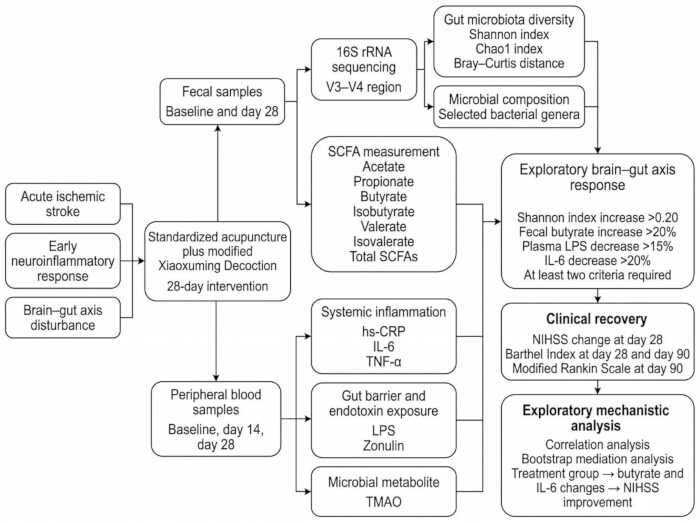
Figure 2: Clinical and biological sampling workflow. Blood and fecal specimens were collected for microbiome, short-chain fatty acid (SCFA), inflammatory, and gut barrier-related measurements. The workflow defines exploratory associations and does not assert a causal brain–gut mechanism. Please click here to view a larger version of this figure.
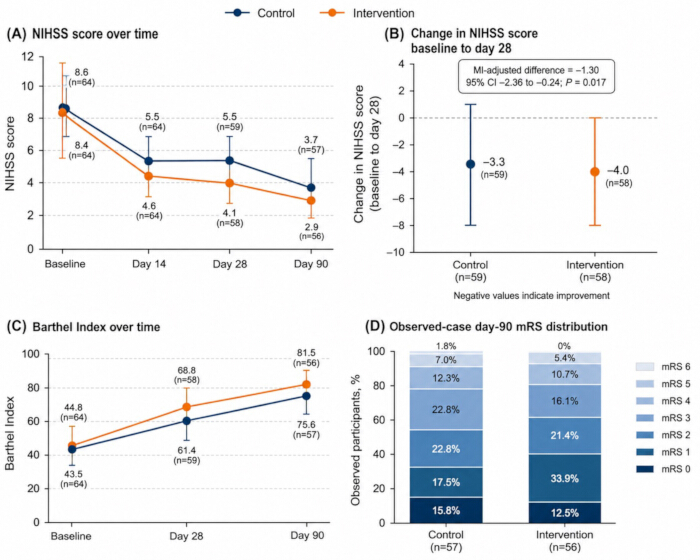
Figure 3: Clinical outcomes. (A) NIHSS trajectory; points are mean ± SD, with n shown at each time point. (B) Observed NIHSS change from baseline to day 28, presented as mean ± SD (control n = 59; intervention n = 58); the annotation reports the 30-imputation ANCOVA adjusted for baseline NIHSS, age, sex, reperfusion, and onset-to-randomization time. (C) Barthel Index, presented as mean ± SD, with n shown. (D) Observed-case day-90 mRS categories (control n = 57; intervention n = 56); percentages use observed denominators. P values are two-sided. No significance symbols are used. CI, confidence interval; MI, multiple imputation; SD, standard deviation. Please click here to view a larger version of this figure.
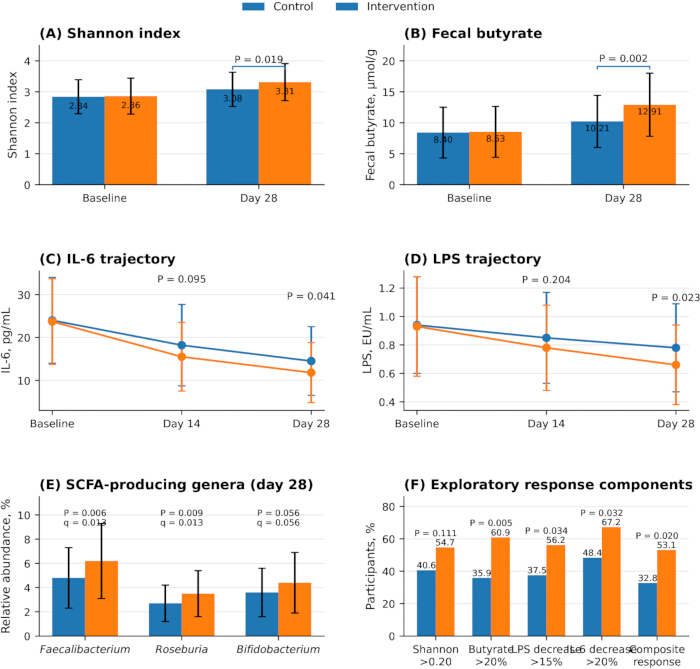
Figure 4: Exploratory biomarkers. Bars and points are mean ± SD. All randomized participants provided evaluable samples for the corresponding analyses; therefore, n = 64/group was available for every panel. Fecal samples were successfully collected and processed from all participants, including those requiring delayed collection within the prespecified collection window. (A) Shannon index and (B) fecal butyrate: day-28 baseline-adjusted linear models. (C) IL-6 and (D) LPS trajectories: day-14 Welch tests and day-28 baseline-adjusted models. (E) Selected day-28 genera: Welch tests with Benjamini–Hochberg correction across the three displayed genera; both nominal P and q values are shown. (F) Response components: Pearson chi-square tests. All P values are two-sided; no significance symbols are used. IL-6, interleukin-6; LPS, lipopolysaccharide; SCFA, short-chain fatty acid; SD, standard deviation. Please click here to view a larger version of this figure.
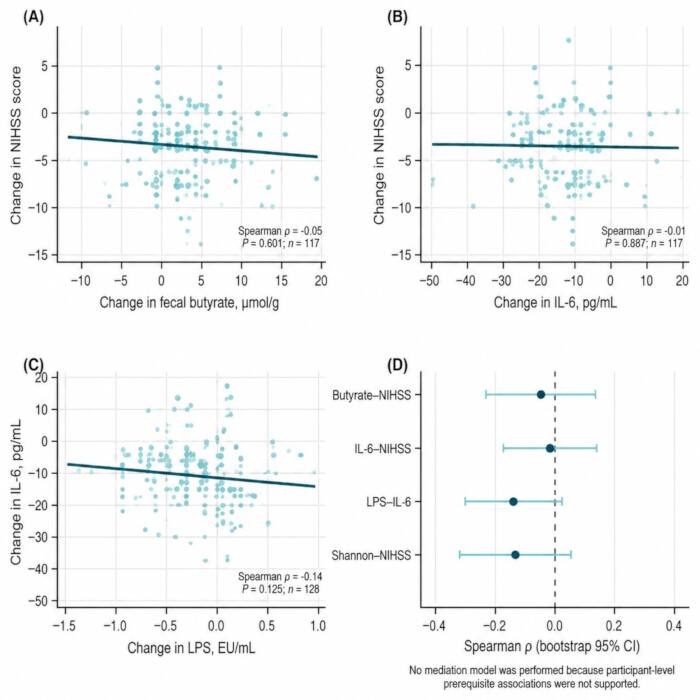
Figure 5: Participant-level exploratory associations. (A) Butyrate change versus NIHSS change (n = 117). (B) IL-6 change versus NIHSS change (n = 117). (C) LPS change versus IL-6 change (n = 128). Lines are shown for visualization only and do not represent regression-based inference. Statistical inference was based on Spearman's rho with 5,000 bootstrap resamples. (D) Spearman estimates with 5,000-resample bootstrap 95% CIs, including Shannon change versus NIHSS change (n = 117). No association met P < 0.05; therefore, mediation analysis was not performed. No significant symbols are used. Please click here to view a larger version of this figure.
| Variable | Control group (n = 64) | Intervention group (n = 64) | P value |
| Age, years | 65.1 ± 8.7 | 64.6 ± 9.0 | 0.775 |
| Male sex, n (%) | 40 (62.5) | 39 (60.9) | 0.855 |
| Onset to randomization, h | 41.7 ± 14.9 | 40.9 ± 15.7 | 0.773 |
| Baseline NIHSS score | 8.6 ± 2.6 | 8.4 ± 2.9 | 0.665 |
| Baseline Barthel Index | 43.5 ± 13.2 | 44.8 ± 12.7 | 0.573 |
| Hypertension, n (%) | 42 (65.6) | 41 (64.1) | 0.855 |
| Diabetes mellitus, n (%) | 18 (28.1) | 17 (26.6) | 0.839 |
| Intravenous thrombolysis, n (%) | 16 (25.0) | 18 (28.1) | 0.690 |
| Mechanical thrombectomy, n (%) | 4 (6.3) | 5 (7.8) | 0.732 |
| hs-CRP, mg/L | 7.21 ± 4.18 | 7.04 ± 4.03 | 0.813 |
| IL-6, pg/mL | 24.03 ± 10.14 | 23.62 ± 9.96 | 0.817 |
| TNF-alpha, pg/mL | 30.5 ± 11.2 | 30.0 ± 11.0 | 0.799 |
| Shannon index | 2.84 ± 0.55 | 2.86 ± 0.56 | 0.833 |
| Fecal butyrate, µmol/g | 8.41 ± 3.99 | 8.53 ± 4.04 | 0.859 |
| LPS, EU/mL | 0.94 ± 0.34 | 0.93 ± 0.35 | 0.870 |
| Zonulin, ng/mL | 54.50 ± 15.60 | 54.11 ± 15.08 | 0.885 |
Table 5: Baseline demographic, clinical, and biomarker characteristics. This table summarizes baseline demographic, clinical, treatment-related, and biomarker characteristics in the control and intervention groups. Values are mean ± SD or n (%). Intravenous thrombolysis and mechanical thrombectomy are reported as separate standard-care categories.
| Safety Outcome | Control Group (n=64) | Intervention Group (n=64) | P Value |
| Any adverse event, n (%) | 8 (12.5) | 11 (17.2) | 0.456 |
| Needle-site bruising, n (%) | 0 | 5 (7.8) | 0.023 |
| Mild gastrointestinal discomfort, n (%) | 3 (4.7) | 6 (9.4) | 0.3 |
| Transient dizziness, n (%) | 2 (3.1) | 3 (4.7) | 0.648 |
| Mild rash, n (%) | 1 (1.6) | 2 (3.1) | 0.56 |
| Abnormal liver function, n (%) | 1 (1.6) | 2 (3.1) | 0.56 |
| Abnormal renal function, n (%) | 1 (1.6) | 1 (1.6) | 1 |
| Blood pressure fluctuation, n (%) | 2 (3.1) | 3 (4.7) | 0.648 |
| Palpitations, n (%) | 0 | 1 (1.6) | 0.315 |
| Serious adverse event, n (%) | 3 (4.7) | 2 (3.1) | 0.648 |
| Intervention-related serious adverse event, n (%) | 0 | 0 | -- |
| All-cause death, n (%) | 1 (1.6) | 1 (1.6) | 1 |
Table 6: Adverse events and serious adverse events. This table summarizes adverse events, serious adverse events, intervention-related serious adverse events, and all-cause death in the control and intervention groups. Values are presented as n (%).
DATA AVAILABILITY:
De-identified participant-level data supporting the reported clinical, biomarker, microbiome, adherence, and safety analyses are publicly available in Zenodo (https://zenodo.org/records/22725409).
Supplementary Table 1: Follow-up, adherence, and clinical outcomes. Observed and imputed analysis populations are labeled separately. The primary estimate uses 30-fold multiple imputation and ANCOVA adjusted for baseline NIHSS, age, sex, reperfusion, and onset-to-randomization time. CI, confidence interval; IQR, interquartile range; mRS, modified Rankin Scale; NIHSS, National Institutes of Health Stroke Scale.Please click here to download this file.
Supplementary Table 2: Exploratory biomarker results. Values are mean ± SD or n (%). Nominal P values and FDR-adjusted q values are distinguished. The composite response required at least two of four prespecified changes and is not clinically validated. Correlation analyses are exploratory; mediation analysis was not performed because the prerequisite participant-level associations were not significant.Please click here to download this file.
Supplementary File 1 : The raw data corresponding to Figures and tables.Please click here to download this file.
Discussion
The combined protocol produced a modest improvement in early neurological deficit, with multiple-imputation ANCOVA estimating a −1.30-point difference in day-28 NIHSS. Day-28 Barthel Index and selected day-28 biomarkers also differed, whereas day-90 outcomes did not reach statistical significance. These findings support evaluation of the combined intervention as an adjunct rather than as a replacement for reperfusion, antithrombotic therapy, rehabilitation, or other standard care.
The clinical effect observed in this trial is consistent with the growing view that acupuncture may contribute to post-stroke recovery beyond symptomatic modulation. Previous work has suggested that acupuncture may improve neurological function and reduce inflammatory activity in acute ischemic stroke, although the magnitude and durability of benefit remain variable across studies21. The present results extend this line of evidence by examining acupuncture as part of a combined intervention with a standardized herbal formula and by linking the clinical effect to predefined brain–gut axis-related biomarkers. The effect size was modest rather than dramatic, which is important for interpretation. A 1-point adjusted difference in NIHSS may be meaningful in mild-to-moderate stroke when accompanied by functional and biological signals, but it should not be interpreted as evidence that the intervention alone determines recovery. The most reproducibility-sensitive steps are consistent eligibility timing, concealed allocation, safe needling, standardized decoction exposure, blinded outcome assessment, and rapid, temperature-controlled specimen processing. Common operational problems include missed acupuncture sessions, unsafe swallowing, delayed stool production, and thawing during transport. These issues were addressed by documenting postponements, withholding oral treatment when unsafe, collecting the next spontaneous stool without research-only laxatives, recording constipation and collection delay, and tracking processing and freeze–thaw history.
The day-28 differences in Shannon diversity, butyrate, IL-6, and LPS were exploratory group-level associations. Participant-level exploratory analyses of butyrate–NIHSS, IL-6–NIHSS, LPS–IL-6, and Shannon–NIHSS associations did not support the prerequisite relationships required for mediation analysis; therefore, mediation analysis was not performed, and the data do not establish a causal brain–gut pathway. Alternative approaches, including shotgun metagenomics, targeted metabolomics with isotope-labeled standards, serial dietary records, and repeated biomarker sampling, would characterize function and temporal order more directly than 16S rRNA sequencing and two fecal time points22,23,24.
Interpretation is limited by the single-center sample, lack of participant blinding, absence of prospective trial registration before enrollment, and the combined intervention design without acupuncture-only or decoction-only groups. The design therefore cannot attribute effects to one component or to synergy. Routine diet, dysphagia severity, enteral nutrition, post-randomization antibiotics, proton pump inhibitor use, constipation, rehabilitation intensity, and length of stay may confound microbiome outcomes. These factors were not included in adjusted microbiome models and therefore remain potential residual confounders. The selected-genus FDR correction was limited to the three displayed genera, and exploratory response thresholds were not externally validated. The biomarker analyses were exploratory; some IL-6 and TNF-alpha concentrations fell below the manufacturers’ nominal assay ranges and should be interpreted cautiously.
Future work should use prospective registration, multicenter recruitment, a factorial design, source-verified co-intervention data, standardized diet/exposure capture, and independently reproducible microbiome and metabolomics pipelines. Larger samples and more frequent sampling are needed before testing mediation, treatment-component effects, or microbiome-defined treatment selection. Safety monitoring identified no definitely intervention-related serious adverse event, but the sample was too small to exclude uncommon harms. Particular attention should remain on bleeding risk, swallowing safety, gastrointestinal intolerance, hepatic/renal function, blood pressure, and arrhythmia when integrating acupuncture and herbal therapy with acute stroke treatment.
In conclusion, standardized acupuncture plus modified Xiaoxuming Decoction was associated with modest day-28 neurological improvement and selected biomarker differences when added to standard care. The biological results are hypothesis-generating and do not demonstrate a causal brain–gut mechanism.
Disclosures
The authors declare no competing interests.
Author Contributions:
Zhiqiang Huang contributed to conceptualization, methodology, investigation, data curation, and writing–original draft; Bo Wang contributed to formal analysis, software, visualization, and writing–review and editing; Zhen Chen contributed to investigation, resources, and validation; Aiping Wang contributed to investigation, data curation, and project administration; and Longhai Wang contributed to conceptualization, supervision, project administration, and writing–review and editing. All authors approved the final manuscript
Acknowledgements
The authors sincerely thank the clinical and laboratory staff at the Hospital of Traditional Chinese Medicine and Western Medicine in Dazhou City, Sichuan Province, for their support during participant recruitment, clinical care, and data collection. The authors also thank the patients and their families for participating in this randomized controlled trial. This research received no specific grant from any funding agency in the public, commercial, or not-for-profit sectors.
Materials
| Name | Company | Catalog Number | Comments |
|---|---|---|---|
| 4-Methylvaleric acid | Sigma-Aldrich, USA | 142342 | GC-MS internal standard |
| 16S rRNA gene primers (V3–V4 region) | Sangon Biotech, China | Custom synthesis | 341F/806R primer pair |
| Acupuncture needles | Hwato (Suzhou Medical Appliance Factory), China | 0.25 × 40 mm | Sterile disposable stainless-steel needles |
| Barthel Index assessment | Not applicable | Not applicable | Activities of daily living assessment |
| Cryogenic tubes | Corning, USA | 430659 | Stool sample storage |
| Ethyl acetate (chromatography grade) | Merck, Germany | 109623 | Organic extraction solvent |
| Filter pipette tips | Axygen, USA | Various | RNase/DNase-free |
| Gas chromatograph | Agilent Technologies, USA | 7890B GC | GC separation system |
| Human IL-6 ELISA Kit | R&D Systems, USA | D6050 | Quantification of serum IL-6 |
| Human Lipopolysaccharide (LPS) ELISA Kit | Cusabio, China | CSB-E13066h | Quantification of serum LPS |
| Human TMAO Assay Kit | Sigma-Aldrich, USA | MAK264 | Colorimetric/fluorometric TMAO quantification |
| Mass selective detector | Agilent Technologies, USA | 5977B MSD | Quadrupole mass spectrometer |
| MassHunter Workstation Software | Agilent Technologies, USA | G1701EA | GC-MS data acquisition and analysis |
| Micropipettes | Eppendorf, Germany | Research plus series | Laboratory liquid handling |
| MiSeq Reagent Kit v3 (600 cycles) | Illumina, USA | MS-102-3003 | Paired-end 2 × 300 bp sequencing |
| MiSeq System | Illumina, USA | SY-410-1003 | Paired-end sequencing platform; 2 × 300 bp sequencing chemistry |
| Modified Rankin Scale (mRS) assessment | Not applicable | Not applicable | Functional outcome assessment at day 90 |
| Modified Xiaoxuming Decoction (herbal formula) | Hospital Pharmacy, Hospital of Traditional Chinese Medicine and Western Medicine in Dazhou City | Not applicable | Prepared according to institutional pharmacy standards; authenticated and dispensed by hospital pharmacists |
| NIH Stroke Scale (NIHSS) assessment form | National Institute of Neurological Disorders and Stroke | Not applicable | Standardized clinical assessment instrument |
| NumPy | NumPy developers | RRID: SCR_008633 | Version 1.26.x |
| pandas | pandas development team | RRID: SCR_018239 | Version 2.1.x |
| Phosphoric acid | Sigma-Aldrich, USA | 79619 | Analytical grade reagent |
| Python | Python Software Foundation | RRID: SCR_008394 | Version 3.11.x |
| QIAamp PowerFecal Pro DNA Kit | Qiagen, Germany | 51804 | Stool microbiome DNA extraction |
| QIIME 2 | QIIME 2 development team | RRID: SCR_008249 | Version 2024.5 |
| Qubit dsDNA HS Assay Kit | Thermo Fisher Scientific, USA | Q32851 | Fluorescence-based DNA quantification |
| scikit-learn | scikit-learn developers | RRID: SCR_002577 | Version 1.4.x |
| SciPy | SciPy developers | RRID: SCR_008058 | Version 1.11.x |
| SILVA rRNA database | SILVA Project | RRID: SCR_006423 | Version 138.1 |
| Ultra-low-temperature freezer | Thermo Fisher Scientific | TSX60086A | −80 °C storage |
References
- GBD 2019 Stroke Collaborators. Global, regional, and national burden of stroke and its risk factors, 1990-2019: a systematic analysis for the Global Burden of Disease Study 2019. Lancet Neurol. 2021;20(10):795-820. doi:10.1016/S1474-4422(21)00252-0.
- Campbell BCV et al. Ischaemic stroke. Nat Rev Dis Primers. 2019;5(1):70. doi:10.1038/s41572-019-0118-8.
- Iadecola C, Anrather J. The immunology of stroke: from mechanisms to translation. Nat Med. 2011;17(7):796-808. doi:10.1038/nm.2399.
- Benakis C et al. Commensal microbiota affects ischemic stroke outcome by regulating intestinal gamma delta T cells. Nat Med. 2016;22(5):516-523. doi:10.1038/nm.4068.
- Xia GH et al. Stroke Dysbiosis Index (SDI) in gut microbiome are associated with brain injury and prognosis of stroke. Front Neurol. 2019;10:397. doi:10.3389/fneur.2019.00397.
- Dalile B, Van Oudenhove L, Vervliet B, Verbeke K. The role of short-chain fatty acids in microbiota-gut-brain communication. Nat Rev Gastroenterol Hepatol. 2019;16(8):461-478. doi:10.1038/s41575-019-0157-3.
- Tsai CY et al. Acupuncture improves neurological function and anti-inflammatory effect in patients with acute ischemic stroke: a double-blinded randomized controlled trial. Complement Ther Med. 2024;82:103049. doi:10.1016/j.ctim.2024.103049.
- Cao JP et al. Acupuncture as adjunctive therapy for acute cerebral infarction: a randomized clinical trial. Front Neurol. 2025;16:1509204. doi:10.3389/fneur.2025.1509204.
- Fu DL et al. Xiaoxuming decoction for acute ischemic stroke: a systematic review and meta-analysis. J Ethnopharmacol. 2013;148(1):1-13. doi:10.1016/j.jep.2013.04.002.
- Li DH et al. A network pharmacology-based identification study on the mechanism of Xiao-Xu-Ming Decoction for cerebral ischemic stroke. Evid Based Complement Alternat Med. 2020;2020:2507074. doi:10.1155/2020/2507074.
- Winek K, Dirnagl U, Meisel A. The gut microbiome as therapeutic target in central nervous system diseases: implications for stroke. Neurotherapeutics. 2016;13(4):762-774. doi:10.1007/s13311-016-0475-x.
- Moher D et al. CONSORT 2010 explanation and elaboration: updated guidelines for reporting parallel group randomised trials. BMJ. 2010;340:c869. doi:10.1136/bmj.c869.
- Brott T et al. Measurements of acute cerebral infarction: a clinical examination scale. Stroke. 1989;20(7):864-870. doi:10.1161/01.STR.20.7.864.
- Powers WJ et al. Guidelines for the early management of patients with acute ischemic stroke: 2019 update to the 2018 guidelines for the early management of patients with acute ischemic stroke. Stroke. 2019;50(12):e344-e418. doi:10.1161/STR.0000000000000211.
- Chen L et al. Additional effects of acupuncture on early comprehensive rehabilitation in patients with mild to moderate acute ischemic stroke: a multicenter randomized controlled trial. BMC Complement Altern Med. 2016;16:226. doi:10.1186/s12906-016-1193-y.
- Lan R et al. Xiao-Xu-Ming Decoction protects against blood-brain barrier disruption and neurological injury induced by cerebral ischemia and reperfusion in rats. Evid Based Complement Alternat Med. 2013;2013:629782. doi:10.1155/2013/629782.
- Broderick JP, Adeoye O, Elm J. Evolution of the Modified Rankin Scale and its use in future stroke trials. Stroke. 2017;48(7):2007-2012. doi:10.1161/STROKEAHA.117.017866.
- Battaglini D et al. Gut microbiota in acute ischemic stroke: from pathophysiology to therapeutic implications. Front Neurol. 2020;11:598. doi:10.3389/fneur.2020.00598.
- Xu M, Li D, Zhang S. Acupuncture for acute stroke. Cochrane Database Syst Rev. 2018;3(3):CD003317. doi:10.1002/14651858.CD003317.pub3.
- Vickers AJ, Altman DG. Statistics notes: analysing controlled trials with baseline and follow up measurements. BMJ. 2001;323(7321):1123-1124. doi:10.1136/bmj.323.7321.1123.
- Yu F et al. Usage, anti-inflammatory effect and safety of adjunctive acupuncture for cerebral infarction: an Apriori algorithm-based data mining and meta-analysis. Front Neurol. 2025;16:1546194. doi:10.3389/fneur.2025.1546194.
- Iadecola C, Buckwalter MS, Anrather J. Immune responses to stroke: mechanisms, modulation, and therapeutic potential. J Clin Invest. 2020;130(6):2777-2788. doi:10.1172/JCI135530.
- Tan C et al. Dysbiosis of gut microbiota and short-chain fatty acids in acute ischemic stroke and the subsequent risk for poor functional outcomes. JPEN J Parenter Enteral Nutr. 2021;45(3):518-529. doi:10.1002/jpen.1861.
- Zhang W, Dong XY, Huang R. Gut microbiota in ischemic stroke: role of gut bacteria-derived metabolites. Transl Stroke Res. 2023;14(6):811-828. doi:10.1007/s12975-022-01096-3.
- Zhang Q et al. Xiaoxuming Decoction: a traditional herbal recipe for stroke with emerging therapeutic mechanisms. Front Pharmacol. 2021;12:802381. doi:10.3389/fphar.2021.802381.