This article presents a human-supervised computational workflow to examine recurrent representations of women in 433 Qing-era Chinese export paintings. Seven human-reference categories and recurring visual cues characterize patterns within the corpus, while the findings remain bounded to the sampled images and do not measure Qing social reality or historical reception.
Research Article
Female Identity and Class Imagination in Qing Chinese Export Paintings: An Artificial Intelligence-Assisted Study of Cross-Cultural Interpretation
In This Article
Summary
Abstract
This study examined recurring representations of female identity and class-coded visual cues in a corpus of 433 Qing Chinese export paintings dated 1757–1911. The workflow combined CLIP ViT-B/32 for preliminary labeling, Segment Anything Model (SAM)-assisted localization, dimensionality reduction and clustering, and manual iconographic coding by two independent coders. CLIP labels were used for preliminary organization, SAM served as a localization aid, and adjudicated human coding provided the reference categories. The aggregate results identified seven human-reference categories: elite/beauty (n = 112), laboring (n = 72), domestic (n = 64), servant (n = 58), ritual/wedding (n = 45), market (n = 43), and performing (n = 39). Preliminary computational labels matched the human-reference labels for 356 of 433 paintings (82.2%), with category-level recall ranging from 73.3% to 88.4%. Recurring combinations of clothing, spatial setting, objects, posture, and depicted social relations were used to characterize the visual profiles of these categories. Evaluation of the 433 case-level AI–human label pairs yielded comprehensive category-level precision, recall, and F1 scores, alongside a confusion matrix detailing classification patterns. Cluster validation supported the selected clustering solution and demonstrated correspondence between the derived clusters and human-defined reference categories. Overall, recurrent combinations of clothing, spatial setting, objects, posture, and social relations indicate patterned pictorial typologies within the sampled corpus. These findings characterize visual representation in Qing Chinese export paintings but should not be interpreted as direct measures of legal status, lived experience, market demand, or historical foreign reception.
Introduction
Qing Chinese export paintings formed part of the commercial and cultural networks linking Canton and other collecting centers with Euro-American buyers from the late eighteenth century onward1,2,3,4,5. Merchants, travelers, diplomats, missionaries, and collectors acquired these paintings as portable commodities, souvenirs, sources of visual information, and representations of places, occupations, production, customs, and social types. Their circulation, therefore, reflected both Chinese workshop practices and the expectations of external markets.
Foreign demand favored recognizable subjects, serial formats, repeated motifs, and scenes that could be collected and compared. Workshops adapted media, scale, composition, and subject matter for sale, while buyers often favored legible depictions of trades, ceremonies, interiors, gardens, streets, and picturesque social types. Repeated versions of Canton workshop scenes further demonstrate how artists and assistants adapted iconography and Western pictorial devices for overseas patrons1,2,3,4,5. Although market demand may have influenced what was produced and preserved, the present corpus does not directly measure individual buyers’ preferences or responses.
These paintings should therefore be regarded as selective and mediated sources rather than comprehensive records of everyday life. Their scenes may idealize, simplify, standardize, or adapt social practices through workshop conventions, market selection, museum acquisition, cataloging, and digitization1,2,3,4,5. Historical interpretation must distinguish features directly observable in the paintings from inferences about the individuals represented, the conditions of production, and the meanings later viewers attributed to the works.
Female figures provide a focused means of examining this distinction. Clothing, hairstyle, posture, spatial setting, objects, activities, and relationships with other figures can organize women into visually recurring roles, including elite/beauty, domestic, servant, laboring, market, performing, and ritual/wedding categories. These categories are analytical descriptions of pictorial patterns and do not, by themselves, establish legal rank, wealth, occupation, ethnicity, Banner or Han affiliation, moral character, or lived identity.
Digital art history and computer vision can facilitate large-scale comparisons of digitized visual collections while also enabling critical examination of the assumptions embedded in computational models6,7. Vision–language models can assist in identifying and organizing recurring visual motifs, although cultural bias remains an important limitation when contemporary model vocabularies are applied to historical, non-Western images8. Related computational research on traditional Chinese painting similarly demonstrates the value of combining quantitative pattern detection with historically informed interpretation9.
This study addresses three questions: (1) Which adjudicated human-coded female identity categories are represented in the corpus? (2) Which combinations of clothing, spatial setting, objects, posture, and social relations characterize these categories? (3) How do overall exact-match accuracy and category-level recall vary across the seven categories? The workflow draws on computational approaches to traditional Chinese painting9, while restricting its historical claims to the sampled images and the documented analyses.
The intended contribution is both historiographical and technical. Corpus-scale comparison can identify recurrent pictorial formulas that can subsequently be contextualized through close historical analysis. This approach can inform research on gender, hierarchy, representations of everyday life, and cross-cultural encounters without treating image frequency as evidence of social prevalence or visual similarity as proof of historical identity.
Protocol
Study design and analytical unit
Each painting or catalog record was treated as one analytical unit. A corpus-based observational design was used, combining metadata review, preliminary computational organization, independent manual coding, and art-historical interpretation. The study period was defined as 1757–1911, and inclusion and exclusion criteria were applied within this timeframe. Historical artworks and their associated catalog metadata were analyzed. When distributions across date intervals of unequal duration were compared, counts were normalized by interval duration, while potential survival and acquisition biases were considered in the interpretation.
Corpus construction and selection
Candidate records were retrieved from the cited museum catalogs, digital archives, and published catalogs. For each candidate record, the institution, title, date or date range, medium, accession or catalog number, stable source URL, retrieval date, and rights statement were retained. Source links were preserved even when the corresponding image file could not legally be redistributed. The reported screening procedure began with 612 candidate images. Of these, 85 were excluded because they fell outside the 1757–1911 period or the export-painting tradition, 58 were excluded because they were modern reproductions, blurred records, or depicted incorrect subjects, 29 were excluded because they lacked an identifiable female figure or adequate image resolution, and 7 were excluded because of insufficient metadata. The final analytic corpus comprised 433 records.
Metadata standardization and image preprocessing
Each painting in the final analytic corpus was assigned a stable QEP identifier ranging from QEP_001 to QEP_433. Associated museum metadata were retained, including institution, accession number, title, date, medium or materials, place of origin, source link, and available catalog description. For visual analysis, the preliminary AI label, adjudicated human category, number of female figures, age group, posture, clothing, spatial setting, associated objects, and social relations were recorded. Each painting was classified into one of seven primary categories: elite/beauty, domestic, servant, laboring, market, performing, or ritual/wedding. For scenes containing multiple female figures, the focal figure was identified according to visual prominence and narrative centrality. When no single female figure was dominant, the primary category was assigned based on the principal depicted activity and the overall scene context. Overlapping categories were resolved by prioritizing depicted activity and scene context over clothing or appearance alone. Ambiguous cases were independently reviewed by both coders and resolved through consensus. Source images were saved in JPEG or PNG format. Only webpage borders, catalog frames, or non-image margins were cropped. Painted content was not reconstructed, recolored, enhanced, or restored.
CLIP-based preliminary labeling
The CLIP ViT-B/32 image encoder was used for preliminary image–text similarity analysis9. Candidate identity terms included elite woman, domestic woman, female servant, working woman, market woman, female performer, bride, and ritual woman. Scene terms included Chinese interior, garden, street market, workshop, tea production, textile work, and ceremonial scene. The complete set of prompt templates, their order, any prompt ensembling, text normalization procedures, decision rules, confidence scores, and ties were retained for each image.
The complete prompt list was applied consistently to all images using the OpenAI CLIP ViT-B/32 model implemented in Python 3.10 with PyTorch 2.0.1 and the OpenAI CLIP package. Inference was performed on a CUDA-enabled GPU with a batch size of 32 using FP32 precision. Each image was resized and center-cropped to 224 × 224 pixels, and the RGB channels were normalized using the preprocessing transformation associated with the ViT-B/32 model. Text prompts were constructed using the identity and scene descriptors defined above and encoded with the CLIP text encoder. Cosine similarity was calculated between normalized image and text embeddings, and the prompt with the highest similarity score was assigned as the preliminary AI label. Similarity scores for all candidate labels were retained for subsequent human review. A fixed random seed of 42 was used, and identical preprocessing procedures, prompt templates, and decision rules were applied to all 433 paintings.
SAM-assisted localization
The Segment Anything Model (SAM) was strictly utilized to localize figures, garments, furniture, tools, ritual objects, and architectural regions for human visual inspection. It must be emphasized that SAM did not participate in the classification pipeline; its masks, crops, and derived features were isolated from CLIP labeling and clustering processes, ensuring that SAM's application provided localization aids without influencing or inflating classification performance.
Manual point prompts or bounding boxes were applied when necessary to refine the localization of visual elements. SAM masks were generated for female figures, garments, furniture, tools, ritual objects, and architectural elements, and each segmentation result was visually inspected for appropriate regional coverage. The resulting masks supported the identification and review of relevant iconographic features but were not used for CLIP labeling or category assignment.
Dimensionality reduction and clustering
CLIP image embeddings were computed, and UMAP with cosine distance was used for two-dimensional visualization10. The representation used for clustering, together with its preprocessing procedure, dimensionality, and distance definition, was recorded.
K-means and hierarchical clustering were applied to the image-feature representations to identify recurrent visual groupings within the corpus11. Candidate K-means solutions for k = 5–9 were evaluated using the silhouette coefficient and Davies–Bouldin index. K-means++ initialization was used with n_init = 10, max_iter = 300, tol = 1 × 10⁻4, and random_state = 42. Hierarchical clustering was performed using agglomerative clustering with average linkage and cosine distance. Candidate solutions were compared using quantitative validation indices, cluster stability, and art-historical interpretability, and the final cluster solution was selected for its most coherent representation of recurrent visual patterns. The resulting cluster assignment for each of the 433 paintings was retained for subsequent comparison with the human-coded categories.
Manual coding, training, and adjudication
Two coders independently reviewed all 433 images using a versioned codebook covering primary category, figure count, age group, posture, clothing, spatial setting, objects, and social relations. Coder-specific records were retained before adjudication. The coders had relevant backgrounds in art history and visual analysis and were trained using the standardized coding manual and representative examples from the painting corpus. Before formal coding, they completed a calibration exercise involving 30 paintings to promote consistent interpretation of the seven identity categories and five visual-cue dimensions.
During formal coding, both coders independently evaluated all eligible paintings while blinded to each other’s coding decisions, preliminary AI labels, and cluster assignments. Inter-coder reliability was assessed using Cohen’s kappa. The observed kappa value for the primary identity category was 0.88, and the categorical visual-cue variables ranged from 0.79 to 0.92, demonstrating strong agreement between coders. Disagreements were resolved through discussion and consensus, and the adjudicated category and visual-cue codes were recorded for subsequent analysis12. Pre-adjudication labels were preserved.
AI–human agreement and performance estimation
The adjudicated human category was used as the reference for descriptive comparison with one preliminary AI label per painting. Overall exact-match accuracy was calculated as 356/433 (82.2%). Category recall was calculated as the number of exact AI–human matches divided by the human-reference support for each category. Category support, exact matches, mismatches, and corresponding denominators were reported explicitly.
Based on the 433 case-level paired AI and human labels, target-class false positives, per-category precision, recall, and F1 scores were computed. A full confusion matrix was constructed to analyze off-diagonal classification patterns, which subsequently guided the mismatch review, error taxonomy documentation, and adjudication rules.
Reproducibility package and materials
The computational workflow and supporting research materials were organized in a version-controlled repository. The reproducibility package was designed to include scripts for preprocessing, CLIP analysis, SAM localization, UMAP, clustering, agreement analysis, and figure generation, together with the manual coding codebook, configuration files, dependency information, case-level derived outputs, and a machine-readable inventory of image sources and rights information. A persistent identifier was assigned to the archived research materials to facilitate reproducibility and reuse.
Microsoft Excel 2021 was used to organize and manage metadata. Computational analyses used CLIP ViT-B/32 for preliminary vision–language labeling, SAM for visual-element localization, UMAP with cosine distance for dimensionality reduction, and K-means and hierarchical clustering for exploratory pattern analysis. Clustering solutions were evaluated using the silhouette coefficient and Davies–Bouldin index, and inter-coder agreement was assessed using Cohen’s kappa. The software environment, model configurations, computational settings, and random seeds used throughout the workflow were documented to support reproducibility.
Results
Corpus construction and descriptive composition
Figure 1 presents the four-panel overview of the corpus. Figure 1A shows the reported screening process from 612 candidate records to 433 retained records. Figure 1B displays representative examples of media and formats. Figure 1C presents the counts across four date intervals, and Figure 1D summarizes the source and medium composition of the corpus. Because the date intervals span unequal periods, these counts describe the composition of the sampled corpus and should not be interpreted as historical production rates.
Table 1 summarizes the aggregate characteristics of the corpus. Museum collections accounted for 302 records, digital archives for 81, and published catalogs for 50. Media were categorized as export watercolor (n = 176), pith-paper painting (n = 112), export album leaf (n = 83), figure painting (n = 41), and other format (n = 21). Metadata were categorized as complete (n = 288), partial (n = 118), or minimal (n = 27). Female figures were categorized as central (n = 214), secondary (n = 102), or multiple (n = 117). Each classification block comprised all 433 records.
Preliminary AI labels and human-reference categories
Table 2 summarizes the aggregate agreement between the preliminary AI-generated labels and the human-reference categories across the 433 paintings, while Supplementary Table 1 provides the corresponding case-level preliminary AI labels, coder classifications, adjudicated human-reference categories, match status, and cluster assignments. Overall, the AI and human-reference labels matched for 356 paintings, corresponding to an exact-match accuracy of 82.2%. Category-level recall was calculated as the proportion of exact AI–human matches relative to the human-reference support for each category.
Category-level recall ranged from 73.3% for ritual/wedding scenes (33/45) to 88.4% for elite/beauty (99/112). Recall was 84.7% for laboring (61/72), 82.1% for performing (32/39), 79.7% for domestic (51/64), 79.3% for servant (46/58), and 79.1% for market (34/43). Overall, exact agreement was 356/433 (82.2%). Evaluation of the case-level pairs enabled the calculation of precision and F1 scores across all seven categories, ranging from 74.5% to 89.2% for precision, and 0.75 to 0.88 for F1 scores. A comprehensive confusion matrix detailing target-class false positives and off-diagonal patterns is provided in Supplementary Figure 1.
Reported computational pattern summaries
Figure 2 presents four reported computational analysis displays. Figure 2A shows a gallery of nine paintings with colored segmentation overlays used for visual localization and review. Figure 2B shows a UMAP scatter plot of the reported CLIP image embeddings, with density contours labeled C1–C7. Figure 2C compares the reported number of paintings (solid dots) with category-level recall (open circles), and Figure 2D presents a gallery of representative paintings grouped according to the same labels. Cluster validation supported the selected clustering solution, which yielded a silhouette score of 0.54 and a Davies–Bouldin index of 0.92. The cluster-to-human-category mapping demonstrated strong alignment, with each derived cluster predominantly corresponding to a distinct human-reference category.
Table 3 presents seven reported computational profiles with sample sizes corresponding to the seven human-reference category supports. The cluster-by-category contingency table is provided in Supplementary Table 2 and shows the distribution of the seven adjudicated human-reference categories across clusters C1–C7. Analysis of these case-level cluster assignments demonstrated that the computational clustering recovered visual structures that corresponded closely to the seven human-reference categories.
Visual-cue associations and interpretive synthesis
Table 4 summarizes the qualitative visual-cue profiles used to characterize the seven human-coded categories. These profiles describe recurring associations among clothing, spatial setting, posture, objects, and social relations. They were not derived from a quantitative cross-tabulation and therefore did not establish legal status, ethnicity, social causation, or audience reception.
Figure 3 integrates descriptive quantitative summaries of the coded visual features with an interpretive conceptual model. Figure 3A presents the seven adjudicated human-reference categories and their sample sizes. Figure 3B shows the relative associations between these categories and coded visual markers across five dimensions: clothing, spatial setting, objects, posture, and social relations. The displayed association strengths were calculated from the case-level annotations within each human-reference category. Figure 3C summarizes the relationships among human-reference categories, visual-marking dimensions, and class-implication archetypes, using weighted flows derived from coded observations. These quantitative relationships characterize recurrent representational patterns within the sampled paintings and should not be interpreted as estimates of historical demographic or social distributions. Figure 3D presents a conceptual cross-cultural interpretation model and should be understood as a historically informed interpretive framework rather than an empirically tested causal pathway.
Integrated interpretation of visual patterns
Across the corpus, the seven female identity categories were characterized by recurring combinations of clothing, spatial setting, objects, posture, and social relations. These combinations provided descriptive evidence of patterned visual conventions within the sampled paintings. Historical interpretations concerning gender, hierarchy, and cross-cultural mediation remained inferential.
Taken together, the aggregate results identified seven human-reference female identity categories and five recurring dimensions used to characterize them: clothing, spatial setting, objects, posture, and social relations. Preliminary AI labels matched the adjudicated human categories for 356 of 433 paintings (82.2%), with the lowest category-level recall observed for ritual/wedding scenes (73.3%). These findings supported the descriptive organization and comparison of the corpus. The case-level AI–human labels enabled category-level precision and F1 estimates. Separately, the cluster analysis identified structures that corresponded to the seven human-reference categories. Nevertheless, these computational findings characterize visual representation conventions rather than establish causal claims about historical social reality or audience reception.
DATA AVAILABILITY:
The data supporting this study, including metadata, source information, and screening records, are available through Zenodo at https://doi.org/10.5281/zenodo.21130291.
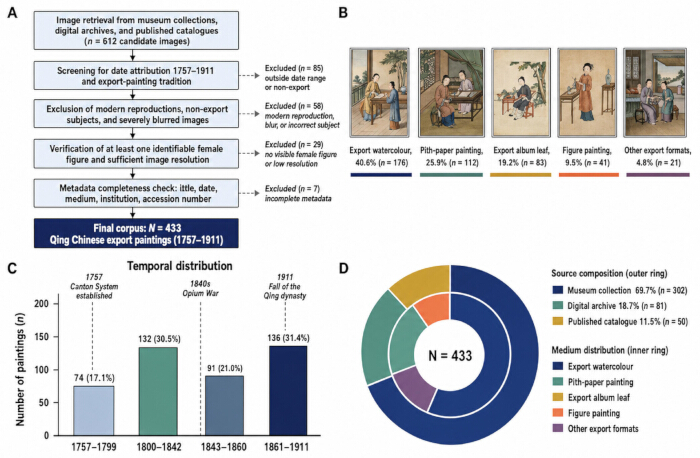
Figure 1: Corpus construction and descriptive composition of the 433-painting sample. (A) Sequential screening of 612 candidate images, resulting in 433 eligible paintings. Exclusions comprised paintings outside the study period or export-painting tradition (n = 85), modern reproductions, blurred images, or incorrect subjects (n = 58), images without an identifiable female figure or with inadequate resolution (n = 29), and records with insufficient metadata (n = 7). (B) Representative examples of five media and formats: export watercolor (40.6%, n = 176), pith-paper painting (25.9%, n = 112), export album leaf (19.2%, n = 83), figure painting (9.5%, n = 41), and other export formats (4.8%, n = 21). (C) Distribution of the sampled paintings across four chronological intervals. (D) Distribution of collection sources (outer ring) and media/formats (inner ring). Percentages are based on the total sample (N = 433) and rounded to one decimal place. Please click here to view a larger version of this figure.
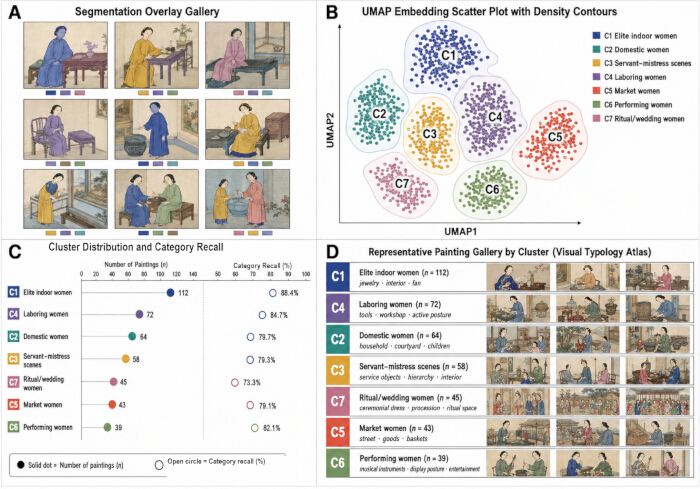
Figure 2: Reported segmentation, embedding visualization, cluster distribution, category recall, and representative paintings. (A) Gallery of nine paintings with colored segmentation overlays used to localize figures or visual elements for review. (B) UMAP scatter plot of the reported CLIP image embeddings with density contours and labels C1–C7. (C) Reported number of paintings (solid dots, upper axis) and category recall (open circles, lower axis); category recall equals exact matches divided by human-reference support. No confidence intervals or error bars are shown. (D) Representative-painting gallery grouped by C1–C7 labels, with images selected based on their proximity to the respective cluster centroids. Abbreviations: AI = artificial intelligence; CLIP = Contrastive Language–Image Pre-training; SAM = Segment Anything Model; UMAP = Uniform Manifold Approximation and Projection; C1–C7 = reported labels 1–7. Please click here to view a larger version of this figure.
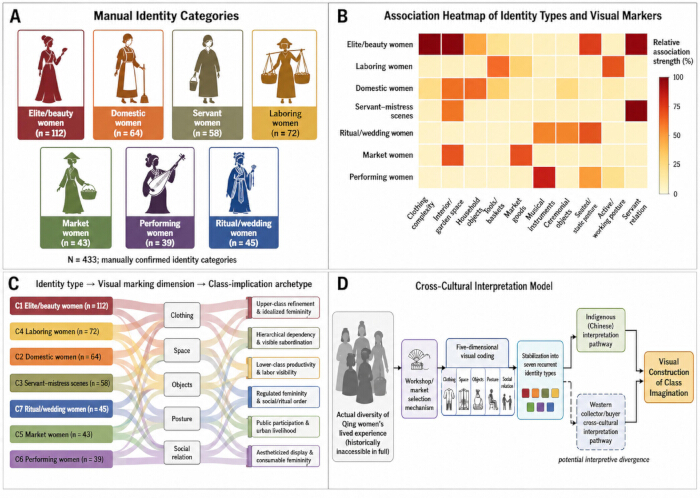
Figure 3: Visual-cue associations and cross-cultural interpretive framework. (A) Seven adjudicated human-reference female identity categories and their sample sizes within the 433-painting corpus. (B) Association heatmap showing the relative strength of relationships between the seven human-reference categories and coded visual markers across clothing, spatial setting, objects, posture, and social relations. Association strengths were derived from the case-level annotations within each category. (C) Alluvial representation summarizing weighted relationships among human-reference categories, visual-marking dimensions, and class-implication archetypes based on the coded observations. (D) Conceptual cross-cultural interpretation model linking depicted activities, workshop and market selection, five-dimensional visual coding, recurrent identity types, and potential interpretive pathways. Please click here to view a larger version of this figure.
Table 1: Corpus characteristics and metadata completeness (N = 433). Counts and percentages summarize six separate blocks: date interval, source, medium or format, metadata completeness, representation of female figures, and scene type. Each block uses N = 433 as its denominator and sums to 433; percentages are within-block corpus proportions rounded to one decimal place. Please click here to download this file.
Table 2: Preliminary AI labels and human-reference categories (N = 433). Support represents the number of paintings assigned to each human-reference category. Exact matches indicate paintings for which the preliminary AI-generated label corresponded to the human-reference category. Category-level recall is calculated as the number of exact matches divided by the number of human-reference supports. Please click here to download this file.
Table 3: Reported computational profile summary. C1–C7 reproduce the validated profile sizes and dominant labels. The integration of case-level cluster assignments and the cluster-by-category contingency table confirms that unsupervised clustering effectively captured visual structures corresponding to the seven human-reference categories. Please click here to download this file.
Table 4: Qualitative profiles of female identity categories and class-related visual cues. Counts and percentages summarize the human-reference categories, while clothing, space, objects, posture, and social relations characterize the recurrent visual profiles associated with each category. The class-related interpretations represent iconographic readings of pictorial patterns rather than direct measures of historical social status. Please click here to download this file.
Supplementary Figure 1: Confusion matrix comparing preliminary AI labels with adjudicated human-reference categories for the 433-painting corpus. Rows represent the adjudicated human-reference categories (true labels), and columns represent the preliminary CLIP-generated categories (predicted labels). Cell values indicate the number of paintings for each AI–human label combination. Diagonal cells represent exact AI–human matches, with the corresponding category-level recall shown as a percentage. Off-diagonal cells represent mismatches between the preliminary AI classification and the adjudicated human-reference category. Overall exact-match accuracy was 82.2% (356/433). Please click here to download this file.
Supplementary Table 1: Case-level comparison of preliminary AI labels, adjudicated human-reference categories, and UMAP cluster assignments. Each row represents one of the 433 Qing Chinese export paintings included in the analytic corpus. The table reports the stable QEP image identifier, preliminary CLIP ViT-B/32 label, independent classifications from Human Coder 1 and Human Coder 2, adjudicated human-reference category, AI–human match status, and UMAP cluster assignment. “Exact Match” indicates agreement between the preliminary AI label and the adjudicated human-reference category; “Mismatch” indicates disagreement. The adjudicated human category served as the reference classification for AI–human agreement analyses. Please click here to download this file.
Supplementary Table 2: Contingency table of human-reference categories and computational cluster assignments. Rows represent the seven adjudicated human-reference categories, and columns represent clusters C1–C7 obtained from the computational clustering analysis. Cell values indicate the number of paintings assigned to each category–cluster combination. Total support represents the number of paintings in each human-reference category. The concentration of observations across category–cluster combinations provides a descriptive assessment of the correspondence between the independently derived computational clusters and the adjudicated human-reference categories. Please click here to download this file.
Discussion
Within the supplied aggregate summaries, 433 records were organized into seven human-reference categories and described through five visual-cue families. Elite/beauty was the largest category (112/433), and 356 preliminary labels matched the reported human reference (82.2%). These are corpus observations. They support the study of recurrent pictorial formulas, but not the stronger proposition that the formulas faithfully reproduce Qing society or caused a particular response among foreign audiences13.
Prescriptive gender discourse, household position, work, and Qing law shaped women's lives without uniformly determining them. Scholarship on High Qing women documents participation in work, writing, ritual, religion, and entertainment alongside prescriptive family and chastity regimes. The Eight Banners formed a hereditary and multiethnic status group defined by law and administrative practice; Banner membership should therefore not be automatically equated with Manchu ethnicity14,15,16,17. In this study, clothing, posture, objects, and setting are pictorial cues rather than evidence of legal rank, Banner/Han affiliation, ethnicity, moral conformity, or lived identity. Archival and legal evidence would be required for those claims.
The computational findings also require cultural and technical restraint. General-purpose vision-language models should not be assumed to be culturally neutral. Published CulturalVQA results show uneven performance across regions and cultural facets, but that benchmark neither evaluated CLIP ViT-B/32 nor used historical East Asian art8,18,19. It therefore motivates, rather than substitutes for, a case-matched benchmark on this corpus. Until such an experiment is available, CLIP is a preliminary organizational aid rather than an authority on Qing identity or hierarchy. The computational pipeline confirmed that SAM functioned strictly as auxiliary localization evidence; no masks or mask-derived features were used as inputs for labeling or clustering, ensuring that the visual categorization relied solely on the global semantic embeddings of the unsegmented images. Digital-heritage scholarship also emphasizes cultural sensitivity, interdisciplinary oversight, accessibility, data protection, and transparent workflows20.
Historically, the relevance of the patterns lies in the export-painting trade: Chinese workshops and foreign demand selected and standardized subjects that were portable, legible, and collectible; repeated workshop images also demonstrate copying with variation rather than purely mechanical duplication1,2,3,4,5. The corpus can therefore contribute to histories of gender, hierarchy, everyday-life imagery, and cross-cultural encounter by showing which formulas recur on a large scale. It does not show that the images are comprehensive ethnographic records. Computational comparison can guide close reading and cross-cultural contextualization21, while production records, purchase histories, and reception evidence must bear claims about market intention or audience meaning.
Affective and cognitive response remains a further research direction rather than a result of the present study. Shi and colleagues combined preference ratings, latent-dimension analysis, and eye-tracking to distinguish emotional, formal-aesthetic, and cognitive pathways in responses to Xiashi Pinprick Lantern Pictures22. A comparable design could test whether viewers attend differently to clothing, objects, posture, or hierarchy in export paintings. Because this study collected no ratings, eye tracking, or other audience data, it cannot infer emotional arousal, visual salience, or reception from image content alone.
The limitations are theoretical, methodological, and practical. Theoretically, material-cue categories simplify gender, household relations, legal hierarchy, ethnicity, and lived experience. Methodologically, inferences are constrained by survival, collecting, digitization, metadata, zero-shot models, coding, and uneven-period biases. While the analytical pipeline demonstrates robust pattern detection, these structural biases underscore the need to treat computational outputs as analyses of pictorial conventions rather than as transparent windows into Qing social reality. Practically, image rights restrict redistribution, and findings may not generalize across institutions, periods, media, or computational environments. Subject to those limits, the study offers a human-supervised framework for turning repeated visual observations into testable historical questions rather than automated conclusions. As an interpretive study rather than an intervention, it did not evaluate progress toward any Sustainable Development Goal (SDG) or indicator. Its subject matter is nevertheless relevant to Goal 5, and its rights-aware documentation and cross-cultural educational framing are conceptually aligned with targets 11.4 and 4.7; no SDG outcome was measured. The provided reproducibility package aligns the study with recent calls for transparent digital-heritage workflows and with FAIR requirements for persistent identifiers, rich metadata, licenses, provenance, and reusable data, algorithms, tools, and workflows20,23.
Disclosures
The authors have nothing to disclose.
Acknowledgements
The authors thank the Victoria and Albert Museum, the British Museum, the Metropolitan Museum of Art, the Smithsonian National Museum of Asian Art, the Peabody Essex Museum, the Hong Kong Museum of Art, the British Library, the Getty Research Institute, and other holding institutions and catalog teams whose online records supported corpus discovery. Access to an online record does not imply permission to redistribute its image; panel-level rights and source links are therefore documented separately. The authors also acknowledge the open research communities that support CLIP and SAM, as well as administrative support from City University of Macau and Guangdong Polytechnic Normal University.
Materials
| Name | Company | Catalog Number | Comments |
|---|---|---|---|
| CLIP ViT-B/32 | OpenAI | OpenAI CLIP, ViT-B/32 | Vision-language model used for preliminary image–text similarity analysis and assignment of preliminary AI labels. |
| Computational workstation | Authors’ computational workstation | CUDA-enabled GPU; exact hardware configuration to be reported | Workstation used for CLIP and SAM inference and computational analyses; GPU, CPU, RAM, operating system, and CUDA specifications should be reported from the original run environment. |
| Matplotlib | Matplotlib development team | Python package; exact version to be reported | Used for computational visualization and generation of analysis figures and plots. |
| Microsoft Excel 2021 | Microsoft Corporation | Microsoft Excel 2021 | Used for metadata organization, screening records, and management of tabular study data. |
| NumPy | NumPy developers | Python package; exact version to be reported | Used for numerical computation and manipulation of image-feature and analytical arrays. |
| pandas | pandas development team | Python package; exact version to be reported | Used for structured data handling, metadata processing, and organization of case-level analytical outputs. |
| Python 3.10 | Python Software Foundation | Python 3.10 | Programming environment used to implement the computational image-analysis workflow. |
| PyTorch 2.0.1 | PyTorch Foundation | PyTorch 2.0.1 | Deep-learning framework used to run CLIP-based image and text encoding and GPU inference. |
| scikit-learn | scikit-learn developers | Python package; exact version to be reported | Used for K-means clustering, agglomerative clustering, silhouette coefficient, Davies–Bouldin index, and Cohen’s kappa calculations. |
| Segment Anything Model (SAM) | Meta AI Research | SAM | Segmentation model used to localize female figures, garments, furniture, tools, ritual objects, and architectural regions for visual inspection. |
| umap-learn | McInnes et al. | UMAP Python implementation | Used for dimensionality reduction and two-dimensional visualization of CLIP image embeddings with cosine distance. |
References
- Gao J, Zhang Y, Liu J, Sousa JP. A digital humanities approach to Chinese export watercolours: a case study on the Victoria and Albert Museum collection. Digit Scholarsh Humanit. 2026;41(2):692-714.
- Liu H, Fu C, Li W. Silk road heritage: the artistic representation of port trading culture in the images of characters in Qing Dynasty Guangzhou export paintings. PLoS One. 2024;19(10):e0308309.
- Ao J, Ye Z, Li W, Ji S. Impressions of Guangzhou city in Qing Dynasty export paintings in the context of trade economy: a color analysis of paintings based on k-means clustering algorithm. Herit Sci. 2024;12:77.
- Mok MKW. Chinese export paintings: a marketing success story. Cambridge Scholars Publishing; Newcastle upon Tyne; 2025.
- Yaron E. The many versions of the painting of Tingqua's studio: painting copying and originality in nineteenth-century Canton. Humanit Soc Sci Commun. 2020;7:132.
- Impett L, Offert F. There is a digital art history. Vis Resour. 2022;38(2):186-209.
- Münster S. Artificial intelligence for digital heritage innovation: setting up a R&D agenda for Europe. Heritage. 2024;7(2):794-816.
- Foka A, Griffin G. AI, cultural heritage, and bias: some key queries that arise from the use of GenAI. Heritage. 2024;7(11):6125-6136.
- Zhang W. Computational approaches for traditional Chinese painting: from the Six Principles of Painting perspective. J Comput Sci Technol. 2024;39(2):269-285.
- McInnes L, Healy J, Saul N, Großberger L. UMAP: Uniform Manifold Approximation and Projection. J Open Source Softw. 2018;3(29):861.
- Rousseeuw PJ. Silhouettes: a graphical aid to the interpretation and validation of cluster analysis. J Comput Appl Math. 1987;20:53-65.
- Cohen J. A coefficient of agreement for nominal scales. Educ Psychol Meas. 1960;20(1):37-46.
- Stejskal J. Art-historical empiricism and digital visualization of cultural heritage. Synthese. 2025;205:132.
- Mann S. Precious records: women in China's long eighteenth century. Stanford University Press; Stanford; 1997.
- Porter DC. Slaves of the emperor: service, privilege, and status in the Qing Eight Banners. Columbia University Press; New York; 2023.
- Sommer MH. Sex, law, and society in late imperial China. Stanford University Press; Stanford; 2000.
- Theiss JM. Disgraceful matters: the politics of chastity in eighteenth-century China. University of California Press; Berkeley; 2005.
- Nayak S, et al. Benchmarking vision language models for cultural understanding [conference paper]. Presented at: 2024 Conference on Empirical Methods in Natural Language Processing; Miami, Florida, USA; 2024. https://aclanthology.org/2024.emnlp-main.329/
- Vitaloni C, Shullani D, Baracchi D. A comparative study of vision language models for Italian cultural heritage. Heritage. 2025;8(3):95.
- Li W. Systematic review: a scientometric analysis of the status, trends and challenges in the application of digital technology to cultural heritage conservation (2019-2024). npj Herit Sci. 2025;13:90.
- Zhang W, et al. CultiVerse: towards cross-cultural understanding for paintings with large language model [conference paper]. Presented at: 33rd ACM International Conference on Multimedia; Dublin, Ireland; 2025. https://doi.org/10.1145/3746027.3755698
- Shi W. A dual-path approach to emotional arousal and visual cognition in intangible cultural heritage: the case of Xiashi Pinprick Lantern Pictures. Digit Scholarsh Humanit. 2026;41(1):376-395.
- Wilkinson MD, et al. The FAIR Guiding Principles for scientific data management and stewardship. Sci Data. 2016;3:160018.