This quasi-experimental study evaluates a fear-avoidance-model-guided game-based rehabilitation protocol for children after elbow fracture surgery and its association with early postoperative kinesiophobia, pain, anxiety, and self-efficacy.
Research Article
Fear-Avoidance-Model-Guided Game-Based Rehabilitation in Children After Elbow Fracture Surgery: A Quasi-Experimental Study
* These authors contributed equally
In This Article
Summary
Abstract
Kinesiophobia after pediatric fracture surgery can hinder early functional exercise and delay recovery. This quasi-experimental, non-synchronous controlled study evaluated a fear-avoidance-model (FAM)-guided game-based rehabilitation program in 151 school-aged children with elbow fractures admitted to a tertiary Grade-A children’s hospital in Anhui Province, China, between April 2025 and March 2026. Using sequential historical-control allocation, 75 children admitted from April to September 2025 received routine nursing care and rehabilitation guidance, whereas 76 children admitted from October 2025 to March 2026 received routine care plus FAM-guided game-based rehabilitation. Kinesiophobia, pain, anxiety, and self-efficacy were assessed using the Tampa Scale for Kinesiophobia (TSK-17), Wong-Baker FACES Pain Rating Scale, State Anxiety Inventory (SAI), and General Self-Efficacy Scale (GSES) at admission, postoperative day 1, and discharge. Repeated-measures analysis of variance showed significant group × time interactions for all outcomes (TSK-17: P < 0.001, partial η2 = 0.729; pain: P = 0.00324, partial η2 = 0.039; anxiety: P < 0.001, partial η2 = 0.756; self-efficacy: P < 0.001, partial η2 = 0.558). The intervention group had lower kinesiophobia, pain, and anxiety scores and higher self-efficacy scores than the control group on postoperative day 1 and at discharge (all P < 0.05). At discharge, the between-group difference in TSK-17 score was 10.63 points (95% CI, 10.17–11.08), exceeding the prespecified minimal clinically important difference of 5 points. These findings indicate that FAM-guided game-based rehabilitation was associated with more favorable early postoperative kinesiophobia, pain, anxiety, and self-efficacy outcomes in school-aged children after elbow fracture surgery.
Introduction
The elbow is a complex joint formed by the distal humerus and the proximal radius and ulna and allows flexion, extension, pronation, and supination of the forearm1. Elbow fractures are common skeletal injuries in children, particularly between 5 and 10 years of age, and are most often caused by falls onto an outstretched hand or directly onto the elbow2. Surgical reduction and fixation can restore anatomical alignment and provide favorable conditions for fracture healing and subsequent functional recovery3. However, the anatomical characteristics of the elbow and the close relationship between the joint capsule, ligaments, and surrounding muscles make the joint susceptible to post-traumatic stiffness and contracture4,5. Early, progressive functional exercise is therefore important for restoring range of motion and reducing capsular and ligamentous adhesion6.
Postoperative rehabilitation may nevertheless be difficult for some children. Pain, concern about reinjury, unfamiliarity with postoperative movement, and limited understanding of rehabilitation instructions may contribute to reluctance or avoidance during functional exercise7. Evidence specific to pediatric fracture surgery remains limited, and kinesiophobia should therefore not be described as universally common in this population. A recent prospective cohort study of 176 children aged 7–15 years who underwent fracture surgery reported kinesiophobia in 59.7% of participants on postoperative day 1 and identified postoperative pain as one of the associated risk factors8. This finding suggests that fear of movement may represent a clinically relevant barrier in a substantial proportion of children after fracture surgery, although its prevalence may vary according to patient characteristics, fracture type, pain management, and assessment method. Difficulties with rehabilitation participation are also supported by previous research showing that only 35.98% of school-aged children with limb fractures demonstrated adequate compliance with functional exercise9. Together, these findings indicate a need to address both physical symptoms and psychological barriers during early rehabilitation.
Kinesiophobia refers to excessive and debilitating fear of physical movement resulting from a perceived vulnerability to pain or reinjury9. Following fracture surgery, fear of movement may reduce participation in functional exercise and contribute to prolonged inactivity, joint stiffness, swelling, and delayed functional recovery10,11. The Fear-Avoidance Model (FAM) provides a theoretical framework for understanding this process12. According to the model, threatening interpretations of pain may increase pain-related fear and encourage avoidance of movement. Continued avoidance can subsequently contribute to physical deconditioning, functional limitation, and emotional distress13,14. In children, this process may also be influenced by cognitive development, parental responses to pain, and the child's previous experiences with injury and medical treatment. Rehabilitation strategies based on the FAM therefore need to present movement and pain information in a form that children can understand while also supporting gradual participation in safe physical activity.
Within this conceptual framework, game-based rehabilitation has emerged as a developmentally congruent intervention. By embedding rehabilitation tasks within scenario-based play, immediate rewards, and role-play, game-based rehabilitation converts tedious, pain-associated exercise into engaging challenges, thereby enhancing self-efficacy and attenuating fear of movement5. Contemporary trials and reviews of game-based and virtual-reality rehabilitation in children—including postoperative populations—report benefits for procedural pain, kinesiophobia, and exercise engagement, supporting the rationale for applying such approaches to pediatric fracture care15,16. However, most existing pediatric game-based rehabilitation studies remain atheoretical and target pain or distraction in isolation, rather than systematically addressing the cognitive, emotional, and behavioral components of the fear-avoidance cycle.
The novelty of the present study is threefold. First, it operationalizes each core construct of the fear-avoidance model—pain catastrophizing, pain-related fear, avoidance behavior, and self-efficacy—into a structured, stage-matched game-based rehabilitation protocol spanning admission and the postoperative ward phase. Second, it integrates caregiver empowerment and peer role-modeling as explicit therapeutic components, reflecting the family- and peer-embedded nature of pediatric fear-avoidance. Third, it simultaneously evaluates psychological outcomes (fear, anxiety, and self-efficacy) and the symptom outcome of pain across the perioperative trajectory, rather than at a single time point. Accordingly, this study designed and implemented a targeted FAM-guided game-based rehabilitation program and examined its associations with kinesiophobia, pain, anxiety, and self-efficacy in school-aged children after elbow fracture surgery.
Protocol
The study was approved by the Ethics Committee of Anhui Provincial Children’s Hospital (Approval No. EYLL-2023-017). All methods were performed in accordance with relevant institutional guidelines and regulations. Written informed consent was obtained from a parent or legal guardian of all participating children; participants could withdraw at any time, and data were handled confidentially.
Study Design and Participants
This was a single-center, quasi-experimental study employing a non-synchronous (sequential, historical-control) design to minimize cross-group contamination of the behavioral intervention. A concurrent randomized design was not selected because implementation of the intervention required staff training, standardized game materials, and changes in ward-based rehabilitation procedures, which could have resulted in contamination between intervention and control participants managed simultaneously in the same pediatric orthopedic unit. A total of 151 school-aged children with elbow fractures who were admitted to the Department of Pediatric Orthopedics of a tertiary Grade-A specialized children's hospital in Anhui Province, China, between April 2025 and March 2026 were enrolled by convenience sampling. The 75 children admitted from April to September 2025 were assigned to the control group, and the 76 children admitted from October 2025 to March 2026 were assigned to the observation group.
Recruitment
School-aged children with an imaging-confirmed isolated elbow fracture who were admitted for surgical treatment were recruited. Eligible children were 6–12 years old and had sufficient verbal communication and reading comprehension abilities to understand instructions and participate in the rehabilitation activities. All included children underwent surgical treatment under general anesthesia.
Children with severe concurrent conditions, including hemorrhagic shock, heart failure, hepatic failure, or multiple-organ dysfunction, were excluded. Children with pathological, multiple, or open fractures were also excluded, as were children with cognitive impairment or a documented psychiatric disorder that could interfere with communication, assessment, or participation in the rehabilitation program. Children whose legal guardians had severe cognitive impairment or an active psychiatric disorder that prevented them from providing informed consent or cooperating with the study procedures were excluded. Children who were concurrently participating in other clinical trials or intervention studies that could affect the study outcomes were also excluded.
Before enrollment, the study purpose, procedures, potential benefits, and possible risks were explained to the children and their legal guardians. Written informed consent was obtained from the legal guardians, and assent was obtained from the children, as appropriate, before participation. The overall study design and workflow are illustrated in Figure 1.
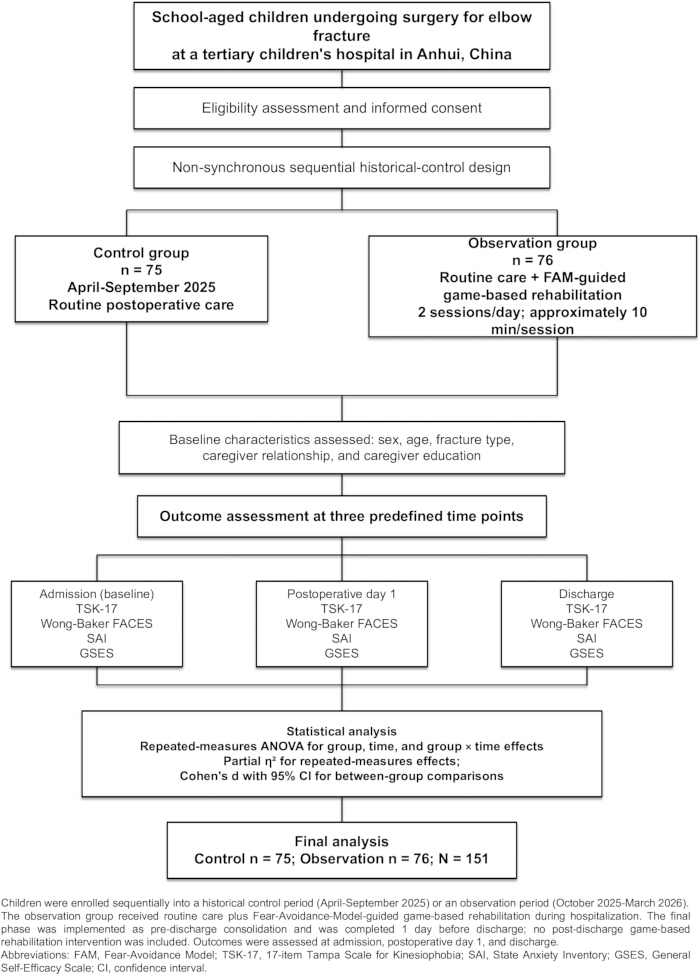
Figure 1. Overall study design and workflow. Schematic of participant eligibility and enrollment, sequential historical-control allocation, intervention procedures, assessment time points, outcome measures, and statistical analysis in the quasi-experimental, non-synchronous controlled study. The control group included children admitted from April to September 2025 (n = 75), and the observation group included children admitted from October 2025 to March 2026 (n = 76). Outcomes were assessed at admission, postoperative day 1, and discharge. FAM, fear-avoidance model; TSK-17, Tampa Scale for Kinesiophobia; SAI, State Anxiety Inventory; GSES, General Self-Efficacy Scale; ANOVA, analysis of variance. Please click here to view a larger version of this figure.
Control of Bias in the Non-Synchronous Design
Because the sequential historical-control design was susceptible to temporal confounding, several measures were taken to protect internal validity. The two recruitment periods were managed by the same surgical and nursing teams, followed the same routine-care protocol, and used the same ward facilities, thereby minimizing potential differences related to staffing and routine clinical care. The two recruitment periods covered different seasons, and potential seasonal effects were considered in the interpretation of the findings. Baseline comparability of fracture type, age, sex, and caregiver characteristics was confirmed (Table 1). To limit performance and detection bias, all outcome scales were administered using a standardized script by trained assessors who were not members of the intervention delivery team. Nonetheless, the assessors could not be fully blinded to group allocation given the overt nature of the game-based intervention; this residual risk was acknowledged in the Limitations.
Table 1: Comparison of baseline characteristics between the control and observation groups. Data are presented as mean ± standard deviation for continuous variables and n (%) for categorical variables. The independent-samples t-test was used for continuous variables, and the χ2 test or Fisher-Freeman-Halton exact test was used for categorical variables, as appropriate. *The Fisher-Freeman-Halton exact test was used for fracture type and caregiver relationship. Please click here to download this file.
Sample Size
The sample size was estimated using a two-sample independent t-test for the primary outcome (TSK-17). With a two-sided α = 0.05 and power (1 − β) = 0.80, an expected minimal clinically important between-group difference (δ) of 5 points, and a pooled standard deviation (σ) of 10 points, 63 participants per group were required. Allowing for 10% attrition, the target sample size was ≥70 participants per group. The achieved sample sizes of 75 and 76 participants therefore provided adequate statistical power. Baseline demographic and clinical characteristics are presented in Table 1.
Interventions
Control Group:
Participants in the control group received routine nursing care and postoperative rehabilitation guidance according to the standardized pediatric orthopedic care protocol used in the ward. On admission, the child and parents received education regarding the cause and clinical manifestations of elbow fracture, perioperative precautions, postoperative limb protection, and the importance of early functional exercise through verbal explanation and a standardized admission-education slide presentation.
After surgery, the affected upper limb was elevated above heart level using an upper-limb support to facilitate venous return and reduce postoperative swelling. Limb position, distal circulation, skin condition, and swelling were assessed during routine nursing care. Postoperative pain was assessed, and routine pain-management measures were provided. Distraction strategies, such as listening to music or watching age-appropriate videos, were encouraged. Local cold compresses or prescribed analgesic treatment were applied when clinically indicated.
Psychological support was provided to the child and parents. Expected postoperative discomfort and the purpose of functional exercise were explained using age-appropriate language, and active participation in rehabilitation was encouraged. Functional exercise guidance began on postoperative day 1 when the child had recovered from anesthesia, vital signs were stable, distal circulation and neurological status of the affected limb were intact, no progressive swelling or wound bleeding was present, and pain was sufficiently controlled to permit participation in exercise. The prescribed upper-limb and elbow exercises were demonstrated to the child and caregiver, and the child was instructed to perform the movements gradually within the permitted range of motion without provoking marked pain. The prescribed exercises included active finger flexion and extension, hand opening and closing, shoulder movement, and, when not restricted by immobilization, wrist movement and forearm pronation and supination. Once elbow motion was permitted, active elbow flexion and extension were added. Each exercise was performed for 10 repetitions per set, 2 sets per session, twice daily, with each session lasting approximately 10–15 min. Movements were performed gradually within the surgeon-prescribed safe range of motion or the limits imposed by the cast or brace, without forced passive stretching or movement that provoked marked pain or increased swelling.
Exercise intensity was adjusted according to the child's postoperative condition, pain tolerance, swelling, and physician-prescribed activity restrictions. Exercise was stopped or postponed if marked pain, obvious swelling, dizziness, nausea, or other clinically significant discomfort occurred.
Postoperative pain was assessed using the standardized pain assessment procedure. Nonpharmacological measures, such as distraction with music or videos and cold compresses, were provided when appropriate. For pharmacological analgesia, ibuprofen oral suspension (Motrin; 100 mg/5 mL) was administered at 5–10 mg/kg per dose every 6–8 h according to pain severity. During the first 24–48 h after surgery, regular dosing was used when pain was more pronounced; thereafter, administration was changed to as-needed dosing. The dose did not exceed 400 mg per administration or a total dose of 40 mg/kg within 24 h. The same postoperative analgesic protocol was applied to both groups throughout the study period.
Observation Group:
Participants in the observation group received all routine nursing care, pain management, psychological support, and postoperative rehabilitation guidance described for the control group. In addition, they received a structured game-based rehabilitation program based on the FAM. The intervention components were mapped to four FAM-related targets: maladaptive cognition, pain-related experience, avoidance behavior, and self-efficacy. The phase-specific intervention content and game procedures shown in Table 2 were followed. The intervention was delivered twice daily for approximately 10 min per session and continued until 1 day before discharge. The final phase was implemented during the late hospitalization period as pre-discharge consolidation; no post-discharge game-based rehabilitation intervention was included in the present study.
Table 2: FAM-guided game-based rehabilitation intervention program. The intervention was structured according to four FAM-related targets: maladaptive cognition, pain-related experience, avoidance behavior, and self-efficacy. The four phases comprised cognitive restructuring, pain control, graded fun exercise, and confidence building. The final phase was implemented during late hospitalization as pre-discharge consolidation and was completed 1 day before discharge; no post-discharge game-based rehabilitation intervention was delivered. FAM, fear-avoidance model; IV, intravenous. Please click here to download this file.
A seven-member multidisciplinary intervention team was established, consisting of one associate chief orthopedic physician, one attending orthopedic physician, one rehabilitation physician, one orthopedic nursing specialist, two orthopedic specialty nurses, and one nursing graduate student. The nursing specialist was responsible for protocol review and quality control; the physicians provided clinical and rehabilitation guidance; the specialty nurses delivered the intervention; and the graduate student assisted with study documentation and data collection. Before study implementation, all nurses delivering the intervention completed an 8-h standardized training program covering the FAM rationale, intervention procedures, communication strategies for school-aged children, game procedures, safety precautions, and intervention documentation. Intervention personnel were required to pass a competency assessment before independently delivering the intervention. Competency was assessed using a standardized checklist covering protocol knowledge, pre-session assessment, correct game-task delivery, communication and reinforcement techniques, safety monitoring, stopping criteria, and documentation. Each nurse completed a simulated intervention session and was required to achieve a checklist score of ≥90%, with all safety-related items performed correctly, before independently delivering the intervention. Nurses who did not meet the threshold received additional training and were reassessed until the criteria were satisfied.
The FAM-guided game-based rehabilitation program began after postoperative functional exercise was clinically permitted. The intervention was conducted twice daily for approximately 10 min per session and continued until 1 day before discharge. Before each session, the child's general condition, pain level, emotional state, willingness to participate, swelling of the affected limb, and ability to safely perform the prescribed movements were assessed. The purpose and rules of the selected game were explained using simple, age-appropriate language. Emphasis on pain or the possibility of reinjury was avoided, and the child's attention was directed toward completion of the game task.
The corresponding game activity was selected according to the predefined FAM-guided game-based rehabilitation protocol, postoperative rehabilitation stage, prescribed range of motion, pain tolerance, fear response, and ability to participate. The prescribed elbow or upper-limb movements were integrated into the game activity. The child was encouraged to complete the required movements actively and progressively within the clinically permitted range without forcing movement through marked pain. During the activity, pain-related expressions, movement hesitation, avoidance behavior, task completion, and emotional responses were observed. Verbal encouragement and positive reinforcement were provided after movement attempts and successful task completion. If fear or avoidance behavior occurred, explanation, demonstration, task simplification, and repeated successful movement experiences were used to encourage continued participation while maintaining postoperative safety.
Game difficulty was progressively adjusted according to the child's movement performance, pain tolerance, confidence, and rehabilitation stage. Task difficulty was increased when the child completed at least 80% of the prescribed game task within the permitted range of motion in two consecutive sessions, without unsafe compensatory movements, marked fear or avoidance, or an increase of ≥2 points on the Wong-Baker FACES Pain Rating Scale from the pre-session level. Progression to the next intervention phase required achievement of these criteria together with clinical readiness for the corresponding rehabilitation activity. Task difficulty was reduced, or the child remained at the current phase, when task completion was <80%, pain increased by ≥2 points, obvious fear or avoidance occurred, or movement could not be performed safely within the prescribed range. The intervention was temporarily discontinued if marked pain exacerbation, increasing swelling, dizziness, nausea, or other clinically significant discomfort occurred. At the end of each session, positive feedback regarding completed movements and rehabilitation progress was provided, successful movement experiences were reinforced, and participation in the subsequent session was encouraged.
The intervention was stopped or postponed if marked pain exacerbation, obvious swelling, dizziness, nausea, substantial emotional distress, or another condition unsuitable for continued exercise occurred. The child was reassessed before the intervention was restarted, and task difficulty or movement demand was modified when necessary. The intervention was restarted only after pain had returned to within 2 points of the pre-session level, swelling was no longer progressive, distal circulation and neurological status remained intact, and the child was clinically stable and willing to continue. Task difficulty or movement demand was reduced when necessary. The same pain, swelling, and safety criteria were applied to routine postoperative rehabilitation in both groups. Session completion, approximate duration, intervention phase, game activity, child participation, pain or fear response, and any protocol deviation or adverse event were recorded after each session.
Intervention fidelity was monitored using a standardized checklist. The orthopedic nursing specialist randomly assessed 20% of all intervention sessions using a computer-generated random-number sequence based on the complete session log. Protocol adherence was calculated as the number of checklist items correctly completed divided by the total number of applicable checklist items, multiplied by 100%. Mean adherence across sampled sessions was maintained above 90%. Any identified deviations were corrected through timely feedback and retraining when necessary.
Outcome Measures
All study outcomes were assessed at three predefined time points: admission, postoperative day 1, and discharge. Trained assessors administered the outcome measures using standardized instructions at each assessment. The postoperative day 1 assessment was conducted after completion of the scheduled rehabilitation sessions on that day, whereas the discharge assessment was performed on the day of discharge, after the final game-based rehabilitation session had been completed on the preceding day. The same assessment timing was applied to both groups.
Kinesiophobia and Pain:
Kinesiophobia was assessed using the 17-item Tampa Scale for Kinesiophobia (TSK-17). The Simplified Chinese version of the TSK-17 has demonstrated acceptable reliability and validity17. Each item was rated on a 4-point Likert scale, and a total score ranging from 17 to 68 was calculated, with higher scores indicating greater kinesiophobia. A score of ≥38 indicated the presence of kinesiophobia. The Simplified Chinese TSK-17 has a reported Cronbach's α of 0.74 and a test-retest reliability of 0.8617. Before the main study, a preliminary small-sample psychometric assessment of the Simplified Chinese TSK-17 was conducted in children with elbow fractures from the target population. The scale demonstrated satisfactory reliability and validity in this preliminary assessment, supporting its applicability for outcome evaluation in the present study. Pain was assessed using the Wong-Baker FACES Pain Rating Scale18. The child was presented with six facial expressions representing increasing levels of pain and was asked to select the face that best represented the current pain experience. The corresponding score was recorded from 0, indicating no pain, to 10, indicating the most severe pain.
Anxiety and Self-Efficacy:
State anxiety was assessed using the State Anxiety Inventory (SAI)19, using the revised Chinese version validated in school-aged children20. The SAI consisted of 20 items rated on a 4-point Likert scale, yielding a total score ranging from 20 to 80. Higher scores indicated greater state anxiety. Self-efficacy was assessed using the Chinese version of the General Self-Efficacy Scale (GSES)21. The scale consisted of 10 items rated on a 4-point scale, yielding a total score ranging from 10 to 40. Higher scores indicated greater general self-efficacy. The Chinese version has demonstrated satisfactory reliability and validity, with a reported Cronbach's α of 0.8721.
Statistical Analysis
The demographic characteristics and outcome assessment data were entered into statistical software for analysis. Normally distributed continuous variables were expressed as mean ± standard deviation (SD), and categorical variables were expressed as number and percentage, n (%). The normality of continuous variables was assessed using the Shapiro–Wilk test, and homogeneity of variance was assessed using Levene’s test. Baseline continuous variables were compared between the two groups using the independent-samples t-test when the assumptions of normality and homogeneity of variance were satisfied. Categorical variables were analyzed using the χ2 test or Fisher’s exact test, as appropriate. Repeated measurements of kinesiophobia, pain, anxiety, and self-efficacy were analyzed using repeated-measures analysis of variance, with time as the within-subject factor and group as the between-subject factor. The main effects of group and time and the group × time interaction were evaluated. The sphericity assumption was assessed using Mauchly’s test, and the Greenhouse–Geisser correction was applied when the sphericity assumption was violated. When a significant group × time interaction was identified, between-group comparisons were performed at each assessment time point using independent-samples t-tests. To account for multiple comparisons across the three assessment time points, the Bonferroni correction was applied, with the adjusted significance level set at P < 0.0167 (0.05/3). Effect sizes were reported as partial η2 for interaction effects and Cohen’s d with 95% confidence intervals for between-group differences. Non-normally distributed or ordinal variables, including Wong-Baker FACES Pain Rating Scale scores when appropriate, were analyzed using the Mann–Whitney U test for between-group comparisons. For Wong-Baker FACES Pain Rating Scale scores, repeated-measures analysis of variance was prespecified to evaluate longitudinal changes across the three assessment time points. The Mann–Whitney U test was used only for cross-sectional between-group comparisons when the normality assumption was not satisfied and was not used for the longitudinal analysis of pain scores. A Bonferroni-adjusted significance threshold of P < 0.0125 (0.05/4) was applied to the primary group × time interaction tests for the four prespecified outcomes.
Results
Kinesiophobia and Pain
At admission, there were no statistically significant between-group differences in either TSK-17 scores (52.73 ± 1.95 vs. 52.28 ± 1.36; t = 1.669, P = 0.098) or Wong-Baker FACES pain scores (4.24 ± 1.43 vs. 4.32 ± 1.50; P = 0.751). Repeated-measures analysis of variance showed significant group × time interaction effects for both kinesiophobia and pain, indicating that the trajectories of these outcomes differed between the two groups. The group × time interaction was significant for TSK-17 (F = 399.883, df = 1.894, 282.251; P < 0.001; partial η2 = 0.729) and for pain (F = 5.998, df = 1.913, 285.098; P = 0.00324; partial η2 = 0.039).
On postoperative day 1, the observation group had significantly lower TSK-17 and pain scores than the control group (both P < 0.001). These between-group differences remained significant at discharge (both P < 0.001). For TSK-17, the between-group mean difference was 8.35 points (95% CI, 7.70–9.00) on postoperative day 1 and 10.63 points (95% CI, 10.17–11.08) at discharge. The discharge difference exceeded the prespecified minimal clinically important difference of 5 points. For pain, the between-group mean difference was 0.75 points (95% CI, 0.46–1.04) on postoperative day 1 and 0.74 points (95% CI, 0.32–1.16) at discharge. Detailed results, including Cohen’s d values for the between-group comparisons, are presented in Table 3.
Table 3: Comparison of kinesiophobia and pain scores between the control and observation groups at different assessment time points. Data are presented as mean ± standard deviation. Repeated-measures analysis of variance was used to evaluate the effects of group, time, and the group × time interaction. Between-group comparisons were performed at admission, postoperative day 1, and discharge. Effect sizes are presented as partial η2 for repeated-measures effects and Cohen’s d with 95% confidence intervals for between-group comparisons. TSK-17, 17-item Tampa Scale for Kinesiophobia; CI, confidence interval; SD, standard deviation; df, degrees of freedom; F, F statistic; t, t-test statistic; Z, standardized test statistic; n, sample size. Please click here to download this file.
Anxiety and Self-Efficacy
There were no statistically significant between-group differences in state anxiety or general self-efficacy scores at admission (SAI: 51.27 ± 1.34 vs. 51.58 ± 1.35; t = −1.427, P = 0.156; GSES: 19.15 ± 1.35 vs. 19.54 ± 1.80; t = −1.514, P = 0.132). Repeated-measures analysis of variance showed significant group × time interaction effects for state anxiety (F = 460.956, P < 0.001, partial η2 = 0.756) and self-efficacy (F = 188.320, P < 0.001, partial η2 = 0.558).
On postoperative day 1, the observation group had significantly lower state anxiety scores and higher self-efficacy scores than the control group (both P < 0.001). These differences persisted at discharge, with further reductions in anxiety and improvements in self-efficacy observed in the observation group. Detailed results are shown in Table 4.
Table 4: Comparison of anxiety and self-efficacy scores between the control and observation groups at different assessment time points. Data are presented as mean ± standard deviation. Repeated-measures analysis of variance was used to evaluate the effects of group, time, and the group × time interaction. Between-group comparisons were performed at admission, postoperative day 1, and discharge. Effect sizes are presented as partial η2 for repeated-measures effects and Cohen’s d with 95% confidence intervals for between-group comparisons. SAI, State Anxiety Inventory; GSES, General Self-Efficacy Scale; CI, confidence interval; SD, standard deviation; df, degrees of freedom; F, F statistic; t, t-test statistic; Z, standardized test statistic; n, sample size. Please click here to download this file.
Overall Findings
Overall, the findings support the study hypothesis that FAM-guided game-based rehabilitation was associated with more favorable early postoperative rehabilitation outcomes in school-aged children after elbow fracture surgery. Compared with routine care alone, the intervention was associated with greater reductions in kinesiophobia, pain, and anxiety and greater improvement in self-efficacy over time. In particular, the between-group difference in TSK-17 score at discharge exceeded the prespecified minimal clinically important difference, supporting the clinical relevance of the observed reduction in kinesiophobia.
Supplementary Data File 1. De-identified participant-level dataset. The file contains participant-level demographic and clinical characteristics and outcome measurements for the control group (n = 75) and observation group (n = 76). Outcome variables include kinesiophobia, pain, anxiety, and self-efficacy assessed at admission, postoperative day 1, and discharge. All direct personal identifiers have been removed.Please click here to download this file.
Data Availability:
The de-identified participant-level data underlying the results, tables, and statistical analyses reported in this study are provided as Supplementary Data File 1. The dataset includes demographic and clinical characteristics and measurements of the study outcomes at admission, postoperative day 1, and discharge.
Discussion
The present study showed that the FAM-guided game-based rehabilitation program was associated with greater reductions in kinesiophobia during early postoperative recovery than routine care alone. The between-group difference in TSK-17 score at discharge exceeded the prespecified minimal clinically important difference, suggesting that the observed change was not limited to statistical significance but may also be clinically meaningful. This finding is consistent with previous evidence indicating that fear-related responses should be considered important targets during rehabilitation22. A critical feature of the present protocol was that rehabilitation did not begin with repeated encouragement to move, but with modification of the child’s interpretation of pain and movement. Picture books, soft-toy role-play, and animated videos were used to explain postoperative sensations in developmentally appropriate ways and to reduce the expectation that movement would inevitably aggravate injury. Subsequent game tasks then provided graded opportunities to perform the prescribed movements and experience successful movement without excessive discomfort. This sequence is consistent with the FAM, in which catastrophic interpretation of pain may promote fear, avoidance, and reduced activity, whereas corrective information and repeated safe movement experiences may weaken this cycle. The concurrent reduction in anxiety and increase in self-efficacy further suggest that the intervention may have influenced several interrelated components of fear avoidance rather than kinesiophobia alone. Previous research in school-aged children with fractures found that a therapeutic play program was associated with lower perioperative anxiety, which supports the anxiety-related findings of the present study23. Similarly, game-based learning in school-aged children undergoing surgery was associated with lower anxiety and higher postoperative self-efficacy, which is consistent with the improvement in self-efficacy observed in the present study24. For school-aged children, incorporating rehabilitation goals into recognizable play activities and providing immediate positive feedback may be particularly useful because abstract verbal instruction alone may be insufficient to sustain attention and confidence during painful postoperative exercise.
Pain represented another important component of the observed response. Children receiving game-based rehabilitation had lower pain scores on postoperative day 1 and at discharge. Similar findings have been reported in school-aged children with limb fractures, in whom virtual reality game interventions were associated with reductions in postoperative pain, fear, and anxiety25. Within the FAM framework, pain may reinforce fear of movement and subsequent avoidance. The present protocol therefore combined routine pain management with distraction, age-appropriate explanation, parental support, and graded movement. Nonpharmacological distraction strategies have also been reported to reduce postoperative pain and anxiety in children26. However, another pediatric surgical study found no significant additional improvement in pain or kinesiophobia with virtual reality-assisted early mobilization15, suggesting that outcomes may vary according to the intervention format and clinical context. Compared with analgesic treatment alone, game-based rehabilitation does not replace pharmacological pain control when clinically required; rather, it provides an additional behavioral context in which the child can reinterpret movement and develop confidence in performing it. Compared with conventional verbal education and demonstration, the game-based approach embeds the prescribed movement into a specific task and supplies immediate reinforcement after successful completion. These characteristics may explain why changes in pain, anxiety, kinesiophobia, and self-efficacy occurred in parallel. Although pain, anxiety, and self-efficacy showed statistically significant between-group differences, validated clinically meaningful change thresholds for these outcomes are not currently established in school-aged children after elbow fracture surgery. Therefore, their clinical meaningfulness cannot be determined with the same certainty as the change in TSK-17 score. Nevertheless, because the present study used a quasi-experimental design, these findings should be interpreted as associations with the intervention rather than evidence that the intervention directly caused each of these changes.
Several protocol steps appear particularly important for reproducibility and clinical implementation. In the present study, game-based rehabilitation was initiated after postoperative functional exercise was permitted and was delivered twice daily for approximately 10 min per session until 1 day before discharge. Previous pediatric postoperative rehabilitation studies have generally used relatively brief sessions. Phelan et al.27 applied immersive virtual reality during postoperative rehabilitation for approximately 10 min once daily over 3–4 days, whereas Walter et al. used daily 10-min virtual reality sessions from postoperative day 1 until discharge or postoperative day 328. Compared with these protocols, the present intervention maintained a similar short session duration but increased the daily frequency to twice per day, allowing repeated exposure to rehabilitation tasks without substantially prolonging individual sessions. The repeated-measures analysis showed significant group × time interactions for kinesiophobia, pain, anxiety, and self-efficacy, indicating that the trajectories of these outcomes differed between groups. Kinesiophobia, pain, and anxiety decreased during postoperative recovery, whereas self-efficacy increased, with more favorable changes in the observation group. In particular, the reported between-group difference in TSK-17 score at discharge exceeded the prespecified minimal clinically important difference of 5 points, suggesting clinical as well as statistical relevance. These findings suggest that repeated short sessions may be suitable for reinforcing safe movement experiences and rehabilitation confidence during the limited period of hospitalization. During implementation, task difficulty and movement demand should nevertheless be adjusted according to pain tolerance, fear response, and rehabilitation stage, while maintaining the prescribed range of motion and standardized intervention schedule.
From a clinical perspective, this protocol provides a relatively low-resource approach for incorporating psychological and behavioral factors into routine pediatric orthopedic rehabilitation. Traditional postoperative rehabilitation commonly emphasizes pain control, limb positioning, education, and demonstration of functional exercises. These measures remain indispensable, but they may not fully address the child's fear of movement once avoidance has developed. The FAM-guided game-based rehabilitation protocol adds structured cognitive explanation, graded movement experience, positive reinforcement, and parental involvement without requiring specialized rehabilitation equipment. Picture books, animated materials, simple movement games, and sticker-based rewards can be incorporated into ward-based care after standardized staff training. The approach may therefore have potential applicability in settings in which access to pediatric psychologists, virtual reality systems, or other technology-intensive rehabilitation resources is limited. However, because participants were recruited from a single tertiary pediatric center, applicability to community hospitals, different cultural settings, and lower-resource healthcare environments was not established in the present study. More technology-intensive approaches should not be regarded as competing methods. Digital games, virtual reality, or remotely supervised rehabilitation could potentially provide greater task variety and automated feedback, whereas the present low-technology protocol may offer advantages in cost, accessibility, and ease of bedside implementation. Future adaptations could evaluate these alternative approaches while preserving the central FAM sequence of correcting maladaptive beliefs, controlling pain-related distress, reducing avoidance through graded activity, and reinforcing self-efficacy. Caregiver coaching may also be incorporated into discharge planning to facilitate continuity of appropriate rehabilitation behaviors after hospitalization, although the effectiveness of a post-discharge extension was not evaluated in the present study.
Several limitations should be considered when interpreting these findings. First, this was a single-center quasi-experimental study using sequential historical controls rather than concurrent randomized allocation. Although the same clinical teams and routine-care procedures were maintained across the two recruitment periods, no concurrent quality-improvement initiatives or relevant changes in routine clinical practice occurred during either study period. Nevertheless, unmeasured temporal influences associated with the sequential historical-control design cannot be completely excluded. The sequential allocation also introduced a risk of allocation bias because participants were not randomly assigned. Although outcome scales were administered using standardized procedures by trained assessors who were not members of the intervention delivery team, assessors could not be fully blinded to group allocation, leaving a residual possibility of observer or detection bias. These limitations mean that the findings should be interpreted as associations rather than causal effects. Second, participants were recruited from a single tertiary children’s hospital, limiting certainty regarding generalizability to community hospitals, other cultural settings, and lower-resource healthcare environments. Third, follow-up ended at discharge, which precludes assessment of whether improvements in rehabilitation engagement, kinesiophobia, pain, anxiety, or self-efficacy were sustained over the longer term. Accordingly, the present findings should not be interpreted as demonstrating long-term adherence or effectiveness. Fourth, the principal outcomes were based mainly on self-reported psychological and symptom scales, and objective functional measures such as elbow range of motion were not included. Future multicenter randomized controlled studies could reduce allocation and temporal confounding and should incorporate longer follow-up, objective functional outcomes, and evaluation across different clinical and cultural settings to further assess the effectiveness, durability, and generalizability of this game-based rehabilitation approach.
Overall, FAM-guided game-based rehabilitation was associated with reduced kinesiophobia, pain, and anxiety and enhanced self-efficacy during early postoperative recovery in school-aged children after elbow fracture surgery. By translating constructs of the FAM into a developmentally tailored, stage-matched intervention incorporating cognitive explanation, graded movement, positive reinforcement, and caregiver involvement, this study offers a clinically applicable approach for integrating psychological and behavioral considerations into pediatric orthopedic rehabilitation. The findings support further investigation of theory-guided game-based rehabilitation as an adjunct to routine postoperative care rather than as a replacement for standard pain management or prescribed functional exercise. Given the single-center, quasi-experimental design and discharge-limited follow-up, multicenter randomized trials with longer follow-up and objective functional assessments are needed to determine whether the observed early associations are sustained and generalizable and to evaluate the potential application of this approach across broader pediatric rehabilitation settings.
Disclosures
Conflict of Interest:
The authors declare no competing interests.
Acknowledgements
This work was supported by the Anhui Provincial Health and Medical Science Research Project (AHWJ2023A20371).
Materials
| Name | Company | Catalog Number | Comments |
|---|---|---|---|
| Admission-education slide presentation | Developed by the pediatric orthopedics study team | Not applicable | Standardized educational material covering elbow-fracture information, perioperative precautions, postoperative limb protection, and early functional exercise. The same educational content was provided to caregivers in both groups. RRID not available. |
| Fear-Avoidance-Model-guided game-based rehabilitation protocol | Developed by the study team | Study-developed protocol; no catalog number | Structured nonpharmacological rehabilitation protocol targeting maladaptive cognition, pain-related experience, avoidance behavior, and self-efficacy. Sessions were delivered twice daily for approximately 10 min per session and ended 1 day before discharge. The final phase was implemented as pre-discharge consolidation; no post-discharge game-based rehabilitation intervention was included. RRID not available. |
| General Self-Efficacy Scale (GSES), Chinese version | Schwarzer & Jerusalem / Freie Universität Berlin | Not applicable | 10-item, 4-point scale used to assess general self-efficacy (total score, 10–40). RRID not available. Source: https://userpage.fu-berlin.de/~health/engscal.htm |
| IBM SPSS Statistics, version 26.0 | IBM Corp. | Version 26.0 | Statistical analysis software. RRID: SCR_016479. Registry: https://rrid.site/resolver/SCR_016479 |
| Ibuprofen oral suspension (Motrin; 2 g/100 mL [100 mg/5 mL]) | Shanghai Johnson & Johnson Pharmaceutical Co., Ltd., Shanghai, China | National Drug Approval No. H19991011; batch No. 260106020 | Postoperative analgesic used in both groups at 5–10 mg/kg per dose orally every 6–8 h according to pain severity. Regular administration could be used during the first 24–48 h when pain was more pronounced, followed by as-needed administration. The maximum dose was 400 mg per administration and 40 mg/kg per 24 h. Product/catalog number not available. RRID not available. |
| Intervention fidelity checklist | Developed by the study team | Study-developed checklist; no catalog number | Standardized checklist used for fidelity monitoring. After all intervention sessions were logged sequentially, 20% of sessions were selected using a computer-generated random-number sequence. Adherence for each sampled session was calculated as the number of correctly completed applicable checklist items divided by the total number of applicable items × 100%; overall adherence was summarized as the mean across sampled sessions and remained above 90%. RRID not available. |
| Puppet role-play props | Developed/assembled by the study team | Not applicable | Simple noncommercial props used for structured role-play to help children distinguish pain-related sensations from fear-related responses. The props were study-developed and were not a standardized commercial product. RRID not available. |
| Rehabilitation certificate and reward stickers | Developed by the study team | Not applicable | Positive-reinforcement materials used during hospitalization, including the pre-discharge consolidation phase, to reinforce task completion, rehabilitation confidence, and self-efficacy. They were not used as a post-discharge intervention. RRID not available. |
| State Anxiety Inventory (SAI), revised Chinese version | Mind Garden, Inc. (original State-Trait Anxiety Inventory, Form Y); Chinese revision by Chen et al. | Not applicable | 20-item State Anxiety Inventory rated on a 4-point scale (total score, 20–80); higher scores indicate greater state anxiety. The revised Chinese version used in school-aged children was administered. The term State Anxiety Inventory (SAI) is used consistently throughout the manuscript. RRID not available. Instrument source: https://www.mindgarden.com/145-state-trait-anxiety-inventory-for-adults |
| Tampa Scale for Kinesiophobia (TSK-17), Simplified Chinese version | Original scale by Kori et al.; Simplified Chinese adaptation by Wei et al. | Not applicable | 17-item, 4-point Likert scale used to assess kinesiophobia (total score, 17–68). The published Simplified Chinese version demonstrated acceptable reliability and validity. Before the main study, a preliminary small-sample psychometric assessment in children with elbow fractures from the target population also showed satisfactory reliability and validity; this was not considered a formal large-scale population-specific validation. RRID not available. |
| Wong-Baker FACES Pain Rating Scale | Wong-Baker FACES Foundation | Not applicable | Six-face self-report pain scale scored from 0 to 10 for postoperative pain assessment. RRID not available. Official source: https://wongbakerfaces.org/ |
References
- Xu H, Zhang JF, Li Y, Wan GL. Establishment and validation of a nomogram prediction model for poor joint function recovery after elbow fracture surgery. Journal of Traumatic Surgery. 2024;26:692-9.
- Deng BC. Correlation between children's temperament characteristics and elbow fracture occurrence and compliance with postoperative rehabilitation exercise. Doctor. 2025;10:84-7.
- Liu ZG. Application value of static progressive stretch training combined with routine rehabilitation training in postoperative rehabilitation of patients with elbow joint fracture. Chinese Journal of Trauma and Disability Medicine. 2024;32:1-3.
- Zhang D, Nazarian A, Rodriguez EK. Post-traumatic elbow stiffness: pathogenesis and current treatments. Shoulder Elbow. 2020;12:38-45.
- Masci G, et al. The stiff elbow: current concepts. Orthop Rev (Pavia). 2020;12:8661.
- Zhang XP. Effect of early comprehensive rehabilitation nursing on postoperative recovery of complex elbow fracture. Henan Medical Research. 2021;30:180-1.
- Wang XH, Zhu M, Zhu L, Liang PR. Characteristics of postoperative psychological stress and kinesiophobia symptoms in children with upper-limb fractures. Journal of Clinical Nursing in Practice. 2024;10:123-5.
- Xiao D, et al. Incidence and risk factors of kinesiophobia in children following fracture surgery: a prospective cohort study. Front Pediatr. 2025;13:1536966.
- Kori SH, Miller RP, Todd DD. Kinesiophobia: a new view of chronic pain behavior. Pain Management. 1990;3:35-43.
- Tang WW, et al. Effect of family-centered interactive temperament intervention on compliance with early functional exercise of affected limbs in school-age children after limb fracture surgery. Chinese Journal of Modern Nursing. 2021;27:4144-8.
- Golden-Plotnik S, et al. Parental perspectives on children's functional experiences after limb fracture: a qualitative study. Pediatr Emerg Care. 2022;38:e947-52.
- Lethem J, Slade PD, Troup JDG, Bentley G. Outline of a fear-avoidance model of exaggerated pain perception—I. Behav Res Ther. 1983;21:401-8.
- Rogers AH, Farris SG. A meta-analysis of the associations of elements of the fear-avoidance model of chronic pain with negative affect, depression, anxiety, pain-related disability and pain intensity. Eur J Pain. 2022;26:1611-35.
- Kami K, Tajima F, Senba E. Brain mechanisms of exercise-induced hypoalgesia: to find a way out from “fear-avoidance belief.” Int J Mol Sci. 2022;23:2886.
- Bezgin S, et al. Use of virtual reality in children undergoing surgery. Front Pediatr. 2025;13:1633310.
- Liszio S, et al. Cooperative virtual reality gaming for anxiety and pain reduction in pediatric patients and their caregivers during painful medical procedures: protocol for a randomized controlled trial. JMIR Res Protoc. 2025;14:e63098.
- Wei X, et al. The Chinese version of the Tampa Scale for Kinesiophobia was cross-culturally adapted and validated in patients with low back pain. J Clin Epidemiol. 2015;68(10):1205-12.
- Wong DL, Baker CM. Pain in children: comparison of assessment scales. Pediatr Nurs. 1988;14(1):9-17.
- Spielberger CD, Gorsuch RL, Lushene R, Vagg PR, Jacobs GA. Manual for the State-Trait Anxiety Inventory (Form Y). Consulting Psychologists Press; Palo Alto, CA; 1983.
- Chen YF, Cao Y, Liu ZK. The application of a revised Chinese version of the State-Trait Anxiety Inventory in migrant children. Chin J Behav Med Brain Sci. 2013;22(8):755-7.
- Wang CK, Hu ZF, Liu Y. Evidences for reliability and validity of the Chinese version of General Self-Efficacy Scale. Chinese Journal of Applied Psychology. 2001;7(1):37-40.
- Wang LJ, Cheng LL. Effect of narrative nursing intervention combined with functional exercise on kinesiophobia in children after supracondylar humeral fracture surgery. Neural Injury and Functional Reconstruction. 2024;19:615-6.
- Zhang Q, et al. Design and application of a perioperative therapeutic play program for school-aged children with fractures based on comfort theory. Chinese Journal of Nursing Education. 2023;20(3):333-8.
- Sofia M, Aranha PR. Effectiveness of game-based learning on anxiety and postoperative self-efficacy among children undergoing surgery. Journal of Health and Allied Sciences NU. 2023;13(1):83-9.
- Bai F, et al. Efficiency of immersive virtual reality game technology on pain management in children with limb fractures: a randomized controlled trial. J Pediatr Nurs. 2025;81:68-73.
- Mathias EG, et al. Nonpharmacological interventions for managing postoperative pain and anxiety in children: a randomized controlled trial. Clin Exp Pediatr. 2024;67(12):677-85.
- Phelan I, et al. Immersive virtual reality rehabilitation after lower limb surgery in paediatric patients. J Pediatr Rehabil Med. 2025;18(1):30-41.
- Walter CM, et al. Virtual reality for the management of postoperative pain and anxiety in children and adolescents undergoing Nuss repair of pectus excavatum: randomized controlled trial. JMIR Perioper Med. 2026;9:e80902.