Perioperative neurocognitive disorders arise from interactions between pre-existing vulnerability and perioperative stress. This narrative review evaluates proposed mechanisms, candidate biomarkers, electroencephalographic features, and the evidence for multicomponent prevention, individualized perioperative care, and emerging neuromodulation. It distinguishes association from causation and established care from investigational approaches.
Review Article
Perioperative Neurocognitive Disorders in Older Adults: Mechanisms, Biomarkers, and Evidence-Informed Management
In This Article
Summary
Abstract
Perioperative neurocognitive disorders (PNDs) encompass cognitive change identified before or after surgery. Postoperative delirium (POD) is an acute, fluctuating disorder of attention and awareness, whereas delayed neurocognitive recovery and postoperative mild or major neurocognitive disorder describe objectively assessed decline over longer intervals. This narrative review focuses on older adults undergoing noncardiac and cardiac surgery and examines neuroinflammation, blood-brain barrier dysfunction, neurotransmitter imbalance, oxidative stress, synaptic dysfunction, candidate fluid biomarkers, and electroencephalography (EEG) features, and evidence-informed management. Multicomponent prevention, medication review, mobilization, sleep support, and individualized anesthetic care remain the most defensible clinical strategies. EEG-guided anesthetic titration can reduce anesthetic exposure but has not consistently reduced POD. Blood biomarkers, machine-learning models, trial-by-trial neural variability, and noninvasive brain stimulation are promising research tools, but none currently replaces standardized clinical assessment or justifies routine mechanism-specific treatment.
Introduction
Surgical care increasingly includes older adults with multimorbidity, frailty, or pre-existing cognitive vulnerability. Although perioperative survival has improved, cognitive complications remain clinically important. The 2018 nomenclature recommendations use PNDs as an overarching term: POD denotes an acute fluctuating disturbance of attention and awareness, delayed neurocognitive recovery applies to objectively assessed decline within 30 days, and postoperative mild or major neurocognitive disorder applies from 30 days to 12 months1. The historical term postoperative cognitive dysfunction (POCD) is retained in this review only when describing older literature that used it2.
Reported POD rates vary by operation, case mix, baseline vulnerability, and assessment method. In older adults undergoing hip surgery, estimates are often substantial, while hypoactive delirium is readily missed because it may present as reduced interaction rather than agitation3,4. These differences make standardized screening and explicit reporting of the study population essential.
POD usually emerges during the early postoperative period. Longer-lasting cognitive change should be characterized with the recommended neurocognitive-disorder terminology, an appropriate preoperative baseline, objective testing, and a defined follow-up interval1,5. This distinction prevents an acute clinical syndrome from being conflated with later cognitive trajectories.
The consequences extend beyond transient confusion. POD is associated with longer hospitalization, complications, functional deterioration, institutionalization, and mortality, although much of this evidence is observational and does not by itself establish causation5,6,7,8. This review therefore focuses on clinically relevant PNDs in older adults undergoing cardiac and noncardiac surgery and separates perioperative evidence from findings extrapolated from nonsurgical populations or experimental models.
Review and Perspective
Scope and evidence selection
This targeted narrative review was updated through September 2026 using PubMed-indexed literature, the reviewer-specified identifiers, and backward citation checking. Priority was given to primary human perioperative studies, randomized trials, recent cohort studies, and directly relevant animal models; reviews were used mainly for context. Because this was not a prespecified systematic review, the synthesis does not claim exhaustive coverage or formal risk-of-bias grading.
Core pathophysiological mechanisms
Neuroinflammation and the blood-brain barrier
Neuroinflammation is one proposed framework for PNDs. Surgical trauma can initiate systemic immune signaling that may interact with an age- or disease-vulnerable brain, but the relative contribution, timing, and causal importance of this pathway vary across models and patient populations.
Peripheral-to-central immune signaling
Surgical tissue injury releases damage-associated molecular patterns, including high-mobility group box 1, and stimulates innate immune signaling9,10. Circulating mediators may influence the brain through endothelial activation, altered blood-brain barrier permeability, vagal and humoral signaling, and regulated leukocyte trafficking; this process should not be described as passive diffusion of peripheral macrophages. Primary perioperative studies have associated cytokine patterns with POD and cognitive trajectories11,12. These observations support an association between inflammatory dynamics and cognitive outcomes rather than proof of a single causal pathway.
Microglial activation and synaptic pruning
When inflammatory signals reach the central nervous system, they may alter microglial state and synaptic homeostasis. Aging and chronic disease can modify these responses, but terms such as microglial priming remain model-dependent13. In a mouse PND model, complement component 1q-mediated microglial phagocytosis was associated with postoperative synapse loss and cognitive impairment14. This direct perioperative evidence is more relevant than extrapolation from Alzheimer disease or traumatic spinal injury, although translation to human PNDs remains unproven.
Neurotransmitter imbalance: the cholinergic-dopaminergic axis
Neurotransmitter imbalance may contribute to the fluctuating attention, arousal, and psychomotor changes of delirium, but these clinical features cannot be reduced to a single neurotransmitter failure. Cholinergic deficiency, dopaminergic excess, and changes in gamma-aminobutyric acid (GABA), serotonin, and melatonin signaling are overlapping hypotheses whose importance likely differs among patients and exposures15,16.
The cholinergic deficiency hypothesis
Acetylcholine supports attention, learning, memory, and arousal. Reduced cholinergic signaling has therefore been proposed as one contributor to delirium17. The strongest clinical implication is avoidance of excessive anticholinergic burden: observational evidence links greater burden with delirium, although this association is not proof that cholinergic deficiency is the sole mechanism18.
The dopaminergic excess hypothesis
Altered dopaminergic signaling may also contribute to agitation, hallucinations, and psychomotor change in some delirium phenotypes17,19. This hypothesis is biologically plausible but does not establish generalized dopaminergic hyperactivity in every patient or support routine prophylactic dopamine antagonism.
Other neurotransmitter systems
Dysregulation extends beyond acetylcholine and dopamine. Imbalances in GABA, serotonin, and melatonin are also observed in POD. Reduced GABAergic activity is implicated in alcohol withdrawal delirium, but the role of GABA in POD is complex, as exogenous GABA agonists (benzodiazepines) often precipitate or worsen delirium, likely by further suppressing specific arousal pathways16. Imbalances in the tryptophan-melatonin pathway disrupt the circadian rhythm, contributing to the sleep-wake cycle inversions common in POD20.
Oxidative stress and cellular bioenergetics
The brain has high oxygen consumption, neuronal membranes rich in oxidation-prone polyunsaturated fatty acids, and limited capacity to tolerate sustained disruption of energy metabolism. During major surgery, hypoxia, ischemia-reperfusion, inflammation, and mitochondrial dysfunction can increase reactive oxygen species while antioxidant reserve may be reduced in older adults. Together, these features provide a rationale for investigating oxidative injury in PNDs without implying that oxidative stress is unique to the perioperative brain.
Reactive oxygen species production and mitochondrial dysfunction
Human evidence is limited and heterogeneous. In a small cardiac-surgery cohort, postoperative superoxide dismutase and malondialdehyde concentrations were higher among patients with POD, although preoperative catalase was the principal predictor21. In older patients after hip-fracture surgery, postoperative day-1 malondialdehyde was associated with cognitive decline defined using the historical POCD terminology22. Experimental mouse work has also linked antioxidant pathway modulation with postoperative cognitive outcomes23. These findings support biomarker investigation but do not establish oxidative stress as a sufficient cause or a validated treatment target.
The integrated stress response
The integrated stress response (ISR) coordinates cellular adaptation through phosphorylation of eukaryotic initiation factor 2 alpha and altered protein translation. In a mouse surgery/anesthesia model, inhibition of the ISR reversed oxidative-stress-related cognitive deficits24. This is direct perioperative experimental evidence, but it does not yet establish an effective or safe human treatment.
Synaptic dysfunction and network disconnection
Cognition depends on coordinated large-scale neural networks. Neuroinflammation, altered neurotransmission, oxidative injury, sleep disruption, and vascular or metabolic stress may converge on synaptic and network function. The resulting postoperative phenotype is therefore better described as a multifactorial network disturbance than as a single established disconnection syndrome (Figure 1).
Synaptic loss and plasticity
Experimental evidence indicates that perioperative inflammation can be accompanied by complement-associated microglial synapse engulfment and reduced synaptic density in mice14. Human studies have not established synaptic loss as the sole structural cause of postoperative cognitive decline; accordingly, synaptic dysfunction and loss should be treated as candidate mechanisms rather than confirmed universal pathology.
Functional connectivity disruption
Neuroimaging findings must be separated by modality. Resting-state functional magnetic resonance imaging (MRI) assesses temporal correlations in blood-oxygen-level-dependent signals and has identified perioperative connectivity changes in small or exploratory cohorts25,26. Diffusion MRI evaluates white-matter microstructure and has identified preoperative vulnerability associated with POD27. Structural MRI studies have examined pre-existing brain features associated with POD rather than demonstrating a characteristic postoperative morphology28. These modalities support heterogeneous vulnerability and network hypotheses, but they do not establish PNDs as a unique neurobiological entity or justify attributing hydrocephalus-like ventricular enlargement to PNDs.
Translating mechanisms into clinical relevance
Mechanistic literature is clinically useful when it identifies a testable vulnerability or modifiable exposure. Inflammatory and neuronal-injury markers may support risk research, but they are not diagnostic tests for POD. Medication review is immediately actionable when anticholinergic burden, sedatives, or avoidable polypharmacy are present. Parkinson disease is also an important vulnerability: a large matched database study found higher odds of postoperative delirium among patients with Parkinson disease, although residual confounding remains possible29.
Biomarkers: towards endotyping
Biomarker research is moving from isolated associations toward multimodal risk characterization. The objective is not to assign a single dominant mechanism to each patient, but to determine whether a reproducible measurement adds information beyond clinical assessment and changes management or outcomes (Figure 2).
Fluid biomarkers: blood and cerebrospinal fluid
Ultrasensitive assays, including single-molecule array platforms, can measure low concentrations of brain-associated proteins in peripheral blood. These measurements and perioperative proteomic studies may support research on neuronal injury, astroglial activation, or inflammatory burden30, but the term liquid biopsy should not imply diagnostic specificity (Table 1).
Neurofilament light chain (NfL)
NfL is an axonal cytoskeletal protein released with neuroaxonal injury. Plasma and cerebrospinal-fluid concentrations are correlated, and higher perioperative or preoperative concentrations have been associated with POD in several cohorts31,32. NfL is not specific to POD and may reflect age, renal function, chronic neurodegeneration, or other neurological injury; clinical thresholds and incremental utility remain unsettled.
Glial fibrillary acidic protein (GFAP)
GFAP is an intermediate filament protein expressed predominantly by astrocytes. Higher concentrations may reflect astroglial activation or injury, but perioperative associations vary across cohorts31,33. NfL and GFAP are therefore candidate risk markers rather than validated stand-alone diagnostic tests.
Phosphorylated tau-181 and other markers
Phosphorylated tau-181 is associated with Alzheimer-type pathology and may index pre-existing neurodegenerative vulnerability rather than a perioperative-specific process31,34. Serum phosphorylated neurofilament heavy chain has also been associated with POD in a small preliminary study35. These findings require independent replication, explicit sampling times, and evaluation against clinical predictors before routine use.
Neurophysiological signatures: electroencephalogram
EEG provides a real-time measure of brain activity. Delirium is commonly associated with generalized slowing, reduced posterior alpha activity, and increased low-frequency power, but these patterns are neither perfectly sensitive nor specific and can be influenced by sedation, metabolic disturbance, sleep, and underlying neurological disease36,37. In Parkinson disease with mild cognitive impairment, a small nonperioperative study found exploratory resting-state EEG changes after cognitive training and physical activity; this supports hypothesis generation but not perioperative validation38.
Background slowing and alpha dropout
A frequently reported EEG feature of delirium is a shift toward lower-frequency activity with attenuation or slowing of the posterior alpha rhythm (Figure 3A)36. Quantitative measures may assist detection or severity assessment in selected settings, but comparative superiority over validated clinical assessment has not been established.
Burst suppression and anesthetic depth
Burst suppression consists of alternating low-voltage suppression and higher-amplitude activity (Figure 3B). It may reflect anesthetic exposure, individual sensitivity, or pre-existing brain vulnerability, and observational studies associate it with POD39,40. However, in the randomized trial, EEG-guided anesthetic administration reduced anesthetic exposure without significantly reducing POD41. The discordance between observational associations and randomized evidence establishes clinical equipoise: EEG can inform anesthetic titration, but routine EEG-guided titration should not be presented as a proven delirium-prevention intervention (Figure 3C).
Artificial intelligence and multimodal fusion
Multimodal prediction models can combine electronic health-record data, physiology, cognitive measures, and biomarkers. Existing machine-learning models support risk stratification, but calibration, transportability, fairness, and impact on patient outcomes require prospective external validation42,43. Prediction should therefore be presented as decision support rather than a substitute for clinical assessment.
Limitations of current prevention strategies
Multicomponent prevention remains the best-supported approach for most hospitalized older adults. Programs such as the Hospital Elder Life Program combine orientation, mobilization, sleep support, sensory optimization, and attention to hydration44. Reviews generally find fewer delirium events with these approaches, although implementation varies across hospitals and may be more difficult when staffing or caregiver support is limited45,46. These interventions should be viewed as a foundation of care, not as evidence that all biological risk has been addressed.
Crucially, these preventive bundles are non-specific. They address environmental precipitating factors but do not directly identify the biological mechanisms active in an individual patient. Therapeutic options remain limited for patients who develop delirium despite optimal nursing care. Systematic reviews have not shown that antipsychotics consistently prevent delirium or improve its duration or severity, and these drugs can cause adverse effects47. A network meta-analysis likewise found insufficient consistent evidence to support a single pharmacological intervention across critically ill populations48. These limitations motivate mechanism-informed research, rather than establishing a mechanism-based treatment standard.
Mechanism-based management strategies
Mechanism-informed management is best framed as an addition to, rather than a replacement for, standard delirium prevention. A patient's baseline cognition, frailty, medication exposure, sleep, and operative stress can guide the intensity of monitoring and the choice of supportive measures. Table 2 summarizes interventions according to the maturity of the supporting evidence.
Pharmacological interventions: targeting the pathway
Drug treatment should not be equated with disease modification. In current practice, medication is used primarily to avoid iatrogenic contributors, manage symptoms when safety is threatened, and support analgesia and sleep. Whether a drug can prevent POD by altering a specific biological pathway depends on the population studied and requires trial-level evidence.
Dexmedetomidine: the anti-inflammatory sedative
Dexmedetomidine provides alpha-2 adrenergic sedation and may reduce opioid exposure. Laboratory and clinical observations suggest anti-inflammatory effects, but the relevance of these mechanisms to an individual patient's delirium risk is uncertain49,50. Meta-analyses and trials report heterogeneous effects across procedures, doses, comparators, and care settings51,52,53. Decisions should be individualized, with attention to bradycardia and hypotension.
Melatonin and ramelteon: restoring circadian rhythmicity
Sleep disturbance can precede, accompany, or follow delirium. Melatonin and ramelteon are therefore of interest as circadian interventions, but trial findings are inconsistent across surgical and medical populations54,55. Evidence syntheses emphasize differences in dose, timing, outcome definitions, and participant characteristics; they do not yet define a universal prophylactic regimen56. Available ramelteon data should likewise be interpreted cautiously57.
Suvorexant: targeting the orexin system
Suvorexant blocks orexin-mediated wake signaling. Available studies include hospitalized populations and a recent randomized trial enrolling older adults from both medical and surgical services rather than a defined perioperative PND population58,59. This mixed setting limits direct application to surgical prevention, and current evidence is insufficient to establish routine perioperative prophylaxis.
The anesthesia debate: general vs. regional
Regional anesthesia may be selected for surgical, analgesic, or physiological reasons, but avoiding general anesthesia alone has not consistently prevented POD or later postoperative neurocognitive disorder. Meta-analytic evidence and a large hip-fracture trial found no clear delirium advantage of regional/spinal over general anesthesia60,61. Consensus recommendations likewise emphasize individualized perioperative brain-health practices rather than a single anesthetic technique62.
Noninvasive brain stimulation
Neuromodulation is an emerging research area. In a single-center randomized trial of older adults undergoing major lower-limb arthroplasty, perioperative transcranial direct-current stimulation was associated with fewer POD cases than sham stimulation, but replication and implementation studies are needed63. Low-intensity pulsed ultrasound has shown exploratory cognitive and motor effects in a small Parkinson-disease study, not in a perioperative PND population64. No robust clinical evidence currently supports routine perioperative ultrasound neuromodulation for PND prevention or treatment.
Prehabilitation and cognitive reserve
Cognitive training before surgery
Preoperative cognitive training has shown favorable results in selected trials and evidence syntheses, including a lower incidence of POD in the Neurobics randomized clinical trial65,66. Results are not uniform, and feasibility studies highlight the importance of adherence and program design67. Cognitive reserve provides a useful vulnerability framework, but reserve is multidimensional and should not be treated as a directly modifiable single biomarker68.
Multimodal optimization
A practical prehabilitation plan is usually multimodal. It may include management of frailty, correction of reversible medical problems, nutritional support, medication review, and discussion with patients and families about delirium risk. Preoperative cognitive assessment and patient engagement are recommended components of postoperative brain-health practice; broader multimodal programs may be helpful for selected older adults, but their effects require further evaluation5,69.
Future directions
Precision approaches in perioperative neuroscience should be judged by whether they improve decisions and outcomes, not by the number of biomarkers collected. The current opportunity is to define which combinations of clinical vulnerability, physiology, and perioperative exposure identify patients who benefit from additional support.
Digital phenotyping and artificial intelligence integration
Electronic health-record models can identify patients with higher observed delirium risk and may support allocation of preventive resources42,43. The prospective BioCog cohort produced an internally validated postoperative-delirium prediction algorithm with promising discrimination, but external validation and demonstration of clinical benefit remain necessary70. A prediction score does not establish the biological cause of delirium in an individual patient.
Novel therapeutic targets
The ISR and endothelial or blood-brain barrier protection remain experimental therapeutic targets. Perioperative mouse data support further study of ISR modulation24, but neither pathway has an established human PND therapy. Candidate interventions should advance through target-engagement, safety, and clinically meaningful outcome studies before adoption.
Study design and biomarker-guided trials
Cross-sectional studies can identify between-group differences but cannot determine preoperative baseline, temporal sequence, or within-person change. Longitudinal studies with preoperative assessment and repeated postoperative measurements are better suited to cognitive trajectories and dynamic biomarkers, as illustrated by perioperative inflammatory and neuroaxonal studies11,31,32. Trial-by-trial (TBT) neural variability is reproducible in healthy participants and sensitive to brain state, making it a candidate EEG feature, but it has not been validated as a PND biomarker71. Combined invasive subcortical recordings and noninvasive scalp EEG can link local and network activity in selected deep-brain-stimulation patients72; this framework may inform future patient-centered treatment-selection research but is not established as a method of perioperative monitoring.
Conclusions
PNDs should prompt structured perioperative assessment rather than therapeutic fatalism. Evidence supports multicomponent prevention, medication review, mobilization, sleep support, and individualized anesthetic and medical care. Inflammation, barrier dysfunction, oxidative stress, synaptic change, and altered network activity are plausible and interacting mechanisms, but their causal contributions vary. Fluid biomarkers, quantitative EEG, prediction models, TBT variability, and neuromodulation remain investigational. Progress will require longitudinal designs, standardized outcomes, external validation, and randomized tests showing that biomarker- or physiology-guided decisions improve patient-centered outcomes.
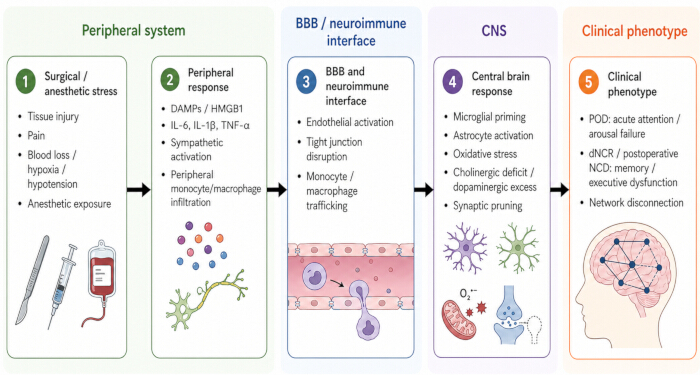
Figure 1: Proposed pathways linking perioperative stressors to perioperative neurocognitive disorders. Surgery and related stressors may initiate systemic inflammation, endothelial and blood-brain barrier signaling, altered glial activity, oxidative stress, neurotransmitter imbalance, and synaptic or network dysfunction. The pathways are biologically plausible and partially overlapping; not all have been established as causal in humans. Solid arrows indicate proposed relationships rather than universally established causal steps. Abbreviations: BBB = blood-brain barrier; CNS = central nervous system; DAMPs = damage-associated molecular patterns; dNCR = delayed neurocognitive recovery; HMGB1 = high-mobility group box 1; IL = interleukin; NCD = neurocognitive disorder; POD = postoperative delirium; TNF-α = tumor necrosis factor alpha. Please click here to view a larger version of this figure.
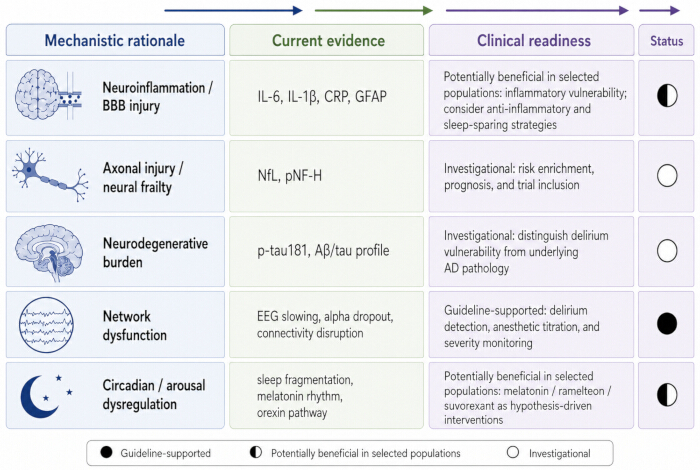
Figure 2: Conceptual framework linking candidate biological domains, measurable signals, and clinical readiness in perioperative neurocognitive disorders. The framework provides a visual synthesis for conceptual endotyping; the evidence strength and clinical-readiness classifications are approximate qualitative summaries rather than clinical guideline grades. Abbreviations: Aβ = amyloid beta; AD = Alzheimer disease; BBB = blood-brain barrier; CRP = C-reactive protein; EEG = electroencephalography; GFAP = glial fibrillary acidic protein; IL = interleukin; NfL = neurofilament light chain; pNF-H = phosphorylated neurofilament heavy chain; p-tau181 = phosphorylated tau 181. Please click here to view a larger version of this figure.
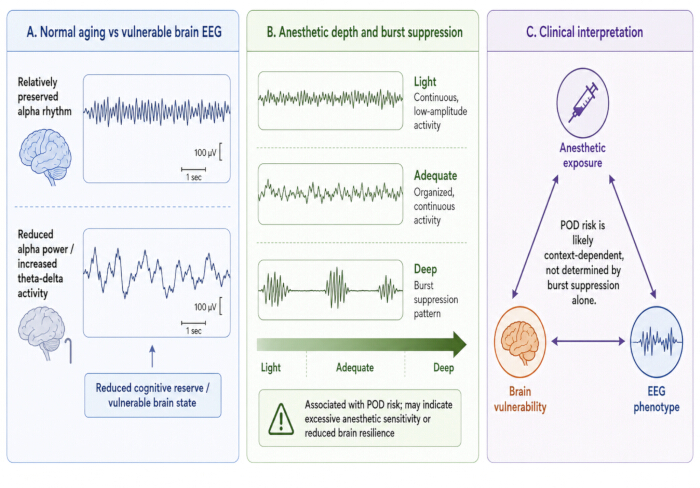
Figure 3: Schematic EEG patterns associated with brain vulnerability, anesthetic exposure, and postoperative delirium risk. (A) Normal aging versus a vulnerable brain state, showing relatively preserved alpha rhythm and reduced alpha power with increased theta-delta activity. (B) EEG patterns associated with light, adequate, and deep anesthetic levels, including burst suppression. (C) Relationships among anesthetic exposure, brain vulnerability, and the EEG phenotype. Abbreviations: EEG = electroencephalography; POD = postoperative delirium. Please click here to view a larger version of this figure.
| Biomarker | Biological domain reflected | Current interpretation and limitations |
| NfL | Neuroaxonal injury | Candidate risk marker. Higher preoperative or perioperative concentrations have been associated with POD, but NfL is not specific to POD and thresholds require external validation [32,34]. |
| GFAP | Astroglial activation or injury | Candidate risk marker. Associations vary across cohorts and do not establish a stand-alone diagnostic test [32,35]. |
| p-Tau181 | Underlying Alzheimer-type pathology | May reflect pre-existing neurodegenerative vulnerability rather than a perioperative-specific process [32,33]. |
| pNF-H | Neuroaxonal injury | Preliminary evidence only. A small study associated serum pNF-H with POD; independent replication is required [36]. |
| IL-1β / IL-6 | Systemic inflammatory signaling | Investigational. Longitudinal cytokine trajectories may relate to cognitive recovery, but measurements are nonspecific and no panel is validated for routine POD diagnosis [11,15,38]. |
Table 1: Candidate fluid biomarkers associated with postoperative delirium and perioperative neurocognitive vulnerability. The table summarizes the biological domains, current interpretations, and limitations of candidate fluid biomarkers. Abbreviations: GFAP = glial fibrillary acidic protein; IL = interleukin; NfL = neurofilament light chain; pNF-H = phosphorylated neurofilament heavy chain; POD = postoperative delirium; p-tau181 = phosphorylated tau 181.
| Clinical or biological target | Strategy | Evidence-calibrated status |
| Multifactorial delirium risk | Multicomponent prevention | Best-supported general approach. Combine orientation, mobilization, sleep and sensory support, hydration, medication review, and complication prevention [46,47,48]. |
| Sedation and analgesic exposure | Dexmedetomidine | Potential benefit in selected settings, but effects vary by procedure, dose, comparator, and adverse-event profile [51,52,53,54]. |
| Circadian disruption | Melatonin / ramelteon | Evidence is heterogeneous; routine prophylaxis, optimal timing, and target population remain uncertain [55,56,57,58]. |
| Sleep and arousal | Suvorexant | Investigational for PNDs. Available randomized evidence includes mixed hospitalized medical and surgical populations, limiting perioperative inference [60]. |
| Brain vulnerability and anesthetic exposure | EEG-informed anesthetic titration | Useful for brain-state assessment and titration, but the ENGAGES trial did not establish reduced POD [42,43]. |
| Cognitive reserve | Preoperative cognitive training | Promising in selected trials; adherence, scalability, and confirmatory evidence remain important [65,67]. |
| Network modulation | tDCS / low-intensity pulsed ultrasound | Investigational. A single-center perioperative tDCS trial requires replication; ultrasound evidence cited here comes from Parkinson disease, not a PND trial [25,72]. |
Table 2: Evidence-informed and investigational strategies relevant to postoperative delirium and perioperative neurocognitive disorders. The table summarizes the clinical or biological targets, corresponding strategies, and current evidence status. Abbreviations: EEG = electroencephalography; PNDs = perioperative neurocognitive disorders; POD = postoperative delirium; tDCS = transcranial direct-current stimulation.
Disclosures
The authors declare no conflicts of interest.
References
- Evered L, et al. Recommendations for the nomenclature of cognitive change associated with anaesthesia and surgery—2018. Br J Anaesth. 2018;121(5):1005-12.
- Needham MJ, Webb CE, Bryden DC. Postoperative cognitive dysfunction and dementia: what we need to know and do. Br J Anaesth. 2017;119(suppl_1):i115-i125.
- Lin HS, Watts JN, Peel NM, Hubbard RE. Frailty and postoperative outcomes in older surgical patients: a systematic review. BMC Geriatr. 2016;16(1):157.
- Aldecoa C, et al. Update of the European Society of Anaesthesiology and Intensive Care Medicine evidence-based and consensus-based guideline on postoperative delirium in adult patients. Eur J Anaesthesiol. 2024;41(2):81-119.
- Saczynski JS, et al. Cognitive trajectories after postoperative delirium. N Engl J Med. 2012;367(1):30-9.
- Witlox J, et al. Delirium in elderly patients and the risk of postdischarge mortality, institutionalization, and dementia: a meta-analysis. JAMA. 2010;304(4):443-51.
- Gleason LJ, et al. Effect of delirium and other major complications on outcomes after elective surgery in older adults. JAMA Surg. 2015;150(12):1134-40.
- Sun M, Chen WM, Wu SY, Zhang J. The impact of postoperative agitated delirium on dementia in surgical patients. Brain Commun. 2024;6(2):fcae076. https://doi.org/10.1093/braincomms/fcae076.
- Terrando N, et al. Resolving postoperative neuroinflammation and cognitive decline. Ann Neurol. 2011;70(6):986-95.
- Vacas S, Degos V, Feng X, Maze M. The neuroinflammatory response of postoperative cognitive decline. Br Med Bull. 2013;106(1):161-78.
- Taylor J, et al. Resolution of elevated interleukin-6 after surgery is associated with return of normal cognitive function. Br J Anaesth. 2023;131:694-704. https://doi.org/10.1016/j.bja.2023.05.023.
- Vasunilashorn SM, et al. Cytokines and postoperative delirium in older patients undergoing major elective surgery. J Gerontol A Biol Sci Med Sci. 2015;70:1289-95.
- van Gool WA, van de Beek D, Eikelenboom P. Systemic infection and delirium: when cytokines and acetylcholine collide. Lancet. 2010;375(9716):773-5.
- Lv J, et al. C1q-mediated synapse loss by microglial phagocytosis is associated with postoperative neurocognitive disorder in mice. Br J Anaesth. 2026;136:1855-69. https://doi.org/10.1016/j.bja.2026.02.024.
- Flacker JM, Lipsitz LA. Neural mechanisms of delirium: current hypotheses and evolving concepts. J Gerontol A Biol Sci Med Sci. 1999;54(6):B239-46.
- Maldonado JR. Neuropathogenesis of delirium: review of current etiologic theories and common pathways. Am J Geriatr Psychiatry. 2013;21(12):1190-222.
- Hshieh TT, Fong TG, Marcantonio ER, Inouye SK. Cholinergic deficiency hypothesis in delirium: a synthesis of current evidence. J Gerontol A Biol Sci Med Sci. 2008;63(7):764-72.
- Egberts A, et al. Anticholinergic drug burden and delirium: a systematic review. J Am Geriatr Soc. 2022;70(5):1480-91.
- Trzepacz PT. Is there a final common neural pathway in delirium? Focus on acetylcholine and dopamine. Semin Clin Neuropsychiatry. 2000;5(2):132-48.
- Fong TG, Tulebaev SR, Inouye SK. Delirium in elderly adults: diagnosis, prevention and treatment. Nat Rev Neurol. 2009;5(4):210-20.
- Karlidag R, et al. The role of oxidative stress in postoperative delirium. Gen Hosp Psychiatry. 2006;28:418-23. https://doi.org/10.1016/j.genhosppsych.2006.06.002.
- Wu C, Gao B, Gui Y. Malondialdehyde on postoperative day 1 predicts postoperative cognitive dysfunction in elderly patients after hip fracture surgery. Biosci Rep. 2019;39:BSR20190166. https://doi.org/10.1042/BSR20190166.
- Ye JS, et al. SIRT3 activator honokiol ameliorates surgery/anesthesia-induced cognitive decline in mice through anti-oxidative stress and anti-inflammatory in hippocampus. CNS Neurosci Ther. 2019;25(3):355-66. https://doi.org/10.1111/cns.13053.
- Jiang L, et al. Inhibition of the integrated stress response reverses oxidative stress damage-induced postoperative cognitive dysfunction. Front Cell Neurosci. 2022;16:992869. https://doi.org/10.3389/fncel.2022.992869.
- Browndyke JN, et al. Resting-state functional connectivity and cognition after major cardiac surgery in older adults without preoperative cognitive impairment: preliminary findings. J Am Geriatr Soc. 2017;65(1):e6-e12.
- Liu Y, et al. Expression of microRNA induced by postoperative delirium-like behavior is associated with long-term default mode network disruption: Sequencing and a secondary analysis of resting-state fMRI data. CNS Neurosci Ther. 2024;30(9):e70038.
- Cavallari M, et al. Neural substrates of vulnerability to postsurgical delirium as revealed by presurgical diffusion MRI. Brain. 2016;139(Pt 4):1282-94.
- Kant IMJ, et al. Preoperative brain MRI features and occurrence of postoperative delirium. J Psychosom Res. 2021;140:110301. https://doi.org/10.1016/j.jpsychores.2020.110301.
- Dham B, Richard I, Schneider EB, George BP. Association of postoperative delirium and Parkinson disease after common United States surgical procedures. J Surg Res. 2023;291:711-9. https://doi.org/10.1016/j.jss.2023.06.051.
- Wiredu K, et al. Intraoperative plasma proteomic changes in cardiac surgery: In search of biomarkers of postoperative delirium. Proteomics Clin Appl. 2023;17(4):2200066. https://doi.org/10.1002/prca.202200066.
- Leung JM, et al. Presence of preoperative neurodegeneration biofluid markers in patients with postoperative delirium. Anesthesiology. 2023;139(4):432-43.
- Umoh ME, et al. Preoperative neurofilament light associated with postoperative delirium in hip fracture repair patients without dementia. J Acad Consult Liaison Psychiatry. 2025;66(1):3-12. https://doi.org/10.1016/j.jaclp.2024.10.002.
- Ferrara MC, et al. Neurofilament-light chain and glial fibrillary acidic protein as blood-based delirium risk markers: a multicohort study. Aging Dis. 2025;17(3):1556-68. https://doi.org/10.14336/AD.2025.0107.
- Mielke MM, et al. Plasma phospho-tau181 increases with Alzheimer's disease clinical severity and is associated with tau- and amyloid-positron emission tomography. Alzheimers Dement. 2018;14(8):989-97.
- Inoue R, et al. Direct evidence of central nervous system axonal damage in patients with postoperative delirium: A preliminary study of pNF-H as a promising serum biomarker. Neurosci Lett. 2017;653:39-44.
- van der Kooi AW, et al. Delirium detection using EEG: what and how to measure. Chest. 2015;147(1):94-101.
- Palanca BJA, et al. Electroencephalography and delirium in the postoperative period. Br J Anaesth. 2017;119(2):294-307.
- Trenado C, et al. Resting state EEG as biomarker of cognitive training and physical activity's joint effect in Parkinson's patients with mild cognitive impairment. Neurol Res Pract. 2023;5:46. https://doi.org/10.1186/s42466-023-00273-5.
- Soehle M, et al. Intraoperative burst suppression is associated with postoperative delirium following cardiac surgery: a prospective, observational study. BMC Anesthesiol. 2015;15:61.
- Pedemonte JC, et al. Electroencephalogram burst-suppression during cardiopulmonary bypass in elderly patients mediates postoperative delirium. Anesthesiology. 2020;133(2):280-92. https://doi.org/10.1097/ALN.0000000000003328.
- Wildes TS, et al. Effect of electroencephalography-guided anesthetic administration on postoperative delirium among older adults undergoing major surgery: the ENGAGES randomized clinical trial. JAMA. 2019;321(5):473-83.
- Wong A, et al. Development and validation of an electronic health record-based machine learning model to estimate delirium risk in newly hospitalized patients without known cognitive impairment. JAMA Netw Open. 2018;1(4):e181018.
- Jauk S, et al. Risk prediction of delirium in hospitalized patients using machine learning: an implementation and prospective evaluation study. J Am Med Inform Assoc. 2020;27(9):1383-92. https://doi.org/10.1093/jamia/ocaa113.
- Inouye SK, et al. A multicomponent intervention to prevent delirium in hospitalized older patients. N Engl J Med. 1999;340:669-76.
- Hshieh TT, et al. Hospital Elder Life Program: systematic review and meta-analysis of effectiveness. Am J Geriatr Psychiatry. 2018;26(10):1015-33.
- Burton JK, et al. Non-pharmacological interventions for preventing delirium in hospitalised non-ICU patients. Cochrane Database Syst Rev. 2021;11(11):CD013307.
- Neufeld KJ, et al. Antipsychotic medication for prevention and treatment of delirium in hospitalized adults: a systematic review and meta-analysis. J Am Geriatr Soc. 2016;64(4):705-14.
- Burry LD, et al. Pharmacological and non-pharmacological interventions to prevent delirium in critically ill patients: a systematic review and network meta-analysis. Intensive Care Med. 2021;47(9):943-60. https://doi.org/10.1007/s00134-021-06490-3.
- He G, et al. Dexmedetomidine attenuates the neuroinflammation and cognitive dysfunction in aged mice by targeting the SNHG14/miR-340/NF-κB axis. Biomed Rep. 2023;19(6):100.
- Deiner S, et al. Intraoperative infusion of dexmedetomidine for prevention of postoperative delirium and cognitive dysfunction in elderly patients undergoing major elective noncardiac surgery: a randomized clinical trial. JAMA Surg. 2017;152(8):e171505.
- Duan X, et al. Efficacy of perioperative dexmedetomidine on postoperative delirium: systematic review and meta-analysis with trial sequential analysis of randomised controlled trials. Br J Anaesth. 2018;121(2):384-97.
- Pasin L, et al. Dexmedetomidine reduces the risk of delirium, agitation and confusion in critically Ill patients: a meta-analysis of randomized controlled trials. J Cardiothorac Vasc Anesth. 2014;28(6):1459-66.
- Keith N, et al. The effects of dexmedetomidine on postoperative delirium in adult cardiac surgical patients: a Bayesian meta-analysis and trial sequential analysis. Acta Anaesthesiol Scand. 2025;69(6):e70069. https://doi.org/10.1111/aas.70069.
- Jaiswal SJ, et al. Melatonin and sleep in preventing hospitalized delirium: a randomized clinical trial. Am J Med. 2018;131(9):1110-17.e4.
- Han Y, et al. Melatonin and its analogues for the prevention of postoperative delirium: A systematic review and meta-analysis. J Pineal Res. 2020;68(4):e12644.
- Blodgett TJ, Blodgett NP. Melatonin and melatonin-receptor agonists to prevent delirium in hospitalized older adults: An umbrella review. Geriatr Nurs. 2021;42(6):1562-68. https://doi.org/10.1016/j.gerinurse.2021.10.011.
- Hatta K, et al. Preventive effects of ramelteon on delirium: a randomized placebo-controlled trial. JAMA Psychiatry. 2014;71(4):397-403.
- Azimaraghi O, et al. Study protocol for a randomised controlled trial evaluating the effects of the orexin receptor antagonist suvorexant on sleep architecture and delirium in the intensive care unit. BMJ Open. 2020;10(7):e038474.
- Hatta K, et al. Suvorexant for reduction of delirium in older adults after hospitalization: a randomized clinical trial. JAMA Netw Open. 2024;7(8):e2427691.
- Mason SE, Noel-Storr A, Ritchie CW. The impact of general and regional anesthesia on the incidence of postoperative cognitive dysfunction and postoperative delirium: a systematic review with meta-analysis. J Alzheimers Dis. 2010;22 Suppl 3:67-79.
- Li T, et al. Effect of regional vs general anesthesia on incidence of postoperative delirium in older patients undergoing hip fracture surgery: the RAGA randomized trial. JAMA. 2022;327(1):50-58.
- Vu T, Smith JA. An update on postoperative cognitive dysfunction following cardiac surgery. Front Psychiatry. 2022;13:884907.
- Tao M, et al. Efficacy of transcranial direct current stimulation on postoperative delirium in elderly patients undergoing lower limb major arthroplasty: a randomized controlled trial. Brain Stimul. 2023;16:88-96. https://doi.org/10.1016/j.brs.2023.01.839.
- Hu C, et al. Clinical efficacy of low-intensity pulsed ultrasound in Parkinson's disease with cognitive impairment. J Neurophysiol. 2024;132:1633-8. https://doi.org/10.1152/jn.00323.2024.
- Qiu X, et al. Effect of different durations of preoperative computerised cognitive training on postoperative delirium in older patients undergoing cardiac surgery: a study protocol for a prospective, randomised controlled trial. BMJ Open. 2024;14(11):e088163.
- Humeidan ML, et al. Effect of cognitive prehabilitation on the incidence of postoperative delirium among older adults undergoing major noncardiac surgery: the Neurobics randomized clinical trial. JAMA Surg. 2021;156(2):148-56.
- Vlisides PE, et al. Home-based cognitive prehabilitation in older surgical patients: a feasibility study. J Neurosurg Anesthesiol. 2019;31(2):212-17.
- Stern Y, et al. Whitepaper: Defining and investigating cognitive reserve, brain reserve, and brain maintenance. Alzheimers Dement. 2020;16(9):1305-11.
- Berger M, et al. Best practices for postoperative brain health: recommendations from the Fifth International Perioperative Neurotoxicity Working Group. Anesth Analg. 2018;127:1406-13. https://doi.org/10.1213/ANE.0000000000003841.
- Lammers-Lietz F, et al. Prediction and risk evaluation of delirium after surgery in older patients: development and internal validation of an algorithm from the prospective BioCog cohort study. Br J Anaesth. 2026;136:1495-508. https://doi.org/10.1016/j.bja.2026.01.025.
- Arazi A, Censor N, Dinstein I. The magnitude of trial-by-trial neural variability is reproducible over time and across tasks in humans. eNeuro. 2017;4:ENEURO.0292-17.2017. https://doi.org/10.1523/ENEURO.0292-17.2017.
- Trenado C, et al. Combined invasive subcortical and non-invasive surface neurophysiological recordings for the assessment of cognitive and emotional functions in humans. J Vis Exp. 2016;(111):53466. https://doi.org/10.3791/53466.