This protocol establishes a standardized workflow for transforming therapeutic Qigong recorded in classical Chinese medical texts into standardized digital rehabilitation resources through text interpretation, movement standardization, expert review, and AI-assisted reconstruction.
Method Article
A Standardized Workflow for Artificial Intelligence-Assisted Digital Reconstruction of Therapeutic Qigong from Classical Chinese Medical Texts
In This Article
Summary
Abstract
Therapeutic Qigong exercises documented in classical Chinese medical texts represent a potentially valuable source of rehabilitation interventions; however, many are preserved primarily as concise textual descriptions and lack standardized movement protocols and visual resources for contemporary application. This study established a standardized workflow for transforming historically documented therapeutic Qigong exercises into structured operating protocols and artificial intelligence (AI)-assisted digital resources. The workflow comprised five sequential stages: literature retrieval and exercise selection, exercise standardization, expert review and protocol refinement, AI-assisted digital reconstruction, and quality evaluation. Classical descriptions were transcribed into modern Chinese, operational movement components were extracted, and ambiguous elements were documented before standardized reconstruction. Historically documented components were distinguished from modern additions, including exercise-prescription parameters and safety considerations. The preliminary protocols were reviewed by eight multidisciplinary experts and refined before being used to guide live-action recording and AI-assisted digital reconstruction. The workflow was applied to ten representative therapeutic Qigong exercises corresponding to the five organ systems. All ten reconstructed exercises underwent internal review, independent evaluation by two reviewers, predefined visual artifact screening, and two-dimensional key-frame comparison. The independent reviewers confirmed all six predefined evaluation criteria for all ten exercises. No predefined visual artifacts were recorded across 50 evaluation points. Two-dimensional comparison of representative key postures yielded a mean absolute angular error of 4.46°, with individual errors ranging from 0.40° to 8.20°. This protocol provides a structured methodological framework for converting therapeutic exercises documented in classical Chinese medical texts into standardized and visualized digital resources. The resulting materials represent standardized reconstructions based on defined historical and methodological references rather than exact reproductions of historical practice. The workflow may support future research, education, and digital development of traditional movement-based rehabilitation interventions.
Introduction
Traditional Chinese Qigong has become an increasingly recognized component of rehabilitation research because it integrates regulated breathing, coordinated body movements, and mental focus. Clinical studies have demonstrated potential benefits of standardized traditional mind–body exercise programs, including Baduanjin, Liuzijue, Wuqinxi, and Tai Chi, in populations with chronic pulmonary diseases1, stroke2, cancer3, and age-related functional decline4. These standardized exercise systems have been increasingly incorporated into rehabilitation practice because their movement sequences, training intensity, and intervention procedures can be clearly described, taught, and evaluated. Consequently, contemporary Qigong research has primarily focused on evaluating the clinical effects and biological mechanisms of established exercise programs.
Despite these advances, currently standardized Qigong programs represent only a small proportion of the therapeutic exercises preserved in classical Chinese medical literature. Numerous classical medical texts describe exercise-based interventions developed for specific diseases, symptom patterns, and functional disorders. However, these historical exercises are generally preserved as concise textual descriptions rather than standardized movement protocols. Differences in philological interpretation, movement reconstruction, and teaching experience may lead to inconsistent implementation, limiting their reproducibility, educational dissemination, and integration into modern rehabilitation research. Therefore, a standardized methodology is needed to systematically transform historically documented therapeutic exercises into reproducible rehabilitation resources.
Previous studies have primarily focused on the clinical effectiveness of standardized Qigong programs1,2,3,4, whereas methodological processes for reconstructing historically documented exercises remain insufficiently described. Consequently, reconstruction of classical exercises often relies on individual interpretation, making consistent reproduction across researchers difficult. Methodological frameworks for intervention standardization emphasize the importance of clearly defining intervention components, operational procedures, and reporting requirements to facilitate reproducibility5. The present workflow addresses this gap by defining each stage of reconstruction, including literature retrieval, philological interpretation, movement standardization, multidisciplinary expert review, human motion acquisition, AI-assisted animation generation, and quality evaluation. This standardized workflow provides a reusable framework for reconstructing additional therapeutic exercises documented in classical Chinese medical literature.
The overall goal of this protocol is to establish a standardized workflow for reconstructing historically documented Qigong exercises into digital rehabilitation resources. The workflow consists of classical literature retrieval, exercise selection, philological interpretation, movement standardization, multidisciplinary expert review and protocol refinement, filming script development, human motion acquisition, AI-assisted animation reconstruction, and quality evaluation. Ten representative exercises were reconstructed using this workflow, and the Zhujie Bashen (Bamboo Stretching Form), a classical exercise selected for the lung excess pattern, is presented as an example to illustrate the complete reconstruction process. This protocol is intended for researchers, rehabilitation professionals, medical educators, and digital health developers seeking a structured methodology for transforming traditional exercise knowledge into standardized educational and rehabilitation resources.
Protocol
This study was methodological in nature and did not involve recruiting patients or other research participants. The live-action demonstrations used for AI-assisted digital reconstruction were performed voluntarily by two of the authors (Tian-Yang Tan and Jia-Xuan Lyu). Both authors consented to the recording and use of their identifiable images for AI-assisted digital reconstruction and to the publication of the corresponding images, videos, and reconstructed digital materials in this article.
1. Literature retrieval and exercise selection
- Retrieve classical descriptions of therapeutic Qigong
- Retrieve classical Chinese medical literature containing descriptions of Daoyin or therapeutic Qigong related to the regulation of the heart, lung, spleen, liver, and kidney systems. Identify passages describing therapeutic movements, breathing exercises, mental-regulation practices, or combinations of these components.
- Review potentially relevant classical sources during candidate identification. For each potentially relevant description, record the title of the classical text, chapter or section, reference edition, original passage, therapeutic indication, and corresponding organ system. Four classical texts—Zhubing Yuanhou Lun6, Zunsheng Bajian7, Shengji Zonglu8, and Huangting Neijing Wuzang Liufu Buxie Tu9—served as the principal sources of the exercises ultimately selected for standardized reconstruction.
- Identify and organize candidate exercises
- Extract potentially relevant passages that contain an identifiable therapeutic procedure involving body movement, breathing regulation, mental regulation, or a combination of these components.
- Distinguish operational exercise descriptions from non-operational materials, including theoretical descriptions of disease or syndrome patterns, dietary recommendations, general health-preservation principles, and safety-only statements.
- Establish a candidate-exercise record for each potentially eligible exercise. Record the classical source, original passage, modern Chinese transcription, associated organ system and syndrome pattern, therapeutic indication, principal movement or breathing characteristics, and interpretation notes.
- Compare candidate descriptions across the working records. Consolidate duplicate or substantially overlapping descriptions while retaining materially different textual or operational variants for further assessment.
- Assess candidate exercises and select representative exercises
- Assess each candidate exercise according to the following criteria: (i) explicit documentation in a classical medical source; (ii) an identifiable and operationally interpretable movement, breathing, or mental-regulation procedure; (iii) a recognizable therapeutic indication or organ-related regulatory purpose; and (iv) sufficient information to support modern transcription and standardized reconstruction.
- Exclude non-operational theoretical descriptions, dietary recommendations, general health-preservation statements, and safety-only statements from the candidate exercise pool. Consolidate substantially duplicated descriptions before representative selection.
- Classify the eligible candidate exercises according to the five organ systems and their corresponding syndrome patterns.
- Compare candidate exercises within each category according to therapeutic relevance, textual interpretability, operational completeness, and suitability for standardized reconstruction.
- Select representative exercises from the eligible candidate pool and submit the preliminary selection for multidisciplinary expert review. In the present study, this procedure resulted in the selection of 10 representative therapeutic Qigong exercises, with 2 exercises representing each of the 5 organ systems.
2. Standardization of therapeutic Qigong exercises
- Organize and transcribe the classical descriptions
- Retrieve the original passage of each selected exercise from the designated reference edition and record the title of the classical text, chapter or section, and bibliographic source. Where textual differences are identified across available editions or working records, document the variant wording before determining which passage to use as the reference text for subsequent standardization.
- Translate the reference passage into modern Chinese according to the principle of preserving the original meaning while improving linguistic clarity. Do not introduce additional movement procedures, clinical interpretations, or exercise-prescription parameters that are not explicitly contained in the classical description at this stage.
- Identify archaic or potentially ambiguous terms related to posture, movement, breathing, and mental regulation. Interpret these terms according to the textual context and traditional Daoyin terminology, and record the interpretation used for subsequent operational reconstruction.
- Extract operational components from the classical description
- Extract all explicitly described operational components, including body position, movement direction, movement sequence, breathing pattern, number of repetitions, duration where specified, and mental-regulation instructions.
- Interpret movement descriptions according to the original classical text and the modern Chinese translation. Maintain the original movement sequence whenever possible. Compare relevant classical texts and contextual information to establish a unified interpretation for ambiguous descriptions. Record all interpretation decisions to ensure consistency throughout the standardization process.
- Mark elements that cannot be determined directly from the classical description as interpretive items requiring standardized reconstruction and subsequent expert review. Do not treat these reconstructed elements as historically documented instructions.
- Develop the standardized operating protocol
- Reconstruct the exercise into a complete operational sequence based on the original passage, modern Chinese transcription, extracted operational components, and documented interpretation of ambiguous terms.
- Organize each reconstructed exercise using a standardized structure comprising the exercise name, body regulation, starting posture, sequential movement steps, ending posture, breathing regulation, and mental regulation. Use consistent terminology to describe body position, movement direction, sequence, repetitions, and rhythm.
- Divide each exercise into sequential movement units according to changes in body posture, movement direction, or functional purpose. Define the starting position, ending position, movement transitions, and execution sequence for each movement unit.
- Record any descriptions that remain ambiguous or cannot be interpreted consistently from classical texts. Compile these items into a discussion list and submit them for expert review in Section 3.
- Add modern exercise prescription and safety components
NOTE: Clearly distinguish information directly documented in the classical source from elements introduced during modern standardization. Historical information includes the original movement, breathing, mental regulation instructions, repetitions, or therapeutic purposes, where explicitly stated. Modern additions may include reconstructed transitions, standardized terminology, exercise-prescription parameters, safety precautions, contraindications, and recommendations for clinical application.- After completing the reconstruction of the classical exercise procedure, separately develop modern exercise-prescription parameters for contemporary rehabilitation applications. Specify training frequency, session duration, exercise intensity, training volume, and exercise sequence where applicable.
- Derive these prescription parameters from contemporary exercise-prescription principles10, rehabilitation considerations, and expert review rather than attributing them to the historical source unless they are explicitly documented in the original text.
- Add exercise-specific safety precautions, applicable populations, and contraindications based on the movement characteristics, anticipated physical demands, contemporary rehabilitation considerations, and expert review.
3. Expert review and protocol refinement
- Establish the multidisciplinary expert panel
- Establish a multidisciplinary expert panel comprising eight experts with senior professional titles and expertise in health preservation and rehabilitation, traditional or exercise rehabilitation, evidence-based medicine, acupuncture, and related clinical disciplines.
- Select experts from institutions in different regions of China to ensure multidisciplinary and geographic representation.
- Conduct the first-stage expert review
- Provide the draft standardized protocols to the expert panel before the consultation meeting.
- Conduct a structured online expert consultation meeting and request the experts to review the syndrome classification, exercise selection, terminology, exercise dosage and intensity, sequence of practice, clinical applicability, safety precautions, and clarity of the standardized operating procedures.
- Record the recommendations raised by each expert and revise the corresponding protocol items after discussion by the drafting group.
- Conduct follow-up confirmation
NOTE: This procedure represents a structured multidisciplinary expert review and follow-up confirmation process rather than a formal Delphi consensus procedure.- After revising the draft according to the first-stage expert recommendations, contact all eight experts individually via WeChat or telephone.
- Present the disposition of the recommendations raised during the first-stage review and the corresponding revisions to the experts for confirmation.
- Record any additional recommendations and further revise the protocol if substantive issues are identified.
- Finalize the standardized operating protocol
- Integrate all approved revisions into the final standardized operating protocol.
- Prepare the input document for digital reconstruction
- Compile the final standardized operating protocol, including the original classical texts, the modern Chinese translations, standardized exercise names, movement instructions, body regulation, breathing regulation, mental regulation, exercise prescriptions, safety precautions, and contraindications. Use the completed protocol as the standardized input document for digital reconstruction in Section 4.
4. AI-assisted digital reconstruction
- Prepare the digital reconstruction script
- Prepare the reconstruction script
- Prepare a digital reconstruction script based on the final standardized operating protocol. Use the script to guide live-action recording, AI-assisted digital reconstruction, and subsequent video production.
- Standardize the script format
- For each exercise, specify the exercise name, movement sequence, movement description, shot number, camera angle, shot type, recording duration, movement rhythm, subtitle content, and technical requirements. Use a consistent script structure across all reconstructed exercises.
- Verify the reconstruction script
- Review the completed script before live-action recording. Confirm that the movement descriptions and sequence are consistent with the final standardized operating protocol and that the recording requirements are clearly defined.
- Record the live-action demonstrations
- Record the standardized movements
- Perform each therapeutic Qigong exercise in accordance with the final standardized operating protocol and the digital reconstruction script. Record the complete movement sequence for each exercise.
- Standardize the recording conditions
- Record the live-action demonstrations using a digital camera mounted on a fixed tripod. Use a chroma-key green-screen background and continuous LED lighting. Maintain consistent camera positioning, lighting conditions, background, and performer clothing throughout the recording.
- Select live-action reference materials
- Repeat complex or critical movements when necessary. Review the recorded materials against the standardized operating protocol and select the recordings that most closely conform to the prescribed movement sequence, direction, and posture requirements. Use the selected recordings as movement references for subsequent AI-assisted reconstruction.
- Generate the AI-assisted digital animations
- Prepare the reconstruction inputs
Organize the final standardized operating protocol, digital reconstruction script, selected live-action reference videos, performer images, and representative key-posture images according to the prescribed movement sequence. Use these materials as textual and visual references for AI-assisted reconstruction. - Generate character and posture reference images
Generate character and posture reference images using an AI image-generation tool. Provide images of the recorded performer as character-identity references and representative live-action postures as pose references. Specify the intended character appearance, clothing, posture, background, and visual presentation in the generation instructions. Review the generated images against the performer and posture references. Retain images that adequately preserve the intended character appearance, body proportions, clothing, and representative posture for subsequent video generation. Regenerate the reference image when an obvious discrepancy is identified. - Prepare the AI generation instructions
Translate the movement requirements defined in the standardized operating protocol and digital reconstruction script into generation instructions for the AI video-generation tools. Describe the required character identity, starting posture, movement sequence, movement direction, camera view, background, and visual continuity. Where supported by the selected tool, provide the corresponding performer or AI-generated character image as the character or initial-frame reference and the selected live-action recording as the movement reference. Use a large language model to assist with the organization and refinement of generation instructions when required. A representative generation instruction and the corresponding reference inputs used for the reconstruction of Zhujie Bashen are provided in the Supplementary File 1.
NOTE: The standardized operating protocol and live-action recording serve as the primary references for movement content. AI-generated images are used as visual references and should not replace the standardized movement requirements. - Generate the animation segments
Generate the required animation segments using AI video-generation tools according to the function required for each segment. Where supported, use the selected character image as the character or initial-frame reference and the corresponding live-action video as the movement reference. Instruct the model to preserve character identity, facial appearance, hairstyle, clothing, body proportions, camera view, and background while reproducing the required movement. Generate exercise in segments when a complete sequence cannot be reliably produced in a single generation. Maintain continuity of character appearance, posture, movement direction, and camera view between adjacent segments. - Screen and select the generated animation segments
Compare each generated segment with the corresponding standardized operating protocol, digital reconstruction script, and live-action reference. Examine movement sequence, key posture, movement direction, character appearance, and visual continuity. Retain the generated segment when it adequately conforms to the reference requirements. Regenerate or replace the segment when substantive movement deviations or obvious generation artifacts are identified. Repeat generation and screening as necessary until an acceptable segment is obtained.
NOTE: Record the AI tool and model version, generation instructions, available generation settings, reference materials, selected outputs, and reasons for regeneration when these records are available. Do not retrospectively assign generation parameters or settings that were not preserved during the original reconstruction process.
- Prepare the reconstruction inputs
- Review and refine the AI-generated animations
- Establish the review references
Use the final standardized operating protocol, digital reconstruction script, and corresponding live-action demonstration as the reference materials for reviewing the generated animations. - Review movement fidelity and visual integrity
Review each generated animation for movement completeness, movement sequence, key posture, movement direction, movement continuity, movement rhythm, and character consistency. Inspect the animation for visible AI-generation artifacts, including anatomical distortion, joint deformation, limb morphing or disappearance, foot sliding or floating, and temporal or frame discontinuity. - Correct identified deviations
When a substantive movement deviation or visible generation artifact is identified, return the affected segment to the generation stage. Modify the generation instruction or reference material as appropriate, regenerate or replace the affected segment, and repeat the review. - Finalize the animation for post-processing
Proceed to post-processing only after the complete movement sequence is represented without substantive deviation from the standardized operating protocol, and no obvious generation artifact requiring correction remains.
NOTE: The review described in Section 4.4 is an iterative internal quality-control procedure conducted during reconstruction. It is distinct from the evaluation of the finalized digital resources described in Section 5, which includes research-team assessment, independent expert evaluation, predefined artifact screening, and two-dimensional key-frame comparison.
- Establish the review references
- Post-process and finalize the digital resources
- Assemble the reviewed animation segments
Arrange the reviewed AI-generated animation segments according to the sequence defined in the digital reconstruction script. Assemble the segments into a complete exercise sequence while preserving the prescribed movement order and temporal continuity. - Prepare the instructional narration
Prepare the narration text in accordance with the finalized exercise instructions and the digital reconstruction script. Generate the required narration using the selected text-to-speech tool where applicable. Review the generated narration for consistency with the instructional text before incorporating it into the final video. - Perform video editing and compositing
Perform video editing and compositing using video-editing software. Integrate the reviewed movement sequences with the required background, narration, subtitles, transitions, and other audiovisual elements, in accordance with the digital reconstruction script. Use image-editing software when preparing or adjusting image materials. - Preserve movement content during post-processing
Do not use post-processing to modify the substantive body posture, movement sequence, or movement direction of the reviewed animation. If a substantive movement error is identified during editing, return the affected segment to the AI-assisted generation and review procedures described in Sections 4.3 and 4.4. - Verify and export the finalized digital resource
Review the completed instructional video against the digital reconstruction script and standardized operating protocol. Confirm the completeness and order of the exercise sequence and verify that the narration, subtitles, and other instructional elements correspond to the intended exercise instructions. Export the finalized instructional video after completing this verification. - Organize the reconstruction documentation
Retain the final standardized operating protocol, digital reconstruction script, selected live-action reference materials, AI-generated character and animation materials, available generation records, narration materials, and finalized instructional video as the documentation package for each reconstructed exercise. Submit the finalized digital resources for the quality evaluation described in Section 5.
- Assemble the reviewed animation segments
5. Quality evaluation of the AI-assisted digital reconstruction
- Perform an internal review of the reconstructed exercises.
- Provide the final AI-assisted reconstruction of each therapeutic Qigong exercise, together with the corresponding standardized operating protocol and live-action reference materials, to two members of the research team for independent review.
- Evaluate each of the ten reconstructed exercises according to six predefined criteria: movement-sequence completeness, consistency of key postures, movement-direction consistency, movement continuity, movement-rhythm consistency, and clinical interpretability.
- Record each criterion as “yes” when the reconstructed exercise conforms to the standardized protocol and live-action reference and as “no” when a recognizable discrepancy is identified.
- Document any identified discrepancy and use the internal review as a quality-control step for characterizing the reconstructed materials.
- Perform independent expert evaluation.
- Provide the final reconstructed videos and corresponding live-action reference materials to two independent reviewers who were not directly involved in AI generation or video post-processing.
- Ask each reviewer to independently assess the same six criteria: movement-sequence completeness, consistency of key postures, movement-direction consistency, movement continuity, movement-rhythm consistency, and clinical interpretability.
- Record each criterion dichotomously as “yes” or “no” and calculate the proportion of conforming judgments for each criterion across the ten reconstructed exercises.
NOTE: Keep this independent evaluation separate from the internal quality-control review performed by members of the research team.
- Screen for visible reconstruction artifacts
- Define five representative evaluation points for each reconstructed exercise, yielding 50 evaluation points across the ten exercises.
- At each evaluation point, visually inspect the reconstructed material for six predefined categories of AI-related artifacts: anatomical distortion, joint deformation, limb deformation or disappearance, foot sliding or floating, temporal or frame discontinuity, and other obvious visual artifacts.
- Record the presence or absence of each artifact category at each evaluation point.
- At the same evaluation points, confirm whether the predefined movement sequence is complete and whether the corresponding key posture is retained.
- Perform two-dimensional key-frame comparison
- Select one representative key posture from each of the ten therapeutic Qigong exercises and identify the corresponding frame in the live-action reference and AI-assisted reconstruction.
- Define reproducible two-dimensional anatomical landmarks according to the movement characteristics of each exercise. Use visible shoulder, elbow, wrist, hip, knee, and ankle landmarks, or a defined trunk axis, as appropriate for the selected posture.
- Digitize the landmarks on the paired images and calculate the corresponding two-dimensional joint or segment angle. Use the same landmark definition for the live-action and AI-assisted images of each exercise.
- Calculate the absolute angular error as:

Calculate the relative angular error as:

- Calculate the mean absolute angular error (MAAE) across the ten paired comparisons and record the maximum absolute angular error.
- When the live-action and AI images differ in camera orientation, use only a reproducibly defined two-dimensional projected angle and document the difference in viewing angle during interpretation.
NOTE: This analysis is intended as a two-dimensional key-frame comparison of reconstruction fidelity and should not be interpreted as three-dimensional kinematic validation. Absolute angular error is used as the primary quantitative measure because relative error may be affected by the magnitude of the reference angle.
- Integrate the quality-evaluation results
- Summarize the internal review, independent expert evaluation, visual artifact screening, and two-dimensional key-frame comparison for all ten reconstructed exercises.
- Use the combined results to characterize the fidelity of the AI-assisted reconstructions relative to the standardized operating protocols and live-action reference materials.
Results
Establishment of the standardized workflow for AI-assisted reconstruction of therapeutic Qigong
Figure 1 presents the standardized workflow established for the AI-assisted reconstruction of therapeutic Qigong recorded in classical Chinese medical texts. The workflow comprises five sequential stages: literature retrieval and exercise selection, exercise standardization, expert review and protocol refinement, AI-assisted digital reconstruction, and quality evaluation.
Implementation of the workflow resulted in the generation of standardized operating protocols, AI-assisted digital resources, and corresponding visualized rehabilitation materials for all included therapeutic Qigong exercises. In the present study, the workflow was applied to ten representative therapeutic Qigong exercises identified from classical medical literature.
To illustrate the practical application of the workflow, Zhujie Bashen, a representative therapeutic Qigong exercise selected for the lung excess pattern, was selected as an example for the subsequent stages of exercise standardization, expert review, AI-assisted digital reconstruction, and quality evaluation.
Identification and selection of therapeutic Qigong exercises from classical medical literature
Classical medical literature containing descriptions of therapeutic Daoyin or Qigong was reviewed to identify candidate exercises related to the regulation of the heart, lung, spleen, liver, and kidney systems. Operational exercise descriptions involving body movement, breathing regulation, mental regulation, or combinations of these components were distinguished from non-operational materials, such as theoretical descriptions, dietary recommendations, general health-preservation principles, and safety-related statements. Duplicate or substantially overlapping descriptions were consolidated during candidate organization.
The candidate exercises were subsequently classified according to the five organ systems and their corresponding syndrome patterns and compared in terms of therapeutic relevance, textual interpretability, operational completeness, and suitability for standardized reconstruction. This process resulted in the selection of ten representative therapeutic Qigong exercises, with two exercises representing each of the five organ systems (Table 1). The selected exercises were principally derived from Zhubing Yuanhou Lun, Zunsheng Bajian, Shengji Zonglu, and Huangting Neijing Wuzang Liufu Buxie Tu.
Standardization of therapeutic Qigong based on classical descriptions
To demonstrate the outcome of the exercise standardization procedure, Zhujie Bashen, a representative therapeutic Qigong exercise associated with the lung excess pattern, was selected as an example (Figure 2). The original classical description was first converted into modern Chinese while preserving its original meaning and without introducing additional movement procedures or clinical interpretations.
Subsequently, operational information was extracted from the classical description, including body position, movement sequence, breathing regulation, repetitions, and mental regulation, and was reconstructed into a standardized operating protocol. The finalized protocol provided a structured description of body regulation, sequential movement procedures, breathing regulation, and mental regulation. Modern exercise-prescription parameters and safety precautions were subsequently incorporated to support contemporary rehabilitation application and were distinguished from the historically documented components of the exercise. The resulting standardized operating protocol served as the reference document for subsequent AI-assisted digital reconstruction.
Expert review and refinement of the standardized protocols
All eight invited experts participated in the first-stage online consultation. The expert review generated recommendations concerning syndrome classification, exercise timing and intensity, exercise selection and dosage, terminology, clinical applicability, safety precautions, and document structure. The drafting group reviewed these recommendations individually and revised the corresponding protocol items.
One representative modification concerned the classification of the kidney-related exercise. The initial “kidney excess pattern” was revised to a “kidney mixed deficiency–excess pattern” following expert review. Other revisions included clarification of exercise timing, standardization of training volume and exercise sequence, refinement of terminology, and strengthening of safety precautions and contraindications.
Following revision of the protocols, all eight experts were contacted again via WeChat or telephone for follow-up confirmation. No new substantive recommendations requiring further modification were raised during this stage. Expert recommendations and their disposition were retained in the final standard to document the refinement process.
AI-assisted digital reconstruction of standardized therapeutic Qigong movements
Following the establishment of the standardized operating protocol, the representative therapeutic Qigong exercise Zhujie Bashen was further processed using an AI-assisted digital reconstruction workflow (Figure 3). The generated digital materials provide a visualized representation of the standardized therapeutic Qigong movements and demonstrate the application of the proposed workflow from standardized movement protocols to finalized digital resources.
The application of this workflow resulted in a complete digital resource, including a digital character model, reconstructed movement animation, and a final instructional video. The standardized operating protocol served as the reference throughout the reconstruction process, guiding the representation of movement sequences, body postures, and exercise procedures.
Quality evaluation of the AI-assisted digital reconstructions
Quality evaluation was performed for all ten AI-assisted reconstructed therapeutic Qigong exercises using internal review, independent expert evaluation, predefined visual artifact screening, and two-dimensional key-frame comparison.
In the internal review, two members of the research team independently evaluated the ten reconstructed exercises against six predefined criteria, yielding 20 judgments per criterion. Movement-sequence completeness, movement-direction consistency, movement continuity, and clinical interpretability were confirmed in all 20 judgments (100%). Consistency of key postures was confirmed in 18 of 20 judgments (90%), and movement-rhythm consistency was confirmed in 18 of 20 judgments (90%). The discrepancies identified during internal review were limited to individual exercises rather than systematic deviations across the reconstructed exercise set (Supplementary Table 1).
Two independent reviewers subsequently evaluated all ten reconstructed exercises using the same criteria. Both reviewers confirmed movement-sequence completeness, consistency of key postures, movement-direction consistency, movement continuity, movement-rhythm consistency, and clinical interpretability for all 10 exercises, resulting in 20 of 20 conforming judgments (100%) for each criterion.
Visual artifact screening was performed at five predefined evaluation points for each of the ten reconstructed exercises, resulting in 50 evaluation points in total. No anatomical distortion, joint deformation, limb deformation or disappearance, foot sliding or floating, temporal or frame discontinuity, or other obvious visual artifacts were recorded at the predefined evaluation points. Movement-sequence completeness and retention of the predefined key postures were also confirmed at all 50 evaluation points (Supplementary Table 1).
Two-dimensional key-frame comparison was further performed for all ten reconstructed exercises. One representative posture was selected for each exercise, and a reproducibly defined joint or segment angle was measured in the corresponding live-action and AI-assisted images. The mean absolute angular error across the ten paired comparisons was 4.46°, and the maximum absolute angular error was 8.20°. The mean relative angular error was 5.03%. Absolute angular errors for individual exercises ranged from 0.40° to 8.20° (Supplementary Table 2).
Taken together, the internal review, independent expert evaluation, visual artifact screening, and two-dimensional key-frame comparison showed that the reconstructed resources generally preserved the predefined movement sequence, key postures, movement direction, and temporal continuity of the standardized exercises. The quantitative comparison further indicated relatively small two-dimensional angular differences between the reconstructed and live-action reference postures. These findings characterize the fidelity of the reconstructed digital resources within the present workflow; however, the key-frame analysis represents two-dimensional image-based comparison rather than three-dimensional biomechanical validation.

Figure 1: Overall workflow for the standardized reconstruction of therapeutic Qigong from classical Chinese medical texts. The workflow comprises five sequential stages: literature retrieval and exercise selection, exercise standardization, expert review and protocol refinement, AI-assisted digital reconstruction, and quality evaluation. Please click here to view a larger version of this figure.
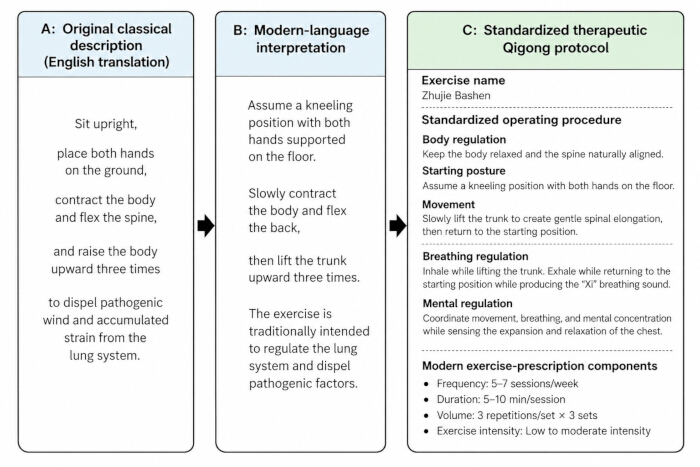
Figure 2: Transformation of a classical therapeutic Qigong description into a standardized therapeutic Qigong protocol. (A) English translation of the original classical description of the therapeutic Qigong exercise Zhujie Bashen. (B) Modern-language interpretation developed from the classical description while preserving its original semantic meaning. (C) Standardized therapeutic Qigong protocol developed from the classical description. The standardized operating procedure includes the exercise name, body regulation, starting posture, movement, breathing regulation, and mental regulation. Modern exercise-prescription components, including frequency, duration, volume, and exercise intensity, were subsequently incorporated to support contemporary rehabilitation applications. Please click here to view a larger version of this figure.
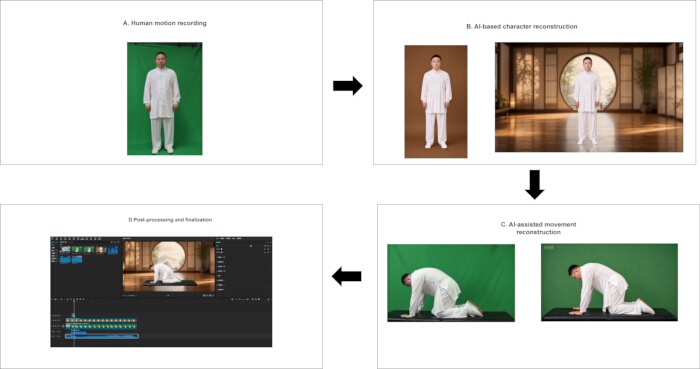
Figure 3: Representative process of AI-assisted digital reconstruction of therapeutic Qigong. A representative example illustrates the reconstruction of Zhujie Bashen from human motion recording to the finalized digital resource. (A) Human motion recording of standardized exercise. (B) AI-assisted character reconstruction based on the recorded performer and representative posture references. (C) AI-assisted movement reconstruction using the corresponding live-action movement as the reference for generating the digital movement sequence. (D) Post-processing and finalization of the reconstructed digital resource, including assembly of the reviewed animation segments, background composition, narration, subtitles, and other audiovisual elements. Please click here to view a larger version of this figure.
| Organ | Pattern | Therapeutic Qigong exercise | Classical source |
| Heart | Excess | Tuiji Kaiyu | Zhubing Yuanhou Lun |
| Heart | Deficiency | Yinchi Guixin | Zunsheng Bajian |
| Lung | Excess | Zhujie Bashen | Zunsheng Bajian |
| Lung | Deficiency | Tiangu Yinquan | Zunsheng Bajian |
| Spleen | Excess | Tiaohe Ganpi | Zunsheng Bajian |
| Spleen | Deficiency | Yunhua Shuitu | Shengji Zonglu |
| Liver | Excess | Shu Shangqiao | Zhubing Yuanhou Lun |
| Liver | Deficiency | Shengjin Yanggan | Huangting Neijing Wuzang Liufu Buxie Tu |
| Kidney | Mixed deficiency–excess | Shuangchui Xieshen | Huangting Neijing Wuzang Liufu Buxie Tu |
| Kidney | Deficiency | Kouchi Fujin | Zhubing Yuanhou Lun |
Table 1: Representative therapeutic Qigong exercises included in the present study. Ten representative therapeutic Qigong exercises corresponding to the five organ systems and their associated syndrome patterns were selected from the candidate exercise pool. These exercises served as research objects for exercise standardization, expert review, and protocol refinement, AI-assisted digital reconstruction, and quality evaluation.
Supplementary Table 1: Quality evaluation of the ten AI-assisted reconstructed therapeutic Qigong exercises.
Note: Research-team assessment: Two research-team members independently evaluated all ten exercises (20 judgments per criterion). Independent expert assessment: Two independent reviewers evaluated all ten exercises (20 judgments per criterion). Visual artifact screening: five predefined evaluation points were assessed for each of ten exercises (50 evaluation points). For artifact categories, n denotes the number of evaluation points at which the artifact was observed; therefore, 0% indicates that no artifact was recorded. For movement-sequence completeness and key-posture retention at predefined evaluation points, n denotes the number of conforming evaluation points. Please click here to download this file.
Supplementary Table 2: Two-dimensional key-frame comparison between live-action references and AI-assisted reconstructions.
Note: This analysis represents a two-dimensional image-based key-frame comparison and should not be interpreted as three-dimensional kinematic validation. Absolute angular error is the primary quantitative measure; relative angular error is supplementary. Please click here to download this file.
Supplementary File 1: Representative AI-generation materials for Zhujie Bashen. Representative generation instructions and corresponding reference materials used for the AI-assisted digital reconstruction of Zhujie Bashen, including the textual movement requirements and available image and/or live-action reference inputs used during the reconstruction process. Please click here to download this file.
Discussion
The protocol presented here establishes a standardized workflow for transforming therapeutic Qigong recorded in classical Chinese medical texts into structured movement protocols and corresponding AI-assisted digital resources. Rather than standardizing the historical texts themselves, the workflow provides a common methodological framework integrating literature retrieval and exercise selection, textual transcription and movement standardization, multidisciplinary expert review, AI-assisted digital reconstruction, and quality evaluation. The reliability of this workflow depends particularly on three interconnected steps: modern Chinese transcription of classical descriptions, movement interpretation and standardization, and multidisciplinary expert review. During transcription, archaic expressions should be converted into modern Chinese while preserving their original semantic meaning, without introducing additional movement procedures, clinical interpretations, or modern exercise-prescription parameters. During movement standardization, explicitly documented movement, breathing, and mental-regulation components should be distinguished from reconstructed transitions and other contemporary additions. Maintaining this distinction is important for methodological transparency and reproducible intervention reporting5,11.
Multidisciplinary expert review provides an additional safeguard when historical descriptions are incomplete or ambiguous. In the present study, eight experts with senior professional titles from multiple disciplines and geographical regions reviewed the preliminary protocols, resulting in modifications involving syndrome classification, exercise timing and intensity, training volume, exercise sequence, terminology, clinical applicability, and safety considerations. For example, the initial classification of one kidney-related exercise as a “kidney excess pattern” was revised to a “kidney mixed deficiency–excess pattern.” The revised protocols were subsequently returned to all eight experts for follow-up confirmation, and no additional substantive modifications were raised. This procedure should be understood as a structured multidisciplinary expert review and refinement process rather than a formal Delphi consensus procedure. Nevertheless, expert interpretation remains necessary when historical descriptions are ambiguous, and different expert groups may make different reconstruction decisions despite following the same methodological framework.
AI-assisted reconstruction introduces a further methodological challenge because visually plausible generated motion does not necessarily ensure accurate motion fidelity, and current human-motion generation methods may exhibit semantic misalignment, physically implausible poses, or insufficient temporal consistency12. The standardized operating protocol and live-action demonstrations were therefore retained as the primary references throughout reconstruction. Generated segments were iteratively screened for movement completeness, sequence, posture, direction, continuity, rhythm, and visible artifacts, including anatomical distortion, joint deformation, limb morphing or disappearance, foot sliding or floating, and temporal or frame discontinuity. Segments containing substantive deviations were regenerated or replaced before finalization. Thus, the AI tools functioned as reconstruction aids under human supervision rather than as autonomous sources of movement standards. The finalized resources subsequently underwent a separate quality-evaluation stage to distinguish reconstruction-stage quality control from post-reconstruction evaluation.
The combined quality evaluation provided both qualitative and quantitative evidence regarding reconstruction fidelity. In the internal review, movement-sequence completeness, movement-direction consistency, movement continuity, and clinical interpretability were confirmed in all 20 judgments for each criterion, whereas consistency of key postures and movement-rhythm consistency were each confirmed in 18 of 20 judgments (90%). Two independent reviewers subsequently confirmed all six criteria in 20 of 20 judgments (100%) for each criterion. Across 50 predefined evaluation points, no predefined visual artifacts were recorded, and movement-sequence completeness and retention of key postures were confirmed at all evaluation points. Two-dimensional key-frame comparison yielded a mean absolute angular error of 4.46°, a mean relative angular error of 5.03%, and a maximum absolute angular error of 8.20°, with individual absolute errors ranging from 0.40° to 8.20°. These results indicate that the reconstructed resources generally preserved the predefined movement characteristics within the conditions evaluated in this study.
Image-plane measurements may therefore be influenced by camera perspective, body rotation, landmark visibility, and viewing angle, and should be interpreted as estimates of two-dimensional postural similarity rather than evidence of three-dimensional biomechanical equivalence13. Second, differences among editions of the same classical text may affect interpretation; a designated reference edition and relevant textual variants should therefore be documented, and reconstructed components that cannot be uniquely determined from historical evidence should be recognized as interpretive decisions rather than definitive recoveries of historical practice14. Third, the ten exercises evaluated here represent only a subset of therapeutic Qigong, and application of the workflow to exercises with substantially different structures, less complete textual descriptions, or other traditional movement-based therapies require further investigation. Fourth, AI-generated output remains dependent on the capabilities of the models and platforms used. Model updates, platform differences, and incomplete reporting of generation parameters may limit computational reproducibility; model versions, generation instructions, reference materials, available settings, output-selection procedures, regeneration decisions, and manual interventions should therefore be documented prospectively whenever possible15. Finally, the present evaluation focused on movement fidelity and visual integrity and did not establish equivalent learning effects, exercise performance, clinical efficacy, or safety across different patient populations.
Compared with studies that primarily evaluate established Qigong programs as clinical or mind–body interventions, the present protocol focuses on the methodological process required to transform therapeutic exercises preserved in historical textual sources into standardized and visualized digital resources. Its contribution lies in linking historical-source interpretation, movement standardization, expert refinement, AI-assisted reconstruction, and post-reconstruction quality evaluation within a single workflow. The resulting resources should therefore be regarded as standardized reconstructions based on defined historical and methodological references rather than exact reproductions of historical practice. This workflow may provide a methodological reference for reconstructing additional therapeutic Qigong exercises and, with appropriate adaptation, other traditional movement-based therapies. Future studies should evaluate implementation across different instructors and patient populations and incorporate synchronized multi-camera recording, three-dimensional motion analysis, digital human modeling, markerless pose estimation, and temporal trajectory analysis to strengthen quantitative evaluation, individualized adaptation, and interactive applications.
Disclosures
The authors have no competing financial interests to disclose. Generative artificial intelligence tools were used as part of the research methodology for AI-assisted digital reconstruction, as described in the Protocol. Generative AI was also used to assist with language editing and figure editing during manuscript revision. All AI-assisted content was reviewed and verified by the authors, who take full responsibility for the final content of the manuscript and figures.
Acknowledgements
This work was supported by the Special Research Program for Improving the Level of Clinical Evidence in Traditional Chinese Medicine of Xiyuan Hospital, China Academy of Chinese Medical Sciences (Grant No. XYZ0202-11).
Materials
| Name | Company | Catalog Number | Comments |
|---|---|---|---|
| Adobe Photoshop | Adobe Inc. | Version 27.9.1 | Used when preparation or adjustment of still-image materials and visual reference assets was required. |
| Chroma-key backdrop and continuous lighting setup | N/A | Green-screen backdrop + continuous LED lighting | Used to provide a consistent recording background and stable illumination for the live-action demonstrations. |
| DaVinci Resolve | Blackmagic Design Pty Ltd | Version 21.0.3 | Used for video compositing, finishing, audiovisual review, and export of the finalized digital resources. |
| Doubao / Seedream | ByteDance | Seedream 5.0 Lite | Used to generate character and posture reference images from performer images and representative live-action postures for subsequent AI-assisted reconstruction. |
| Jimeng AI | ByteDance | Seedance 2.0 | Used for AI-assisted video generation and reconstruction using selected character/posture references and live-action movement references. |
| Jianying Pro | ByteDance | Version 11 | Used for assembly of reviewed animation segments, timing adjustment, subtitles, narration/audio integration, and routine video post-processing. |
| Kling AI | Kuaishou Technology | Kling VIDEO 3.0; Kling VIDEO 3.0 Omni | Used as an AI-assisted video-generation tool for reconstruction of movement segments using available character and live-action movement references. |
| Mirrorless digital camera | Canon Inc. | EOS R10 | Used to record the standardized live-action demonstrations that served as movement references for AI-assisted digital reconstruction. |
| Qwen | Alibaba Cloud | Qwen3.8-Max (Preview); Qwen3.7-Plus; Qwen3.7-Flash | Used to support organization and refinement of generation instructions, reconstruction scripts, and production documentation. |
| Tripod and camera-positioning support | N/A | Adjustable fixed-camera configuration | Used to maintain a stable camera position and consistent framing during live-action recording. |
| Wireless microphone recording system | DJI (SZ DJI Technology Co., Ltd.) | DJI Mic 3 | Used to record instructional audio and movement-related verbal cues during live-action recording where required. |
References
- Tong H, Liu Y, Zhu Y, Zhang B, Hu J. The therapeutic effects of qigong in patients with chronic obstructive pulmonary disease in the stable stage: a meta-analysis. BMC Complement Altern Med. 2019;19(1):239.
- Chen BL et al. Effect of traditional Chinese exercise on gait and balance for stroke: a systematic review and meta-analysis. PLoS One. 2015;10(8):e0135932.
- Oh B et al. Impact of medical Qigong on quality of life, fatigue, mood and inflammation in cancer patients: a randomized controlled trial. Ann Oncol. 2010;21(3):608–614.
- Chang PS, Knobf T, Oh B, Funk M. Physical and psychological health outcomes of Qigong exercise in older adults: a systematic review and meta-analysis. Am J Chin Med. 2019;47(2):301–322.
- Hoffmann TC et al. Better reporting of interventions: template for intervention description and replication (TIDieR) checklist and guide. BMJ. 2014;348:g1687.
- Chao YF. Zhubing Yuanhou Lun. Song BY, annotator. Beijing: China Medical Science and Technology Press; 2011. Chinese.
- Gao L. Zunsheng Bajian. Beijing: China Medical Science and Technology Press; 2011. Chinese.
- Zhao J. Shengji Zonglu. Beijing: People's Medical Publishing House; 1982. Chinese.
- Hu Y. Huangting Neijing Wuzang Liufu Buxie Tu. Jin ZJ, annotator. Beijing: China Press of Traditional Chinese Medicine; 2016. Chinese.
- American College of Sports Medicine. ACSM's guidelines for exercise testing and prescription. 12th ed. Philadelphia: Wolters Kluwer; 2025.
- Slade SC, Dionne CE, Underwood M, Buchbinder R. Consensus on Exercise Reporting Template (CERT): explanation and elaboration statement. Br J Sports Med. 2016;50(23):1428–1437.
- Wang H, Yan W, Lai Q, Geng X. Temporal consistency-aware text-to-motion generation. Vis Intell. 2026;4:7.
- Wade L et al. Examination of 2D frontal and sagittal markerless motion capture: implications for markerless applications. PLoS One. 2023;18(11):e0293917.
- May BH et al. Systematic assessment of the representativeness of published collections of the traditional literature on Chinese medicine. J Altern Complement Med. 2013;19(5):403–409.
- Reproducibility in the era of large language models [editorial]. Nat Comput Sci. 2026;6(9):907.