Guest Editor

Collection Overview
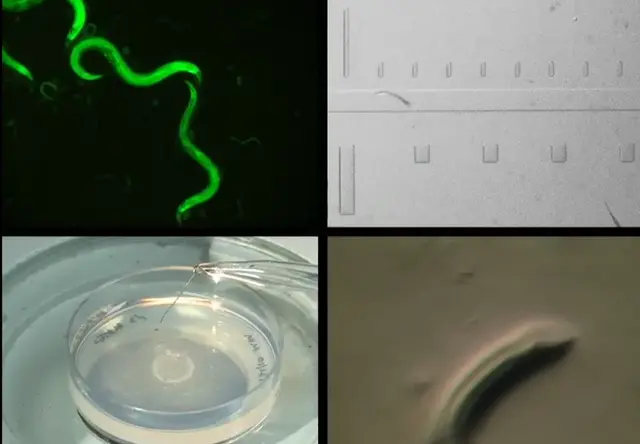
The short lifespan and genetic homology with humans, makes the roundworm Caenorhabditis elegans ideally suited for research studies to uncover the basis of changes in gene expression, behavior, and metabolism associated with aging. In broad terms, C. elegans gerontologists are concerned with understanding how long animals live (lifespan) and the duration of vitality (health span). Both are most commonly measured through manual scoring assays where the behavior of individual animals is recorded by hand under a stereomicroscope at regular intervals over time courses lasting days to weeks. Laborious and time-consuming, manual scoring assays are prone to inconsistencies due to experimenter bias, repetitive manipulation of animals, and irregularities in the conditions or timing of data acquisition. Similar concerns surround analogous assessments of age-dependent changes in other invertebrate species that are used to investigate the aging process, such as the fruit fly Drosophila melanogaster. To address these problems, several approaches to automate the analysis of lifespan and healthspan have been developed for invertebrate models, and many involve de novo-engineered devices such as the WormBot for C. elegans and the DIAMonDS system for Drosophila. While the substrates differ among these automated techniques (from microfluidic chambers to textured agar compartments to multi-well culture dishes), each employs digital imaging interfaced with software that allows the behavior and locomotion of hundreds or even thousands of animals to be tracked over time. Automated techniques are poised to become the new standard for many types of aging studies.
The purpose of this Methods Collection is twofold: to present a set of best practices for collecting data through the use of robotics and imaging software and to showcase new applications of automated systems that may allow for multiplexed assays that monitor a combination of markers, allowing for a more complete picture of aging at the physiological and cellular levels. In addition, we welcome protocols describing the modification of existing home-made devices to endow them with new capabilities for measuring parameters in addition to movement/locomotion/behavior. Although the main model organisms for this collection are the canonical invertebrates C. elegans and D. melanogaster, we also invite methods involving other invertebrate aging models including (but not limited to) planaria, hydra, the urochordates such as Botryllus schlosseri, the tunicate Cionaare, sea urchins, and Daphnia.
Articles

High-Throughput Behavioral Aging and Lifespan Assays Using the Lifespan Machine
0 Views
•
Cited by 1
•
2024
•

Quantifying Food Intake in Caenorhabditis elegans by Measuring Bacterial Clearance
0 Views
•
Cited by 4
•
2024
•
Abstracts
Evaluating Automated Motility Platforms as Proxies for Healthspan and Lifespan in C. elegans
Agnieszka Sztyler1,
Pankaj Thapa1,
Wojciech Pokrzywa*1
1International Institute of Molecular and Cell Biology in Warsaw
Measuring Food Intake in C. elegans longevity mutants
Michael Petrascheck*1
1The Scripps Research Institute
Frailty-Index–Based Protocol for Quantifying Lifespan Decline in Drosophila Alzheimer’s Disease Model Using Composite Physical Performance Metrics
Rajaguru Aradhya*1
1School of Biotechnology, Amrita Vishwa Vidyapeetham