20.3
View the full transcript and gain access to JoVE Core videos
Q1: Why is work done by a gas path-dependent?
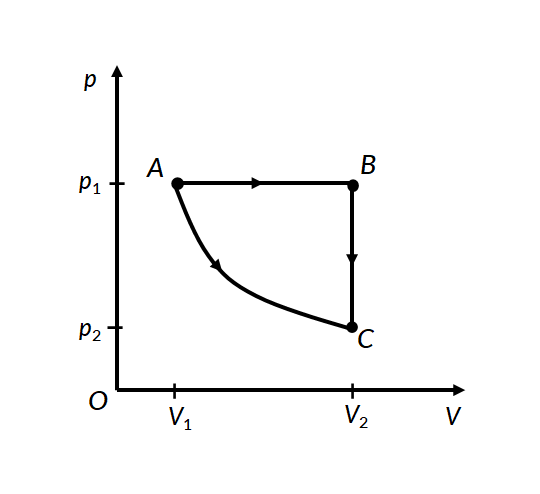
Work done by a gas depends on the specific process path taken between two thermodynamic states, not just the initial and final states. For example, when a gas expands from volume V1 to V2, the work done differs if the process occurs at constant temperature versus constant pressure. The work equals the area under the pressure-volume curve, which varies for different paths, demonstrating that work is a path-dependent function.
Q2: How does isothermal expansion differ from isobaric expansion in terms of work?
In isothermal expansion, temperature remains constant while volume increases, and work is calculated using W = nRT ln(V2/V1). In isobaric expansion, pressure stays constant while volume increases, and work equals W = p(V2 - V1). Although both processes may connect the same initial and final states, the work done differs because the pressure-volume paths are different, illustrating path dependence.
Q3: What happens to a gas when external pressure on a piston decreases?
When external pressure decreases, the internal pressure of the gas becomes higher than the external pressure. This pressure difference causes the piston to move forward, increasing the gas volume until a new equilibrium is reached. The system performs work during this expansion and transitions to a new thermodynamic state with different pressure and volume values.
Q4: Can the same final thermodynamic state be reached through different processes?
Yes, a gas can reach the same final state from an initial state through multiple different processes. For instance, reducing a piston mass in one stage or two stages both result in the same final pressure and volume. However, the total work done by the gas differs for each process because work depends on the path taken, not just the endpoints.
Q5: What does the area under a pressure-volume curve represent?
The area under a pressure-volume curve represents the work done by the gas during a thermodynamic process. When a process involves multiple stages, the total work equals the sum of areas under each curve segment. This graphical representation shows why different paths between the same two states produce different amounts of work.
Q6: How does reducing a piston mass in stages affect total work done?
Reducing the piston mass in stages creates a multi-step process where each stage contributes to the total work. In the first stage, pressure decreases to an intermediate value and work is performed. In the second stage, further pressure reduction occurs with additional work. The total work equals the sum of work from both stages, demonstrating that the path taken significantly influences the final work value.
Q7: Why does constant volume expansion produce no work?
During constant volume expansion, the gas volume remains unchanged, so no displacement occurs against external pressure. Since work is defined as pressure multiplied by volume change, W = p(ΔV), when ΔV equals zero, no work is done by or on the gas. This is why the isobaric and isochoric portions of a multi-stage process contribute differently to total work.