18.15
View the full transcript and gain access to JoVE Core videos
Q1: What is the Stefan-Boltzmann law of radiation?
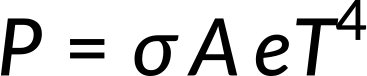
The Stefan-Boltzmann law describes the rate of heat transfer by emitted radiation from an object. It depends on the Stefan-Boltzmann constant, the object's surface area, and its absolute temperature raised to the fourth power. This strong temperature dependence allows detection of even small temperature variations, enabling applications like medical thermography and heat leak detection in buildings.
Q2: Why does a body absorb radiation from its surroundings?
When a body at temperature T1 is placed near another body at temperature T2, both emit thermal radiation simultaneously. The first body absorbs radiation from the second body while radiating its own heat. This mutual radiation exchange occurs because all objects above absolute zero emit electromagnetic radiation proportional to their temperature.
Q3: How is net radiation rate calculated when absorption occurs?
Net radiation rate equals the heat radiated minus the heat absorbed by an object. The refined Stefan-Boltzmann equation accounts for both the object's emissivity and the surrounding environment's temperature. When the net rate is positive, heat transfers from the object to its surroundings; when negative, heat flows into the object.
Q4: What role does emissivity play in radiation absorption?
Emissivity determines how effectively an object emits and absorbs thermal radiation. The balance of radiation into and out of an object depends solely on its emissivity, regardless of whether the surroundings are white, gray, or black. Objects with high emissivity both radiate and absorb radiation efficiently.
Q5: When does heat transfer from hot to cold in radiation?
Heat transfers from hot to cold when the surrounding temperature T2 exceeds the object's temperature T1, making the net radiation rate positive. This follows the fundamental principle that thermal energy naturally flows from higher to lower temperatures. The magnitude of heat transfer depends on the temperature difference and the object's surface properties.
Q6: What practical applications use the fourth-power temperature dependence of radiation?
The fourth-power relationship enables sensitive temperature detection in medical thermography, identifying abnormally high body regions indicating disease. Similar techniques detect heat leaks in homes, optimize blast furnace performance, improve workplace comfort, and remotely map Earth's temperature profile. This strong temperature dependence makes radiation ideal for detecting small thermal variations.
Q7: How does the Stefan-Boltzmann law change when considering both emission and absorption?
The original Stefan-Boltzmann law accounts only for radiation emission. When an object absorbs radiation from its surroundings, the equation requires refinement to include the surrounding temperature. The corrected formula calculates net heat transfer by subtracting absorbed radiation from emitted radiation, providing an accurate description of thermal exchange in real environments.