29.8
View the full transcript and gain access to JoVE Core videos
Q1: Why does the divergence of a magnetic field equal zero?
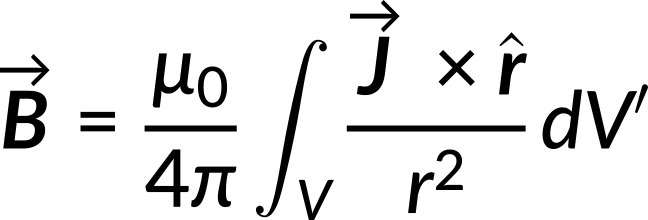
The divergence of a magnetic field is zero because applying the divergence operator to the Biot-Savart equation yields terms that cancel through vector analysis. This result holds for any magnetic field, whether static or time-dependent. Zero divergence means magnetic flux entering a closed surface equals flux exiting it, implying magnetic field lines form closed loops and magnetic monopoles do not exist.
Q2: What does the curl of a magnetic field represent?
The curl of a magnetic field equals the vacuum permeability multiplied by the current density. This relationship is derived by applying the curl operator to the Biot-Savart equation and simplifying through vector analysis. The same result emerges from applying Stokes' theorem to Ampere's Law, establishing the differential form of Ampere's Law for steady currents.
Q3: How does Stokes' theorem connect to the differential form of Ampere's Law?
Stokes' theorem transforms the integral form of Ampere's Law into differential form by converting the line integral of the magnetic field around a closed loop into a surface integral of the curl of the magnetic field. Since this relation holds for any closed loop, the integrands must be equal, yielding the differential form: curl of B equals vacuum permeability times current density.
Q4: Why do magnetic field lines always form closed loops?
Magnetic field lines form closed loops because the divergence of the magnetic field is zero. This means the magnetic flux passing through any closed surface is zero, requiring that the number of field lines entering the surface equals the number exiting. This property distinguishes magnetic fields from electric fields and confirms that isolated magnetic monopoles cannot exist.
Q5: What happens when divergence is applied to the Biot-Savart equation?
Applying divergence to the Biot-Savart equation simplifies through vector analysis. The term involving the curl of current density vanishes because current density is independent of field coordinates. The second term also reduces to zero using vector identities, ultimately proving that the divergence of the magnetic field is zero for any current distribution.
Q6: How is the differential form of Ampere's Law derived from its integral form?
The differential form of Ampere's Law is derived by rewriting the integral form in terms of volume current density and applying Stokes' theorem. This converts the line integral around a closed loop into a surface integral of the curl of the magnetic field. Since the relation holds for any closed loop, the integrands must be equal, yielding the differential form.
Q7: What does zero divergence of the magnetic field imply about magnetic monopoles?
Zero divergence of the magnetic field implies that magnetic monopoles do not exist. If monopoles existed, they would act as sources or sinks of magnetic field lines, creating non-zero divergence. Instead, magnetic field lines always form closed loops with no beginning or end, confirming the absence of isolated magnetic charges in nature.