6.7
Q1: What is the method of sections used for in truss analysis?
The method of sections determines forces acting on specific members of a truss by cutting along a sectional plane and analyzing the equilibrium of the resulting segment. Based on the principle that a truss in equilibrium has each of its segments in equilibrium, this approach allows engineers to calculate internal forces without analyzing every joint.
Q2: How many members can a sectional plane intersect in the method of sections?
A sectional plane intersects a maximum of three members to keep the analysis manageable. This limitation ensures that the number of unknowns does not exceed the available equilibrium equations, allowing for a solvable system when combined with moment and force equilibrium conditions.
Q3: Why are unknown forces assumed to be tensile in the free-body diagram?
Assuming unknown forces as tensile is a standard convention that simplifies the analysis. If the calculated result is negative, the force is actually compressive. This assumption provides a consistent starting point and allows the equilibrium equations to determine the true nature and magnitude of each member force.
Q4: What role do moment equations play in the method of sections?
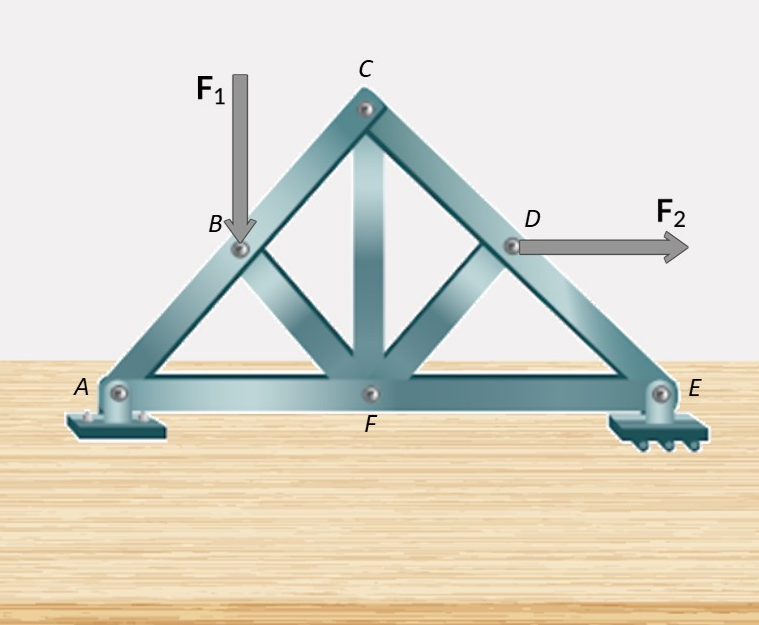
Moment equations are crucial for isolating individual member forces. By summing moments about a strategic point, such as joint D, engineers can eliminate multiple unknowns and solve directly for a single member force. This approach is more efficient than solving simultaneous equations for all unknowns at once.
Q5: How are inclined member forces resolved in the method of sections?
Inclined forces are resolved into horizontal and vertical components using trigonometry. Applying equilibrium conditions separately for horizontal and vertical directions yields two independent equations. Solving these simultaneous equations determines the magnitudes of the inclined member forces.
Q6: What is the first step in applying the method of sections to a loaded truss?
The first step is to calculate support reactions using equilibrium equations for the entire truss. The equilibrium equation for moments about a support joint, such as point A, yields the reaction force at another support point, such as point E. These reactions are essential boundary conditions for analyzing any section.
Q7: How does the method of sections differ from analyzing individual joints?
The method of sections cuts through multiple members and analyzes a segment, allowing direct calculation of internal forces without examining every joint sequentially. This approach is more efficient when only a few member forces are needed, whereas method of joints problem solving requires analyzing joints one at a time.