10.13
View the full transcript and gain access to JoVE Core videos
Q1: How does a vector's time derivative relate to angular velocity?
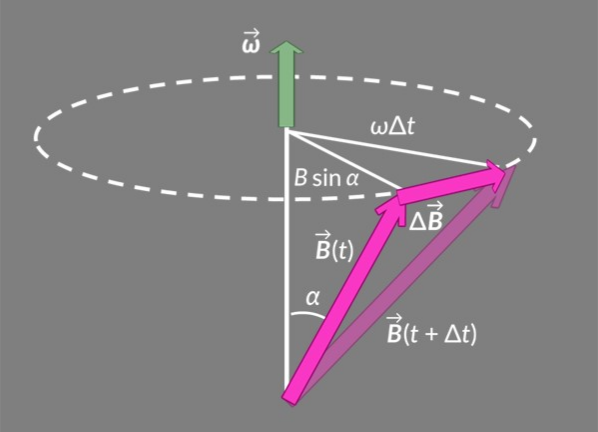
When a vector rotates about an axis with angular velocity, its time derivative equals the cross product of the angular velocity and the vector itself. This relationship holds for any vector undergoing pure rotation at constant angular velocity along a fixed rotational axis. The magnitude of change depends on both the angular velocity and the angle between the vector and the rotation axis.
Q2: What is the difference between time derivatives in inertial and rotating frames?
In an inertial frame, a vector's time derivative depends only on its scalar components. In a rotating frame, both scalar components and unit vectors change. The time derivative in the inertial frame equals the time derivative in the rotating frame plus the cross product of angular velocity and the vector, accounting for the rotation of the coordinate system itself.
Q3: How do unit vectors change in a rotating coordinate system?
Unit vectors in a rotating system rotate with constant angular velocity. Their time derivative equals the cross product of the angular velocity and each unit vector. This rate of change is essential for transforming vector derivatives between rotating and inertial frames, ensuring accurate descriptions of motion in both reference systems.
Q4: How is the velocity transformation equation derived in rotating systems?
The velocity transformation equation is obtained by replacing the arbitrary vector with a position vector in the general vector transformation equation. The velocity in the inertial frame equals the velocity in the rotating frame plus the cross product of angular velocity and the position vector. This transformation is fundamental for analyzing motion observed from rotating reference frames.
Q5: What does the acceleration transformation equation reveal about rotating frames?
The acceleration transformation equation is derived by replacing the velocity vector in the general transformation equation. It shows how acceleration measured in an inertial frame relates to acceleration in a rotating frame, incorporating the effects of the rotating coordinate system. This equation is essential for understanding forces and motion in rotating reference frames like those involving rotation with constant angular acceleration.
Q6: Why is the cross product essential in vector transformation equations?
The cross product captures the geometric relationship between angular velocity and a vector's orientation. It naturally encodes both the magnitude of rotation and the angle between the vector and rotation axis. This mathematical operation elegantly expresses how rotating coordinate systems affect vector derivatives, making it indispensable for transforming between inertial and rotating reference frames.
Q7: How do scalar components and unit vectors contribute to vector transformation?
A vector's representation depends on both scalar components and unit vectors. In rotating frames, both change with time. The transformation equations account for changes in scalar components measured in the rotating frame and changes in unit vector directions due to rotation. Together, these components fully describe how vectors transform between reference frames.