14.2
View the full transcript and gain access to JoVE Core videos
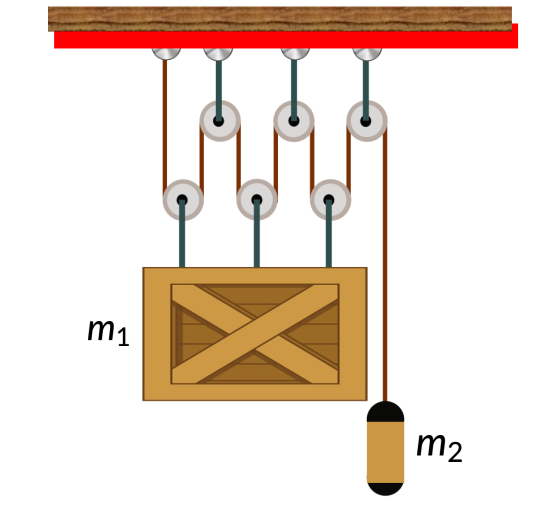
Q1: How do you establish a coordinate system for a pulley system with a wooden box and cylinder?
Establish a coordinate system to determine the total rope length by identifying segments attached to each object. The entire rope length remains constant as the system moves. Taking the time derivative of this length equation yields the velocity relationship between the wooden box and cylinder, showing how their velocities are constrained by the pulley geometry.
Q2: What forces act on the cylinder in a pulley system analysis?
The cylinder experiences two primary forces: its weight acting downward and tension in the rope acting upward. When applying the principle of linear impulse and momentum for a single particle, the integral of the net force over a time interval equals the change in the cylinder's momentum, allowing you to solve for its velocity.
Q3: Why do the wooden box and cylinder have opposite velocity directions?
The wooden box and cylinder move in opposite directions because they are connected by an inextensible rope over a pulley. As the cylinder moves downward, the rope pulls the wooden box upward. When the cylinder has positive downward velocity, the wooden box exhibits negative velocity, indicating upward motion.
Q4: How do you apply impulse-momentum equations to both objects simultaneously?
Draw free-body diagrams for both the cylinder and wooden box, showing all forces acting on each. Apply the impulse-momentum principle to each object separately, generating two equations. Substitute the velocity relationship from the rope constraint, then solve the three equations simultaneously to find the unknown velocities of both objects.
Q5: What does the time derivative of the rope length equation represent?
The time derivative of the rope length equation gives the velocity equation, establishing the kinematic constraint between the two objects. Since total rope length is constant, this derivative shows that the velocity of the wooden box and cylinder are related inversely, allowing you to express one velocity in terms of the other.
Q6: Why is the initial momentum of the system zero at the start?
The system is released from rest, meaning both the wooden box and cylinder have zero velocity initially. Since momentum equals mass times velocity, and velocity is zero, the initial momentum of each object is zero. This serves as the starting condition for applying the impulse-momentum principle over the time interval.
Q7: How does the principle of linear impulse and momentum apply to a system of connected particles?
For connected objects like a pulley system, apply the principle of linear impulse and momentum for a system of particles by analyzing each object individually with its own free-body diagram and impulse-momentum equation. The constraint equations linking their motions allow you to solve the system simultaneously, accounting for internal forces like tension.