Here, we describe the use of a novel microplate assay to enable mechanical manipulation of biomolecules while performing ensemble biochemical assays. This is achieved using a microplate lid modified with magnets to create multiple static magnetic tweezers across the microplate.
A subscription to JoVE is required to view this content. Sign in or start your free trial.
In This Article
Summary
Abstract
Mechanobiology describes how the physical forces and mechanical properties of biological material contribute to physiology and disease. Typically, these approaches are limited single-molecule methods, which restricts their availability. To address this need, a microplate assay was developed that enables mechanical manipulation while performing standard biochemical assays. This is achieved using magnets incorporated into a microplate lid to create multiple magnetic tweezers. In this format, force is exerted across biomolecules connected to paramagnetic beads, equivalent to a typical magnetic tweezer. The study demonstrates the application of this tool with FRET-based assays to monitor protein conformations. However, this approach is widely applicable to different biological systems ranging from measuring enzymatic activity through to the activation of signaling pathways in live cells.
Introduction
Mechanobiology focuses on understanding how the propagation of physical forces within and between cells regulates cellular activity1,2 and how this correlates with the organization and dynamics of both proteins and cells.
Single-molecule force measurements have revealed how force is used in biological systems, from single proteins to whole cells and tissues3,4,5,6,7. These challenging experiments require specialized equipment and technical expertise. Conversely, standard biochemical assays can be performed at higher throughput in readily available commercial equipment.
Here, the study describes a mechanobiology assay that enables magnetic tweezer-based manipulation and biochemical assays to be performed together8. Magnets are placed on a 3D printed microplate lid (Figure 1A-D), enabling the use of commercial plate readers for the assays. Force is applied across the biomolecule of interest by coupling the molecule to paramagnetic particles. The magnets then exert tension across the molecule. Altering the distance between the particles and magnets adjusts the exerted force across the biomolecule (Figure 1E).
We represent the use of this assay using the actin-based molecular motor, Myosin VI. Myosin VI is regulated by intramolecular backfolding9. Myosin VI has been shown to exist in an auto-inhibited state, whereby the binding of partner proteins, such as NDP52, triggers the unfolding of myosin VI10,11. To perform these assays, we will use a dual-labeled construct of the myosin VI tail domain with an N-terminal GFP and a C-Terminal RFP whereby backfolding of the protein generates Fluorescence Resonance Energy Transfer (FRET) between GFP and RFP. The N-terminus also carries a biotinylation tag to immobilize the protein on the surface. We use this assay in combination with FRET measurements to show how force can impact myosin VI back-folding.
Access restricted. Please log in or start a trial to view this content.
Protocol
Sample proteins required for this experiment and a list of reagents are found in the Table of Materials. Equivalent proteins should be produced for the user's system of study to measure conformation changes.
1. 3D printed magnetic lid
- Design a microplate lid to house the magnets within a 24-well microplate. An example CAD file can be downloaded from GitHub12. The measurements are shown in Figure 1.
NOTE: The height of the pedestal can be altered to change the distance between magnets and surface to alter the applied force. In addition, the final force exerted upon the particle depends on the particle size and gap between the pair of magnets. Equations to calculate the applied force for 1 µm and 2.8 µm particles at 0.5 mm, 1 mm, and 2 mm gaps are given in Dos Santos et al.8. For the experiments described here with 2.8 µm particles and a 2 mm gap, use Equation 1.
Equation 1:
- 3D print a microplate lid using Polyethylene Terephthalate Glycol (PETG) on a 3D printer system.
NOTE: Use a printer with a layer resolution of 0.02 mm to enable accuracy and reproducibility. The impact of printer accuracy was discussed in Dos Santos et al.8. - Attach pairs of 5 mm cube Neodymium N42 magnets using adhesive to the pedestals with the magnetic poles orientated to create the field directed towards the bottom of the microplate.
- Leave at least 1 position empty to act as a no-magnet control.
- Store in a sealed container of sufficient size to readily place and remove the lid.
2. Microplate surface modification
- Take a clean non-treated glass-bottomed 24-well microplate.
- Wash the wells 3x with 500 µL of wash buffer (50 mM Tris-HCl (pH 7.5) and 50 mM NaCl) at room temperature.
- Add 200 µL of biotin-BSA (0.2 mg/mL) in the wash buffer and leave it undisturbed for 15 min at room temperature.
NOTE: Biotin-BSA is used for both passivation and attachment. Other passivation and surface attachment strategies can be used. For first-time use and optimization, the concentration of biotin-BSA can be varied up to 1 mg/mL. - Wash the wells 3x with 500 µL of wash buffer.
- Add 200 µL of streptavidin (20 µg/mL) in the wash buffer and leave it undisturbed for 15 min at room temperature.
NOTE: For first-time use, the concentration of streptavidin can be varied up to 1 mg/mL. - Remove the solution and then wash the wells 3x with wash buffer.
- Cover the wells with 500 µL of wash buffer.
- Store at 4 °C until ready to use. Plates should be used on the same day.
3. Sample preparation: Protein immobilization
- Allow the surface-modified microplate to reach room temperature.
- Wash the wells with 500 µL of wash buffer.
- Add 100 nM biotin-eGFP-Myosin VI Tail-mRFP (stock sample protein) and incubate for 15 min at room temperature in wash buffer.
NOTE: This example protein is produced as described by Dos Santos et al.8. Concentrations and incubations times can vary depending upon the protein. - Wash the wells 3x with 500 µL of wash buffer.
- Set up the plate reader to record fluorescence spectra for GFP (excitation 490 nm and emission 510-600 nm) and RFP (excitation 560 nm and emission 580-650nm) to confirm the presence of the fusion proteins.
- If there is a lack of protein, increase the concentration at step 3.3.
NOTE: Poor binding could relate to inadequate biotin-BSA and/or streptavidin binding, and therefore, the amounts could be increased 10-fold. - If possible, perform a well-scan measurement to determine if the fusion protein is bound across the microplate (Figure 2).
NOTE: This measurement will record the fluorescence intensity at specific points across the microplate well. It will reveal if the protein is bound across the well. - Ensure that the signal is uniform (within 5%) in the center of the well where the assay measurement occurs.
4. Magnetic bead preparation
- Vortex the vial of 2.8 µm paramagnetic beads with recombinant Protein A (Table of Materials) for 30 s to resuspend the beads.
- Transfer the volume corresponding to 1 mg of paramagnetic beads to a 1.5 mL tube.
- Place the tube in a magnetic isolator (Table of Materials) and then remove the supernatant.
- Resuspend the beads in 200 µL of PBS by gently pipetting the solution up and down.
- Place the tube in the magnetic isolator and then remove the supernatant.
- Repeat the wash step 3x.
- Dilute 10 µg of Anti-RFP antibody in 200 µL of PBS.
- Isolate the beads in the magnetic isolator and then resuspend in the antibody solution.
- Rotate at 20 rpm for 10 min at room temperature on a benchtop rotator.
- Place the tube in the magnetic isolator and remove the supernatant.
- Wash 3x in PBS.
- Resuspend the beads in 200 µL of wash buffer.
- To confirm antibody immobilization on the beads, incubate the antibody-loaded beads with a solution of >1 µM RFP fusion protein.
NOTE: Confirm visually whether the protein is isolated by the beads. - Alternatively, measure the fluorescence intensity of the supernatant (excitation 560 nm and emission 580-650nm) for RFP in a fluorescence spectrometer.
5. Sample preparation: Bead attachment
- Add 10 µg of the paramagnetic bead-antibody fusion diluted in wash buffer (200 µL) to the protein-bound microplate wells.
- Do not place beads in one control well to check for the effect of beads on the fluorescent signal. Prepare a control sample without antibodies to determine any non-specific interactions with the beads.
- Incubate the microplate at room temperature for 30 min.
- Wash the wells 3x with 500 µL of wash buffer.
- If available locally, check that the beads are bound to the surface on a brightfield microscope. If there is a lack of beads, increase the concentration in step 5.1 to 500 µg/mL.
6. Data acquisition
- Place the microplate, without lid, into a fluorescent plate reader at 25 °C.
- Set up the plate reader to record fluorescence spectra for GFP (excitation 490 nm and emission 510-600 nm) and RFP (excitation 560 nm and emission 580-650 nm) to confirm the presence of the fusion proteins.
NOTE: Measure/record the fluorescence spectra through the bottom of the microplate to place the lid on top. Therefore, a suitable microplate reader should be selected. - Record a FRET fluorescence spectrum (excitation 490 nm and emission 510-650nm), or monitor fluorescence at 510 nm and 610 nm with excitation at 490 nm. This is set up according to the manufacturer's guidance.
- Remove the microplate from the reader and add the magnetic lid.
- Return to the plate reader and leave the sample for 2 min.
- Repeat the FRET measurement, as in step 6.3.
7. Data analysis
- Export the data for import into a spreadsheet (e.g., Excel).
- Manually extract the data for Donor GFP at 510 nm and acceptor RFP at 610 nm.
- Calculate relative FRET using Equation 2 for each condition.
Equation 2: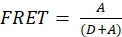
A: acceptor intensity (RFP 610 nm), D: donor intensity (GFP 510 nm).
NOTE: Use the recombinant RFP under the same excitation and emission conditions to control for the background excitation of the acceptor.
Access restricted. Please log in or start a trial to view this content.
Results
Figure 2 shows an example of a well-scan measurement where the fluorescence intensity of GFP has been recorded at 1 mm intervals across the microplate well. Typical fluorescence measurements are performed at the center position of the microplate well (position 8,8 in Figure 2); it is, therefore, important that there is bound protein at this location. As shown in Figure 2, the intensity is highest in the center of the well within a r...
Access restricted. Please log in or start a trial to view this content.
Discussion
This approach enables force-based measurements to be readily applied in a microplate using fluorescent plate readers. Importantly, this assay format assumes there is functional protein when it is bound to a surface. Therefore, prior knowledge is required before embarking on these measurements to ensure there is protein activity. It is also beneficial to make sure that the binding of molecules to the paramagnetic beads and surface is optimized for each system.
This concept can be modified to f...
Access restricted. Please log in or start a trial to view this content.
Disclosures
The authors declare no competing interests.
Acknowledgements
We thank Cancer Research UK (A26206), the MRC (MR/M020606/1), and the Royal Society (RG150801) for funding.
Access restricted. Please log in or start a trial to view this content.
Materials
| Name | Company | Catalog Number | Comments |
|---|---|---|---|
| 24 well glass-bottom microplate | Cellvis | P24-1.5H-N | Multiple sources are available. Unless needed, it is best to avoid treated surfaces and we use Imaging grade glass N1.5. |
| Anti-RFP antibody | Abcam | ab290 | Multiple sources are available but must ensure there is minimal reactivity with GFP. |
| Bench top light microscope | Optika | IM-3 | |
| Bench top Rotator | Cole-Palmer-Stuart | SB3 | |
| Biotin-BSA | Sigma Aldrich | A8549 | |
| CAD Software - Sketch Up Educator | Sketch Up | Alternative CAD softwares can be used. Users should ensure the file formats are compatiable with their 3D printer. | |
| Dynabeads Protein A | Fisher Scientific | 10746713 | 2.8 µm paramagnetic beads with recombinant Protein A |
| Impact contact adhesive | EVO-STIK | ||
| MagnaRack magnetic separation rack | ThermoFisher Scientific | CS15000 | Magnetic Isolator |
| NaCl | Fisher Scientific | 10316943 | |
| Neodymium N42 5mm cube Magnets | Supermagnete | W-05-N | |
| Plate Reader - ClarioStar | BMG Labtech | All plate reader systems can be used where measurements are possible from under the microplate. The magnet lid excludes standard measurements from above | |
| Streptavidin | Sigma Aldrich | 189730 | |
| Tris-HCl | Fisher Scientific | 10142400 | |
| Ultimaker PETG Filament | Ultimaker | ||
| Ultimaker S3 - 3D printer | Ultimaker |
References
- Jansen, K. A., et al. A guide to mechanobiology: Where biology and physics meet. Biochimica et Biophysica Acta. 1853, 3043-3052 (2015).
- Dos Santos, A., Toseland, C. P. Regulation of nuclear mechanics and the impact on dna damage. International Journal of Molecular Sciences. 22 (6), 3178(2021).
- Dos Santos, A., et al. DNA damage alters nuclear mechanics through chromatin reorganization. Nucleic Acids Research. 49 (1), 340-353 (2020).
- Elosegui-Artola, A., et al. Force triggers YAP nuclear entry by regulating transport across nuclear pores. Cell. 171, 1397-1410 (2017).
- Lherbette, M., et al. Atomic force microscopy micro-rheology reveals large structural inhomogeneities in single cell-nuclei. Scientific Reports. 7, 8116(2017).
- Seo, D., et al. A mechanogenetic toolkit for interrogating cell signaling in space and time. Cell. 165, 1507-1518 (2016).
- Yao, M., et al. The mechanical response of talin. Nature Communications. 7, 11966(2016).
- Dos Santos, A., Fili, N., Pearson, D. S., Hari-Gupta, Y., Toseland, C. P. High-throughput mechanobiology: Force modulation of ensemble biochemical and cell-based assays. Biophysical Journal. 120, 631-641 (2021).
- Fili, N., Toseland, C. P. Unconventional myosins: How regulation meets function. International Journal of Molecular Sciences. 21 (1), 67(2019).
- Fili, N., et al. Competition between two high- and low-affinity protein-binding sites in myosin VI controls its cellular function. Journal of Biological Chemistry. 295, 337-347 (2020).
- Fili, N., et al. NDP52 activates nuclear myosin VI to enhance RNA polymerase II transcription. Nature Communications. 8, 1871(2017).
- MagPlate at GitHub. , Available from: https://github.com/cptoseland/MagPlate (2021).
- Toseland, C. P. Fluorescent labeling and modification of proteins. Journal of Chemical Biology. 6, 85-95 (2013).
Access restricted. Please log in or start a trial to view this content.
Reprints and Permissions
This article has been published
Video Coming Soon