The protocol presents an OLIF L5-S1 technique that offers a more feasible approach for lumbosacral fusion sharing a common surgical plane with OLIF L2-5. This facilitates reproducible multi-level interbody fusions extending from L2 to S1 through a retroperitoneal oblique corridor between the Psoas muscle and the great vessels.
Method Article
Oblique Lumbar Interbody Fusion at L5-S1 Segment Through an Approach Between the Psoas Muscle and the Great Vessels
Opens in a new tab
In This Article
Summary
Loading...
$$\rightleftharpoonup{xx}$$
$$\longleftharp{xx}$$,
$$\longrightharp{xx}$$,
Abstract
Loading...
$$\rightleftharpoonup{xx}$$
$$\longleftharp{xx}$$,
$$\longrightharp{xx}$$,
Over the years, the oblique lateral interbody fusion (OLIF) technique has gained significant recognition for treating various spinal conditions in lumbar segments L2-L5. However, the adoption of OLIF for the L5-S1 segment has not been widely embraced by the spinal surgery community, given that significant concerns remain regarding the applicability of OLIF for lumbosacral fusion. In this study, a cohort of 20 patients underwent interbody fusion at the L5-S1 level using the OLIF technique through a single retroperitoneal oblique approach positioned between the Psoas muscle and the great vessels. The procedure involved discectomy and endplate preparation accomplished through a surgical window created on the anterolateral side of the L5-S1 disc. For secure interbody fusion cage placement, a supplementary cage insertion approach was employed. All patients were followed up for a minimum of 12 months. The mean preoperative visual analog scale (VAS) score for lower back pain was 6.3 ± 1.5 and experienced a significant reduction to 1.2 ± 0.8 at 12 months. The VAS score for lower limb pain significantly decreased from 5.6 ± 1.4 preoperatively to 0.8 ± 0.3 at 12 months after the surgery. Furthermore, the preoperative Oswestry disability index (ODI) improved from 82.4% ± 16.2% to 8.1% ± 2.0% at 12 months. Radiographic evaluations after surgery confirmed improved lumbosacral junction reconstruction for all patients. At the final follow-up, successful bony fusion was observed in all cases. Based on these findings, the OLIF technique for L5-S1 fusion represents an attainable approach for lumbosacral reconstruction. The procedure's success hinges on a comprehensive preoperative plan and precise intraoperative techniques.
Introduction
Loading...
$$\rightleftharpoonup{xx}$$
$$\longleftharp{xx}$$,
$$\longrightharp{xx}$$,
Lumbar interbody fusion represents the mainstay of treatment for many lumbar disorders. The most commonly performed techniques are posterior lumbar interbody fusion (PLIF) and transforaminal lumbar interbody fusion (TLIF). The advent of minimally invasive spine surgery has given rise to the lateral lumbar interbody fusion (LLIF) approach, a minimally invasive transpsoas approach to the lumbar spine. This approach, also known as the minimally invasive lateral transpsoas approach, offers advantages, including reduced blood loss, shorter operative times, decreased hospital stays, and diminished postoperative pain. Despite its merits, LLIF is associated with a risk of injury to the neural structures of the lumbar plexus, a concern held by various spine surgeons1. In response to these challenges, the oblique lumbar interbody fusion (OLIF) technique has emerged as an innovative approach for lumbar spine reconstruction1,2,3,4. As an alternative to LLIF, OLIF holds several theoretical advantages, including avoiding disruption to the Psoas muscle, preventing lumbosacral plexus injury, and consistent access to the lower lumbar levels without necessitating neuromonitoring3,4. In recent years, OLIF has achieved broad recognition as an effective procedure for addressing an array of spinal pathologies within the L2-L5 segments, encompassing degenerative disc disease, lumbar spondylosis, spondylolisthesis, lumbar stenosis, and scoliosis2,5,6,7.
Capitalizing on advancements in surgical techniques and instruments, numerous spine surgeons have ventured into L5-S1 interbody fusion using the OLIF approach (OLIF L5-S1)2,6,7,8,9,10,11,12. Theoretically, the application of OLIF at the lumbosacral junction offers a larger surface area for robust fusion, re-establishment of anterior column support, and simultaneous achievement of indirect decompression and sagittal alignment correction. However, the anatomic intricacies of the retroperitoneal oblique corridor to the L5-S1 disc present technical hurdles to spine surgeons, especially the complexities posed by neurovascular structures and disruptions involving the iliac crest2,9,11,12,13,14. Despite limited recent literature discussing OLIF L5-S1, this approach has not gained the same widespread acceptance within the spine community as OLIF L2-5. Concerns about the feasibility of OLIF L5-S1 for lumbosacral fusion persist in the scientific community2,13,14, with many variations in the L5-S1 OLIF technique employed by previous studies.
Since 2017, OLIF has become one of the techniques of choice for achieving lumbosacral fusions in our department. The potential anatomic space between the iliac vessels and psoas muscle allows the OLIF procedure at L5-S1. Additionally, specialized instruments are available for OLIF at the lumbosacral junction to avoid the obstruction of the iliac crest. This study outlines the developed OLIF L5-S1 technique through detailed case illustrations. The method provides a consistent means to achieve fusion at the lumbosacral segment using a single retroperitoneal oblique corridor between the Psoas muscle and the great vessels.
Protocol
Loading...
$$\rightleftharpoonup{xx}$$
$$\longleftharp{xx}$$,
$$\longrightharp{xx}$$,
This study was carried out in accordance with the clinical ethics committee guidelines of the First Affiliated Hospital of Zhejiang University. Written informed consent was obtained from all participating patients. The OLIF L5-S1 technique is indicated for patients with various spinal pathologies of L5-S1 involving degenerative disc disease, lumbar spondylosis, low-grade spondylolisthesis, and scoliosis. Patients with a history of trauma, neoplasia, or infection were excluded.
1. Patient position
- All patients were operated under general anesthesia with endotracheal intubation. Place patients in a lateral decubitus position on a radiolucent table, with fixation at the greater trochanter and shoulder (Figure 1A,B).
- Use a left-sided approach for multi-level spine reconstruction involving the L5-S1 junction to minimize the risk of injury to the great vessels. In the case of patients with a scoliotic spine convex or prior left-sided abdominal surgery, a right-sided approach was considered.
2. Approaching the L5-S1 intervertebral disc between the Psoas muscle and the great vessels
- Obtain an accurate lateral view of the lumbar spine using fluoroscopy. Mark the anterior superior iliac spine (ASIS) and L5-S1 disc locations on the skin. Roughly 2 cm anterior to ASIA, make a 4 cm oblique anterolateral incision toward the midpoint landmark of the L5-S1 disc (Figure 1B).
- After making a skin incision, use a vascular clamp to dissect the external oblique, internal oblique, and transversus abdominis muscles along their fiber lines (Figure 1C). Make a blunt dissection to access the retroperitoneal space and the retroperitoneal fat, peritoneum, and ureter. Shift the tissues and organs forward using tonsil sponges.
- Extend the retroperitoneal dissection over the anterior Psoas muscle border until the iliac vessels are visualized.
- Use a handheld retractor to gently mobilize the left iliac artery anteriorly to expose the entry to the L5-S1 disc, guided by the left common iliac vein. Dissect with a suction apparatus to clear fatty connective tissue in this region. This meticulous dissection creates a surgical window approximately 1.8 cm wide on the anterolateral side of the L5-S1 disc (Figure 1D).
- If the iliolumbar vein was encountered at the L5-S1 disc entry point, preserve it unless it obstructs the surgical field. In instances of obstruction, use bipolar cautery or clipping to manage the vein before the discectomy.
3. Exposure of surgical field at the L5-S1 disc
- Once the L5-S1 level is confirmed via fluoroscopy (Figure 1E), use a handled retractor and Kirschner wires to sustain proper exposure, avoiding the need for expansion retractors.
- Position the handled retractor laterally to the iliac vessels, offering gentle retraction. Insert Kirschner wires into the L5 and S1 vertebral bodies, minimizing Psoas major muscle retraction and keeping the iliolumbar vein outside the surgical window. Position the Kirschner wires close to the end plate while minimizing the neurovascular risk.
4. Discectomy and cage insertion
- Perform discectomy and endplate preparation within the surgical field. Carry out discectomy using a pituitary rongeur, followed by the preparation of the endplate using elongated angled curettes, as previously described by Kim et al.8. Carry out sequential trials with different-sized cages for disc space distraction and contralateral annulus release (Figure 1F-H).
- After selecting an appropriate cage size based on preoperative planning and intraoperative trial sizing, place a bone graft and bone marrow from the iliac crest within the cage.
- For L5-S1, the elevated position of the iliac crest poses a challenge for conventional cage insertion. Use a supplementary cage insertion approach to navigate this obstacle (Figure 2A-F).
- Insert the cage obliquely until approximately 75% of the cage is within the disc space. Use a shorter implant inserter to tap the anteromedial corner of the cage, allowing orthogonal turning and further insertion (Figure 2D-F).
- Apply strict radiological anteroposterior and lateral radioscopic control during cage insertion until optimal positioning is achieved intraoperatively. Use a small retractor to shield the iliac vessels.
5. Pedicle screws fixation
- Carry out posterior fixation using pedicle screws in the prone position. Mark pedicle entry points via fluoroscopy before surgery. Choose the connecting point of the transverse process, the upper articular process, and the vertebral lamina as the entry point for the pedicle.
- Perform a longitudinal midline skin incision with a scalpel, followed by the identification of the anatomical cleavage between the multifidus and longissimus muscles to expose the pedicle screw entry points. Insert pedicle screws with their positions confirmed using fluoroscopy. The pedicle screws were located within the pedicles.
- Close the fascia with running stitches and close the skin with an intradermic suture.
6. Postoperative period
- Remove the incision drain on the first postoperative day. Carry out postoperative pain control using nonsteroidal anti-inflammatory drugs, narcotic analgesics, and muscle relaxants.
- Obtain early lumbar X-rays at 2 to 3 postoperative days to verify cage and pedicle fixation positions.
- Allow the patients to ambulate with waist circumference protection. Most patients were discharged within 4 to 5 days after the operation.
7. Radiographic and clinical evaluation
- Obtain radiographs preoperatively, immediately postoperatively, and at 3-6 months, 9-12 months, and the last follow-up. Perform CT scans at 9 and 12 months postoperatively and at the final follow-up to assess bone union. Determine fusion status by continuous trabeculae bridging bone formation without gaps between the vertebral endplate and the cage.
- Assess lower back pain using a visual analog scale score. The Oswestry disability index was recorded preoperatively, at 1 and 12 months, postoperatively. Document perioperative data and complications.
Results
Loading...
$$\rightleftharpoonup{xx}$$
$$\longleftharp{xx}$$,
$$\longrightharp{xx}$$,
Clinical outcomes
A total of 20 patients underwent OLIF L5-S1 via a retroperitoneal oblique corridor between the Psoas muscle and the great vessels. The study population exhibited female predominance (n=12, 60%), with a mean age of 55.4 ± 6.8 years. OLIF L5-S1 procedures were performed on patients with isthmic spondylolisthesis (n=10), degenerative disc disease (n=6), and degenerative spondylolisthesis (n=4). The procedures included single-level (n=16) and two-level cases (n=4), involving L4-L5 (n=4) and L5-S1 (n=20). The mean blood loss volume was 133.4 ± 48.5 mL, and the average operative time was 153.6 ± 38.3 min. Based on preoperative axial MR images, the left common iliac vein (LCIV) was categorized into three types according to the difficulty of mobilization: type I - no requirement for mobilization; LCIV runs laterally for more than two-thirds of the length of the left side of the L5-S1 disc, type II - easy mobilization; LCIV obstructs the L5-S1 disc space, but the perivascular adipose tissue is present under the LCIV, and type III - potentially difficult mobilization; no perivascular adipose tissue under the LCIV. In our series, patients were classified as type I (n=3), type II (n=14), and type III (n=3) LCIV. For two patients with type III LCIV, no other perioperative complications were observed apart from iliolumbar vein lacerations during exposure.
The preoperative VAS score for lower back pain was 6.3 ± 1.5, significantly decreasing to 1.2 ± 0.8 at 12 months. The VAS score for lower limb pain was 5.6 ± 1.4 preoperatively and significantly decreased to 0.8 ± 0.3 at 12 months (Figure 3). The preoperative Oswestry disability index improved from 82.4% ± 16.2% preoperatively to 8.1% ± 2.0% at 12 months (Figure 4).
Radiographic outcomes
Postoperative radiographic examinations confirmed improved reconstruction at the lumbosacral junction for all patients. At the final follow-up, bony fusion was observed in all patients (Figure 5). No cage retropulsion or pedicle screw loosening cases were observed.
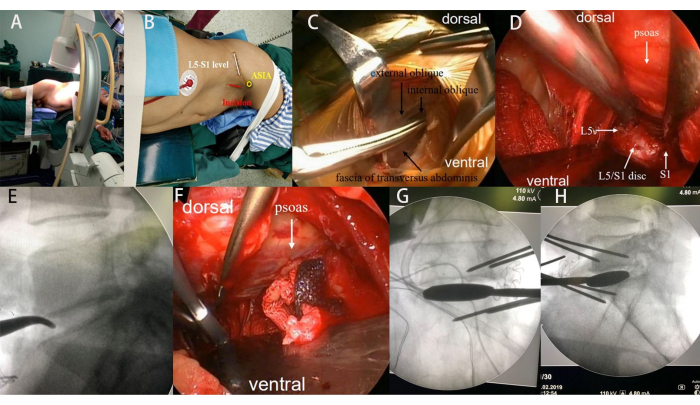
Figure 1: Intraoperative photographs. (A-B) The patient's lateral decubitus position and skin marking for the incision. (C) Blunt dissection involving the external oblique, internal oblique, and transversus abdominis muscles. (D) Exposure of the L5-S1 disc space using handheld retractors and Kirschner wire pins. (E) Intraoperative confirmation of the L5-S1 disc space by fluoroscopy. (F-H) Sequential use of different trial sizes to distract the disc space and release the contralateral annulus. Please click here to view a larger version of this figure.
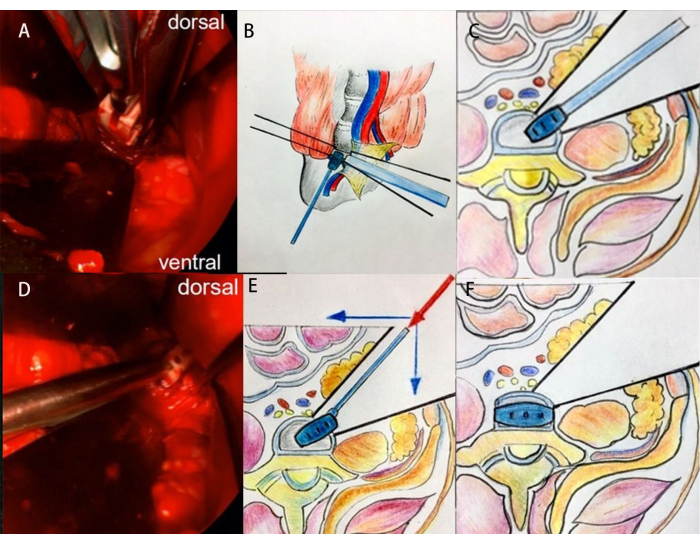
Figure 2: Intraoperative clinical images and schematic diagrams illustrating the technique for cage insertion at the L5-S1 segment. (A-C) First step of cage insertion. (D-F) The second step of cage insertion. Please click here to view a larger version of this figure.

Figure 3: Visual analog scores (VAS) for low back and leg pain. (A) Over 12 months, the VAS score for lower back pain reduced from 6.3 ± 1.5 to 1.2 ± 0.8, and (B) for lower limb pain, the VAS score decreased from 5.6 ± 1.4 preoperatively to 0.8 ± 0.3. Data presented as mean ± SD. ****: Signifies a significant difference by Student's t-tests (p < 0.001). Please click here to view a larger version of this figure.

Figure 4: Oswestry disability index scores. The preoperative Oswestry disability index (ODI) improved from 82.4% ± 16.2% to 8.1% ± 2.0% at 12 months. Data presented as mean ± SD. ****: Signifies a significant difference by Student's t-tests (p < 0.001). Please click here to view a larger version of this figure.
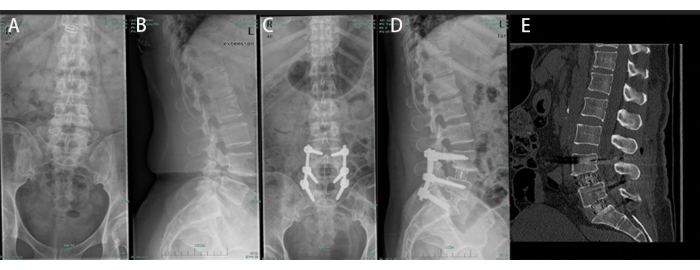
Figure 5: A 51-year-old male undergoing OLIF from L4-5 to L5-S1. (A, B) Preoperative anteroposterior and lateral radiographs displaying spondylolytic spondylolisthesis at L4-L5 and L5-S1. (C, D) Postoperative anteroposterior and lateral radiographs reveal satisfactory L4-S1 reconstruction. (E) Bony union was observed at the final follow-up. Please click here to view a larger version of this figure.
Discussion
Loading...
$$\rightleftharpoonup{xx}$$
$$\longleftharp{xx}$$,
$$\longrightharp{xx}$$,
An increasing body of evidence from recently published studies suggests that OLIF therapy brings technical advantages and favorable outcomes for lumbar degenerative diseases, especially in the L2-5 segments2,5,6,7. While recognizing these benefits, efforts have been made to extend the use of OLIF to the lumbosacral junction. However, the technical strategy for performing OLIF at L5-S1 remains subject to controversy within the spine surgery community2,13,14,19,20.
Based on their experience with anterior lumbar interbody fusion, some researchers have suggested that the OLIF L5-S1 procedure should be executed through the central portion of the L5-S1 disc, situated below the iliac vessel bifurcation6,7,8,11,13. Indeed, this technique is viewed as a minimally invasive retroperitoneal ALIF performed in lateral position16. However, this approach necessitates patient repositioning when achieving multi-level fusion involving the L5-S1 segment in a single-stage operation. Furthermore, this technique sacrifices the integrity of the anterior disco ligamentous complex (anterior longitudinal ligament and annulus), potentially compromising the effectiveness of OLIF in achieving indirect neural decompression. The presence of the superior hypogastric plexus directly over the L5-S1 disc space below the iliac vessel bifurcation raises concerns about the risk of damaging this structure and resulting in retrograde ejaculation16. In some cases, with aberrant vascular structures, the low iliocaval junction or the medially located left common iliac vein make this approach challenging and may result in life-threatening vascular injury17,18.
To address these issues, Silvestre et al. proposed accessing the L5-S1 disc through the oblique corridor between the iliac vessel and the Psoas muscle. However, a significant concern regarding potential damage to the iliac vessel and its tributaries, notably the iliolumbar vein, has led some surgeons to abstain from using OLIF at the L5-S1 level2. Zairi et al. recommended ligating the iliolumbar vein as a prerequisite for successful access to the L5-S1 disc, aiming to reduce the risk of injuring these vulnerable structures9. However, this approach entails more extensive dissection and manipulation, potentially resulting in postoperative thigh pain and increased risk of neurovascular complications. Furthermore, the variable vascular anatomy encountered during exposure can complicate the search for the iliolumbar vein.
Based on experience, the distinct nature of the OLIF L5-S1 procedure necessitates surgeons' familiarity with lumbosacral anatomy. The accessible corridor is within the anatomical space between the Psoas muscle and the LCIV. Cadaveric studies by Kai et al. revealed that the average distance from the LCIV to the Psoas muscle was 12.00 mm at the L5-S1 disc space14. Mild Psoas retraction effectively increases the corridor width to 18 mm, sufficient for introducing cages into the disc space. The limited access space to the L5-S1 disc restricts the use of expansion retractors. To counter this, Kirschner wires are preferred in the procedure for maintaining adequate exposure through elastic retraction. The refined technique requires less dissection and retraction to achieve a suitable working zone for OLIF L5-S1, thus offering a simpler method than previously described. We emphasize meticulous dissection and direct visualization for safe exposure. All dissections should be performed under direct visualization of anatomical landmarks. Additionally, the procedure employs a smaller arthroscope to gain a detailed view of the significant anatomy crossing the surgical window, especially the location of the iliolumbar vein. The iliolumbar vein can typically be protected from incidental damage, obviating the need for vascular ligation and the resulting extensive exposure.
Another technical challenge of the OLIF L5-S1 procedure is implant insertion when encountering the iliac crest2,9,11. Iliac crest obstruction at the L5-S1 level can hinder the orthogonal maneuver of the inserted instrument, potentially resulting in postoperative misplacement of interbody fusion cages. In our series, a supplementary insertion approach was adopted to turn the implants orthogonal to the true lateral direction under fluoroscopy guidance, ensuring a satisfactory cage position. This surgical strategy for cage insertion can also be applied to the same OLIF device system for consecutive L2-S1 reconstruction through the same surgical plane, offering a more versatile and widely applicable procedure for clinical practice.
Finally, a thorough preoperative analysis of vascular anatomy is critical when performing OLIF at the L5-S1 level. An anatomical study by Chung et al. using MRI found a strong association between the morphological characteristics of LCIV and the risk of mobilization at the L5-S1 level15. The LCIV position and perivascular adipose tissue should be considered when accessing the L5-S1 disc between the iliac vessels. Although the classification system used in the study by Chung et al. may not fully apply to this approach, we found that the absence of fat around LCIV results in the adventitial layer adhering tightly to surrounding connective tissue, making blunt dissection and retraction more challenging. If the facet line cuts through the LCIV and no fat plane exits under the left CIV, this is a challenging intra-bifurcation access to the L5-S1 disc. Based on our experience, type III LCIV's anatomical features pose a higher risk of venous laceration for surgeons during exposure. Therefore, we emphasize the preoperative evaluation of perivascular adipose tissue on axial MR images. We do not recommend the OLIF technique for a single L5-S1 fusion in cases of type III LCIV. More recently, Berry et al. employed a similar facet line method to assess the relationship between the left LCIV and the L5-S1 disc, further aiding approach selection20.
Disclosures
Loading...
$$\rightleftharpoonup{xx}$$
$$\longleftharp{xx}$$,
$$\longrightharp{xx}$$,
The authors have nothing to disclose.
Acknowledgements
Loading...
$$\rightleftharpoonup{xx}$$
$$\longleftharp{xx}$$,
$$\longrightharp{xx}$$,
The study was funded by the Zhejiang Provincial Natural Science Foundation (grant number 2022RC136, 2022KY1455), Alibaba Youth Studio Project (grant number ZJU-032). The funding bodies had no role in the design of the study; in collection, analysis, and interpretation of data; and in drafting the manuscript.
Materials
| Name | Company | Catalog Number | Comments |
|---|---|---|---|
| Fluoroscopy System | Allengers | ||
| Handheld retractor | gSource | gS 36.9362 | |
| Kirschner wire | Sklar surgical instruments | SKU 40-1535 | |
| OLIF cages | Medtronic Sofamor Danek, Memphis, Tennessee, USA | ||
| Pedicle screws | Beijing Fule Technology Development Co. , Ltd China | ||
| Tonsil sponge | teleflex | MC-008133 | |
| Vascular clamp |
References
Loading...
$$\rightleftharpoonup{xx}$$
$$\longleftharp{xx}$$,
$$\longrightharp{xx}$$,
- Lumbar interbody fusion: techniques, indications and comparison of interbody fusion options including PLIF TLIF, MI-TLIF, OLIF/ATP, LLIF and ALIF. J Spine Surg. 1 (1), 2-18 (2015).">Mobbs, R. J., Phan, K., Malham, G., Seex, K., Rao, P. J. Lumbar interbody fusion: techniques, indications and comparison of interbody fusion options including PLIF TLIF, MI-TLIF, OLIF/ATP, LLIF and ALIF. J Spine Surg. 1 (1), 2-18 (2015).
- Complications and morbidities of mini-open anterior retroperitoneal lumbar interbody fusion: Oblique lumbar interbody fusion in 179 patients. Asian Spine J. 6 (2), 89-97 (2012).">Silvestre, C., Mac-Thiong, J. M., Hilmi, R., Roussouly, P. Complications and morbidities of mini-open anterior retroperitoneal lumbar interbody fusion: Oblique lumbar interbody fusion in 179 patients. Asian Spine J. 6 (2), 89-97 (2012).
- Review of early clinical results and complications associated with oblique lumbar interbody fusion (OLIF). J Clin Neurosci. 31, 23-29 (2016).">Phan, K., Maharaj, M., Assem, Y., Mobbs, R. J. Review of early clinical results and complications associated with oblique lumbar interbody fusion (OLIF). J Clin Neurosci. 31, 23-29 (2016).
- Lateral and oblique lumbar interbody fusion-current concepts and a review of recent literature. Curr Rev Musculoskelet Med. 12 (3), 305-310 (2019).">Hah, R., Kang, H. P. Lateral and oblique lumbar interbody fusion-current concepts and a review of recent literature. Curr Rev Musculoskelet Med. 12 (3), 305-310 (2019).
- Effect of indirect neural decompression through oblique lateral interbody fusion for degenerative lumbar disease. Spine. 40 (3), E175-E182 (2015).">Fujibayashi, S., et al. Effect of indirect neural decompression through oblique lateral interbody fusion for degenerative lumbar disease. Spine. 40 (3), E175-E182 (2015).
- A new extensile anterolateral retroperitoneal approach for lumbar interbody fusion from L1 to S1: a prospective series with clinical outcomes. Spine J. 16 (6), 786-791 (2016).">Molloy, S., et al. A new extensile anterolateral retroperitoneal approach for lumbar interbody fusion from L1 to S1: a prospective series with clinical outcomes. Spine J. 16 (6), 786-791 (2016).
- Oblique retroperitoneal approach for lumbar interbody fusion from L1 to S1 in adult spinal deformity. Neurosurg Rev. 41 (1), 355-363 (2018).">Kim, K. T., Jo, D. J., Lee, S. H., Seo, E. M. Oblique retroperitoneal approach for lumbar interbody fusion from L1 to S1 in adult spinal deformity. Neurosurg Rev. 41 (1), 355-363 (2018).
- How I do it? Oblique lumbar interbody fusion at L5S1(OLIF51). Acta Neurochir. 161 (6), 1079-1083 (2019).">Kim, J. S., Sharma, S. B. How I do it? Oblique lumbar interbody fusion at L5S1(OLIF51). Acta Neurochir. 161 (6), 1079-1083 (2019).
- Mini-open oblique lumbar interbody fusion (OLIF) approach for multi-level discectomy and fusion involving L5-S1: Preliminary experience. Orthop Traumatol Surg Res. 103 (2), 295-299 (2017).">Zairi, F., et al. Mini-open oblique lumbar interbody fusion (OLIF) approach for multi-level discectomy and fusion involving L5-S1: Preliminary experience. Orthop Traumatol Surg Res. 103 (2), 295-299 (2017).
- Minimally invasive L5-S1 oblique lumbar interbody fusion with anterior plate. Neurosurg Focus. 41 (Video Suppl 1), 1(2016).">Pham, M. H., Jakoi, A. M., Hsieh, P. C. Minimally invasive L5-S1 oblique lumbar interbody fusion with anterior plate. Neurosurg Focus. 41 (Video Suppl 1), 1(2016).
- Miniopen oblique lateral L5-s1 interbody fusion: a report of 2 cases. Case Rep Orthop. 2014, 603531(2014).">Kanno, K., et al. Miniopen oblique lateral L5-s1 interbody fusion: a report of 2 cases. Case Rep Orthop. 2014, 603531(2014).
- Use of an alternative surgical corridor in oblique lateral interbody fusion at the L5-S1 segment: A technical report. Clin Spine Surg. 31 (7), 293-296 (2018).">Chung, N. S., Jeon, C. H., Lee, H. D. Use of an alternative surgical corridor in oblique lateral interbody fusion at the L5-S1 segment: A technical report. Clin Spine Surg. 31 (7), 293-296 (2018).
- Retroperitoneal oblique corridor to the L2-S1 intervertebral discs in the lateral position: an anatomic study. J Neurosurg Spine. 21 (5), 785-793 (2014).">Davis, T. T., et al. Retroperitoneal oblique corridor to the L2-S1 intervertebral discs in the lateral position: an anatomic study. J Neurosurg Spine. 21 (5), 785-793 (2014).
- The anatomic characteristics of the retroperitoneal oblique corridor to the L1-S1 intervertebral disc spaces. Spine. 44 (12), E697-E706 (2019).">Wang, K., et al. The anatomic characteristics of the retroperitoneal oblique corridor to the L1-S1 intervertebral disc spaces. Spine. 44 (12), E697-E706 (2019).
- Preoperative evaluation of left common iliac vein in oblique lateral interbody fusion at L5-S1. Eur Spine J. 26 (11), 2797-2803 (2017).">Chung, N. S., Jeon, C. H., Lee, H. D., Kweon, H. J. Preoperative evaluation of left common iliac vein in oblique lateral interbody fusion at L5-S1. Eur Spine J. 26 (11), 2797-2803 (2017).
- Superior hypogastric plexus and its surgical implications during spine surgery: A review. World Neurosurg. 120, 163-167 (2018).">Eid, S., et al. Superior hypogastric plexus and its surgical implications during spine surgery: A review. World Neurosurg. 120, 163-167 (2018).
- The vascular anatomy anterior to the L5-S1 disk space. Spine. 26 (11), 1205-1208 (2001).">Tribus, C. B., Belanger, T. The vascular anatomy anterior to the L5-S1 disk space. Spine. 26 (11), 1205-1208 (2001).
- Major vascular injury during anterior lumbar spinal surgery: incidence, risk factors, and management. Spine. 32 (24), 2751-2758 (2007).">Fantini, G. A., Pappou, I. P., Girardi, F. P., Sandhu, H. S., Cammisa, F. P. Jr Major vascular injury during anterior lumbar spinal surgery: incidence, risk factors, and management. Spine. 32 (24), 2751-2758 (2007).
- Technical and conceptual review on the L5-S1 oblique lateral interbody fusion surgery (OLIF51). Spine Surg Relat Res. 5 (1), 1-9 (2020).">Orita, S., et al. Technical and conceptual review on the L5-S1 oblique lateral interbody fusion surgery (OLIF51). Spine Surg Relat Res. 5 (1), 1-9 (2020).
- Inclusion of L5-S1 in oblique lumbar interbody fusion-techniques and early complications-a single center experience. Spine J. 21 (3), 418-429 (2020).">Berry, C. A., Thawrani, D. P., Makhoul, F. R. Inclusion of L5-S1 in oblique lumbar interbody fusion-techniques and early complications-a single center experience. Spine J. 21 (3), 418-429 (2020).
Reprints and Permissions
Request permission to reuse the text or figures of this JoVE article
Request Permission